Spider-Man (2002)

The modern superhero genre as we know it began with Richard Donner’s Superman (1978) starring Christopher Reeve. Then, there were subsequent releases like Tim Burton’s Batman (1989) with Michael Keaton or even Wesley Snipes’s Blade (1998). Also, the first X-Men in 2000 has seen many subsequent additions throughout the 21st century.

I’m no superhero cinema historian so there is plenty of room to quibble, but Sam Raimi’s Spider-Man feels like a portent of what was to come for a whole generation of superhero movies from Marvel and DC that have dominated the cineplexes since.

What I appreciate about the movie is how it’s not just a superhero movie, but a comic book movie. I mean this by how it conceives of itself. We have drama, but it’s not overly dark and oppressive; there’s room for humor and an acknowledgement that this is meant to be light and a genuine good time.

There’s an energy reminiscent of the teen movies of the 90s-2000s like Can’t Hardly Wait or She’s All That. Peter Parker’s in high school. He’s a bit of a dweeb with his nerd glasses and a nebbish persona, harboring a crush on Mary Jane Watson (red-headed Kirsten Dunst), the literal girl-next-door who doesn’t even know he exists.

Whatever people’s opinions of Tobey Maguire, I think all the ardent faithful hold him close to their hearts because of what he represents at the center of this film. He’s really the first Spider-Man in the modern era in a franchise that has now spawned so many progeny. And perhaps this is a gross generalization of the audience, but those who rally around him probably see Peter Parker as one of their own. They see themselves in him. Even if Tobey was a little old be playing a high schooler. 

The movie willfully pulls out all these dorky bits of contrivance: Peter living next to MJ, though they’ve never seemed to talk before. Likewise, his best friend (a brooding James Franco) just happens to be the son of the man who effectively becomes Peter’s arch nemesis. But we forgive these things because aside from being bitten by a radioactive spider, Peter feels like a grounded human being in all other departments.

Willem Dafoe’s turn as The Green Goblin has a Gollumesque duality to it. It escapes me which film came first, but we see both his sympathetic father figure and the cunning conscience that comes alive in him as he hopes to make Oscorps into a success. He wants to prove all the corporate suits and military officials wrong. Even 20 years on, Dafoe’s always the kind of actor who gives the material its due and people admire and respect him for it. There’s no distinction between high and low art, whatever that even means. 

Meanwhile, J.K. Simmons dives into the cartoonish nature of newspaperman J. Jonah Jameson without any hesitancy whatsoever. From his hair to his over-the-top demeanor and constant vilification of Spider-Man, he’s good for a few laughs.

But we want this broader larger-than-life quality because it fits with a world that in some ways mimics ours. Simultaneously, it’s meant to be fanciful and push us into a narrative of heightened imagination, romance, heroes, and villains.

What’s most refreshing about the film is how the drama has not yet been stricken with bathos — something that seems so en vogue now. It’s as if contemporary films need everyone to know they’re in on the joke and having a sardonic laugh at the expense of the stories and tropes themselves. We must undercut any genuine moment for fear of something being too soppy.

In Spider-Man the moments of sincerity are still there. The most evident are carried by Cliff Robertson, a revered stage actor and personality from the bygone era of Classic Hollywood. He utters the famed line “With great power comes great responsibility.” Sure we’ve heard these words so many times, they can feel like a cliché, but as he sits across from Tobey Maguire, the candor and simpatico between them is unmistakable.

I was also pleasantly surprised by the special effects of the film; they’re not always pristine and still they never pull us out of the movie completely. Raimi does a wonderful job giving us at least a few images to grab hold of. The most telling has to be the upside-down kiss between Spider-Man and MJ.

It’s the kind of visual iconography that by now feels emblematic of the film itself even as it gave a fresh face to movie romance. The key is how all involved do not scorn the moment; they still believe in the magic of the movies.

From the running time to the scope of the story, it feels almost quaint watching Spider-Man, and while there were no doubt sequels in the pipeline, it feels like it can function as a standalone movie. There’s not a lot of added dross either, but we still get a gripping story to take in and enjoy.

My final thought is only this. Principal photography for the film officially began in January 2001, and 9/11 not only changed New York’s skyline over the course of filming, it changed the film. But Spider-Man feels like one of those startling post-9/11 films. 

We often think of stories where the material is inexplicably tied to those horrible events that stay with anyone who ever lived through them. However, I can’t help seeing movies like Spider-Man or even Elf, from the following year, in light of those events. Because their themes and heart unwittingly gave the audience laughter, thrills, and soaring spectacle in the face of terror.

These are not spoken sentiments, and yet they are baked into the very fabric of what these films are. They are wish-fulfillment and fantastical fairy tales in a world that often feels so harsh and foreboding. That’s why we still flock to stories like these even today. That’s part of why people still turn out to see Spider-Man. We like to look for the heroes.

4/5 Stars
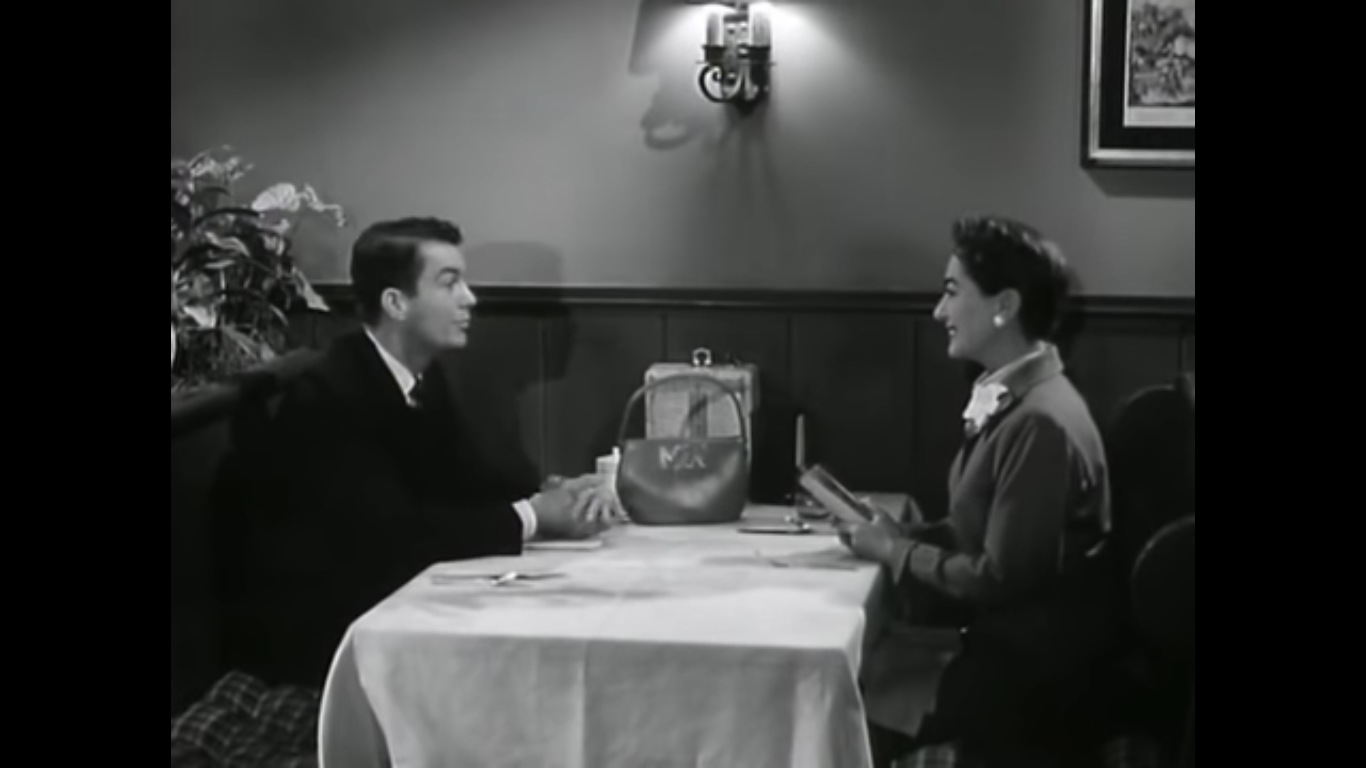
Autumn Leaves (1956): Cliff Robertson and Joan Crawford

You might not immediately connect Joan Crawford and Nat King Cole, but his brand of velvet crooning provides a fine backdrop (and namesake) for Autumn Leaves. It presents the consummate leading lady with a lighter more congenial personality — the kind of Joan Crawford who seems easier to connect with.

She’s known for her typing speed, working from home before it was en vogue, and banging out manuscripts for thankful clients. Although she leads a solitary existence alone, she’s buddy-buddy with her landlady and seems generally contented with life. When she goes out to a show or dinner, she’s comfortable going alone — it doesn’t feel foreign to her — and she enjoys her time in solitude.

There’s a moment in Autumn Leaves as Crawford sits in an audience, the lights go out so the spotlight is only on her, and the pianist on the stage takes her back into her memories. It felt so reminiscent of a scene in Penny Serenade where music, whether live or on vinyl somehow fills up the human heart and carries with it so many easily-tapped emotions.

“Autumn Leaves” feels less like a gimmick to cash in on the season’s newest love song, and it starts to pervade and then slowly suffuse throughout the entire movie until it becomes the tactful accent to almost every scene of the ensuing romance.

Because this all feels like a prelude. We have yet to meet our other primary player. Cliff Robertson was from the east coast and an actor forged out of his training at the Actor’s Studio. He’s still fresh-faced and Autumn Leaves was his second truly substantial movie role after the movie adaptation of Picnic with William Holden.

When he steps into the bustling restaurant and eyes Milly in the one booth with an extra seat, he makes his way over. There’s a disarming approachability about him. It starts to melt the ice and break down the barriers between him and his new acquaintance. Partially because there’s no threat to him though he’s still good-looking. Rather you feel like you can get to know the guy and like him. And she does.

They spend time together, going out more and even taking day trips. It’s a mutually beneficial relationship, and yet I hesitate to use these terms because it makes it sound mercenary. In the most innocent ways, they just enjoy one another’s company, and it shows.

The former Army veteran shows off his beach body on one outing chasing Milly into the waves. He feels like a movie creation. Can Joan Crawford have her own version of a 1950s manic pixie dream boy? But this is only a momentary suggestion. He becomes more of a person in the ensuing scenes. When she prods him about his old girlfriends, he shrugs them off. “Young people are too young for me,” he says.

If they do seem like an odd couple, they aren’t totally unprecedented. Because while loneliness is not a foundational reason to get married, it’s true we need each other. Burt believes that sometimes you meet someone and you know; they provide something you are lacking. I’m reluctant to say they complete you. Still, maybe with someone else’s hand to hold, it makes the world just a little less lonely and the pain a little less galling. Milly loves him and after minor reservation, falls into his arms for better or for worse.

They have a bit of marital bliss below the border, and yet something starts happening. Burt lets bits of his biography slip. All very matter-of-factly and there’s nothing guileful about it; it feels innocent enough, but she begins to realize they don’t match up. First his hometown, then his military service, and there are other discrepancies.


Then, Vera Miles shows up on her doorstep as a manifestation of all her sinking fears about Burt. His insinuating father (Lorne Green) is next to appear. There was a time when the movie could have easily been Joan Crawford’s Middle of The Night. Instead, she becomes devastated by the newfound revelations about her husband, and then must become protectorate shielding her love from the unfeeling world all but ready to exacerbate his condition.

She’s ready to battle for him. If it’s not righteous anger then it’s certainly indignant anger. She sees people for who they really are and calls them on it. Whatever Burt’s shortcomings, he has everyday, common decency. Her maledictions against the character of others might seem excessive (“Your filthy souls are too evil for hell itself”), and yet she’s not entirely wrong. If nothing else, she’s lashing out as a defense mechanism.

However, she’s also caught in the most excruciating of conundrums — one of those scenarios where it seems you are required to do something against your nature out of the deepest sense of sacrificial love, even if it’s not perceived as such. Her deepest longings are for Burt to be born again — that he might live a new, better life than he had before. It leaves the door open for another outcome. It’s very possible if he overcomes his illness, he might come out on the other side as a man who wouldn’t need her anymore. It’s either keep him for herself or watch him return to a happy, normal life (without her).

In the meantime, Burt isn’t getting better. In fact, his circumstances are far worse, and so Crawford is stirred to action. One of the film’s more pronounced shots is of Crawford as she reaches for the phone and resolves to make the fateful call. The low angle makes her loom large in the frame, not so much in a threatening way, but expressing just how much magnitude this moment is imbued with. Her eyes flicker slightly, this way and that, before she speaks into the receiver. There is no turning back.

Whether it’s purely a credit to the scenario, the direction, or the winsomeness of Crawford, I’ve never felt so devastated for her before. She’s put through the emotional wringer, not from noir tension or antagonism, but the kind of burden cutting deep and breaking your heart in the most tender of ways. She’s rarely been more sympathetic and her fortitude is easy to admire.

The final moments are quick, but that is not to say they aren’t pregnant with meaning. The couple is reunited, and I will leave the rest up to you to experience. Robertson and Crawford make the movie work, and this whole story hangs in the balance of their rapport. They weather both the mundane and the melodrama together. It’s pleasantly captivating watching them.

4/5 Stars