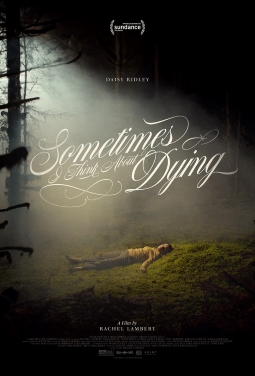
Sometimes I Think About Dying (2023)

Sometimes you start a film and there’s such a specific sense of place, rhythm, and tone you perk up in anticipation. I felt that sensation from the opening credits of this new film starring Daisy Ridley.

The score is replete with a few murmuring voices and a harp, and there’s the muted color palette of a certain sleepy town in the Pacific Northwest. There’s an instant sense of where we are and what end we might be converging on. That is, besides death.

Sometimes I Think About Dying is directed by Rachel Lambert from a screenplay co-written by Kevin Armento, Stefanie Abel Horowitz, and Katy Wright-Mead. It’s easy to pigeon-hole it as a project filling the quirky indie fix and the proof of concept seems littered with a minefield of tropes.

Fran (Ridley) works in an office — the dreaded 9 to 5 desk job — and between emails and spreadsheets her mind will drift away to far off places in her subconscious. It’s also a movie with plenty of inserts of contorted posture. At times it’s uncomfortable watching her exist.

Robert (Dave Merheje) is the new guy. He’s personable and a little dorky in a charming sort of way. Make him a cinephile and you have a perfect movie character. He feels like the Yin to Fran’s Yang and somehow that bodes well.

They don’t so much have chemistry as stunted, awkward interactions. They go see a movie at the local art house theater. They have pie afterward as one does. One wouldn’t label them a couple so much as they’re two people looking for a connection; he’s just moved to town and well, she’s not the most sociable human being.

In this depicted life of dreary and at times surreal isolation, human connection is such a moving balm. They meet up again and she sees his new home, gets the tour, and learns he has his own past; he’s been divorced, not once but twice.

Ridley’s performance does feel like a performance, but the act of playing something so stunted and repressed and yet giving the sense of a charming person just trying to get out is such a meaningful focal point. Because in another movie it would vie to get bigger, but she never allows it to get into a cartoonish heightened reality of indie purgatory.

A distinction must be made. Fran doesn’t hate her life. She’s good at her job and in her own way is a part of the ecosystem in the office. Whereas Excel sheets and requisition forms are soul-crushing for someone like me, Fran seems to thrive in such a regulated environment. But that doesn’t mean she doesn’t also feel the pangs of loneliness. It’s not like they are mutually exclusive; people are nuanced.

Within the context of the film, budding feelings are meager but precious. Her personal hurt and even her greatest transgression are never extended blow outs but these contained moments thoughtfully developed within time and space by the filmmakers.

Fran and Robert get invited to a get together and they both oblige. The subsequent gathering of murder in the dark is a nice evocation on the movie’s primary theme. It’s a visualization of death for a character who does consider its headiness from time to time. The best parts of these scenes is that they feel like a rambunctious good time. That is one of the movie’s strengths: balancing these emotions of warmth and affability with real melancholy.

Robert tells her later in the car, “You’re secretly good at a lot of things. You just don’t let anyone know.” It’s true. Introverted people like this do exist in the world. I feel like I know at least a few of them. On the surface, they seem so taciturn and unassuming but there interior lives or even what they do in their off hours are so vibrant. They offer so much, but they don’t need to tell everyone about it. Selfishly I wish we knew about more of them because we would do well to learn from their example.

My primary critique of the movie initially might have been its opening runway. It felt like for a fairly truncated film, it took a lot of time to get to Robert’s introduction; we even watch as they give a going away party to his predecessor who is set to retire and go on a cruise with her husband.

But even this is paid off when Fran stops by a local coffee shop to get donuts for the office. She’s going through a different kind of pain and regret because she said something regrettable that she cannot take back; she wants to acknowledge her remorse; tell Robert how she feels. But how can she do that if she can barely string two sentences together?

There Fran bumps into her retired co-worker surprised. She was supposed to be on a cruise. Except her husband had a stroke; she couldn’t bear to tell anyone and so now she drinks her coffee alone and looks out the window at the harbor wistfully. Fran could have traded pleasantries and left it at that. There is no personal utility to stick around, and yet she stops and sits down. She makes the decision to listen and her reactions feel real.

Somehow these feelings make her empathy and concern genuine. The action of getting something for her coworkers — a learned altruistic behavior is one thing — but there is also another turn. For one of the first times, we see her sympathy on display for another human being. She connects even if it’s just a little thing.

Later, she asks Robert genuinely, “Do you wish you could unknow me?” What a question, but it comes from such a place of honesty and fear. It fits hand in hand with the hypothetical question, “If you died tomorrow, would anyone care?” Could the lie be true? The voices in our own heads can be vicious.

There’s probably an HR caveat in here somewhere, but a movie is a movie. What lingers is this reverberating optimism. Human connections are worth the risk and effort. I left the film thinking, “Me too, Fran. Me too.” I resonate with this title though not because of some kind of ideation. From dust we come and from dust we will return. 

In the final embrace of the movie, it’s in a copy room. But within seconds it’s transformed into a garden-like greenhouse — a little slice of paradise. The imagery seems only fitting. We were not made to be alone.

3.5/5 Stars
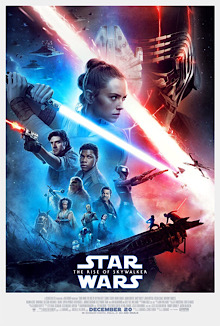
Star Wars: The Rise of Skywalker (2019): An Adequate Force Awakens Sequel

Star_Wars_The_Rise_of_Skywalker_poster.jpgYou might say I turned up to Star Wars: The Rise of Skywalker out of respect for the dead. Because we’ve lost many of our beloved figures. Han. Luke. Carrie Fisher. Peter Mayhew. Kenny Baker. You get the idea. And from the rumblings I couldn’t avoid hearing, it felt like Star Wars might be dead on arrival too.
After seeing the final installment of Disney’s Star Wars trilogy, my reaction is hardly so dramatic, and you can judge whether that is a good or bad portent. In many ways, it succumbed to all the fears a myriad of voices had shouted out in years gone by. In others regards, it still managed to be entertaining, albeit with a host of caveats.

There’s a nagging conflict inside of me not unlike the dark or the light side of the force — this tug-of-war between Rey (Daisy Ridley) and Kylo Ren (Adam Driver). I want to enjoy Skywalker for all its delights and at the same time, it does feel like a bit of an out of body experience.

Because I look at this film, and it zooms by. There’s plenty of spectacle, likability, and adorableness to get us in the seats; it’s so easy to pass over the lapses (as it is with just about anything when its played against John Williams’ magnum opus).

Highlights include the return of Lando (Billy Dee Williams), another cameo worthy of a buzz of adulation. In this episode, C3PO (Anthony Daniels) has more license to jabber on (though R2D2, yet again, feels decidedly less important). There’s also a particularly hallowed place for Carrie Fisher within the film acting as a nice tribute.

The relationship between Rey and Keylo remains the most dynamic and intriguing element, carrying itself through the series as they maintain their intimate connection through the Force.

Daisy Ridley was positioned as the heartbeat of the franchise, and she more than proves her mettle navigating the last leg of the journey with an earnest conviction. Adam Driver is her near equal. Not perfect, but there’s something not entirely phoned in about him, an issue Poe (Oscar Issac) and Finn (John Boyega) sometimes fall prey to. Invariably, Rey and Keylo have it out in a turbulent lightsaber duel recalling some of the epic glories of old.

However, now that the third and final trilogy is done, it does feel a bit haphazard, like it was dashed off without giving immense thought to how all the pieces fit together. Rose (Kelly Marie Tran) feels all but cast aside, her place filled by two new strong female characters (Keri Russell and Naomie Acker) not without their charms, but really it’s too little too late. One questions why they showed up now and not in The Force Awakens.

A continuous trail of blatant MacGuffins and exposition along with a deus ex machina in the form of a giant convoy stuff the story end-to-end. To that point, the finale feels drawn out in a cavernous throne room high on mind-numbing spectacle but somehow empty of the genuine conflict I felt when Luke faced Darth Vader or when father saved son.

Did it all feel like a lie after what Rian Johnson’s film had suggested? Was it like a last-minute patch job to bring Emperor Palpatine (Ian McDiarmid) back for an ending that looked eerily familiar, simply drawn out on a bloated scale? Somehow bigger explosions and darker interiors didn’t help the film’s case. It’s like anything. Bigger isn’t always better. Excess can make it lose its significance.

Because while Star Wars was always a broad galaxy, it remained grounded through characters and very personal stories we could relate to about family and friends. And whether it was entirely true or not, it always felt like George Lucas was some kind of marionette master who had at least an inkling of a plan for his world.

With Disney’s trilogy, we have been left wondering and as a result, there’s been a general lack of cohesion, which has been aggravated the further we’ve gone into this revamped franchise. Abrams feels like he’s making a sequel to The Force Awakens and thus if Rian Johnson’s movie didn’t exist, it might mesh better. But The Last Jedi does exist as is, and it deserved a finale worthy of the questions it dared to ask.

I’ll do something I’ve never done before by quoting myself from an earlier review. Because with The Last Jedi I said all of  Rian Johnson’s breaks with tradition would be worth it if the subsequent film could stick its landing:

I resolutely admire Rian Johnson for his choices because it seems like he’s made a Star Wars film that is hardly cookie cutter in nature and the fact that it will not please everyone is a marvel (no pun intended) given the usual reality that blockbusters are supposed to be easy on the eyes while hardly divisive. Though flawed, it’s a relatively bold movie in running time, in how it utilizes its characters, and ultimately how it chooses to depart from its longheld traditions.

The Rise of Skywalker falls back on what is, for the most part,  familiar. This partially comes down to giving J.J. Abrams the impossible task. Instead of saying this is the end of one trilogy, it’s implied this is supposed to be the thrilling summation of eight other films spanning over 42 years. That’s like catching force lightning in a thimble. Of course, he’s not going to be able to pull it off.

I very rarely cast aspersions on anyone, but I think it’s safe to direct our ire toward Disney if there is any blame to be had. Time has reminded us over and over again, Disney was more invested in their lucrative commercial investment than giving us the best story they could.

Marvel was the initial template, and we’ve seen films of wildly uneven quality with the worst functioning as soulless potboilers made to order on schedule. Star Wars is too dear for me to riddle it with such criticisms. It’s a fault and a bias to be sure, but I will say, out of any of the Star Wars films, Skywalker comes the closest to what I feared. I remember vividly my reactions to Rogue One in 2016, a film I modestly enjoyed for exploring New Hope nostalgia:

My loyalty towards the franchise (more so than DC or Marvel or Star Trek) makes me also fear the continued mechanization of this world into a continuing box office cash cow. With film after film, story after story, it’s indubitable that Star Wars too will lose its allure. It will be run into the ground or become besmirched by some egregious plot hole, discontinuity, or for some far worse fates…

Even as Rian Johnson boldly ran roughshod over Star Wars lore, it feels as if this final film has done it a major disservice by falling back on the status quo. It goes beyond plot points for me. The writing off of Snoke is easy enough, even the clarification on Rey’s parentage (Obi-Wan pulled a similar trick on Luke if you remember).

But it’s the fact that none of this film’s digressions carry more than an ounce of surprise or what we might term movie magic. There’s nothing to take our breath away or make the hair stand on end. Everything it has in terms of charm and charisma is pent up inside those characters — those protocol and astromech droids, that wookie, etc. — and I do love them as much as anyone else.

Still, I was ill at ease trying to appreciate the moments we’ve been granted and feeling, simultaneously, they’re not quite right. We deserved something better from Disney who has served us up a Ghost of Star Wars Past.

President Lyndon B. Johson famously said something to the effect that when he lost Walter Cronkite on the Vietnam issue, he had lost public opinion. There’s a related point here somewhere, and here it is.

While my older brother’s not quite Walter Cronkite, I consider him one of the most thoughtful, well-versed Star Wars fans out there. He pored over the books, played the card games, collected the collectibles, and will no doubt remain a resolute Star Wars fan for years.

However, his reaction to this latest film was lukewarm at best. If I didn’t make it clear already, he loves Star Wars. In my little pocket of the world and the manner in which I perceive this galaxy as a very real and personal entity we cherished, it feels like someone has lost.

If not the Rebels, or Disney (who will rake in more money than ever), then it’s the fans who had such a profound affection for this franchise they wanted something more than a purely wish-fulfilling imitation. It felt so close yet so far from a long time ago in a galaxy far far away. The movie emphatically proclaims “The Dead Speak!” Sometimes it’s best to let them rest in peace. Something I’m not sure Disney understands or is willing to do.

3.5/5 Stars

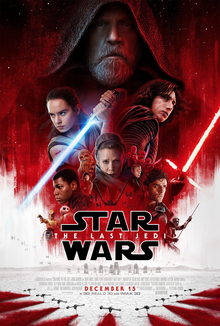
Star Wars: The Last Jedi (2017)

Star_Wars_The_Last_Jedi.jpg“Let the past die.”  – Adam Driver as Kylo Ren

I left the theater feeling completely taciturn. It’s an onerous task to begin articulating all the jumbled fragments circulating through my mind but I will try my very best.  Certainly, there is a great deal to be enjoyed and to be relished about Episode VIII and you would be served well to go into The Last Jedi not searching out its faults but reveling in the successes that are there. Let it be known that there are many and Rian Johnson is a fine maker of movies as he guides us through the Resistance’s latest evasion of The First Order still up to their old business of quashing anyone who dares defy them.

True, I did not necessarily find it a narrative of revelatory reveals or epic showdowns in the vein of what I initially envisioned. However, I can see the picture separating itself from all of its predecessors — subverting the norm and drawing away from all that we knew before. That gels with much of what was said in the wake of The Force Awakens. It could not simply be another Empire Strikes Back if the new franchise was to flourish. In that regard, there’s no doubt Johnson’s film is an undisputed success building on the character arcs instigated in J.J. Abrams’ effort.

Yet my feelings are somehow conflicted.  Kylo Ren’s (Adam Driver) call to action to Rey (Daisy Ridley) midway through was never more pointed. “Let the past die. Kill it if you have to.” And that’s much of what has been done here. Not simply in a single film or to the Jedi order or the legacy of a character but in some respects to an entire franchise.

I am realizing that though I cherish Star Wars as my own, the many aspirations and fantasies of my childhood, it is a communal narrative. It might seem odd to get so thoroughly introspective but I can’t help it. Star Wars is almost inbred into my DNA.

Watching this film might topple the white knights. For one, the Jedi order as we know it. They lose much of their mythical stature that they always evoked. We already lost Han Solo and it’s little surprise that Luke and Leia (with Carrie Fisher’s passing) will most likely not be returning either. The old guard has been all but removed from their posts (with the exception of R2, C3PO, and Chewbacca though Anthony Daniels is the only other returning core cast member).

But it’s no surprise that I often savor the past — the way things used to be. That’s part of what made The Force Awakens such an enjoyable ride. There was an innate sense that this was something new, yes, but it was also squarely centered on the glories of the original trilogy. If I said it once I said it a thousand times, it was like returning to the company of old friends.

Now the old is gone and don’t get me wrong the new additions were greatly appreciated. Once more Rey (Ridley), Fin (John Boyega), and Poe (Oscar Issac) are indubitably winning personalities and fine action heroes. It’s easy to become immersed in their individual journeys along with the newcomers such as Rose (Kelly Marie Tran). However, that doesn’t take away my wistfulness at the conclusion of The Last Jedi.

It wasn’t even the kind of bittersweet conclusion we saw in earlier installments either but a plaintive ending without a giant climax. Harrison Ford received a venerable though tragic send off. His contemporaries not so much. There is still hope and events have been prolonged for Episode IX but not in some monumental cliffhanger fashion.

Whenever I take in a new film I am also constantly filtering it through the reference points that I already know. Obviously, Star Wars has such a vast lineage that must be sorted through but this latest film also can be read through various other archetypes. It strikes me that Luke Skywalker, the Star Wars hero I always aspired to emulate, was like Welles’ Harry Lime in The Third Man — waiting in the wings until he finally stepped out of the shadows.

Though I enjoyed that moment and the pure rush of adrenaline when he came back to the fore, expectations do not always correlate with reality.  Although we get to see Luke Skywalker and there are some enjoyable moments, the best of them come as all too brief reunions with his faithful astromech pal and his sister followed by a showdown with his main adversary — The nephew who turned to the Dark Side — again it was this wistful sense of an anticlimax.

We see in Luke what Obi-Wan (Alec Guinness) once was at least in a visual sense. A hermit who has removed himself from society. Cloaked, bearded, and detached. But whereas Old Ben was a wise, eccentric, and even a fatherly wizard, Luke has become a world-wearied, surly misanthrope. A far cry from the man we dreamed about.

The reverberations of the past echo down in other ways too from the inciting distress signal from his sister that started him off on this cinematic adventure all those many years before and then a visitation from a furry friend.

Likewise, the final showdown is somehow more reminiscent to the archetypal lightsaber battle of A New Hope than all the fanciful epic showdowns we imagined of Jedi Master Luke Skywalker tackling every conceivable villain with his green lightsaber. The old man’s words even mirror the final lines of his late mentor (Strike me down in anger and I’ll always be with you. Just like your father).

Even briefly with lightsaber in hand facing down the greatest forces in the universe as we always thought possible in our mind’s eye, there’s a momentary catharsis. Though the full satisfaction of the moment is stripped from us. Luke is not quite how we remembered him, nay, maybe not even the same man Mark Hamill embodied all those years ago.

It does bring to mind the mythological line out of John Ford’s The Man Who Shot Liberty Valance. “When the legend becomes fact, print the legend.” And it’s still true of Luke Skywalker for those in the galaxy far, far away and right there he can remain a hero.

The film’s most intriguing dynamic reveals itself in the perceived connection between arguably our two most crucial characters in Rey and Kylo Ren also known as Ben Solo. But that core struggle between the two of them — literally the dissonance between the Light and Dark sides of the Force — is rudely disrupted. It’s such an ambiguous dividing line between good and evil and though it still remains, the character of Supreme Leader Snoke, equally implicated in this web comes off as little more than a ploy. All the potential grand conspiracies around it are gone in a puff of improbable smoke.

Intertwined with this is Rey’s familial identity which has been of paramount importance to everyone ever since these new pictures were conceived. It’s not so much that I minded what the revelation was (minor as it was) but it was more the fact that this bit of seemingly crucial exposition was so quickly cast aside as well. It felt once more a bit like a bait and switch — as if the Star Wars saga was somehow rewriting its own mythos in counterintuitive ways.

Maybe for once, Star Wars has become a bit more pragmatic; it has sought out realism and the things of this world more than a galaxy far, far away. Here I will admittedly contradict myself but I am not sure how to deal with this development because Star Wars was always a fantasy, always a science fiction fairy tale built out of imagination and dreams. Now it seems to be inching more and more toward the real world. Not because there are any fewer lightsaber battles or blaster fights or fewer alien species and star systems to explore, but the makeup of the new generation of characters is somehow different.

It is a pipe dream to believe that Star Wars could always be the same because it was not created in a vacuum, it is no longer George Lucas’s, and it has so many other parties invested in it. I for one must come to accept that. The film ends on a rather odd beat with young children getting rapt up in tales of the Last Jedi and looking off into space empowered by the hope brought by the Resistance before the credits roll. Though it felt very un-Star Wars it’s somewhat fitting given this new direction.

Hopefully, younger fans eat up this latest installment and conceive adventures and worlds of their own like I once did, feeding on the visions of the screen as fuel for countless Lego lightsaber battles and made up assaults on the enemy forces with their ragtag band of Rebel Scum. These new films don’t mean so much to me but maybe they can mean something to the current generation. Maybe that’s what they’re meant to do.

Will I see The Last Jedi again? I wouldn’t be at all surprised but unlike The Force Awakens, this isn’t so much an extension of the original trilogy. This is a breaking of the chain. This is something starkly different and it’s taken the galaxy into uncharacteristic territory.

I resolutely admire Rian Johnson for his choices because it seems like he’s made a Star Wars film that is hardly cookie cutter in nature and the fact that it will not please everyone is a marvel (no pun intended) given the usual reality that blockbusters are supposed to be easy on the eyes while hardly divisive. Though flawed, it’s a relatively bold movie in running time, in how it utilizes its characters, and ultimately how it chooses to depart from its longheld traditions. But the boy inside of me still yearns for the Luke Skywalker of my youth as naive as that might sound. I suppose I’ve never been much of a realist.

4/5 Stars

Star Wars: The Force Awakens (2015)

Star_Wars_The_Force_Awakens_Theatrical_PosterAnyone who is at least a little bit familiar with ring theory knows that the Star Wars saga has often folded back on itself, with near-mirror images, similar plot devices, and obvious parallelism. It gives any fan a new found appreciation for the films, and with that mentality, The Force Awakens can be thoroughly appreciated.

Without a doubt, it is positively exploding with entertainment value, up and coming talent, as well as the old friends that we were looking to catch up with after 30 long years. However, this is not simply another installment, reimagining, or remaking of Star Wars (although Abrams does succeed in rebooting the franchise). This chapter is yet another refrain in the epic intergalactic ballad that is Star Wars. As such, it points to the future and recalls the past much like many ancient texts, fairy tales, and pieces of mythology.

In this film, we do see many things that hearken back to the earlier films, which makes sense due to the return of screenwriter Lawrence Kasdan as well as legendary characters like Han, Chewie, and Leia (now known as General Organa).

The Force Awakens also introduces a lowly scavenger girl (Daisy Ridley), who is reminiscent of Luke Skywalker in her hero’s journey. A new evil has risen up in the form of The First Order, and the Rebellion has been replaced by the more progressive Resistance. They still have many of the same problems, however, like defying a menacing dark lord who is very strong in the force. There is also a giant battle station dubiously named “Starkiller” which dwarfs any previous Death Star. Young Rey must sneak around the colossal fortress much like her predecessors, and a meager fleet led by crack pilot Poe Dameron looks to find the one weakness to bring the menacing giant to its knees. We’ve seen variations of it all before, but whereas remakes get old all too quickly, our contemporary culture revels in the remix. That’s part of the magic behind what J.J. Abrams has done.

He’s left the framework: We have our obligatory opening introduction, there are the glorious orchestrations of living legend John Williams and numerous other familiar touchstones. In fact, it’s frighteningly familiar. We see the rubble of star destroyers and AT-ATs. Stormtroopers have a facelift, the Millennium Falcon is still kicking, and some of the planets strikingly resemble the likes of Tatooine, Yavin IV, and Hoth. A lightsaber in the snow brings back images of a Wampa’s cave from The Empire Strikes Back. Nightmarish hallucinations feel reminiscent to the caves of Dagobah, and plucky little BB-8’s secret map makes us think of all those years ago when R2 first took that message from Princess Leia. It all falls wonderfully into place.

But there is also so much that this film does that inches away from the original trilogy, without cutting ties completely. It brings in a new batch of capable stars: Daisy Ridley, John Boyega, and Oscar Isaac. It gives us new pieces of backstory, more definition to this galaxy, while simultaneously creating characters, weaponry, and settings that little boys, and now girls, all across the galaxy will be emulating.

However, perhaps one of most profound aspects of the latest continuation of the saga is its diversity on so many levels. There is a strong female lead in Ridley, an ethnically diverse cast, and there are actually some juicy roles for actors over the age of 45. Aside from the newcomers and the vets, we are also treated to the likes of Adam Driver, Domhnall Gleeson, Lupita Nyong’o, Andy Serkis, Gwendoline Christie, and even Max von Sydow. Most of them by now are well established, but each one explored different avenues with their characters allowing for greater definition and depth.

In fact, Mark Hamill has arguably the most enjoyable role, because he is the main driving force behind this whole tale (He also gets top billing to boot). Everyone is looking for him, and in this way, he’s rather like the Third Man, Harry Lime, a character who makes the most of a brief climatic cameo, due to the vast shrouded mystery that has been developed around his character. In this case, we are itching to know where he is and what he’s been up to. Why? Because he is Luke Skywalker! The last Jedi in the galaxy. Do you need a better reason?

Thus, The Force Awakens has some dour notes, but it most certainly is a narrative of beginnings, awakenings, and rebirth. We do not quite know actually where they will lead because evil still exists in the shadows and the light side has yet to bring absolute peace to the galaxy.

Star Wars VII is most everything that any hardcore fan or casual viewer could desire in a saga that bursts at the seams with cultural clout. The exciting part is the titillating prospect that there’s still so much room to grow and a lot more galaxy to be revealed. Perhaps it’s best that Abrams hands over the reins to someone else so they can try their hand at expanding the galaxy. But for now, he did a stellar job at bringing balance back to the force, at least for a couple years. We had a bad feeling about this, but we can all let out a collective sigh of relief. All is right in the Star Wars universe.

4.5/5 Stars