
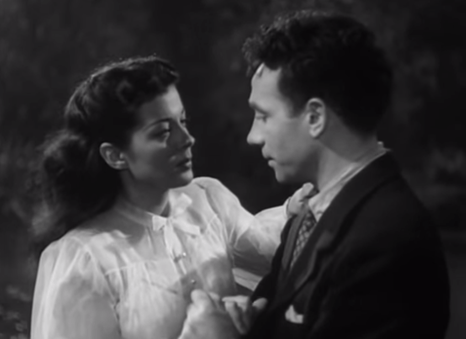
It’s like being in a long dark tunnel…the way you look and act and talk. ~ Gail Russel as Gilly
From its very foreboding outset, there’s no question that Frank Borzage’s Moonrise could be characterized as film-noir. Everything suggests as much from the scoring to the stylized imagery and even the subject matter. We have hangings, brawls, fistfights, and murder all under 5 minutes of celluloid. But equally important, the film delves into the psychological depths of despair and more than any of Borzage’s films it seems invested in the mental well-being of its characters.
Dan’s personal narrative is brought to us early on. His father was hung for some inexplicable reason. The kids in school brutally tease him about the ignominious shame of his family which he has no control over and all throughout his life thereafter he carries a chip on his shoulder. We don’t quite understand him but at least we begin to empathize. We meet Dan (Dane Clark) again as an adult at a local dance.
That’s where the next chapter in his story begins as he tries to bridle his anger and keep the reins firmly in check. It doesn’t always work so well for him. After all, he is the man with a constant death wish driving cars on wet roads like it’s the Indy 500. He is the man who is prone to strong-arm tactics. He is the man who trusts no one to be his friend and expects very little from others. But he does have one thing going for him.
Her name is Gilly (Gail Russell), she’s the local schoolteacher, and if nothing else her very presence humanizes him. She formerly ran with the local hotshot (Lloyd Bridges) but she has found some quiet decency in Dan and if she sees it, maybe we can see more in him as well. In some ways, he’s still a little boy and she reads him like one of her students with thinly veiled observations. His frumpy Aunt Jessie pins him as a good boy but that doesn’t make up for the absence of his parents or the anger that he still harbors from boyhood.
But a small town setting and a purported crime prove to be an ever-intriguing synthesis of Americana and the ugly underbelly which if it doesn’t rear its head through gossip alone, then murder certainly fits the bill in a pinch. It’s summed up by dances, carnivals, and coon hunts with an undeniable undercurrent of darkness.
As far as I can tell Charles F. Haas had few other feature scripts to his name but his work in Moonrise offers up some interesting figures full of witticism and unique voices that help to differentiate each from the diverse pack.
The bullied mute Henry Morgan is at one time befriended and also berated by Dan. Rex Ingram proves to be a landmark African-American actor for the era, full of a quiet strength and wisdom. As local keeper of the bloodhounds, he addresses his canines as Mr. Dog surmising that everyone is entitled to a certain amount of dignity. Just as importantly, he rightfully asserts that man is a communal being (Man oughta have a woman. Man oughta live with other folks).
The Local Soda Jerk has the jive talk down pat and Lloyd Bridges and Harry Carey Jr. fill in for a couple relatively minor spots. Of course, Ethel Barrymore is in the coveted keynote cameo as Daniel’s sagely Grandma. But aside from Ingram’s significant turn, Alyn Joslyn is one of the more entertaining characters as the sheriff who waxes philosophical. One of townsfolk even notes as much that he should have been a preacher man instead of a lawman.
Cinematically speaking, Moonrise proves that the finest places to meet your best gal seem to be darkened interiors and if nothing else it’s a feast for the eyes and a treat for the audience. And it’s true that with its quaint country backwoods and swamps, Borzage’s picture shares some of its world with Joseph L. Lewis’s Gun Crazy (1950). But for Borzage, in particular, this feels very much like a departure which is by no means a bad thing. Here the love story is still present but it seems to ultimately have a different functionality altogether from many of the director’s most remembered entries.
3.5/5 Stars
 Whatever our criticisms of the previous generations, there’s still something within me that sees something uniquely compelling about films of old. Hollywood in the 30s and 40s could sugar coat, they could oversell the drama, but there was also a general decency that pervaded many of those films.
 The strands of our lives are woven together and neither time nor the world can break them.
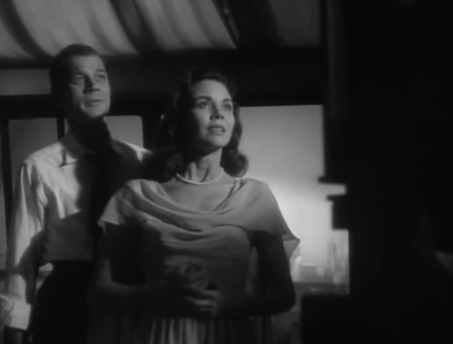 But it’s a chance encounter with a young girl named Jennie (Jennifer Jones) that gives Eben the type of inspiration that every artist dreams of because it’s precisely this spontaneous spark of joyous energy he needs to add something vibrant to his own life. In her constantly evolving role, Jennifer Jones exudes an effervescence, a certain radiance in body and spirit that lights up the screen in embodying this apparition of a girl.
 I find that despite his pedigree Joseph Cotten still comes off as an underrated actor and with each film I see him, I enjoy him immensely. Maybe for those very qualities. He’s not altogether handsome but he has a pleasant face. His voice isn’t the most formidable or debonair but it does have character. The supporting players lend some Irish flair to the cast and it’s striking that everyone from Ethel Barrymore to Lilian Gish glows with a certain hope. There is no obvious antagonistic force in this film. Eben Adams found his inspiration — the muse of a lifetime — and that passion is enough to lay the foundations of a film.

 4 Star Films