Donnie Brasco (1997)

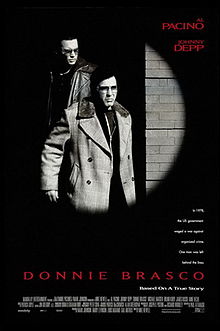
220px-Donnie_brasco_ver2In the tradition of such films as Serpico, Goodfellas, and even The Departed, Donnie Brasco is another worthy addition to the gangster canon. You have a necessary mainstay in Al Pacino, playing the veteran and streetwise hit man Lefty. He’s been around and is claimed to have 26 “whacks” to his name. One fateful day he took Donnie under his wing and the two became real pals. Better than that they were family and Lefty vouched for Donnie, bringing him into his life and his business. It’s just that his business revolves being a member of one of the mob families.

The story is twofold, however, because Donnie Brasco’s real name is Joe Pisone, and he is an undercover agent for the FBI. However, in order to do his job he has to be gone for months on end. He checks in and has a tape recorder on his person, but for all intent and purposes, he is a member of the mob. They think he’s one of them which Pistone’s superiors are delighted about, but he also begins to relate to them and see himself pulled into their reality.

Long months away from his wife and kids do not help their marriage or his family life. Whenever he drops in their life, he’s cold and detached. His wife expects something more. She wants her husband back, but all he has for her is a fiery temper courtesy of the crowd he hangs out with now.

He follows their crowd from New York, down to Florida trying to get a cut of the land there, but after getting ousted by the cops, they must head dejectedly back to New York. Several times Joe almost gets his cover blown, but even more perturbing he stops checking in with his superiors. His wife is bearing the toll of his absence and tries to content herself with thoughts of him being dead. It’s easier to take.

Meanwhile, young hopeful Sonny (Michael Madsen), with the help of his cronies, knocks off his rival and things are looking up for the whole lot of them. Donnie knows however that there will come a point where he will be pulled out and that will be the end of it. He tries to give his new found friend and confidante Lefty a way out. He offers money to his pal, in a last-ditch effort to get the vet to leave this life behind. Instead, they follow through with the hit that they’re supposed to.

The irony of this story is that Joe Pisone gets a medal and a $500 check for his services to his country. He spent however many months and years in this high tension, high-stress environment and that’s what he gets. You can see him scoffing at it. His marriage is essentially shot to hell. He lost one of the best friends he had and that’s the end of it.

It’s great having Al Pacino in this film because he along with Robert De Niro will always embody the gangster to me. Except instead of playing the steely Michael Corleone, he’s the more world wearied type. Bruno Kirby sounded so much like Joe Pesci that it was almost uncanny to me. And it was a pleasure to see Johnny Depp in such a role since he is so often remembered for his quirkier roles. Here he truly seems to show his dramatic acting chops, and the camaraderie between him and Pacino is palpable in their scenes.

4/5 Stars
The Roaring Twenties (1939)

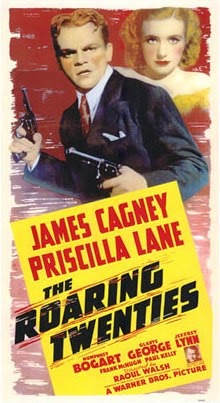
e08f7-the-roaring-twentiesHere is a retrospective gangster film reminiscing about the Jazz Age and Roaring Twenties extending from the post WWI period  of prohibition to the election of FDR.
Two mainstays of the genre including the original gangster James Cagney and hard-boiled Humphrey Bogart star as two men in a group of three soldiers who meet during World War I. In the ensuing years Eddie Bartlett (James Cagney) initially has difficulty getting back into society, but after meeting Speakeasy owner Panama Smith (Gladys George) he finds himself climbing the ranks in the bootlegging business. Soon through grit and a ruthless drive Eddie makes good racketeering by utilizing taxis with booze to make it big. 

Through it all Eddie becomes smitten with a young singer he used to know when she was a young girl (Priscilla Lane), except she does not share his affection. Pretty soon his ol’ buddy George (Bogart) comes back into the picture, with a some shifting dealings of his own. Eddie practically runs the town now but when the Crash happens he gets pushed out by George and now Jean is off and married to her lawyer beau. Eddie is a washed-up taxi driver still hanging around Panama and he has time to do one last favor for Jean.

This is one of the last great gangster films of the 1930s following in the wake of other Cagney classics like The Public Enemy and Angel with Dirty Faces. Raoul Walsh directs this film and it develops as another dynamic, action packed film with a lot of drama and heart thanks to Cagney and George. It is however different from previous gangster flicks in that it plays out as a history although it keeps the nitty-gritty look of the previous films. Like Angel with Dirty Faces especially, there are also some sentimental moments because Cagney is not a complete scoundrel, just mostly. Not wanting to continue being typecast Cagney took a break from the genre not coming back until White Heat in 1949. He did pretty well for himself during the 1940s though with performances in The Stawberry Blonde and Yankee Doodle Dandy. There was another fellow who did not do too bad in that interim period either, new found leading man Humphrey Bogart.

“What was his business?”
“He used to be a big shot.”
 
4/5 Stars

Bonnie and Clyde (1967)

b1a0c-bonnie_and_clydeStarring Warren Beatty and Faye Dunaway, with director Arthur Penn, the film chronicles the crime life of a group of notorious gangsters during the 1930s. Clyde Barrow (Beatty), a small time thief meets the beautiful young girl Bonnie Parker (Dunaway) and together they begin robbing banks. Soon they enlist the help of a dim-witted mechanic C.W., and then Clyde’s brother joins the fray bringing along his wife. They have a string of successes and they become infamous nationwide. Soon they begin to bicker among themselves and the police start to buckle down. In a shootout Buck is shot dead and Bonnie, Clyde, and C.W. just barely escape. However, their actions eventually do catch up with them and thus ends the story of these two figures depicted as anti-heroes. This film is significant because it was influenced by the French New Wave but it in turn ushered in a new era of American film . It has a unique combination of comedy, romance, violence, and of course banjo music.

5/5 Stars

White Heat (1949) – Film-Noir

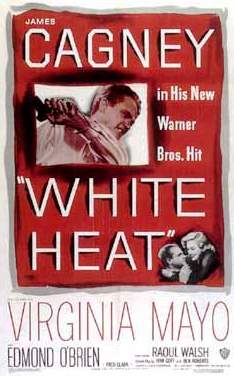
Starring James Cagney, Edmund O’Brien, and Virginia Mayo, once again Cagney does the gangster role. However, his Cody Jarret is older and more psychotic than ever as he leads his band of thugs. Although he has a beautiful wife, the main woman in Jarret’s life is his mom who watches over him. After an initial robbery, Jarret beats the rap by confessing to a smaller crime. While he is in jail the police plant one of their men (O’Brien). Eventually the pair and a crew of cronies break out and plan their next move. However, the undercover man cleverly tips off his colleagues and they follow in hot pursuit. Pretty soon the only one left is Jarret and he is isolated near high above near a gas storage tank. In a crazy fit, Jarret yells to his ma that he has made it to the top of the world as he goes up in flames. This movie has wonderful suspense in the end and Cagney is chilling yet again.

5/5 Stars