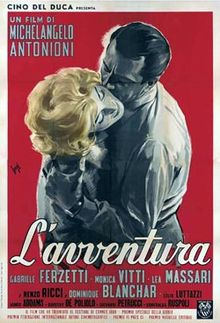
L’avventura (1960)

L'avventuraSmallL’avventura is one of those films that it is difficult to make a cohesive review for. If you are watching it purely to be entertained, you have it all wrong, because that is not its main purpose. Its greatest attribute is the special place it has in the pantheon of film art.

It is a film about a group of high society adventurers who go on a boat trip through some islands, only to have a woman passenger literally disappear, practically into thin air. Her boyfriend and her best friend search for her in the ensuing days, only to fall for each other, and that is about it. This is, of course, the most superficial level possible.

L’avventura is quite interesting visually and I wish I could have seen it on the big screen. The reality is, oftentimes, not a whole lot is happening, but it causes you to actually focus on the images in the frame. Michelangelo Antonioni gives us numerous settings all over Italy, and most have something to do with the wanderings of natural beauty Claudia (Monica Vitti) or her companion Sandro.

Anna (Lea Massari), despite her early importance, is hardly in the film. She is only a wisp in the wind and the mystery surrounding her is of lesser importance. The outcome is what matters as her friend and boyfriend become lovers. Theirs is the relationship that is explored as it develops, evolves, and becomes fully tested.

In the final moments, Antonioni toys with us, suggesting just possibly that Anna might be in the picture again. In fact, he must have a very cruel sense of humor indeed. Here in L’avventura as well as Blow-up (1966) he waves a mystery in front of our nose and leaves it unresolved. It is absolutely maddening, in some respects, and yet he makes us look at something else altogether. He also had the gall to name a film with a meandering plot like this L’Avventura! The nerve of it all, and yet I respect him for it because it messes with our conventions and forces us to be uncomfortable.

It is understandable that this was a polarizing film at Cannes in 1960, and I can only imagine that it has the same effect over 50 years later. One thing is for sure. This is no Gilligan’s Island with a three-hour cruise set in Italy. There is a lot more to it than the plot. Not my favorite adventure, but I respect its pure audaciousness of form.

4.5/5 Stars
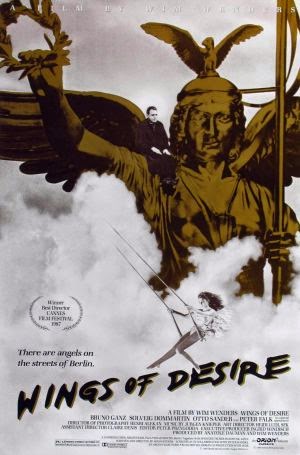
Wings of Desire (1988)

7ebbf-wingsofdesireposterDirected by Wim Wenders, this German film has almost a stream of consciousness feel. It opens over the skies of West Berlin where a couple angels watch over the humans as unseen and unheard guardians. They pay attention to the thoughts, desires, joys, and fears of a plethora of folks from all walks of life and act as unobserved comforters. These angels are immortals and although they are familiar with humanity they are not a part of it. 

Among others, the angel Cassiel observes an old man named Homer who dreams of a world of peace. Damiel on his part finds himself infatuated with an utterly lonely circus trapeze performer, and he also watches over the actor Peter Falk as he begins shooting his next film. Because of his newfound love, Damiel desires to feel what it is to be human. Aside from affection, he yearns to be able to do the little things that go along with being mortal like drinking a hot cup of coffee. Finally, determined Damiel does indeed shed his angel wings and immortality for a chance to be human. He knows what it is to breathe, to tell colors apart, and he finally does get his cup of coffee. 

Quite by chance, he has an encounter with Falk who tells Damiel a secret and encourages him in his new life. Cassiel, still an angel, tries to stop a suicidal youth from jumping, but he is unsuccessful and it hits him hard. 

In the final moments of the film, by fate, Damiel meets his girl at a concert, and they embrace as if they had known one another for an eternity and in a way they had. This film is beautifully photographed in a sepia tone that reflects the viewpoint of the angels. It is only the humans who see the world in all its glory, bursting with different colors. This film was quite fascinating, and it is the type of film I would want to make that really gets up close and personal with some many people without actually focusing on them. Furthermore, Peter Falk was a wonderful addition to this film, and he was a pleasure to watch because he gave off the impression that he was simply being himself. And I think he was.

Next on my list to see from Wim Wenders is Paris, Texas, but I would also like to explore more of the New German Cinema from the likes of Rainer Werner Fassbinder and Werner Herzog. 

4.5/5 Stars

Alien (1979)

70cca-alien_movie_posterIn the wake of other Sci-Fi smashes like Star Wars (1977) and Close Encounter of the Third Kind (1977), Alien was a radically different film, since it lacked the same sentiment of its precursors. One would wager a guess that this core variance stems from director Ridley Scott who certainly is no George Lucas or Spielberg. His films are generally darker, more world-wearied, and disillusioned. Blade Runner is a perfect illustration of this, but three years earlier came Alien, a Sci-Fi Horror film of immense critical acclaim and impact even to this day.

The film opens as a spacecraft called the Nostromo gets ready for a return trip to earth after a commercial excursion by its 7 member crew. However, a distress signal halts their plans and the captain named Dallas (Tom Skerritt) resolves to go investigate. On the surface of the abandoned planet are the remnants of what seems to be an ancient alien empire. One member of the crew Kane (John Hurt) comes upon a chamber full of what appear to be eggs and as is expected he is attacked. We knew it was building up to this point.

Back on the craft, Kane is still alive but now he has an octopus-like alien clinging to his head. It’s an acidic situation because it appears to be feeding him oxygen and it has no plans of coming off anytime soon. Next, comes the calm before the much-anticipated storm as the tension slowly increases exponentially.

What ensues is a cat and mouse game between the crew and this belligerent alien which has grown increasingly larger. Its evolutionary adaptations make it seemingly immune to extermination, but the crew tries desperately to destroy it with electric prods and flamethrowers. Soon it’s difficult to know who the cat and who the mice are, but it certainly favors the alien.

It doesn’t help that Jones the cat is on the loose and there is even a bit of mutiny aboard the craft. It feels a bit like a tense Agatha Christie novel with person after person slowly getting knocked off. But that sensation does not last long when we actually see what we are dealing with. This creature has no conscience. No humanity. It only cares about survival by killing its prey. To win you must do the same and beat it at the game.

Thus, although I initially thought it a weakness to only have one alien, it turns out that it makes this film all the more tense. Also, very little of the action actually takes place outside of the ship. They are stuck on board in the middle of outer space fighting for their lives. Not much can be more horrific than that, and it is a very unnerving ride with surprisingly good pacing and many graphically shocking moments

The cast is a nice diverse group of actors including Skerritt, Hurt, and Ian Holm, but Sigourney Weaver is undoubtedly the standout as 3rd in command Ellen Ripley. She is the last one to keep her head and her story would set the framework for the entire Alien franchise. Not to mention the role propelling Weaver to stardom and introducing the archetypal model for future female protagonists.

Alien definitely has a lot to offer and I am excited to see the next installment Aliens. That added “s” has me intrigued.

4.5/5 Stars

Monty Python and the Holy Grail (1975)

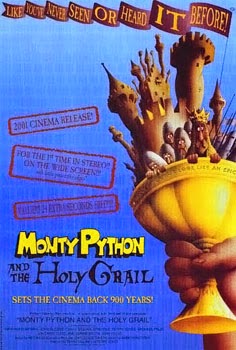
830e6-monty_python_and_the_holy_grail_2001_release_movie_posterThe beauty of The Holy Grail is that it is absurd in every sense, and it is keenly self-aware the entire time. The comic troupe Monty Python found fame from its British T.V. show Monty Python and the Flying Circus. Now Graham Chapman, Eric Idle, Terry Gilliam, John Cleese, Terry Jones, and Michael Palin transferred their brand of humor to the big screen. What better canvas for their brand of humor than Medieval Europe? It’s got Castles, Trojan Rabbits, French Soldiers, Swords, Knights who say Ni,  Headbanging monks, a killer rabbit and so on.

They offer us the weirdest, oddest, and downright hilarious revisionist parody of King Arthur’s legend.  I use the term plot loosely because The Holy Grail follows no strict set of parameters or plot points. The quest for the Grail by Arthur and his right-hand man Patsy is purely an excuse for gag upon gag upon gag. Even while he recruits his Round Table, the fun is not in the completion of the quest, but the detours the plot takes for the sake of a laugh. And it goes all over the place. Tangents abound and the story jumps back and forth, oftentimes for no good reason. The film has the oddest of openings (involving llamas) and it ends just us weirdly as it began with the arrival of the police. Don’t question it. Just enjoy.

When is the optimal time to watch The Holy Grail you ask? The real answer is anytime, but it reaches its maximum potential when you watch with others late at night in a giddy delirium. Let the comic absurdity of it all carry you off into the Monty Python world. The first time watching it you might be a little befuddled, but the beauty is that it gets better nearly every time. Anachronisms become your friend, quotability skyrockets, and there is a kind of joy that surfaces from each vignette of comedic madness.

It works so well because the ensemble is so wacky and fun with no one individual completely outshining the others. They are never relegated to a certain role but instead are given free reign to show off their skills in many zany incarnations. Thus, the actor playing a certain character becomes less important and  the comedy that is found in this or that role takes precedence.

I never have been too keen about living in the Middle Ages, and after watching The Holy Grail I… definitely would not want to live in the Middle Ages. It’s certainly good for a few laughs, though. Ni! Ni! Ni!

4.5/5 Stars


Review: Star Wars (1977)

ccbff-starwars1Star Wars has such a giant mythology and full-blown culture surrounding it that it becomes nearly impossible to separate the entire galaxy from the film franchise. It is so much more than just a movie with a plot and some characters going on an adventure. Sure, George Lucas let his boyhood imagination run wild taking pages out of numerous playbooks from John Ford’s westerns, Kurosawa’s samurai, and the serialized sci-fi adventures of Buck Rogers.

However, when I look at this classic that I grew up with for so many years now, it is nearly impossible to shed the role of a pure fan and take on the role of a film critic. One prime example would be Sir Alec Guinness. All my knowledge of film history tells me he is one of the greatest English actors of all time and for good reason. However, there is also this innate conflict that says he’s Obi Wan Kenobi since that’s what I knew him for originally. That’s what I identify him with, and I probably always will. Because, as I said before, Star Wars: A New Hope (As it was later titled) means so much to so many people like me on a personal level.

But let me hold off on that for a moment and focus on Star Wars the film. First and foremost, you would be hard-pressed to find a more colorful array of characters. C3PO and R2D2 are the films jesters and the story is told from point of view, to begin with. You have the hapless farmboy, the wise old man, a spunky princess, a dashing tough guy, and his ever faithful fuzzy sidekick. Not to mention the greatest, most imposing villain every developed for the silver screen. It took some developing with three different actors, a mask, a cape, and SCUBA sounds all joined to create his persona.

That aside, the world Lucas created is so astounding and inventive that it has become second nature to true Star War fans. Jawas on Tatooine, the Cantina in Mos Eisley, and Storm Troopers on the Death Star are simply a no brainer. They are part of our lexicon just as many of these quotes easily roll off our tongue. “May the force be with you,” “I’ve got a bad feeling about this,” “Help me Obi Wan Kenobi, you’re my only hope.” You get the idea.

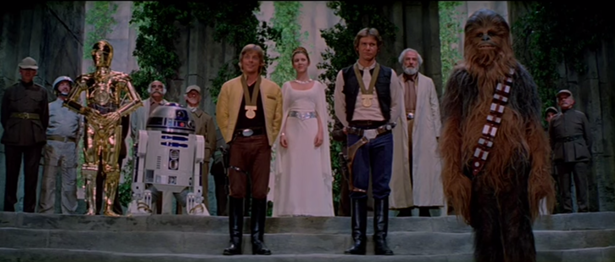
Then, it goes without saying that John Williams propelled this film from being good to great. Because without his iconic scoring, Star Wars is just not the same. It lacks the same energy and epic vibrancy that pulses through every scene. One prime example is the final scene in the Throne Room on Yavin IV. That could have been the longest most awkward award ceremony in history.  When you think about it, no one is talking, they just stare at each other as the medals get bestowed. But with Williams score, it develops a grand crescendo that caps the film on the highest notes as the credits role.

I am also convinced that Ben Burtt is a genius because he breathed still more life into the Star Wars world through his sound design. He gave us blaster noises, RD-D2’s “voice,” Chewie’s distinctive growls, and of course the hum of lightsabers and Darth Vader’s iconic breathing. A personal favorite of mine is the ever present Wilhelm Scream, but I digress.

Thus, what we witnessed the first time we saw Star Wars (followed by countless more times) was not just a film, but a revolution, and I’m not just talking about the rebel alliance blowing up the Death Star.

As I suggested before, Star Wars is so affecting because it is not simply a movie we watch. In many respects, it brings up flashbulb memories in our lives. I remember birthday parties, childhood afternoons playing Legos, or being a Jedi with my very own lightsaber. Star Wars infected my entire adolescence and so when I watch this film it causes all the many great memories to flood back.

It is a joy to watch it again because I almost feel like a kid once more, experiencing the same excitement all over again as if it’s the first time around. My taste in films may continue to mature and evolve, but I dearly hope I never lose my affinity for Star Wars. In many, it would be like losing some of my memories and even a little bit of my humanity.

Not to worry, though, because based on this most recent viewing I will not be dismissing Star Wars any time soon. As some wise man once  said, “absence makes the heart grow fonder.” I forgot how much I missed “a long time ago in a galaxy far far away.” It was great seeing an old friend.

5/5 Stars

Shadowlands (1993)

2bfce-shadowlands_ver2Starring Anthony Hopkins and Debra Winger with direction by Richard Attenborough, this film chronicles the romance of famed Christian professor and author, C.S. “Jack” Lewis with the American poet Joy Gresham. Jack is by now a respected professor at Oxford and a widely acclaimed lecturer who often speaks on the issue of human suffering. In his personal life, he is rather reserved. He lives with his older brother Warnie and spends times with his colleagues discussing topics of all sorts at the local pub in the evenings. 

It is not until he receives a letter from an American admirer named Joy Gresham that his life seemingly begins to change. He first accepts to meet her only to be gracious, but soon their relationship develops into a close bond. Jack meets Joy’s son Douglas who is enthralled by Narnia. He even offers them a place to stay during the Christmas season, since they have nowhere else to go. Lewis and Gresham are very different people, to say the least. He is a quiet intellectual with the sensibilities of an Englishman, while she is a plain -speaking American who does not mince words. However, these differences bring them closer together because they help each other to view the world in a radically new light.  Jack learns how Gresham’s marriage is going badly and he settles to marry her in a practical union so she and Douglas can stay in England. They do not speak of it much and it hardly seems real. Joy calls him on it realizing for herself that he allows no one to challenge him. There is no vulnerability to him whatsoever.

However, then Joy is diagnosed with bone cancer and slowly but surely she begins to deteriorate. For the second time in his lif,e Lewis understands the anguish that comes when a loved one is suffering. Because, the fact is, he most definitely loves Joy, and it simply took a tragedy to make him realize it. As with any inexplicable suffering, Lewis is tested in his faith, and the reality human suffering has new meaning to him. It is no longer just lecture material, becoming a far more personal process.

Although this film is not so much focused on C.S. Lewis as a Christian theologian or apologist, I think Anthony Hopkins does a wonderful job of portraying him as a kindly and gentle man of faith. He struggles with doubts and fears like every human, but he found something wonderful in his love for Joy which ultimately changed him.

Debra Winger must also be commended because she played well off of Hopkins and even though I have no picture of the real Gresham, Winger seemed to embody her. In some ways, I found her most beautiful when she was bedridden, absent of all makeup and seemingly so pure. It positively tears your heart out watching her son say a tearful goodnight or to look on as Jack stays up with her. This is a better picture of real, unadulterated love than most films can hope to manage because it very rarely becomes a sappy melodrama instead resorting to more deliberate means. As Jack says we live in the “Shadowlands,” but amidst the pain and suffering, love seems to shine through even brighter.

This was such an enlightening film for me because I always envision C.S. Lewis as a scholar and rational thinker, which he was. But he also had a vulnerable human side and this film, as well as A Grief Observed (written after Joy’s death), prove that point. It’s hard not to feel for him and that’s part of the beauty of this story.

4.5/5 Stars

The Conversation (1974)

6d644-theconversationDirected by Francis Ford Coppola and starring Gene Hackman, this film begins with a commonplace conversation between a young man and woman in the relatively busy Union Square in San Francisco. As they make their way around their words seem of little importance and yet unbeknownst to them they are being followed and recorded. 

The mastermind behind it all is the surveillance expert Harry Caul who uses his know-how and a small team to track their words from a van.  As a professional and a highly respected member of his field, Caul is guarded and he tries not to concern himself with the reasons behind his surveillance. However, as he works his magic in his private lab space, Caul finally does become affected when he picks up on bits and pieces of the conversation. It deeply troubles him and he continually plays the tapes back. 

Because of his concern, Caul holds out on giving the tapes to the assistant of the Director, the man who commissioned the job. The aide pressures him more and more and then finally Caul finds the tapes are stolen. Fearing that the couple is in grave danger, Caul takes the room right next to theirs, but unfortunately despite his best efforts, his fears seem to be confirmed. After searching the empty room Caul goes to confront the Director only to find that things are not as they seem and Caul is the only one who realizes it. The disillusioned man is then threatened over the phone and informed that now the shoe is on the other foot and he is under constant surveillance. Little did he know the implications of the conversation… 

Gene Hackman may have played more memorable characters like Popeye Doyle, Lex Luthor, or even Norman Dale in the Hoosiers, however, I am not sure if he played a more complex character than Harry Caul. He is a detached man who has no telephone, tells white lies about his birthday, has multiple locks on his door, keeps his equipment caged and he has no significant relationships. The other side of him loves the saxophone and is a devout Catholic. He is no hero and not what we would normally call a villain. He is Harry Caul a lonely, confused human who has tendencies for good but still constantly struggles to reconcile that with his career. Above all, The Conversation is a thought-provoking psychological thriller which gives the audience lots to mull over.
 
4.5/5 Stars

Persona (1966)

f15de-persona1“Persona: The image or personality that a person presents to other people” ~ Merriam-Webster Dictionary 

Ingmar Bergman’s Persona got me thinking. About what I’m not quite sure, but it did leave me confused and utterly perplexed which I suppose is a good thing. Since I am a fan of comparisons, I will go out on a limb and say I felt like I was watching the cross between L’Avventura and Repulsion. Persona is certainly befuddling psychologically and it has the crispest, most pristine black and white cinematography I have seen in a long time, courtesy of Sven Nykvist. 

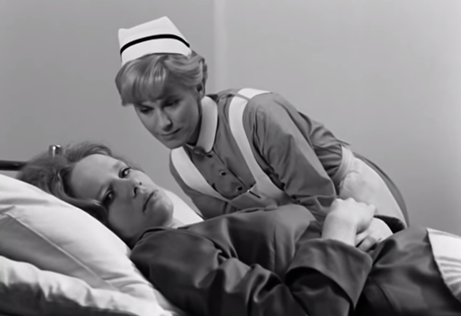
The opening sequences in the hospital are noticeably minimalist with an accentuated sterile environment. The close-ups feel reminiscent of The Passion of Joan of Arc and the highly dramatic and unnerving score  sends twinges down our spine. To top it off, the takes can be excruciatingly long, focusing on an inert face or a solemn figure crouching in a doorway. Silence is just as prevalent as dialogue.

At its core, Bergman’s film is an examination of individual characters in space. Alma (Bibbi Andersson) is the young sprightly nurse who is called in to take care of catatonic actress Elisabet Vogler (Liv Ullmann). Their interactions quickly move from the plain hospital room to the seaside cottage loaned out to Mrs. Vogler for her recovery.

What begins as attendant watching over patient soon evolves into a vulnerable woman finding a silent foil to confide in. The Persona is changing. 

All of a sudden roles are reversed and when Alma discovers a letter Elisabet sent away to the administrator, things are never the same. She feels betrayed learning that the actress has been analyzing her in silence. All that’s left is bitterness and anger towards her mute companion. No words come out of her mouth. Only blank stairs and more silence. She remains strangely calm in juxtaposition with the agitated Alma who becomes more and more tormented. But it is at this point we have lost much of our grip on reality. The lines, as well as the images, are often blurred and warped.

Persona takes on some brazenly edgy topics with frankness that is often abrasive. A repeated monologue by Alma follows the discovery of a recovered photo of Elisabet’s little boy. In the sequence, Alma speaks the words on Vogler’s mind and we are forced to labor painfully over her words yet another time. In many ways, Alma becomes the stand in or understudy for the actress and the role is far from elegant.

By the time the film came to its conclusion I hardly knew what to think. It elicited powerful feelings and reactions of aching and apprehension. If nothing else Bergman certainly makes you think and his Persona is unquestionably a striking piece of cinematic art. He has the skill of riddling our minds like a Bunuel or even Godard. It’s powerful if not completely satisfying because we can never hope to fully understand it.  

4.5/5 Stars

Wages of Fear (1953)

2c3da-salairedelapeurr350Directed by Henri-Georges Clouzot, this international thriller stars a cast headed by Yves Montand. The film opens in a hell-hole of a town in South America where many jobless drifters spend their days. The joke is that it is really easy to get there, you just can never get out again. 

A Frenchman named Mario (Montand) is one of these vagabonds who has little to do except make eyes at a pretty girl (Vera Clouzot), and sit around the local hangout. Then a massive fire breaks out at a nearby oil field of the corrupt, American Southern Oil Company (SOC). In order to stop the devastation, the solution is to use explosions triggered by nitroglycerin. But the journey to the fields is extremely dangerous so there is the brilliant idea of finding four eager vagrants to transport two trucks of nitro on this 300-mile suicide mission. In need of a break, most of the town jumps at the opportunity. However, only four men actually get this “privilege.” 
One is Mario, another his jovial roommate Luigi, and then the closed off and menacing Bimba. The fourth man who eventually joins this trio is Jo who is an older French fellow who befriended Mario. Then, Mario and Jo leave in one vehicle followed by Bimba and Luigi with the fun just beginning. They must navigate the treacherous roads full of not only bumps but barricades and giant boulders. All the while they are worn thin physically and psychologically. 

Soon the confident Jo turns into a sickly coward, but the other three must keep on going if they want their payoff. In the end, this mission turns out to be too much for some. Eventually, Mario gets ready to return to his girl with $4,000 in toe, a deliriously happy man.
First off, when it is said that this film is a “thriller,” we are not talking about a Hollywood thriller here, with overwhelming action followed by twist after turn. What makes the Wages of Fear so powerful is the sustained intensity because every moment that the nitroglycerin is in the picture you half expect something to go wrong. As such a thriller, I almost came to expect the ending because I really do not think it could have ended any other way. In many ways, it is not simply a critique of the American oil industry, but also the American film industry, and it confidently defies both.

4.5/5 Stars

Review: American Graffiti (1973)

e38f5-americang3 The year was 1962. Cars were cool, the music was hopping, and teens were young and in love. It’s a simpler world, but it is not a world without your typical worries, especially since high school is over and college is just around the corner for some.

Curt (Richard Dreyfuss) is destined for college with a big scholarship under his belt, but he is still not convinced it’s the right fit for him.

Steve (Ron Howard) is also college bound, but he finds himself spending his last night patching things up with his girlfriend, Curt’s sister Laurie (Cindy Williams).

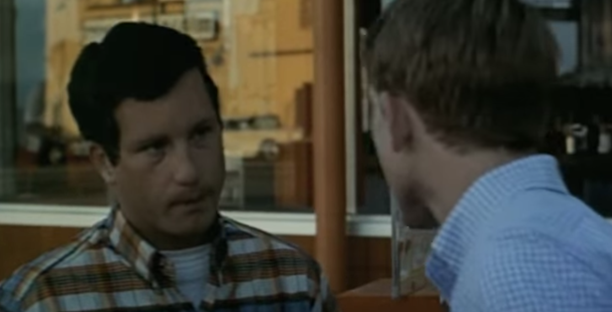
Their friend Toad (Charles Martin Smith) has the night of his life with Debbie (Candy Clark), leaving his puny Vespa behind after Steve’s loans his ride to the lovable geek.

Cool king of the strip John Milner (Paul Le Mat) gains an annoying co-passenger and winds up having an unorthodox but memorable night all the same.

It would be a pleasure to dive further and further into each arc, but it seems wholly unnecessary. The joy of American Graffiti is the ride it takes you on. The differing perspectives, varying experiences, and ultimately, a full realization of a certain time and place. True, I was never around in 1962, but it feels like I was. Some of Buddy Holly’s thunder has been stolen by the Beach Boys. JD (James Dean) is boss and Ozzie and Harriet can be seen on the picture tube. It goes without saying that the hottest pastimes are cruising and necking.

Understandably, George Lucas pulled from his own past love of cars and music to transport us back in time. That would have been impossible without the music that acts as the ultimate jukebox and it is pervasive wherever the night takes us. With that nostalgia comes Wolfman Jack who highlights the lightness of the age while also making a more somber cameo which contrasts with the image that he created on the radio waves.

This is a story about young adolescents, and it certainly is a comedy as life is often a comedy. There are memorable moments, fights, and times where we just need to puke. Through it all we learn a little about ourselves and those around us. Dreams can be made and re-imagined as they were for Steve and Curt. However, when it all comes down to it, each one of us has our own path we must carve an existence out of. For each individual it looked a little different. However, one of the reasons I always come back to American Graffiti is the timelessness or rather the way it so wonderfully freezes time. I feel like I’m there in the moment with these characters. I laugh, cheer, and empathize with them. Perhaps the time and place of their world differs from mine, but their worries and aspirations are universal.

No one wants to fade into the past and we all are looking for our girl in the white T-Bird. Only time will tell what actually happens. We just have to live life and see what kind of ride we get taken for.

5/5 Stars