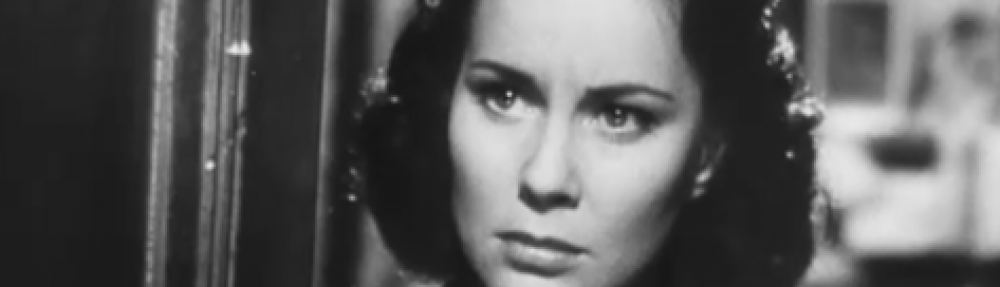
Moonrise (1948)

MoonriseHere is a low budget yet artistic film from Frank Borzage. I will be honest that I had never heard of Borzage before a year or two ago and he seems to have lost some of the respect he had early on in the 20th century. The same can be said for his stars Dane Clark and Gail Russell who are unknowns to most unless you hailed from those times. I was saddened to find Russell struggled with alcoholism which contrasts with the surprisingly hopeful ending of this melodramatic noir.

Ultimately, Danny Hawkins (Clark) was able to let go of all his hatred and accept justice. Instead of throwing away his life he got the girl and came to terms with reality.

Perhaps the most striking moment of this film was the highly stylized and dark opening showing the hanging of Danny’s father and his early childhood afterwards. In only a few minutes Borzage told us so much about Danny. Thus, during the entire films those images stuck with us and we could still feel a sense of empathy for him.

Despite there small parts, I was excited to see Lloyd Bridges, a young Harry Morgan, and Harry Carey Jr. All in all this was an interesting film and it causes me to want to see more from Borzage.

3.5/5 Stars

She Wore a Yellow Ribbon (1948)

6a177-sheworeayellowribbonpost“Never apologize. It’s a sign of weakness.”

She Wore a Yellow Ribbon can probably be considered lighter fare than the Searchers or Liberty Valance, but it is still worth a watch for Ford or Wayne fans.The 2nd installment of John Ford’s cavalry trilogy, this film was shot in Monument Valley in color and features a 41 year old John Wayne playing a 60 year old captain on the verge of retirement. However, before he is done he must diffuse the aggression of the Native Americans due to the aftermath of the Little Big Horn. At base and on the the trail he must deal with two young bucks (James Agar and Harry Carey Jr.) and the stuck up girl (Joanne Dru) they are fighting over. However, he also has some very capable men in his company, two of which are played by Victor McClaigen and Ben Johnson. With his retirement imminent he salvages his last mission before riding off as a civilian towards California. Except they are not quite done with him yet.

Here Wayne takes on a more fatherly role and does a good job dispelling his knowledge and know how as the experienced Nathan Cuttings Brittles. As usual John Ford does not disappoint and there is some brilliant scenery whether it is Monument Valley in the rain or the shine. Next are Fort Apache (1948) and then Rio Grande (1950)!

4/5 Stars

The Searchers (1956)

d4eb3-the_searchersOne of John Wayne and John Ford’s best westerns respectively, The Searchers follows an ex-Confederate soldier (Wayne) as he looks for his niece Debbie, who was taken by Indians when they killed her parents. Now Wayne and a young man played by Jefferey Hunter must look for her and bring Debbie home. With an almost obsessive desire, Wayne’s character Ethan Edwards vows to find her. Along the way, the old vet and young man have conflicting personalities that get in the way. Even when they finally find her, she has become more Indian than white, and Edwards seems bent on killing her much to Hunter’s horror. In the end, the gruff but courageous searcher shows his true colors.

A great western, and simply a wonderful film, The Searchers has a lot to offer with great action, Monument Valley scenery, and of course John Wayne. The supporting cast is good as well, including Vera Miles, Natalie Wood, Ward Bond, John Qualen, Hank Worden, and Ken Curtis.

There are some pivotal scenes in this film that I think really get to the core of what it is about, and Ford constructs a multitude of scenes which are simply a joy to observe as they unfold. One turning point has to be when the two Searchers look over a few white girls that the cavalry recovered from the Comanche. One of the girls gives off a childish screech, which causes Ethan to turn around, and Ford’s camera closes in on his scowling face half covered by shadow. Here is a proud man who would not surrender during the end of the Civil War. Here is a man full of prejudice and vengeance. Here is a man who shows glimpses of kindness, and here is a man who knows pain. It is complicated because he heads out after Debbie seemingly in an act of love. But soon it seems that it has become his vendetta, and Ethan has simply become bent on revenge. It takes his final confrontation with Debbie to reveal the true depth of his character.

Undoubtedly this is one of the preeminent American westerns, but I think you could also call it a social commentary on racial prejudice. Furthermore, The Searchers influence ranges from the plight of Luke Skywalker in Star Wars to the music of Buddy Holly (“That’ll be the Day”). I think fittingly enough the film ends with Wayne framed in the doorway, walking off into the distance. After all, he is a searcher, and you cannot expect a man like that to stay put.

5/5 Stars