Seven Samurai (1954)

fde86-seven_samurai_movie_posterDirected by Akira Kurosawa, this is often considered one of the greatest films of all time. The story begins in a small Japanese village that is constantly being tormented by marauders. The bandits are about to strike again but decide to return after the harvest. The village elder advises the people to find some samurai in the time they have. Although they have no money, several men go to a town to look for help. There they witness the skill of an experienced samurai. He agrees to help them and also gathers five other skilled men who have no allegiance. They are followed by a seventh, wild samurai. The rest of the film follows the difficult relations between the anxious villagers and their protectors. The samurai fortify the village and also train the farmers for combat. Three samurai make a raid on the enemy and then later the bandits attack. They are hindered by the fortifications but still wreak havoc. The following day the climatic battle takes place. After the showdown, the village is safe but only 3 of the 7 are still alive.

4.5/5 Stars
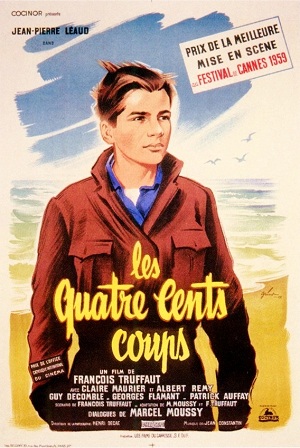
The 400 Blows (1959)

This French New Wave film directed by Francois Truffaut, more aptly titled The Wild One or Raising Hell, is about a young boy named Antoine. He comes from a working class family and his parents are struggling and frustrated. In school he gets poor grades and his teacher often punishes him. Annoyed with his life, he runs off for a time committing petty crimes and exploring the streets with a friend. That ends when he is caught stealing his father’s typewriter. Fed up for the last time his parents send him away to an observation center for boys. After he arrives Antoine escapes and runs to the ocean a sight he has never seen. With that the camera zooms in and we clearly see the face of this troubled, young boy. It is easy to appreciated this film because it does not glamorize the situation but tries to deal with it sensitively. Truffaut made a very good one here reflecting on his own experiences.

5/5 Stars

The Rules of the Game (1939)

bcb9f-la_regle_du_jeuThis French film directed by Jean Renoir is a light comedy that turns into a critique of the Upper classes. The film involves the superficial events and racy love affairs as only the French can have. It opens as a famous aviator lands his plane only to be disappointed that his married lover did not come to see him. Soon we learn that her husband has a mistress of his own. Put these four together,  Renoir in his jolly role of Octave, all the other guests, then the many servants, and soon you have a major spectacle. They dine, hunt, gossip, put on a show, quarrel, and above all fall in love. It is all fun and games however until someone gets hurt. Although this film is not what we may be accustomed to in our present generation, it is easy to appreciate the satire, cinematography, and ensemble cast. Kudos to Renoir for making a very intriguing film.

4.5/5 Stars

Tokyo Story (1953)

42390-tokyo_story_posterThis critically acclaimed Japanese film directed by Yasujiro Ozu has a relatively simple plot having to do with a kind elderly couple going to Tokyo to visit their adult children and extended family. They are excited to see the big city but it is not quite like they had expected. Furthermore, all their relatives and family have very busy lives making it difficult for them to spend time with the couple. The eldest son who is a doctor and then a daughter who owns a salon decide to send their parents off to a spa. Unhappy, the elderly couple return to Tokyo but they feel like they are imposing. Finally, the two of them head home and there the wife becomes ill. Because she is dying, her children do decide to visit. However, after she has passed away it seems they all too soon forget her and go on with life. This film is an interesting study of the void between generations. It also uses realism and focuses on the manners of the Japanese without fully criticizing them.

4.5/5 Stars

Ikiru (1953)

4b946-426px-ikiru_posterDirected by Akira Kurosawa and starring Takashi Shimura, this drama is loaded full of irony. As the film opens, right away we learn the protagonist has stomach cancer, except he has yet to find out. He has spent 30 years of his life working at a monotonous job as a bureaucrat. Only after he discovers that he barely has 6 months left does Watanabe-san actually begin to live his life again. He tries the night life of Japan and it does not satisfy. Then he starts spending time with a lively, young worker that he used to know. All the while he thinks about telling his son about his condition but he cannot bring himself to do it. However, Watanabe-san finally finds a way to leave his mark on this life. And yet 5 months later he is dead and his fellow bureaucrats seemingly dismiss his accomplishment  Through a series of flashbacks they ultimately realize what he really did. I found this film to be powerful because this idea is so powerful. It makes me question if I am really living my life to the fullest extent.

5/5 Stars

Rashomon (1950)

Directed by the famed Akira Kurosawa, the film starts off with two men eventually joined by a third. Both seem very melancholy and they explain this is because of something that happened three days earlier. Apparently a bandit met a husband and wife on the road and raped the wife with the husband being killed. However, this event is shown in four different accounts all varying greatly and we never learn what is fact and what is actually fiction. Because of this horrible event, one of the men who is a priest loses faith in mankind. The film ends just as it began with the two men alone under a pagoda watching the driving rain. However, an act of kindness quickly renews the priest’s belief. Kurasawa’s film certainly has an interesting plot device and camera work. Historically, it is also important because it introduced the world to Japanese cinema

5/5 Stars

Stray Dog (1949)

Directed by Akira Kurosawa and starring Toshiro Mifune and Takashi Shimura, the plot revolves around a rookie cop who has his gun swiped on a trolley in Tokyo. The young man is obsessive about getting his weapon back and after reporting the missing gun, he walks the streets looking for answers. His searching leads to a gun racket and after a crime is committed the rookie partners with an old vet on the case. They eventually wind up at a baseball game and begin searching for a man named Yusa. Another crime is committed and now the pair question a reluctant show girl. The older Sato follows the trail of Yusa and meets with trouble. Finally, the girl talks and the desperate rookie searches for the mysterious Yusa. In their final showdown he rights everything and retrieves his gun. I found this film-noir very atmospheric with post-war Tokyo and heat and humidity that you can almost feel. The two main characters have a solid chemistry because only together can they catch the Stray Dog.

4/5 Stars

Throne of Blood (1957)

Directed by Akira Kurosawa, this film is an adaption of Macbeth placed in a Japanese setting. Two great warriors come before their lord to be honored but before they arrive a spirit gives them a prophecy. One of the men who was initially loyal, decides to take the throne for his own after hearing the prophecy and being goaded by his wife. Soon he has become an overconfident madman bent on defeating everyone. Again the spirit in the forest gives him a prophecy that all but ensures his victory. However, all too soon his good fortune ends and that’s not all. This film has some slow parts but many of the images are very striking and atmospheric while the ending is also enjoyable. This is arguably the best adaption of Macbeth to film.

4/5 Stars