
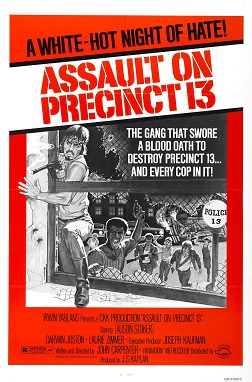
 John Carpenter is one of the most impressive multi-hyphenates, not only directing and writing but also scoring his work and this level of auteurship results in a punchy and effective thriller.
He introduces Assault on Precinct 13 not with a lot of needless expositional but by throwing us directly into a world and giving us the most salient details to figure it out for ourselves. It becomes apparent that a large cache of high-powered weapons have been stolen by a local gang.
The police react with swift retribution against several members of the gang, and in its wake, some of the gang leaders enact a gruesome blood oath. They vow vegeance against the police department if it’s the last thing they do.
Against this ticking time bomb Carpenter creates a tableau that belies his low budget. There’s a wide-ranging sense of the city grabbing hold of multiple points of view. The first of our four threads involves a carload of gang members out to avenge the deaths of 6 of their own.
The next centers on a newly installed policeman, Lt. Bishop (Austin Stoker), who’s expecting a quiet evening seeing out a defunct police precinct that’s all but packed up and moved to another location. Then, there’s a caravan of prisoners being carted off and transported to their new holding facility — one of them being the irreverent Napoleon Wilson (Darwin Joston).
Perhaps the most curious of all of them involves a father and his little girl purportedly on a mission of mercy to get their nanny to move out of her rough neighborhood. They slowly navigate the unfamiliar streets of the poor side of town.
Time stamps orient us to when and where we are lending a procedural type aspect to the proceedings. There’s also something agreeable about featuring all no-name actors because we have nothing prior to imprint on them and somehow it lends itself to this idea of L.A. realism. These are everyday people. Necessity becomes an asset even as we know full well that we’re watching a movie.
What struck me with Assault on Precinct 13 is the level of economy paired with this unsentimental sense of brutality making it feel reminiscent to something like Targets. This goes down to young men with their gunsights pointed at innocent passersby. It gives me the shivers because Carpenters triggers us to recognize the sheer fragility of human life. It’s so easy to become collateral damage.
One lynchpin scene involves an ice cream truck driver. He knows these streets better than this little girl who only has eyes for an ice cream cone — it means he always keeps a pistol close at hand — but he also signals the danger at hand. The gang thugs stalk the streets in their black ride with the predatorial intent of Spielberg’s shark.
The true ingenuity of the story comes with building out a broader world that subsequently services a smaller story scaled to Carpenter’s budget. So with the resources at his disposal somehow he’s able to tell something gripping that has a full-bodied immersion to it without getting too ambitious.
The bus must make an unexpected pit stop at the nearest station because one of their prisoners is especially sick. The special agent wants to stash him away in a holding cell for the time being. He has no concern when the precinct is closing down.
But the level of conflict is ratcheted even more so by the father intent on avenging his little girl. He ultimately stumbles into the station, catatonic and stricken with fear because he knows the silent killers are on the doorstep ready to get him. Thus, all our storylines are brought together and we can distill the premise down to one of Carpenter’s purported inspirations.
He wanted to craft his version of the prototypical Howard Hawks westerns — the westerns written by Leigh Brackett and coming in the forms of Rio Bravo, El Dorado, and Rio Lobo respectively. Obviously, the context is different — contemporary gang wars cost less than period western wear — but the sense of morality is easy enough to approximate.
The “sheriff,” Lt. Bishop, must shore up the outpost and deal with an incoming onslaught, outgunned and outmanned with no clear communication to the outside world. The stakes are evident, and we must sit back and wait to see what goes down as the entire gang mobilizes around the precinct ready to ambush all its inhabitants.
Carpenter takes his time to absolutely obliterate the police station set. Obviously, this amount of firepower is absurd to consider. It does little and acts nothing more than an intimidation tactic but it’s another way Carpenter gives us spectacle or the illusion of spectacle without having to involve his actors. It’s all wonderful reaction and demolition work that’s impact is felt all the way around.
When our remaining heroes pull themselves up off the floorboards we scarcely want them to show their faces, knowing they could just as easily be blown away in a shower of bullets and shattered glass.
The writer-director flips the script by allowing the Black man, two women, and a couple of prisoners left over to be the ones to live and carry the movie. It’s a quietly radical creative decision and gives us something generally uncommon in a ’70s action flick. Carpenter’s able to do it purely because he’s not working in the mainstream though he still must make a conscious choice.
Although the ties to Hawks are unmistakable including the inclusion of the unflappable secretary “Leigh” (Laurie Zimmer), by the end it’s hard not to see the specter of George Romero’s Night of The Living Dead over this one. It comes with a faceless foe who might as well be zombies as they climb through windows and doorways, falling back, only for a new barrage of marauders to take their place. It’s endless almost mind-numbing.
What’s most rewarding about Assault on Precinct 13 is how it delivers on its premise. It’s not polished or pristine and yet it’s a full-bodied story with a tenacity and a sense of ingenuity. Most important of all you feel the menace all throughout the picture as the adrenaline pumps. It doesn’t pull its punches and Carpenter more than rewards his audience for their attention. He proved himself to be a filmmaker to watch. Love it or hate it, you know when you’re watching a Carpenter film.
4/5 Stars

