
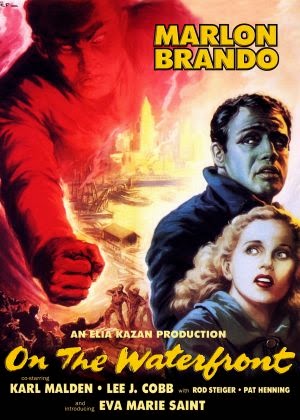
 “They always said I was a bum, well I ain’t a bum Edie.” That is what washed up prizefighter Terry Malloy (Marlon Brando) must try and prove to himself and others for the entirety of this crime-drama. On the Waterfront is ultimately his story of conscience and redemption that we watch unfold. It’s not pretty, but you’ll soon see for yourself.
Living on the waterfront is a tough existence. The mob decides who works and who won’t. Longshoremen are expected to be D & D (Deaf and Dumb) or else they have something coming. That’s how big shot Johnny Friendly (Lee J. Cobb) and his boys can run the entire area. They utilize fear and money to keep the working masses at bay. No matter what police or the crime commission might try to do, they have no hold on the waterfront. It’s a jungle out there and if you want to survive you look out for number one, don’t ask questions, and live another day.That is Terry Malloy’s philosophy and it suits him just fine. His brother Charley is Friendly’sright-handd man and he’s made a good life for himself thanks to his brains. Terry is more brawn than brain, and he does what his brother says. One night he blows the horn on a young man named Joey because he called out Johnny Friendly. That same evening Joey is knocked off, literally. Terry tries to justify it. He only thought they were going to “lean on him” a bit. With that incident begins Terry’s inner battle.
The moral compass of the film is supplied by two people. Edie Doyle (Eva Marie Saint) returns to her town from school with her beloved brother Joey now dead. She cannot understand why no one else will speak out about it or do anything to carry his cause. It is ultimately Father Barry (Karl Malden) who does just that realizing that his parish is the waterfront. He must fight against the injustice of the mob and hope others will join him. It’s a tall order. At the first meeting he holds in the church, a window gets busted, and thugs wait outside for people to beat up on. Terry was sent by Johnny to check it out and it is there that he meets Edie. He is immediately taken by her, and she warms to him. She sees him differently than the others without knowing what role he had in her brother’s death. The Father and Edie encourage Terry to testify at the crime commission after another man is killed in an “accident.”

Friendly can’t have a canary and its Charley’s job to straighten out his brother. That’s when they take their fateful car ride. Terry spill his guts (I coulda had class. I coulda been a contender. I coulda been somebody, instead of a bum, which is what I am, let’s face it. It was you, Charley.) and Charley responds the only way he knows how. He saves his little brother who he has always looked out for and pays the price.
Now Terry has his reason to testify and soon enough he goes before the crime commission to call out John Friendly. He has broken the waterfront code and gone canary. All respect for him is gone and Friendly wants his hide, but Edie is overjoyed in him. Finally, Terry has left the shackles on the waterfront and freed his conscience. He confronts the big man himself and is beaten to a pulp. But as Father Barry says he may have lost the battle, but he won the war.
Before getting to Brando, I must acknowledge the other players for their stellar performances. Eva Marie Saint is just that, a saint, and she gives a heartfelt performance as Edie. It is her love and care that leads Terry to turn himself around because she sees a little piece of humanity left in him. Karl Malden has perhaps one of his finest roles as the Father who represents a man of the faith remarkably. He is no joke, and he does not cave to hypocrisy. His waterfront sermon is one of the most powerful moments:
“You want to know what’s wrong with our waterfront? It’s the love of a lousy buck. It’s making the love of the lousy buck – the cushy job – more important than the love of man! It’s forgettin’ that every fellow down here is your brother in Christ!”
However, Rod Steiger’s poignant scene with Brando in the car is similarly extraordinary, because he realizes where he has failed. He does not need the words. He just stays silent, and we see it on his face. He is the one who pays for the mistakes, though, and he is far from a bum. Then, of course, there is Marlon Brando himself. He is often hailed one of the greatest actors of all time, but he usually played corrupt undesirables or rebels. Terry Malloy is perhaps his best role, and he is the good guy for once. He must struggle to do what is right by him, and he must struggle to prove himself to others. Brando plays him with some much genuineness, heart, and vulnerability at times. He is far more than the brusque meat head we take him for initially.
Elia Kazan was a champion of hard- edged dramas especially in the 1950s and he never succeeded more so than with this film. The black and white cinematography with perpetual fog drifting in fits the dire mood nicely and Leonard Bernstein’s score further compliments the drama. This is a fine example of Classic Hollywood cinema which was praised back then and lauded now. Our fake blood may have gotten better, but otherwise, it’s hard to top this film.
5/5 Stars



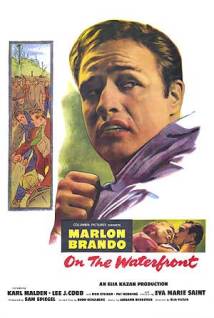 eat crime film Marlon Brando teamed with Elia Kazan and played a very different sort of character. It tells a moving story of a man who chooses to change in very difficult circumstances and to do what is ultimately right. This film has great characters and memorable dialogue that show the complexity of the human race. It proved that Brando could play a true hero and not only a villain.
 4 Star Films