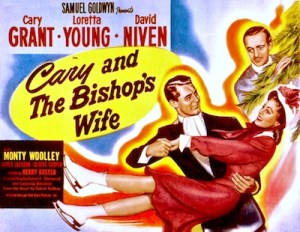
 Although its theology probably isn’t sound, rather like It’s a Wonderful Life, The Bishop’s Wife nevertheless utilizes its central plotting device wonderfully.
Imagine if on a whim an angel came to your rescue, and then imagine that the angel is named Dudley and looks and acts like none other than Cary Grant. In this case, the person in need is a distraught Bishop named Henry Brougham (David Niven). He is right in the middle of a major undertaking to build a new cathedral, and his primary benefactor Mrs. Hamilton (Gladys Cooper) is being a thorn in his side. The building project has consumed all his time and efforts, causing him to neglect his radiant wife Julia (Loretta Young), their little daughter Debbie, and the people from their old parish.
Director Henry Koster crafts a whimsical and rather sentimental film much in the same mold as Harvey (1950) which came three years later. This time Dudley is the character who exists outside of worldly convention. He is constantly kind, always patient, never hurries, and is always helpful to everyone in need be it blind man or bishop. In truth, everyone adores him, because after all, he is an angel. Everyone, that is, except Henry who needs him most. Henry unwittingly asked for help and now he has an angel in his midst, but Dudley will not allow that to be revealed to anyone else. It’s an unnecessary detail, and besides, he has much more pressing matters like attending to Julia and assisting Henry with his work. To her, he is purely a radically pleasant and good-hearted individual. With such positives, there hardly needs to be any explanation, only wonderment.
He takes Julia through the old town she used to live in happily with Henry. They meet old friends like the blustering Professor Wutheridge (Monty Wooley), who Dudley also happens to give inspiration to. He makes little Debbie a ringer in a snowball fight, and he and Julia are joined by a chipper taxi driver (James Gleason) in an ice skating adventure. Even a check in on the humble cathedral at St. Vincent’s leads to an angelic rehearsal by the local boy’s choir. Meanwhile, Henry is absent, attending to other matters.
Of course, he is as bitter and distressed as ever by his plight — his attention still skewed in the wrong directions. Even when Dudley goes to grumpy old Mrs. Hamilton and totally redeems her perspective in order to feed the hungry, Henry hardly seems pleased. His artifice, his tower is now even farther from being completed.
The final scenes of Bishop’s Wife are key because it’s in these moments where we see the change in Henry. Cary Grant might seem obviously miscast for this role, and in truth, it was originally supposed to go to Niven who was to play opposite the equally angelic Teresa Wright. But Grant’s debonair side is important for this final act because it makes sense when he makes a pass at Julia. It fits his screen persona as the suave bachelor, angel or not. You can debate whether he was actually in love with the beautiful mortal, or if he was just doing it to get a rise out of Henry. Whichever way you see it, for the first time Henry is driven to fight for his wife out of love and because of the human emotion that still pulses through his veins. Finally, he drops the peripheral and looks at what is central, his family and friends. Dudley, or Cary Grant, takes one final approving look and walks off in the snow. His work here is done. Peace on Earth and Goodwill towards men.
4/5 Stars
“We forget nobody, adult or child. All the stockings are filled, all that is, except one. And we have even forgotten to hang it up. The stocking for the child born in a manger. It’s his birthday we’re celebrating. Don’t let us ever forget that. Let us ask ourselves what He would wish for most. And then, let each put in his share, loving kindness, warm hearts, and a stretched out hand of tolerance. All the shining gifts that make peace on earth.”
~ Final Message given by Henry (David Niven)

 4 Star Films