The Farmer’s Daughter (1947)

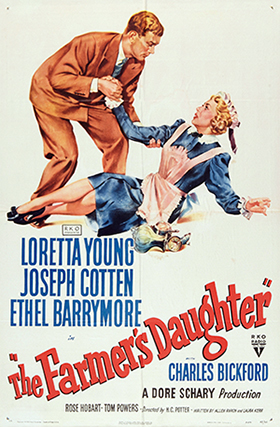
The_Farmer's_Daughter_(1947_film).jpgWhatever our criticisms of the previous generations, there’s still something within me that sees something uniquely compelling about films of old. Hollywood in the 30s and 40s could sugar coat, they could oversell the drama, but there was also a general decency that pervaded many of those films.

The cynical edge of dirty politics and corruption was given credence but more often than not, all that was good would win out in the end. Is it realism? Certainly not. Is is dated? Probably so. But there’s something overwhelmingly pleasant about a film like The Farmer’s Daughter for the very reasons mentioned above.

Our heroine is intelligent, plucky, and sincere. She’s from good Scandinavian stock which not only explains her vitality but informs a bit of her work ethic and her constant handle on what is right and true. That’s something we could always use more of today. A bit more of those core values sprinkled into our upbringings. It’s not informed by pride, or entitlement, selfishness or greed. It cares about what is good for all people and looks to be honest in all circumstances. To her credit, Loretta Young embodies all those qualities with a profound earnestness.

Katrin (Young) makes her way into the spotlight after acquiring a position as a maid for a local political dynasty after losing her hard-won funds for nursing school to a local swindler.  Still, in the home of Agatha Morley (Ethel Barrymore) and her son the promising young senator Glenn Morley (Joseph Cotten), Katrin soon makes a strong first impression.

She proves to be a gifted woman not only in doing housework but also in ice skating, with Swedish massages, making glogg, and much more. She’s also politically astute and though she lacks education her practical upbringing allows her to see every individual in practical terms. She bases none of her opinions on hearsay, ad campaigns, or newspaper spreads. Her thoughts come from what she’s heard first hand and what officials have done in the past. She’s also an impeccable judge of character.

The most obvious tension running through the film is the fact that Glenn is slowly growing attached to Katrin for the very reasons mentioned previously. Although he already has a bit of a fling with a local reporter who is smitten with him. But the real problems come into being when a seat opens up in the house and the incumbent’s choose to back an unscrupulous career politician.

Katrin sees right through him and openly grills him at a town hall meeting. Now the opposition is calling on this young woman to be their candidate and she agrees to run against her employers. She’s crossing political lines because she constantly exercises her freedom to do as she sees fit. That is her prerogative after all. Glenn in one sense is incensed by her decision but he’s also madly in love with her and he has to make a choice.

A raucous screwball finale turns out to be surprisingly gratifying given the sentimentality and political drama that provide most of the film’s makeup. The comedy is also bolstered by the generally open-minded and wryly amused Ethel Barrymore who looks at all the unfoldings in front of her with a bit of a glint in her eye. Meanwhile, Charles Bickford’s gruff charm as the valet Mr. Clancy serves as the perfect foil for Katrin’s affability. Because he’s really a good man as well.

The Farmer’s Daughter might turn some modern viewers off for a purported simplistic view–a film of overt goodness where the woman ends up with the man who in turn allows her to succeed. But what is wrong with a good Joseph Cotten and an effervescent Loretta Young? A dose now and then can hardly be considered harmful.

What struck me was a timeless statement that Mrs. Morley teases out of the crooked Mr. Finley. He’s opposed to things that don’t meet his definition of “100% Americanism” and it’s a very narrow view. Namely whites, no foreign-born, and the right kind of religion. Ironically, 70 years later we are still guarding against such poisoned intentions. Because if anything, Katrin represents in a small way a great deal of what makes America great. Let us not forget that.

3.5/5 Stars
 

The Bishop’s Wife (1947)

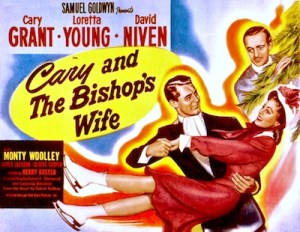
Cary_and_the_Bishop's_Wife_posterAlthough its theology probably isn’t sound, rather like It’s a Wonderful Life, The Bishop’s Wife nevertheless utilizes its central plotting device wonderfully.
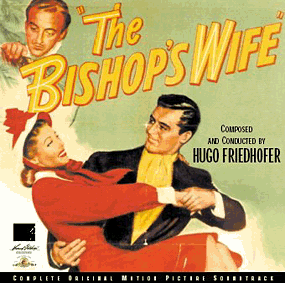
Imagine if on a whim an angel came to your rescue, and then imagine that the angel is named Dudley and looks and acts like none other than Cary Grant. In this case, the person in need is a distraught Bishop named Henry Brougham (David Niven). He is right in the middle of a major undertaking to build a new cathedral, and his primary benefactor Mrs. Hamilton (Gladys Cooper) is being a thorn in his side. The building project has consumed all his time and efforts, causing him to neglect his radiant wife Julia (Loretta Young), their little daughter Debbie, and the people from their old parish.

Director Henry Koster crafts a whimsical and rather sentimental film much in the same mold as Harvey (1950) which came three years later. This time Dudley is the character who exists outside of worldly convention. He is constantly kind, always patient, never hurries, and is always helpful to everyone in need be it blind man or bishop. In truth, everyone adores him, because after all, he is an angel. Everyone, that is, except Henry who needs him most. Henry unwittingly asked for help and now he has an angel in his midst, but Dudley will not allow that to be revealed to anyone else. It’s an unnecessary detail, and besides, he has much more pressing matters like attending to Julia and assisting Henry with his work. To her, he is purely a radically pleasant and good-hearted individual. With such positives, there hardly needs to be any explanation, only wonderment.

He takes Julia through the old town she used to live in happily with Henry. They meet old friends like the blustering Professor Wutheridge (Monty Wooley), who Dudley also happens to give inspiration to. He makes little Debbie a ringer in a snowball fight, and he and Julia are joined by a chipper taxi driver (James Gleason) in an ice skating adventure. Even a check in on the humble cathedral at St. Vincent’s leads to an angelic rehearsal by the local boy’s choir. Meanwhile, Henry is absent, attending to other matters.

Of course, he is as bitter and distressed as ever by his plight — his attention still skewed in the wrong directions. Even when Dudley goes to grumpy old Mrs. Hamilton and totally redeems her perspective in order to feed the hungry, Henry hardly seems pleased. His artifice, his tower is now even farther from being completed.

The final scenes of Bishop’s Wife are key because it’s in these moments where we see the change in Henry. Cary Grant might seem obviously miscast for this role, and in truth, it was originally supposed to go to Niven who was to play opposite the equally angelic Teresa Wright. But Grant’s debonair side is important for this final act because it makes sense when he makes a pass at Julia. It fits his screen persona as the suave bachelor, angel or not. You can debate whether he was actually in love with the beautiful mortal, or if he was just doing it to get a rise out of Henry. Whichever way you see it, for the first time Henry is driven to fight for his wife out of love and because of the human emotion that still pulses through his veins. Finally, he drops the peripheral and looks at what is central, his family and friends. Dudley, or Cary Grant, takes one final approving look and walks off in the snow. His work here is done. Peace on Earth and Goodwill towards men.

4/5 Stars

“We forget nobody, adult or child. All the stockings are filled, all that is, except one. And we have even forgotten to hang it up. The stocking for the child born in a manger. It’s his birthday we’re celebrating. Don’t let us ever forget that. Let us ask ourselves what He would wish for most. And then, let each put in his share, loving kindness, warm hearts, and a stretched out hand of tolerance. All the shining gifts that make peace on earth.”

~ Final Message given by Henry (David Niven)

The Stranger (1946)

f6c39-the_stranger_filmIn a whirlwind, the film goes from a moody foreign locale to a quaint American town called Harper, but it never ceases to be a gripping film noir. Considered Orson Welles‘ weakest project thus far, The Stranger is still thoroughly enjoyable thanks to the performances of Edward G. Robinson, Loretta Young and Welles himself. Much like Shadow of a Doubt, this film shows that noir thrillers can still take place in middle America, and they can be pulse-pounders all the same. Also, an evil man can easily exist in a mundane environment and still be evil.

The reason we end up in Harper of all towns has to do with an “escaped” Nazi war criminal. He was allowed to escape and investigator Mr. Wilson (Robinson) follows him. It’s an idyllic little town and one of its most respected members is professor Charles Rankin (Welles), who is soon to be wed to pretty Mary Longstreet (Young). Little does she know that he is former Nazi war criminal Franz Kindler, and he is the man the escaped Konrad Meinike is looking for. Mr. Wilson is very interested in his whereabouts too.

Meinike soon disappears but not before deterring Wilson. However, not one to shy away from his duty, Wilson soon ingratiates himself with the local people, especially the newly married Mary and her kindly family. He is eager to learn more about the professor and at first, the gentleman seems above reproach, but something lurks underneath his calm exterior. Soon the beloved family dog Red is killed, an increasingly manic Rankin confesses his predicament to his wife and conveniently leaves out a few facts. Now constantly paranoid, Mary’s life is in far more peril than she realizes, and Wilson takes all the precautions he can. The clanging of the newly refurbished clock becomes a point of major contention, and it also serves as the perfect locale for a final climatic showdown (Put aside the absurdity and just watch it).

The whole town turns out for the show and finally after getting conked on the head and nearly killed during the case, Mr. Wilson finally has time to relax. Welles is not quite as memorable as Harry Lime here but still a sophisticated villain of sorts.  Likewise, Barton Keyes is a bit more memorable but Edward G. Robinson still brings his personality, iconic voice, and memorable mug to the table. Loretta Young has a radiant face and eyes like always. In other words, they do what they do. It works in making The Stranger a worthwhile thriller with the expected melodramatic music and shadowy facades of a film-noir. This is undoubtedly an oversimplification, but  then again, Orson Welles needs no introduction, and he certainly does not need me to vouch for creative genius.

4/5 Stars

The Bishop’s Wife (1947)

Starring Cary Grant, Loretta Young, and David Niven, I would certainly consider this film a Christmas classic. It opens and we are introduced to the kindly and handsome angel Dudley (Grant). When a Bishop prays for guidance in the difficult task of building a Cathedral, Dudley is sent to him. The once genial man has become frustrated and troubled, making life more difficult for his loving wife. When Dudley arrives, Henry finds out in disbelief that he is an angel. However, to everyone else Dudley is simply a charming man who has come to assist Henry. Everyone gravitates towards his kindness, except Henry. Dudley befriends an old professor, is kindly to the servants, helps their little daughter, and above all makes the Bishop’s wife happy by spending time with her. Over time he becomes attracted to her but she doe snot feel the same way. A jealous Henry stands up to the angel and realizes he must strengthen his marriage. Before he leaves Dudley explains he will not be remembered and he will not reutrn. Then on Christmas Eve the Bishop delivers a sermon as a new man. Dudley look on contentedly, knowing that he wrote the sermon. Most importantly he fixed the Bishop’s attitude and marriage so he could continue doing good with or without a cathedral. Grant’s charming portrayal reminds me somewhat of Clarence Oddbody and it makes sense because Henry Koster directed James Stewart in Harvey as well.

4/5 Stars