
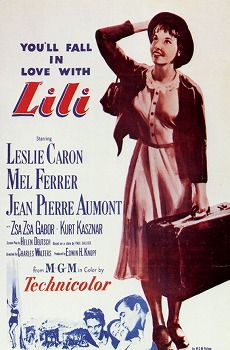
 “She’s like a little bell who gives off a pure sound.”
Leslie Caron always cast an image of a sweet young gamine presaging Audrey Hepburn, and thus, early in her career, it’s a masterstroke to cast her in the role of a destitute orphan with nowhere to go.
Set in provincial Hollywood — somewhere vague and still distinctly French, Lili (Caron) shows up in a small town with an address and a name. Her father is dead, she has no relatives, and the acquaintance she meant to inquire about has since moved away. She has no leads, no food, no shelter.
A shopkeeper next door hears her sad story and is prepared to take advantage of her. She flees his abode and follows a troupe of performers like a little lost puppy. They feel sorry for her, and so they try and do her a favor.
Their world is a cornucopia of colors. The story itself is a trifle. Magician Marc is such a charismatic fellow. Lili is quickly devoted to him and taken by his lifestyle, mesmerizing people with his illusions. She, too, falls under his spell, smitten with her first crush. She’s so taken in fact she quickly gets fired from a temp job as a waitress. She was too invested in the floor show to keep up with her work.
While Ferrer is the biggest name, he somehow flies under the radar until we become aware he’s in love with this girl. He cuts a gaunt figure, mostly agitated and repressed as he nurses his wounds and bruised ego since he can no longer dance after being maimed in the war. He masks his feelings by treating Lili gruffly and pushing her away.
However, because he and his compatriot are puppeteers, Ferrer uses his alter ego to form a bond with her. There’s a fine line here for them to walk, and somehow it comes off because of Caron’s clear-eyed belief. Each interaction feels real and genuine. I liken it to the authenticity I always felt in the human-to-puppet interactions in childhood episodes of Mr. Rogers’ Neighborhood of Make-Believe. There’s no condescension, and everything seems to be taken with true sincerity.
Lili expands on their performance because she imbues the puppets with meaning and attributes personality to them just with her gaze and a total commitment to their words. She believes they are real, and it becomes one of the enchanted conceits of the movie.
Otherwise, it would fall apart and feel disingenuous. Within the story itself, her interplay draws in an audience and helps their little trio grow a following. She, in turn, is given a stake in their profits and a small place to stay. For the time being, she has a home.
The meta conversations with the puppets become more pointed when they ask her, under the veil of performance, what she wants in life and how she feels about her love potentially leaving her. What’s special about her is that there is no compartmentalizing of fantasy and reality; she keeps them both together so they remain one and the same. The curtain between Lili and Paul makes it all the more intriguing. Because there is some kind of shroud mediating them.
Although Audrey Hepburn has already been mentioned, there is also a shared affinity between Lili’s performance on the green and the Punch and Judy Show in Charade. It might feel like reaching, but because of the connection between Hepburn and Mel Ferrer, it’s difficult not to intertwine them in my mind.
A turning point in Lili’s maturity is not so much one of passion or romance, but recognizing there is cruelty in the world, and it is something to buttress yourself against. We see Marc in a different light. He’s a married man and free spirit who plays up his bachelorhood for the sake of their show and perhaps his own desire to live the life of an uninhibited bon vivant. Fidelity is not one of his highest priorities.
Zsa Zsa Gabor is poised as the blonde “other woman” or rival for Marc’s affections, and yet she is given a more sympathetic position once we realize Marc is actually her husband. She has every right to be protective of him.
It occurs to me, just like how Lili says she was living in a dream like a little girl, this movie is like a fairy tale. As C.S. Lewis pointed out in close conjunction with his friend J.R.R. Tolkien, these tales can be a kind of safe space to explore topics of evil and suffering while eliciting responses like wonder and joy.
When Mel Ferrer pulls back the curtains and makes his pronouncements about his character, a bit of something is lost, but not enough to look down upon the movie. Lili had me charmed, and it doesn’t outstay its welcome. It’s slight and enchanting in a way children can appreciate, and adults so often dismiss. You must come to it with a childlike heart.
It’s possible to be prejudiced against musicals that only have songs. Dance is something that taps into the visual medium in other ways. No pun intended. Caron, of course, made a name for herself as a ballerina, and although her opportunities here are minor, there’s a lithe elegance with which she carries herself that serves her well.
The ending evokes Dorothy on the Yellow Brick Road with all her friends. And yet, for her, as the puppets become living, breathing beings in her dreams, it signals the end of something, not the beginning of the journey.
With each representing some part of Paul, their absence is too much for her to bear. Like all the great musical interludes, it’s almost wordless, but the confluence of movement and melody conjures up all the emotions we require between Caron and Ferrer to make their parting and reunification mean something.
Because of the child-like outlook of the movie, it brings to mind the words written by journalist Francis Church to a young girl named Virginia. He said:
“You may tear apart the baby’s rattle and see what makes the noise inside, but there is a veil covering the unseen world which not the strongest man, nor even the united strength of all the strongest men that ever lived, could tear apart. Only faith, fancy, poetry, love, romance, can push aside that curtain and view and picture the supernal beauty and glory beyond.”
The magic of Lili is how its own veil is torn in two, and still the movie maintains the semblance of a fairy tale. When the divide is breached, it brings more supernal beauty and not less. Again, it’s a lovely paradox wrapped up in an often overshadowed MGM musical. Perhaps this is the eucatastrophe Tolkien talked about.
3.5/5 Stars


 The legend goes that the ever-meddling megalomaniac of RKO Pictures, Howard Hughes, insisted the film’s title be changed to Rancho Notorious because European audiences wouldn’t know what a “Chug-a-Lug” was. Director Fritz Lang, who was himself a European emigre, snidely replied they definitely knew what a “Rancho Notorious” was.
 4 Star Films