Run for Cover (1955)

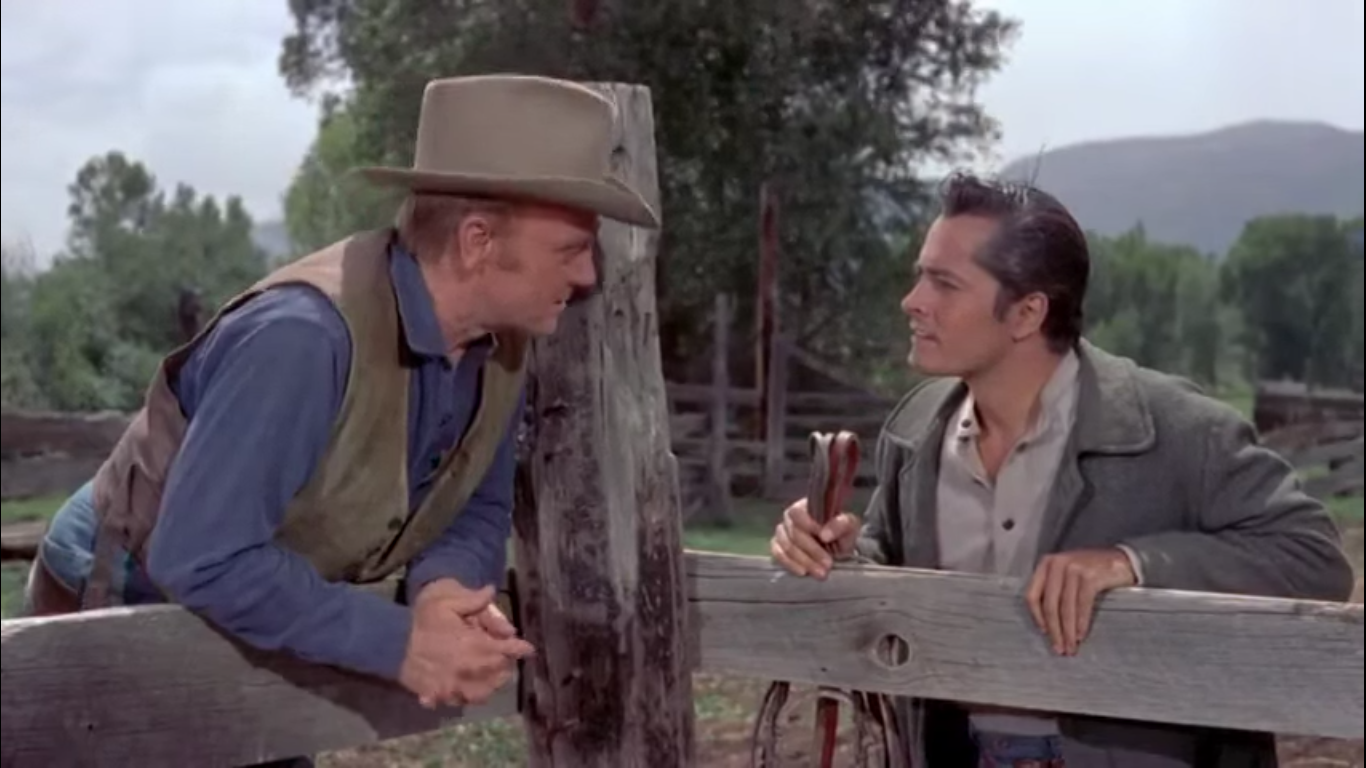
Run for Cover is rarely talked about in conversations of westerns, but there’s something fascinating about getting a James Cagney-led sagebrusher.  Like seeing Edward G. Robinson in The Violent Men, it’s hard not to read his entire history of gangster pictures into his backstory because although it’s a different decade, genre pictures still hold a place in the viewing public’s hearts.

Before they broke out with the likes of Hud, Harriet Frank Jr. and Irving Ravetch penned the story this movie was based on. Although it hardly has the pedigree of Nicholas Ray’s Johnny Guitar, the images of the picture are still stunning in their own right shot on location in Aztec, New Mexico.

The opening premise is frankly pretty corny. Cagney meets John Derek at a watering hole very conveniently. They ride on together with no apparent purpose except to get to the nearby town. Then, in a freak misunderstanding, while they’re shooting some scavengers out of the sky, the two men are mistaken for train robbers, and they have a bag full of cash literally dropped in their laps.

The locomotive heaps on the coal to race back to town to sound the alarm after their close scrape with the “outlaws.” Realizing what has happened, Cagney, always the level-headed one, looks to follow behind and return the money. They have nothing to hide. Still, there’s only one way this might end.

The mountains in the background are towering — truly awesome to look at — but there are more pressing matters at hand. It’s rather foreboding. It’s been some time between viewings, but there definitely are elements of The Ox-Bow Incident and Johnny Guitar here where the lynch-mob mentality takes over the local populations driven mostly by fear and traumatic experience.

However, this is all a false start, a way of developing the scenario ahead of us. It’s about that same man played by Cagney — now the town marshal — and his young companion who’s stricken with a life-altering injury. They must figure out what it means to live their lives.

Cagney rarely got a lot of late-period credit. There’s White Heat and then One, Two, Three comes to mind — these are marvelous showcases for his tenacious talents. Run for Cover is rarely talked about, whether it’s in the context of ’50s westerns, the career of Nicholas Ray, or that of Cagney himself.

But it does feel like another picture to buttress his legacy with. Not because it’s some grand masterpiece; he proves that he can make a slighter, quieter picture like this sing. Because his talents were not always purely bellicose or irascible. He has a more general charisma even later in his career.

He’s summed up so beautifully in a crucial scene. The doctor says Derek will never walk again. Cagney won’t hear of it, and he walks into the adjoining room as the boy lies on the floor crying out that he can’t get up. As their kindly Swedish benefactor (Viveca Lindfors) attends to him, Cagney simply beseeches him to “get up.”

There’s an authority in his words that feels almost Christ-like. It might seem like it comes out of a place of callousness, but really there is so much concern there. He doesn’t want the boy to give in and waste his life. In some manner, he is a miracle maker, a man of faith looking to bring the best out of this boy.

it’s a fairly slow-paced, straightforward western and this means much of the brunt of the movie must be carried by the merit of the performances — the relationships cultivated between them.

John Derek feels like little more than a pretty face, and the young actor might have said as much, but Cagney seems generous to him just as his character is generous to his young companion enlisting him as his deputy. He gives him credence and importance in this movie that he wouldn’t get otherwise without such a consummate professional to partner with.

There is some menace in the picture. Ernest Borgnine represents one — a shifty outlaw — and later some godless out-of-towners come tumbling into church mid “Christ The Lord is Risen Today” prepared to raid the bank.

What Run for Cover has to its advantage is how it turns all manner of dynamics on its head. The sheriff lambasts the townsfolk who are so righteous, so willing to condemn others, even as they are supposed to represent civilized society.

Then his one protégé becomes the film’s final and most crucial point of conflict, and this is not just like the Searchers, the ornery old man budding heads with the impetuous youth.

It’s a different kind of complication as they must face off against one another and come to terms with who they are down to their very core.  There’s a clear-cut emotional intensity that can only be resolved in one telling act. It’s tragedy and redemption all rolled up into one, and here we have something that feels distinctly of Nicholas Ray.

3.5/5 Stars
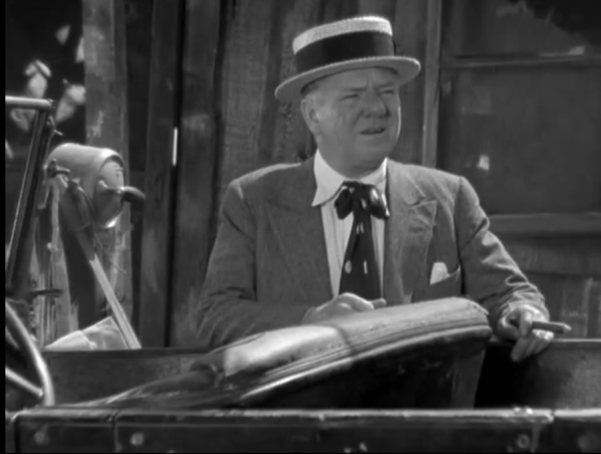
It’s a Gift (1934): “California, Here I Come!”

Screenshot 2020-07-07 at 8.04.46 PM

It’s a Gift is built out of the framework of the domestic lifestyle. This is where it gets its comedy. Take for exhibit A an early sequence. Harold Bissonette (pronounced bis-on-ay) tries to shave with a straight edge despite the interference of his daughter. It leads him to resort to using the reflection of a can and then a mirror suspended from the ceiling dangling around the room.

He follows it around taking intermittent swipes at his gullet covered with shaving cream quite unsuccessfully. It’s a wordless sequence that’s a wonderful escalation of utter absurdity. Because it bubbles with human invention and though Fields takes it further than seems necessary, that’s part of the fun — watching him keep it going.

For any of this comedy to function, there must be a suffocating bulwark around Fields in the form of his family. He has a perfectly henpecked, windbag of a wife (Kathleen Howard) berating him incessantly. His cackling kid’s either gliding around on his roller skates or leaving them lying around so they can be tripped over. His daughter is simply boy-crazy.

Put them together and it’s a perfect combustion engine for his comedic shtick. He has dreams of leaving his corner drugstore for an orange grove in California. If his uncle keels over like he’s supposed to maybe he’ll be left some inheritance.

For the time being, he has the daily grind, which isn’t much better than his home life. A huffy man demanding kumquats. There’s a blind and deaf fellow with an ear horn who’s a walking booby trap. The stock of light bulbs never had a chance. Even his oafish shop hand is hopeless; riding his bicycle indoors, falling asleep, failing to keep a wayward baby from spreading molasses all over the shop floor. You name it. It happens to him.

W.C. Fields becomes a vehicle of antagonism and all the ires of the world seem to be directed at him. This is the source of giddy delight in the comedy strung out over the progression of loosely connected scenes. Could it be he can never catch a break or maybe he’s just enough of a doddering fool to never warrant one?

Normally the image of the comedian is sculpted as a hater of mutts and tykes. It’s true this ornery image makes him all the more human. Here in this movie, it feels strikingly different because he’s effectively accosted on all sides even as he’s just lying around minding his own business. He’s allowed no peace.

One of the ripest gags is set out on the back porch one morning. Fields is trying rather unsuccessfully to get some shuteye, thwarted by an uncooperative couch, a milkman rattling his morning stock of “sleigh bells,” and about anything else you might possibly imagine. Don’t forget a rolling coconut exuding 10 times its decibel level — it’s practically a bowling ball as it thunks down the steps. Likewise, babies are infernal creatures out to get him and wage war against his comforts, no fault of his own.

It’s also one of the most visibly cinematic scenes in which we get this stratified sense of comedy as if it’s from the old two-reeler days of the silent era.  Though, here, the sound is such a vital element. That’s what sets it apart.

Then, the needle drops on “California Here I Come” to send the move in motion again. He’s gone and put his money into his dream. He done and bought an orange grove on a whim, loading up the jalopy and taking the wife and kids out west.

With it comes camping and sprawling West coast estates with rolling greens and statues. In fact, a witty passing gag has Fields crashing into the lawn ornament while his wife exclaims, “It’s the Venus de Milo” now in mint condition having been decapitated a la real life.

They make themselves at home on the private land. Their ensuing picnic is replete with sandwiches and meats wrapped in paper, feather pillows, feisty dogs, and sprinkler systems. By the time they leave the premises, it looks a bit like a ravaged water park gone awry. It’s an example of incremental chaos all conjoining into this culminating mayhem.

In the end, Bissonette is duped with what looks to be a precursor to Green Acres‘ Haney Place. In the immortal words of Bette Davis, “What a dump.” It’s a shack falling apart at the seams. His wife is indignant, ready to walk out on him, and he’s left to sit on the front stoop. What a dismal place to be in if this is truly the end. We only have minutes left after all.

But the cinematic world of W.C. Fields is an absurd space where only moments later all his miseries are turned on their head. Soon he’s sitting on the veranda pulling Oranges straight off the tree to squeeze into his own juice. It’s an outrageous joke scenario and a lampooning of idealized California culture, but in the face of The Grapes of Wrath and other such images, it’s a welcomed relief. If only every Tom, DIck, and Harry who took his family plunking out to the west coast struck it rich like this. It really is a comedy…That is until he sees the property taxes he owes.

3.5/5 Stars

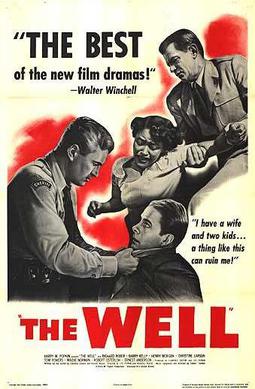
The Well (1951): A Noir about Racial Tension and Resolute Hope

The film opens when a little black girl named Carolyn tumbles into a well buried beneath some weeds. There’s a melodramatic handling of the material, but already we see something rather uncommon with the period noir. Normally black characters live on the periphery of film noir if they exist at all.

Here Martha (Maidie Norman) and Ralph Crawford (Ernest Anderson) reach out to the local Sheriff Ben Kellogg (Richard Rober) when they learn their 5-year-old daughter has gone missing. They become the emotional center of this local drama with greater implications. As an aside, it’s a pleasure to see Ernest Anderson once again.

Those who recall him in This is Our Life (1942) will remember him to be a performer of tremendous intelligence and dignity. It’s only a shame the impediments of prejudice meant he never had a more sterling career. This film acts as a small recompense.

Upon closer inspection, The Well has shades of some other movies like Captive City or Phenix City Story where there is an adherence to faux realism as we kick around the beat meeting people, and getting to know the world they call home.

It’s fascinating to witness how this inciting incident — the disappearance of little Carolyn — sets the story in motion with Russell Rouse and Leo C. Popkin slowly turning the screw. Because it’s true there’s something rather insidious about this movie causing it to wheedle its way into our psyches.

It feels more relevant and more compelling than many of the old procedurals because of the subject of the case. It’s not just about a crime, but it’s complicated and made more tenuous with this added layer of racial tension, a very real issue even today.

Being a lifelong MASH aficionado, there’s something pleasing about Harry Morgan playing a central role as mining engineer Claude Packard. It’s quickly corroborated that he may have been the last person to see the girl; he’s a stranger from out of town, and curiously enough, he bought her a flower before sending her on her way.

It doesn’t take a genius to put all the pieces together and the racial element along with circumstantial evidence quickly brings the out-of-towner under the observation of the police.

The rumors quickly make the rounds throughout the neighborhood. In one brief vignette, a group of black students sits at a library conversing about race prejudice and a white man accused of a crime against a black child. It’s easy to forgive the blatant quality of this scene because it feels entirely unique for the era. I’ve never seen a moment like this before. But it’s not just a matter of the film feeling ahead of its time. After all, a lot can happen in 70 years, and values can change, though many things like racism feel deeply entrenched.

Still, there’s a complexity to the film that feels quite groundbreaking with something to speak to our current moment. Rather like Sam Fuller’s The Crimson Kimono, it’s a film about race, but it takes a somewhat nuanced approach.

The dramatic situation is obvious. Here there’s a white man being held for a crime against a black girl. The added wrinkle is that he didn’t actually commit a crime, but that doesn’t impact how the execution of justice is perceived by all bystanders on both sides of the racial line. It’s so easy to buy the message, “You can get away with murder if you’re the right color” because we’ve seen it play out so many countless times.

It’s also true Claude’s uncle is the highly influential businessman, Sam Packard (Barry Kelley) who runs a local construction company. He’s prepared to pay bail for his relation regardless of guilt or innocence. He doesn’t seem to care what the man did even as Claude vehemently pleads his innocence. If you’ve ever seen Kelly in another picture, he slides so easily into this role accentuated by his corpulent build and a pair of beady eyes.

From the outside looking in it’s so easy to view this as a miscarriage of justice where the authorities are steamrolled and wealth and privilege are able to get a white man out of anything. We’ve seen this before too.

At this point, retribution is all but expected, and it escalates with each successive confrontation between the divisive factions of blacks and whites. Once a tipping point is reached it’s like a never-ending feedback loop descending into chaos and quickly stoking the fires of unrest.

It strikes me how the mob is always going after the individuals in an almost faceless fashion. And both sides do it. There’s never a familiarity. It’s always swift and unfamiliar. But this kind of violence and hatred only breeds in anonymity where others are dehumanized and not dealt with as other human beings. It makes it easier to disassociate and perpetrate acts of malice.

It’s easy to gather the rest of the film is paved with this kind of violence. A full-blown riot is set to blow up the town and overwhelm any semblance of law and order. A movie like this also shows how the borders around language were so contrived. So many words were banned from motion pictures and yet the N-word flies so easily. It always catches me off guard, especially if we’re used to the normally manicured veneer of Classic Hollywood.

There are so many moments I can’t forget, but most of them are small observations. Take for instance, once when a white officer has a black kid up against the wall; he’s battered and bleeding, and he’s one of the perpetrators.

It turns out he was brawling with five white kids who the officer didn’t find a need to bring in. He gets a look from his superior and proceeds to get reassigned to phone duty so another officer can take this battered boy to the hospital. It’s a moment like this encapsulating something damning about law enforcement and the wheels of justice.

Part of me was expecting the film to detonate. With everything we witness, it’s all but inevitable. I’m hesitant to admit it, but I almost wanted it to. Instead, we get something else that’s closer to what we need. It feels like a near-timeless denouement because I need it as much today as audiences did back in 1951.

It shows people trying to help each other and trying to patch things up and figure things out. This is the hard work of reconciliation that’s not glamorous or easily cobbled together in a few solitary moments. And The Well’s also not a cloying feel-good balm to make all the bleeding hearts feel their work is done. It can’t patch over all the lingering wounds and racial tension. Not even time has done that.

Still, even as I mentioned Kelley is so easily identified and cast as a villain, the film uses this to say something more. He’s no saint, but he’s also a human being.

Billy Wilder was apparently interested in bringing the story to the screen in some form. I can see the parallels between Wilder’s Ace in The Hole/Big Carnival and this movie. However, whereas Wilder’s penchant is always toward portraying opportunistic cynicism, here we see something vying for the communal good.

Because of course, someone finally stumbles across Carolyn and that well. The movie switches directions as quickly as it starts. The whole town including mean old Mr. Packard and the accused Claude rally together their resources to rescue that little girl because there’s a chance she’s still alive and that’s all they require to act on.

That little girl becomes so crucial to this story representing so much more than her individual little frame. Forgive me, but I couldn’t help thinking about how George Floyd came to represent something else entirely in June of 2020.

I won’t try to come up with comparisons. All I know is that this movie deeply affected me, and I hope and pray that we might live in a world reflected in the rescue of that little girl. Because it says so much. If that little girl is alive now, over 70 years later (either in the film’s world or ours), I would hope she might stand as a beacon of what can be done.

What would it say about our towns if we were willing to go the extra mile to save the lost, the least of these, and the people who look different than us? It would suggest each of us has innumerable worth regardless of our skin color. It’s part of what makes us unique and individual.

These are not faceless beings lost in the masses but people known and loved. And what if it was not lip service or political PR, but actually lived out in our every day because it was the right thing to do. This feels like the movie I needed right now.

4.5/5 Stars

Note: I originally wrote this review in November 2021

Too Late Blues (1962): Art and Commerce

It’s hard not to instantly think of Too Late Blues as a historical curio. Here’s a studio film from John Cassavetes that seems fully aware of the context of Shadows. Shadows, of course, was his independently-made directorial debut that took improvisation and a jazz-like mentality to the streets of New York and the beat generation.

The images here are sleek, but they feature much of the same world carried over from the previous film with a young black audience watching as a group of white musicians play their set. We come to know the boys through their daily rituals: they hang out, shoot pool, drink beer, and play music in parks and beer hauls for pennies. It’s not much of a life, but they seem generally content with what they’re doing.

Cassavetes originally wanted Montgomery Clift and his wife Gena Rowlands in the leads. I would definitely have paid to see that film, but there’s still more than enough that’s intriguing about what he ended up with. Bobby Darin doesn’t sing a lick and it’s a daring career decision because it rests on the bearing of performance.

His Ghost Wakefield is at his best as one of the boys because they function together as a mirthful and inspiring unit. As was thinking when they show up at a local gather how I dig a John Cassavetes party. It’s lively and a packed room, but there’s a cool, relaxed ambiance to it as the boys get greeted by their host and Bobby Darin makes his way up the spiral staircase to mingle.

Cassavetes feels like he’s giving us so many great perches to watch and observe the social experiment going on around us. There are optimal spaces from which to focus on the actors, whether through close-ups or a camera that constantly seems to be following them from the hilt with grave interest.

It’s a bit cleaner, it has the bangles, the bells, and the whistles that give off Hollywood, and yet there are still elements of his directorial debut and future works that bleed into this picture. If you’ll pardon the term, it’s “tainted,” but it still fits fluidly into Cassavetes’s body of work even as it functions at its best as a group effort. It wouldn’t work without the many voices and faces who are more than ready to oblige.

Rupert Crosse as Baby is one such figure as is Seymor Cassel, beginning his own auspicious collaboration with the writer-director. If you’re like me, you also get a private satisfaction in seeing Ivan Dixon even for the briefest of moments.

However, we have yet to mention our heroine: Stella Stevens. We meet her stationed by a piano accompanied by a lively crowd. She’s a flustered young singer and as parties such as these are not for the faint of heart, it’s an excruciating moment to watch her try to perform.

In the aftermath, her eyes flutter like a beautiful deer caught in the headlights. Ghost watches her and compliments her. It seems genuinely sincere. Instead of sticking around, they set up in a booth at a local bar. If it doesn’t sound like Too Late Blues is about anything consequential, at least in theatrical terms, then we’ve come to an understanding of why the movie was never a box office smash.

The sinews of the story are all an examination of characters as only Cassavetes might be fascinated in documenting, and the narrative gladly moseys along at its own predetermined pace. The wheeling-dealing agent Benny with his crewcut wears a crooked smile, though he generally means well. He does his best to scrounge up work for Ghost and the boys as well as Jess with varying degrees of success. The bottom line is that Benny tries and he really is tender at heart.

With all this groundwork, what’s really appealing about Too Late Blues are individual scenes or ideas that have been assembled together to create something else. Take, for instance, the interludes where Jess goes from self-loathing to loving Ghost, even lusting after him. They head to her apartment and on the way take a detour onto the diving board.

She lets him in. Coaxes him to keep the lights low and to wait on the bed. She’s prepared to make his evening as it were, but that’s not what he’s looking for. He wants her common, everyday unadulterated love. It flips the script even slightly as she becomes the aggressor.

However, if Ghost’s masculinity is ever in jeopardy, it’s during a bar room brawl. Vince Edwards gets the most prominent cameo as a rowdy pool player who stirs up trouble after a line of drinks. He gives everyone the business, but as he’s got the pianist in a helpless headlock, his girl looking on, it’s like his dignity has been snapped like matchwood. If she is a fragile human being, his ego is more fragile still, and he lashes out. They are actions he cannot take back.

The one false step might be the arc of Ghost. He’s not altogether the most interesting part of this picture. It’s an endeavor functioning in the crowd and the ensemble — him paired with Princess or the barman or his agent together — living out their lives in these standalone moments strung together. The luster is gone when we start seeing a version of A Star is Born or Limelight. We hardly need another. Time flashes forward and we see he’s just another phony. There is no revelation here.

Thrown back together with Jess, they have a renewed moment of rage. For once the camera shakes, and it feels telling. We are aware of the movie again, and in one glorious bathroom drain shot, there is a cinematic directness of Hitchcockian proportions. The camera cuts to the core of the moment, this final act of drama and duress. Graciously we are allowed an exhale afterward.

It occurs to me this movie is a lovely bit of metanarrative. During their recording session, when Ghost charges into the sound booth vowing to play the music his way, it’s like a switch has been flipped. He intimates that he thought the financier wouldn’t tell him how to play his music — that the Man would just listen. He’s rebuffed. This is not the way the world works; it’s not what people want. Commercialism is what makes the world go round.

Whether there’s more than an ounce of truth in the analogy, it’s easy enough to cast Cassavetes as the jazzman fighting against the constraints around him to make his art as he sees fit. Like Ghost, he’s trying to navigate an industry trading in commerce and art.

To his credit, it seems Cassavetes never became totally beholden to one or the other straddling the line between both quite spectacularly and even holding together some semblance of a personal life. By that I mean he had a wife and family and of course, it helped that his wife Gena Rowlands was an actress, and they remained on the same wavelength for most of his career. In the end, he didn’t fulfill the destiny of Ghost. He found a way to live his own life.

3.5/5 Stars

The Paleface (1948)

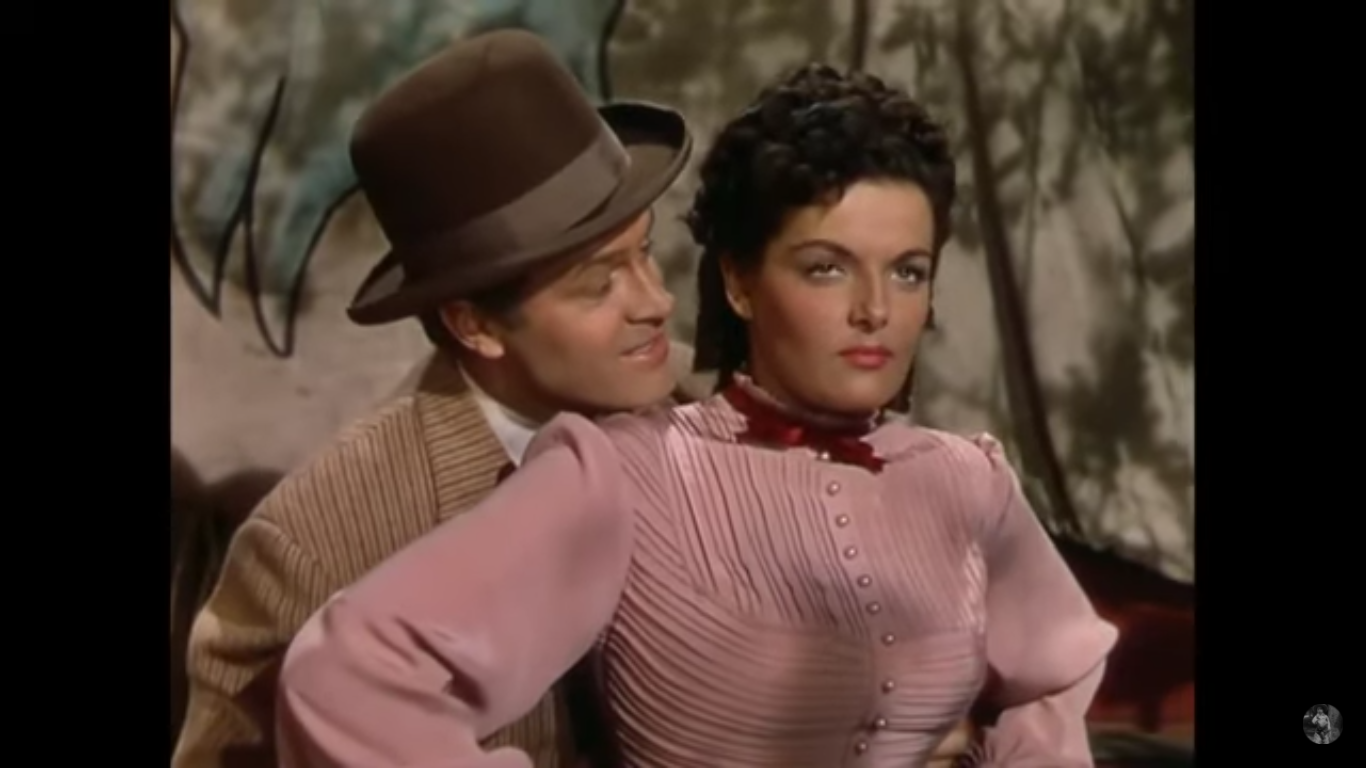
As a kid, I was fond of Frank Tashlin’s Son of Paleface for a myriad of reasons. Thanks to that esteemed institution known as the local library I was well-versed in the Hope & Crosby Road Pictures by an early age and Roy Rogers was probably second-only to Gene Autry as king of the Singing Cowboys. Jane Russell wasn’t too bad herself.

More recently, coming to understand Tashlin himself — his background in animated comedy and his partnership with Jerry Lewis — gives greater context to his place as a creative visionary. Because it’s true he blends the gray area between live-action and the cartoon logic of animation better than almost anyone else.

In an interview with Peter Bogdanovich, Tashlin had these unsavory words for The Paleface and its director:

“After seeing the preview of it, I could’ve shot Norman Z. McLeod. I’d written it as a satire on The Virginian (1929), and it was completely botched. I could’ve killed that guy. And I realized then that I must direct my own stuff.”

While it’s true the original movie doesn’t have the same outrageous commitment to comic gags that its successor did, if Tashlin was not so close to the material, he might be able to appreciate some of its elements.

However, before we go there, it seems necessary to introduce a caveat. The Paleface is a film out of a different era. If you’re an immediate impression of the movie is one of distaste, there aren’t any surprises here. Particularly jolting is when they are taken in by the local Natives to die some gruesome death only to be saved by Hope’s masquerading as a medicine man armed with the black magic of dynamite.

But if you have a sense of nostalgia, can look past the blind spots, or have a reservoir of goodwill toward Bob Hope, it delivers alongside the best of his comedies by providing a genre and allowing him to bend it to his will, courtesy of his usual feckless, smart-aleck shtick.

It works by first introducing all the western tropes Tashlin was mentioning. Russell, the feisty female outlaw, Calamity Jane, is enlisted by the government to investigate clandestine operations supplying the Indians with firearms. She joins a wagon train after outsmarting some adversaries in the ladies’ showers. It allows her to do some recon and she uses a first-class boob as her cover.

Bob Hope (as Painless Potter) is showcased with a row of dentistry gags including his canister of laughing gas, which becomes a recurrent plot point throughout the picture. When he’s not getting them lost in the woods, he knocks back “Buttons and Bows,” a tune that has remained a lasting relic of the movie, thanks to renditions by the likes of Dinah Shore, and its reintroduction in the sequel.

Every kiss he shares with his costar is like a rap over the head with the butt of a pistol. But along with being the aggressor, Russell also does his shooting for him on multiple occasions. In fact, when he is goaded into a shoot-out over the hand of a woman in a saloon, the outcomes prove surprisingly close to The Man Who Shot Liberty Valance (Paleface was released over a decade earlier). Could it be John Ford was influenced by Paleface? I’ll let you be the judge.

As for Norman Z. Macleod, I’m inclined to give him my good graces given his pedigree with Marx Brothers and screwball-like comedies of all sorts. While he might not commit to gravity-defying visual gags as Tashlin would have — we understand how he would be able to expand and punctuate them — Macleod always seems intent on zipping the pace along and keeping the tone zany.

This suits Hope even as Russell and the other characters allow the story to still stay true to many of the western tropes of cowboys, Indians, and western towns needing to be tamed. This melding of the usual beats with the wacky subversions instigated by Hope is the crux of the movie and blended with its color photography and the antagonistic chemistry of its stars, it’s more than enough to garner a watch. My own biased nostalgia still makes me partial to The Son of Paleface.

3.5/5 Stars

Scarlet Empress (1934): Marlene The Great

Screenshot 2020-07-10 at 10.15.53 PM

In the case of his excursions into historical drama, director Joseph Von Sternberg only used the past as a kind of malleable tableau on which to impart his own creative vision. Once more the cornerstone of this vision is Marlene Dietrich, and she is poised to become the greatest monarch of her time: Catherine The Great.

A nice bit of tribute finds Dietrich’s daughter (Maria Riva) portraying Sophia in her youth. Her movie mother’s only desire is to find a fine husband for her to marry to improve the family’s stability. Her father is a far more benevolent figure (C. Aubrey Smith).

Very early on there is the juxtaposition of ghastly torture mechanisms reminding us how dastardly humans can be with their cruel devices. Contrary to this is the sheer opulence and in this regard, The Scarlet Empress is all but unparalleled in its generation of period dramas. Historical accuracy be hanged.

The story continues with pace which is usually a welcomed addition when it comes to the often sluggish genre of period drama. Marlene plays her opening scenes wide-eyed, with a kind of spaced-out innocence. Because she is still a creature of adolescence as she gets sent to Russia as the betrothed of Peter III.

Her husband to be (Sam Jaffe in his debut) is vacuous, head on a swivel with a dopey incredulousness plastered on his face. Meanwhile, her demonstrative Queen Mother (Louise Dresser) remakes the impressionable girl to her liking — with a new name, new clothes, and all the expectations that come with her new station. More than anything else, she is expected to bear a son, an heir to the throne, and this is her primary usefulness. This is her only agency.

It’s almost gluttonous how indulgent the wedding sequence and all the subsequent sequences are in their pomp and regal showmanship. With the nation still dragged down by the Depression, one questions if the common man was taken with the escapism or was nauseated by the sheer extravagance.

While the images are visually splendorous, initially there are far too many title cards interspersed. However, they do begin to make their purpose more evident as the movie never seems to get unnecessarily bloated by dialogue. In some respects, they do set a kind of narrative precedent and use that to create a rhythm throughout the movie. It’s almost more like a silent picture, more concerned with a sweeping overview of a life — the impressions left behind — than honing in on every significant moment.

The sheer scale is staggering in the most extraordinary manner because there is no CGI. Von Sternberg has manicured and incubated this entire consolidated world inside the palace that’s without equal.

Screenshot 2020-07-10 at 9.34.16 PM

The lighting, the ornate touches, gossamer canopies veiling Dietrich’s face in her chamber, and then outside the inner court hosts of ghoulish gargoyles, statuettes, and iconography of the Pantokrator fill the halls. It gives this uneasy sense of orthodoxy mixed with German Expressionism, but Von Sternberg utilizes it well. The Scarlett Empress really does feel like an exhibition for his skills as a wizard of mise en scene and environment. The costuming certainly is another extension of this.

Dietrich doesn’t really come into her own until a good hour and 10 minutes into the movie. From thenceforward there’s no stopping her consolidation of power. With his mother on a sharp decline and then on her deathbed, the king (Jaffe) is ready to marry his mistress and cast his wife out as he makes his long-awaited ascension.

But Catherine is no longer that ignorant girl she once was who merely avoided her gawky husband. She now knows how to play the political game — the kind of nepotism a station like hers relies on, and she readily uses all the means at her disposal.

Her feminine wiles mean she has the army in her skirt pocket bent to her whim. One of her greatest allies and lovers is the dashing rapscallion Count Alexei (John David Lodge). She has a secret passageway in the back of her chambers where she can usher her lovers in and out so they realize they aren’t totally indispensable.

What’s intriguing about the movie is not distinct plot points but growing to understand the textures of the world and how they form and shape the people in their midst. The Scarlet Empress becomes as much about how people look and how they carry themselves as much as anything else.

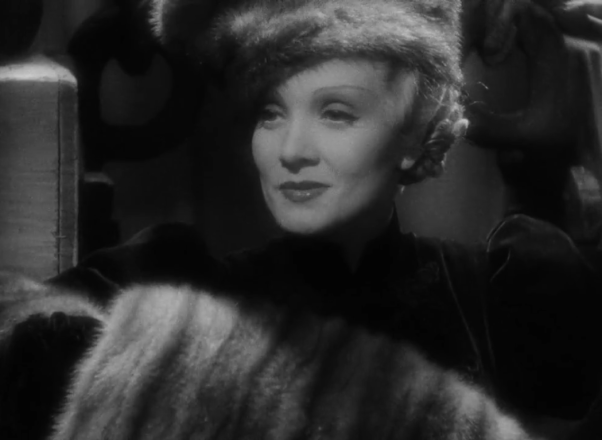
Marlene Dietrich might be altogether unmatched in this department. Purportedly she requested her iconic fur hat to be created especially for her, and it met with some resistance from the costuming department. Whatever the qualms, who could ever doubt her?

She only wears it momentarily. Maybe for a mere scene. Is it too frivolous? Certainly, but as she walks through the chambers inspecting the troops, looking as smart as she ever has, she’s totally inimitable. In that moment, she feels like one of the greatest cinematic royals hands down. Images are powerful. We know that.

It has little to do with policy or even action. All these things come later and that’s why we read our history books. No, here in The Scarlet Empress it’s about posture and presence and all those intangibles making the greats great and all the others merely peons and subsidiaries in the game of life.

Amid the clamoring bells and rapid montage, as she charges up the steps triumphant, flanked by her newfound army, Von Sternberg aids in The Scarlett Empress’s ascension to the epoch and with it the ascension of Marlene Dietrich as a star. It takes someone with true magnetism to fill up such a role promising so much, and she handles it with her usual aplomb. You can’t well forget her. She won’t let you. She embodies the Scarlet Empress. She is Marlene The Great.

4/5 Stars

Dishonored (1931): Marlena Dietrich, The Sultry Spy

Screenshot 2020-07-10 at 7.47.31 PM

The premise is established in broad strokes. It’s 1915 and the remnants of the Austrian empire are caught up in war. This can only have meaning if we see some of the chaos in front of us. In this case, a prostitute lies dead in the street — with a host of onlookers crowded around — a mysterious mustachioed man eavesdropping and poking about. He’s looking for someone, listening to their conversation.

As the people walk through the streets, the sensation of rain sounds almost tinny and fake but this is part of the marvelous illusion. Because this is Joseph Von Sternberg, the famed spinner of bounteous tales offering so much to their audiences in the form of sensations and palpable milieu.

Eventually, the clandestine man — actually the chief of Austrian secret police — settles on a woman, but not just any woman. It is Marlene Dietrich in all her glory. They settle on a romantic rendezvous.

Not only does Dietrich give us so much, as is her habit, but her apartment itself is cluttered with all the sorts of trinkets that allow us to make sense of a person or at the very least appreciate them more fully.

There’s the piano. Sketches up on the walls. The place where she stashes her shoes. The little dancing figurines suspended from the ceiling. The empty bottle of wine. However, more crucial than anything else she proves her own character — she might live a meretricious lifestyle, and yet she’s a staunch loyalist and a war widow. Her allegiances are unmistakable.

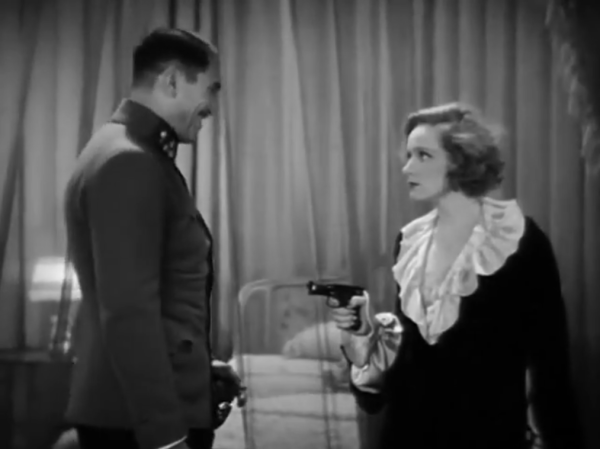
It’s immediately evident Marlene is a woman in a man’s world, but she sure has her pick of the litter. Because everyone is bending over backward to escort her, to be with her, to get to know her. Her new superior is well aware of her assets supplying her a new alias — X-27 — and an assignment of vital importance to her homeland.

There’s a casual nonchalance to her when being propositioned spy work. But this only works if there’s a brazenness in the face of certain danger. She has both in equal measure. It’s true the subject matter plays as surprisingly lithe and modern for Von Sternberg as he casts his muse as a Mata Hari-inspired spy with steely poise and a touch of class. She’s an inscrutable beauty fit to play the game.

What’s lovely is how everything is delivered in between the lines. Heroes. Villains. Friends. Enemies. What’s the difference? For these people, it’s their business and so they find time for romance whatever the scenario might be. There are no hard feelings because the current climate has bred this kind of immediacy. Nothing beyond the here and now can matter. One must make the most of the moment.

Dietrich is brilliant at the masquerade party. It’s our first chance to see her in her new regalia — plumed and sequined, teeth smiling from under her disguise — and she’s only one of a myriad. It’s the most gloriously decadent party I’ve ever seen. You’ll have to see for yourself if it’s hyperbole or not.

However, X-27 has other business to attend to. Her first mark is Warner Oland a high-ranking General who’s also subsequently purported to be a turncoat. She must use the art of seduction to implicate him. But he’s not the only one.

dis

Captain Kranau (Victor MacLagen) was also present at the party and equally taken with the woman’s allure. He’s a Russian Agent playing the same game of cat and mouse she is. In the service, of Ford, MacLagen always felt broadly Irish. Here he seems toned down and well-fitted for the role if only for the fact he hardly tries to upstage Marlene. It’s better not to have Coop. She needs no equal in this picture and it’s true no one can outdo her. This is her story more than anyone else’s.

What more can be said as they joust back and forth globetrotting across borders and meeting under all varying degrees of circumstances? X-27 does her finest impression of a cleaning woman and a kitty cat all in one sequence. He finally has her cornered. We think this spells the end and yet she riggles free. Her wealth of secrets transcribed into music and memorized. She wins another round.

This is what becomes so riveting because the movie is constructed out of these kinds of jocular bits of leisure, but they are a pretense or a visual projection or smokescreen over a very harsh even cutthroat subject matter. He tells her in one interchange, “the more you cheat the more you lie, the more exciting you become.” It’s like a harbinger of Bond decades later.

However, lest anyone misconstrue his intentions, Von Sternberg is vehemently critical of unyielding military protocol. In fact, in a gut-wrenching final scene, it makes a young soldier blubber. He witnesses the utter cruelty of war when it comes to the rule of spy and counter-spy. Still, Marlene takes it with her usual poise — stalwart to the end — and frankly, she’s unforgettable. As she waits out her final days, her last requests are authentic to her character from the beginning. She requests her piano and the black dress she used to wear in her previous life. These are her identity. This is her uniform.

The ultimate irony of the movie is its title. Against the vociferous objects of Von Sternberg, the studio settled on “Dishonored.” But this cut-and-dry analysis of her station in life fails to understand the intent of the entire film. It’s tantamount to saying Sophie Scholl was dishonored in standing up to the Nazis or that the figure of Christ was dishonored for standing up for what he believed in, what he was called to. In X-27’s case, her guiding light was love — even love precipitated in momentary encounters — it can still be a driving source behind any human heart.

We have a fair amount of modern spy movies now anchored by female stars. Their main objective seems to be an exhibition in showing women as powerful entities, capable of kicking butt. This is fine, but sometimes there is no illusion left. No added depth of character. Dietrich is unparalleled, feeling exciting and aloof until the very last frame. We want more of her not less, but she leaves us while she’s still ahead. What a run she had with Von Sternberg, in her third picture following The Blue Angel and Morocco, with still more to come.

It’s less heralded but might just be the best of the lot. It comes quietly and then ambushes you with all its many assets — thoroughly exquisite to look at and also thematically resonate. What’s more, it has a genuine sense of fun and intrigue which isn’t always the easiest combination to come by. Its range of surprises is the kind you relish as a moviegoer. They stay with you.

4.5/5 Stars

Angel (1937): A Mature Lubitsch Love Triangle

For those familiar with Trouble in Paradise, Angel has a  sublime outside-the-window tracking shot in its own right to bring us flush into the world of Parisian soirees. Thusly, we become acquainted with Russian Grand Duchess Anna (Laura Hope Crews), who facilitates meetings between men and women. 

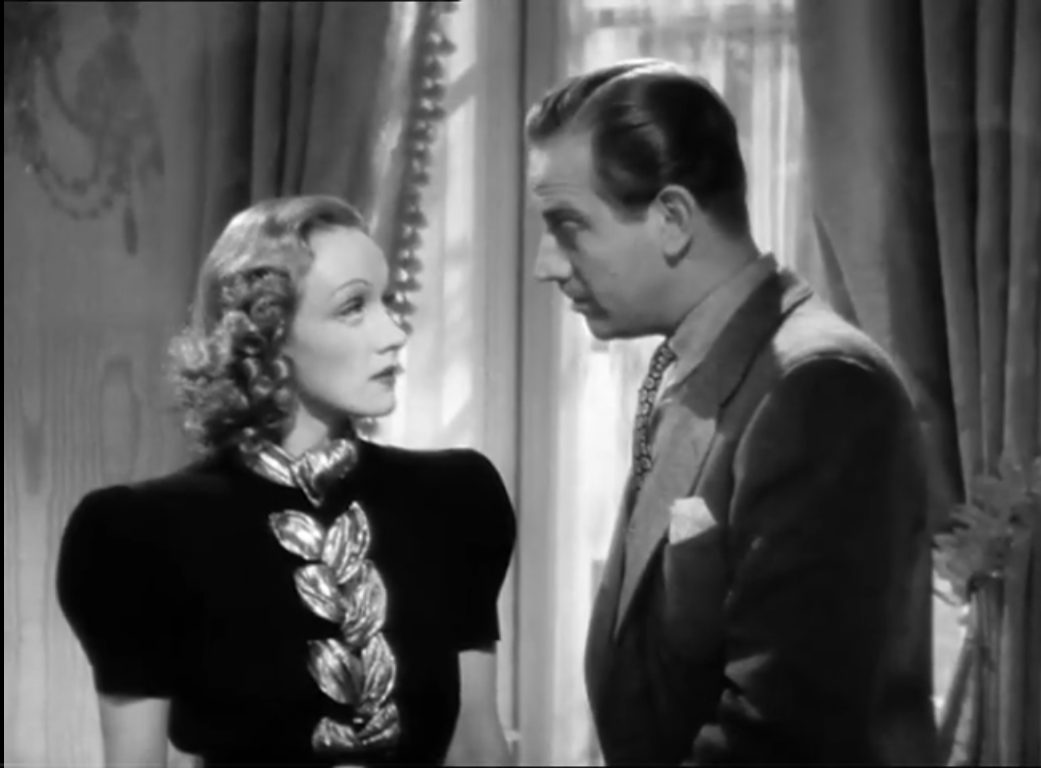
It’s possible to barely catch the subtext here. What’s apparent is by the sheer serendipity of cinema Marlene Dietrich and Melvyn Douglas wind up in a drawing-room together. Dietrich feels particularly laid back. Normally, she’s beautifully aloof; here it’s a bit different because she’s not looking to maintain an aura at all. It makes her all the more genial.

Joseph Von Sternberg always cast and projected Dietrich as a screen goddess. Working with Lubitsch, Dietrich feels like a far more relatable human being albeit a beautiful, refined one. She doesn’t totally overwhelm with her sensuality remaining mostly reserved. 

Tony Halton (Douglas) is in town for the day and is looking for a time. She offers up the Mona Lisa, the Eiffel Tower (that big steel thing sticking up in the air), and Notre Dame. No offense to “The City of Light,” but none of them pique his interest. The lady in front of his eyes is far more incandescent. She’s a bona fide angel.  

It’s true there’s something fresh and appealing about their interaction. They don’t know one another’s names nor does she bother to correct the mistaken identity, and it doesn’t matter. In fact, it even augments what they have because they are so fascinated by one another. It means a dinner invitation and spending the night together. This could be the movie right there. 

Then, Sir Frederick Barker (Herbert Marshall) is shown aboard a screeching steam engine 20 minutes into the picture. We almost forgot about him, and we take a total about-face toward events that remain interrelated. Before we ever meet the man, we learn he must be a gentleman of some renown because he’s all over the papers. 

He is served faithfully by his fastidious manservant (Edward Everett Horton), Graham, who has the ear of a very powerful man. He’s seen his fair share of diplomatic affairs: dinners, white ties, and tailcoats. They make him quick to judge the merits of international diplomats. Because his master is one of the finest, single-handedly standing up to 21 countries in The League of Nations (not including the U.S.). 

Barker returns home late one evening to be reunited with his wife Maria (Dietrich). It’s obvious they have affection for one another — they care deeply about their marriage — but before she fell for another man, there was already a third party in their relationship: his work. 

To grasp at obvious metaphors, there’s a tinge of Casablanca married with a kind of Melvyn Douglas Ninotchka romance and the stuffy propriety of Cluny Brown. Take, for instance, the mélange of servants headlined exquisitely by Horton and Ernest Cossart.

In perfect Lubitschian fashion, a dinner is viewed from the kitchen’s point of view as they perceptively observe two of their dinner guests are out of sorts. They didn’t touch their food. They weren’t hungry. Although it’s never said outright, Lubitsch allows us to put two and two together. One can only surmise it’s due to lovesickness. 

Because there is only one way this movie can get more complicated and more painful. The men must meet. However, far from being antagonistic, they are old friends meeting on a whim. Once upon a time, they shared a French girl all the way back during the war years when they were both still young. Whether they know it or not, they also share another girl: Angel. They have no idea the beehive that’s been kicked. Lubitsch only gives that to us. We are resigned to watching the outcomes. 

The hourglass structure of the movie means we must end where we began. We know time is running out. We are back in Paris, back with the Duchess, and she performs her narrative duties a bit like a maestro. Unwittingly or not, she has all the main players stashed away in different drawing rooms. It’s inevitable that they find each other. The situation calls for it. There is no other possible resolution. 

In the olden days, you have a sense this film would have been lithe and effervescent as only Lubtisch could offer up. Standing before us are all his penchants for drawing rooms, the affluent classes, and their servants. 

But what sets Angel apart is the tone and the profound solemnity Lubitsch often brings to the proceedings. The melancholy of the central love triangle is unmistakable even in the final minutes of the film. In this case, it’s difficult to totally dismiss the extravagance. Still, we’ve come to understand these people, both their passions and their nobility. Because Lubitsch’s films somehow compel me the most when they grab hold of such feelings, where the emotions cut far deeper than the surface ironies. 

As far as Dietrich’s concerned, it might be one of her greatest performances. In the place of ostentatious allure, there stands a quiet dignity comfortable with silence. The whole movie is made in such a mode where these interludes develop the longing. In a quiet encapsulation, husband and wife walk out of the giant estate both together and apart. Their marriage still standing but on the verge of dissolution.  It’s not so much a paradox as it is an indication of the tenuous nature of their lives moving forward.

3.5/5 Stars

One Hour With You (1931): Jeanette MacDonald and Maurice Chevalier

one hour with you

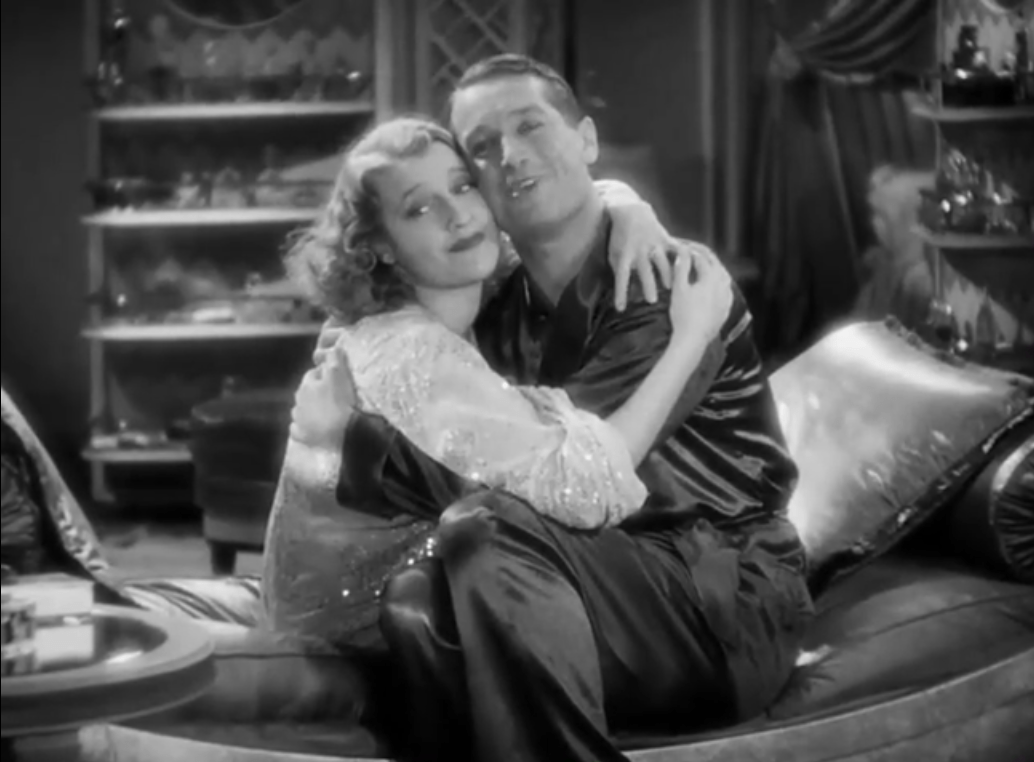
Ah, Spring in Paris! The local gendarmerie is intent on cleaning up the parks of couples canoodling. Among them are Andre Bertier (Maurice Chevalier) and his gal pal Colette (Jeanette MacDonald). But it’s perfectly decent. As they sing, later in bed together, “what a little thing like a wedding ring can do.”

Samson Raphaelson avails himself, having a fine time turning a phrase in all sorts of situations — in a police station or romantic tete-a-tete — it really doesn’t matter, and it serves Lubitsch’s standard suavity wrapped up in the sing-song operetta quite well.

Chevalier offers up his winking monologue to the camera and all the folks sitting out in the audience, providing a theatrical aside borrowed most obviously from the stage. His prevailing charms do not cater to everyone nor does his style of balladeering, but there’s no denying he carved out a niche for himself in the 20s and 30s as one of the most romantic swoons of his generation. Whether that had more to do with his coveted Europeanness or something else…

This story is built out of a taxi ride. Andre happens to hop into the cab with a person of the opposite sex named Mitzi (Genevieve Tobin). The possibilities are endless. It’s the fact that they totally dissect the situation, insinuate and flutter their eyes at one another, taking a banal scenario, and instantly giving it romantic tension. In fact, just about every scene informs a world full of sensual suggestions and connotations.

He abruptly ditches the taxi on the verge of a kiss and infidelity, though the damage is already done. No one will ever believe them to be perfectly innocent, and they’ve conveniently created a comic drama for themselves out of nothing. It almost blows up between them, and they are as good as guilty.

This would all mean nothing, if not for the subsequent scene. Colette is reunited with her best friend: Mitzi! They share all the usual chatter, fawning over wardrobes and shared memories. Imagine the devoted husband’s shock when the woman in the taxi and his wife’s best pal are one and the same! We have a real story on our hands and Lubitsch knows precisely how to work it.

Take another scene where Mitzi feigns illness to get the doctor alone with her. Mitzi’s own husband (Roland Young) walks in on a doctor’s visit. It’s all perfectly innocent (as it always is). They trade pleasantries. One’s a doctor, the other a professor — ancient history. It’s an emphatic punchline hanging in the air.

There’s also a glamorous party put on by the Bertiers. All their friends will be there sitting at a table together in a very public environment. A round of name card roulette takes place between husband and wife with diabolical consequences — romantic speaking of course. Colette is trying to protect her man from the wrong woman even as she rebuffs the blundering advances of a madly infatuated socialite (Charlie Ruggles).

Genevieve Tobin remains out on the prowl for Chevalier. It doesn’t much matter what she’s does; it’s how she does it. This is the secret of most of the characters in this movie. It’s the power of inference.

When she musses up his bowtie, he doesn’t know how to remedy the situation (because he can’t tie a bowtie). Going back inside is tantamount to social suicide — people will talk — but if he follows the beguiling harpy into the garden, who knows what fate will befall him. He’s a prisoner on his own veranda! This is the movie’s persistent predicament in a nutshell.

However, there must be a caveat in any discussion of One Our With You. His name is George Cukor, and he was actually the original director of the picture, although he eventually relinquished his duties to Lubitsch.

With complicated productions such as this one, considering where one director begins and the other ends is always an intriguing conundrum. Take, for example, something like Come and Get It from a few years later, directed by Howard Hawks and William Wyler at different points. One doesn’t often confuse their filmographies but shot to shot it’s not exactly easy to ascertain the difference aside from some intuitive observations.

There are moments of cloying cattiness, particularly between the female characters and at the grand party that we might find down the road in a picture like The Women, but we never quite broach that territory completely. Because ultimately, it’s the overarching sensibilities and the shepherding of the comedy by Lubitsch leaving their mark. It certainly makes for another fine exemplar of his work during the period.

My main qualm is the squandering of its supporting cast. Between the likes of Tobin, Ruggles, and Roland, there are some real personalities, and opposite our stars, they do yeoman’s work in a handful of scenes. However, it does feel like they drop off and disappear rather conveniently. Their arcs never coil up in a sufficient manner — in a way we can appreciate — and they probably deserve a few more minutes of satisfying resolution.

However, Lubitsch is not concerned with a more raucous screwball crescendo. Thus, the ending just about wins it for me, partially because for once MacDonald is in on the gag, and it doesn’t feel like the Chevalier show. They’re in this kissing comedy together, beginning to end, singing to their little hearts’ content. If you like it, you like it…anywhere.

3.5/5 Stars

Broken Lullaby (1931) and The 5th Commandment

broken lullaby

It intrigues me that this fascinating outlier in Ernst Lubitsch oeuvre, once upon a time was released as The Fifth Commandment. For those keeping count, it’s the one in the Catholic faith that says thou shall not kill or rather thou shall not murder. But already you might see the semantic ambiguities at play in the translation. In modern English, murder and killing can maintain different definitions. Often you only need to look at a human conscience to deduct the difference. This is integral to the movie’s core dramatic question.

However, we must first unveil the scene, introduced as only Lubitsch could envision it. It’s now the first anniversary of armistice: November 11, 1919. It becomes a montage of perceptive comic juxtapositions — with small-town jingoism in full-force — parades, bells ringing, and cannon shots booming right outside a hospital. No one seems to heed the sign calling for silence while the shell-shocked vets remain terrified by the living nightmare.

Then, inside a grand cathedral, the minister extolls peace in the wake of such carnage. Thinking better of it, Lubitsch focuses on the sabers of all the military men as they sit listening in the pews, weighed down by their many war medals — no doubt won in battles. The camera focuses on the crucifix hanging on the wall as “bombs burst in air.” These are all incongruous pictures if we want to make any sense of war.

With the stirring homily done, the pews clear out in a flurry and only one man is left prostrate in the pew. He comes up to the religious man seeking absolution. In a former life, he was a first violinist, now he wishes to confess to a “murder.” It registers a response of repugnance until the minster finds out it was out on the battlefield. He is freed from any crime having done nothing but his duty.

For this man, Paul Renard (Phillips Holmes), it’s some small recompense for the tribulation of his soul moaning out on his behalf — on behalf of the man he killed — because surely this is not the way men were supposed to live with one another.

In all earnestness he yells out, “I came to find peace and you haven’t given it to me.” He gets chastised, has his absolution read, and feels little better for it. Again, his heart still aches with guilt. His head goes aloft to the portrait of the Pietta — she lost her son — and she forgave the murderers…

It’s the germination of an idea: a mission of mercy and a personal pilgrimage. Paul must go to the homeland of the man he murdered and see his parents — to call upon their mercies — and assuage his wounded conscience. Holmes is a bit of an exaggerated talent but his zombie-like despondency allows him to function rather well in the shell-shocked part.

It’s apparent from the opening interludes a kind of pre-world war II chivalry and romanticism still exists between the Teutonic and Gallic traditions because they have yet to experience the full thrust of the radicalized regime of Hitler.

This doesn’t mean war is logical and totally naïve. Far from it. There’s a prescience in the following line from Raphaelson’s script: “9 million people got slaughtered and they’re already talking about another war and the next there will be 19 million and the world calls that sane.”

broken lullaby

Broken Lullaby simultaneously becomes an impeccable exercise in how Lubitsch is able to take the material from Samson Raphaelson — their first of many collaborations together — and in some integral way, shape it to his will. Continually the dramatic irony can be cut with a knife, and so in specific scenes, you don’t need much more aside from the knowledge. Lubitsch does the rest and uses that to benefit his audience.

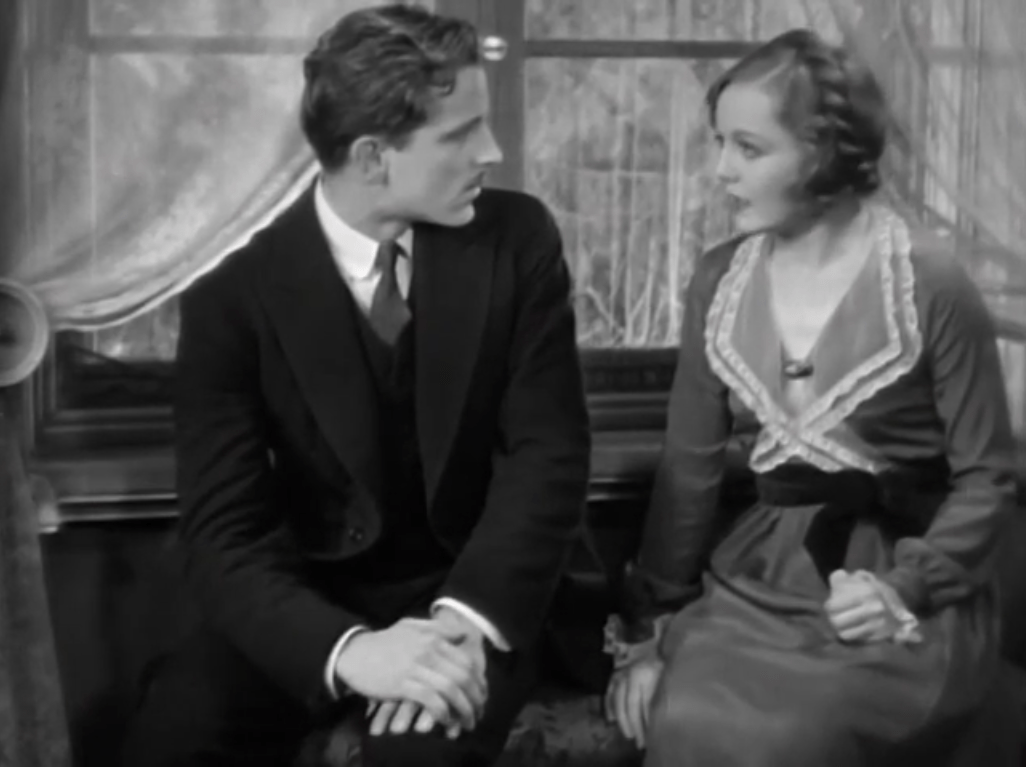
Because Renard makes his journey — dutifully visits the grave of the man he killed. War mothers often come to visit and on this day the dead man’s fiancée: Elsa (Nancy Carroll). He flees the scene like a frightened deer, but his mission is clear. He visits Dr. H. Holderlin (Lionel Barrymore); he is the father who lost his boy in the war. We know what must come next.

Lubitsch doesn’t make it easy — it detonates in our faces — wrenches the knife into our emotional hearts and forces us to continue on the dramatic arc. Even as Paul is eventually brought into the Holderlin family, he grasps at illusions to make them happy — in an attempt to not totally trample the fond memories of their son from when he was alive. Because he only knew the man in the pitiful trenches of war on the edge of death. It’s not a nice type of place to keep people within your memories.

Likewise, the town is a textbook Lubitschian environ of Europe through the lens of Hollywoodland. It’s the old world spritzed with the touches of the movies. It’s a magical land where the discrepancy of language and culture fall to the wayside in deference to emotional truth and visual elegance. Where Zasu Pitts showing up as a housemaid hardly feels anachronistic or out of the ordinary.

It also plays like a precursor to To Be or Not to Bes lucid commentary overlapping with the quaint familiarity of The Shop Around the Corner. There are many such establishments in a place like this. Perfect for blissful love to come into bloom. Because it’s true Paul and Elsa take a shine to one another — they share a naïve benevolence as they try and pick up the pieces in the shadow of war.

They also turn all the heads and ring all the bells in the town as they walk by together arm-in-arm. In this regard, any sense of realism or authenticity is made superfluous. This is a film made out of its emotional impressions more than anything else.

Meanwhile, Elsa’s scorned suitor drums up conspiracy about the foreigner with his brood of beer drinkers at the local Hofbrau. A newfound absurdity is born as they secretly contest the content of his locked violin case. Surely, it holds something far more nefarious than a musical instrument.

Finally, the good doctor is shocked out of any former strains of narrow-mindedness. He sees it spewed back at him, and it repulses his sensibilities. Barrymore stares down the gauntlet at all the men affronted by his house guest, and he lets them know promptly his wife likes him, Elsa likes him, and he loves him. It’s such a courageous pronouncement in such company.

He says, “No one can tell me the meaning of death or the meaning of hatred. I’ve drunk deep of both of them.” In some form, he’s beginning to understand the world anew much like Paul before him. Fathers drinks to the death of sons (on the other side). Some drink beer and others wine. It’s no different, and they all propagate the system of patriotic butchering. It’s insanity.

Broken Lullaby does what a majority of movies try to accomplish with any amount of dialogue and plot points. Lubitsch doesn’t need them. Instead, we get an impression. Paul is able to take up his original calling once more — that of a violinist — and he is joined on piano by Elsa. The parents look on in a contented reverie. Before us is the reconciliation of residual hurt leftover from an entire war allayed by two melodies joined together in perfect harmony.

We must stand corrected. The Broken Lullaby is the right title for the picture. It might be difficult to categorize for movie pundits, but this is of negligible importance here. What remains are the reactions. In turns, it’s moving and it’s excruciating. I was made totally distraught, and yet the salve is finer still.

Life, even today, is won in no man’s land where no one wants to go. Still, I am reminded of even a monumental moment of harmony like the famed Christmas day ceasefire in 1914. I’d like to believe restoration is possible. Lubitsch seems to suggest as much and he does so quite elegantly. I’d expect nothing less.

4/5 Stars