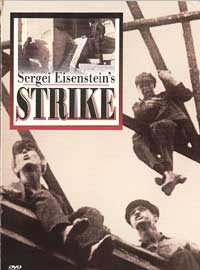
Strike (1925)

Strike_(film)Strike deserves a place alongside Battleship Potemkin and Man with a Movie Camera in a trifecta of films from the Soviet Union that while reflecting political agendas most certainly influenced film as a medium. Honestly, it’s a film that’s hard to pin down exactly. It’s the debut of a man named Sergei Eisenstein, who at this point had very little experience, although he would gain renown in later years. It’s a film to glorify the state that commissioned it by depicting events before the state was ever founded. Is this a comedy, solely propaganda, or a social drama?

It’s a film commenced with a quote by Lenin and broken into sections like, Reason to strike, The strike draws out, and Extermination. And yet words or plot summary is not enough, especially with a filmmaker like Eisenstein. How do you describe the impact of a man hanging himself? How do you explain the hordes of people fleeing the police? Wives and children suffering without food and provision, because the men of the house are striking. It’s a mass protest certainly, but when you break it down to the individuals, that’s where you begin to see the real pain.

Maybe I’m forgetting something, but I’d almost rather watch Strike than Eisenstein’s undisputed masterpiece Battleship Potemkin. In some ways, I found this strike and uprising more exciting and vibrant. In itself, the Odessa Steps is an amazing sequence and literally textbook stuff, but this film feels more fun thanks to a lighter initial tone. The common men are throwing the baddies out of town. There are spies with the greatest code names, pocket watch cameras, and antagonists who are great big caricatures.

Instead of feet on steps, it’s hands with fire hoses that become the focal point of the retribution. By the end, it feels like we’ve been manipulated by a wicked sense of humor. We have slowly been descending deeper and deeper into chaos. People running. A cow getting slaughtered. Carnage. Eisenstein effectively plays with the emotions and it’s not without impact. Although the last chapter is somber, Strike feels very accessible for a silent film. There’s a lot to be seen here and like Man with a Movie Camera or Battleship Potemkin, it’s much more than propaganda. I’m not communist and the ways of Lenin and Stalin have generally gone out of fashion as far as I know. However, the work of Eisenstein has remained pertinent, and his inventiveness and investment in the film-making craft are immense. At a basic level, he knows how to elicit emotions persuasively and that is a powerful aspect of film.

4/5 Stars
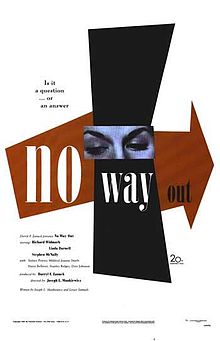
No Way Out (1950)

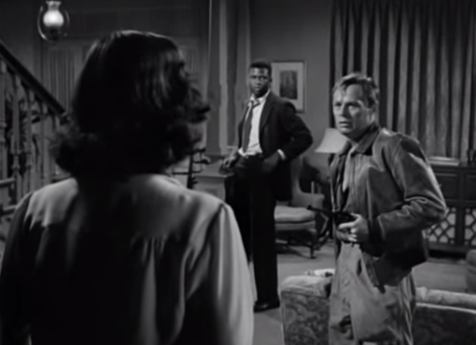
220px-No_Way_Out_(1950_film)_posterI had a preconceived notion that No Way Out might be the kind of social drama that was groundbreaking for its day and by today’s standards looks mundane and quaint. 65 years have passed and this film from Joseph L. Mankiewicz still packs a wallop, believe it or not. We are blessed with the first major role for screen icon Sidney Poitier as young doctor Luther Brooks. His main antagonist is Richard Widmark playing a racist scumbag like he does best, and Linda Darnell also gives a key performance, although her career would soon be on the decline.

The film opens with the young interning doctor — Poitier was only 22 at the time –getting ready for a night shift. His first customers just happen to be Johnny and Ray Biddle, who both got it in the leg after a botched robbery attempt. At first glance, their wounds look superficial, but Luther notices Johnny is disoriented. His diagnosis is a brain tumor so he tries to administer a spinal tap which ends up unsuccessful, partially due to Ray’s constant berating. But Ray has no sympathy; all he knows is that this black doctor has killed his brother. A white doctor could have saved him and all his prejudiced beliefs of blacks are confirmed. At least that’s what he tells himself in his narrow little mind.  Luther even goes to his superior Dr. Wharton (Stephen McNally), and although he cannot be absolutely certain, he maintains confidence in Luther’s competence.

nowayout1Again that bears little importance to Ray and he will not grant them the opportunity to do an autopsy. After all, his mind is already made up. So the next best thing is to track down Johnny’s former wife Edie (Darnell), who has pulled herself out of the gutter which is Beaver Canal and made a modest living for herself. They want her help, and unbeknownst to them, she does go see Ray. You can see it in how they interact with each other. She was Johnny’s wife once, but there was something between them and Ray won’t let her forget it. That’s undoubtedly why she wanted to get away, but Ray brings out the worst in her. Even as they speak, her racist sentiments come bubbling to the surface. It’s in her veins after all. It doesn’t help that unrest is building in the city. A riot is at hand and the slow build-up leading to the imminent rumble is boiling with tension. Mankiewicz does something important here. He shows both perspectives. I cannot help but think some things have not changed a whole lot over the years. Black vs. white. The same racism. The same belligerence. The same lack of understanding.

nowayout2Of course, after that is all done, that still does not wrap things up with Ray. He still has to settle a score with Luther and he uses Edie against her will. They set a trap at the home of Dr. Wharton for the unsuspecting Luther, and this scene has vital importance to the film, not simply because Biddle and Brooks come face to face once more. This is the scene where Edie must make a choice. Really it’s the universal choice. Stand passively by as injustice is being done or take a stand against it.

So you can make your own diagnosis, but this was not a superficial message movie. It hits fairly hard. I was even surprised by how often Ray Biddle lets the N-word fly. It completely fit Widmark’s characterization, but the production codes allowed it. Supposedly the actor apologized profusely after many of his scenes with Poitier, but his performance is nevertheless potent. It’s certainly convicting and we cannot be too quick to find fault with any of these characters because, truth be told, we all have some apathy and narrow-mindedness stuck inside our skulls. No Way Out is a striking reminder of that.

4/5 Stars

Three Days of the Condor (1975)

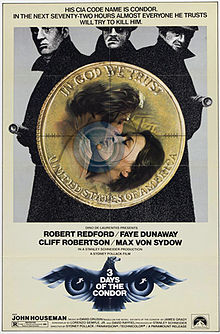
Three_Days_of_the_Condor_posterIn the wake of Watergate, the 1970s saw the advent of many political thrillers with arguably the granddaddy of them all being All The President’s Men. Three Days of the Condor is another film that finds Robert Redford trying to get to the bottom of a web involving politics and intrigue. However, this film reminds me a great deal of The Parallax View which came out a couple years earlier. Similarly, this film has probably its most startling moments during its opening sequence and slowly unwinds after that into a thriller full of paranoia and uncertainty.

Sidney Pollack’s film kicks into high gear abruptly as all “Condor’s” colleagues at a CIA-backed literature research post are gunned down by unknown professional hit men. Joe Turner (Robert Redford) was literally out to lunch picking up sandwich orders, and he returns to find his colleagues dead. From that point on begins his life of constant fear, because he cannot know who is with him and who is against him. He can trust no one.

While taking a moments respite, Turner notices a patron named Kathy Hale who is about to meet her boyfriend on the slopes, and he follows her and holds her hostage so he can have a place to stay. It’s supposed to be a matter of chance, but I mean, it is Faye Dunaway so it cannot be that random right? No matter, she’s initially deathly afraid of him, and he does not give her any relief holding her at gunpoint and tying her up. They’re both afraid.

But whether it’s some form of Stockholm syndrome or the fact that she actually believes his predicament, Kathy agrees to help him, and they have the obligatory lovemaking session inter-cut with the stark pictures on her wall.

What happens after this is sometimes difficult to track with as Redford’s character begins his search for a government agent named Higgins, avoiding hit men, while trying to understand who is even after him. Why do they want him? He’s just a lowly bookworm with one cockamamie theory about the odd languages a certain thriller has been translated in.

This one idea has got him caught up in something much bigger than he can ever know involving a hired mercenary named Joubert, CIA Deputy of Operations Leonard Atwood, and oil! That’s what it was all about. That’s why 7 people died and Turner can do barely anything about it. After all, who will print his story? Who will believe him? That’s is the country and the era he lives in after all.

Redford gives an admirable performance, and I personally prefer him to Warren Beatty any day. Dunaway walked a weird line between being demure and submissive, while also dishing out some sass every once and a while. It made her character feel uneven in a sense and she came to like Turner rather abruptly. Then again it was Robert Redford.

All in all, this film’s plotting seems utterly ludicrous to me now, and it becomes more and more ambiguous by the end. It feels hardly like a conclusion at all, much like the Parallax View. And much like the other film I can understand how this story could really strike a cord, especially after Watergate, when so much governmental corruption seemed possible. The sky was the limit and so Three Days of the Condor was perhaps not as far-fetched as it initially appeared. That’s a scary thought indeed.

3.5/5 Stars

The Battle of Algiers (1966)

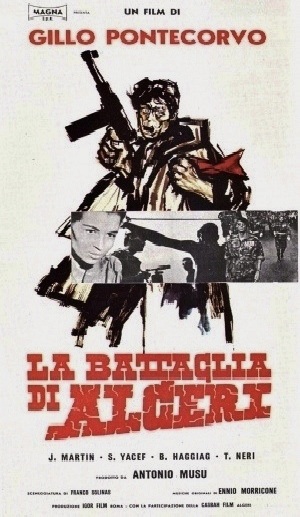
The_Battle_of_Algiers_posterBeing rather oblivious to the relations between France and Algeria as well as the battle of Algiers, this documentary-style film proved to be an enlightening and thoroughly engaging historical exercise. I certainly cannot corroborate all the facts, but the reality is, The Battle of Algiers is one of the most well-paced films that I have ever seen coming out of Europe. There is a great deal of drama, harrowing intensity, and it all brings up numerous political questions that parallel the world we live in even to this day.

It’s the story of 1950s Algeria and specifically the Casbah Muslim district of the city. It is there between 1954 to 1957 that the National Liberation Front waged war against their perceived oppressors from France. And they certainly had a point that imperialism has left an indelible mark on them. However, their own strategies include bombings and assassination that utilize civilians and people loyal to the front. You don’t know when the next attack will come, and they sweep across the land like wildfire. The leaders of the FLN include the fiery Ali la Pointe and El-hadi Jafar, who recruited la Pointe early on. A Lieutenant Colonel named Mathieu is brought in to bring down the enemy, but it proves to be a difficult task since the FLN, much like a tapeworm, will never die until the head is destroyed. Otherwise, it’s extremities will keep rebuilding in the form of loyal underlings.

The film is rather shocking in its straightforward depiction of violence, whether it be bombed buildings, gunfights in the streets, or French authorities being gunned down by insurgents. Somehow these images feel still very relevant to the contemporary age. You have the imperialists clashing horns with the locals. There’s racial profiling. Women and children are involved in the violence just as much as anyone else, and destruction pervades the public squares. There is no refuge from bomb or evil. Anyone coming around a corner could be carrying a bomb or looking to shoot you when you least expect it. Really it is amazing that a film like this was even made, and it was undoubtedly a lightning rod for controversy.

In the film’s epilogue, the unrest continues and it is finally noted that Algeria did eventually receive their independence. The French may have won the battle, but they ultimately lost the war. The audience is left to develop their own opinions about this conclusion. As for me, I find Gillo Pontecorvo’s film fascinating, because he takes a point of view that does not seem especially biased. This is not noticeably propaganda in its depiction, but instead, it is a thought-provoking document of civil unrest developing questions on war and race relations. Maybe we can even learn something from it as well in this modern age that still includes so much human conflict.

5/5 Stars

The Revenge of the Sith (2005)

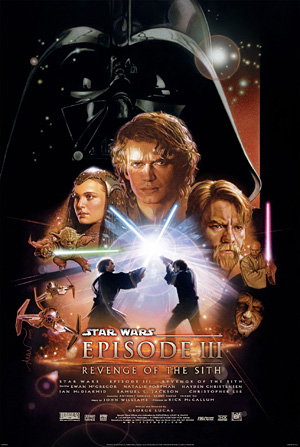
Star_Wars_Episode_III_Revenge_of_the_Sith_posterRevenge of the Sith was the film that all Star Wars fans were looking forward to. For the younger generations, it meant the closure of the trilogy we had grown up with. For older fans, it meant that the Star Wars saga might finally be complete in some sense of the word. All movies linked together in this crucial last piece that smoothed out any last ambiguities about how Anakin Skywalker evolved into the feared Darth Vader.

It was a pretty big deal because it would either close the series on a controversially sour note or with the type of visceral storytelling George Lucas inundated us with in the 1970s. This certainly is no Empire Strikes Back (the darkest film of the original saga as many know), but it was probably the most enjoyable installment of the new trilogy and that is the most genuine of statements. As pure fans we liked it, and it was a worthy installment full of action as well as personal conflict.

Is it even necessary to go over the plot of Star Wars? Before anyone answers, I will give a recap more for my own sake than anything else. The Clone Wars are still being waged against the Separatists and the tides are slowly turning. Anakin is now even more renowned as he continues to team up with his Jedi Master and mentor Obi-Wan. But Revenge of the Sith quickly turns into a story of inner turmoil and political unrest with young Skywalker caught in the middle.

He is secretly married to Padme, taken under the wing of Chancellor Palpatine and then called on by the Jedi Council to spy on the Chancellor. It’s a web of confusion, anger, and fear going way back to his mother’s death, visions of his wife dying and perhaps his unfortunate nickname “Ani” leading to masculinity issues. Anyways, that is the situation that he finds himself and ultimately Palpatine (as we always guessed was Darth Sidious) poisons Anakin, who slowly turns against his friends and the Jedi Council.

Although we always knew this moment was coming, it is still so satisfying and painful to see it play out. It leads to some sad deaths (ie. Mace Windu) and some of the most epic lightsaber battles, going so far as to pit friend vs. friend against the backdrop of lava and John Williams’ score.

It is very hard not to appreciate this moment in the narrative where we finally see how the Empire came into being. How Anakin became Vader. How Luke and Leia were split up and how Obi-Wan became a hermit in order to protect the boy. As far as the films go, the original trilogy will undoubtedly remain the favorites, but that does not take away from the entertainment and emotional energy of this film.

Sith take Revenge and Jedi simply Return to put things right. Now I have to go back and watch the original films because I would not mind a happy ending about now. The beauty is that the bleak conclusion of this film is not the end of the story. Thank goodness we still have Yoda.

4/5 Stars

Selma (2014)

Selma_posterMartin Luther King’s legacy will always be the “I Have a Dream” Speech. It’s a crowning moment in history with iconic images and soaring rhetoric. But Doctor King was far more than that. He was a minister, a social activist, and a champion of equality, justice, and peace. Selma is the film his story deserves, taking a magnifying glass to the events surrounding the 1965 march from Selma to Montgomery, Alabama which led President Lyndon B. Johnson to pass the Voting Rights Act of 1965.

So much had already happened. We had Rosa Parks, Sit-ins, Freedom Riders, Malcolm X, the march on Washington, the assassination of President Kennedy and of course the Civil Rights Act of 1964. In the upcoming years, there would be the further escalation of the war in Vietnam, riots in Watts, The Black Panther Party and the assassinations of both Robert Kennedy and Dr. King in 1968. The social unrest was far from over, just like it is not over now. That’s part of what makes Selma so poignant because it is certainly a necessary historical reminder and its relevance remains evident today.

Honestly, the film at times felt rough around the edges and not always the most aesthetically pleasing. For lack of a better word, it felt choppy. That was only a personal observation and not something to get too hung up on though. After all, at its core, Selma is about the characters and the moment of history they were living in. There were some spectacular performances starting with Englishman David Oyelowo as Doctor King himself. He exudes the quiet strength and displays the deliberate but powerful voice that made King the champion of all that was good and right. He is not a perfect man or perfect husband, but he was a man of God who remained true to his convictions and his friends and family.

Ever since I did some reading up on him, LBJ has always been a fascinating character to me, because he was the ultimate politician who was able to accomplish so much and yet he will always have a tarnished legacy due to Vietnam. He is played impeccably by Tom Wilkinson with the imposing figure, southern drawl, and strong will all there. LBJ is at odds with King on occasion and in him you can see a man with a job that no person would desire, trying to make political decisions that no one would want to. Somehow, through it all, the Voting Rights Act was still passed. Then, of course, you have other players like the living legend and present congressman John Lewis as well as Southern Governor and primary villain George Wallace, who seemingly turned his life around in his later years.

Even down to the smallest roles, Selma has power. We begin to see depictions of real-life individuals who lived in a world of fear and disempowerment. Where southern whites ruled with their racist ways and blacks looked for a much-needed answer to the death and suffering. Doctor King was able to lead the movement and yet he had help from friends and the common man as well — black and white. It is interesting how many of the figures who ultimately answered King’s stirring call to action were often pastors, priests, and other clergymen. It’s as if they realized that this was not just a race issue, it was a moral issue, an issue of justice, and ultimately a personal conviction. How could they live hypocritical lives of the status quo while so much was left to be healed in the South? We could ask the same questions of our society now.

The film interestingly enough led many songs to float through my head. There’s Sam Cooke’s “A Change is Gonna Come.” Bob Dylan’s “Only a Pawn in Their Game.” Dion’s “Abraham, Martin, John” and Barry Maguire’s “Eve of Destruction” to name a few fitting tunes.  For that matter, even the award winning anthem “Glory” could have been played during the film and that would have made sense. And yet Selma finds its sound in more traditional tunes that lend a true authenticity to the story that is surprisingly effective.

To say that Selma really resonated is a given. The images of force and brutality, bitter prejudice, billy clubs, and tear gas are still disturbing. They should be and they should never fail to outrage us. But I think there were several times where I was really struck with the weight of all of this. The first being when King kneeled down to pray and all the masses joined him. Such a display was so visceral and moving. Also, the archive footage showing the final march was a cheering reminder that equality and change by peaceful means are possible. Dr. Martin Luther King sadly did not make it to the Promise Land, but he led the United States and his people ever closer. For that, we all owe him an incredible debt of gratitude and for that very reason, we must never forget Selma.

4.5/5 Stars

Paths of Glory (1957)

87e30-pathsofgloryposterStarring Kirk Douglas and directed by Stanley Kubrick, this war film with a twist follows a French Colonel Dax (Kirk Douglas) and his men during World War I. He is ordered to take part in a suicide mission by a general and everything soon goes awry. After they unsuccessfully go through with the mission , three of Dax’s men find themselves being court martialed as examples for supposed cowardliness. Despite a defense by Dax in court, the three men are found guilty and later executed by firing squad. This and other events cause Dax to openly question the decisions of his superiors. In a very touching final scene there seems to be a questioning of the inhumanity of war. In one of his earlier films Kubrick delivers a poignant piece.
 
4/5 Stars

Mr. Smith Goes to Washington (1939)

84a24-mrsmithgoestowashingtonposterAs both a political drama and feel good movie, this film cemented James Stewart as an acting powerhouse. Furthermore, despite its age, it acts as a timeless reminder of the evils of political machines. It makes us root for the underdog, and it is distinctively American. Here is a cast and a story that seemingly could never be equaled, but what this film really had going for it was an idealistic outlook. I can, myself, often be a cynical person, and still Mr. Smith never fails to make me acknowledge the numerous attributes that make our country great, whether it is through montage, monuments, music, and of course Jefferson Smith himself. 

In one of his best performances, Jimmy Stewart is an idealistic, naive boy’s troop leader named Jefferson Smith. The starry-eyed Smith trusts that our nation is founded on some very noble principles that should be fought for tirelessly in government and in society. Above all, he is a likable fellow, who earnestly believes in the merits of this country, and he is beloved by boys all across the state. Now, this all sounds fine and dandy, but it would never have come across on the screen if it had not been for Stewart. He emanates this awkward and innocent energy that puts life into the idealistic creation of Jefferson Smith. 

When the film opens, everything is in turmoil when a senator suddenly dies and a replacement is needed fast. Believing Smith will be a pawn, a powerful man named Taylor (Ed Arnold) gets Smith a seat in the nation’s Senate. There he joins the respected Senator and old family acquaintance, Joe Paine (Claude Rains), who is also a cog in Taylor’s machine. However, although he is out of place in Washington, the patriotic Smith does his best to be worthy of his position. He realizes that the press will not give him a break, and the other Senators do not take him seriously.

So, on the urging of Paine, he decides to come up with a bill for a boys camp back in his home state. He requires the help of the world-weary secretary Saunders (Jean Arthur) to get his bill done. Initially, she is disgusted by his naivete, but as she grows to know him, she realizes he is only going to get himself hurt. His action to propose a bill soon find him face to face with the political machine that elected him. Taylor also has stakes on the piece of land where the boy’s camp would be, and he wants it for a dam. 

Smith finds himself being accused of using his position for his personal gain, and pretty soon he is before a committee with false evidence piling up against him. With all odds and seemingly everyone else against him as well, Smith makes one last monumental effort. Thanks to the help and guidance of Saunders, Smith fights to plead his case through a filibuster.

Fatigued by many hours of giving impassioned speeches and reciting the Constitution, Smith finally collapses, but not before effectively succeeding at his task. I doubt this would ever happen in real life, but in the film, it is fantastic watching the Senate break out into complete and utter mayhem. Ultimately, a young man with “a little bit of plain, ordinary, everyday kindness and a little looking out for the other fella,” was able to win. True, it may be overly sentimental, but it is a wonderful piece of sentiment all the same.

Frank Capra was wonderful at these type of cheering tales and his stars were in top form. There is an absolutely wonderful supporting cast here including Claude Rains, Edward Arnold, Eugene Pallette Thomas Mitchell, Charles Lane, Harry Carey, William Demarest, Beulah Bondi, and numerous other familiar faces I don’t even know the names of. That’s the beauty of the studio system I guess. It may have the same director, same leading man, and some of the same general themes, but Mr. Smith Goes to Washington covers completely different territory from Capra’s later classic It’s a Wonderful Life. Mr. Smith should be seen as a unique, and very much American film.


5/5 Stars