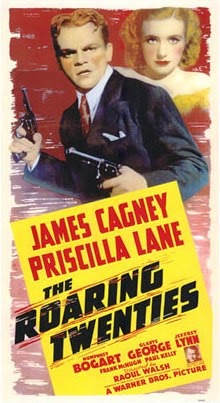
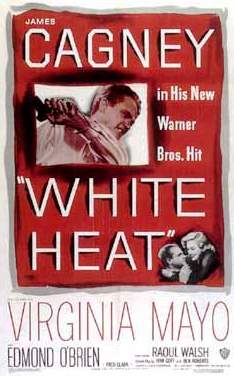
They Drive by Night is a surprisingly engrossing picture and I only mention it for its obvious relation to High Sierra. It came out a year earlier, helmed by Raoul Walsh starring George Raft, Ann Sheridan, Ida Lupino and, of course, Humphrey Bogart. The important fact is that if Walsh had gotten his way, he would have cast Raft again as Hollywood’s perennial tough-guy leading man.
But Bogart saw what this film, based on the work of W.R. Burnett, could do for him and he talked Raft out of the part while lobbying Walsh for the role. Reluctantly the director agreed and as it turned out it was the perfect vehicle for Bogart’s big break as he had foreseen.
High Sierra functions as a crossroads of sorts between America’s standard genres. There’s no question that Roy Earle is a gangster in the former sense of the word. And even as an actor Bogart was used to playing second fiddle to the likes of the Cagneys, Rafts, and Robinsons. But if there was ever a poster boy for the emerging film-noir movement Bogart is the shining example carrying that tough as nails persona from gangster films but also functioning as a fatalistic antihero in the same sense. We see it with Spade, Marlowe, and all the rest. Also, as an early heist drama, High Sierra ushers in a trend that would be explored further in films like The Asphalt Jungle, Kansas City Confidential, and The Killing (notably all gritty cogs in the film-noir canon).
To understand what Bogart saw in this picture and to comprehend what a lynchpin it was, it’s necessary to delve into the story itself penned by Burnett and Bogart’s long time future collaborator John Huston.
Veteran gangster Roy Earle (Bogart) has just earned a government pardon with a little help from a powerful friend. It’s this aged gangster from the old days Big Mac who pays his loyal henchman a favor so he can run point on a new bank job. Big Mac is on his deathbed and the changing of the guards seems all too imminent, still, Earle is beholden to him. He’s a loyal son of a gun and tough as all get out. He’s not about to trust a copper and just about scoffs at the men who are supposed to help in pulling off the job.
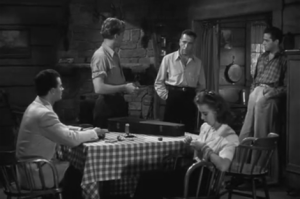 He’s not about to lose his nerves or take his eyes off the objective but the two young bucks he’s thrown in with (Alan Curtis and Arthur Kennedy) carry the tough guy bravado well but there hardly as experienced as him. He’s not too happy about the girl (Ida Lupino) they have hanging around either because she’s an obvious liability. In his experience, women squawk too much. The man on the inside (Cornel Wilde) is even worse, a spineless hotel clerk with even less nerve.
Earle’s philosophy is nothing out of the ordinary. It’s what we expect from a gangster picture. However, there are several elements to suggest that we are on the brink of a new movement to reflect the changing American zeitgeist. High Sierra is actually composed of a great deal of on location shooting throughout the Lone Pine area that adds a layer of credence to this entire tale but also a certain visual tranquility. And although it’s difficult to know precisely how much involvement Huston had on the script, there’s no doubt that his impact on noir was crucial with The Maltese Falcon released the same year.
But the bottom line is Bogart’s character has another side. With the gears of the heist in motion, he wryly notes, “Of all the 14 karat saps, I start out this caper with a girl and a dog.” And it’s true he has a certain soft spot for Marie Garson, and the yippy dog Pard (Bogart’s own pet Zero) but that’s not the extent of his character. In the stories most striking B plot, he befriends a trio of poor country folk led by their patriarch the always amiable Henry Travers and important to Roy because of their pretty granddaughter (Joan Leslie) who also happens to be a cripple.
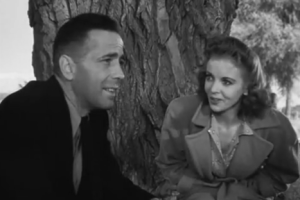 In an unassuming act of charity, Roy has a doctor friend take a look at Velma and ultimately pays for the surgery that heals her ailment completely. Still, if the story ended there it would be a happy ending but with the heist in the works, Roy is not so lucky. He pulls off the job and makes his getaway but with most any cinematic criminal activity in Hollywood’s Golden Age there must be repercussions. After all, that’s what keeps things interesting and it’s true that Roy and Marie are able to lay low for a time but soon the word is out and the gangster is a wanted man.
Walsh orchestrates the tense finale stirringly in a way that still has the power to excite with editing, score, and camera all flowing seamlessly for the most crackerjack of endings. It’s true that big shots are brought low and the irony was that it was hardly a woman or a dog that caused his downfall. It was himself. In those faltering moments, Bogart won his audience over as a leading man and would never lose them again. Certainly, we have the rather unfair added benefit of hindsight, but High Sierra stands as a monumental picture.
4/5 Stars