Close-Up (1990)

close up 1I’ve heard people like director Jean-Pierre Gorin say that there is little to no distinction between documentary and fiction. At first, it strikes us as a curiously false statement. But after giving it a moment of thought it actually makes sense, because no matter the intention behind it, the medium of film is always subjective. It’s always a created reality that’s inherently false and even in its attempts at realism — that realism is still constructed.

So you see, this is the start of an interesting idea. Film is about what you decide to put within the frame and what you keep out. Directors, cinematographers, screenwriters, and editors among others all play a part in this process. They all formulate what we see on the screen — the reality that we perceive.

It occurs to me that Abbas Kiarostami’s film Close-Up stands at the crossroads of the documentary and classical fiction filmmaking with the two lineages blurring together like very few undertakings have ever been able to do, at least to my knowledge.

The story feels simple. It follows the real-life trial of a man who impersonated popular Iranian film director Mohsen Makhmalbaf in order to gain the confidence of a family of film enthusiasts. He wanted to make a movie and they were to be his actors. Abbas obviously took interest in the story that he read of in a magazine because of its relation to film. Here was a seemingly ordinary man who loved movies so much, that he was willing to masquerade as a film director. The irony is that this cinephile Hossain Sabzian also became an actor in the process, donning this role for the family. The family who accused him consider him a confidence man, even a burglar but that’s not how he sees himself. In fact, in a way, this film reminds us that we’re all actors. It all depends on your definition and the circumstances at hand. In some way, shape or form at a given point in time, we’re playing someone who is supposed to be us.

close up 2The beauty of Close-Up that not only does it feature the real individuals involved in this whole ordeal: There’s Sabzian playing himself, the Ahankhah family who brought the case to court, and Kiarostami appearing as well. But it blends the actual footage from the trial with reenacted scenes set up by the director as if they are happening for the first time.

One of the few things to tip us off that some of these moments are reenactments is that we see the same sequence twice, just from different perspectives. Thus, the whole docudrama becomes this blend of reality and falsity. Documentary paired with purposeful re-creation, utilizing a kind of cinema verite filmmaking. I almost don’t want to know what is real and what is fake and in some respects, I don’t care. And that’s what’s fascinating about Close-Up. The story is not altogether extraordinary but, again it’s this dichotomy between reality and fiction. The dividing line proves to be paper thin.

Since much of the film is made of a close-up on Sabzian’s face, it does bring up some questions about the defining factors of identity. Is this man in front of us really what he says he is? Is how he is acting genuine and real. Is it all a facade? Was this whole sequence contrived by a director for the benefit of the viewer? You could go on and on with such assertions and with such questions I think you start getting at the profound aspects of Kiarostami’s film and film as an artistic, expressive construction.

If you’re ready to actually consider what you are being fed, what you are viewing and how you can react to it, this is a film worth your time. I have never known a film to be more engrossed in the dilemma of reality versus fiction.  It took me long enough to see a film by this late great of Iranian film, but now that I have been opened up to his oeuvre, I look forward to more on my horizon from Abbas Kiarostami.

4/5 Stars

Model Shop (1969)

Model_Shop_FilmPoster.jpegAt face value, Model Shop is an ordinary film of little consequence but look a little deeper and it’s actually a fascinating portrait of the L.A. milieu in 1969. Part of that is due to the man behind it all.

Jacques Demy is among the foremost of French directors, most obviously for his work in musicals like The Umbrellas of Cherbourg and The Young Girls of Rochefort. And Model Shop, his first American production, functions in some capacity as a type musical (featuring a score from SoCal rock band Spirit), while also incorporating Anouk Aimee’s character from his earlier success Lola (1961).

It’s a musical in the way that American Graffiti is a musical except its soundtrack is a mixture of Spirit and classical music in equal measures emanating from car radios. But it also maintains Demy’s type of storytelling where he weaves characters together with acts of fate.

The film follows a typical day in the life of Gary Lockwood who is an architecture grad floundering in a general malaise as he lives in a shack with his girlfriend who is making a go of becoming an actress. He’s not ready for a long-term commitment and the fact that his car is about to be impounded pretty much sums up his life.

On a whim, he follows a beautiful woman up into the hills by car and nothing happens right away, although he is taken by the panoramic views of Los Angeles. The sequences that follow develop L.A. into a character on its own. One moment George stops for a girl who quickly rolls a joint and offers him one as KRLA hums over the radio waves, in another, he is making his way down the Sunset Strip. There’s a substantial cameo from Spirit keyboardist Jay Ferguson, who genially gives George a helping hand while trading a bit of small talk. It’s might seem a rather odd inclusion and yet from Demy’s point of view, this group evokes something of the L.A. ethos. It’s understandable.

The biggest reveal comes midway through the film when George learns he’s been drafted to go fight in Vietnam. It’s a bitter twist of fate that shakes up his existence in only a matter of minutes. His freedom has instantly been constrained to a matter of days. That’s all the time he has to get to know this mysterious woman who he professes love to. These are the last moments he will see his girlfriend as their relationship subsequently goes down the tube.

So in some ways, Model Shop shares a bit of Demy’s earlier sensibilities but it by no means feels like he’s trying to transport his style flatly to an American audience. If I didn’t know any better, initially, I would say that this was a purely American production because it feels relevant and realistic to the degree that it can be. Except as he always does Demy is making a sort of fantasy, even if we don’t realize it at first. There’s the reverence of an outsider, someone who sees this City of Angels for its beauty and utopian qualities, while others have begun taking it for granted, seeing only the smog and the violence. That’s what Demy lends to this story, a hint of admiration. And in the moments the dialogue gets more introspective it hardly feels stale but really evokes a candidness.

It strikes me that George is mesmerized by the French woman, although his own girlfriend is very pretty. In my own mind, for me, it becomes a sort of an allegory for European versus Hollywood cinema. One perhaps is more glamorous, namely Hollywood, but other countries oftentimes have far more intriguing films. However, it’s important to note that Demy seems to have an appreciation for both. He more than some had a deep admiration for the musicals of Hollywood’s Golden Age especially.

Another fascinating caveat about this unassuming film is the fact that it could have featured a performance from a young unknown named Harrison Ford. Wouldn’t that have been interesting? But in the studio’s infinite wisdom they assumed Lockwood would be a bigger box office draw. It’s probably because he was in a little film called 2001 A Space Odyssey the year prior. For what it’s worth, Demy’s film didn’t do so well and it still resides in relative obscurity. However, it gives an image of Los Angeles that is rather like a time capsule, starkly different than Demy’s other work and still beautifully tied together with his previous films through a photo album showcasing faces that are very familiar. It’s a striking callback and in some strange way, it connects the director’s work together in a surprisingly satisfying way. Jacques Demy is still worth a watch.

3.5/5 Stars

Red Desert (1964)

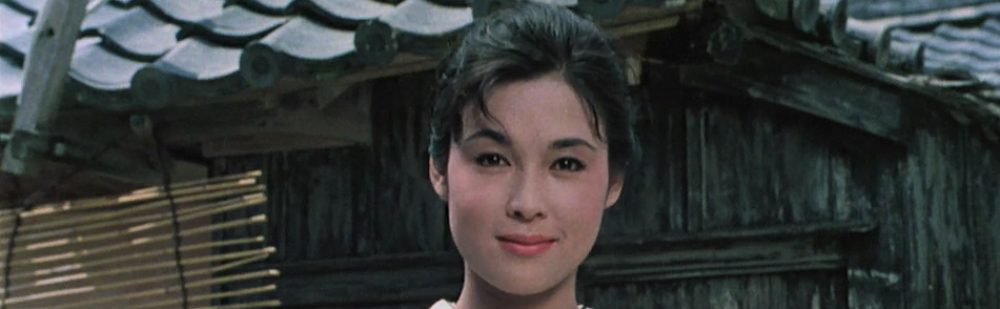
red desert 1John Donne is noted for writing that no man is an island, but if this film is any indication, there might be a need to qualify that statement to suggest that some women are islands — at least when portrayed by the elegiac Monica Vitti. Red Desert begins with blurred images and a high-pitched piercing melody playing over the credits. From its opening moments, two things are evident. It gives off the general sense of industry and it features one of the most extraordinary uses of color ever with the blues and grays contrasting sharply with the brighter pigments.

In fact, it’s oftentimes easy to think of Michelangelo Antonioni as a filmmaker well-versed in the poetic imagery of black and white but you have only to see Monica Vitti in her green coat standing with her son like two solitary beacons, to know that he is equally fit for color. He is a master equally skilled with a new palette.

You could make the assumption that the world has become a sort of wasteland. More comic depictions of these themes are obvious in the works of Chaplin and Tati. In my own mind, a bit of Modern Times and Playtime began to float to the fore. There were bits and pieces of those films that felt like they could be analogous to what Antonioni is trying to accomplish here with his images of the industrial Ravenna. There are smokestacks, bells, whistles, factories, machines and so on.

It’s easy to quickly surmise that this is all a condemnation of the world slowly going to hell because there’s no doubt that many of the opening visuals are bland and austere. But underlying Red Desert is a stark beauty that permeates the entire landscape. Thus, Antonioni’s perspective is perhaps a lot more nuance that the viewer will even acknowledge at first.

In an interview, he once said the following, “It’s too simplistic to say—as many people have done—that I am condemning the inhuman industrial world which oppresses the individuals and leads them to neurosis. The line and curves of factories and their chimneys can be more beautiful than the outline of trees, which we are already too accustomed to seeing. It is a rich world, alive and serviceable.”

red desert 2However, even if this word does reflect its share of beauty, it is Monica Vitti’s character who still embodies paranoia and disorientation with the modern civilization. In other words, she is the one out of step with the contemporary world that she finds herself in, due in part to an auto accident and a subsequent stint in a hospital. She is struggling to readjust to reality.

And it’s no wonder that Antonioni made a string of four films with her because she has a remarkable gift for personifying all that is distant and aloof in a human being, while still bearing immense powers of attraction. In this case, it’s the visiting recruiter (Richard Harris) who is taken with her. But not even a fling with him can remedy what she is struggling through. There’s no one who can fully understand her, not even the audience.

red desert 3As per usual with Antonioni, his film invariably feels to be altogether more preoccupied with form over content and that’s what is most interesting. It’s fascinating some of the environments he develops. Atmospheres full of billowing fog, wispy trees, stark alleyways, gridiron structures, and all the while the color red pops in every sequence. There’s no score in the typical sense, instead, the dialogue is backed by foghorns, machinery, and an occasional electronic sound effect.
We get a little better understanding of her psyche when she recounts a mesmerizing story to her young son about a young girl who spends her afternoons swimming in the glassy water off the coast of an immaculate island. The pantheistic fantasy she so vividly paints for him is strikingly juxtaposed with the world around her — a world she has yet to feel fully comfortable in. However, both worlds somehow seem empty.

4.5/5 Stars

Silence (2016)

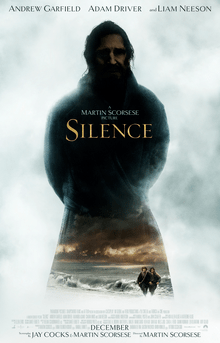
Silence_(2016_film).pngIf we can take Martin Scorsese’s varied film career as a reflection of the human experience, then his completion of his long-awaited passion project Silence is not all that surprising. He’s crafted numerous classics, countless cultural touchstones, some spiritual, some historical, and some incredibly honest. But at this point in his career it seems like he has nothing left to prove to us as his audience and maybe at this point in life, if nothing else, we could do well to try and learn from someone like him. Because given the climate with funding and the like, Scorsese could not have made such a film just for other people or money or acclaim. He must have made it, at least partially, for himself.

There’s no question that his life has been tough at times, even taking him to the brink of death, and in Silence, we see a period tale that touches on everything that is thought-provoking and all that is paramount in life. Man has long wrestled with God. Jacob did it literally in the narrative of Genesis. Nothing is new under the sun in a sense. And Scorsese by way of Shusaku Endo is doing a truly remarkable thing to consider these very questions. I admire him for having the wherewithal to even begin to tackle this material.

Coincidentally this is also a very faithful adaptation of Endo’s novel and so rather than recount the entire plot, my best advice is to read Endo for yourself and watch Scorsese’s own musing on the text afterward. But for those who don’t know, Silence is a fictionalized account based on true events involving two 17th century Portuguese priests Rodrigues (Andrew Garfield) and Garppe (Adam Driver) who head to Japan in order to spread their Christian faith–a faith that already has approximately 300,000 believers. Their mission is twofold as well, to track down their illustrious mentor Father Fereira (Liam Neeson) who is rumored to have apostatized.

However, their beloved faith is under fierce attack by the Japanese magistrate and for good reason. As articulated by the oddly compelling and strangely comical antagonist Inoue, foreign missionaries sometimes come to Japan like jealous women looking to steal the country away. They often are lacking cultural understanding meaning their message is neither contextualized or delivered in such a way that is helpful to the people. Is the message missionaries brought even the same anymore or do they simply trust that it will reach the people as they intended?

But delve into this issue and doubters can beg the question, can the Truth (capital T) be universal? There are certain similarities between religions. From a cursory level, you can either draw up the similarities between Christianity and Buddhism or cast them far apart. Father Ferreira finally conceded that doing good is enough. It leads to human flourishing but also to the detriment of his previous beliefs. And that’s only the one conflict.

Silence delivers numerous other tough questions to any viewer who is willing to consider them. How do you equate personal suffering versus the suffering of others? If to die a martyr is what some call Christ-like, to let others die for you could easily be called selfish and weak.

Still, is recanting Christ, the core of these missionaries’ belief system, worth it for the safety and well-being of others? The answer seems simple and yet somehow still so divisive. Most importantly of all, and potentially the most volatile and insidious question of all is this: Can you still be worthy of love if you have doubted, turned away, or committed evil? That is the central question at the heart of Silence.

In different ways, Scorsese’s film brings to mind droves of others from the likes of Bergman and Dreyer but the polarities of the emotions are more pronounced here and somehow the nuances still manage to be incredibly subtle. Bergman’s The Silence already seems to assume God is out of the equation entirely. Ordet takes the spiritual doubts of mankind and culminates in a miraculous crescendo of hope. Scorsese’s work strikes a tougher middle ground. And for that matter, this film is undoubtedly rough going. It’s long, pensive, and unsettling.

The heroes do not arrive at some Oscar-worthy self-actualization. Violence is not some entertaining cathartic release. On the contrary, these characters are at times pitiful–even the dregs–and the violence is methodical and repetitive like a deluge of ocean waves beating us back.

But as such, this is not a film to stew in or even a film to view alone. It is meant to be seen together, ruminated over in tandem, and considered with a certain amount of thoughtfulness. It asks for its viewer to be open, to be aware, and if need be, do their own amount of soul-searching. Are there questions that you’ve never been willing to confront? And this goes for anyone from any type of background, belief, or point of view.

For the spiritual, this undoubtedly would be a tough picture because it confronts their doubts head-on. For those who do not consider themselves all that religious, it throws you right into the dilemma of fallible man and demands you at least consider the problems therein.

Thus, to call it slow or plodding completely circumvents the entire point. Such an assertion strips this film of its power which is derived from the very audacity of its silence. The way in which Garfield practically whispers his dialogue in voiceover. How there is hardly ever a score because Scorsese takes his title seriously. He’s not about to disrupt the novel’s power with Hollywood expectations. Silence can be just as powerful as noise if not more so. Some would argue that is the very power of the God of the Bible. It’s these very paradoxes that run through Endo’s entire novel.

The humility of the Japanese throughout the film is astounding and the utter hopelessness of the priests at times is equally telling. It flips the savior paradigm that we expect. The most substantive example is the Japanese guide Kochijiro and Father Rodrigues. The Father sees the other as the Judas figure, the betrayer, and yet he is Peter. He too has denied the one who loves him most. They’re no different. Except Kochijiro is far more aware of his shortcomings–there’s no pretense to think he is Christ-like. He is humbled just as we can be humbled by the sheer boldness of Silence.

4.5/5 Stars

Mustang (2015)

Mustang_posterThere’s something inherently striking about the title Mustang. It signifies something about the title girls, their free-spirits, billowing brown locks, continually running in a type of a herd, constantly full of life, movement, and motion. But with a mustang and any other creature full of life and vitality, there’s always an opposite force looking to impede, tame, and prod the spirit into some sort of submission. Because being free, being wild is constantly challenged in the world that we live in and this story is a prime example.

The film opens when what can be called little else except for a “tribe of girls” leave their school to go traipsing along the beach with a group of boys. In these moments we begin to understand quite well since frolicking, laughing and playing chicken are the same in every culture. But that’s not how their elders see this seemingly innocent act. Instead, it’s full of passion, lust and moral depravity.

In many ways, although it’s set in Turkey, Mustang plays with some of the same themes of Sofia Coppola’s Virgin Suicides but it is a film that surges with vim and vigor rather than wistful detachment. And even though it has those aloof moments at times, they feel more personal because most of the time instead of being on the outside looking in, we’re constantly being shown the perspective of these girls, a far more frightening point of view.

Furthermore, this isn’t simply about one fundamentalist family that’s the outlier but an entire culture that holds women in a certain regard. There’s obviously something amiss in cultures that lack social mores and a sense of reality, but there’s something equally frightening in those cultures that are utterly repressed. Life is literally driven by fear and shame. Bringing dishonor and gaining the respect of your neighbors. A life like that can be nothing aside from taxing because you can never possibly measure up to the societal standards.

The television, the media, and everything else seems to reinforce exactly these points. Meanwhile, the girls go sneaking out to a football match only to miss the bus, only to hitch a ride with an unfortunate bystander who gets them there in time for the excitement.The images at the football match carry an almost infectious backbeat, hyperactive and frenetic with hair flying, hands flailing and bodies going every which way, but still, every action has a consequence. Every moment of freedom is met with an equal event of restraining power.

In this case, the girls are prepped and prepared for marriage, arranged between families like a shrewd business deal to save face. Their fearful grandmother and domineering uncle think it’s the best for everyone and the girls have little say in their fate.

The youngest girl, Lale, is a tomboy, a perpetual climber but she like the others feels trapped. And they are, as first one sister than another are hitched up in a marriage. But it’s when marriage no longer becomes a joyful union but a suffocating prison of unhappiness, something that it was never meant to be at all. True, one girl gets a bit lucky, the other is utterly unhappy. Still, two down and three to go. That’s the way grandmother thinks of it.

By this point, the three remaining girls are forced to find any little piece of rebellion they possibly can whether it be snickering at the dinner table or something altogether more audacious. Grandma and uncle are unrelenting in their matchmaking and finally, Lale and the only sister she has left are at a crossroads. They must take a plan of action or resign themselves to their impending fate. You can probably guess what their decision is but that doesn’t make executing it any easier.

Mustang is certainly a cultural commentary and you get the sense that it’s a very personal work by writer-director Deniz Gamze Erguven. However, within its portrait of youth, womanhood, and marriage there are also some universal truths to be gleaned. There’s something to be said for freedom — in youth and adulthood. To take it lightly is to commit a grave error

4/5 Stars

Rosemary’s Baby (1968)

Rosemarys_baby_posterFrom the haunting opening notes of a lullaby to the otherworldly aerial shot floating over New York, Rosemary’s Baby is undeniably a stunning Hollywood debut for Roman Polanski.

What follows is a tale weighed down by impending doom and paranoia. But although the tone is very much suited for Polanski, it’s perhaps even more surprising how faithful his adaptation is to the original source material. Most of the dialogue if not all of it is pulled from the pages of Ira Levin’s work and the Polish auteur even went so far as getting the wallpaper and interiors as close to the novel’s imagery as he could. But that hardly illuminates us to why the film is so beguiling–at least not completely.

In an effort to try and describe the look of the film, the best thing that I can come up with is inscrutably surreal. Some of it is undoubtedly due to the lighting. Partially it’s how the camera moves fluidly through the cinematic space which is mostly comprised of interiors. But nevertheless, it’s absolutely mesmerizing to look at and it pulls you in like the wreckage of a car crash. As much as you don’t want to, your eyes remain transfixed.

Mia Farrow, with her figure gaunt and her hair short, becomes the perfect embodiment of this young wife. The progression she goes through is important. Because she starts out young, bright-eyed and cute. Still, as time progresses she evolves into her iconic image, shadows under her eyes, ruddy and covered in beads of sweat. Her state is no better signified than the moments when she walks through oncoming traffic in a complete psychological daze.

John Cassavetes brings his brand of comical wryness to the role of the husband and struggling actor. But face value gives way to more sinister underpinnings. Old pros like Ruth Gordon, Sidney Blackmer, and Ralph Bellamy are given critical parts to play as an overly hospitable old crone and her husband and the aged doctor who are all privy to this deep-seated conspiracy.

You’ll find out soon enough what that means if you watch the film. However, for me what kept coming back to me is that this is, in essence, a subversion of the Christ child narrative with a new “Mother Mary” figure.  And hidden behind this psychological horror show is something, oddly enough, darkly comic. It’s summed up by the scene in the doctor’s office waiting room where Rosemary begins to leaf through Time Magazine. The headline reads bluntly, “Is God Dead?” As a relapsed Catholic surrounded by people who scoff at religion, the world is seemingly devoid of such things. Even the film itself features more profane moments, greater sensuality, and darker themes than any film of the early 60s. Thus, that magazine headline is not too far from the truth

It’s a question that many would have undoubtedly answered in the affirmative in 1968 too, a year fraught with rebellion, unrest, assassinations, and conflict. Polanski himself would even lose his beloved wife Sharon Tate at the hands of the Mansion family. Mia Farrow was served divorce papers by Frank Sinatra on set. It surely was a dark time and yet while Rosemary’s Baby is disillusioning, there’s also an absurdity running through it.

However, the bottom line is that it maintains its frightening aspects because so much is left ambiguous. We don’t see the baby. We never fully understand what’s afoot. And we don’t even know what will happen to Rosemary in the end. What choice will she make? What path will she choose? Is this all a cruel nightmare or will she wake up? Can anyone rescue her from her torment? There are no clear-cut conclusions only further and further digressions to be made.  There’s something fascinatingly disturbing about that. It ceases to grow old.

4.5/5 Stars

Son of Paleface (1952)

Son_of_PalefaceIt’s hard to grow tired of Bob Hope. In many ways, he’s a universal entertainer — transcending time — circumventing the decades with a brand of humor that is timeless. And the same goes for his iconic persona. He can quip with his lips like Groucho Marx but he’s more of a lovable dope. He likes to think he’s clever and when he lets his mouth run off Hope certainly is, in a cheeky sort of way. It’s just his characters who are always dumb.

Whether it was his own stellar ad-libbing or a careful premeditation of calculated gags, there’s no doubt that Bob Hope has staying power. The Road Pictures with Bing Crosby are a testament to that, but in my own personal estimation, Son of Paleface is arguably one of his best films. Ironically, it came as a sequel to the standout hit Paleface from 1948. But for many, the second go-around is markedly better.

Here Hope is reincarnated as a pompous Harvard man, Junior Potter, a young college magnum cum laude who is intent on heading out West to collect on his heralded father’s long-lost fortune. He expects the welcoming committee to be waiting for him, but there’s only a town of locals intent to settle long-standing debts.

There’s also someone else who is quite interested in Junior Potter and most specifically his supposed fortune — the wanted outlaw The Torch. Of course, no one knows that this brazen outlaw comes in the form of sultry saloon owner Mike (Jane Russell) the jewel of every man’s eye. Junior’s not the least among them, not knowing what her true intentions are. He doesn’t mind getting to know her a little better and she obliges, though it doesn’t help he has all the charm of a bad toothache.

Mike’s not the only one masquerading, however, a government agent is undercover as well, bent on catching the notorious outlaw in his/her tracks. Enter Roy Rogers with his trusty steed Trigger stage right. Thus, the stage is set for a classic western showdown dragged through the mud and riddled with jokes thanks in part to Hope. Rogers and Russell are mostly serious but once and a while they offer a quip or two because Hope prompts such a response every now and then.

Frank Tashlin who helped script Paleface a few years before, wanted more creative control and found himself helming the sequel much more to his liking. But this a film propelled by its leads. There’s also are surprisingly good musical numbers starting with the earlier hit “Buttons and Bows” and bolstered by the catchy additions of “Wingding Tonight,” “Four-Legged Friend,” and”Am I in Love?”

It’s true with the great parodies that they know when to go for gags and when to play it straight. There needs to be a clash of tones, a cacophony of the outlandish with the dramatic. Hope supplies the pratfalls and one-liners with his usual aptitude — just like another walk in the park or an Oscar ceremony (he did host 19 times after all). Because it’s exactly that type of material that’s built into his persona free of charge. It flows out so naturally, with extreme ease. Breaking up the action is exactly what we expect from him. There are madcap chase scenes, catcalls and pratfalls,  fourth wall breaking, and numerous prattling asides that Hope fills with his usual wit. I used to watch Hope a lot as a kid and even after so many years it still feels fun.But that’s not to discount Roy Rogers and Jane Russell one bit. They make up a winning western trio indeed.

3.5/5 Stars

Tu dors Nicole (2014)

Tu_dors_Nicole_POSTER“Nicole, you’re sleeping…”

I admire a film that is able to linger and I’ve read enough scripts to know that there is a difference between filling up scenes with mindless dialogue and slowing the action down in a way that’s inherently more lifelike. In fact, I now have an increased fascination with the films that don’t rely so much on plot points at all but characters and the everyday situations that they encounter. Because, if I’m honest, everyday situations often make up most of my life and they are most relatable to me. They’re the stories that feel the most genuine.

Just looking at Stephane Lafleur’s Canadian drama, Tu dors Nicole, a little bit of the mundane is evident. Sorting racks in a clothing store. Lazy afternoon bike rides. Lifeless neighborhood streets. Long summer days with the sound of crickets outside the window. Hot nights where you can hardly keep your eyes clamped shut due to the miserable heat that keeps you tossing and turning.  It might all seem of little consequence and in many ways it is. But in the modern arena where every film must be the next big thing, the greatest spectacle imaginable and so on, it’s actually quite refreshing when someone dares to tone it down a notch.

There are some oddly weird moments throughout the film. Namely, Martin, a boy who has the vocal range of a 30-year-old man. And the traces of harp music whenever something especially enchanting comes to the fore. Then, there are the closing images of water spouting off into the atmosphere.

However, what’s at the core of Nicole is a story of adolescence coming into adulthood. It’s not so much a coming of age narrative as emblematic of that period of transition. And if Nicole had the fragments of a prototypical plotline it would be this.

The eponymous young woman (Julianne Cote) has recently graduated college and is working a menial job. Her parents have gone away for a little vacation leaving her behind with a list of tasks to complete in their absence. She would have the house to herself if it wasn’t for her older brother who is always jamming away with his bandmates in the living room and all throughout their house. Their backbeat is constantly reverberating through Nicole’s life. She hardly gets any peace and quiet.

And yet even in the tranquil moments, our protagonist still seems a bit melancholy. Mini golf isn’t as fun as it used to be. A trip to Iceland is more fun to plan for than it is to actually go through with. Nicole gets in a row with her best friend. She loses her job after taking a few articles of clothing home with her. But life continues like it always has.

In this case, black and white is not simply an aesthetic choice but an appropriate palette to reflect the underlying tone of this film. There is a listlessness, an apathy to Nicole’s life at the moment.  The thing is it’s due to nothing in particular, at least nothing spoken aloud or seen overtly onscreen, but like life, it just is.

Our main hint comes from the title itself. Could it be that Nicole is asleep? She cannot sleep at night, because, perhaps she does her sleeping during the day–going through the motions without a great deal of purpose — without a goal to drive her. We’ve all been there. Maybe even a few moments ago. Growing up in this fashion is not always all it’s cracked up to be.

The question to ask at the end of this particular narrative is this: Have things changed? Not really. But so it is with the vicissitude of life. There will be highs and lows. Moments of vibrant colors and grayish doldrums. Quarter life crises and galvanizing flashbulb moments. Still, we keep on living, latching onto what gives our confusions and doubts even a shard of meaning. We aren’t meant to live life asleep.

3.5/5 Stars

Don’t Bother Knocking (1952)

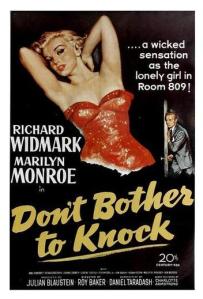
Don't_bother_to_knockYou’re silk on one side and sandpaper on the other.” – Richard Widmark as Jed Powers

For a film so short, Don’t Bother Knocking is overflowing with wonderful talent from Richard Widmark to Anne Bancroft to a haunting performance from Marilyn Monroe. Then Elisha Cook Jr. shows up as the obliging doorman, Jim Bachus as a young girl’s father, and even the prolific Willis Bouchey takes a turn as the bartender. It’s one of those story’s that revels in the classical age of the Hollywood studio actor. The familiar faces carry with them a certain amount of depth that allows the characters to mean so much in only a few fractions of the time normally required.

Anne Bancroft’s nightclub singing (in her screen debut) sets the background mood for everything going on within the  McKinley Hotel — a seemingly upstanding establishment. It’s precisely this aloof demeanor established by the music that lends itself nicely to the strangely haunting aspects of the film.

All characters seem to lack passion, emotion, and most any type of energy except the bubbly camera gal who goes around trying to sell snapshots to patrons. Widmark is at his morose dirtbag best yet again as Jed Towers, a guy who can’t figure why his girl has dumped him.

It’s a chamber piece, and while not a man on a ledge story like Fourteen Hours, it still uses the corridors and diegetic street sounds to create a mildly intriguing environment for some minor noir thrills. You can see the lust in Widmark’s eyes when he looks out the window at Monroe prancing and swaying about seductively. Little does he know what her deal is. His frustration with life and love is right at the center of this film and he must rectify his situation one way or another.

For her part, she has some telltale signs of psychological distress aside from a constantly glazed expression. Namely, scars on her wrists. Strings of little white lies, compulsive fibs that trickle out and a flustered edge that slowly becomes more and more demented by the minute.Whether it’s Monroe’s best performance is up for interpretation but it’s certainly her most terrifyingly dramatic.

She becomes the lightning rod for all the drama, lashing out against the little girl put in her stead and distressing her uncle (Elisha Cook Jr.) who got her this gig, despite her utter lack of experience. Nell Forbes flutters so quickly between fear and hysteria, at first wary of Towers and fawning all over him the next moment — afraid that he will leave her.

It’s her histrionics that force a reaction out of Jed. He must choose what type of guy he wants to be, whether he chooses the tame or wild side of life. And as it turns out, there’s absolutely no contest in the end. He knows full well which girl is for him.

Unfortunately, the ending is a bit of a cop-out, because it is the relational and psychological dysfunction of the characters that becomes most rewarding and, in the end, most indicative of the noir malaise. A happy resolution, therefore, does not stay true to the heart and soul of this film. Stone cold and depraved. Still, this one’s a winner at 76 minutes.

3.5/5 Stars

An Officer and a Gentleman (1982)

an officer and a gentleman 1Lou Gossett Jr. What a performance. He imprints himself on our brains just like the new recruits he berates, pushes, and toughens on a daily basis. He’s inscrutable. We want to hate him. We want him to get his comeuppance.  Yet in the end, we cannot help but appreciate him. We are just like one of his recruits and that’s, in part, why this story works at all.

We’re there in the mud and the mire. We hold our breath in preparation for the latest inspection. Every drill has some consequence. Each failure and each conquest is like one of our own. And the desire for intimacy and love is in us too. This film takes many of its characters through the hell that is Aviation Officer Candidate School. But isn’t it the most trying times that remain the most memorable and truly mold us as human beings? It seems so.

It’s easy not to like the coolly defiant Richard Gere as Zach, even when we know a bit of his past because he can be distant at times. But we learn more about who he really is and as with most people, he grows on us. The same goes with his best buddy  Sid (Keith David) who is well-liked by everyone but realizes he’s been living his life all wrong. Likewise, Paula (Debra Winger) and Lynette (Lisa Blount) the two bodacious gals who have dreamed of dancing the night away with a pair of up and coming cadets, have their own set of problems.

an officer and a gentleman 2Watching An Officer and a Gentleman, it is rather amazing that it succeeds as part romance, part war drama since all its action takes place at an air force cadet school. They haven’t even reached the front yet. There are no explosions or bombs bursting in air. It even shares similarities with Fred Zinneman’s star-studded From Here to Eternity (1953) years before. But that story had far more star power and a climatic event like Pearl Harbor to build the story around. Here there’s nothing quite like that. But it’s not really needed. We are reminded that mankind is inherently interesting and when you throw a bunch of them together under duress it’s a formula for heightened emotions.
an officer and a gentleman 3Certainly, the film functions because it has all the necessary components, a rebellious hero played by Gere, troubled pasts, innumerable odds and the like. However, breaking the film down to its simple plot points hardly gives the film the credit it is due. There are so many intangibles when you watch something on the screen that really gets to your gut. It’s not necessarily manipulation on the part of any one person, director, screenwriter or otherwise. It’s simply the emotional clout that the medium of film is capable of.

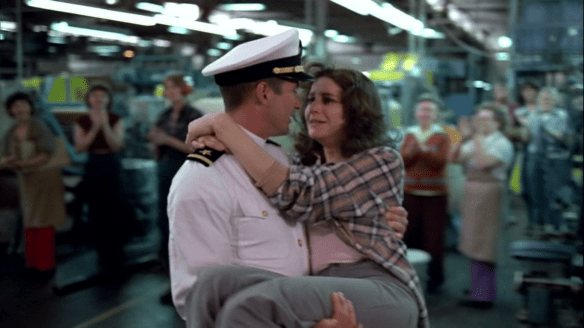
As I watch Richard Gere carry his love (Debra Winger) out of her dead-end factory job, rather like a groom taking his bride over the threshold of their new lives, I too cannot help but smile ruefully. This is the schmaltzy ending of passionate love. But that is only one scene bookending so many others. Some that take us in a stranglehold. Others that fill us with contempt or pity. And as with any film, some that feel superfluous. What stays with you though when the screen goes black are the highs and the lows. An Officer and a Gentleman hits them both with ample fortitude.

4/5 Stars