
 “You have the darndest way of bouncing a fellow down and bumping him up again” ~ Henry Fonda as Charles Pike
The story goes that screenwriting wunderkind Preston Sturges penned The Lady Eve with Barabara Stanwyck in mind. He promised her a great picture and he most certainly delivered a stellar screwball like only he could. It plays off the archetypal biblical temptress with comic effect, and it finds the greatest of comic couples in Stanwyck and Henry Fonda. They both are iconic stars, but the narrative works so well, due to that, but also the fact that the film constantly undermines the typical plotting. As the title suggests the woman is really the focal point of the film — she’s the one in control.
In this instance, Stanwyck is shady trickster Jean Harrington, who joins forces with her equally conniving father (Charles Coburn) to take people to the cleaners in any way possible. They’re real smooth operators with cards and any other type of con you could think of. A luxury ocean liner seems like the perfect place to set up their business. Out of all the many high profile passengers, one man stands a head above the rest. His name is Charles Pike (Henry Fonda). He keeps his nose buried behind a book, tries to avoid the gazes of all the pretty girls, and has a penchant for reptilian wildlife after getting back from a long expedition. He also just happens to be the heir to a gargantuan Ale fortune. That’s what catches everyone eye, including the beautifully sly Stanwyck.
 In fact, we have a brilliant introduction to her as she narrates the scene unfolding in front of her with the aid of her compact mirror. She trips up the bumbling bachelor and their introduction is the first exclamation point in a bumpy relationship. She’s ready to play him and marry rich and famous, because he’s a pretty naive fellow, and stiff around the ladies. Fonda’s nervous charm proves the perfect recipe for success as he is constantly being overwhelmed by Stanwyck’s frenetic barrage. His defenses are down and he hasn’t the foggiest what has hit him. Either he was really that uncomfortable or otherwise, he does a superb job of faking it since there’s never another moment where he’s not being fondled or manipulated.
Jean is very quick to get cozy with “Hopsy” (after alcohol and not a rabbit), but something strange begins to happen. For some strange, ludicrous reason she begins to fall for her mark — this goofy guy with loads of cash. That certainly was not in her cards, yet she doesn’t seem to mind. What follows are some wonderful card playing antics between Charles Coburn and Barbara Stanwyck as she tries to stave off her father from pulling one over on her new beau. But of course, just as Pike is getting his sea legs he catches wind of the whole charade quite by chance, and he’s quick to turn off Harrington for the fraud he thinks she is.
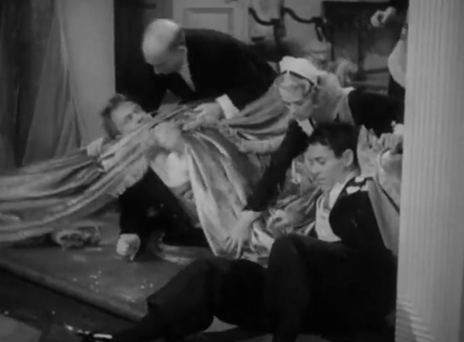 The story could end there, but Sturges has set his story up perfectly for a killer second act. Jean plans a perfectly sneaky revenge plan to get back at “Hopsy” by posing as the British niece of another con man (Eric Blore). He uses his own wily charm and influence to get them an invitation to the Pike household for dinner. There we see several other great character actors in action including Horace Pike (Eugene Pallette), and the perennial sourpuss Muggsy (William Demarest). Jean shows up now as the Lady Eve and successfully convinces her “Hopsy” that she is a completely different individual. The film works wonderfully on this axle of ludicrousness because young Pike is completely befuddled and awestruck again. He goes thudding, clanking, and crashing all evening long, a true victim of love. Pike thought he lost one girl for good and here’s another even better prospect. A whirlwind romance follows and everything is falling into place beautifully. There’s a frantic montage in preparation for the big day and then it happens. They get hitched. Afterwards, it’s all done and the two lovebirds are on a train barreling down the tracks interspersed with the long laundry list of all Eve’s beaus from Angus, to Herman, and Cecil and so on. It’s Charles’ worst nightmare, and he hopes to get out of it as quickly as possible.
But then by chance, he runs into the first girl, who is, of course, Stanwyck as well. He’s genuinely happy to see her, and they embrace like nobody’s business. Being the honorable man that he is, Pike acknowledges that he is, in fact, married now, but the joke’s on him. She is too! It’s an entirely irregular ending, but that’s screwball comedy for you.
 What makes Sturges’ film so wonderful is all the parts making up the whole. His script is perfectly contrived mayhem. He sprinkles it with his typical slapstick, his loudmouthed stock company lends an added layer, and his typically lightning-quick repartee is brought to life by his leads. Stanwyck was the quintessential leading lady of the 1940s and in 1941 she was in fine form (Balls of Fire and Meet John Doe). She can dance so effortlessly between dynamic comedy to heartfelt drama that is positively palpable. She overshadows Fonda in a sense, but they still work together, because he is her perfect foil, the precise innocent fool to fall into her web of feminine wiles. She can muss up his hair, manhandle him, and completely manipulate his feelings. Yet we still like both of them in spite of it. They are a hilarious match, and there’s space for some passionate canoodling as well. It’s probably one of the most perfectly wonderful, utterly dysfunctional relationships we could ever hope to see put on screen. By continually whipping out punch line after punch line to the very last quip, Sturges makes this comedy look positively effortless.
4.5/5 Stars
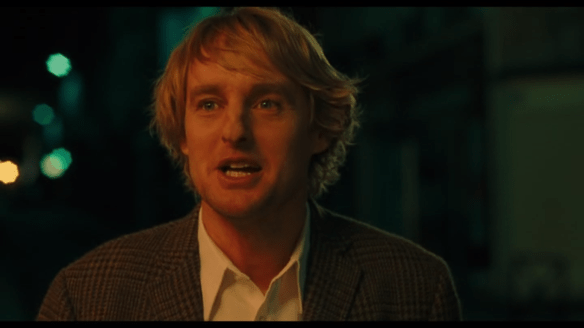 Midnight in Paris begins with scene after scene of the Parisian landscape. It gives off the feel of a lazy vacation, strolls in the park, sidewalk cafes aplenty, and even romantically rainy afternoons. For those who have never been to Paris, it makes you fall in love with the city in only a matter of minutes. Gil Pender (Owen Wilson) is such a person who would easily be content with the Left Banke, Baguettes, and a chance to write his latest novel. There is an air of wonderment that pervades his very being. He’s often naive and unassuming — hardly someone you would peg for a big Hollywood success story.
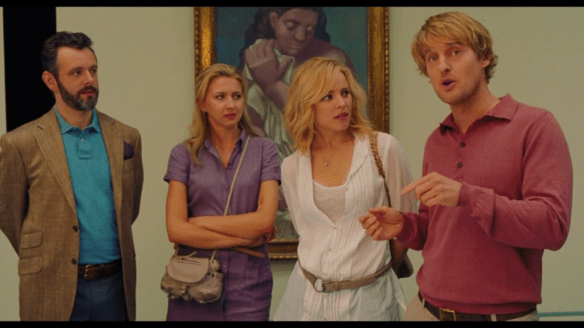 For obvious reasons, Gil cannot stand spending time with his wife’s friends. Instead, those breezy, absent-minded walks down the lanes are more his taste. Inez can’t begin to understand why he does it, but one night he’s in for a big surprise. One minute he’s out for a stroll and then the clock chimes twelve. All of the sudden something a la Cinderella happens. A coach pulls up, Gil tentatively gets in not knowing what he has just stumbled upon, incognizant of the adventure ahead of him.
 The linchpin of the whole story is really the ravishing French beauty Adrianna (Marion Cotillard), the muse of Picasso, the desire of Hemingway, and a newfound friend of Gil. He cannot help but be enraptured by her grace and the time they spend together is wonderful, that is until he tells her that he is pledged to be married. Although, it looks like he and Inez will not be together much longer as they continue to drift further and further apart.
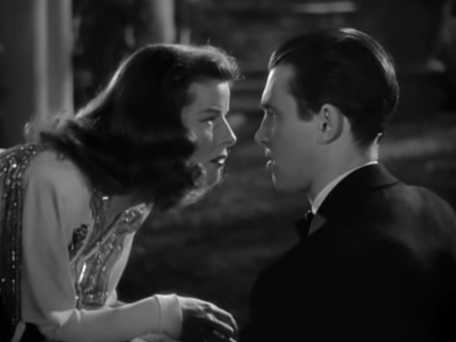
 Anyone who is at least a little bit familiar with ring theory knows that the Star Wars saga has often folded back on itself, with near-mirror images, similar plot devices, and obvious parallelism. It gives any fan a new found appreciation for the films, and with that mentality, The Force Awakens can be thoroughly appreciated.
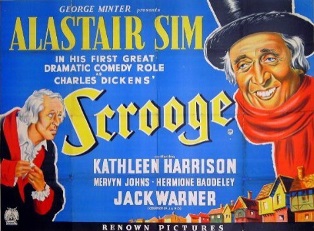 Oftentimes during the holidays, we are quick to label someone a “Scrooge,” almost jokingly because it’s a moniker that’s somehow lost a great deal of its magnitude with overuse and the passage of time. However, if we look at this film, so wonderfully anchored by Alastair Sim, and even Charles Dickens original work from which it is derivative, we would adopt a much wider definition of the word “Scrooge.”
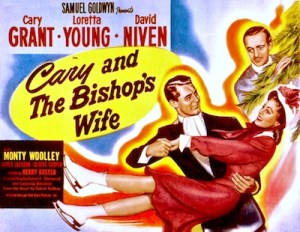 Although its theology probably isn’t sound, rather like It’s a Wonderful Life, The Bishop’s Wife nevertheless utilizes its central plotting device wonderfully.
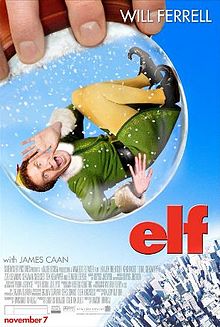 “The best way to spread Christmas Cheer is singing loud for all to hear.”


 4 Star Films