The Young Girls of Rochefort (1967)

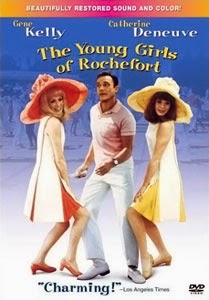
Directed by Jacques Demy and starring an ensemble cast including Catherine Deneuve, Francois Doreleac, Gene Kelly, Michel Piccoli, George Chakiris, Grover Paul, and Danielle Darrieux, this is a whimsical French musical.

The film opens with a group of performers coming into the town of Rochefort to get ready for a big outdoor show. They become acquainted with the local hangout that includes a kindly matron and many locals including an idealistic artist and sailor, who is searching for his ideal lover.

Nearby her two adult twin daughters hold piano and ballet lessons as they two get their little prodigies ready for the big show.  Delphine is fed up with her suitor and desires a new love while Solange on her part hopes to advance her career as a pianist. She goes to the proprietor of a local music store to see if he can introduce her to a prestigious American friend.

The dramatic irony sets in, and the plot is constantly moved forward through song. Yvonne at the café is still depressed over a split with a lover 10 years prior because he had an unfortunate name. Solange has a chance encounter while stopping to pick up her kid brother Booboo, and Delphine becomes curious about an artist, who painted a portrait that looks strikingly like her. All of these events reach their apex on the Sunday of the big performance and in need of some performers, the Carnies enlist the help of the twins. They are a huge success and things wind down.

The next morning the performers get ready to leave for Paris, and the girls decide to follow suit. However, Solange has another encounter that changes her plans, and then Yvonne is reunited with her love. That leaves only Delphine to go with the boys to Paris, but not to worry. She would be united with her love soon enough.

The singing is an integral part of this film, and sometimes there seems to be so much that it gets tiresome. However, the light and very French-sounding tunes are hard not to like. Demy pays homage to the Hollywood musicals of old going so far as casting Gene Kelly in his film. The film takes place in a real location, but it truly is a fantasy world that the characters inhabit, full of perpetual dancing and most of the talking comes out in song. The real-life sisters do a wonderful job in this film, and most of the characters are pleasant in this comedic musical of renewed and new found love.

4.5/5 Stars

Shane (1953)

10788-shaneposterThere is often something special about westerns, and Shane is no different. Directed by George Stevens and starring Alan Ladd, Van Heflin, Jean Arthur, and other great character actors, Shane is simple yet charming. It has many of the qualities of a great movie, because of what it shows of mankind. Furthermore, it simply makes you feel good.

In the film Shane (Ladd) is a wandering ex-gunslinger, who decides to live with a frontier family as a hired hand. His presence makes everyone happy because he is quiet, humble, and fundamentally so good. However, there is trouble from a man named Riker and his gang. Heflin’s character is adamant he must face the foe and defend his home. Shane will not allow it knowing this is a job for him. The two friends fight it out with Shane winning and riding into town. In the end, he wins the shootout but more importantly he is reconciled with the family’s boy Joey. The time has come for him to move on and Shane rides off into the distance, a humble hero.

The first thing that always strikes me about this film is the brilliant scenery around Jackson Hole, Wyoming with the Tetons looming majestically behind a solitary cabin. In some sense, this is not just a western, but the archetypal story of a family taming the land.

The very next thing of importance is the eponymous and unassuming drifter Shane. He always seems so kind and good, but early on there are glimpses of another, perhaps darker past. And yet from the point of view of Joey, he is an idolized, almost mythological figure. What is so striking about Shane is that he is obviously handy with a gun and an excellent fighter, but he never flaunts it. Perhaps it is because he wishes to rely on it as his last possible resort, or maybe it is because he is just a humble man.

As an audience, much like Joey, we want him to fight back, and we are happy when he finally does. During the course of the film, Grafton’s mercantile and saloon is often the place of conflict, and here multiple times Shane ultimately uses violence. It is his fallback, but he uses it effectively even against his own friends if he sees fit. Then Shane drifts on and the cycle undoubtedly continues again.

Yes, he certainly could be called a hero, with no last name to speak of, but he is a man, who will always be on the move. This may not be because he wants to, but because he really has no other option. Shane foresaw what we did not want to see, and now he cannot come back even if he wants to, so he rides on. This is the middle of George Steven’s so-called “American Trilogy” and probably the hallmark of his illustrious career.

5/5 Stars

Argo (2012)

339c3-argo2012posterDirected and starring Ben Affleck, this historical thriller is based on the real events revolving around the Iranian Hostage Crisis that erupted in 1979. After a brief interlude, we are thrown right into the fray outside the U.S. Embassy in Tehran where nationalists are protesting vehemently. They break in and it becomes frantic insides as files must be burned and help must be found.

 Soon they are overrun and 69 hostages are taken, however, six Americans were able to escape and then seek refuge with the Canadian ambassador. From that point on the CIA must figure out how to get them out as they monitor the tense situation from home. All ideas seem doomed to failure, and soon an ex-filtration specialist named Tony Mendez (Affleck) is brought in. He has one wild idea, but it is the only one with a chance. 

With the help of a Hollywood makeup artist and film producer, he begins to create a fake movie so he can get the six out as part of a movie crew scoping out exotic locations. With this daring plan in mind the sci-fi film Argo is born, and Mendez heads to Iran. He must race against the clock because the Revolutionaries are near to discovering that some Americans are missing. Furthermore, his plan leaves the refugees skeptical and scared. Mendez is able to get them all on board as part of the film crew, and he preps them with fake Canadian identities, passports, and rapid-fire interrogations. Everyone is tense as they get ready for the day of departure because so many things could go wrong. The CIA shuts down the operation, but Mendez is adamant to keep on as planned. 

Despite some setbacks, interrogation, and near catastrophes, they miraculously make it to their flight and after one last tense moment, they enter airspace, officially safe, mission complete, and able to drink alcoholic beverages again. The six return to the U.S. amidst much fanfare and Tony Mendez returned an unsung hero. 

I found this film entertaining, tense, and fascinating. This is a part of American and international history that is seemingly glossed over and it needs to be known. I felt the film created an atmosphere that reflected the 1970s very well whether it was news broadcasts, sponsor spots for the Love Boat, mentions of John Wayne, or allusions to such films as Network, Kramer vs. Kramer, Star Wars, and Planet of the Apes. 

I know films like Argo can never be completely accurate, but it is amazing how close so many of the actors looked to their real-life counterparts. Furthermore, I did not feel I was being fed one side of the story. As with any international situation, both Iran and the U.S. were at fault. Ultimately, there was a happy resolution on January 21, 1981, and Mendez finally gained recognition.
 
4.5/5 Stars

The Searchers (1956)

d4eb3-the_searchersOne of John Wayne and John Ford’s best westerns respectively, The Searchers follows an ex-Confederate soldier (Wayne) as he looks for his niece Debbie, who was taken by Indians when they killed her parents. Now Wayne and a young man played by Jefferey Hunter must look for her and bring Debbie home. With an almost obsessive desire, Wayne’s character Ethan Edwards vows to find her. Along the way, the old vet and young man have conflicting personalities that get in the way. Even when they finally find her, she has become more Indian than white, and Edwards seems bent on killing her much to Hunter’s horror. In the end, the gruff but courageous searcher shows his true colors.

A great western, and simply a wonderful film, The Searchers has a lot to offer with great action, Monument Valley scenery, and of course John Wayne. The supporting cast is good as well, including Vera Miles, Natalie Wood, Ward Bond, John Qualen, Hank Worden, and Ken Curtis.

There are some pivotal scenes in this film that I think really get to the core of what it is about, and Ford constructs a multitude of scenes which are simply a joy to observe as they unfold. One turning point has to be when the two Searchers look over a few white girls that the cavalry recovered from the Comanche. One of the girls gives off a childish screech, which causes Ethan to turn around, and Ford’s camera closes in on his scowling face half covered by shadow. Here is a proud man who would not surrender during the end of the Civil War. Here is a man full of prejudice and vengeance. Here is a man who shows glimpses of kindness, and here is a man who knows pain. It is complicated because he heads out after Debbie seemingly in an act of love. But soon it seems that it has become his vendetta, and Ethan has simply become bent on revenge. It takes his final confrontation with Debbie to reveal the true depth of his character.

Undoubtedly this is one of the preeminent American westerns, but I think you could also call it a social commentary on racial prejudice. Furthermore, The Searchers influence ranges from the plight of Luke Skywalker in Star Wars to the music of Buddy Holly (“That’ll be the Day”). I think fittingly enough the film ends with Wayne framed in the doorway, walking off into the distance. After all, he is a searcher, and you cannot expect a man like that to stay put.

5/5 Stars

Her (2013)

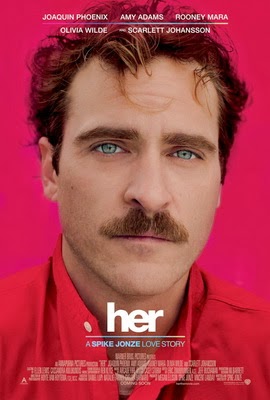
e69ce-her2013posterHer is a film that examines hyper-technological culture through a lens that has been around for centuries: romance.  In a not so distant future Los Angeles, Theodore Twombly is a craftsman of greeting cards. The only difference is he dictates personal messages, which are then transcribed by computers to be given to loved ones. He himself is going through a rough patch in life after a breakup with his wife and it has left him taciturn and distant.
Then one day he purchases the new OS or Operating System. Samantha, as she is called, is a very high level of artificial intelligence (Siri on steroids), who is able to openly communicate, do tasks, and even show emotion to some extent. Even though she does not actually have a tangible body (unless you count Theodore’s phone), he still finds a way to become enchanted by her. Not only can she check his emails, but Samantha also has access to vast amounts of data that allow her to evolve with Theodore, and she soon becomes his closest confidant and companion. Her desire to constantly discover the world invigorates Theodore, who is constantly used to the same technological, yet monotonous existence. Ironically, he develops his deepest relationship with Samantha, because she reflects how lonely technology has made him. 
Real human interaction seems foreign and awkward, whether it is with his estranged wife, work friends, or a blind date. For that matter sexual relations have also been perverted and, in a sense, trivialized by technology. Theodore’s complicated relationship with Samantha brings these and many other realities to light. 
Samantha can never truly be Reality. She can never have physical contact. This causes Theodore to put greater focus on the other aspects about her. Yes, she is not a normal human, but her knowledge on everything and her curiosity opens up numerous beautiful avenues for them to explore together. It could be love letters, the music she is composing, or even the sensation of ambling down a street. 
Ultimately, there is a downside to technology because despite being in an advanced future it cannot fully emulate the human experience and as Theodore painfully discovers there are terrible complications in relation to Samantha. 
This can be a difficult film, a strange film, and at times even a crass film, but for the most part Spike Jonze gives us a very thought-provoking piece that is pertinent to this social media and technologically saturated culture that is also our everyday reality. The world shown to us is washed out in its pastel shades, and yet it does not seem too far removed from us. 
It certainly brings up some interesting dilemmas about Her, whoever she may be. How do you reconcile technology whether computers, phones, video games, etc. with the human interactions that still make up (or should make up) most of our existence? For Theodore, Samantha leaves him with wonderment for life and an inquisitiveness which allows him to unplug a little and truly live in the present. 
Joaquin Phoenix gives a wonderfully nuanced performance, but everyone really wants to see, or rather, hear Scarlett Johansson as Samantha. Others who take on smaller but crucial roles are Amy Adams, Rooney Mara, Chris Pratt, and Olivia Wilde. Her is invariably melancholic but undoubtedly powerful stuff all the same.
 
4.5/5 Stars

The Leopard (1963)

Directed by Luchino Visconti and starring a stellar cast including Burt Lancaster, Alain Delon, and Claudia Cardinale, this Italian film revolves around a Prince and Patriarch during a period of social change in Italy in the 1860s. 

His Excellency the Prince of Salina (Lancaster) is a highly respected noble, who lives with his family on a large estate in Sicily. In his own life, the Prince is annoyed with his marriage and perturbed about the company his nephew Tancredi (Delon) is keeping. However, a revolution led by a man named Garibaldi means great change for the nation and finally following the lead of his nephew, who joins the rebel redshirts, the Prince sides with the new way and supports the plebiscites that are set up. His nephew falls for the beautiful daughter (Cardinale) of an aristocrat, and despite the fact that his own daughter has an eye on Tancredi, Don Fabrizo fully supports the marriage knowing it is good for the family. Because of his title and the respect he has garnered, the Prince is offered a position as a senator in the new government. But he courteously turns it down feeling he is too old and too attached to the old ways. Tancredi and Angelica are to be engaged and they are presented together at an extravagant ball. Over the course of the evening, Don Fabrizo has time to talk, dance with the young beauty Angelica, and reflect on his own life. As the lavish evening begins to dwindle the Leopard walks off to clear his head. 

In some respects, I saw this as an Italian equivalent to Gone with the Wind, and I could see some precursors to The Godfather here because the Italians portrayed are very religious and chivalrous people who can also be ruthless. However, I think it is fair to say that The Leopard is its own film entirely, and it should be taken as such. Tancredi and Angelica are no Rhett and Scarlett and the Prince is not the Godfather. They are their own unique characters. In my personal opinion, I would recommend the Italian version because that is the way the director meant it to be seen and Lancaster’s normal voice seems out of place in the film. Some may say that this detracts from his performance, but I think his presence and acting ability show through even if he is dubbed.

4.5/5 Stars

Le Cercle Rouge (1970)

LecerclerougeDirected by Jean-Pierre Melville and starring a cast including Alain Delon and Yves Montand, this crime film hearkens back to heist films such as The Asphalt Jungle, back in the 1950s.

In a cold open, two storylines are introduced. One man, Vogel, is in custody and is handcuffed to a policeman as they board a train. At the same time, a man named Corey is let out of prison, on good behavior, and he is tipped off on a possible heist job. In both cases, we have little background information to go on. Then, Corey pops in unexpectedly on an old mob boss and forcibly “borrows” some money from the man, who has also stolen his girl. He buys a new car and throws off a couple of thugs who were sent after him. As the morning dawns, the captive on the train makes a daring escape and flees into the nearby forest. Soon roadblocks are set and the manhunt begins. He desperately gets into an open car trunk to hide, ironically it is the same car of the man, who was recently released.

However, he was noticed and Corey tells him to get out of his hiding place.  Vogel is tense but his cool and collected acquaintance helps him sneak through a checkpoint noting that Paris is his best chance of escape. Corey is chased down once again by Rico’s henchmen, but Vogel sneaks out and comes to his aid. They head to Paris and find a sharpshooter to case the jewelry store and help them with their plan. The police detective is still searching for his quarry, and he tries to enlist the help of a crooked club owner. Meanwhile, the plans are made, and the heist is pulled off with great precision and efficiency. They get away with the jewels smoothly enough. However, the marksman settles to take no part of the plunder, and their initial buyer falls through. Relatively quickly there is a new person interested, so Corey takes the goods to him. Only too late Vogel comes to warn him, and just like that, they must flee the premises with police all around.

Much like Le Samourai, this film gives off an extremely cool vibe, and it makes it all the more enjoyable to watch. Alain Delon is such a smooth operator, and whether it is the way he dresses, talks, smokes, or pulls off the heist, it cannot be easily dismissed. However, the other main players give serious and nuanced performances of their own, which cannot be overlooked. Melville makes all of his scenes so interesting, through the setup and the fashion in which his characters go through the world of the film. His characters act in the mode of behavior that they believe is correct and most are rather taciturn and guarded. I cannot decide if I like Le Samourai or Le Cercle Rouge better, but it must be said they are in a special class of crime films.

4.5/5 Stars

American Hustle (2013)

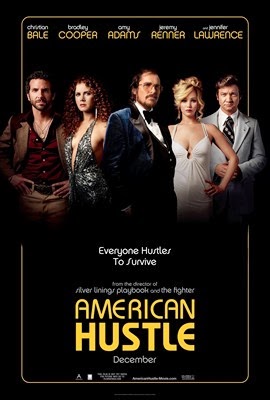
f88cd-american_hustle_2013_posterFrom the get-go, this film sets the tone when we are cheekily told that “some of this actually happened.” Not that it’s based on a true story or based on actual events, but some of this might be true and other parts might be livened up a bit. Then we are thrown into a story we do not quite understand as of yet. All we know is that it’s the 1970s, the hair is crazy, the clothes are tacky by today’s standards, and America’s “Horse With No Name” still sounds good even after all these years.

For me, if this film was all about the story it would be okay, but the reason to watch it is really for the characters. Each one is a caricature who we can hardly take seriously, and yet in many respects, they are going through some very serious stuff. Christian Bale is a con man with an epic comb-over, a pot belly to match, and a Bronx accident, wearing his ever-present shades. He is one of the smartest con men around, but he also has a family life since he married a widowed woman and adopted her young son.

Amy Adams is the stylishly smart dame he meets at a party, and the two of them start a lucrative partnership upping the profitability of his conning enterprise.  Adams character hustles everyone with her fake English accent and identity, that over time it seems like she even seems to believe it herself until it is too late.

They are flying high and the two of them are drawn to the confidence and smarts they see in each other. However, in one instance they are not quite careful enough, and they have the Feds giving them heat. Namely, Bradley Cooper’s character who is out to make a name for himself. He is a man will a lot of attitude and a primped hairstyle, yet he seemingly knows very little. He forces Bale and Adams to work under him in order to trap others and of course they do.

But his plan becomes so big that the con becomes extremely volatile. It involves an Atlantic City mayor played by Jeremy Renner, the Mob, some congressmen, and even a senator, who have all unwittingly gotten themselves into something illegal.

Bale and Adams are trapped living lies that they must stop at some point because he has formed a bond with Renner and she is still masquerading as Lady Edith Greensley.

The final act ends with one final con, and I must admit that I was satisfied with the ending because as a member of the audience I expected a twist to come and, sure enough, it came. But I would have never have guessed it. It ultimately lived up to its name American Hustle.

I think what makes the performances good in this film are not the fact that they are lifelike or even realistic, but they are, in fact, larger than life. Sure, people like Irving, Richie Dimaso, Sydney Prosser, and Rosalyn probably did walk this earth, but the film highlights all their quirks and idiosyncrasies. Whether it is how they talk, dress, or even how they do their hair. Furthermore, they have even messier and crazier personal lives than their hair, and that’s saying a lot. These are not the kind of folks that you would want for friends, and yet could it be possible that there is a little bit of these characters in each one of us? Do we still live in a world where the Carmines are the victims and the real perpetrators get away scot-free? It’s something to ask ourselves.

I’m not sure why people compare this film to Scorsese, perhaps because it is a crime film, it takes place in the 1970s, it features the Mob, or it shows off one of Scorsese’s acting icons in Robert de Niro. No matter the reason, American Hustle is a separate entity that seems completely different from Scorsese. That does not make it bad, just unique. And that it is. You have to give David O. Russell credit for teaming his two previous casts (The Fighter and Silver Linings Playbook) in this one for an acting extravaganza. It will be difficult to top this one as far as acting power goes. I must admit I was a sucker for the music too.

4.5/5 Stars

The Spectacular Now (2013)

1ae0b-the_spectacular_now_filmFeaturing two rising stars in Miles Teller (Rabbit Hole) and Shailene Woodley (The Descendants), this film nicely melds a rough exterior with a heartfelt core to great effect.
Sutter (Teller) is a guy who parties hard, drinks incessantly, and has a long-term relationship with a beautiful girl named Cassidy (Brie Larson). He is the self-proclaimed life of the party and people like him, but no one takes him too seriously. At home, he lives with his mom, has no idea where his dad is, and hardly ever talks with his older sister. School, much less Geometry, is of little importance to him.
Matters take a turn for the worse when he and his girlfriend have a fight. He drives home plastered one night, only to wake up the next morning on a front lawn with a girl standing over him. And that is how he meets the quiet, studious, Aimee Finicky (Woodley). They strike up a friendship instantly as he helps her with a paper route, and she soon begins helping him with math. Although he convinces himself that he is doing it just because she is nice, he genuinely begins to like her. He invites her to a party and there their relationship deepens. It comes out that she is planning to stand up to her mom so she can go to university in Philadelphia. She wants Sutter to ask his mom about his estranged father. Together the two of them go to visit his dad, and Sutter is devastated to find out the truth about his father, which he never wanted to believe. On the drive home, half intoxicated by alcohol, half by his anguish, Sutter rejects Aimee’s love and tells her to leave, with dire consequences.

High school winds down and so does Sutter’s job. The night Aimee leaves for Philadelphia, however, he gets inebriated in a bar not wanting to hurt her anymore. He returns home in a stupor and confronts his mom, but he breaks down believing that he is exactly like his father. Despite all the annoyance that had been there before, she comforts him and proves Sutter otherwise.
Finally, Sutter is able to realize that his limitation is himself because even though he might veil his fears with jokes and alcohol, he has always been afraid. He takes another trip in his car, this time to Philadelphia to see Aimee again. The film ends on the steps of the university as their gazes meet and Aimee is just about to react. Who knows how it ends, but much like “Say Anything…” we can believe what we want. Needless to say, though he wasted so many of the previous “Nows,” Sutter seems destined to make the best of his tomorrow. 
This film is engrossing because although we have seen the story before no doubt, it is made fresh by the leads. A lot of people know someone like Sutter Keely. He is a person who is rough around the edges because of family, divorce, and alcohol. He often makes the stupidest of decisions. But there is still something about him that is likable and it creates empathy. Aimee on her part could be a real individual as well. She can be shy, but she is sweet and beautiful in her own unique way. However, because they are messy and have faults, it makes these two all the more believable. Neither of them can be labeled as a one-dimensional cliché because they have a genuine human quality. As Aimee would say they are not just defined by one thing, there’s more to them than that.

Some of the best moments in the film have to be when the two leads are talking with each other. It seems so real, even commonplace, the way they go through conversations. It is wonderful to watch. First, it begins awkwardly, builds into a friendship, and finally, evolves into a full-fledged relationship. These chats that they share not only cause them to grow closer, but it causes the audience to grow closer to them. I will admit I was in shock during the climax of the film, and I also dreaded the times Sutter drove home obviously drunk. That shows an actual attachment to the characters, something that is not always present in this type of film or any film for that matter. 
For a split instant I was disappointed that the film ended where it did, but then I quickly realized that’s how it had to be and it is better for it. Already I cannot wait for more from Miles Teller and Shailene Woodley especially. She is one of the most promising actresses of today along with Jennifer Lawrence. 
 
4.5/5 Stars

Saving Mr. Banks (2013)

13b45-saving_mr-_banks_theatrical_posterThe name Disney is universal, and if you ask people if they ever saw Mary Poppins as a kid they will probably give you a nod and break out in song. Mr. Banks is the film about the film, and it stars Emma Thompson as P.L. Travers, the difficult and complex author of the source novel. She is balanced out by Tom Hanks, who takes on the role of the larger than life Walt Disney. 

The year is 1961 and for 20 years now he has been prodding Mrs. Travers for the rights to her work. Each and every time she refused him, but now the royalties are only trickling in and so she reluctantly agrees to head to Los Angeles, very sure the endeavor will fail. She is a difficult lady and very hard to please whether it is the airplane, her talkative personal driver, the gifts in her hotel suite, and most of all her literary creation. She won’t have her Mary Poppins frolicking about and there will be no songs, no animation, and certainly no Dick Van Dyke. Disney is willing to make concession after concession in order to bring the story to life since it is very dear to not only him but his daughters as well. Mrs. Travers begins work with the Sherman Brothers and the screenwriter, but she is constantly displeased and calling for changes. It seems that nothing will satisfy her. Though some breakthroughs are made and Disney continues to be patient, Travers is distraught to learn there are to be animated Penguins. Just like that, she heads back to England.

However, that is only one-half of the storyline. The other occurs in flashbacks scattered throughout the film. Travers was a little girl in Australia with a playful father who was a banker. He encouraged her to never stop dreaming, but he also struggled with alcoholism. His problems cause all sorts of problems for his wife, for his bank, and most definitely his girls. Only later would Helen Goff, aka P.L. Travers, realize the impact of what had happened. She watched her mother nearly commit suicide, and she saw her father die because there was no thing and no one to save him. 

Back in the present, Walt Disney finally figures out a little more about Mrs. Travers, and he personally travels to England to talk it out with her. They have a heart to heart, and he assures her that Mary Poppins is not only hers but his and many others, who have enjoyed the magic and hope that came off the page. The fact that Mary came to save Mr. Banks gives comfort to her own tragic story, and with this realized the Mary Poppins film became a reality that numerous fans have enjoyed for nearly 50 years now. 

This film is made enjoyable by the back and forth of Emma Thompson and Tom Hanks. Thompson is especially good in her initially prickly but then softhearted portrayal of P.L Travers. Ralph the kindly driver and Colin Farrel as Travers Goff were also integral pieces of the film. The nostalgia and period look that is created of the 1960s is also pleasant to view. Initially, I did not care much for the flashbacks that fill the entire film, but I will concede that they are important to understanding the inner workings of P.L. Travers. All in all, this is a great sentimental picture that should leave us with a smile on our faces and a desire to sing some ditties like “Chim Chim Cheree.”

3.5/5 Stars