Jaws (1975) at 50

I remember my dad telling a story about the first time he saw Jaws back in 1975, now 50 years ago. He was on a road trip visiting a childhood friend in the Midwest, and though he had spent all his life in California, he was grateful to be in a place that was landlocked when the movie came out. 

If my dad was representative of the general populous, this reaction was not unusual, and for any number of reasons, Jaws was a true cultural phenomenon. It changed the playbook of what a movie could be as a summer blockbuster, even as Steven Spielberg willfully built off the formula of Alfred Hitchcock while bringing his own youth and flair for storytelling to the fore.

It struck me watching the film this time how it is really split into two sections. There are the scenes in the island getaway town of Amity where Police Chief Martin Brody (Roy Scheider) is introduced as a New York City transplant (Coincidentally, it’s convenient to read The French Connection as a bit of backstory). We soon get a sense of his family life, his happy marriage with his better half (Lorraine Gary), and the small-time responsibilities that come with the incoming tourist trade. He also hates the water…

These are the throes of summer, on the verge of the July 4th weekend, and a town like this thrives and even relies on out-of-town business. The first inkling of a shark attack comes when the mangled body of a young woman is found washed up on the shore.

Then, there’s the moment for all time when Brody tries to relax in the arms of his wife on the seashore, only to see an ominous creature emerge from the water and confirm all his worst fears.

A friend pointed out how Spielberg pays homage to Hitchcock with the “Vertigo Effect” or dolly zoom, which gives us as an audience such a perturbing sensation as we are physically reeled into the moment. From then on, it’s not just a threat, but a battle that Brody must wage, dealing with the local repercussions, backroom politics, and general hysteria that gets dredged up in the face of such a news story. As the police chief, it feels like the weight of the whole fiasco falls on him, and what’s worse is that he has so little support.

It all comes to a head when a grieving mother (Lee Fierro) confronts him with a public slap to the face: She found out he knew about the shark threat, and he still kept the beaches open. We know what actually happened, but still, as a beacon of safety, it falls on him, and he internalizes the outrage. Because he has a conscience and a family, too. 

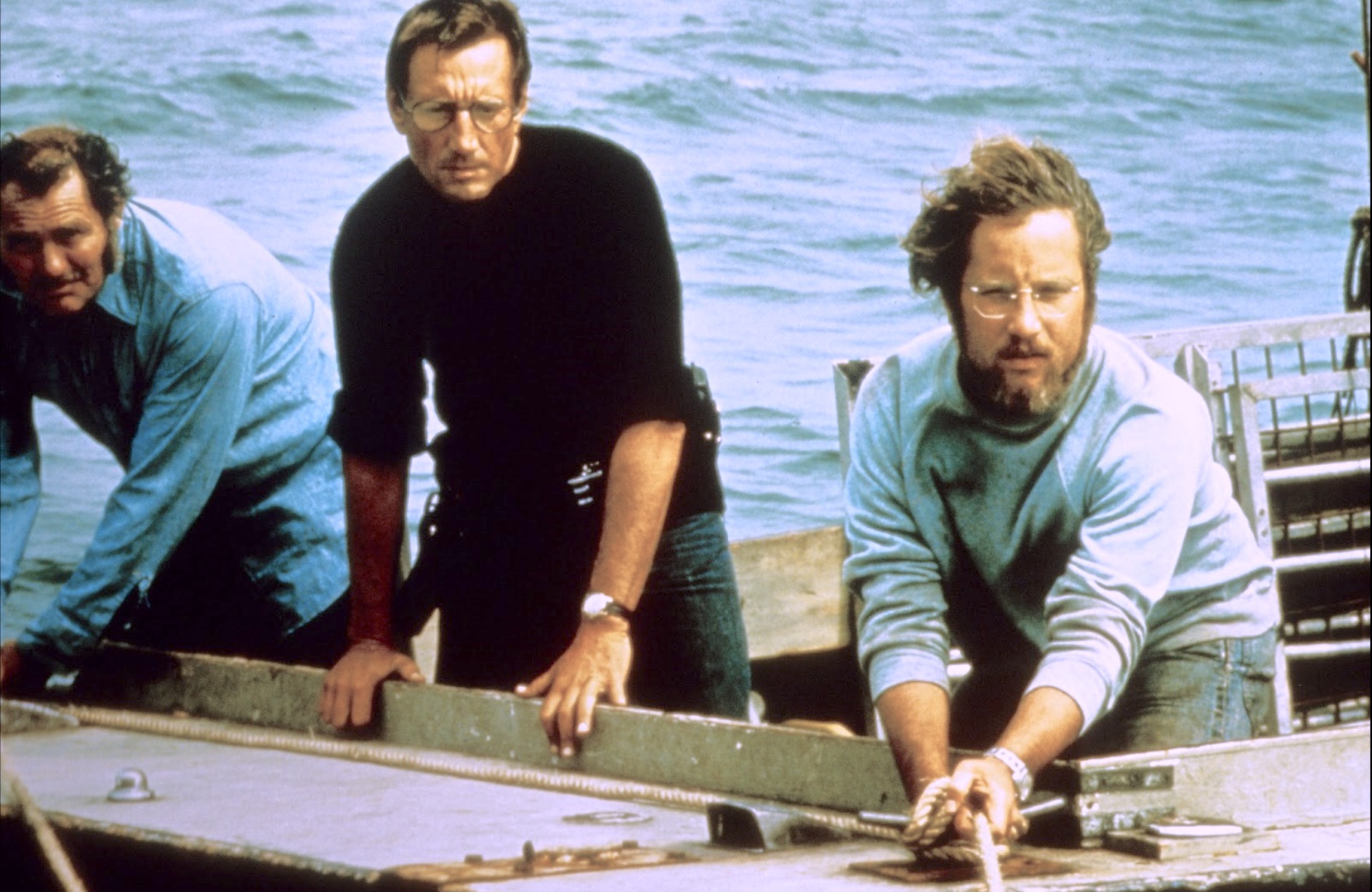
Then there are the later scenes where three men go out on a mission to hunt down the Great White terrorizing the town. It is an elemental story of man vs. nature. The cast thins out with the three primary stars and a big shark playing out a game of cat and mouse on a boat against a vast ocean. It’s an isolating, harrowing undertaking.

Put in these terms, and it feels like an entirely different movie, and yet there’s not a moment when they don’t feel anything but intimately related. A lesser film would have simply shot the second part — extended it — added some more sharks, guts, and explosions, and made it the movie (I haven’t seen the Jaws sequels, so I’m not sure if this formula applies). Although I’m sure this is what drew Spielberg to Peter Benchley’s source material. 

However, this movie is made better by how it builds out an entire world, and we see how it develops the context and creates the stakes and emotional resonance for the entire story.

Scheider is also the only one who can kill that shark in the end. He moved away from the urban jungle to have a quieter life. But the movie calls for him to face this threat head-on, and he does it in an extraordinary way, aided by Richard Dreyfuss and Robert Shaw’s characters.

They both provide two sides of an ethos appeal that lend credence to the evolutionary brutality of this underwater leviathan. Because one represents youthful intellect and scientific know-how of an oceanographer, while the other is a veteran of the sea, grizzled and tenacious. But we know intuitively that the trajectory of the story revolves around Scheider coming face to face with his own fears. It’s inevitable. No one else can save him. 

These words don’t always go together, but Jaws has some delightfully effective expositional scenes. I think of the opening hook where a bunch of young people are on the beach mingling together. The eyes of a young man and woman meet. Then, the camera pulls away as they have their meet-cute. We understand everything without hearing, and the next thing we know, they’re racing off toward the water to skinnydip… 

There’s also the scene where oceanographer Matt Hooper (Dreyfuss) pays a house call. It’s been a tumultuous day, and the police chief has grown introspective, jaded by the day’s events. Hooper awkwardly has two bottles of wine, and he’s wearing a tie. It becomes a scene with the wife talking to the young man, and we learn about both of our leads with this lovely sense of organic humor. 

Then there’s Quint’s moment on the boat one evening, recounting his harrowing experience on the U.S.S. Indianapolis in 1945 on a mission related to the atomic bomb. Ultimately, they were sunk, and many of the survivors were picked off by swarms of sharks in the ensuing hours. An event like that forms a man for life. 

Moments like these are chilling and give the moments of levity even more import. It’s like an escape valve for the tension. Spielberg does an admirable job of choreographing the hubbub of the town with frantic conversations and characters speaking over one another in a manner mirroring real life.

In another scene, Brody is deep in his thoughts, obviously distressed, then, right next to him at the dinner table, his little boy mimics his every move. It’s such an endearing moment of childlike warmth and affection. Or later, a drunken Shaw and Dreyfuss partake in some one-upmanship as they trade tattoo stories gaily after being at one another’s throats for most of the journey. 

Spielberg, at such a young age, already feels adept at creating a total immersive experience in film (You only have to look at his work on Columbo and Duel to see the work he put in before Jaws).

The underwater POV shots from below as human bodies tread above the waterline draw us in, and the notes of John Williams’ score never cease to cause my feet to tense up in my shoes. There are even jump scares I had forgotten about. The cumulative effect is still overwhelming. 

There’s an extraordinary blending of visual compositions that tell us the story succinctly, sprinkled with the kind of humor, exposition, and personal conflict that give the broader drama of Jaws a genuine meaning. Because we are not animals; we are not evolutionary machines. We are embodied creatures. We have hearts, limbs, eyes, voices, and feelings that make us who we are. It’s difficult to extricate ourselves from these realities, and what kind of unfeeling Social Darwinism would that leave us with? 

The Mayor (Murray Hamilton) is a character who is easy to dislike. He does come off as a kind of irrefutable sleaze, and yet when he visits the hospital to give his condolences and reluctantly sign off on Quint’s hunt, he finally makes an admission. His kids were on the beach too, where the attacks happened. For a moment, he is as human as anyone else. 

Because he’s emblematic of a story about locals trying to protect a way of life, and outsiders trying to maintain their own lives somewhere new. It’s a pleasure to watch Jaws and see it not simply as a historical lodestar in the blockbuster age, but 50 years on, it still remains a captivating saltwater thriller showing a young up-and-coming filmmaker on the ascendancy. 

I’ve rarely seen my dad set foot in the ocean during my lifetime. It’s probably coincidental, although Steven Spielberg (and John Williams) might have something to do with this, too. 

5/5 Stars

Close Encounters of The Third Kind (1977): Sci-Fi, Spielberg, and Truffaut

close encounters of the third kind 1.png

Close Encounters is built on a mystery and Steven Spielberg’s follow-up to Jaws starts off in a jarring fashion challenging us to stay with him. Because he quickly throws us into the action and suggests this is a sci-fi tale on a global scale.

Bob Balaban, a cartographer-turned-French translator, speaks for all of us trying to figure out what’s going on, yelling out against whirring old WWII fighter engines, “I don’t understand!” Two lines of juxtaposed dialogue are all we need. The planes were reported missing in 1945. But they look brand new! It takes a moment to tease out the dramatic situation, but there we are. The question is how did this happen? As this is a Spielberg creation, we must point our gaze heavenward or more precisely to the outer reaches of the galaxy.

Francois Truffaut somehow feels like a special piece of casting. The Nouvelle Vague director and hero of Spielberg is cast as Lacombe, a French scientist leading a surprisingly cooperative international team.

It’s not simply because this is the only film he acted in that he didn’t also direct. It has to do with his temperament and the subject matter. There’s something serene and utterly profound about Truffaut. He’s deeply human and engaged and yet feels implacable even as everyone else — the Americans especially — seem frantic and harried. He’s a calming force in a literal maelstrom.

Because Spielberg immediately sets the picture up as not only a national but a global storyline with implications for the entire world. It’s not just higher-ups and government officials covertly working on the issue. Extraterrestrial life would mean potential hysteria, especially for the common man. In this regard, he introduces a few stand-ins.

One is Roy Neary (Richard Dreyfuss). He loves to tinker, isn’t a particularly devoted father or husband, and he’s a staunch believer his kiddos should grow up with the quality entertainment he had as a kid like Pinocchio, instead of vacuous putt-putt games.

If we are to be honest, Dreyfuss can be a perfectly genial hero in something like American Graffiti or even Jaws, but within this narrative, reflected by his family life, he often comes off whiny and obnoxious, and it hurts his rapport with the audience.

In this particular instance, there’s some difficulty in feeling a true human connection with him even as we are drawn and fascinated by what forces he might have witnessed because that is the million-dollar mystery propelling the picture and keeping humanity agog with visions of UFOs and the great unknown of outer space.

Yes, we are planted in the ’70s so if you want to blame his wife (Terri Garr) for not being a particular understanding or his children for being exasperating you can, but today it just makes him out to be a selfish dolt. This isn’t the same whimsy of some of his cinematic predecessors; it just feels like immaturity.

Sadly, without a substantial protagonist, a Hollywood blockbuster like this can feel intermittently detached and impersonal. It’s not based on lack of effort by the director or the actor. We simply don’t like the man.

It’s much more agreeable to stick with the sci-fi elements because this is where the film really has its deepest successes. Special effects hardly feel like a detriment. They are simple and practical casting just enough of a spell to hold up. But they are not there to do all the heavy lifting.

The first encounter happens when Roy is driving down a country road in his truck only to be ambushed by the most spellbinding sight he’s ever witnessed in his life. It’s greater than any Aurora Borealis and sends his car into a state of zero gravity. The only indication he has after the fact of what he’s just seen is a burning sunburn across the side of his face.

From that point on Roy is doggedly firm in his resolve. It’s almost a primordial urge. He has to see the beautiful lights again, he has to understand them, he needs everyone to appreciate them as much as he does.

One person who does is a single mother, Jillian Guiller, whose little boy Barry has some transcendental encounters in the evening hours, drawn to forces outside of himself — the same forces pulling Roy to something unnameable. In fact, they are the same forces Lacombe is so intent on learning more about. It leads his team traipsing around Mexico, India, Mongolia, etc. all on the trail of this great unexplainable mystery.

For Roy, unadulterated obsession sets in. He can’t get the image out of his head. His wife is frightened. His kids think he’s crazy, and they have every right to. He drags all the family out to stare at the sky. He loses his job. He starts shoveling dirt through the kitchen window with the whole neighborhood watching the spectacle.

With his wife driving off in a tizzy, trying to rescue her family from a maniacal husband who needs mental health, he goes back inside. They fail to see the final destination, the symbol so many people have subconsciously remembered. It’s a clue of where our story must travel.

That leads us to a family road trip — at least one my family took while I was in high school. One of the stops was Devil’s Tower, christened the first National Monument by Teddy Roosevelt in 1906. Like Mt. Rushmore in North By Northwest — which I coincidentally saw on the same vacation — Devil’s Tower is an iconic American symbol. Natural and still somehow mystifying even otherwordly. The perfect seat for our finale.

It’s a mesmerizing experience sitting atop Devil’s Tower taking in the bright lights, the musical patterns of communication putting John Williams’ talents to the best possible use. Though it would be lying to say it didn’t verge on monotony in patches, at its very best, Spielberg has an unabashed appreciation for the wide-eyed spectacle and his stroke of genius is taking a very concrete relic and making it so integral to this encounter.

There’s something totem-like, it is a monolith in its own right, and suggests something as ancient as time itself. His other choice is to make the creatures on the other end the most amiable beings imaginable. Years of watching The Thing from Another World and Body Snatchers taught a different paradigm, but Spielberg is an optimist at heart. It shows through and through as the story is carried away by the exponential magic of the final climactic moments.

In many regards, it is a taste. For those still capable of awe where special effects or time or comprehension don’t get in the way of enjoyment, those final moments can indeed be spellbinding. It’s true their trance-like grip reached out to me. The only regret is some of the momentary distractions leading us on this road. It takes a whole lot of roadblocks and digressions to finally get us to our close encounter.

There’s something else nagging inside me. Dreyfuss fulfilled his unerring obsession like an angelic pioneer sent off to the great unknown. He reached the apex as he conceived it. There is nothing more for him to do. Still, one must wonder how exactly are the wife and kids doing at his sister-in-laws? It seems Spielberg has conveniently left the problematic issues of earth behind for the extraterrestrial. Too bad we are not afforded the same luxury.

4/5 Stars


Note: I viewed the Director’s Cut although there is also the previous theatrical cut and the special edition featuring an extended “mothership” scene.

Review: Jaws (1975)

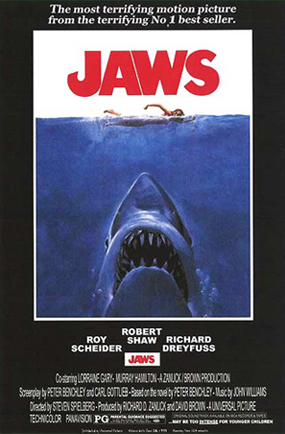
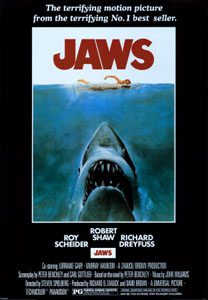
JAWS_Movie_posterAlfred Hitchcock once was quoted as saying, in typical Hitchcockian fashion, “There is no terror in the bang, only in the anticipation of it.” A young Steven Spielberg channeled this type of sentiment when he directed the smash hit and archetypal summer blockbuster Jaws in 1975. It’s still a cultural phenomenon and for good or for bad, it has forever instilled a fear of great white sharks in the general populous.

The film is a man-versus-beast type of story. It starts off on Fourth of July weekend on a New England resort town named Amity. After a girl is found the beach chewed up, it starts a frenzy. Well, not quite initially because although police chief and mainlander Martin Brody (Roy Scheider) wants to shut down the beaches, the local mayor will have nothing of it. Really, the first half of Jaws is very much political, as the mayor attempts to do anything he can to keep the masses flocking to his town because Amity gets all their revenue from the summer months. Meanwhile, Brody has the beaches monitored, but that does not stop a young boy from getting attacked. Up until now, we have only seen the handiwork of the beast, but in a brief instant we can catch a glimpse of him and it is shocking.

The vacationers flee the shoreline, and Brody is left to answer to the boy’s mother since he did not close down the beaches. She holds him responsible. However, Brody’s hands are still tied, especially when local fishermen catch another shark that they assume is the culprit that has terrorizing the town. He is met by a young marine biologist named Matt Hooper (Richard Dreyfuss), who also realizes the gravity of this shark problem. No one will take him seriously except Brody, and Hooper labels him the only other sane man on the island.

Because all the precautions that are taken cannot avoid still another shark attack from going down. And it is at this point that Brody and most certainly the Mayor, have to change things. At a tense news conference, they must walk a fine line in order to assuage the locals and the business owners. Ultimately, Brody convinces the mayor to let him go out with the salty veteran seaman named Quint (Robert Shaw) who agrees to take the shark down for a fee.

For most of us, the second half is what we all remember or at least equate with the film (probably for the iconic line, “We’re going to need a bigger boat.” It is this part of the story that breaks the adventure down to three men, our stars, going off on a mission to take on the terror of a great white (ie. “Bruce”). It feels very Captain Ahabesque, thanks to the addition of the grizzled fisherman Quint, but if he is a stabilizing force it soon becomes obvious that not even he is fully ready to take on this behemoth creature. It seems like no amount of barrels, harpoons, or even a “shark-proof” cage can humble it.

What we end with is utter destruction that spirals out of control. That’s what makes this shark such an intriguing foe because we certainly cannot really call it evil, but it certainly is an overpowering force of nature. Brody stands in for many of us who have an innate fear of the ocean and what lies underneath the surface. For all the plucky young adventurers they have a stand-in in Hooper. I am struck by how tense this film is even to this day, and Spielberg never seems to show is hand too early and he never gives us too much of the shark. Otherwise, it might look faker, and it would lose that heightened anticipation. Above all, John Williams lent a great deal of potency to Jaws, single-handedly, with his ominous score. Without his score, Jaws is nowhere as scary and certainly not as memorable.

5/5 Stars

What About Bob? (1991)

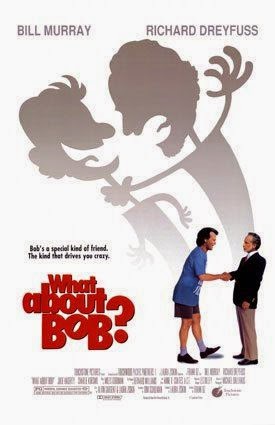
1f90d-what_about_bob_filmI was not sure I would like this film because honestly Bill Murray is not usually one of my favorite actors. However, his portrayal of Bob Wiley, a man with every phobia imaginable, is maybe his most lovable. True, he is annoying and neurotic, but he means well. In many respects he reminds me of Jimmy Stewart as Harvey because both characters were able to captivate most of the people around him. Only with Bob he got under the skin of one man and that man was his psychologist Dr. Leo Marvin (Dreyfuss). Bob tags along on Dr. Leo’s family vacation and that is where the conflict really gets started and the laughs begin. Every moment that the doctor loses his sanity continually builds up  until the stress of Bob is just too much to take! All in all this was a pretty entertaining film and I gained a new found respect for Bill Murray.

3.5/5 Stars

Review: American Graffiti (1973)

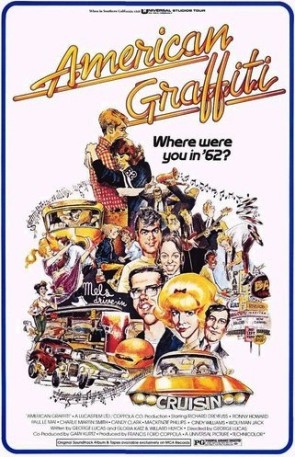
e38f5-americang3 The year was 1962. Cars were cool, the music was hopping, and teens were young and in love. It’s a simpler world, but it is not a world without your typical worries, especially since high school is over and college is just around the corner for some.

Curt (Richard Dreyfuss) is destined for college with a big scholarship under his belt, but he is still not convinced it’s the right fit for him.

Steve (Ron Howard) is also college bound, but he finds himself spending his last night patching things up with his girlfriend, Curt’s sister Laurie (Cindy Williams).

Their friend Toad (Charles Martin Smith) has the night of his life with Debbie (Candy Clark), leaving his puny Vespa behind after Steve’s loans his ride to the lovable geek.

Cool king of the strip John Milner (Paul Le Mat) gains an annoying co-passenger and winds up having an unorthodox but memorable night all the same.

It would be a pleasure to dive further and further into each arc, but it seems wholly unnecessary. The joy of American Graffiti is the ride it takes you on. The differing perspectives, varying experiences, and ultimately, a full realization of a certain time and place. True, I was never around in 1962, but it feels like I was. Some of Buddy Holly’s thunder has been stolen by the Beach Boys. JD (James Dean) is boss and Ozzie and Harriet can be seen on the picture tube. It goes without saying that the hottest pastimes are cruising and necking.

Understandably, George Lucas pulled from his own past love of cars and music to transport us back in time. That would have been impossible without the music that acts as the ultimate jukebox and it is pervasive wherever the night takes us. With that nostalgia comes Wolfman Jack who highlights the lightness of the age while also making a more somber cameo which contrasts with the image that he created on the radio waves.

This is a story about young adolescents, and it certainly is a comedy as life is often a comedy. There are memorable moments, fights, and times where we just need to puke. Through it all we learn a little about ourselves and those around us. Dreams can be made and re-imagined as they were for Steve and Curt. However, when it all comes down to it, each one of us has our own path we must carve an existence out of. For each individual it looked a little different. However, one of the reasons I always come back to American Graffiti is the timelessness or rather the way it so wonderfully freezes time. I feel like I’m there in the moment with these characters. I laugh, cheer, and empathize with them. Perhaps the time and place of their world differs from mine, but their worries and aspirations are universal.

No one wants to fade into the past and we all are looking for our girl in the white T-Bird. Only time will tell what actually happens. We just have to live life and see what kind of ride we get taken for.

5/5 Stars

American Graffiti (1973)

Starring Ron Howard and Richard Dreyfuss with a host of others, this George Lucas directed film follows the lives of young people in California during the early 60s. It is the night before Curt and Steve are going off to college. They both want to make the most of the time left. However, Steve spends all his time trying to strengthen his relationship with his girlfriend (Cindy Williams). Curt, on the other hand, finds himself out in the town talking with girls and proving himself to a group of thugs. The rest of the film consists of the hot rodding antics of two other characters. A tough speedster (Paul Le Mat) finds himself driving around a 12-year-old girl. “Toad” the nerdy one (Charles Martin Smith), finds himself spending a wild night with a nice but peculiar girl.

With its classic music accompanied by Wolfman Jack and the vintage cars, American Graffiti is a blast of nostalgia that allows us to remember simpler times. It takes this important day in the life of these young individuals and it allows us to be a part of it. Each character has his own experiences that cause them to grow. Toad matures, Curt realizes he must experience college, Steve learns the importance of his girlfriend, and Milner realizes he really does not want to be “The King” anymore.

This film may have slower parts but that just makes it more enjoyable because then the night kicks into high gear when Toad loses the car, Milner beats up the thugs, or Curt has visions of a blonde in a T-Bird. Fittingly as he flies away to his unknown future he sees her white car cruising down the road. It was something that I had wanted to see the first time around but I had seemingly missed it. It made the ending even better.

5/5 Stars

Jaws (1975)

This is arguably the first great modern blockbuster and it had such a tremendous cultural impact. Who knew a rogue shark, a wonderfully chilling score, and an isolated setting off the east coast could send so many shivers up the spines of audiences. Jaws is the classic man vs. nature story and proves how deadly it can turn out.

*May Contain Spoilers

The movie that kept millions of people from going in the Ocean in the 70s, Jaws tells of a shark terrorizing a tourist trap off the coast of Massachusetts. The policeman (Roy Scheider) must team up with a marine scientist (Richard Dreyfuss), and a hunter (Robert Shaw) to bring down the monster. Together they embark to try to hunt down and kill this menace of the deep. Little do they know how dangerous this creature is. When they finally meet they are in for a few unpleasant surprises. It is evident that either man or best must win or die. There is no compromise when man goes up against shark. This early Speilberg film was a glimpse of good thing to come and successfully began his great career.

5/5 Stars