Jaws (1975) at 50

I remember my dad telling a story about the first time he saw Jaws back in 1975, now 50 years ago. He was on a road trip visiting a childhood friend in the Midwest, and though he had spent all his life in California, he was grateful to be in a place that was landlocked when the movie came out. 

If my dad was representative of the general populous, this reaction was not unusual, and for any number of reasons, Jaws was a true cultural phenomenon. It changed the playbook of what a movie could be as a summer blockbuster, even as Steven Spielberg willfully built off the formula of Alfred Hitchcock while bringing his own youth and flair for storytelling to the fore.

It struck me watching the film this time how it is really split into two sections. There are the scenes in the island getaway town of Amity where Police Chief Martin Brody (Roy Scheider) is introduced as a New York City transplant (Coincidentally, it’s convenient to read The French Connection as a bit of backstory). We soon get a sense of his family life, his happy marriage with his better half (Lorraine Gary), and the small-time responsibilities that come with the incoming tourist trade. He also hates the water…

These are the throes of summer, on the verge of the July 4th weekend, and a town like this thrives and even relies on out-of-town business. The first inkling of a shark attack comes when the mangled body of a young woman is found washed up on the shore.

Then, there’s the moment for all time when Brody tries to relax in the arms of his wife on the seashore, only to see an ominous creature emerge from the water and confirm all his worst fears.

A friend pointed out how Spielberg pays homage to Hitchcock with the “Vertigo Effect” or dolly zoom, which gives us as an audience such a perturbing sensation as we are physically reeled into the moment. From then on, it’s not just a threat, but a battle that Brody must wage, dealing with the local repercussions, backroom politics, and general hysteria that gets dredged up in the face of such a news story. As the police chief, it feels like the weight of the whole fiasco falls on him, and what’s worse is that he has so little support.

It all comes to a head when a grieving mother (Lee Fierro) confronts him with a public slap to the face: She found out he knew about the shark threat, and he still kept the beaches open. We know what actually happened, but still, as a beacon of safety, it falls on him, and he internalizes the outrage. Because he has a conscience and a family, too. 

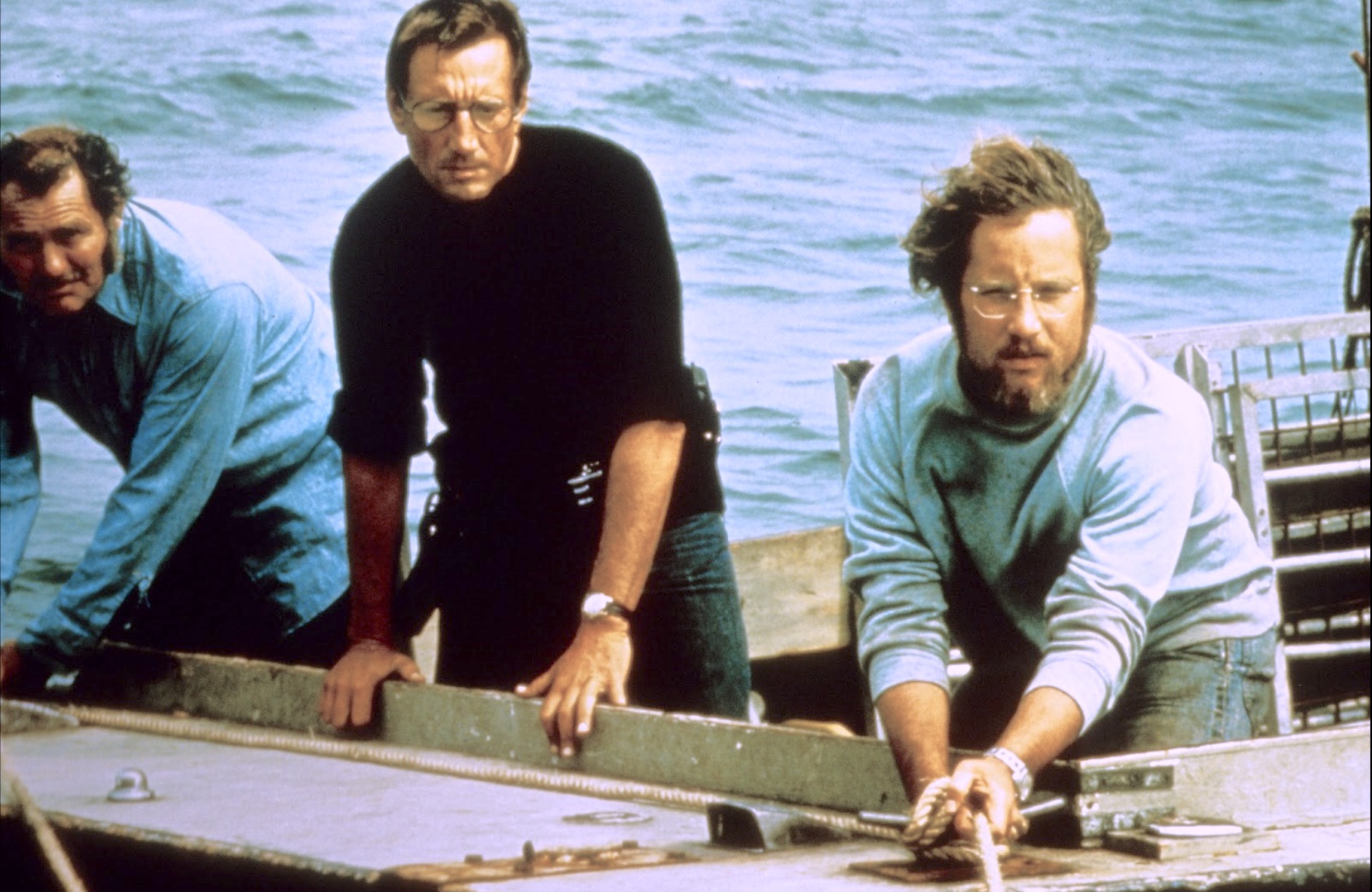
Then there are the later scenes where three men go out on a mission to hunt down the Great White terrorizing the town. It is an elemental story of man vs. nature. The cast thins out with the three primary stars and a big shark playing out a game of cat and mouse on a boat against a vast ocean. It’s an isolating, harrowing undertaking.

Put in these terms, and it feels like an entirely different movie, and yet there’s not a moment when they don’t feel anything but intimately related. A lesser film would have simply shot the second part — extended it — added some more sharks, guts, and explosions, and made it the movie (I haven’t seen the Jaws sequels, so I’m not sure if this formula applies). Although I’m sure this is what drew Spielberg to Peter Benchley’s source material. 

However, this movie is made better by how it builds out an entire world, and we see how it develops the context and creates the stakes and emotional resonance for the entire story.

Scheider is also the only one who can kill that shark in the end. He moved away from the urban jungle to have a quieter life. But the movie calls for him to face this threat head-on, and he does it in an extraordinary way, aided by Richard Dreyfuss and Robert Shaw’s characters.

They both provide two sides of an ethos appeal that lend credence to the evolutionary brutality of this underwater leviathan. Because one represents youthful intellect and scientific know-how of an oceanographer, while the other is a veteran of the sea, grizzled and tenacious. But we know intuitively that the trajectory of the story revolves around Scheider coming face to face with his own fears. It’s inevitable. No one else can save him. 

These words don’t always go together, but Jaws has some delightfully effective expositional scenes. I think of the opening hook where a bunch of young people are on the beach mingling together. The eyes of a young man and woman meet. Then, the camera pulls away as they have their meet-cute. We understand everything without hearing, and the next thing we know, they’re racing off toward the water to skinnydip… 

There’s also the scene where oceanographer Matt Hooper (Dreyfuss) pays a house call. It’s been a tumultuous day, and the police chief has grown introspective, jaded by the day’s events. Hooper awkwardly has two bottles of wine, and he’s wearing a tie. It becomes a scene with the wife talking to the young man, and we learn about both of our leads with this lovely sense of organic humor. 

Then there’s Quint’s moment on the boat one evening, recounting his harrowing experience on the U.S.S. Indianapolis in 1945 on a mission related to the atomic bomb. Ultimately, they were sunk, and many of the survivors were picked off by swarms of sharks in the ensuing hours. An event like that forms a man for life. 

Moments like these are chilling and give the moments of levity even more import. It’s like an escape valve for the tension. Spielberg does an admirable job of choreographing the hubbub of the town with frantic conversations and characters speaking over one another in a manner mirroring real life.

In another scene, Brody is deep in his thoughts, obviously distressed, then, right next to him at the dinner table, his little boy mimics his every move. It’s such an endearing moment of childlike warmth and affection. Or later, a drunken Shaw and Dreyfuss partake in some one-upmanship as they trade tattoo stories gaily after being at one another’s throats for most of the journey. 

Spielberg, at such a young age, already feels adept at creating a total immersive experience in film (You only have to look at his work on Columbo and Duel to see the work he put in before Jaws).

The underwater POV shots from below as human bodies tread above the waterline draw us in, and the notes of John Williams’ score never cease to cause my feet to tense up in my shoes. There are even jump scares I had forgotten about. The cumulative effect is still overwhelming. 

There’s an extraordinary blending of visual compositions that tell us the story succinctly, sprinkled with the kind of humor, exposition, and personal conflict that give the broader drama of Jaws a genuine meaning. Because we are not animals; we are not evolutionary machines. We are embodied creatures. We have hearts, limbs, eyes, voices, and feelings that make us who we are. It’s difficult to extricate ourselves from these realities, and what kind of unfeeling Social Darwinism would that leave us with? 

The Mayor (Murray Hamilton) is a character who is easy to dislike. He does come off as a kind of irrefutable sleaze, and yet when he visits the hospital to give his condolences and reluctantly sign off on Quint’s hunt, he finally makes an admission. His kids were on the beach too, where the attacks happened. For a moment, he is as human as anyone else. 

Because he’s emblematic of a story about locals trying to protect a way of life, and outsiders trying to maintain their own lives somewhere new. It’s a pleasure to watch Jaws and see it not simply as a historical lodestar in the blockbuster age, but 50 years on, it still remains a captivating saltwater thriller showing a young up-and-coming filmmaker on the ascendancy. 

I’ve rarely seen my dad set foot in the ocean during my lifetime. It’s probably coincidental, although Steven Spielberg (and John Williams) might have something to do with this, too. 

5/5 Stars
Review: The French Connection (1971)

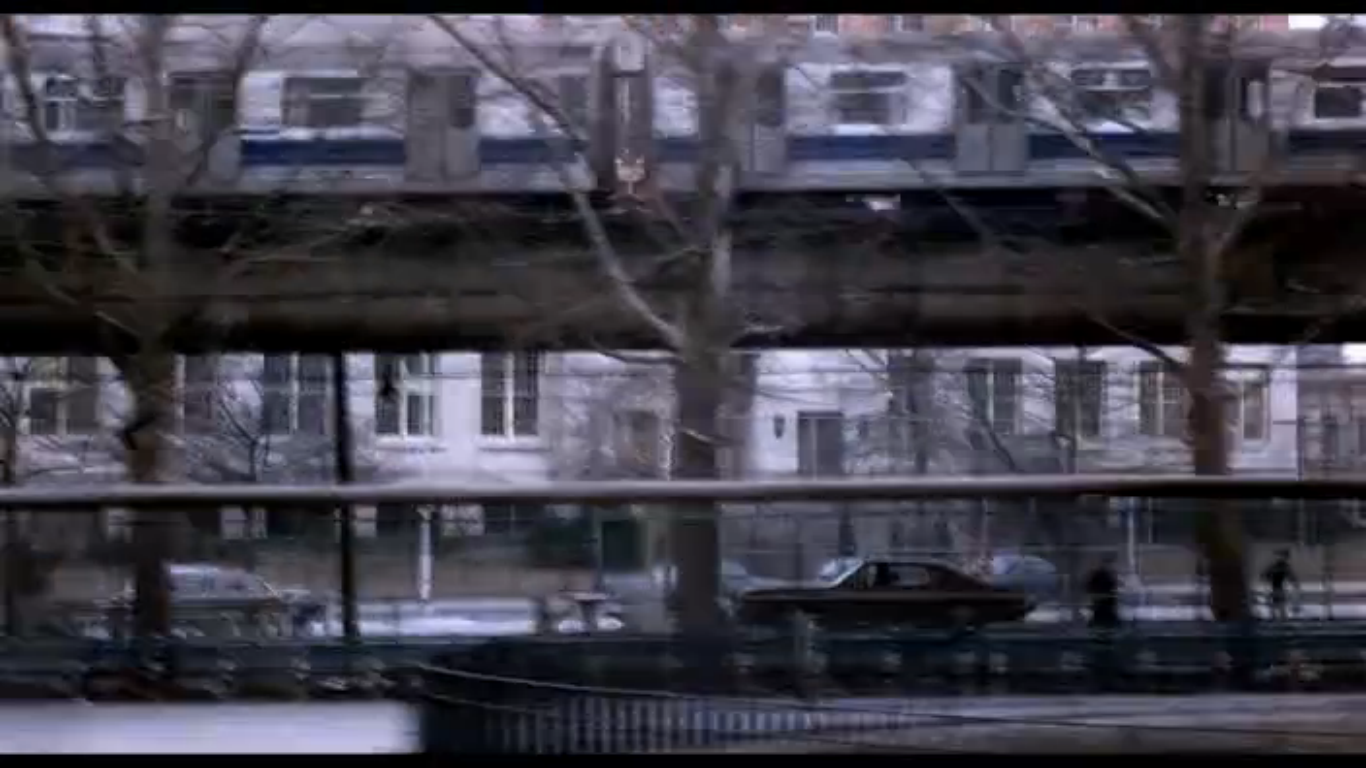
frenchcon5There is a pervading gritty realism to William Friedkin’s French Connection that undoubtedly took some cues from the French New Wave and the Neorealist movements. Hand-held cameras are taken to the streets of New York and to the train terminals. There is literally trash piling up in the gutters, old dilapidated bathroom stalls, and worn out facades all over the city. It’s urban, depressed, and a place of crime. In many ways this film is like Bullitt for New York, in fact, Steve McQueen was even offered the lead.

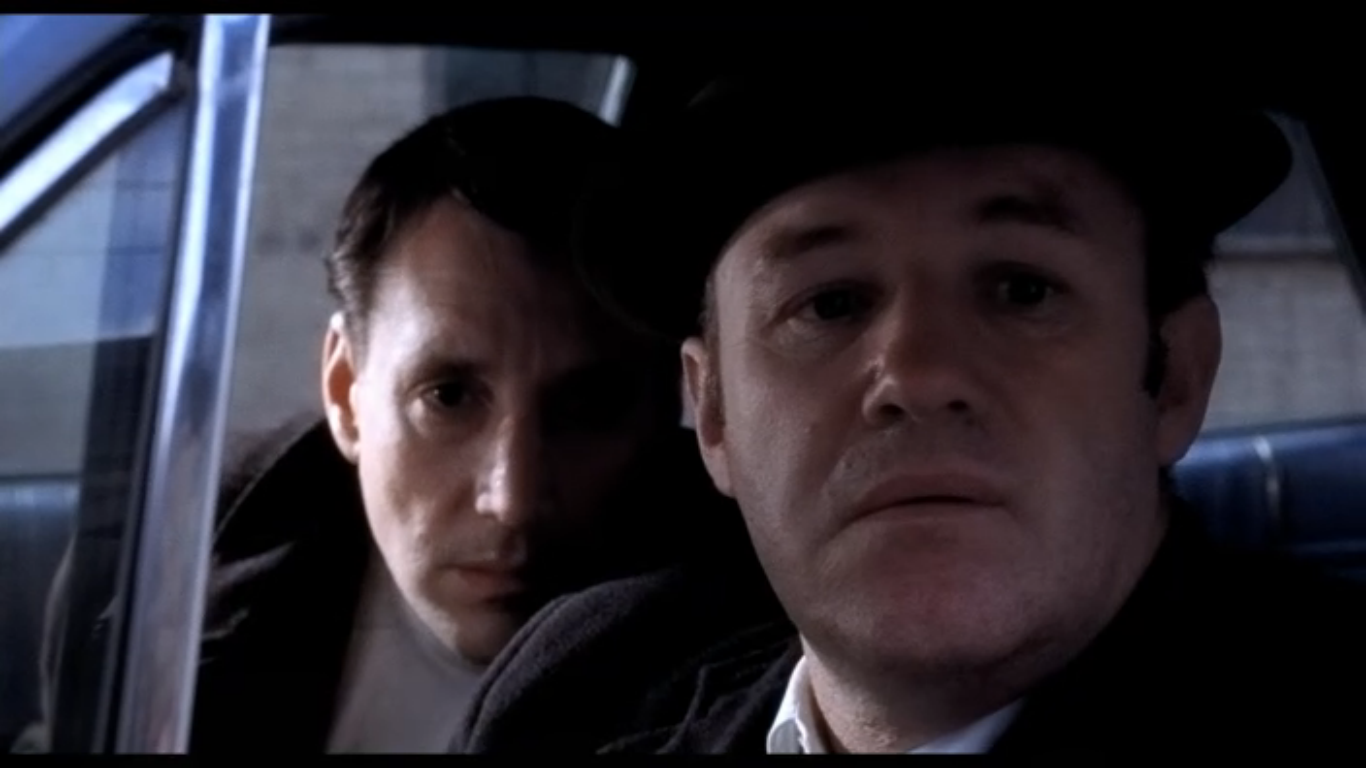
However, this time around our main cop is Popeye Doyle (played by Gene Hackman) and his partner Cloudy Russo (Roy Scheider). Both play a key role, but Popeye (the man with the hat) is of the greater interest. He’s a wise guy, belligerent, barking, loud-mouthed hot head, often driven by obsession in his job. He also happens to be an undercover cop in the narcotics division. He’s used to getting dirty and using the rough stuff when necessary. After all, it’s a jungle out there and there’s no room for pushovers.

From the get-go, we come to understand that this story has a French Connection, in Marseilles to be exact, and we know who is involved (Fernando Rey). We just cannot quite pick out all the details. Simultaneously, on a hunch, Doyle and Russo start running surveillance on a guy they happen upon in a club. Things don’t quite add up since he runs a deli called Sal and Angie’s by day and lives it up at night. An undercover informant also tips Popeye off to a big shipment of heroin that’s coming in.

frenchcon9Sal Boca has to be into something and so a game of tailing begins on the streets after he and his French contacts are spotted together. Frog 1 named Charnier (Rey) has Popeye on his tail only to shake him adeptly. That’s only the beginning, however, after a sniper comes after Popeye and yet another chase ensues. The fugitive boards a train and Doyle commandeers a car to follow close behind. Thus, was born one of the greatest car chases of all time and it doesn’t even involve two cars. After the adrenaline of that moment has worn off Doyle and Russo are on another stakeout and this time impound a car belonging to frog # 2 Henri Devereaux. Popeye has a gut feeling that the vehicle’s dirty and they literally tear it apart end to end, with little luck. But he’s a force of nature and very little will get in the way of his obstinate drive.

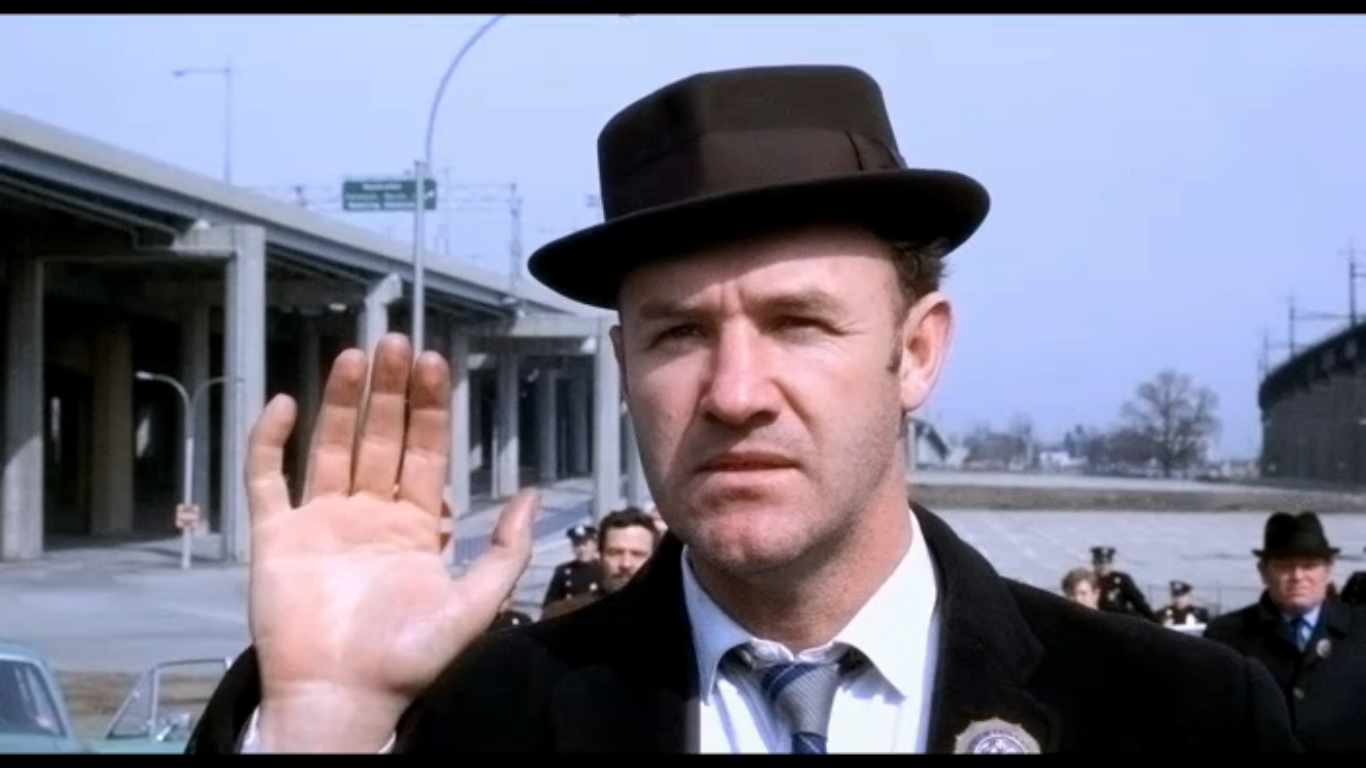
frenchcon11When the drop finally takes place everything goes off smoothly enough, but there’s a roadblock, and Popeye is waiting for them with a playful wave. He’s got them now. The final roundup leads him into an old warehouse as the hunt continues, but The French Connection finishes open-ended. Sal was gunned down, the meeting was busted, but not everyone was caught, and Charnier seems to have vanished into thin air. To top it off, Doyle shoots the wrong man and without flinching continues his obsessive hunt.

Friedkin’s film was partially based on true events from the 1960s and the two men the story was patterned after actually are featured as the boys’ superior Walt Simonson (Eddie Egan) and federal agent Bill Mulderig (Bill Hickman), who has a longstanding dislike for Doyle. Their presence in the production of this film helps to lend to the realism and nuances that the film is able to take on. The score isn’t all that noticeable, but it’s a tense arrangement that adds some underlining anxiety to some scenes. Stakeouts get more interesting than you would ever give them credit for. Really on the simplest level, this film is about one man’s hunt, his obsessive chase, which at times no longer seems about justice at all, but personal vindication.

4.5/5 Stars

Review: Jaws (1975)

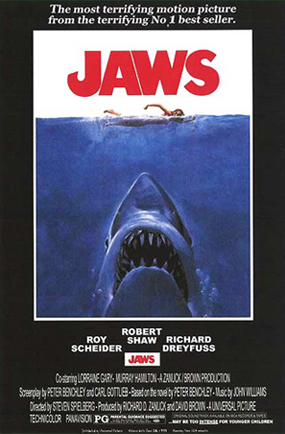
JAWS_Movie_posterAlfred Hitchcock once was quoted as saying, in typical Hitchcockian fashion, “There is no terror in the bang, only in the anticipation of it.” A young Steven Spielberg channeled this type of sentiment when he directed the smash hit and archetypal summer blockbuster Jaws in 1975. It’s still a cultural phenomenon and for good or for bad, it has forever instilled a fear of great white sharks in the general populous.

The film is a man-versus-beast type of story. It starts off on Fourth of July weekend on a New England resort town named Amity. After a girl is found the beach chewed up, it starts a frenzy. Well, not quite initially because although police chief and mainlander Martin Brody (Roy Scheider) wants to shut down the beaches, the local mayor will have nothing of it. Really, the first half of Jaws is very much political, as the mayor attempts to do anything he can to keep the masses flocking to his town because Amity gets all their revenue from the summer months. Meanwhile, Brody has the beaches monitored, but that does not stop a young boy from getting attacked. Up until now, we have only seen the handiwork of the beast, but in a brief instant we can catch a glimpse of him and it is shocking.

The vacationers flee the shoreline, and Brody is left to answer to the boy’s mother since he did not close down the beaches. She holds him responsible. However, Brody’s hands are still tied, especially when local fishermen catch another shark that they assume is the culprit that has terrorizing the town. He is met by a young marine biologist named Matt Hooper (Richard Dreyfuss), who also realizes the gravity of this shark problem. No one will take him seriously except Brody, and Hooper labels him the only other sane man on the island.

Because all the precautions that are taken cannot avoid still another shark attack from going down. And it is at this point that Brody and most certainly the Mayor, have to change things. At a tense news conference, they must walk a fine line in order to assuage the locals and the business owners. Ultimately, Brody convinces the mayor to let him go out with the salty veteran seaman named Quint (Robert Shaw) who agrees to take the shark down for a fee.

For most of us, the second half is what we all remember or at least equate with the film (probably for the iconic line, “We’re going to need a bigger boat.” It is this part of the story that breaks the adventure down to three men, our stars, going off on a mission to take on the terror of a great white (ie. “Bruce”). It feels very Captain Ahabesque, thanks to the addition of the grizzled fisherman Quint, but if he is a stabilizing force it soon becomes obvious that not even he is fully ready to take on this behemoth creature. It seems like no amount of barrels, harpoons, or even a “shark-proof” cage can humble it.

What we end with is utter destruction that spirals out of control. That’s what makes this shark such an intriguing foe because we certainly cannot really call it evil, but it certainly is an overpowering force of nature. Brody stands in for many of us who have an innate fear of the ocean and what lies underneath the surface. For all the plucky young adventurers they have a stand-in in Hooper. I am struck by how tense this film is even to this day, and Spielberg never seems to show is hand too early and he never gives us too much of the shark. Otherwise, it might look faker, and it would lose that heightened anticipation. Above all, John Williams lent a great deal of potency to Jaws, single-handedly, with his ominous score. Without his score, Jaws is nowhere as scary and certainly not as memorable.

5/5 Stars

The French Connection (1971)

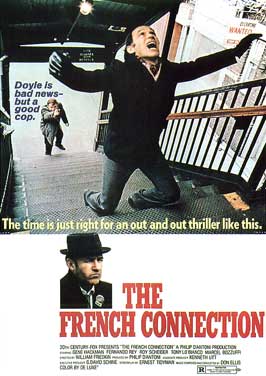
af50c-thefrenchconnectionIn this crime thriller starring Gene Hackman and Roy Scheider, two detectives, Popeye Doyle and Cloudy Russo, work the grimy, tough streets of Brooklyn. They think they have happened upon a narcotics job and they use tapping and tailing to close in on the suspicious activity with a french connection. With no real results, they get pulled off the special assignment. That all changes after an unexpected twist followed by a wild chase. Doyle and his partner are finally close to cracking the case but it still takes more work and even more waiting. Finally, they seem to have the culprits but it ends far from perfectly for them. Up to the end Doyle is bent on finding “the frog” who has eluded him for so long. The ending felt a little too abrupt for my liking. However, this film did a good job at portraying the ugly and dirty side of New York realistically.

4.5/5 Stars