It Happened One Night (1934)

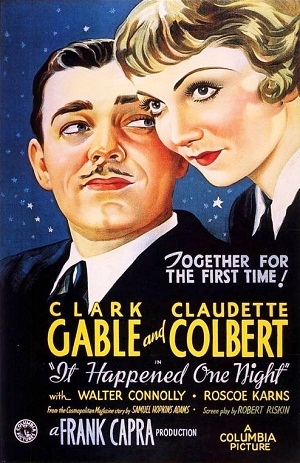
Gable_ithapponepm_posterStarring Clark Gable and Claudette Colbert with director Frank Capra, this light romance pits a sunk newspaper man with a dissatisfied socialite. Colbert feels stuck in her life with a domineering father who does not approve of her marriage, and so she runs off to get away. While on a bus she meets the recently fired Peter (Gable) and there is immediate friction between them. However, realizing she is inexperienced, Peter watches out for her and they travel together. Finding out who she is, he is even more driven to get a story and stay with her. Along the way Colbert begins to fall in love but he does not immediately react. When he finally realizes his true feelings, the situation becomes complicated when Colbert returns to her father and fiancee. In the midst of the wedding she hears of Peter’s true love and runs off to him. By that evening they are married and the “walls of Jericho” come tumbling down. Gable and Colbert both do well in this film and Capra gives us another light classic.

5/5 Stars

The More The Merrier (1943)

e0052-the_more_the_merrier_-_posterDirected by George Stevens and starring Jean Arthur, Joel McCrea, and Charles Coburn, this comedy makes light of the housing shortage in Washington D.C. during WWII. Retired millionaire Benjamin Dingle comes to D.C. as an adviser for the housing crisis. Unfortunately he cannot find a place to stay right away. By chance he happens upon an ad for a room the only thing is that the other tenant is a young woman. Mr. Dingle will not take no for an answer and despite her misgivings she agrees to let him stay. It soon proves to be a hilarious situation and it gets even more complicated when Dingle rents half of his half to a Sergeant Joe Carter who is about to ship out. Of course he doesn’t tell Connie. There is initial conflict however Dingle tries to play matchmaker. The only problem is that Connie is already engaged to a bureaucrat. Then Dingle oversteps his boundaries reading Ms. Milligan’s diary to Joe. Dingle accepts the responsibility and leaves but Connie allows Joe to stay since he will be gone soon. Through a series of events the newspaper gets a hold of the situation so Mr. Dingle advises them to get married to stop a scandal. As Joe gets ready to leave they realize they really do care for each other and Dingle was right Connie finally gave into her true feelings. All the main players were good and I think Charles Coburn was really the standout because he was the character who kept the whole story together. As is his motto, “Damn the torpedoes, full speed ahead.”
 
4.5/5 Stars

His Girl Friday (1940)

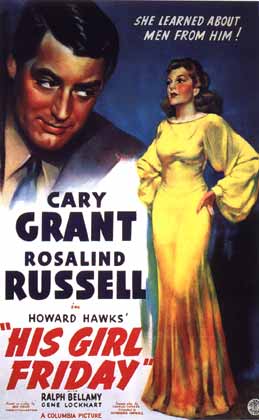
30c9f-his_girl_friday_posterStarring Cary Grant and Rosalind Russell with direction by Howard Hawks, this film’s rapid and overlapping dialogue helps make it a witty comedy romance. Walter Burns (Grant) is a newspaper editor who was formally married to Hildy Johnson (Russell). However, now they are no longer together and she is on the verge of marrying another man (Ralph Bellamy). Grant still loves her and tries all the tricks he knows in order to get her back. Soon the two of them are deeply involved in a story having to do with a man who is soon to be hung. As they work to get the scoop, the two of them slowly begin to realize they still love each other despite their differences. Finally, Russell rejects a normal life with her new fiancee and she and Grant unite once again. A directing legend, Hawks has another success with the screwball comedy. Grant and Russell play well off each other and they have a good supporting cast behind them.

This film is a sensory overload with words whizzing by so fast that you hardly have time to catch them. But what you do pick up is great and the overlapping, rapid fire dialogue is delivered so effectively by the entire cast, including Grant and Russell. Russell takes on the persona of the independent career woman prevalent in the late 30s and early 40s. As such she knows how to trade blows with the boys in the newsroom and she delivers a spirited performance to counter Grant’s constant conniving and tricks in his sly attempt to win her back. Aside from the main stars, the film has a brilliant set of stock characters and the dialogue is such that it seems like it would be a joy to read the script. There is the self-referential humor to Ralph Bellamy, then to a Mock Turtle as well as Archie Leach. The first is Grant’s role in Alice in Wonderland and the second is his real name. The film even has time to deal a few jabs to Hitler, Communists, and most especially the newspaper industry. All in all His Girl Friday is a comedic whirlwind but it is a pretty good piece of mayhem.

4.5/5 Stars

Bringing Up Baby (1938)

In this mile-a-minute screwball comedy directed by Howard Hawks, Cary Grant is forced to deal with Katharine Hepburn’s ditsy socialite character. A Paleontologist (Grant) has been trying to assemble a dinosaur but he is missing a bone. On top of that Huxley is about to enter into an unhappy marriage and he also must impress a museum donor. The next day he meets a socialite (Hepburn) by accident and through a mix up he finds himself being taken to her home in order to help take care of a tame leopard named Baby. In the following chaos a dog buries the bone needed for the dinosaur, visitors come, Baby runs away, a wild leopard is on the loose, and the free-spirited girl finds herself falling for “Mr. Bone.” To complicate matters, the pair wind up in jail trying to explain their story to a quirky constable. In the end everything works out and despite the craziness, Huxley realizes he cannot live without this girl. This may not be  my favorite screwball comedy, but I would say it definitely is the zaniest and that stands for something.

4/5 Stars

The Awful Truth (1937)

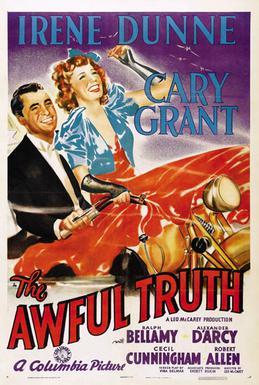
99f81-theawfultruth1937Starring Irene Dunne and Cary Grant, the film revolves around a couple after they split up over unfounded assumptions of unfaithfulness. The divorce is granted and after the wife gains custody of the beloved dog Mr. Smith, the 90 day waiting period begins. First she tries to get over him by spending time with a kind but dimwitted man from Oklahoma. Then Grant gets involved, and at first he gets enjoyment seeing his wife uncomfortable, but he soon becomes a bit jealous and sad. He then takes up his own relationship with an heiress and on the eve of their divorce they seem to be parting ways. However, Dunne’s character will not let it end that easily and she poses as his sister, eventually getting him away from his fiancee. Needless to say that in the end they get back together. This screwball comedy has very funny dialogue and Grand does some wonderful slapstick. It probably is one of my favorites from the genre.

4.5/5 Stars

The Palm Beach Story (1942)

06b18-the_palm_beach_story_postrStarring Claudette Colbert and Joel McCrea with direction by Preston Sturges, the film opens with the chaotic marriage of a couple. As the story progresses we learn they are essentially broke because the husband is a lowly architect and his wife cannot do much anything. She resolves to divorce him so that he will not have to support her. She makes her way to Palm Beach by train, using her feminine charm on many men. One such millionaire is especially smitten with her. Despite his awkwardness, she continues the relationship as she wants to send money to her husband so his airport can be built. However, things get complicated when her husband comes for her and the millionaire’s chatterbox sister comes to visit as well. In order to save face Colbert’s character introduces him as her brother. Now her husband is being pursued by another woman and she is close to being proposed to. Finally, she explains what is going on leaving the brother and sister disappointed. However, there is still hope thanks to a hilarious coincidence. The film ends with there beautiful simultaneous wedding ceremonies. Preston Sturges definitely has a knack for the quirky dialogue and situations. I have to say I personally enjoyed the Lady Eve and Sullivan’s Travels more but this film was certainly all over the place.
 
4/5 Stars

The Lady Eve (1941)

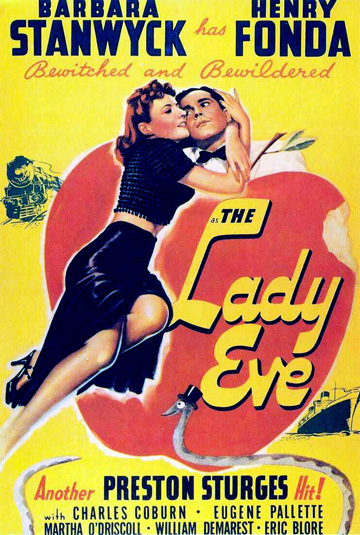
Starring Henry Fonda and Barbara Stanwyck with director Preston Sturges, this screwball comedy is a good one. The supporting cast is rounded out wonderfully by Charles Coburn, Eugene Pallete, and William Demarest. The story begins on a big ocean liner where a beautiful young woman (Stanwyck) tries to pull a con on a naive, rich bachelor (Fonda). Slowly however they begin to fall in love and they plan to get married. He catches wind of her notoriety and becomes cold and that ends their relationship. In an act of revenge she poses as someone’s niece, a Lady Eve, so that she can be close to him. Through a series of events he thinks she is a different person who looks similar and over time they decide to get married. When Eve tells him about all her boyfriends he feels he has made a mistake. Back on the ship he is ecstatic to see the first girl and they embrace. Fonda’s character feels guilty because he is already married but then again she is too…to him. This film has a great combination of wit and slapstick which makes it an enjoyable classic.

4.5/5 Stars

Ball of Fire (1941)

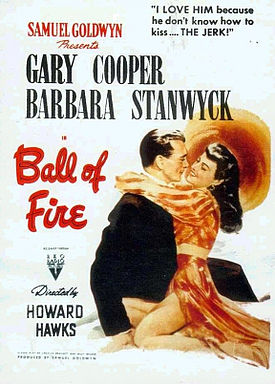
a5490-ball_of_fire_movie_posterStarring Gary Cooper and Barbara Stanwyck, the film revolves around a young man (Cooper) and seven older intellectuals compiling a Encyclopedia who get involved with a burlesque dancer (Stanwyck). They are interested in her constant use of slang and she is happy to use them as a cover to avoid the cops while she waits for her gangster boyfriend. However, things take a turn when the young man falls for her and proposes. Little does he know they are being used until they unknowingly transport her back to the gangster. He feels betrayed and she realizes her love for the corny intellectual. Although they are held by the gangster’s thugs, the intellectuals join their wits to overcome their foe. In the nick of time they stop the marriage and the true loves get back together. Howard Hawks directs a nice combination of humor and romance. The story by Billy Wilder, is Snow White and the Seven Dwarfs with some major twists.

4.5/5 Stars

Ninotchka (1939)

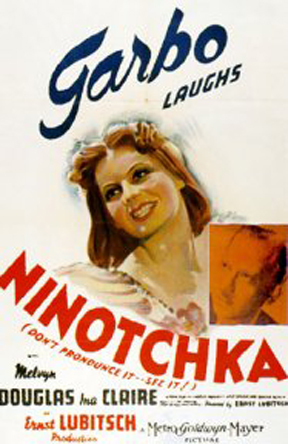
e937e-film_ninotchkaStarring a cast including Greta Garbo and Melvyn Douglas with director Ernst Lubitsch, the film opens in Paris with three quirky Soviet Russians. They are sent to sell some jewels and at the same time to marvel at the capitalist society. Their curt, robotic, and serious comrade arrives to help them. She meets a Parisian playboy and seriously hopes to learn about his society.  However, after he finally makes her laugh the two of them become romantically involved. A jealous duchess manipulates the situation and Ninotchka is back in Moscow. She is reunited with her friends there but still is somber because she is no longer with her love. That changes quickly enough though. Lubitsch gives us another witty comedy that plays off the conflict between ideologies and cultures. Garbo, Douglas, and the three Russians are all likable characters that help make this film fairly good.


4/5 Stars

Mr. Deeds Goes to Town (1936)

Starring Gary Cooper and Jean Arthur with director Frank Capra, this film follows a man from a small town who is left $2 million by a dead relative. Longfellow Deeds is thrust into a life in New York where everyone wants his attention in order to get money and support. However, this man they took for a stooge has common sense and grows fed up with them all. The only person he talks to is Arthur’s character who is actually a reporter. While she writes damaging articles, they slowly begin to fall for each other. He finds out what she did and eventually decides to give his money away. Fortune hunters try to claim he is crazy and they bring their case to court. Initially Deeds does not defend himself, but when his love speaks on his behalf he changes his mind and fights for his cause. Capra was wonderful at making the feel good films about the common man. Here he does it once again in a precursor to Mr. Smith Goes to Washington and Meet John Doe.

4.5/5 Stars