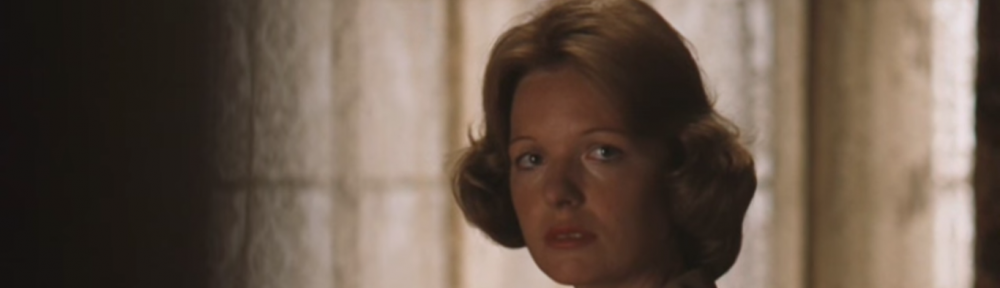
 In one sense Blackmail proves to be a landmark in simple film history terms but it’s also a surprisingly frank picture that Hitchcock injects with his flourishing technical skills. It’s of the utmost importance to cinema itself because it literally stands at the crossroads of silent and talking pictures and holds the distinction of being one of Britain’s first talkies.
So close did it ride the lines, in fact, that two versions were released. It was initially supposed to be a full-fledged silent until it was requested that Hitchcock update the production to follow the tides of the times.
Far from being hampered by the transition, Hitch takes everything in stride and delivers a story that is pure cinema. It means simply that the film functions as a visual narrative. Still partially silent, yet using dialogue, and utilizing all the tools at his disposal to develop the greatest impact to reach his audience.
The story is simple really, about a young woman named Alice (Anny Ondra, future wife of German boxing icon Max Schmeling) who’s having a bit of a rough time with her boyfriend who’s on the police force. Still, she’s trying to make it work but another man has taken her fancy. He’s an artist and he uses the excuse of showing her his work as a pretense to get her up in his room. We all have an inclination of what might happen next. She’s taken advantage of and Alice has no recourse but to defend herself.
A conniving low-level conman is looking for an easy bit of blackmail and the policeman goes to great lengths to protect his girl but she herself is struggling with her guilt with what happened. Her nerves cannot take the constant strain because she was never meant for such circumstances. She’s hardly a bad person. In fact, she has no reason to feel remorse because, in the film’s candid portrayal of the artist’s less than honorable intentions, it’s easy to sympathize with Alice.
What makes the picture extraordinarily refreshing is that Hitch never relies too heavily on dialogue although it was the newest technology. He seems to already have an intuitive sense of how it can be used in cadence with the moving image. He can still make a film that for sequences is much like a silent picture and far from detracting from the story he is developing it further. It only serves to bring out more of the story whether it be the atmosphere or certain amounts of character development.
The local gossip chattering on and on about the murder and how she would never use a knife no matter the provocation but we are also privy to the young woman’s reaction shots as the word “knife” reverberates through her consciousness. Even in that moment, the dialogue underlines her inherent guilt and the further moral dilemma she has been put in.
Hitchcock’s already resorting to using memorable locales, in this case, The British Museum to make his chase sequences pop with character. You might say this is even an obvious precursor to Vertigo (1958) with a chase sequence that takes off across the rooftops of the museum.
But the ending comes with a bit of fateful luck that’s simultaneously darkly comic in quintessential Hitchcock fashion. It’s the perfect punctuation on a film that spun on an unfortunate split second altercation and it just as easily fell back on track with another such moment of good fortune. It’s the director’s way of teasing his audience in a sense and he’s very good at it — mingling murder with wit.
3.5/5 Stars
 What’s striking about Alfred Hitchcock is the sheer breadth of his work and how his career managed to take him in so many directions as he continued to evolve and experiment with his craft from silent pictures, to talkies, then Hollywood, and all the way into the modern blockbuster age. And yet the very expansiveness of his oeuvre begs the question, where to begin with it all? Certainly, his lineup of masterpieces in the 1950s are a must.
 7th Heaven is one of those films that revels in classical storytelling where the drama is rich and deep; the score hits all the crescendos and fills them in with the sweetest of notes that are both beautiful and moving. The love scenes are rapturous in a way that makes us hold romance in a higher esteem than we did previously and the horrors of war abhorrently brutalize the world like never before. These are the kind of themes as old as storytelling itself.
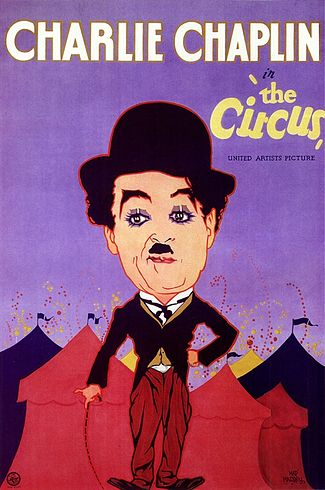
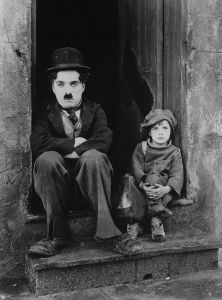 “A picture with a smile — and perhaps, a tear…”
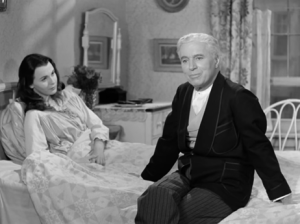 The glamour of limelight, from which age must pass as youth centers
 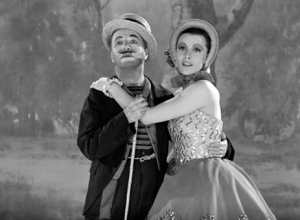 But now no one’s there. The seats are empty, the aisles quiet, and he sits with a dazed look in his flat the only recourse but to go back to bed. It’s as if the poster on the wall reading Calvero – Tramp Comedian is paying a bit of homage to his own legend but also the very reality of his waning, or at the very least, scandalized stardom. It adds insult to injury.
 It’s important to know that he writes off such an assertion as nonsense and one can question whether this is Chaplin’s chance at revisionist history or more so an affirmation of his life’s actual trajectory–working through his current reality that the world questions (IE. Marrying a woman much younger than himself in Oona O’Neil who he nevertheless dearly loved).
 The Greek gods created a woman – Pandora. She was beautiful and charming and versed in the art of flattery. But the gods also gave her a box containing all the evils of the world. The heedless woman opened the box, and all evil was loosed upon us.
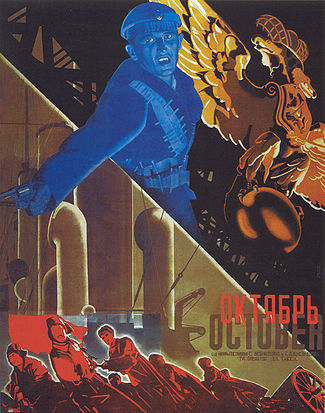 It’s curious that the first image October conjures up is a biblical nightmare from the book of Daniel. In that instance, the Babylonian king is frightened in his dream by a giant statue that comes tumbling to the ground. Of course, in that context, it had a lot of the same connotations, that his kingdom would come crashing to the ground with a resounding thud.


