Au Hasard Balthazar (1966)

auhasard1Robert Bresson’s Balthazar is the best piece of art I have viewed in some time and it is art in the sense that it may have various interpretations, it causes us to think, and it elicits an emotional response. In truth, it is a story that I do not fully understand and I can never hope to know, but there is nevertheless an austere beauty to this parable. Furthermore, there is a kind of magic in this air of ambiguity. I want to watch it, again and again, to see if I can understand, to see what revelations come my way. It was one of those experiences that left me wondering what I had just watched, however, I know enough by now not to fight it, but enjoy that feeling of not comprehending in full.

Essentially this is a tale about a donkey cherished by a young girl and over the years they lose contact, reunite, and go away again, as is the rhythm of life day to day. The plot points started becoming less important in comparison to the images and emotions that begin to well up inside of us. At the same time that the donkey is often being mistreated or carrying the burdens of his various masters, his girl Marie (Anne Wiazemsky) is growing up trying to figure out what love is. She is close to a boy named Jacques only to have him drift in and out of her life several times. She cannot decide how she feels exactly about him. There’s the boy Gerard who is good at raising hell and Marie spends some time with him. But it remains to be seen what the real agenda of her parents or Gerard and his friends are. What of these matters of honor and murder? Do all the particulars even matter that much?

Balthazar’s own path includes whippings, long hard toil as a beast of burden, a stint in the circus with all the other captive animals, and happy times driving Marie’s cart. But is that wrong to personify him? Is he even capable of emotion? I’m not sure if he is, but the audience certainly is. We can be joyful when we see that cute young donkey being enveloped in hay with young children playing. We can become somber as Balthazar is slowly being worked to death as the years drag ever onward and his master considers putting him down in lieu of getting a new harness. Somehow a donkey can be a victim of his circumstances, bravely taking the abuse of others, and living without a shred of retaliation. In some strangely entrancing way, it works.
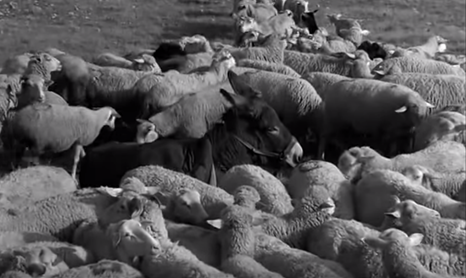
auhasard2Then, Balthazar takes a stray bullet and weakened he comes upon a green pasture where he kneels down peacefully to die. Around him comes a flock of sheep led by a shepherd. It’s a deeply heart-wrenching and visually arresting moment evoking Biblical imagery from Psalm 23. The full life having been lived and now it’s over in tranquility. It’s really a summation of the spiritual journey that each one of us traverses in our lifetime and yet Bresson brings us this allegory through simple, clean strokes. Images and sounds balanced exquisitely together in a completely naturalistic mode of expression.  Wiazemsky on her part is a natural beauty who positively captivates with every move she makes (reminding me of Anna Karina) Furthermore, Bresson somehow causes us to build a deep connection with a donkey which is hard to believe.

It’s the trademark of Bresson to have a stripped-down, straightforward approach to film-making, so much so that his style almost feels like no style at all. It’s so clean and unobtrusive. He shows us the world simply, succinctly, and without pomp. Even with the casting of non-actors, and in this case a donkey, as his main players. But he’s undoubtedly the master of inducing a response based on even the most basic of subjects. There are times it’s almost easy to forget you’re watching a film entirely because you get so wrapped up in what he is showing us.

4.5/5 Stars
Through a Glass Darkly (1961)

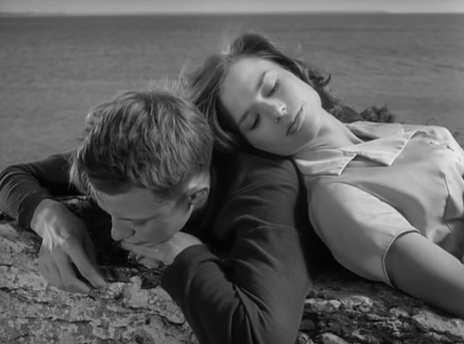
througha2There is so much that could be talked about with Through a Glass Darkly, but I feel the need to point out the more obvious, to begin with. Ingmar Bergman, in retrospect, envisioned this film as the first installment in his 1960s trilogy. As such, the film is a chamber piece that takes place entirely on a single island with only four main players. It lets go of some of the symbolism of many of Bergman’s films, but it still surges with religious content that reflects Bergman’s own background and spiritual conflict.

Through a Glass Darkly is one translation of 1 Corinthians 13, essentially suggesting that at the present time we only get a poor reflection of what is to come. In other words, we cannot fully understand the ways of the world and the ways of God. But how does this theme relate to the film you ask? That’s what I wanted to know as well.

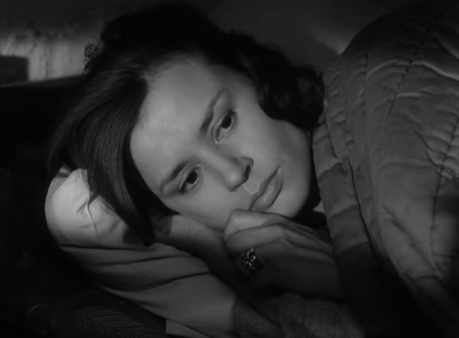
At a basic level, this is yet another story about family and interpersonal relationships. Karin is staying on an island with her husband Martin (Max von Sydow), her father David (Gunnar Bjornstad) who is an author, and her baby brother Minus. She recently was released from a hospital for schizophrenic-like symptoms while her father has recently returned from Switzerland trying to combat a fierce case of writer’s block.

In a day’s time, these four individuals try to parse through all that is going on. Though they initially attempt to shroud it with morning swims and silly stage productions, they cannot completely disregard their reality.

througha3Minus feels he is lacking love and affection. He feels like his sister makes fun of him while his father is aloof and withdrawn from his life. Meanwhile, David is grief-stricken in private, realizing that his daughter’s condition is incurable and yet he also regrets his morbid fascination with it. David tries to cope with his wife’s condition, but although she seemed jovial and fine at first, Karin’s situation begins to decline.
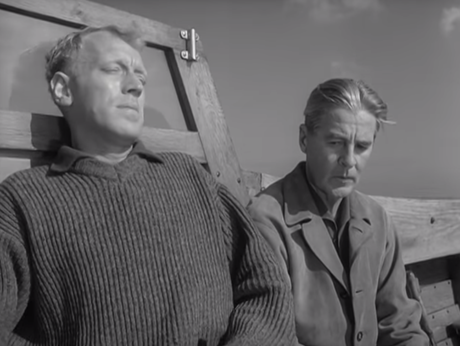
She hallucinates, speaks of going through the walls, and faints. Matters are made worse when the voices in her head tell her to go through her father’s diary. There she reads about his thoughts on her and her “incurable” state. When they take a boating outing Martin asks his father-in-law about what he wrote on the request of Karin, and they get into a discussion. As Martin surmises he seems to be a man with all the right words, but no clue about life itself, and David does not try and object.

Back on the island Minus is with his sister, who confides in him about the voices, and when a storm hits she hides dejectedly in the hull of a boat. Minus follows soon after along with his father. They send for an ambulance to fetch Karin and in a penultimate moment, she speaks candidly with her father one last time before she is to be taken to the hospital. In these final moments she goes up to the attic and while being observed by her husband and father, Karin, breaks into hysterical fits. The visions she has seen are obviously too horrible to bear

througha5This is a film about brothers, sisters, husbands, wives, fathers, and daughters. All revolving around four characters wrapped up and intertwined in this complex spider web of relationships. The spiritual content is great and there is also a lot of minutiae in Through a Glass Darkly. It shares some of the same mind-bending moments as Persona (1966) and yet this film felt even more personal if that is possible. As the title suggests and David even tells his son, we cannot fully understand what is happening, but we can be certain that someday we will know if only we grasp hold of love and the love that God has for his people.

Ingmar Bergman’s type of film-making seems foreign to us now and I don’t mean simply since it’s Swedish, but due to the fact that it is so connected to issues of spirituality and deep questions of faith and love. He cannot and will not allow his work to be cut and dry, because he cares about delving into the human condition. And that condition by default is chock full of ambiguity and complexity. Through a Glass Darkly. The title fits aptly indeed.

4.5/5 Stars

Lilies of the Field (1963)

Original_movie_poster_for_the_film_Lilies_of_the_FieldStarring Sidney Poitier, the film opens with a black construction worker who has an overheated car in the middle of a desert. He spots at the residence of some European nuns to get water. Homer is intent on making a quick pit stop but the mother superior has other ideas. She sees him as a gift from God so that their Chapel might be built. He reluctantly decides to stick around for a little while to help them out and teach them some English. The stubborn Mother Superior wants everything her way and Homer ends up leaving them. Although he realizes he will not get paid, Homer’s ambition to be an architect leads him to eventually start the Chapel for the nuns. He takes on a part-time job and starts the undertaking while the nuns request materials. Soon the locals want to help but Homer is adamant that he do everything. Eventually, they do join in and more materials come. Progress picks up and Homer becomes the foreman. The building is finally put up and yet the proud Mother will not thank Homer. That night she is finally tricked into thanking him and Homer leads them in a spiritual one last time before driving off into the night. This film is a battle of sorts between two strong-willed people. In the end, it brings a great deal of good.

4/5 Stars

The Passion of Joan of Arc (1928)

6d281-passionarcAs cliche as it will sound, this is one of those films that transcends the years for me. It is still that powerful after so many decades.

Using low angles and numerous close ups Carl Theodor Dreyer pulled me into this story early on. It was tense and claustrophobic causing the viewer to become emotionally involved in the trial and the plight that surrounded Joan.

The actors that he chose have wonderfully expressive visages that are so distinct even with out makeup of any kind. Then there is Falconetti who undoubtedly has a pair of the most expressive eyes ever shown on the silver screen.

I watched the film without any score so the complete silence was a new experience for me, but it forced me to pay particular attention to the images. Those were enough to keep my attention by  making me squirm and empathize the entire time.

By the end of the film there is an immense connection for Joan built because she seems an innocent victim. A martyr to be sure who reflects the sufferings of Christ. That is the story of The Passion of Joan of Arc. Certainly a simple tale but a master work of silent cinema nonetheless.

I am intrigued to see more from Carol Theodor Dreyer especially because his filmography is so sparse.

4.5/5 Stars

Ida (2013)

28ceb-ida1At hardly an hour and 20 minutes, you would think Ida has very little to offer, but that just is not the truth whatsoever. Polish director Pawel Pawlikowski blessed us with a nuanced film full of power and strangely pleasing visuals. It’s stark, yet crisp, black and white cinematography did not have to be that way, but it looks absolutely beautiful.

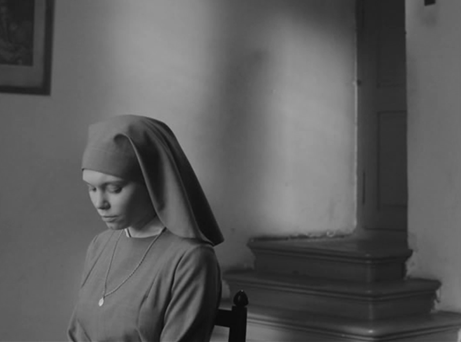
In the opening sequence, we see a young nun carving a statue and then carrying it to the grounds outside. We realize it depicts Christ and it feels rather reminiscent of La Dolce Vita and yet this film has a note of reverence.

We have been transposed to Poland during the 1960s where novice nun Ida lives a simple and disciplined lifestyle within a convent. The meager plot follows her pilgrimage to meet her only relative before taking her vows. It’s the aunt who refused to take her in after Ida’s parents passed. They have never met before now.

There doesn’t seem to be much to say. In fact, what can you say? Ida has taken up a religious calling and her aunt, a former judge named Wanda Gruz, lives life the way she pleases. Men, alcohol, and smoking are all a part of that lifestyle.

Thus, they have little in common until the moment when Gruz discloses the truth to Ida. Her real name is Ida Lebenstein. She is Jewish. Her parents were killed during the War, but the details are not too clear. They can probably guess how it happened.

Ida’s whole identity is rocked because she is now a Jew within a convent which seems like a gross incongruity. Ida’s resolve is to find her parents’ resting place and so the unlikely pair set off looking for answers.

That’s about all the film’s plot right there, and though it does not sound like much, it is far more engrossing than a lot of the other fair we come across. There are moments when it feels like we are watching something from Robert Bresson. It’s simple. There are not frills but it is chock full of humanity and seemingly real characters with real emotions.

Ida is very rarely in the center of the frame, more often than not her eyes are averted, looking away from the camera. Pawlikowski also has a curious habit of focusing on one character during a scene of dialogue. It seems to denote how isolated and confused many of these characters are. It’s one of those films that leaves us with more questions than answers and that lends itself to a truly insightful viewing experience.

4.5/5 Stars

This Jesus of yours adored people like me” ~ Wanda Gruz

Shadowlands (1993)

2bfce-shadowlands_ver2Starring Anthony Hopkins and Debra Winger with direction by Richard Attenborough, this film chronicles the romance of famed Christian professor and author, C.S. “Jack” Lewis with the American poet Joy Gresham. Jack is by now a respected professor at Oxford and a widely acclaimed lecturer who often speaks on the issue of human suffering. In his personal life, he is rather reserved. He lives with his older brother Warnie and spends times with his colleagues discussing topics of all sorts at the local pub in the evenings. 

It is not until he receives a letter from an American admirer named Joy Gresham that his life seemingly begins to change. He first accepts to meet her only to be gracious, but soon their relationship develops into a close bond. Jack meets Joy’s son Douglas who is enthralled by Narnia. He even offers them a place to stay during the Christmas season, since they have nowhere else to go. Lewis and Gresham are very different people, to say the least. He is a quiet intellectual with the sensibilities of an Englishman, while she is a plain -speaking American who does not mince words. However, these differences bring them closer together because they help each other to view the world in a radically new light.  Jack learns how Gresham’s marriage is going badly and he settles to marry her in a practical union so she and Douglas can stay in England. They do not speak of it much and it hardly seems real. Joy calls him on it realizing for herself that he allows no one to challenge him. There is no vulnerability to him whatsoever.

However, then Joy is diagnosed with bone cancer and slowly but surely she begins to deteriorate. For the second time in his lif,e Lewis understands the anguish that comes when a loved one is suffering. Because, the fact is, he most definitely loves Joy, and it simply took a tragedy to make him realize it. As with any inexplicable suffering, Lewis is tested in his faith, and the reality human suffering has new meaning to him. It is no longer just lecture material, becoming a far more personal process.

Although this film is not so much focused on C.S. Lewis as a Christian theologian or apologist, I think Anthony Hopkins does a wonderful job of portraying him as a kindly and gentle man of faith. He struggles with doubts and fears like every human, but he found something wonderful in his love for Joy which ultimately changed him.

Debra Winger must also be commended because she played well off of Hopkins and even though I have no picture of the real Gresham, Winger seemed to embody her. In some ways, I found her most beautiful when she was bedridden, absent of all makeup and seemingly so pure. It positively tears your heart out watching her son say a tearful goodnight or to look on as Jack stays up with her. This is a better picture of real, unadulterated love than most films can hope to manage because it very rarely becomes a sappy melodrama instead resorting to more deliberate means. As Jack says we live in the “Shadowlands,” but amidst the pain and suffering, love seems to shine through even brighter.

This was such an enlightening film for me because I always envision C.S. Lewis as a scholar and rational thinker, which he was. But he also had a vulnerable human side and this film, as well as A Grief Observed (written after Joy’s death), prove that point. It’s hard not to feel for him and that’s part of the beauty of this story.

4.5/5 Stars