
 “I don’t like anybody pushing me around. I don’t like anybody pushing you around. I don’t like anybody getting pushed around.” Van Heflin as Sam Masterson
Lewis Milestone never quite eclipsed the heights of All Quiet on the Western Front. Still, The Strange Love of Martha Ivers is brimming with some engaging performances. Although it is, at times, more of a melodrama than noir, there is still merit in Robert Rossen’s script. When it does not falter with didacticism, the film has a certain twisted, deep-seated emotion that runs through it. Barbara Stanwyck is the one at the center of it all, as the title suggests.
The film begins in 1928 with three children. The assumption is that these three individuals will become of greater importance later on. After that fateful evening, one would be left without any family, one would leave for good, and one would be left in the perfect position to rise up the ranks. These opening moments boasts spiraling staircases, thunder, the pounding orchestration of Miklos Rozsa, and a complete gothic set-up.
 17 or 18 years later a full-grown Sam Masterson (Van Heflin) decides to return to his old stomping grounds, Iverstown, on a whim. He’s surprised to learn that the “little scared boy on Sycamore street” is now District Attorney (Kirk Douglas). And he’s now married to Martha Ivers (Stanwyck). She and Sam had something going long ago, but he’s all but forgotten it by now. He’s made a living as a gambler who has a pretty handy dandy coin trick, but really Heflin’s character could be anything.
He meets a sultry, smoky-voiced Lizabeth Scott with the pouting face. For those unfamiliar, I would liken her to a Lauren Bacall-type, although she was less well-known and ultimately got typecast in noir roles. Here Scott’s “Toni” Marachek is an often despondent woman who just got out on probation.
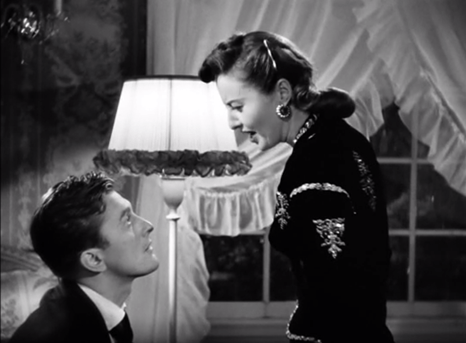 We don’t actually see Barbara Stanwyck’s face until 30 minutes into the film, but it doesn’t matter. She as well as Kirk Douglas (in his screen debut), leave an impression right off the bat. They are a married couple alright, but she seems to hold the keys to the kingdom, so to speak. All her power is propping him up as he makes his political rise. Perhaps there’s more going on here, however.
From its outset, Martha Ivers looks to be a tale with two threads that slowly begin to intertwine, bringing together some old pals and acquainting some new ones. When Sam wanders into the lives of Martha and Walter O’Neil, it’s putting it lightly that they’re taken aback. The district attorney is good at putting on a face for an old boyhood chum. His wife, on the other hand, is not about to hide her excitement in seeing her old flame.
However, they both think he has an agenda, misreading the twinkle in his eye as intent to blackmail, for a payoff after what he saw all those years ago. But that’s just it. Only we know that he didn’t see anything. Martha Ivers slips up, caught between love, hate, and a suffocating life. She has so much power and yet so little. So much affection and yet so much bitterness.
 Honestly, although Stanwyck is our leading lady, it’s quite difficult to decide whose film this really is. Van Heflin and Barbara Stanwyck are at its core, but then again, Scott and Douglas do a fine job trying to upstage them. There’s a polarity in the main players, meaning Stanwyck and Heflin have the power, and the other two are the subservient man and woman respectively. However, the film really becomes a constant tug-of-war. Douglas is not just a spineless alcoholic. There’s an edge to him. Scott seems like a softy and yet there’s an incongruity between her persona and that prison rap that hangs over her. Heflin seems like the one relatively straight arrow because as we find out, Stanwyck is fairly disturbed. She’s no Phyllis Dietrichson and that becomes evident in yet another climatic conflict involving a gun. But she’s still demented, just in a different way.
3.5/5 Stars


 4 Star Films