Miracle of Morgan’s Creek (1944)

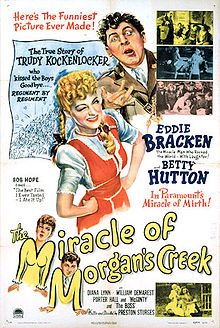
220px-The_Miracle_of_Morgans_Creek_1944_posterPreston Sturges was a revelation when I first saw Sullivan’s Travels and then The Lady Eve. His scripts are always wildly hilarious and full of memorable characters, whether they are headliners or just supporting the stars. The Miracle of Morgan’s Creek (1944) was a lesser known film to me, starring Eddie Bracken and Betty Hutton, but I was ready to see what this screwball could deliver.

With the start of the war, there began a push on the home front to strengthen morale by throwing parties and drinking victory lemonade in honor of the boys going overseas. Young Trudy is intent on dancing the night away with a lot of soldier boys. She just wants to do her part in the war effort after all. Her grumpy and domineering daddy Mr. Kocklenlocker (William Demarest) forbade her from taking part in such a shindig.

She sullenly goes to the movies with Norval Jones (Eddie Bracken), the young man who has been infatuated with her since they were kids. However, she somehow talks Norval into letting her go off to a party, and she spends the night living it up, while he waits dejectedly at the theater. When she finally returns its late morning of the next day and Norval knows her father will kill him.

However, Trudy also discovers a ring on her finger signifying that she married a soldier in her wild stupor the night before. The only problem is she cannot remember who it was, there were so many soldiers that she danced with after all. On top of that, add the prospect of a baby and you have a real doozy that has small-town scandal written all over it.

Norval tries his best to help remedy things for Trudy, only to wind up in jail with a big to-do building up — even making its way to the governor! Things don’t look good for poor Norval until Trudy gives birth and it’s a MIRACLE! When he finds out about what happens he has a little fainting spell.

That’s the craziness that is the Miracle of Morgan’s Creek, thanks to the rapid-fire dialogue and caricatures created by Preston Sturges. William Demarest is especially memorable as the hard apple Mr. Kocklenlocker who is always bossing his daughters around, but he’s not all bad. By now Morgan’s Creek looks dated, but all the same, it is still a memorable piece of WWII homefront cinema. Supposedly it was standing room only back in the day and honestly, it’s surprising that this film ever got past the censors. Bigamy, pregnancy, and so much more all comically mentioned in a 1940s film. Who would have thought?

4/5 Stars

Mr. Smith Goes to Washington (1939)

84a24-mrsmithgoestowashingtonposterAs both a political drama and feel good movie, this film cemented James Stewart as an acting powerhouse. Furthermore, despite its age, it acts as a timeless reminder of the evils of political machines. It makes us root for the underdog, and it is distinctively American. Here is a cast and a story that seemingly could never be equaled, but what this film really had going for it was an idealistic outlook. I can, myself, often be a cynical person, and still Mr. Smith never fails to make me acknowledge the numerous attributes that make our country great, whether it is through montage, monuments, music, and of course Jefferson Smith himself. 

In one of his best performances, Jimmy Stewart is an idealistic, naive boy’s troop leader named Jefferson Smith. The starry-eyed Smith trusts that our nation is founded on some very noble principles that should be fought for tirelessly in government and in society. Above all, he is a likable fellow, who earnestly believes in the merits of this country, and he is beloved by boys all across the state. Now, this all sounds fine and dandy, but it would never have come across on the screen if it had not been for Stewart. He emanates this awkward and innocent energy that puts life into the idealistic creation of Jefferson Smith. 

When the film opens, everything is in turmoil when a senator suddenly dies and a replacement is needed fast. Believing Smith will be a pawn, a powerful man named Taylor (Ed Arnold) gets Smith a seat in the nation’s Senate. There he joins the respected Senator and old family acquaintance, Joe Paine (Claude Rains), who is also a cog in Taylor’s machine. However, although he is out of place in Washington, the patriotic Smith does his best to be worthy of his position. He realizes that the press will not give him a break, and the other Senators do not take him seriously.

So, on the urging of Paine, he decides to come up with a bill for a boys camp back in his home state. He requires the help of the world-weary secretary Saunders (Jean Arthur) to get his bill done. Initially, she is disgusted by his naivete, but as she grows to know him, she realizes he is only going to get himself hurt. His action to propose a bill soon find him face to face with the political machine that elected him. Taylor also has stakes on the piece of land where the boy’s camp would be, and he wants it for a dam. 

Smith finds himself being accused of using his position for his personal gain, and pretty soon he is before a committee with false evidence piling up against him. With all odds and seemingly everyone else against him as well, Smith makes one last monumental effort. Thanks to the help and guidance of Saunders, Smith fights to plead his case through a filibuster.

Fatigued by many hours of giving impassioned speeches and reciting the Constitution, Smith finally collapses, but not before effectively succeeding at his task. I doubt this would ever happen in real life, but in the film, it is fantastic watching the Senate break out into complete and utter mayhem. Ultimately, a young man with “a little bit of plain, ordinary, everyday kindness and a little looking out for the other fella,” was able to win. True, it may be overly sentimental, but it is a wonderful piece of sentiment all the same.

Frank Capra was wonderful at these type of cheering tales and his stars were in top form. There is an absolutely wonderful supporting cast here including Claude Rains, Edward Arnold, Eugene Pallette Thomas Mitchell, Charles Lane, Harry Carey, William Demarest, Beulah Bondi, and numerous other familiar faces I don’t even know the names of. That’s the beauty of the studio system I guess. It may have the same director, same leading man, and some of the same general themes, but Mr. Smith Goes to Washington covers completely different territory from Capra’s later classic It’s a Wonderful Life. Mr. Smith should be seen as a unique, and very much American film.


5/5 Stars

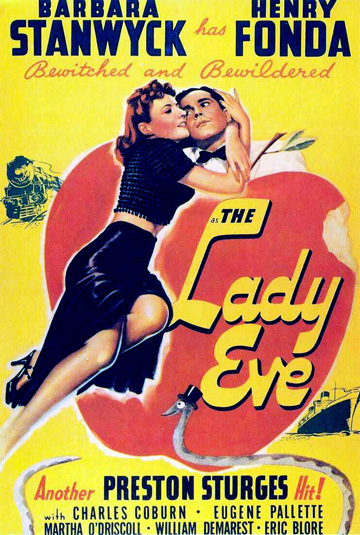
The Lady Eve (1941)

Starring Henry Fonda and Barbara Stanwyck with director Preston Sturges, this screwball comedy is a good one. The supporting cast is rounded out wonderfully by Charles Coburn, Eugene Pallete, and William Demarest. The story begins on a big ocean liner where a beautiful young woman (Stanwyck) tries to pull a con on a naive, rich bachelor (Fonda). Slowly however they begin to fall in love and they plan to get married. He catches wind of her notoriety and becomes cold and that ends their relationship. In an act of revenge she poses as someone’s niece, a Lady Eve, so that she can be close to him. Through a series of events he thinks she is a different person who looks similar and over time they decide to get married. When Eve tells him about all her boyfriends he feels he has made a mistake. Back on the ship he is ecstatic to see the first girl and they embrace. Fonda’s character feels guilty because he is already married but then again she is too…to him. This film has a great combination of wit and slapstick which makes it an enjoyable classic.

4.5/5 Stars

Sullivan’s Travels (1941)

63a32-600full-sullivanStarring Joel McCrea and Veronica Lake, with director Preston Sturges, Sullivan’s Travels is about a highly successful film director (McCrea) who wants to make a movie about the common man and suffering. However, he usually writes comedies and so he decides to go on the road as a hobo to try and understand the lifestyle. During his adventures he meets a young failed actress (Lake) who is about to leave Hollywood. Wanting to help her, Sully tells the girl what he is doing and they go off together masquerading as tramps. After taking a short respite, he goes on the road again, this time alone. Through a series of events he finds himself in a chain gang while his friends assume he is dead. Eventually he is freed but not before learning a valuable lesson. If he wants to relate with the poor he should give them laughter instead of hardship. I found this movie to be an enjoyable  light comedy (even though I had never heard of it beforehand).

5/5 Stars