Summer School (1987)

I never went to summer school, and I genuinely enjoyed taking standardized tests. But I still feel an instant kinship for these kids and their world.

I was a high school student decades later, and I’ve only taught in a classroom on a very limited basis. And yet, these experiences made me recognize one of the continual ironies of public education.

Sometimes it feels like the place where learning goes to die, and if not learning, then at least curiosity and passion. Oftentimes, organized education takes all the fun out of learning, assigning letters and tests to each of us and thereby effectively replacing our genuine desire to know more with extrinsic, even mercenary motivation.

If you’re like me, someone genuinely impatient with wasted time, public school is one of the worst time sucks known to man. If you factor in the substitute teachers, passing periods, and busy work, there are very few equals. It’s no wonder kids get bored, and that’s not even factoring in other distractions or genuine learning disabilities. It’s a wonder anyone learns anything at all, and this is a testament to inspiring teachers (and a certain amount of self-dedication).

I initially had to do a double-take because I thought Rob Reiner was the director until I realized it was his father, Carl Reiner (who also has a delightful opening cameo). The movie’s screenplay was written by Jeff Franklin, who created Full House very soon after.

Although there are pretty exchange students, bikini gags, and a few throwaway moments that are regrettably 80s, for the most part, the fact that Summer School feels quintessentially of its time is the highest compliment, given the world and rank-and-file of Ocean Front High School.

The school itself feels instantly placeable from its sun-soaked vibes to the student body’s total devotion to summer and the sweet freedom it represents to every teenager since the dawn of time. 

It might be a testament to what my cinematic diet has been of late, mostly dour and serious “cinema,” but sometimes you want something diverting like this; it delivers on its promise and doesn’t try to overshoot its ambitions as a teen comedy. And yet in delivering the goods, it does what many of its peers can’t always manage. It bends toward heart over crassness, making for a satisfying confection.

Mark Harmon is also such a charismatic lead. As a former UCLA football star, he falls easily into the role of a So-Cal P.E. teacher who has more use for waves to surf than a classroom. The premise works because there’s a sense that he used to be like some of his students. He’s more of a friend than a figure of authority. The latter role is taken on by the cartoonish ’80s villain par excellence, Vice Principal Gills.

Kirstie Alley is slotted in as the teacher overseeing the honors course next door. She watches Shoop with mild interest and then bemusement as she goes for the more intellectual romantic option in the vice principal, but we know who she’s meant to be with. Our hero does too. It’s only a matter of time.

In this way, perhaps it is a fantasy, fulfilling genre conventions, and yet as he’s stuck teaching an English course in Summer School to a room full of failures and misfits, there is a joyous, genuinely hilarious camaraderie that forms. It allows the movie to become something worthwhile above the level of typical drivel. 

I’m completely sympathetic to their desire to break out of the monotony and drudgery of the classroom. At first, they take “field trips” to Knott’s Berry Farm bumper cars and petting zoos, although these plans are eventually curtailed, and they have to either get it together or throw in the towel for good.

Sure, there are complications. Mr. Shoop looks about ready to give up multiple times, even as his cordial advances toward Ms. Bishop are politely rebuffed. The movie develops a nice cadence not through the usual antagonism of a Breakfast Club, but a pact between teens and adults to get to the finish line together.

Their contract of sorts involves “wishes” from all of them, and Mr. Shoop agrees to help them along if it means they will at least try to study and not goof off. However, it becomes more than bargaining because they see a teacher who goes above and beyond, and they begin to form a community where they look out for one another and cheer for each other’s victories.

“Chainsaw” and Dave are two of the worst goof-offs and loafers, but in their deep, abiding love for Chainsaw Massacre and gore in general, we see a passion and expertise in costuming and makeup that’s extraordinary even as it does not fit into the neatly created parameters of vocab tests and SAT scores.

As I’ve gotten older, I’ve realized more and more of the flaws in education. And I loved school, but for some people, they have gifts and talents that will not be showcased in the classroom unless they are given the space to explore what truly interests them. These are the spaces where they can flourish.

This might seem too high-minded for a goofy comedy like this, but I think that’s part of why I was so taken with Summer School. These characters feel inherently decent, and we want to cheer for them as they bond.

There’s a teen pregnancy played for a laugh, and yet the girl has the baby — it’s never a question — even as she decides to give the child up for adoption since she doesn’t feel prepared. Another teen is smitten with her teacher, and it feels like a queasy scenario, yet she’s mature and realizes it is only a phase. Others have their own growth, whether it’s getting a driver’s license or improving their study habits.

What’s more, the message is not perfection or even the pipe dream that now everyone gets straight As and will go off to Harvard thanks to their teacher. The dream is of a different nature. All these kids and their parents gather in the principal’s office as the vice principal accuses Mr. Shoop, like Satan in a suit and tie.

Because the story it’s telling is not about doing all of this so you’ll get into a school of your dreams or get your heart’s content (though there is some wish fulfillment). Instead, it’s saying something more about what it means to truly invest in a community and pour into other people. Sometimes we think it will take everything out of us; we must simply look after our own interests. Except Mr. Shoop gives of himself, and everything else is added to him.

And sure, in his case, he gets a From Here to Eternity embrace with Kirstie Alley in the surf and doggy kisses to boot. But it just goes to show Summer School never forgets its identity while also never totally dumbing itself down to the least common denominator.

I feel like many people might be pleasantly surprised by what this movie has to offer, especially if they’re craving a trip back to the ’80s in all their glory. I never lived through the decade, but with a teacher like Mr. Shoop, I wish I had at least momentarily. Although that probably goes for any era, because teachers are such formative people in our adolescent lives.

3.5/5 Stars
Some Kind of Wonderful (1987)

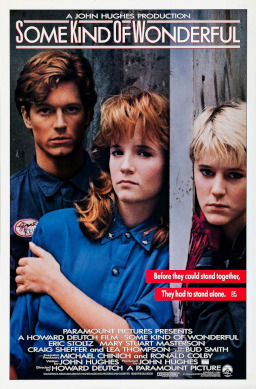
Some Kind of Wonderful announces itself in all its ’80s glory with a montage of drums, synths, working-class grease monkeys tinkering on cars, and a pair of teens making out. There’s no doubt it’s a John Hughes movie, and though Howard Deutch was called back after Pretty in Pink to helm this one, the script has many of the same tenets of the earlier picture, albeit gender-flipped.

Keith (Eric Stolz) is a teen from the poor side of town, and if he weren’t so reticent, the way he watches Amanda Jones (Lea Thompson) and her boyfriend from a wistful distance would be creepy. Actually, it is creepy, but we’re supposed to empathize with him.

The other parts of his life are more relatable. He’s the eldest of three siblings. There’s the young brainiac, the annoying middle child, and he’s the moody older brother. His father keeps on hassling him about the college question; it’s well-meaning because his dad doesn’t want him to wind up selling tires like his old man.

Although he doesn’t have many friends, Keith’s closest companion is drumming tomboy Watts (Mary Stuart Masterson), who eschews high school convention, wearing her hair in a bleached pixie cut. Hughes is also having a gleeful time with the Rolling Stones in-jokes.

All around them, the halls are spilling over with eightiness — the hair, the clothes, and the prototypical tough guy scuzzballs. Every school needs at least one. This one (Elias Koteas) looks like a buff Danny DeVito in his Cuckoo’s Nest era.

We soon learn he’s not half bad. It’s the prima donna preps with their coiffed hair, smooth talk, and pretentious narcissism who are really the dregs. What makes it worse is that people like Hardy (Craig Sheffer) have all the toys and the girls — namely, Amanda Jones. Keith will always be subservient to these jerks in the social hierarchy, left to fill up their gas tanks.

And yet his daydreams about Amanda won’t abate. He fantasizes about being with her and uses any excuse just to be close to her. It backfires when he willfully finds himself in detention, although Hughes sidesteps a mini Breakfast Club set-up when she skips out after cajoling her teacher.

Keith is left doing time with the bruisers and weirdos, but it’s a strange camaraderie that builds within their ranks. The trash have to stick together, and it’s a delightful if mostly unforeseen development.

The other crucial relationship is between Keith and Watts because it’s painfully apparent that there is a sexual tension between them. This girl is devoted to him, and yet she allows her feelings to be stepped over as he seeks her advice in pursuing the object of his desire.

They undergo a practice kiss, complete with embrace and all the trimmings, played against Stephen Duffy’s “She Loves Me.” It’s both uncomfortable and a strange portent. We question him for being so asinine. Surely a real person would recognize this is a bit more than friendship. 

If you start poking holes around, you find the problems and some of Hughes usual shortcomings. Keith exists as a fairly blasé male protagonist who represents the writer’s limitations. The female characters feel like they could have been even more intriguing if the story were from their POV.

Watts is all twisted up inside with unrequited feelings and wounded to boot. Amanda is perceived as a preppy person, and yet she’s dealing with an unfaithful boyfriend and petty friends. And it can’t come down to Stoltz because if he was ditched from Back to The Future, he also gave a stellar performance as Rocky in Mask.

But for a film of his that’s very rarely talked about, Some Kind of Wonderful might be my underrated pick of the lot. It has to do with specific moments. The whole trajectory of the movie is building to a party at Hardy’s place.

Keith knows full well that it’s meant to be a set-up to humiliate him in front of Amanda as payback, but he wants to go anyway. He also spends all his college funds on a lavish gift for this girl. It sounds extravagant and crazy, and yet he does it with a clear-eyed lucidity. Nothing else matters, and this girl feels the weight of it all. She wasn’t able to bring herself to dump him, and now she’s swept up by his candor.

They have an uptight dinner date over caviar at an uber-fancy restaurant, and then he lines up some entertainment after hours at a local museum. It’s closed, but he has some connections and gets a little help on the inside. It’s a bit peculiar and pure Hughes romanticism as the two teens walk through the exhibition rooms in an echo of the tranquility of The Art Institute of Chicago in Ferris Bueller. Keith tells her, “This place is my church.”

I’m not sure what to make of these more ethereal interludes. Although by the time we get to Hardy’s party, we’re ready for a showdown. The most uncomfortable detail is how they refurbish Watts’s ride, and she becomes their chauffeur for the evening. Keith shows his obliviousness by effectively taking two girls out for the evening.

Hardy has his own fall from grace as Hughes goes away from a prototypical roughing-up in favor of something more symbolic. Keith wins the competition because he maintains his reputation and calls the other boy’s bluff. He feels as feeble and phony as all the rest. What’s more, Keith’s detention buddies show up and have his back, staking their flag with the indelible line, “This party is about to become a historical fact!”

The movie’s coasting down the mountain. Keith heads out the door with Amanda on his arm after she gives Hardy a couple of cathartic and well-deserved slaps. However, Keith’s so thick in the head he needs her to tell him that Watts loves him…

It’s a bit frantic as Hughes tries to right the wrong from his earlier picture. The movie’s recognition is the open secret of the whole story, and sure, it’s what we want as an audience, but it feels a bit rushed as Keith chases after the girl who always had feelings for him.

Ask me if it all fits together, and I’d say “No,” and yet as a casual watch, it does seem like Some Kind of Wonderful delivers on the ’80s teen movie experience with a few caveats. It makes me want to go out and watch more Mary Stuart Masterson because this is her movie. She stakes her claim to it through a persona brimming with pathos and charm.

3/5 Stars

Wargames (1983)

Wargames is a movie for the age of “Star Wars,” and by Star Wars, I’m referring to Ronald Reagan’s Strategic Defense Initiative. Because, despite detente, these are still the days of the Cold War, mutually assured destruction, and the threat of nuclear holocaust. Warm and fuzzy topics to be sure.

But isn’t this the beauty of movies from the ’80s? They can be packaged in such a way that’s entertaining, somewhat ridiculous, and generally cathartic. Somehow, it seems like there is a greater license for the suspension of disbelief. Wargames could be a certain type of movie that’s easy to place. We’re introduced to a NORAD control center with a brain trust of government employees who keep the country protected alongside gruff cigar-chomping military types.

One of their great assets is technology. Namely, the WOPR, a supercomputer using game theory to calculate all possible outcomes of a WWIII, should we ever come to such a crisis.

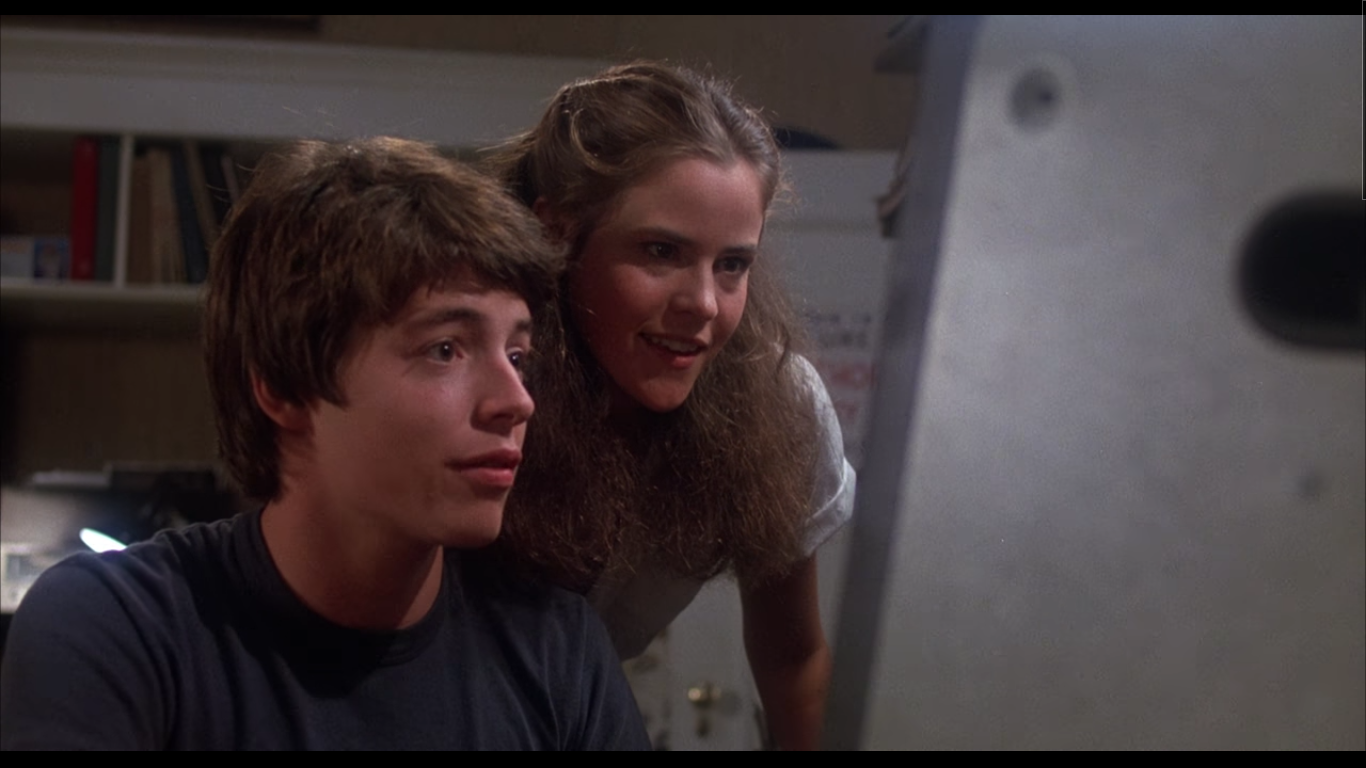
However, we also meet David Lightman (Matthew Broderick). He’s seemingly your average Seattle high school student. Unmotivated but intelligent. Broderick plays him as a bit of a likable smart-aleck who also happens to be a video game and technological whizz.

When he’s not in the arcade or goofing off in class, he’s holed up in his bedroom. His love interest is obvious. Peer pressure or crossing social cliques is never an issue in this picture, and they form a relaxed rapport from the outset. Ally Sheedy is your quintessential giggly All-American teenager (Pre-Breakfast Club). She’s lovey-dovey with the family dog and comes jogging past the home in her gym attire to pay a visit.

With a certain boyish bravado to impress a girl, David gets into the school computer and proceeds to change both their failing grades. Jennifer has some amount of personal conscience, but not enough to be a killjoy.  Anyway, these escapades feel relatively mundane given the world we find ourselves in.

To this point, it also sounds like we’re talking about two entirely different movies: one concerned with world affairs and another a lot more juvenile in scale. Where can these worlds collide?  It’s all too obvious.

You can see how it’s a jumping-off point for the troublemaking charisma of Ferris Bueller that seems to come so easily for Broderick. Instead of a day on the town, his prowess winds up helping him unwittingly break into the government’s defense program.

It turns into a rather illuminating exploration of contemporary technology like computers (green text on a black screen),  library index systems, and newspaper microfilm readers, all tools of the trade for those trying to find any form of information, well before the proliferation of Google and the interwebs. For those with shorter lifespans or attention spans, it’s a reminder of where we’ve been before.

Sure enough, he gets into the program thinking he’s playing a game simulation called thermonuclear warfare, and it is a simulation, one that the computer “Joshua” believes to be real. David pretty much triggers a shot heard around the world.

We get establishing shots of the Emerald City, and later, David is being tracked down by FBI agents. Forget about Sleepless and Seattle. I’ll never think about the city the same way again after War Games. It’s crazy, cathartic, compelling — all of these things — blending the current events with all the facets of what we think of the 1980s coming of age genre.

Why do they leave him unattended in an office with a computer? You could name any number of other reservations with the plot, but then this is a movie with a whole premise based on a teenager who disrupts the United States government’s defense mechanisms. Any of these passing captious nitpicks misses the entire point.

In the era celebrating heroes like MacGyver, there’s something to be said for independent know-how when Google couldn’t answer all your questions, and it’s possible to use your superior intellect to solve seemingly life-or-death situations.

It’s hardly a narrative criticism when they meet an eccentric genius (John Wood) living in obscurity with a clouded past and an infatuation for dinosaurs. He’s living on a remote island under a presumed name. He’s become jaded by the world, and for whatever reason, he believes extinction is just a part of the natural order of things. Add it to all of the film’s other nerdy stereotypes.

Likewise, a game of tic-tac-toe was never so important. Every clock imaginable is counting down. They’re on the hotline with the president, jets are preparing to meet the enemy, and they have open lines of communication with bases all across the continent. And then the game is up, and all the screens burst into fireworks. What do they tell us? “Joshua” has concluded rather succinctly: No one wins in nuclear war. The message couldn’t be any clearer.

So David gets the girl and saves the world from imminent destruction. It sounds like the synopsis to a really bad movie. Believe it or not, I found Wargames rather refreshing. It isn’t imbued with a great deal of social significance, nor does it take itself too seriously, but it has a dose of ’80s-era charm, of Spielberg or Hughes, giving it a sense of good fun and developing an experience we can enjoy and be a part of. There’s also a message.

I’m usually quite hard on the ’80s from a film perspective, but the decade certainly has its share of perks. You only miss something like Wargames when you don’t see it being made anymore. It seems right to say it. They don’t make movies like they used to.

4/5 Stars