Unknown's avatar

About 4 Star Films

I am a film critic and historian preserving a love of good movies. Check out my blog, 4 Star Films, and follow me on Twitter @FourStarFilmFan or Letterboxd. Thank you for reading!

Love and Death (1975)

3e061-loveanddeath2Most every Tom, Dick and Harry has heard of the great Russian epic War and Peace. Love and Death is Woody Allen’s companion piece. It has nods to Tolstoy, Dostoevysky and channels a bit of the Marx Brothers. As one would expect, Boris aka Woody Allen comes from your typical Russian family where he is atypical in his stereotypical, bookish and misanthropic way. He was not made for 19th century Russia trading in valor and facial hair for his glasses and nihilistic philosophy. But he winds up going to war anyway watching his beloved second cousin (Diane Keaton) marry herself off to a run of the mill fishmonger.

Eventually, Boris is able to get his true love back and they are wed. It’s a union full of philosophical debates as only Woody Allen could have. But the invasion of Napoleon puts all this on hold as Sonja resolves to go and assassinate the Little Corporal. Boris hesitantly agrees to accompany her. In an ending fit for a Woody Allen film  parodying Bergman, Sonja goes through a life altering conversation while the recently executed Boris skips off with The Grim Reaper. It’s hard to beat Annie Hall but this still fairly early Allen piece has its quintessentially Woody Allen moments that are quirky and fun poke at Russian culture.

3.5/5 Stars

Review: It’s a Wonderful Life (1946)

5632c-wonderfullife4Every time I go through the emotional, romantic, heart-warming and at times uncomfortable roller coaster that is It’s a Wonderful Life, something new always seems to stick out to me.

It is always impressive for a film of this length that so much is packed into it. Within minutes we are fully enveloped in this story, and every sequence gives further insight into these characters. There is hardly ever a wasted moment because there is significance in each scene. Pointing us to the nature of George Bailey.

Furthermore, it is easy to forget the darkness that this film submerges itself in because it reaches such a jubilant crescendo. However, this is a story that covers the years including The Great Depression and World War II. Its protagonist sinks into a state of wretchedness complete with angry outbursts, negative feelings, and drunkenness. George Bailey loses all hope and his perspective is so completely distorted. For all intent and purposes, his life looks like it’s over, and it takes a frightening alternate reality to shake him out of his disillusionment. Put in this framework, it makes sense why it was a commercial flop when you juxtapose it with the big winner that year The Best Years of Our Lives. They both deal with post-war reality, but with very different lenses.

That’s the benefit of hindsight and a new context since we do not usually see It’s a Wonderful Life as a gloomy post-war tale, but a more positive parable that is universal in its impact. The first part of this story feels a bit like a Job story of hardship, and the second act is reminiscent to Dickens’ A Christmas Carol, but that’s the simplest of observations. There is a lot more to be parsed through.

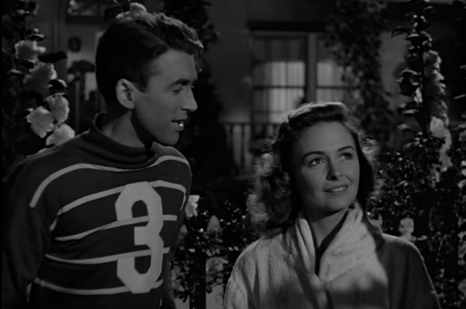
The romance of George and Mary is what many of us aspire to and it causes us to really empathize with their young love that weathers the good and bad breaks they receive. It’s the fairy tale love story we want, with the rock hard reality we are used to in our own lives. Some favorite moments in their life together would be the splash they make during the Charleston dance off, singing Buffalo Gals together, smooching on the telephone together, sharing a makeshift honeymoon together, and embracing after George gets his new perspective on life.

There are a fair number of close-ups utilized in this film, but they are usually used at crucial points in the narrative, and they tell us a great deal about both George and Mary.

The first key moment comes during a freeze frame of grown up George with hands outstretched giving us our first look at the man we will be following from there on out. The next big moment occurs when George learns that Potter will gain control and the Building and Loan will be disbanded if he leaves. He realizes in an instant that he must give up his plans. Then, he waits excitedly for Harry with Uncle Billy and it is a happy moment, but George learns his younger brother might have another job. The camera follows his worried face as he goes to follow his new sister-in-law. Never thinking of himself, he realizes that Harry has a chance for better things and that leaves George still working the Building and Loan.

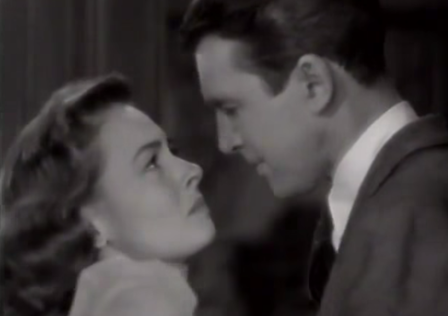
After their tiff, the scene where George and Mary are talking on the phone with Sam Wainwright is a solidifying moment in their relationship. There are so many underlying emotions and unspoken feelings that they are having trouble figuring out and reconciling. And yet there is that violent epiphany when their eyes link. The tears and anger are quickly traded for passionate kisses reflecting the often complicated facts of romance.

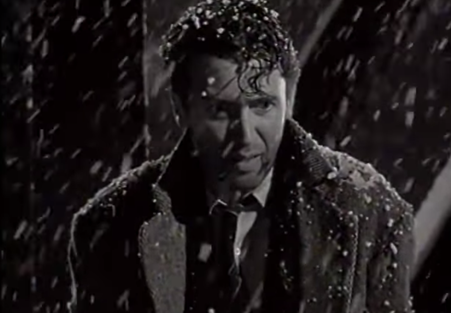
One of the final close-ups that hits home occurs when the now non-existent George stumbles away from the front door of his mother, who now has no concept of him. There is sweat on his brow (maybe from the 90 degree summer heatwave) and desperate bewilderment in his eyes. This is the lowest point he could have imagined. His own mother does not know who he is. His wife has grown old and lonely in an existence of exile. Stewart’s face is so expressive and earnest suggesting that George knows just how important human companionship is. Humanity was made to be in fellowship with each other. Lack of money means very little in comparison to our friendships and family ties. This is essentially what George finally comprehends and what Clarence reminds him. George understandably lost sight of his wife and his children and his friends. They were a gift not to be taken lightly.

Aside from these close-ups, it is also evident that a great deal of  effort was put into creating this world from the characters and their back stories to the town itself which was constructed on the RKO lot. Everything from the building facades, to stray dogs, and snow make the drama more atmospheric. It’s one of those films that reveals the beauty of using real props inhabited by seemingly real people. That’s why I sometimes am disillusioned by CGI. Although it can allow us to create amazing spectacles, oftentimes it creates a world that feels altogether fake and alien. It’s not relatable and it lacks the humanity that makes up our existence each and every day. In other words, it has very little of what makes It’s a Wonderful Life so compelling to me.

Perhaps there are more impressive or greater films, but there are few with greater heart and there is something to be said for that.

5/5 Stars

Hondo (1953)

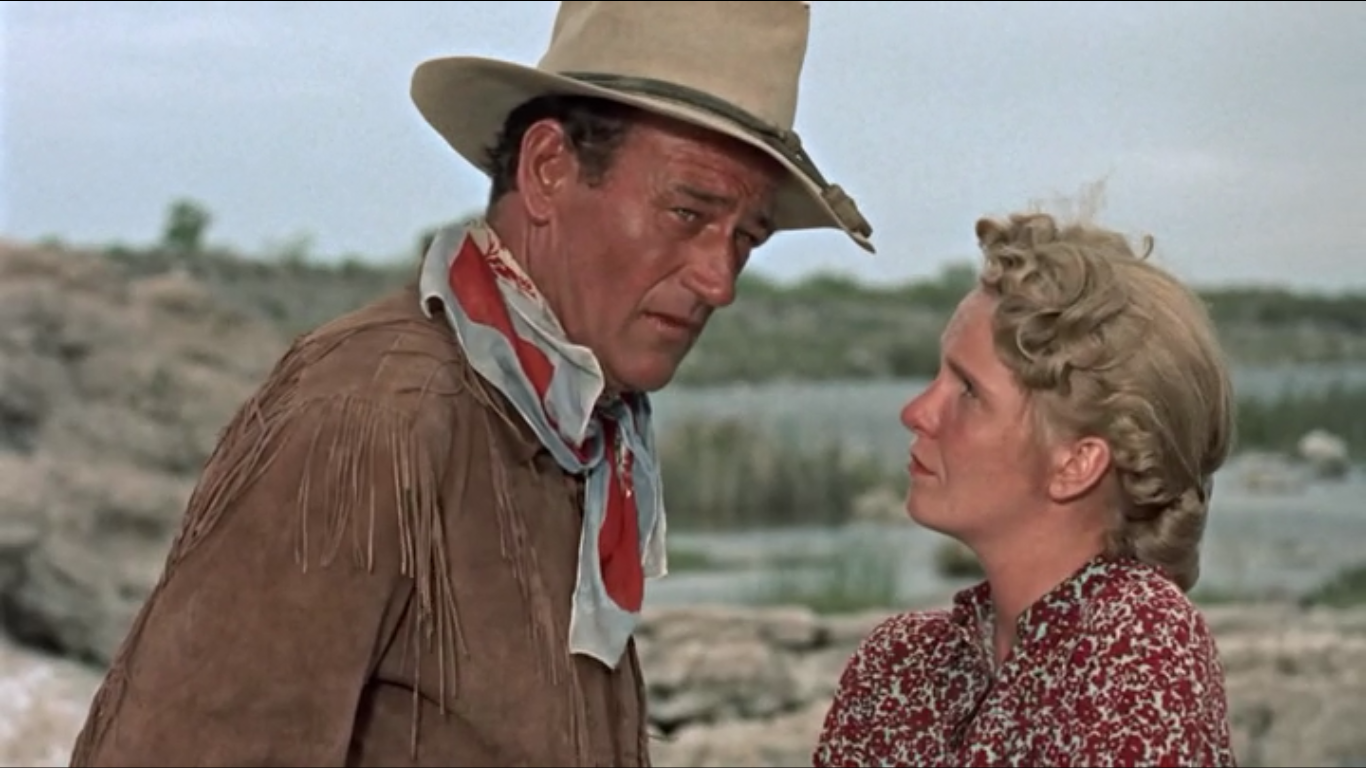
0a5df-hondo3In many ways Hondo feels a lot like Shane since it came out the same year and follows a wandering gunslinger who comes in contact with a frontier family. The story based off the novel by famed western writer Louis L’Amour is a lesser addition to the Western canon, but its hard to complain about a film with John Wayne. I was not a big fan of Geraldine Page (she seemed too needy) but I was happy to see some western mainstays in Ward Bond and a young James Arness.

The film opens with homesteader Angela Lowe and her 6 year old son Johnny spotting a man off in the distance. At first they are tense but as he gets closer and they interact with Hondo, it is clear he only has the best intentions and needs assistance since he lost his horse.

A great deal of the film revolves around the conflict between the native Apache and the U.S. Cavalry with Lowe and her son stuck in the middle of it all. Both sides seem to be at fault at times and in the right in others. Hondo used to be a scout for the Cavalry and he killed three men in the past year which raises the lady’s suspicions but she does not know the circumstances.
When Hondo’s not having run-ins with the Apache or on the brink of being killed, he gets in hot water with Lowe’s vagrant husband. Through it all he returns to the ranch and watches over Johnny who has been made a blood brother to the Apache.
His relationship with Angie deepens and when all seems to be lost during an Apache ambush, he breaks up their wagon circle and kills the enemies leader allowing them to flee. Hondo has a happy family life ahead of him, but it is pretty evident that the Apache existence will die out soon with the arrival of still more Cavalry forces.
3.5/5 Stars

Review: Miracle of 34th Street (1947)

703c5-miracleon34thChristmas movies do not get much better than this. What a concept! Here’s a film about a man who really is Kris Kringle aka Santa Claus. He gets picked up by Macy’s department store to be their Santa Claus, and he winds up facing a hearing to decide whether he is legitimate or not. His pet project is to make an unsentimental little girl (Natalie Wood), and her practical mother (Maureen O’Hara) believe in him. He finds an ally in a young lawyer (John Payne) who believes in his holiday cheer and is also smitten with the girl’s mother.

Some people would undoubtedly say it’s a bunch a hogwash to make a movie about such a topic. Maybe it is only holiday tripe, but I find it is very hard to refute this “Miracle” of a Christmas classic. The characters portrayed are so spot on and heartfelt it is so easy to get pulled into their story. At the same time, it’s difficult not to like a film where department stores help each other, the hustle and bustle is toned down, and for once mankind has faith in each other for awhile.

As an audience, we gravitate towards Edmund Gwen because he represents the Santa we all wish to know. He is kind, thoughtful, generous, and above all a magical gift giver. Maureen O’Hara goes through a character progression that mirrors that of her daughter, except it is perhaps a little more poignant in her case due to her maturity. It would seemingly be easy to dislike her and yet thanks to O’Hara we cannot help but feel for her. She is also extremely beautiful, even in black and white. Although young, Wood proves to be a memorable little girl in this one, and she was just getting started. Payne is a good addition in his own right — a highly underrated actor.

The film is rounded out by a wonderful array of characters in the Macy’s store like magnate R.H. Macy (Harry Atrim), well-meaning Mr. Shellhammer (Philip Tonge) and friendly young janitor Alfred (Alvin Greeman). Shoppers such as the one and only Thelma Ritter in an early role, and civil servants like Judge Harper  (Gene Lockhart) round out New York’s population with generally decent people who we can relate to. The one exception is Dr. Sawyer (Porter Hall), the company psychologist, and greatest villain of the film, who is the antithesis of Kris and his Christmas spirit.

My hope is that this one never pales, never loses its cheer, and maintains its timelessness for many Christmases to come. Until the next Macy’s Thanksgiving parade comes along have yourself a merry little Christmas and remember all psychologists are not evil jerks looking to ruin the holidays!

5/5 Stars

White Christmas (1954)

58e88-white_chrismas_filmMany times I feel like a broken record (this time playing a Christmas tune), but White Christmas is one of those classics that I never get tired of. It is so ingrained, so integral to my childhood memories, that I have difficulty analyzing it or finding fault.

Wonderful, visceral films stop being something that must be thought about and simply become an all out experience. That’s what White Christmas is for me. A full blown Christmas experience courtesy of Bing Crosby, Danny Kaye, Rosemary Clooney Vera-Ellen, Dean Jagger, director Michael Curtiz and of course Irving Berlin.

I mean this as a compliment, but at a basic level, I always thought of White Christmas as a Christmas-like version of Singin’ in the Rain. We have a talented and dashing leading man in Crosby (Bing Crosby) and his mischievous and hilarious partner in crime (Danny Kaye). They are never better than during their parody of the sister’s act (It’s a priceless gem of a moment). Although, there is constant chemistry throughout the film thanks to the bickering and back and forth between two buddies.  Similarly to Singin’ in the Rain, you also have big spectacles, lavish sets, great songs, dancing, and constant quotability. It brings out the most reluctant of crooners and even the guys with two left feet. But what about the story?

White Christmas follows those two war buddies as they make it big as a boffo double act. Along the way, they help out a pair of sisters as well as their washed-up former commander General Waverly (Dean Jagger), who owns an inn in snow-less Vermont. Although, it’s lacking in business,  it’s the perfect locale for matchmaking, acts of kindness, and misunderstandings courtesy of local innkeeper and resident eavesdropper Emma (Mary Wickes). But what we end up receiving is a joyous romance with plenty of Christmas cheer and sentiment to go around.


Bing Crosby’s pipes are as good as ever (“Count Your Blessings”) and Danny Kaye can make his voice crack like no other. Vera-Ella has a talented pair of legs and Rosemary Clooney can carry a tune in her own right opposite Crosby. Whether it’s “Snow,” “Sisters,” or the eponymous track, there’s so much to offer. Weather any slow sections and you will be rewarded thanks to the even-handed direction of Michael Curtiz (Casablanca), paired with the ever memorable compositions of Irving Berlin. Now go spend the holidays with your kith and kin. Vermont must be nice this time of year, all that snow.

4/5 Stars

Christmas in Connecticut (1945)

416cc-christmasinconnecticutElizabeth Lane  is the perfect cook, hostess, wife and mother who is the talk of the town thanks to her daily column in a reputable publication. Anecdotes from her quaint lifestyle out on a Connecticut farm have everyone from war vets (Dennis Morgan) and publishing magnates (Sydney Greenstreet) fawning over her cooking. She’s a chef extraordinaire. Except she doesn’t actually exist, or rather not in that incarnation. Instead the persona is the creation of New York columnist Elizabeth Lane who lives in an apartment with very little culinary ability of her own. That’s why things get complicated when a young sailor followed by the old publisher want to meet her and share Christmas on her farm. She knows Mr. Alexander Yardley is a stickler for the truth and so she rushes to pull off a masquerade to keep her job. It’s a harebrained scenario involving the farm of a beau and her kindly chef pal Felix (S.Z. Sakall) who covers for her lack of cooking ability. For a while it works and romance is in the air, but as you would expect things get a little complicated. Everything ends up hunky dunky in the end. If you’re feeling a Christmas comedy with screwball elements, you’ve come to the right place. Stanwyck is always great and Sakall invariably steals the show at times.

3.5/5 Stars


Boyhood (2014)

13113-boyhood1Surely others have said this already but Boyhood struck a chord with me and it was the prettiest of melodies.  Pure and simple in its brilliance.

This is not my childhood by any means or my life or my family, but there are glimpses of it here. Quick flashbulbs or touchstones that for a brief instant take me back. Sometimes many years ago or just one or two. Nostalgia is the strangest type of memory for a young person, because we are transcending the space between the here and now, which we are so used to, and going to the “back then.”

12 years is a long time but even more so when you have fewer years under your belt. Thus, Boyhood in comparison to my own life is an epic film in every sense of the word. Whereas it might only be a wonderful coming-of-age tale for older generations, there is a feeling that this film in some small way represents where I’m coming from.

A film could never fully encapsulate or perfectly represent what it is to grow up in adolescence. It’s different for every child depending on where they live, what their family is like, and so on. But Boyhood is an unprecedented depiction of what that existence looks like to many young people. There is certainly something special and important in that.

1cce5-boyhood2There are so many different vignettes, almost like short films, characterizing each and every year in Mason Jr.’s life. We are given no blatant indication of time and place. It is all context clues, cultural references, and watching Mason and his family grow and evolve around him. Always innovative Richard Linklater does not hold out a giant megaphone saying this happened that year or this year. Instead, Mason’s story plays out like it would in the so-called “real world.” There are some major milestones or life-shaping moments that are shown, but most of this journey has to do with the little caches of time that make up life.

I feel drawn to do something that I don’t normally do, but Boyhood is such a unique film it deserves to be approached in a different light since to put it truthfully, it cannot be pigeonholed into any standard category.

Instead of trying to acknowledge the entire narrative of Mason’s life, which would be as impossible with him as with anyone else, I want to give reference to the many moments and bits and pieces that Linklater placed either by accident on purpose. The fact is Boyhood is chock full of these markers of the passage of time which make it a fascinating journey of human life.

Here we go, get ready:

Coldplay’s Yellow over the credits
Britney Speares fandom
Star War dilemma: Yoda vs. Grievous
Game Boys and Wave Boards
The Astros’ Rocket Roger Clemens
Harry Potter and the Half Blood Prince
The Landlord – Will Ferrell
High School Musical – We’re All in This Together
Wii Boxing with a Nunchuk
Presidential Election in 2008
Facebook profiles
The Dark Knight
Phoenix – 1901
Twilight books
War in Iraq and Afghanistan
Lady Gaga and Beyonce
Iphone Facetiming
Gotye – Somebody That I Used to Know
Atlas Genius – Trojan

and on and on….

c94ae-boyhood3Against this backdrop, the separation of Mason’s parents (Ethan Hawke and Patricia Arquette) takes center stage. Next, follows another failed relationship riddled with abuse. Switching cities and starting a new life followed by another step-dad and another failed marriage. Then, dad (Hawke) gets remarried and it actually works out. There’s peer pressure and experimentation. Girls become a big deal. Photography is a passion. Sister (Lorelei Linklater) goes through the rebellious phase. High School graduation comes around and college soon after. Breakups happen and life still continues ever onward.

You could make an argument that Linklater could have gone on longer. He could have wrapped everything up nice and neat or cheated and fast forwarded to the end. But that was not his way out and it did not have to be. College is a major moment of change, confusion, and finding oneself, so in a sense, it is a fitting place to leave Mason behind.

He remained introspective, philosophical, and aloof for the majority of his life, despite family of origins issues and the like. It is mind-boggling to think of all the people cycled in and out of his life. Ever changing and often forgotten.

Thus, Boyhood is a gift to us for a multitude of reasons, but hopefully, its visual biography of Mason Jr. will lead us down memory lane and cause us to consider our path. For most of us, we have more than 12 years in front of us. Let us use our time well and wholeheartedly navigate the realities of life whether it is movie worthy or not. It’s our life and that’s all that matters.

4.5/5 Stars

Edge of Tomorrow (2014)

24f4a-edgeoftomorrow1

Time loops are fun. Scratch that. They’re fun to think about and to watch as an audience in the comfort of an armchair, but they get old real fast for movie characters. Just ask public affairs officer-turned-time looper William Cage (Tom Cruise).

He’s an indolent former advertising agent who wants no part of the actual fighting that is taking place in Europe with a mysterious alien army of so-called Mimics. In his attempts to avoid combat, he ends up handcuffed, stripped of his rank of Major, and shipped off to a base at Heathrow. His worst nightmare is becoming reality as he is quickly thrown into the front lines where he is headed to face the enemy without any training. He is an absolute pitiful mess and his platoon mates spare him no mercy. After all, he’s a sniveling complainer.

He’s just as incompetent on the battlefield, and it becomes obvious he’s not going to last long (There’s potential for a very short movie). But before he gets killed by one of the aliens, its blood covers him. Did you get that? Although seemingly insignificant the whole film soon hinges on this fact.

Where does he wake up? No not hell or heaven, but back at Heathrow airport, handcuffs and all, with a superior yelling at him yet again. He’s back in this nightmare once more and it continues for the rest of the film.

Honestly, Edge of Tomorrow is an awful name for this film. The tagline Live. Die. Repeat. is a little closer. At least it gets at the heart of what this sci-fi tale is about. In a similar vein as Phil Connors in Groundhog Day, Cage first gets acclimated to his new ability to experience a moment in time. He learns how to manipulate and navigate it to help himself, but as would be expected it gets tiresome and monotonous. With great power comes great responsibility, difficulty, and fatigue.

Live. Die. Repeat. Live. Die. Repeat. Slowly but surely Cage makes it farther and father against the mimics joining forces with famed soldier Rita Vrataski who is the poster girl for this noble war (Emily Blunt). Her early advice, “Come find me when you wake up,” is the strangest of greetings, but it starts the ball rolling. In a world where humanity is continually walking into an ambush, they are the only two who comprehend what is happening. Vrataski knows because she used to have Cage’s ability but lost it, so he is the new hope. Live. Die. Repeat. Live. Die. Repeat. She shapes him into a more efficient fighter over numerous time loops and gives him more insight into their enemy. He’s getting sick and tired of getting killed too. Live. Die. Repeat. etc.

He starts seeing visions of the Omega (the nucleus of the mimic), but they soon realize that the mimic is leading them on. Live. Die. Repeat. By this point, Cage has gone through so much with Vrataski and he cannot bear to see her continually dying. They finally locate the whereabouts of the Omega but after numerous failures, they finally run out of second chances. Cage loses his ability to loop, like Vrataski before him, needing a blood transfusion to pull through. Live or Die. No repeat this time.

Thus, begins their descent into the throes of their foe towards the Louvre where the Omega is. However, this time Cage convinces his squad to help and they prove their worth. An alpha comes after Cage and Vrataski as he blows up the Omega with a pack of grenades. There’s an instant of doubt, an uneasy feeling. Live. Die. Repeat…

Except now Major William Cage is back on the helicopter. No stripping of rank, no orders to the front lines, and with a newly weakened enemy. The nightmare is over so it seems and Cage is twice the man he was before. Only one thing matters. You guessed it. He goes looking for Sergeant Vrataski and sure enough there she is where he always found her before. She greets him with the same curtness as he smiles knowingly and most definitely with relief. For the last time or the first, depending on how you see it.

Quick cut to credits and “Love Me Again” by John Newman and it’s all over. It’s an ending that we hate as an audience, but it is the right one. As far as modern sci-fi films go, this one reminded me a bit of Source Code and Looper. Similarly, once you bought into the premise and invested in the setup, it proved to be a smart and entertaining ride.

Tom Cruise proved he can still do action movies and Emily Blunt carried the film with a toughness that would have made Ellen Ripley proud. This may be summer blockbuster material, but it’s also a worthwhile trip that takes us for a loop. Awful pun intended.

4/5 Stars

The Grand Budapest Hotel (2014)

35f8c-grandbudapest3

The farthest Eastern boundary of the European continent makes the perfect landscape for a new addition to the quirky Wes Anderson canon. But more on that later. First our story.

It gains inspiration from the writings of forgotten Viennese author of the 30s and 40s Stefan Zweig. In fact, the author’s own plot device is used in this story of friendship, love, and murder. An inquisitive writer (Jude Law) from the 1960s becomes intrigued by the aging proprietor of the Grand Budapest Hotel Zero Moustaffa (F. Murray Abraham).

The rather mysterious figure is glad to tell his story and how he came to acquire the iconic hotel. And that’s where our real story begins, back in 1932, with concierge and small time celebrity M. Gustave (Ralph Fiennes). He is a dying breed of a man, full of culture, a bit effeminate, and known to wine and dine older patrons. He also has an immense affinity for poetry.

It was under his leadership that the young, stoic bellboy Zero got his start. What an exciting beginning it was.  One of Gustave’s most faithful patrons, Madame D (Tilda Swinton), dies suddenly and he is bequeathed the priceless painting Boy with Apple.

The family of the deceased is in an uproar led by belligerent son Dmitri (Adrien Brody). Soon Gustave has become the strangest of fugitives as he is wanted for the murder of the old lady.

During that time, young love springs up and Zero meets the love of his life Agatha (Saoirse Roman), a spunky baker who returns his affection.

Now the imprisoned Gustave takes part in an escape attempt a la Le Trou except this rendition is successful to a degree. Faithful Zero meets up with his mentor, and Gustave turns to the only ones he can. The concierges from all the surrounding area. They oblige, getting the two fugitives away, but soon Dmitri’s cold-blooded assassin Jopling (Willem Dafoe) is on their tails at a local monastery.

War is imminent and back at the Grand Budapest things do not look promising.  The ever fearless Agatha agrees to go fetch Boy with Apple, but she is soon spotted and pursued by the ever brutish Dmitri who tries to use his gun. That’s not a smart thing when all the rooms are full of quartered soldiers and a chaotic gunfight ensues.

In the aftermath, a second will is uncovered that makes M. Gustave the sole owner of the Grand Budapest and many other possessions that Madame D owned. In a Deja Vu moment, Gustave and Zero ride the train once again before getting boarded and questioned. Always the gentlemen, Gustave defends Zero who is targeted for his immigration status. It was in that way the story ends and returns to the young author and elderly Zero Moustaffa.

He never could bear to give up the Grand Budapest despite the toll of Communism. It’s not because of Gustave, but his dear Agatha who died only two years after. It’s his only link to the happiest times of his life.

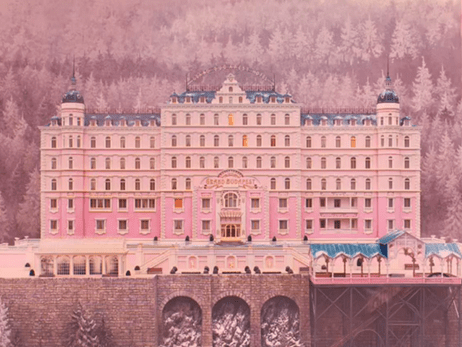
What The Grand Budapest Hotel ends up being is an odd mix of black comedy and romantic sentiment all wrapped up in an Anderson world.

His shots are often framed symmetrically and muted pastels abound as well as scaled miniatures, creating his always distinctive mise-en-scene. He is also a fan of a smooth moving camera often involving zooms.

Anderson is obviously a student of cinema and his film at times are reminiscent to 30s fair such as Grand Hotel and The Rules of the Game. He also channels another famed Viennese Ernst Lubitsch who was a master of highbrow romantic comedies.

Hotel also boast a superb cast comprising most of Anderson’s stock company. If there’s anyone who has been in more than one of his movies, they are probably in this one, even for just an instant.

So given the normal Wes Anderson flair or eccentricities, this film is visually pleasing and quite entertaining. It is a worthy follow up to Moonrise Kingdom, darling.

4/5 stars
The Party (1968)

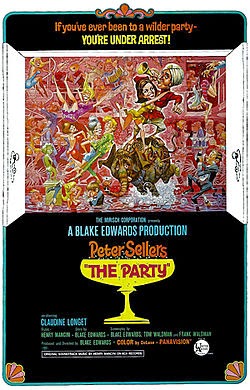
7af4c-party_movieWhen you begin to watch the Party it becomes obvious that it is less of a comedy film and more of a comedy concept. Peter Sellers in all his glory is a bumbling Indian actor who is mistakenly invited to an elegant party. He is in many ways very similar to Mr. Hulot. Both are likable mess ups who are constantly getting themselves into trouble.

I am of the opinion that Seller’s comic genius alone could carry a film. However, the Party has a great multitude of weirdos and snobs that create a great comedic collaboration. Possibly the best example would be the constantly inebriated waiter. Furthermore, by the end the Party is no longer distinguishable and it culminates in a surreal world of bubbles and groovy music. This was the only collaboration of Sellers and Blake Edwards that was not Pink Panther and it honestly is not half bad! We even get a performance from a young Claudet Longet.

This is one of those films that might be lacking in plot at times but it is more fun simply to sit back and watch the fireworks begin.

3.5/5 Stars