Carefree (1938)

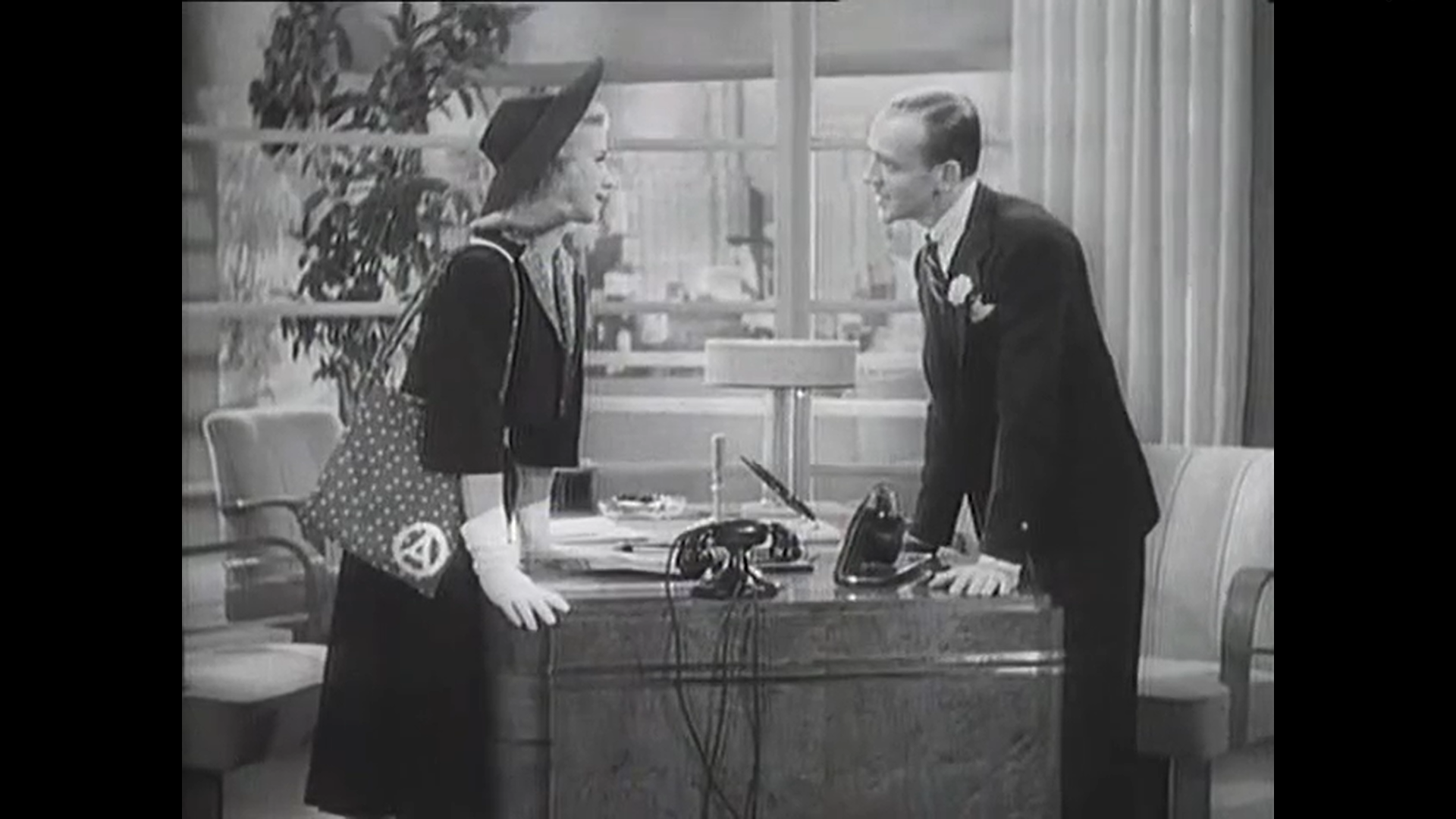
Ralph Bellamy, Jack Carson, and Fred Astaire sounds like a stellar triumvirate for a movie, and Carefree does us a favor by getting the three men together. Bellamy takes up his usual post as the other man and jilted lover, Stephen Arden. Amanda Cooper (Ginger Rogers) can’t seem to make a decision to marry him, and so she agrees to visit his buddy, who just happens to be a psychiatrist.

Fred Astaire as Dr. Tony Flagg is quite the piece of casting, and the situation gets more outlandish when she happens to overhear some of his condescending dictation about the female psyche.

By the time he calls her in for psychoanalysis with perfect candor, she’s already wise to him becoming the most wearisome patient he can possibly imagine. No one takes kindly to disparaging remarks.

With old pros like Clarence Kolb and Franklin Pangborn rounding out the cast at the local country club, you know exactly what you’re going to get. Luella Gear isn’t quite Helen Broderick as far as the wisecracks go, but she has a kind of warm, bright-eyed gameliness in her own right. Behind a certain level of propriety, as Amanda’s Aunt Cora, there’s also a dry sense of humor.

Although it feels like Rogers’s picture for the most part, a high point for Astaire is watching him make dance out of golf, looking quite competent with both as he hits balls off the tee with a rapid fire cadence perfectly in step.

There’s also a dreamscape Astaire and Rogers number within Amanda’s mind, giving license to their longest and most luxuriant kiss to date on celluloid. “I Used to Be Color Blind” would have been more spectacular and made more thematic sense if it had been filmed in Technicolor, but the slow-motion action has a novelty to it. It’s also a secret she must keep to herself: She must subconsciously love Tony, not Stephen.

Not much stock should be put into Astaire’s therapy techniques because they only serve to aggravate the situation, though this is very much on purpose. Ginger under anesthesia allows the story to play up its best screwball antics, and she was always game for a laugh and a few shenanigans.

She proved time and time again in movies of the era like Vivacious Lady and Bachelor Mother, that she was an unmatched comedienne, even when there was little to no dancing for her to partake in. Carefree ventures into the arena of near-surreal silent comedy as she effectively plays a “drunk” character bumbling nearby traffic, giving the stink eye to truck drivers and the like.

“The Yam” is a quirky piece of puff, but it’s exhilarating to watch Astaire and Rogers in one of their most wide-ranging immersive dances. Usually, we get these specified incubated perimeters in which to enjoy their dancing and marvel at their prowess.

Here, it feels like giddy performance art where everyone is drawn into the far more fluid frame with them as they pick up onlookers like an ever-growing amoeba. They move their way through the country club, strutting through the dining rooms past tables as Rogers bounces in and out of the seats with a sweep of her partner’s arms. It’s an utterly delightful outpouring from the consummate professionals.

In a subsequent scene, Astaire talks to his subconscious in the mirror. He knows he’s falling in love with Amanda, and he tries one final desperate act to salvage her relationship with his friend. He hypnotizes her and implants the idea that “men like him should be shot down like dogs.” It’s definitely not a recommended method, but it sets Rogers up for the final act.

Watching the actress skeet shooting Tyrolian hats under the spell of hypnosis is one of the more hilarious things in the picture. It’s good ol’ fashioned fun playing off Kolb’s ornery judge character. One doesn’t work as well without the other.

But there’s also a real menace, even if it’s screwy watching her tromp around the club as the men flee every which way to stay out of the line of fire of her shotgun. Astaire’s ploy worked a little too well.

He realizes he still loves her and expresses his feelings with the crooning classic “Change Partners” imbued with a kind of melancholic yearning out on the dance floor. He waits until the eleventh hour, but with Jack Carson’s help, they try to get into Amanda to thwart Stephen and make sure the right people get married on the wedding day.

There’s a subtle shift in this film within the Astaire and Rogers canon in that it leads with the screwball elements, with the musical aspects playing almost a secondary role. In other words, it breaks with their typical formula and relies on a more compact screwball structure and the capacity of its stars. But the movie also feels like a supreme showcase for what Rogers was capable of on her own.

3.5/5 Stars

Follow The Fleet (1936)

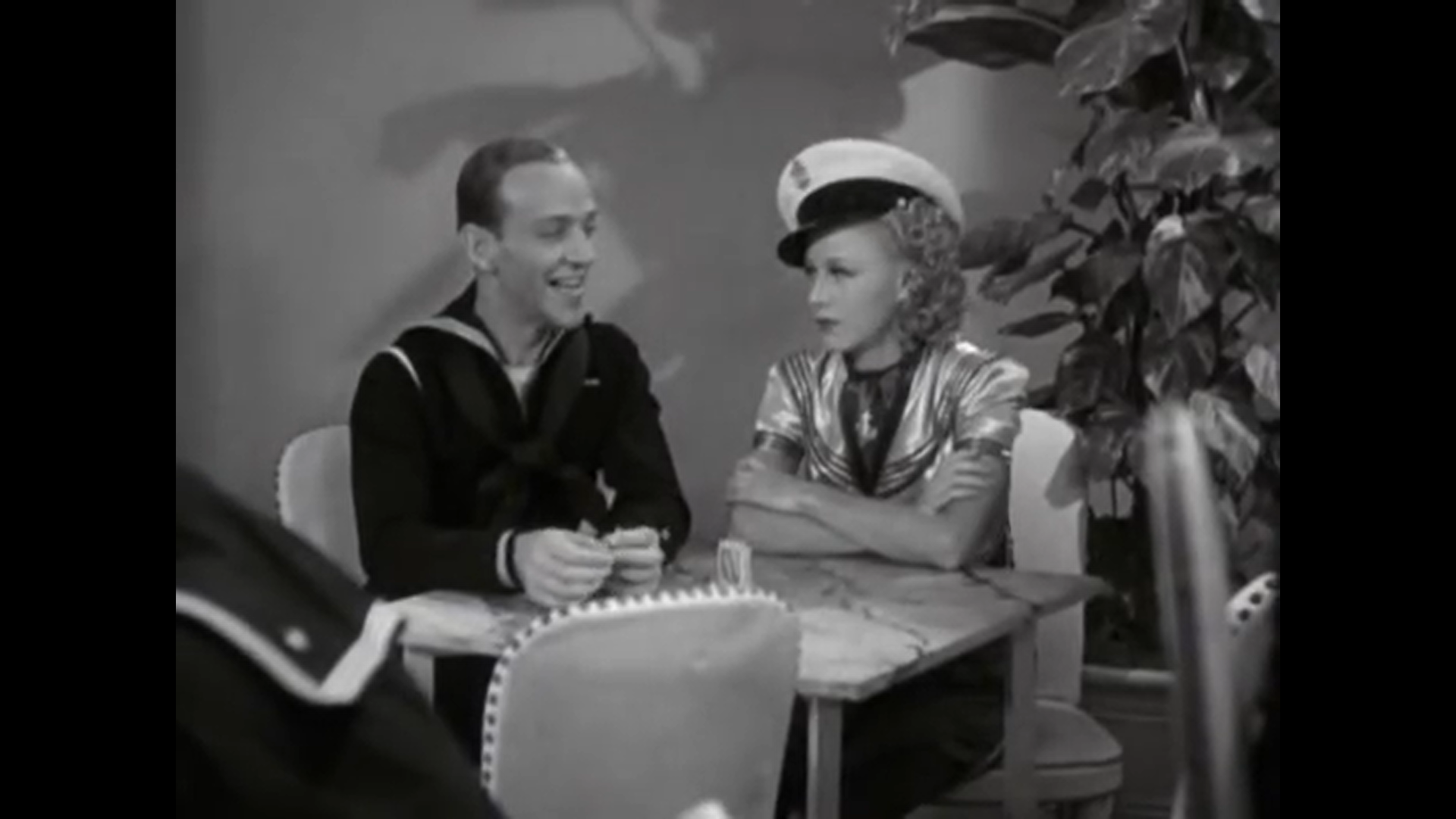
Taken in the lineage of movie musicals, Follow The Fleet feels like a prototype for On The Town, or maybe there were just more movies focusing on sailors on leave back in the day. It’s like romances set on ocean liners. With the proliferation of commercial air travel, it’s possible a whole subgenre went kaput. For now, it’s safe, and the boys descend on Frisco.

Fred Astaire stars as a gum-smacking sailor, Blake Baker. He wears the abrasiveness lightly because he was always an appealing personality beyond his graceful taps. Randolph Scott takes on the role of the best bud, Bilge Smith, as they continue their pairing from Roberta. Astaire similarly has a girl he wants to check in on…They had a falling out, and you can just about imagine who might be playing her.

As the sailors roll into the city, it has the distinct stench of a pile of pesky high schoolers infecting the place. They sneak into a local joint on one ticket, and Bilge hooks them up with a couple of paper bags of beer from the outside. All they require is the establishment’s table, and they do the rest themselves.

Connie Martin (Harriet Hilliard) plays a homely, bespectacled brunette girl who makes Randolph’s acquaintance; she needs a man to get inside, and he obliges, though he’s quick to brush her off and forget about it. Connie also just happens to be the sister of Sherry (Ginger Rogers), who’s the floor show at Paradise.

It’s the old trope we’ve known since the dawn of time. Ginger Rogers hails from the Gentlemen Prefer Blondes school. As she points out, men like blondes because they look dumb. The operative word is “look” since you would never believe someone pulling one over on Ginger Rogers.  “It takes a lot of brains to be dumb.”

Lucille Ball enlisted to make Connie look presentable. The ugly duckling arc feels dead on arrival. This movie just needed another plot to bide its time. Her new look makes a startling impression on Bilge, and we know she has feelings for him already. His problem is living a transient life; he’s also easily swayed by shinier, more affluent objects in the form of divorced socialites.

Rather like Roberta, the sluggish romance all but writes itself, making Astaire and Rogers the primary reason to stay with the picture and see it through. There’s the fun pretense of a dance-off with another couple, and then Astaire and Rogers go nuclear into another stratosphere. The scene becomes there’s, and there’s alone. The movie almost seems to forget there were ever any other dances spliced into the scene, and we do too. 

The sailors are whisked away on a moment’s notice, and the women — as the title implies — must take up pursuit! The movie requires it. Connie vows to get a boat so the man that she loves can captain it.

It’s rather hypnotic seeing Astaire tapping on deck with a whole host of sailors keeping time behind him; there’s a military cadence to it with a certain added level of artfulness. It’s like the maritime context creates a playground for him to then work within and offer us some novel hoofing.

There’s also a cruel comic irony watching him return to town trying to nab his girl an audition and derailing a “sure thing’s” chances by spiking her drink with bicarbonate of soda. His wires get horribly crossed. You can fill in the rest because Ginger’s the poor woman who suffers at his hands. Being pretty plucky herself, she’s more than equipped for some brutal payback.

These moments of “plot” are the movie’s saving grace because at least A & R’s romantic entanglements are mostly comedic. Rogers has the feistiness to make them a joy, and Astaire doesn’t have a malicious bone in his body, so the comedy comes off mostly affable and light.

The final act is comprised of putting on a show to keep Connie from losing the refurbished ship she sunk her savings into — she did it for Scott, but you hardly need to know this. Nor the fact that Blake has to go AWOL to get to the benefit in time. It doesn’t matter.

All that matters is that Fred is there to dance with Ginger, and everything else falls away. The apex of the movie is “Let’s Face The Music and Dance,” which feels like a quintessential American Songbook number that I’ve been sleeping on. My sincerest apologies to Irving Berlin.

It’s classic  Astaire and Rogers at their classy best, dancing on the deck of the ship and making us forget the sitcom fluff for something transcendent like they gave us so often. It’s a worthy place to end.

I said my apologies to Berlin, and now I owe one to Ms. Hiliard. I didn’t realize she was thee Harriet of Ozzie and Harriet fame until I was practically finished with this review. The longevity of her career in itself is quite remarkable.

3.5/5 Stars

Roberta (1935)

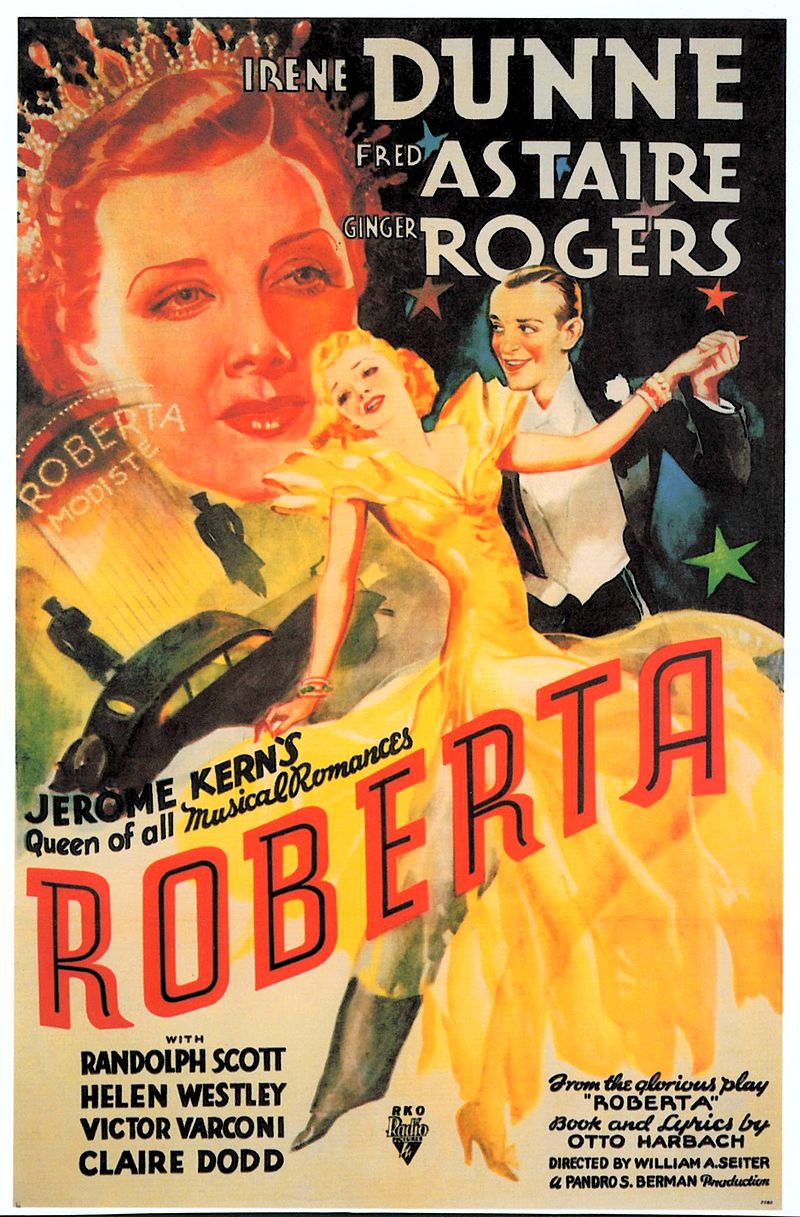
Roberta opens with a troupe of musicians known as the Wabash Indianans who perform a wonderfully kooky organ routine in the middle of a train depot. It’s so inventive in fact, including the verbal gymnastics of Candy Candido, that they get sacked before they can even begin their gig in France. The proprietor was looking for some more exotic entertainment.

The boys need a fallback plan fast. Huck Haines (Fred Astaire) vaguely knows a girl named Lizzie, and John Kent (Randolph Scott), well, his aunt just happens to be the most famous dressmaker in the city. Only in the movies…

Time is of the essence, and so he pays the famed monoymous Roberta (Helen Westley) a visit. Scott gets stuck in the gilded elevator and has his meet-cute with Irene Dunne. It took a moment to recognize her because she addressed him in French. Stephanie (Dunne) is Roberta’s designer and most faithful staff member.

Scott is instantly smitten and goes leaping up and racing across the room just to have the chance to open the door for her. He rumbles around with the giddy energy of a colt; his aunt likens him to her favorite Newfoundland puppy.

If you’re keeping score, there’s one name that hasn’t cropped up yet. Ginger Rogers shows up as a feisty countess; her accent is worse than Dunne’s, but it doesn’t matter. She’s got the spunk to make it count. She stands at the balcony listening to the band do their performance, and when she actually gets face-to-face with Astaire, there’s really some fun to be had.

Flying Down to Rio found them coming into their own; they were sidekicks who caught the eyes of the audience with their craze-creating “Carioca” routine. With Roberta, they had already hit it big with The Gay Divorcee, and now they get to have a good time with the material without the onus of the story being on them.

They seem to relish this kind of sidekick role; it’s almost like they’re playing a level of meta comedy here because they know all the beats of the story and what it takes to have the commensurate repartee. After all, outside the film, they’ve already built up a cache of goodwill.

We really begin to understand it when they both drop the act. Because she’s not a countess but the same fast-talking dame named Lizzie he knew in a former life. Now their familiarity makes sense for the sake of the story.

In “I’ll Be Hard to Handle,” they get reacquainted with some flirtatious dancing as they reminisce about old times. This devolves into a dance-off with a slap for good measure, all captured in a rush of an unbroken take between two consummate performers loving what they do in front of us.

It feels like things are humming along. The demonstrative nightclub owner Alexander Petrovich Moskovitch Voyda, who communicates only in raised octaves, is coaxed by Lizzie into offering the boys a job this time around. Things are looking up.

There’s even a French lesson with Randolph Scott and Fred Astaire, which so obviously lays the groundwork for “Moses Supposes” in Singin in the Rain. It’s impossible to see it any other way.

Admittedly, Scott and Dunne have a rapport I like, though I’m equally tempted to say I want to see the movie with Astaire and Rogers at the reins. They almost need two separate movies because the story’s not big enough for all they have to offer. The script goes tugging and seesawing good-naturedly enough between the players, but the story almost doesn’t know how to handle it all.

It’s an embarrassment of riches, and it’s not even named for any of them. This distinction goes to Helen Westley. Then, Auntie Auntie dies peacefully — Scott and Dunne have a pact to run her fashion empire together, and John’s old flame Sophie comes from America for the obligatory complication.

She and Astaire don’t mask their mutual disdain for each other, and her entrance is great for the sake of comedy if little else. The fact that they have a bet over how her dress will be received by John pays dividends simply with the opportunity of watching Astaire’s smug face as he struts off and palms her dough.

Roberta could be a stolid affair straight through, and it is from time to time. No disservice to the lovely Irene, but her style of singing went out about 80 years ago, and I will always be enraptured by the Platters’ cut of “Smoke Gets In Your Eyes.”

I realized what made the Astaire and Rogers formula work was that they cut out the middle man: they were the floor show, the romance, and comedy all wrapped up into one. Roberta almost has too many parts.

Irene Dunne’s a star deserving top billing to be sure, but it’s easy to say the same about her costars even if it’s in retrospect. Still, there are enough delights in this one to look kindly on it.

3.5/5 Stars

It’s a Gift (1934): “California, Here I Come!”

Screenshot 2020-07-07 at 8.04.46 PM

It’s a Gift is built out of the framework of the domestic lifestyle. This is where it gets its comedy. Take for exhibit A an early sequence. Harold Bissonette (pronounced bis-on-ay) tries to shave with a straight edge despite the interference of his daughter. It leads him to resort to using the reflection of a can and then a mirror suspended from the ceiling dangling around the room.

He follows it around taking intermittent swipes at his gullet covered with shaving cream quite unsuccessfully. It’s a wordless sequence that’s a wonderful escalation of utter absurdity. Because it bubbles with human invention and though Fields takes it further than seems necessary, that’s part of the fun — watching him keep it going.

For any of this comedy to function, there must be a suffocating bulwark around Fields in the form of his family. He has a perfectly henpecked, windbag of a wife (Kathleen Howard) berating him incessantly. His cackling kid’s either gliding around on his roller skates or leaving them lying around so they can be tripped over. His daughter is simply boy-crazy.

Put them together and it’s a perfect combustion engine for his comedic shtick. He has dreams of leaving his corner drugstore for an orange grove in California. If his uncle keels over like he’s supposed to maybe he’ll be left some inheritance.

For the time being, he has the daily grind, which isn’t much better than his home life. A huffy man demanding kumquats. There’s a blind and deaf fellow with an ear horn who’s a walking booby trap. The stock of light bulbs never had a chance. Even his oafish shop hand is hopeless; riding his bicycle indoors, falling asleep, failing to keep a wayward baby from spreading molasses all over the shop floor. You name it. It happens to him.

W.C. Fields becomes a vehicle of antagonism and all the ires of the world seem to be directed at him. This is the source of giddy delight in the comedy strung out over the progression of loosely connected scenes. Could it be he can never catch a break or maybe he’s just enough of a doddering fool to never warrant one?

Normally the image of the comedian is sculpted as a hater of mutts and tykes. It’s true this ornery image makes him all the more human. Here in this movie, it feels strikingly different because he’s effectively accosted on all sides even as he’s just lying around minding his own business. He’s allowed no peace.

One of the ripest gags is set out on the back porch one morning. Fields is trying rather unsuccessfully to get some shuteye, thwarted by an uncooperative couch, a milkman rattling his morning stock of “sleigh bells,” and about anything else you might possibly imagine. Don’t forget a rolling coconut exuding 10 times its decibel level — it’s practically a bowling ball as it thunks down the steps. Likewise, babies are infernal creatures out to get him and wage war against his comforts, no fault of his own.

It’s also one of the most visibly cinematic scenes in which we get this stratified sense of comedy as if it’s from the old two-reeler days of the silent era.  Though, here, the sound is such a vital element. That’s what sets it apart.

Then, the needle drops on “California Here I Come” to send the move in motion again. He’s gone and put his money into his dream. He done and bought an orange grove on a whim, loading up the jalopy and taking the wife and kids out west.

With it comes camping and sprawling West coast estates with rolling greens and statues. In fact, a witty passing gag has Fields crashing into the lawn ornament while his wife exclaims, “It’s the Venus de Milo” now in mint condition having been decapitated a la real life.

They make themselves at home on the private land. Their ensuing picnic is replete with sandwiches and meats wrapped in paper, feather pillows, feisty dogs, and sprinkler systems. By the time they leave the premises, it looks a bit like a ravaged water park gone awry. It’s an example of incremental chaos all conjoining into this culminating mayhem.

In the end, Bissonette is duped with what looks to be a precursor to Green Acres‘ Haney Place. In the immortal words of Bette Davis, “What a dump.” It’s a shack falling apart at the seams. His wife is indignant, ready to walk out on him, and he’s left to sit on the front stoop. What a dismal place to be in if this is truly the end. We only have minutes left after all.

But the cinematic world of W.C. Fields is an absurd space where only moments later all his miseries are turned on their head. Soon he’s sitting on the veranda pulling Oranges straight off the tree to squeeze into his own juice. It’s an outrageous joke scenario and a lampooning of idealized California culture, but in the face of The Grapes of Wrath and other such images, it’s a welcomed relief. If only every Tom, DIck, and Harry who took his family plunking out to the west coast struck it rich like this. It really is a comedy…That is until he sees the property taxes he owes.

3.5/5 Stars

Million Dollar Legs (1932): Klopstokia and The 1932 Olympics

Screenshot 2020-07-06 at 8.25.11 PM

“All the women here are named Angela. And all the men are named George.”
“Why?
“Why not?” – Jack Okey and Susan Fleming

This kind of laissez-faire, anything-goes mentality is one of the obvious strengths of Million Dollar Legs‘ comic tableau. There need not be a given rationale behind what it does and with this brand of laxity, there is an empowerment to do anything it so desires.

Thus, the narrative opens in a far-off Eastern European land called Klopstokia. Their chief exports, imports, and inhabitants are goats and nuts! If it’s not evident already the movie looks like it might be an equally oddball companion piece to Duck Soup.

It’s hard not to see its shared space and that’s mostly on a perfunctory level (and because of the fact Susan Fleming married Harpo Marx). One must also note it came first to precede the L.A. Olympics, though it’s not too hard to believe the Mankiewicz brothers did conceive the movie as a vehicle for the crown princes of anarchy.

Since this is not the case, Million Dollar Legs is ripe for rediscovery propping up some other stars who are sometimes less remembered. They didn’t get them, but Herman and Joseph working with director Edward F. Cline wrangled together an absurdist universe for the likes of Jack Okey. He might be most famous to modern audiences for parodying Mussolini in Chaplin’s The Great Dictator.

Here he’s front and center, an itinerant brush salesman, who happens upon the nation on business only to fall head over heels for the country and its people — one person in particular — her name is, of course, Angela (Susan Marx). They brush each other off rather seductively as her kid brother (Dickie Moore), a begrudging and silent cupid, does his best to keep them apart.

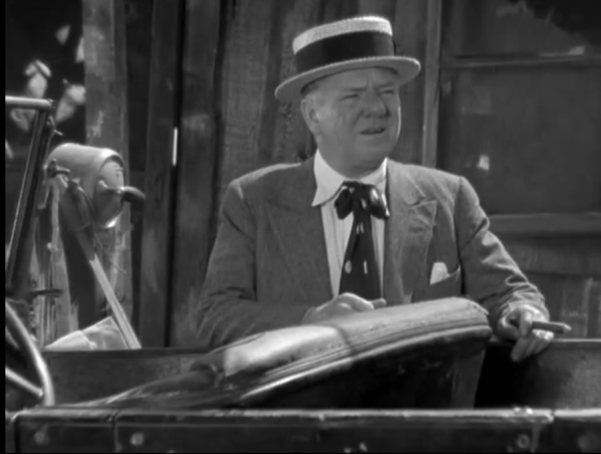
But she also has a connection to the country’s fearless leader. Her father is the President (and also W.C. Fields) with his hat and a dictaphone perfect for bad-mouthing his subordinates on his daily carriage ride to the office. He’s the broadest, most formidable name in the movie.

He makes a daily show of his brawn arm-wrestling his sneezing cabinet including such hoodwinked bumblers as Hugh Herbert and Billy Gilbert. The President is oblivious to their conspiratorial endeavors because frankly, even with their secret cache of spies, they hardly seem likely to hurt a fly. One of their spies out in the field, no less, is a pantomiming, cross-eyed man in black portrayed by Ben Turpin.

However, despite their impotence, they agree to call upon the woman who men can’t resist — the ultimate vamp and a caricature of the Dietrich archetype — Mata Macree (Lyda Roberti). What are her plans? To seduce the entire Klopstokia Olympic team in their bid for the 1932 Olympics! It has no import aside from meeting narrative expectations.

So everyone piles onto the ocean liner, including the President, Migg, and his best girl Angela. The movie’s apex might come when W.C. Fields on one side and his cabinet on the other start yanking the wall back and forth as Okey tries to woo his girl with the gibberish national anthem. It’s delightfully absurd both in the immediate visuals and the auditory accompaniment.

The Olympics aren’t much different with the Klopstokian contingent in a shambles before Angela rallies them jumping from the high dive to have it out with the duplicitous mata hari once and for all. Then, her father shows off his feats of strength in the weightlifting competition against his rival cabinet member. All pretense of logic is gone. Just go with it. Take it for what it is.

The final baton is taken up by the speedy Major-Domo who zips past the competition as a last-second entry coming from behind on the urging of Angela on a motorbike.  Truthfully, I’m still trying to figure out who owned the pair of million-dollar legs. For my money, it’s the galloping Major-Domo

What’s not up for contention is Million Dollar Legs as an intriguing vessel of comedy functioning as a kind of cultural time capsule. Not only does it help chart the famed Mankiewicz brothers before the heights of their future successes, it’s also a contemporary commemoration of the L.A. Olympics. Marx Brothers or not, it might just be worth a look as a historical curio.

3.5/ Stars

James Whale: The Old Dark House (1932) and The Invisible Man (1933)

The Old Dark House (1932)

The Old Dark House has a disarming levity that broadsided me at first. James Whale, the man who famously gave us Frankenstein, has all of his notable features with the tinges of horror on hand for another ghastly delight, and then he goes and pokes fun at the whole setup. Raymond Massey is instantly pegged as a slightly stuffy husband. His wife, dazzling Gloria Stuart, a young ingenue has signed up for more than she bargained for with the outrageous downpour dousing them in the dead of night.

Then, there’s old reliable Melvyn Douglas playing his quintessential character type, always good for a wisecrack, with his feet kicked up, and his pipe tucked in his mouth as they proceed to get hopelessly lost. And of course, he can’t help but whistle a few fractured bars of “Singing in the Rain” when their waterlogged buggy has no recourse but become semi-amphibious.

Oftentimes bathos is used as a kind of criticism — this idea of anticlimax or a break of the mood — because it’s too jokey and therefore undermines all the groundwork put down before it. However, Whale seems to be doing something different.

At any rate, it’s not an out-and-out drama and so while somehow deconstructing his tropes and suggesting to his audience he knows precisely what he’s doing, we reap the benefit of the humor and the chills in ample measure. This is the underlying success of the film in a nutshell. It carries off both and becomes invariably more intriguing in the process.

Because The Old Dark House fits seamlessly into the tradition of Cat and the Canary, Hold That Ghost, House on Haunted Hill et al. A dark and stormy night is a genre given, but the abode itself must bring with it the unnerving idiosyncrasies to make the audience ill at ease. Rest assured. It does.

The proprietors include a white-haired gentleman trembling with timidity and his eternally deaf and priggish sister who condemns all blasphemers en masse. Their valet (Boris Karloff) might as well be a grunting prototype for the wolf man. All of this doesn’t quite suggest a warm and amicable atmosphere. It screams something else. But that’s just the beginning of the festivities…

If I’m to be terribly honest, it seems like an utter waste of Karloff’s talents, especially because I was barely aware he was playing the part. He gets partially overshadowed by the more verbal characters. Charles Laughton, for one, comes tottering through the front door soaked through as gregarious Sir William accompanied by his playful and rather giddy companion (Lilian Bond). Her lithe spirit mirrors Douglas, and they gel nicely. The night quickly turns them into an item. In fact, all the guests hang together.

One could wager it comes out of necessity. It’s a ghoulish space filled with funhouse angles and other parlor tricks. Locked upstairs is a decrepit patriarch and behind another closed door is crazy Saul, who makes a cameo appearance spouting the story of King Saul and David. You know the one, where malevolence came over Saul and he proceeded to spear the other man to death.

He finds a knife and brandishes it with a kind of giddy insanity we don’t know how to respond to. He could do anything. Douglas, the picture of casual confidence and charm for most of the picture, finds his own veneer unseated filling in for David. It’s these kinds of digressions that we never expected, and somehow they make the picture by leaving the audience totally nonplussed.

By the time The Old Dark House is wrapped up, it feels like the gold standard of this brand of haunted house movie because it’s just as much about being a mood piece — finding humor in these outlandish scenarios — and Whale does all of the above with assured aplomb.

4/5 Stars

The Invisible Man (1933)

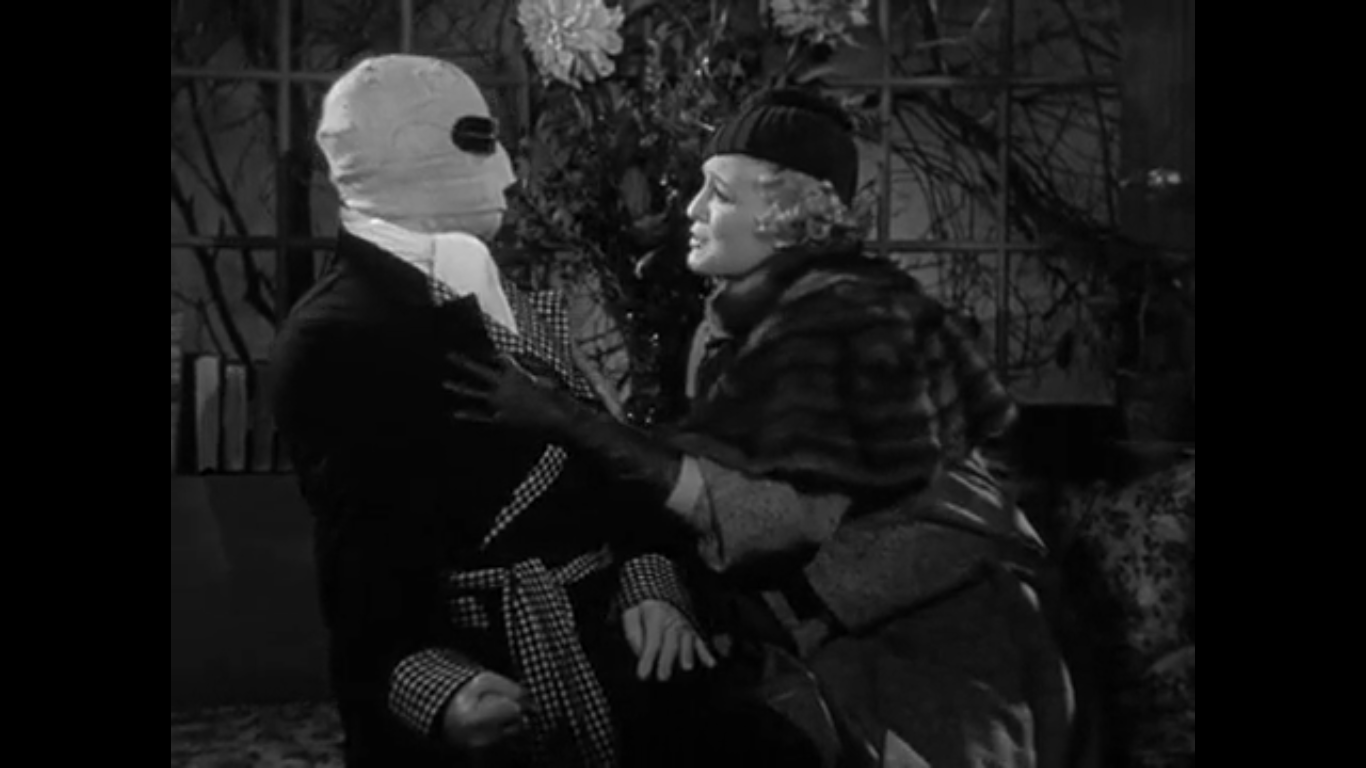
I always thought about The Invisible Man as a scientific marvel, but now I understand how he’s firmly planted in the realm of horror with added superhuman abilities. There’s something that feels somehow modern about Claude Rains’ portrayal of the eponymous character. It’s almost as if he’s the precursor to some enigmatic alien creature from Star Wars.

He’s unique and out of step with this more traditional setting of a bar and lowly establishment as local folks chew the fat and the incomparable Una O’Connor runs the place. One feels quintessentially British, albeit through the prism of the Hollywood dream factory. Rains is totally a movie machination born of smoke, mirrors, and special effects.

But it’s also as if this camouflage provided Rains the means to give one of his most ballistic and volatile performances. It’s not that he couldn’t play, wry, sly, or even bad-tempered, but his typical onscreen disposition was one of regality. He commands the room but in a very different way.

He’s seething one moment and then hysterical the next. The local constable rightly asserts, “He’s invisible. He gets those clothes off and we’ll never catch him for a thousand years!” It makes the stakes obvious. Soon thereafter the maniacal doctor commences a reign of terror making good on his threats by committing murders and diverting trains off their rails. He makes it clear he has the power to make the world grovel at his feet.

If it’s not obvious already, he’s taken on the mantle of a violent “Superman” cut out of the cloth of Dostoevsky’s Raskolnikov. What’s worse, there seems to be no one capable of stopping him.

What’s most fascinating is how the film builds the legitimacy of the Invisible Man. It’s not merely a sitcom-like trope where the invisible are given the freedom to pull practical jokes or take on a Groundhog Day-type disregard of worldly conventions. This is part of it, yes, until it becomes something more.

It turns into a story of fear and broader social implications broadcasted over the news and through every small town by word of mouth. He’s continually left unchecked and the drug he’s taking pumps him full of delusions of grandeur. It’s a drug and addiction of a different sort. Not even the affection of his former girlfriend (Gloria Stuart) can change his mind. He’s too far gone.

The special effects and the choreography get better and better as a crowd of bobbies forms a human dragnet to converge on him in the dead of night. He skips away with a policeman’s trousers sowing chaos and discord wherever he goes. But before anyone gets the idea The Invisible Man is a mere lark, we’re quickly shocked back to reality.

It has a jagged edge of vindictiveness which the production codes would make sure soon enough would never see the light of day (at least for a good many years). For now, it feels like a chilling, compact drama chock full of ideas, invention, and not a wasted minute of running time. It’s also without a doubt Rains’ finest entrance in a movie: It happens in the final frame.

4.5/5 Stars

Reviews: The Mummy, Island of Lost Souls, The Black Cat

The Mummy (1932)

There’s something deeply prescient about The Mummy beginning with an archeological expedition for The British Museum. If it’s not evident from the outset, the film is firmly planted in the reality of 1922 when Howard Carter famously discovered the tomb of Tutankhamun. This is only one historical example, but even I remember hearing about the exploits of this modern discovery.

Now we live in a world in dialogue with the history of colonialism from the cultural tension over the Elgin Marbles to the very idea of ancient antiquities being housed in museums themselves. Even if it’s mostly to capitalize on something the contemporary audience might be aware of, The Mummy makes it plain, this kind of potential cultural desecration is not a totally new idea from our “enlightened” age. It has deeply entrenched traditions.

The British expeditioners come from two different camps, and they must mediate the pull between doing their methodical work of cataloging and then following the finds that will gain the most press. Those who are fully committed know they are working for the cause of science and not for loot.

It begins with a young man who will not heed the terrible curse on a casket, and he awakens a creature from eons before. It is Imhotep (Boris Karloff), who enters back into the world fully prepared to take back what is rightfully his and reunite himself with his long-lost love by any means at his disposal.

The Mummy starts out promising, but it never quite nails down the extent of its mythology and everything feels far too convenient with the re-animated mummy capable of doing anything he pleases to serve his purposes (and the plot). He’s well-versed in mind control, he has what looks like a shortwave television, and he’s all but indestructible to human hands.

The flashback sequences of Egypt hearken back to the expressionistic imagery of silent cinema and here is where our director, Karl Freund, seems to show his origins as the fantastic cinematographer for revered works like Fritz Lang’s Metropolis.

The film’s other compelling theme involves a woman of Egyptian blood (Zita Johann), who almost functions as a doppelganger through time. One man falls in love with her in the present (David Manners) and another man loved her in the past. She’s effectively trapped between two worlds — one distantly remembered — and yet now dwelling in the body of a young woman, breathing and alive.

She is not prepared to make the kind of sacrifice asked of her and only the supernatural can save her. Karloff is expectedly chilling, but the pieces around him aren’t quite as enjoyable as his greatest monster movies.

3.5/5 Stars
Island of Lost Souls (1932)

“Mr. Parker, do you know what it means to feel like god?” – Dr. Moreau

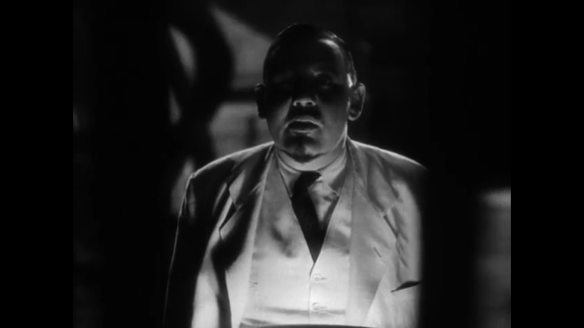
Island of Lost Souls is the kind of movie that all but disappeared with the more stringent implementation of the production codes in 1934. It begins with an uneasy mood as a castaway is rescued by a not-too-genial sea captain, who’s anxious about dumping him at the first sign of land.

This is how our protagonist Richard Parker (Edward Arlen) catches a ride to shore on the Island of Dr. Moreau. There’s something rather uneasy about the whole setup and the movie frequents a landscape and a world not so foreign from The Most Dangerous Game. It’s as if an island conveniently eschews all traditional rules of law and order.

While the earlier film is harrowing, subjecting Joel McCrea and Fay Wray to a grueling game of high-stakes cat and mouse, this one is more thematically rich. This might be entirely thanks to H.G. Wells. He is the man who originally conceived of Dr. Moreau. However, something else must be attributed to Charles Laughton.

There’s a level of devilish forethought to Laughton’s performance. Although he’s not an entirely imposing figure, there’s something mischievous about him. Sometimes he comes off gleefully boyish even as he takes on these calculated and totally premeditated social experiments on his self-made ecosystem.

Parker knows nothing about the world he’s wandered into, but he is our stand-in representing everything inherently decent about humanity. And there is something deeper to this since he is white in the age of colonialism. While he might not necessarily bear the “white man’s burden,” certainly he’s aware of his place in the social hierarchy. He’s a benevolent figure. Dr. Moreau is this privileged mentality gone astray.

Judeo-Christian society would look back to Genesis, and the parallel imagery is made plain fairly quickly. There’s a specific order to the world, a created dichotomy between humans and beasts. Because Moreau has installed himself as god on his own private world. However, he has somehow perverted what is good in strange and troubling ways.

These themes get murkier when you start considering ideas of eugenics and even how the aforementioned production codes forbade the outright depiction of miscegenation or the mixing of races in romance. These are not synonymous terms when it comes to humans and beasts living on the island, but it’s hard not to see how predominantly white audiences at the time might conflate the two.

Because Moreau’s rudimentary imitation of creation has elements to mirror what we already know intuitively. His creatures live by basic laws shouted out by their de facto leader (Bela Lugosi), and they realize through roundabout means certain tenets. He has taught them what pain is, and he’s molded some like his prized creation Lota (Kathleen Burke) into his own human image.

If the Christian origin story hinges on a Fall from grace where Adam and Eve were deceived by the serpent and ate from the forbidden tree of knowledge of good and evil, then Island of Lost Souls has its own paradigm. Suddenly, these indigenous monstrosities of his realize their creator is mortal or at the very least they can rebel against him. The law is no more and it’s been disproven. There is no longer anyone willing to uphold or live by it. Namely, because they realize it’s fallacious.

Parker is mostly uninteresting as we watch his repugnance grow, and he looks to be reunited with his innocent love (Gloria Stuart). Meanwhile, the doctor toys with him and tries to set him up with Lota. Lota fits crucially into this deeply human narrative because there’s a suggestion of her “evolution” within the arc of the film even if it’s not in purely Darwinian terms. Because she has come to understand what sacrificial love is: laying one’s life down for one’s friends.

If nothing else, surely this shows her not to be a creature without reason or logic but predetermined with something deeper and more primal inside of her. I find it impressive how something that feels deeply exploitive could still come down on some deeply philosophical ideas without ever forfeiting its obligation to a paying audience. It’s the kind of genre film capable of triggering all sorts of ancillary conversations, and I’m all the more curious to return to Wells’s source work.

4/5 Stars

The Black Cat (1934)

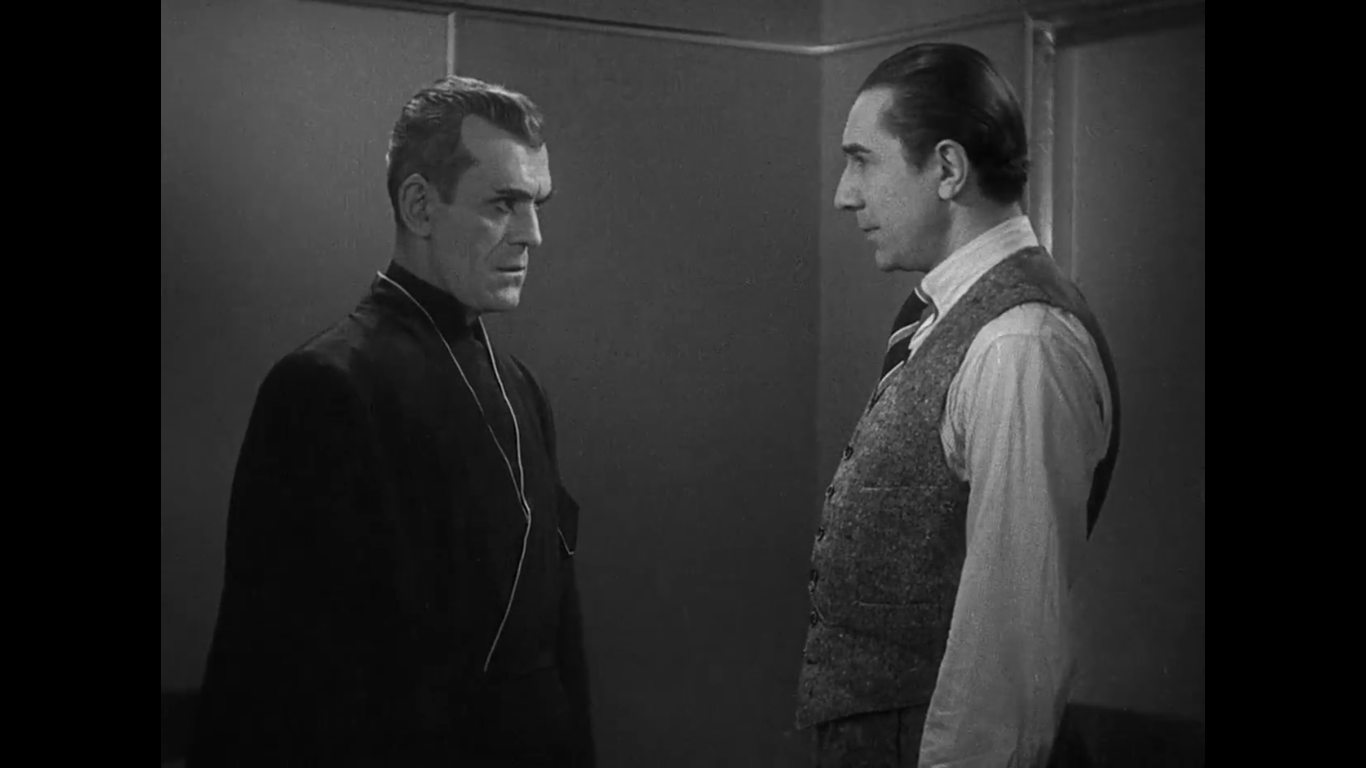
Each lineage of horror movies must have its own in-house aesthetic and stable of performers matched with specific technicians who come to exemplify a studio and their body of work. The Black Cat brings together much of what made Universal Pictures horror so lucrative from the studio, and it gathers together two of their most iconic stars: Bela Lugosi and Boris Karloff.

Although we’re not in Transylvania, the story picks up aboard a train traveling through Hungary, a typically foreign locale for a hometown audience. We meet a newlywed couple (David Manners and Julie Bishop) on their honeymoon only to have their compartment’s marital bliss disrupted by Lugosi’s Dr. Vitus Werdegast. He looks nice enough, but there’s always something menacing behind his eyes (even when he’s playing pleasant).

Inclement weather leads to a devasting crash and the couple and their newest acquaintance show up on the doorstep of one of his old friends, although I use the word friend loosely. Hjalmar Poe is a famed Austrian architect, and his abode lives up to his reputation. We must expect nothing less as we are welcomed into the home of the always foreboding Karloff.

For the rest of the picture, The Black Cat feels like an oblique tour throughout the art deco space with a subtle game of death going on between Karloff and Lugosi. Because instead of bringing two unsuspecting victims into their lair, this is much more a grudge match with two unsuspecting parties caught in the middle.

It becomes a world modulating between the polls of the supernatural and baloney. With a rogue gallery of Lugosi and Karloff, we know better, and as the good doctor demures, “There are many things under the sun.” His evocation of Ecliasstes has very ominous underpinnings.

But that’s not the only source of disquiet. The way the two actors lurk around the corridors, the very way they interact around the woman is unnerving. Karloff always seems to be leering and ogling even if that’s how his face is predisposed. Then, moments later, he’s caressing a chess piece in a disturbing manner. Or is it only our imaginations playing tricks on us?

There were lulls that I wouldn’t mistake for tension, and yet there is so much to be said about the architecture of that house even when the architecture of the film seems to fail. Because this aspect of the mise en scene embodies something that fits so perfectly with the personas of Karloff and Lugosi. Somehow always incongruous and ill at ease.

And the film never feels pulse-pounding; it’s outrageous, yes, but it also builds to these harrowing moments. They’re sinister and escalate into a final descent into the pit of Hades further accentuated by the lines of the architecture.

The ending nearly balks on the entire movie. It’s a wink and a joke that dares us to tell others about what we just saw. They’d never believe it because this is the apex of outlandish storytelling. The Black Cat‘s not great, nor is it mediocre; instead, it feels deeply alive with something probably more indebted to Edgar G. Ulmer than Allan Poe.

3.5/5 Stars

Freaks (1932): We’re All Sideshow Attractions

One of the personal details of Tod Browning’s life was his adolescence spent working in the circus. This gives him an accessibility to the material that some other less-attuned director might have lacked. And yet there’s little denying Freaks is a genuine showpiece when it comes to turning heads. It still bristles with controversy and outlandishness 90 years later.

The movie itself is presented as such to the audience. If you are familiar with any of these carnival entries from Browning’s own The Unknown or later works like Nightmare Alley or The Greatest Show on Earth, you have an immediate comprehension of the milieu.

The people we are about to witness are presented as “living, breathing monstrosities” and “accidents of birth” to the audience. If not outright reviled, they should be reeled at with horror and maybe a dash of pity. These opening moments make it evident the whole movie is quite literally a sideshow exhibition.

But somehow as the movie builds, it both feels exploitative and strangely sympathetic. This seemingly conflicting observation deserves to be broken down. And for this, we must start with the characters and their world.

One of them is the gorgeous trapeze artist, Cleopatra (Olga Baclanova), who is obviously aware of her own attractiveness and uses it to woo those around her. Because perceived ugliness or otherness has a habit of making the vein feel that they themselves are even more superior. Never once does she have a genuine ounce of care for the other performers. They are more like playthings than real people.

Front and center is the dwarf Hans (Harry Earles). Although he already has a girl, he becomes increasingly smitten with the gorgeous blonde and she gladly strokes his ego — fawning over him — she thinks she’s giving him the thrill of his life. When she finds out he’s come into a decent sum of money, that’s even better, and one day they are wed. The fact she is colluding with the local strong man remains to be brought to light.

But this is only one facet — one individual storyline in the world — since Freaks intersperses a lot of narratives throughout highlighting numerous real-life people who existed as sideshow attractions.

A single line of dialogue that might resonate with others goes like this, “God looks after all his children.” The implication is that there are no exceptions or omissions. These people are ostracized simply for the way they look or act, and while they might be different than the norms of their contemporary society, it in no way makes them sub-human. They are worthy and deserving of the same human dignity as everyone else.

Even as Freaks has been hailed as a horror film of the macabre — and there is some truth in this given the way Browning presents the material — he also normalizes the experience of these outcasts. Mind you, this is back in the 1930s. People were more than prepared to gawk at conjoined twins, bearded ladies, a human caterpillar, etc. But we’re not totally enlightened people now by any means. I admit my own shortcomings; some of these characters unnerve me but that is only based on outward appearance. We supposedly learn this in childhood, but how wrong it is to judge people by outward appearance alone.

We need to know their character before we dare to make such rash judgments. In many ways, while Leila Hyams and Wallace Ford are “normal” able-bodied folks, they are also allies and open our own eyes to these characters.

The production was turbulent with footage being heavily cut and talents like Victor McLaglen and Myrna Loy balking at the material. We cannot fully know their reasoning, whether it involved subject matter, money, or costars. Hopefully, we have the opportunity to appreciate Freaks more now because whatever the underlying reasons, Hollywood gave performers on the fringes the spotlight.

As we sink deeper into the bowels of the movie, we are privy to a wedding feast. All the outcasts sitting there, and Hans feels so ashamed as his new wife berates him and his “deformed” friends. It’s so pernicious and ghoulish all at the same time.

My mind could only drift off to what a wedding feast is meant to be. It’s a celebration, it’s a community, it’s a reminder of all the blessings we have been afforded in our lives; it points to a hopeful future of what is yet to come, and it is a capstone of mutual commitment. It’s open to all and everyone who is willing to accept it and be made new. Alas, we live in a broken, befouled world.

Given its shared setting and tortured themes, Freaks plays as a fine companion piece with Browning’s earlier silent feature The Unknown. In fact, it features a finale, equally evocative and terrifying, if not more so. Because a plot to kill Hans is enacted, but he catches wind of it, and they strike in the dead of night as their carnival show moves on amid a downpour.

In some alternative universe, this might be some misshapen, ill-formed hell as Cleopatra is chased off into the darkness by the “Freaks,” who take vengeance upon her. In a moment of self-reflection, the horror is not so much about our own ugliness; maybe it’s more so about how we belittle and dismiss other people. Are we also deserving of such a grisly fate?

Tarred and feathered and paraded in front of everyone as a sideshow attraction to stew in our ignominy for a lifetime. It’s a hellacious image but also a striking warning call. Judge lest you be judged. But enough with the moralizing. If you let it, Freaks still has the power to shock your sensibilities.

4/5 Stars

Dracula (1931): Starring Bela Lugosi

As the story behind Universal’s Dracula unfolds, it’s a joy to pinpoint all the elements helping to intensify the dread and solidify it among the studio’s emerging array of horror classics.

There has to be a kind of mythology and lore that the scares can be built out of. The protection of the cross is that of a powerful talisman capable of warding off evil.  Superstition and religion intermingle seamlessly like many of the horror films of the day.

Likewise, there must be a visual palette to help the world manifest Bram Stoker’s famed character. He already received a dose of notoriety in F.W. Murnau’s unauthorized adaptation, but now Nosferatu returns in the guise of Bela Lugosi’s now-paradigmatic Dracula. He definitively ate up and defined all future tropes for years to come.

The tale opens in a carriage when a callow young man named Renfield (Dwight Frye) disregards the warnings of the local population and ventures to the castle of Count Dracula on some proposed business. I watch Dracula and I’m immediately taken by the gaunt Transylvanian atmosphere.

Far from feeling corny, there’s an eerie spareness that’s to the credit of the picture introduced in the bleakness of night. The count’s ominous castle proves itself to be both a foreboding space and one falling apart with decay. Working with director Tod Browning, the incomparable Karl Freund translates his cinematography from Europe to become the epitome of Hollywood genre filmmaking at its finest.

The second portion of the story is born when a schooner, the Vesta, is found drifting into Whitby harbor with all the crew having perished aside from one raving madman. He’s put under lock in key in Seward Sanitarium, all but prepared to do his master’s bidding. Because of course, Renfield is now beholden to his master Dracula — by his blood.

In this new locale, Dracula borrows liberally not only from the traditions of Bram Stoker but the menacing Jack the Ripper, Jekyll & Hyde-type atmosphere of foggy London streets weighed down with gloom. It’s in this milieu one evening that Count Dracula makes the acquaintance of Doctor Seward (Herbert Bunston) as well as his daughter Mina. They are perfectly oblivious to who he really is. But, of course, he’s hardly looking for a romantic partner. Rather, he’s on the prowl for another unsuspecting human to provide him their life’s blood.

Meanwhile, a Professor Van Helsing (Edward Van Sloan) takes a particular interest in Renfield’s peculiar tendencies. When he starts making claims about the undead, Nosferatu, and vampires, this is yet another dose of necessary logos to explain the movie’s scares. Wolfbane is another tried and true vanguard against this unknowable evil.

As such, even as others remain skeptical, Professor Van Helsing becomes the film’s main advocate and certainly fits the mantle of a detective, prepared to deduce the answers and go head-to-head with Count Dracula. The man has no reflection and when he’s found out, he gets desperate like a caged beast.

The Professor and The Count have a standoff in the study — a literal crossing of wills — although Dracula manages to get to Mina and fuse with her blood. It remains to be seen if she (or Renfield) can be saved from their sorrowful fate.

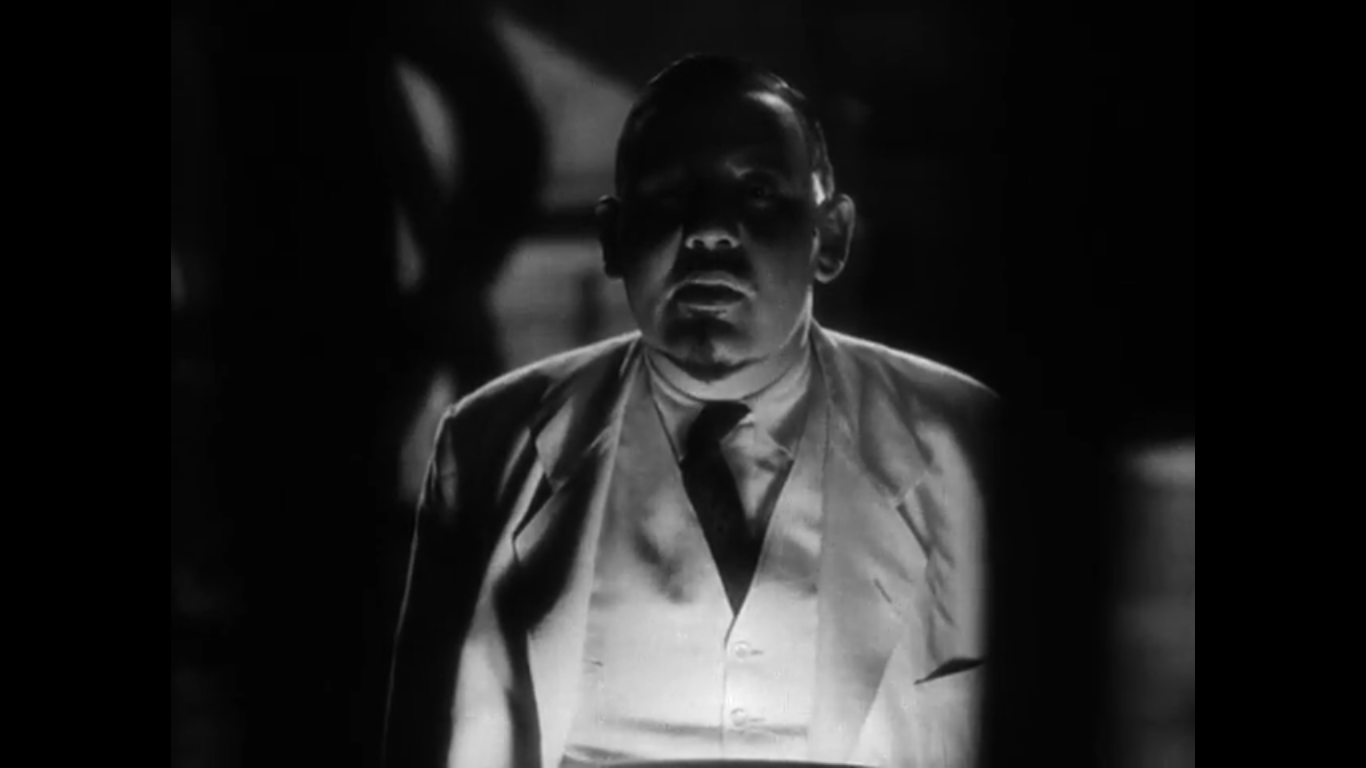
Most of the movie’s horrific power is born in the face of Lugosi — how he is lit, the fire in his eyes — it’s indelible imagery. The rest is illusion borne in the space between what we see on the screen and the cut away. This is what makes it quite effective even generations later. Because it’s not about hokey gore or any such dated method of special effects.

It relies on us and the frights we can conjure up within our own imaginations. The movie supplies the building blocks of terror, but we must put them together for ourselves. Even 90 years later there’s something deeply powerful in this cumulative effect.

This might be an unpopular observation, but somehow, having a movie unaccompanied by music somehow augments this sense of piercing dread. There’s something direct and unembellished about it — it’s starkly beautiful — and yet it pierces like a stake through the heart.

The story is expeditious, but these quick strokes are so heartily effective until the very last heartbeat. Dracula does everything we should require from a horror movie, and it remains a timelessly perturbing experience.

Like so many of the horror greats, Bela Lugosi would forever be typecast by the part. It’s the curse of an actor but the glory of a screen icon. He’s unforgettable and people never have forgotten him even those who have never seen the movie. He lives on purely through our cultural consciousness.

4/5 Stars

Colbert and MacMurray: Gilded Lily, Take a Letter Darling, Egg and I

One of my latest ventures was to view a handful of romantic comedies of the ’30s and ’40s, many with screwball elements, and you could not broach this territory without eventually crossing paths with Claudette Colbert and Fred MacMurray. They starred in 7 films together throughout the decade and also paired opposite some of the most prominent stars of the era (including Clark Gable and Carole Lombard).

Here are three of their movies, two that star both of them, and one with Fred MacMurray in the lead with another worthy romantic partner:

The Gilded Lily (1935)

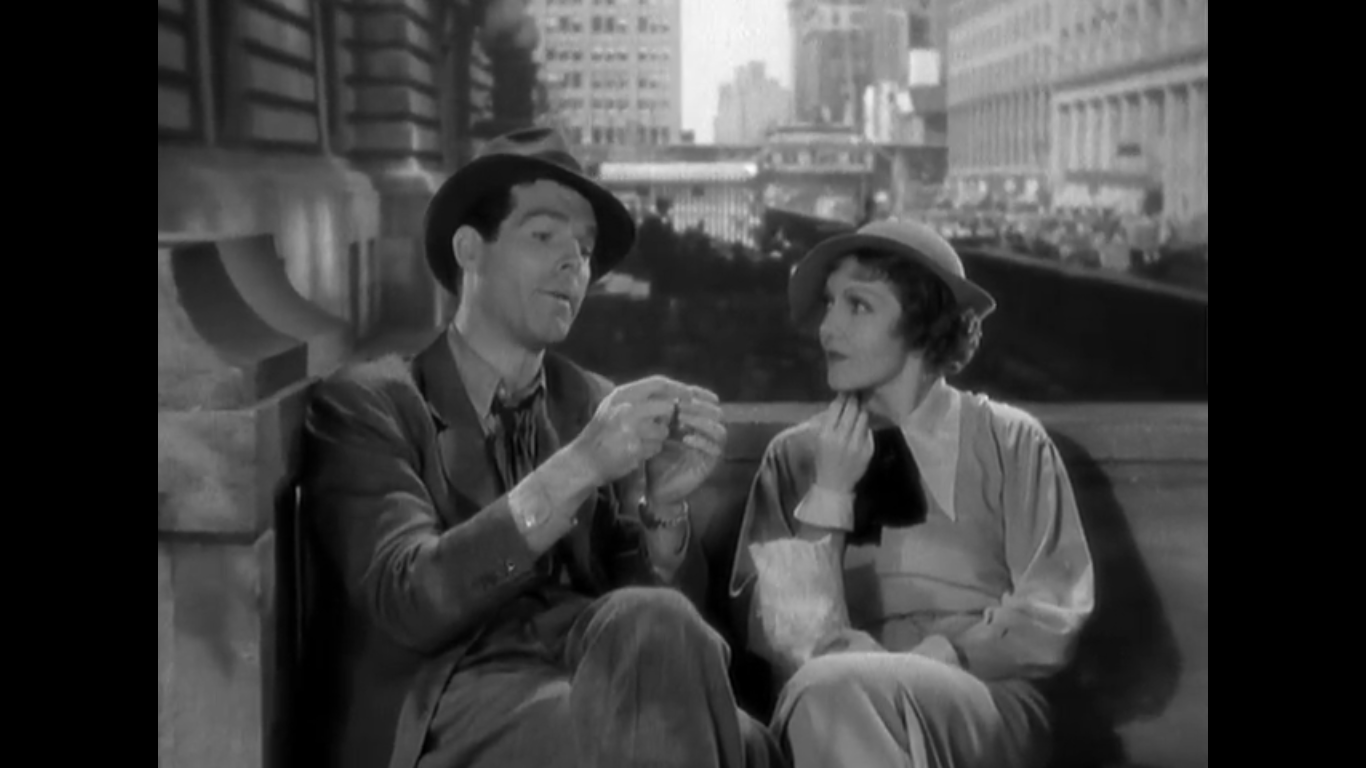
It opens on a park bench with MacMurray and Colbert chewing the fat as they share a bag of popcorn. What it does is create this instant familiarity going far beyond the bounds of the film as we’re thrown into their relationship that feels more platonic than romantic.

Thus, it’s not so much about the build-up to a prototypical relationship but the chafing that comes with their differing feelings. He has the hots for her. She loves him as a friend but still seems to be looking for her prince charming.

Prince Charming comes in the form of Ray Milland, a rich British aristocrat who’s come to America incognito. You can immediately imagine the complications arising from the fact Peter (MacMurray) is a nosy newshound and the other man has a secret to hide. They’re still to be cast as true romantic rivals and there’s already a tense undercurrent between them.

Meanwhile, Marilyn finds herself having to choose between two men as Lord Charles (Milland) promises a life of cultured sophistication. But Peter is always there, her ever-faithful confidante, and he’s also not going down without a fight.

He churns up the news mills to turn her into a household celebrity and the whole world seems to know her name. Even Charles is tickled by her world-class notoriety, but this is only a paltry imitation. If it’s not evident already, she needs a man who wisecracks, buys her popcorn, and wants to love all of her, whether she’s a big shot or not.

I’m still a bit smitten by the movie’s public bench premise because it allows our stars to do what they do best: laugh at the world together. No one can break their bond, and it teases out new contours to the Colbert-MacMurray partnership.

3.5/5 Stars

Take a Letter Darling (1942)

Although he does have a devoted following, Mitchell Leisen still does feel like a mostly unheralded director in broader circles. Take a Letter Darling is another modest feather in his cap, and it has numerous charms.

The gender norm-bending premise was actually quite intriguing for the era and MacMurray and Russell are more than up to the task of sparring in and out of the office. She’s a high-powered businesswoman who enlists a male secretary who can help her land her deals. He has a very important job: keeping jealous wives satisfied as she trades shop talk with their husbands.

There’s an obvious level of emasculation to the part, and MacMurray is more than game for it as he becomes the laughingstock of the secretarial peanut gallery. You see, he’s MacGregor’s fourth man and she’s running out of options. Still, it’s a lucrative way to bankroll his true passion: painting.

If Claudette Colbert was in fact originally earmarked for the part, I think I’m still partial to Russell in this particular role. I just find her brand of delivery perfectly metered for any kind of antagonistic comedy. And there’s a sense it builds on the kind of workplace dynamics she stirred up with such legendary fervor with Cary Grant in His Girl Friday, between quizzical glances and whipsmart repartee.

I will admit that Take a Letter Darling loses some of its comic edge when it turns saccharine, and the inevitable romance materializes. Until this point, the movie uses its premise to mine a plethora of laughs only to peter out as it makes Russell shed her authoritative business acumen for warm, fuzzy feelings.

However, while the final act can’t quite maintain the same level of comic tenacity, it also doesn’t whimper out as much as I was expecting. Yes, MacGregor wants her man back, but in typical Russell fashion, she crosses paths with him out on the road and comes armed with pebbles. She’s not going down without a fight, and she won’t totally acquiesce. It’s against her nature.

I feel like womanhood, especially in the ’50s, is glazed with this perceived antiquated patina, but watching the likes of Russell, Barbara Stanwyck, Jean Arthur, or even Irene Dunne during the ’30s and ’40s, provides a more nuanced landscape. It wasn’t all marriage and motherhood. They managed to grapple with the lives of modern working women in numerous ways. While Take A Letter Darling is no unsung masterpiece, it’s still easy enough to extend the recommendation.

3.5/5 Stars

Egg and I (1947)

Egg and I is based on a popular real-life memoir by Betty MacDonald, but for anyone who doesn’t remember it, it’s easy to pitch it as the original Green Acres — a Hollywoodized version of Grant Wood’s American Gothic. The fact it began with source material explains Claudette Colbert’s conspicuous introduction to the audience.

Otherwise, much of the movie is forged through comedy of the situation much like the wacky ’60s comedy with mostly mild and goofy trifles to contend with. The long-standing screen chemistry of Fred MacMurray and Colbert anchors the movie as its most imperative asset.

They’ve bought themselves a dilapidated house that’s riddled with leaks during the first rain. And once they’ve hunkered into their new home, next come the daily rituals that come with tending to a farm, and its livestock. They have lots to get used to. However, there’s also the local anthropological element.

Before the “Rural Purge” in the early ’70s, in deference to more urban entertainment, Hollywood has long mined comedy out of eccentric country bumpkins. Egg and I was no different introducing audiences to the first incarnation of Ma and Pa Kettle who became a bit of a low-budget institution in their own right with Marjorie Main and Percy Kilbridge.

One of the representative moments involves the local hoedown where men of all shapes, sizes, and dancing styles whirl Colbert around the dance floor, leaving her feet sore and her ears talked off. However, her greatest concerns are the advances of a local beauty (Louis Albritton), who her husband must do business with. She’s worried it’s a bit more than business, but if you watch him look at her, it does feel a bit silly.

I found the movie to be a bit too long and a tad more twee than it was gripping. Especially because Green Acres had numerous episodes and seasons to engage with analogous themes and character tropes to greater effect.

However, there are a few rewarding moments. It’s easy to recall the almost deceptively moving solidarity when the whole town bands together to loan the couple resources after a devastating fire obliterates their livelihood. For all their flaws, it’s a reminder of the close ties of small communities, and it makes Egg and I easy to root for even if it is mostly light-hearted recreation.

3/5 Stars