The Man Who Knew Too Much (1934)

The_man_who_knew_too_much_1934_poster.jpgAlthough Hitchcock did many riffs off the same themes, he very rarely tried to do the same film twice over. The Man Who Knew Too Much might be the one exception and even then if you place these two thrillers from 1934 and 1956 up next to each other, they’re similarities are fairly nominal.

The bare-bones plot involving international espionage, a pair of unassuming parents, and the kidnapping of their child remains the same. But most everything else is drastically different.

Thus, it becomes an interesting exercise in juxtaposition. It really depends on what the viewer deems definitive in a quality film mixed with personal preference. Without question, this initial offering from a younger director is grittier and less made up but it’s subsequently a less technical sound achievement with also little score to speak of. We trade out James Stewart and Doris Day’s singing for the less remembered pair of Leslie Banks and Edna Best. But nevertheless, this version of The Man Who Knew Too Much is an enjoyable international adventure crossing the globe from the Swiss Alps to England.

The Lawrences are on a lively vacation complete with skiing and skeet shooting with their precocious daughter (Nova Pilbeam) but after an acquaintance winds up murdered, the family finds themselves embroiled in a treacherous world of espionage. The dead Frenchmen left them a message to pass on to his contact but that knowledge finds them deeply distressed when their daughter is kidnapped. From that point, the intentions of the story are fairly straightforward. It’s simply a matter of watching Hitchcock at work.

Peter Lorre fresh off his emigration from Nazi Germany in the wake of Hitler, ironically plays the quintessential international menace, cigarette curled between his lips. It was so recent in fact that the man who made a name for himself as slimy undesirables learned all his lines phonetically because he still had yet to gain full command of the English language. But thank goodness we had him for this film and many to come. He perennially made movies more interesting by his mere presence. That marvelous face of his is one in a million.

There are some wonderful sequences and typical touches of Hitchcockian style and subversion, namely a sun-worshipping cult hiding out in a cathedral but, overall, it’s not always a cohesive exhibition in suspense. His greatest achievements always seem to fit together seamlessly to the perfect crescendo like a thrilling piece of clockwork. Whereas sometimes it feels as if a few of these scenes are strung together.

But that does not take away from some of the better set pieces namely Hitchcock’s original Royal Albert Hall sequence and a different finale altogether with a final shootout that is still harrowing in its own right. And of course, the foreboding clangs of Peter Lorre’s pocket watch leave their mark on this film just as his eerie whistling became his foretoken in Lang’s M (1931). Hitch would only continue to fine tune his formula but there’s no question that The Man Who Knew Too Much is a diverting thriller and the first in a lineup of six consecutive successes from the director during the 1930s.

3.5/5 Stars

Murder! (1930)

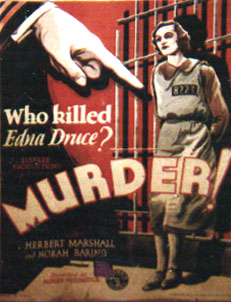
Murder_hitch.jpgAlfred Hitchcock captures the pure bedlam that overtakes a neighborhood when their peaceful dreams are rudely disrupted by an awful din. As is customary everyone is in a foul mood, peers out their windows, bickers with everyone else, and moves into action.

Then in a split second, everything’s beastly still. The reason: The dead body lying on the floor discovered by the policeman making his rounds. The blunt instrument is at the feet of a disoriented young actress who looks to be the obvious culprit. But there has to be more to this story than what meets the eye. This cannot be as simple as we are led to believe. It’s a stellar environment to introduce a murder. Acting as one of Hitch’s few whodunits, Murder! involves itself with the rest of a stage acting troupe full of players.

Still, in the ensuing court hearing, the aspiring starlet, Diana finds her life on the line in the hands of a jury. Their deliberations feel a bit like 12 Angry Men (1957) as Sir John (Herbert Marshall) is hustled and hurried into coming to a guilty verdict by groupthink as the one remaining holdout.

In these sequences, there’s a sense that Hitchcock has a bit of frustration with the state of affairs with the legal system or if nothing else a great interest in its functions much like Fritz Lang did in pictures like M (1931), Fury (1936), and You Only Live Once (1937). But it’s truly a Hitchcock touch to have the pronouncement of death given as the camera continues to focus on a worker cleaning up the juror’s room. But it’s key that the story does not end here, rather like The Phantom Lady (over a decade later) there’s more to the story and only one man is interested in figuring it out. Because of his sheer fortitude, it’s understandable that he becomes our hero.

Sir John finds himself in a bit of a moral dilemma (as denoted with an early example of character voiceover) because he feels partially responsible for the problems assailing young Diana and he resolves to do something about it. Unfortunately, the film’s latter half slogs on a bit as Sir John calls upon the services of Ted Markum and his wife — two witnesses in the opening scene — to help close in on the real killer. The individual they suspect to be the culprit. However, the real trouble is not simply pinning the murder on this perpetrator but also figuring out how they did it.

A woman’s life hangs in the balance as the gallows sit menacingly in her future. Still, Hitchcock uses some cruel poetic justice to tie his story’s loose ends up. A trapeze act gets a lot more morbid than ever before and again Hitchcock returns to human tumult which livens up his picture moderately and makes Murder! truly worthy of its name. In such instances, there are obvious signs of the master at work. Otherwise, this is hardly Hitchcock’s most diverting offering in the genre.

3/5 Stars

Man’s Castle (1933)

220px-Mans-castle-1933.jpg“Blessed are the poor in spirit for their’s is the kingdom of heaven”

With Frank Borzage taking on both WWI and WWII in his career it only makes sense that he would take on the event that in many ways bridged them — The Great Depression.

It’s fairly early on in the story where the local resident Ira (Walter Connolly), a minister by day and a night watchman by night cites the Sermon on the Mount and later references 1 Corinthians 1:27. The moral being: Blessed are the poor in spirit and God chooses the lowly things of this world and the despised things to nullify the things that are strong.

If nothing else a character such as Ira is one of the lovable figures in this fairly dank and dreary tale but his words breathe an inherent worth into the masses of everyday individuals slogging their way through the Depression.  In many ways, this film is a eulogy to those very people, the downtrodden, the poor, the heavy-laden folks.

But sometimes those same folks seem to come in all shapes and size making it nearly impossible to get a line on them. We first meet Bill (Spencer Tracy) a veteran fast-talking Artful Dodger-type who works the streets of New York in his top hat and tails. In this very first sequence, he’s in the middle of a seemingly frivolous activity offering breadcrumbs to the pigeons.

He catches the young gal (Loretta Young) next to him giving him the eye and calls her out. Although she might not look it, she’s destitute, going without food on two days now so he begrudgingly agrees to treat her to some fine dining. Of course, when the time to pay the check comes so comes the big reveal. Bill is just about as broke as Trina and they get thrown out (at least with full bellies).

For the rest of the film they hold up together in a shantytown in the local Hooverville where the existence is sparse but Trina exists as a happy homemaker whose indefatigable spirit never seems to dampen. Bill spends his days drifting finding bits and pieces of work here and there and in the evenings he comes home to his gal. Any other circumstances and their lives would seem fairly normal.

He playing the breadwinner. She playing his devoted spouse. Except he gets the bread by serving a summons to a local stage performer and stilt walking in his free moments, among other things. But he scrapes together enough to get Trina a new stove for their hovel. The fact that they remain unmarried is invariably inconsequential and Trina’s not looking to tie down her man — she’s far too understanding and open-minded for such thoughts.

And although partially unbelievable its integral in how Tracy’s protagonist reveals his true character. Yes, he is a man with restless feet constantly playing the curmudgeon — disdaining the “ball and chain.” However, there’s an old adage that would be apt in describing him. His bark is worse than his bite.

There’s no conceivable way that two individuals such as this should remain together and even in the film there are moments when their symbiotic relationship seems to be splitting at the seams.

Tracy is brusque and surprisingly stink-eyed but as is his custom he comes around and has the audience on his side for the very fact that Loretta Young is so devoted to him. On her part, the sprightly and ever-effervescent Young at the ripe young age of 20 might be skinny but she holds her own and is crucial to making this love story something of substance.

Borzage once more dissects a romance that’s, in this case, one of the most unlikely pairings but Bill ceaselessly subverts our expectations. He’s not such a bad cad after all and Trina makes him be better than he has any right to be.

In this specific instance, the two lovers get their happy ending clutching each other closely in a pile of hay aboard a freight train. The destination nor the future seems to matter because the underlining factor is they have each other. You’ll be hard-pressed to find many affluent people in this picture and this is an important distinction to make. This is not a screwball comedy. On the contrary, center stage is given to members of society who are usually marginalized and it comes off exceedingly well thanks to Tracy and Young.

3.5/5 Stars

Note: It’s most likely that the cut you will see is the 1938 reissued version following the installation of the Hays Codes. I’m not actually sure if an original print is still available or if it’s considered lost.

A Farewell to Arms (1932)

394px-Poster_-_A_Farewell_to_Arms_(1932)_01Again, I must confess that I have not read yet another revered American Classic. I have not read A Farewell to Arms…But from the admittedly minor things I know about Hemingway’s prose and general tone, this film adaptation is certainly not a perfectly faithful translation of its source material. Not by any stretch of the imagination.

However, I do know at least a little something about Frank Borzage a filmmaker that time has been less kind to, though he contributed some quality pictures during the silent era and during the ensuing generation of talkies — even a couple of reputed classics. And yet watching A Farewell to Arms you can see his philosophies working themselves into the story line — the very themes that he would repeat again and again in many of his movies.

It soon becomes apparent that Borzage’s film is not about a war at all though WWI is a major plot point. He would examine an analogous idea with The Mortal Storm. Its his predilection not to focus so much on the carnage or alienation of war and more so on the effects that such a cataclysmic event has on the lives of those thrust into the middle of it. So his narrative borrows from Hemingway but hinges on this idea of lovers battling against the wiles of the world through the sheer euphoria of their romantic fling and yet it proves to be more than transient.

There’s without question a verisimilitude and a candor to the portrayals of Gary Cooper and Helen Hayes as said lovers — an ambulance driver and a nurse. Two seemingly unextraordinary individuals who nevertheless become extraordinary in each other’s arms. They will go to such great lengths to remain together despite the obstacles hindering them on every side. Perhaps it’s heightened by the times but still, there is this general belief in what they do on the part of the audience — that they can actually fall in love and will do whatever it takes to stay together.

Even if it’s not wholly plausible, they lend that needed credence to the parts. Their emotions feel genuine even as their romance gets crippled by the very circumstances they find themselves in. Where years are sped up into days and marriage must be forged in the most humble of moments. There’s no time or space for a normal life with a normal love affair even if that’s what both parties desire. It cannot be so.

Gary Cooper exudes a gentle tenderness in the majority of his scenes and he manages to be as vulnerable as we’ve ever seen him in the part because this romance tears him apart. Helen Hayes is an actress that I, unfortunately, know very little about but she strikes me as a beauty like Claudette Colbert and yet I find an easier time liking her and by some form of transference, the same goes for the character that she plays. It’s also crucial to note the splendorous black & white cinematography of Charles Lang which paints the contours of this love affair with expressionistic shades while never quite allowing us to forget the war at hand.

Though we can compare Borzage’s film with the original novel it seems equally compelling to juxtapose this cinematic adaptation of A Farewell to Arms with Joseph von Sternberg’s romance, Morocco, of only two years prior also starring Gary Cooper and Adolphe Menjou with von Sternberg’s muse Marlene Dietrich. Hayes doesn’t have the same gravitas or allure of Dietrich but that actually serves her better in this film with what Borzage is trying to accomplish.

Because this story is a tragedy as much as it is a romance of faithful devotion. Whereas von Sternberg seems most interested in the locality and the depictions of his stars — allowing them to have looser morals, you could make the argument that Borzage film holds a greater stake in its thematics and what such a romance can represent in such a turbulent world. The Great War is only an unfortunate backdrop to play the action against and it’s unfortunate because love is a rapturous thing. But it’s the many evils of the world that tear it asunder. The kind of troubles that force two people to bid each other a tearful adieu even if it’s the last thing they want in the world.

3.5/5 Stars

The Kennel Murder Case (1933)

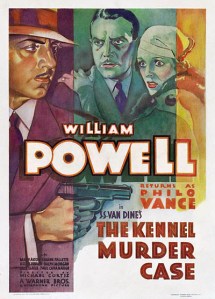
The-kennel-murder-case-1933It’s happened in some well-documented cases that the same actor has played two characters that feel nominally similar and based on this cursory level of comparison the general public has been forever befuddled. You could cite some notable examples being Bogart playing Sam Spade and Phillip Marlowe the archetypal pulp private eye heroes of Dashiell Hammett and Raymond Chandler.

Even the fact that Fess Parker played Davy Crockett for Disney and then Daniel Boone on the small screen undoubtedly still has the less historically inclined folks to question if there is any difference between the two men.

A still earlier example would be William Powell who was famed as Nick Charles in The Thin Man Series pairing him with Myrna Loy but about that time he also did pretty well for himself as the eponymous Philo Vance in a handful of mystery serials. In truth, this installment would be his last time performing the role but he slid rather seamlessly into The Thin Man series that arguably allowed him more freedom for comedy.

Other actors took on the mantle as well including Basil Rathbone, Warren William, Paul Lukas, and even Alan Curtis. But it was The Kennel Murder Case directed by one of Warner Bros. top craftsman Michael Curtiz that remains the hallmark of this Pre-Code franchise.

Although Raymond Chandler called Philo Vance, “the most asinine character in detective fiction,” much of that quality was toned down in the feature adaptations and after all, with a charmer such as William Powell, how could he not be at least a bit compelling?

In this particular storyline, there’s initially no case at all only Vance missing out on the big prize at a prestigious dog show. But on his way to Italy riding an ocean liner for a much-needed vacation, he catches wind of the death of one of his kennel acquaintances Mr. Archer Coe. Although the authorities including the straight-laced District Attorney Markham (Robert McWade) and the lovable police detective Heath (Eugene Palette) assume it is suicide, Vance comes in on the proceedings with a hunch of his own.

It has murder written all over it but the circumstances are most peculiar and the extensive array of suspects makes it no small matter to pinpoint the culprit. But that’s the fun of the chase as our perceptive detective looks to derive the correct conclusion and the audience along with him (without much success I might add, at least in my case).

It’s very easily to surmise that nowadays we are so culturally well-versed in crime, mysteries, and whodunits that this film’s script feels clunky at times because the characters say all the things and hit all the marks that we might expect. It’s a rite of passage to have the police constantly dismiss our hero’s deductions as it is to hear the shots ring out in the house or the various suspects nervously fib and cover up for this reason and that person.

However, to its credit, the resolution gets so lost among the various characters with numerous motives and the like that when the killer is revealed it still provides a certain amount of satisfaction. So in some sense, you could say that The Kennel Murder is a successful mystery because it does hit all the marks.

Yes, a no-nonsense Powell isn’t quite as fun as a snarky slightly tipsy Powell, although he still makes for an enjoyable lead. But supporting spots for the always jovial Eugene Palette and noir icon Mary Astor add a dash of character across the rank and file of the cast. Meanwhile, James Lee plays a rather fascinating character for the time, a Chinese cook who nevertheless attended Columbia and is highly educated in Chinese porcelain.

And there is undoubtedly an efficiency to The Kennel Murder Case such that a great deal is able to unfold and be resolved without feeling tedious or overlong aided by Curtiz’s direction and plenty of screen wipes. It proves to be just about the right length to make the payoff worthwhile and the story’s mystery generally engaging. More character development is always a plus but with a whodunit that’s usually not your main concern.

3.5/5 Stars

My Man Godfrey (1936)

my man godfrey 1.png

There’s a key moment in My Man Godrey where the ditzy Irene Bullock (Carole Lombard) giddily announces to her mother, “Godfrey loves me. He put me in the shower!” Her mother’s response could best be described as one of indignance but it’s a barrel of laughs for the audience. Because this film is full of off-the-wall remarks which taken out of context are so peculiar you don’t even want to attempt to understand.

That’s the beauty of this screwball comedy from the often underrated Gregory La Cava, best known for this picture and the following year’s Stage Door. Otherwise, the script is courtesy of Morrie Ryskind a veteran of some of the Marx Brothers’ comedies.

It opens as a biting satire of the affluent masses occupied by inane decadence and a multitude of frivolous diversions from scavenger hunts to parading livestock around in front of their friends. The screenwriter’s efforts were well worth it no doubt but the cast indubitably breaths incredible gales of life into the material with each battling for laugh after laugh.

The following interludes repeatedly exhibit perhaps the wackiest, most melodramatic family of comedy from most any decade. It comes from having too much time on their hands, too much money, and not enough sense. They’re a real screwy bunch. We meet the two Bullock daughters (Lombard and Gail Patrick) as they try and outdo each other in the middle of the previously mentioned scavenger hunt, searching out “a forgotten man.” They have no concern for who he is and how he lives. Only that he might win them the game.

Still, the said man plays along and somehow finds himself hired on by young Irene as the family’s latest butler to not only spite her older sister but also so that she might have a protege and maybe due to an inkling of a girlish crush. It makes little sense, only to say her mother’s protege is a musician named Carlo (Mischa Auer) who is good for very little except offering up the pretense of culture and eating them out of the house.

But Godfrey proves to be just about the best butler that the Bullock’s ever could muster, navigating their morning routines of hangovers and playing straight-man to the incessant chaos that constantly swarms around him. On their part, they are so self-absorbed and oblivious, they never seem to question how perfectly he has transformed into a butler. Surely, he cannot actually have been “a forgotten man” from off a trash heap? But no, they don’t concern themselves with such things. It goes unnoticed.

It seems like each member of the family has their special calling card.  They are a bunch of bubbleheads and Carole Lombard is the queen of them all, though mother (Alice Brady) is equally effervescent and a tad asinine. That’s  a part of her charm. She also flatters very easily.

Meanwhile, the other daughter Cornelia (Patrick) is more acidic, purring like a feline ready to pounce and make her sister pay for whatever trivial affront she’s perpetrated. Because, truthfully, they’re just a whole clan of boorish rich people who have no idea what’s happening to the world on the outside — if that point has not already been asserted enough. They’ve probably never heard of The Great Depression much less felt its true effects.

Mr. Bullock (Eugene Pallette) probably has it the worst as the long-suffering father — the nearest thing to a sane individual in the entire family. Still, you can’t live in a house of such madness and not have a few unhinged moments of your own. He’s constantly finding himself piping up amid the bedlam his gravelly voice trying to secure even a moments peace. He rarely succeeds.

Again, Godfrey is the calming force that brings a modicum amount of stability to such a place. He along with the veteran maid Molly (Jean Dixon) navigate the choppy waters of melodrama every day as Irene becomes increasingly infatuated, her emotional outbursts becoming more frequent, and Cornelia looking for any way to possibly make his life miserable to get him fired. Still, he goes about his duties.

And that’s part of the joke at the core of this film. The “forgotten man,” this tramp coming up against their own upper-class sensibilities and coming out looking like the true human being with brains and class and culture. Except it’s really a joke within a joke because maybe Godfrey is more than we first perceived him to be. In fact, he’s a lot more.

Pair such a raucous cast with some top tier comic patter that sizzles with wit and you’ve just happened upon the most wonderful mess imaginable. There might be other screwball comedies I enjoy more, but few are as hairbrained as My Man Godfrey and that is a grand word of praise for this brand of comedy. If it’s not stark raving bonkers it can hardly claim the name screwball honestly. No such problem exists here.

William Powell is a natural in this role showcasing that typical dry wit of his that effortlessly pokes fun at these people but also seems to appreciate them for all their shortcomings even finding time to truly respect them in the sincerest of ways. As per usual, Carole Lombard is so over the top to the nth degree with her sniveling zaniness spilling over into every scene.

In the past, I mistook her performances as a sheer annoyance but now I see how perfect she is for such a part. There’s an overwhelming commitment to the craziness that pays heavy dividends and by the film’s end, she’s overrun everyone with her energy — even Godfrey. He has no rebuttal.

For a time she was the greatest screwball actress though over the subsequent years the likes of Katharine Hepburn, Jean Arthur, Rosalind Russell, and Barbara Stanwyck gave her a run for her money. Still, there’s something undeniable about being the first and, in many ways, she was that woman.

If there were any residual ill feelings between Powell and Lombard now three years out from their divorce, there’s no visible animosity and together they succeed in forging My Man Godfrey into a classic screwball through and through.

4.5/5 Stars


The Thin Man (1934)

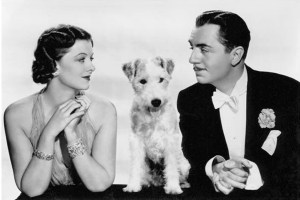
The_Thin_Man_Publicity_Photo

“What were you doing on the night of October fifth, nineteen-hundred-and-two?” ~ William Powell as Nick Charles

“I was just a gleam in my father’s eye.” ~ Myrna Loy as Nora Charles

With The Thin Man, Dashiell Hammet successfully crafted several archetypes that go beyond the basic pulpy film noir standards that he also helped to define. Nick and Nora Charles were a cinematic power couple even before the word was in vogue and as their real life counterparts, William Powell and Myrna Loy were quite the pair in their own right being matched in a mind-boggling 14 films together.

The Thin Man became one of the most beloved pairings, helmed by W.S. Van Dyke and spawning a wildly popular series of sequels that continued throughout the 30s and 40s. At the very least it suggested that it was not so much the story lines but more so the characters that resonated with the general public.

It’s true that casting William Powell as Nick Charles was one of the hand in glove situations. He had a certain dashing even debonair quality with his pencil mustache perfectly thrown askew by the scenarios he gets himself into. Above all, he has a witticism or lithe quip handy for any given situation. He’s a real riot at dinner parties. One of those men who has a perpetual smirk on his face.

But Myrna Loy is just as impeccably cast as his fun-loving wife who is as game as he is to have a rip-roaring good time. She’s constantly keeping up with his droll wit while continually chiding him good-naturedly to get back into the amateur detective game.

For the time, with no children to speak of, their beloved wire terrier Asta (the famed Skippy who was also featured in other such classics as The Awful Truth and Bringing up Baby) rounds out their happy clan.

It really is a strategic depiction of marriage and family circa 1934. The Great Depression still had a fresh imprint on the nation and yet in Nick and Nora you see no indication of any such malaise.  Their days are spent drinking martinis and gallivanting around town while their nights are filled with fancy dinner parties and the occasional crime caper.

These forms have been so often parodied to this day but at the time it seems obvious that The Thin Man whether subconsciously or not was an escapist fantasy that indulged the desires of those less fortunate. Because if nothing else, they could at least spend some fun taking a load off and joining the Charles for an enjoyable evening. Everyone laughs. Cops and citizens have close knit connections. Excessive drinking is only a delightful diversion. The only ones who were in need were the slothful and the greedy.

Although The Thin Man employs admittedly incomprehensible plotting at times it’s hardly a knock. So many characters get thrown in and chatted about it becomes difficult to keep them all straight much less figure out what their bearing on the plot is. And it is the oddest cross section of individuals to be sure.

Much like The Third Man, this precursor, The Thin Man acts as a nifty MacGuffin in a pinch, driving the plot forward with his spectral presence. The fact he’s hardly on screen does not detract from his overall importance in this film. Meanwhile, his invested daughter (Maureen O’Sullivan), wife, mistress, and various other involved parties all get tossed around as culprits and accomplices including Porter Hall and Cesar Romero.

While not noir in the typical sense James Wong Howe’s photography does give the film certain dark sensibilities at times to contrast with the plethora of more comic moments in drawing rooms and the like. It also shares in the tradition of Agatha Christie and other such detective fiction narratives with bits of amateur sleuthing and all the subjects rounded up for a dinner party so the culprit might be revealed.

But what The Thin Man truly explored was the capabilities of crime when paired with comedy. In some sense here is a film where you have certain screwball aspects but I hesitate to call this film a true screwball just as I hesitate to call this a gangster picture though there are cops and thugs.

It’s that immaculate blending of comedy and crime that makes The Thin Man go down like a perfectly mixed martini. It was the charisma of Powell and Loy that allowed the series to exist well beyond the parameters of a one hit wonder.

4.5/5 Stars

Destry Rides Again (1939)

Destry-Rides-Again-1939Destry Rides Again is integral to the tradition of comedy westerns–a storied lineage that includes the likes of Way Out West, Blazing Saddles, and Support Your Local Sheriff. It takes a bit of the long maintained western lore and gives it a screwy comic twist courtesy of classic Hollywood.

The rambunctious town carries the fitting name of Bottleneck which runs rampant with guns, beer, floozies, and more beer. The town’s mayor has a permanent seat in the local saloon playing solitary games of checkers while turning a blind eye to many clandestine activities. Meanwhile, the bar’s proprietor and local hot shot (Brian Donlevy) keeps grips on numerous shady dealings including dirty poker and murder, if you want to get technical. Though he does put on a good time with a floor show courtesy of his best girl Frenchy (Marlene Dietrich) who has the whole town swooning with her knockout looks. That’s the way the world works in Bottleneck and it’s a fairly crooked operation.

After the latest sheriff is laid waste the banjo-playing drunk is christened the town’s next lawman. It certainly is a fine joke but he does something somewhat admirable. He resolves to lay off the sauce and sober up. Calling in the grown son of one of his buddies from the old days to be his deputy.

Now he’s no longer a drunk. Just a blustering old fool who no one takes seriously for one moment. Still, when Destry comes into town he believes he will have the hulking spitting image of the boy’s father, a man who will instill fear in every local troublemaker. After all, that’s how things have worked in Bottleneck as far back as anyone can remember.

But instead of a leering heavy, he finds himself face to face with gangly Tom Destry Jr. who makes a memorable first impression on the town holding a woman’s parasol and a cage of parakeets as he helps a young lady off of the stage. However, in those opening moments he does a seemingly dangerous thing, instead of exerting his dominance he seems oddly comfortable in his skin. The townsfolk think he’s a pushover and he strings them along rather well. After all, he doesn’t carry any guns. He spends a great deal of time whittling and there’s a good-natured affability to his demeanor in nearly all circumstances. Added to that he has the oddest quirk of supplying an ever-ready stream of anecdotes for any given situation.

It’s such displays that earn the glee of the local thugs and hoodlums and the ire of not only his sheriff but the folks who feel he’s aiding their enemies. And yet in certain moments, he surprises them, proving to be an incredibly humble marksman (a precursor to Atticus Finch), breaking up a vicious catfight between two women with a pail of water, and getting buddy-buddy with the town’s rebels only to turn on them.

He seeks to bring law and order to the town on his terms looking to pin a murder on Kent in order to put him away for good. Of course, he’s not about to take it lying down and the town blows up into a scatterbrained finale that equals any of the zaniness in any of its aforementioned brethren of western comedy. As the menfolk fight it out with guns, Frenchy with a new resolve gathers all the womenfolk in an assault on the opposition using all blunt instruments imaginable from rolling pins to gardening tools. It’s sheer madness.

That’s not to say that Destry does not have its share of tragedy and that might be its greatest fault. Sometimes it doesn’t quite know where to fall between the lines of comedy and drama. Still, with the two legendary icons as luminary as James Stewart and Marlene Dietrich, it’s hard for this one not to be a winner though they seem so diametrically opposed to each other.

However, Cooper and Dietrich worked surprisingly well in Morocco and so Stewart and Dietrich work in a pinch here.  There’s also an abundant stock company including future stars like Brian Donlevy and Jack Carson not to mention small time funnymen like Billy Gilbert, the long-suffering bartender, and Mischa Auer, the man who unwittingly loses his pants in a poker game. Moral of the story is, don’t gamble. In fact, I wouldn’t be surprised if Destry would come in with a story right about now.

4/5 Stars


Review: Mr. Smith Goes to Washington (1939)

James_Stewart_in_Mr._Smith_Goes_to_Washington_trailer_cropThe opening credits roll and recognition comes with each name that pops on the screen. Jean Arthur, James Stewart, Claude Rains, Edward Arnold, Guy Kibbee, Thomas Mitchell, Eugene Palette, Beulah Bondi, H.B. Warner, Harry Carey, Porter Hall, Charles Lane, William Demarest, Jack Carson, and of course, Frank Capra himself.

We are met with the ubiquitous visage of Charles Lane calling in a big scoop on the telephone. A senator has died suddenly. The likes of Porter Hall and H.B. Warner fill the Senate Chamber presided over by a wryly comic VP, Harry Carey. Corruption is personified by the flabby pair of Edward Arnold and Eugene Palette while Claude Rains embodies the tortured political journeyman. The eminent members of the press include not only Lane but the often swacked Thomas Mitchell and a particularly cheeky Jack Carson.

To some people, these are just names much like any other but to others of us, linked together and placed in one film, these figures elicit immense significance and simultaneously help to make Mr. Smith Goes to Washington one of the most satisfying creations of Hollywood’s Golden Age from arguably “The Greatest Year in Cinematic History.”  The acting from the biggest to the smallest role is a sheer joy to observe as is Capra’s candid approach to the material.

As someone with a deep affection for film’s continued impact, it gives me great pleasure that stories such as Mr. Smith exist on the silver screen if only for the simple fact that they continually renew my belief in humanity, whatever that means. Because it’s an admittedly broad, sweeping statement to make but then again that’s what Frank Capra was always phenomenally skilled at doing. He could take feelings, emotions, beliefs, and ideals synthesizing them into the perfect cultural concoctions commonly known as moving pictures.

But his pictures always maintained an unfaltering optimism notably in the face of all sorts of trials and tribulations. He never disregarded the corruption dwelling in his stories–it was always there–in this case personified by the stifling political machine of Jim Taylor gorging itself off the lives of the weak and stupid.

The key is that his narratives always rise above the graft and corruption. They latch onto the common everyday decency, looking out for the other guy, and in some small way uphold the great commandment to love thy neighbor.

Politics have never been my forte. Like many others, I’m easily disillusioned by “politics” as this becomes a dirty word full of arrogance, partisanship, and scandal among other issues. It seems like the founding principles that laid the groundwork for this entire democracy often get buried under pomp & circumstance or even worse personal ambitions.

Although this film was shot over 75 years ago everyone who’s been around the block lives as if that’s the case then too and so they’re not all that different from today at least where it matters. Cynicism is a hard thing to crack when it runs through the fabric of society from the politicians, to the newspapers, all the way down to the general public. It’s not hard to understand why. Still, the genuine qualities of a man like Jefferson Smith can act as a bit of an antidote. He as a character himself might be a bit of an ideal, yes, but I’d like to have enough faith to believe that people with a little bit of Jefferson Smith might still live today.

Common, everyday people who nevertheless are capable of extraordinary things like standing up for what’s right when they know that no one else will or when they know all that waits for them at the end of the tunnel is disgrace. But the promise of what is beyond the tunnel is enough. That is true integrity to be able to do that and those are the causes worth cheering for when David must fight Goliath and still he somehow manages to overcome. That’s the chord Mr. Smith strikes with me. thanks in part to Capra’s vision but also Stewart’s impassioned embodiment of those same ideals.  He has a knack for compelling performances to be sure.

Time and time again James Stewart pulls me in. His career is one of the most iconic in any decade, any era no questions asked. There are so many extraordinary films within that context perhaps many that are technically or artistically superior to Mr. Smith by some  estimations, but he was never more candid or disarming than those final moments in the senate chambers as he fights for his life — clinging to the ideals that he’s been such a stalwart proponent for even as his naivete has been mercilessly stripped away from him.

In the opening moments, his eyes carried that glow of honest to goodness optimism, his posture gangly and unsure represented all that is genuine in man. Now watching those same ideals and heroes come back to perniciously attack him, he presides with almost reckless abandon. Is he out of his mind? At times, it seems so, but as he wearies, his hair becomes more disheveled, and his vocal chords have only a few rasps left he still fights the good fight. There’s an earnest zeal to him that’s positively palpable.

As our stand-in, Saunders (Jean Arthur) first writes him off as a first class phony or at the very least a political stooge ready to do another man’s bidding but she does not know Jefferson Smith though she does grow to love him. And Arthur’s performance truly is a masterful one because without her Smith would hardly be the same figure. She brings out his naivete by sheer juxtaposition but she also puts the fight back into him because he brought a change over her that in turn rallies him to keep on pushing. They’ve got a bit of a mutually symbiotic relationship going on in the best way possible. You might call it love.

Capra repeatedly underlines Smith’s honesty and genuine nature not only through numerous rather simplistic montages of Capitol Hill and the surrounding national monuments but in the very way his character carries himself around others. He never assumes a position of superiority. He’s always humble. He sees the inherent need to raise up young people well so that they might progress to become the leaders of tomorrow with a great deal to offer our world. He fumbles with his hat in the presence of pretty girls and holds his idols in the highest esteem. It’s all there on Stewart’s face and in his actions. We too comprehend the solemnity and the gravity that he senses in the office of the Senate.

While this was not Jimmy Stewart’s debut and it was only at the beginning of a shining career as has already been noted, it was in these moments that the cinematic world fell in love with him. He can’t be licked and for good reason. He was never one to give up on lost causes just like his father before him.

I guess this is just another lost cause, Mr. Paine. All you people don’t know about lost causes. Mr. Paine does. He said once they were the only causes worth fighting for, and he fought for them once, for the only reason any man ever fights for them: Because of one plain simple rule: Love thy neighbor. ~ James Stewart as Jefferson Smith

5/5 Stars
Review: Mr. Deeds Goes to Town (1936)

Gary_Cooper_in_Mr._Deeds_Goes_to_Town_trailer“He could never fit in with our distorted viewpoint, because he’s honest, and sincere, and good. If that man’s crazy, Your Honor, the rest of us belong in straitjackets!” ~ Jean Arthur as Babe Bennett

Mr. Deeds Goes to Town is a true treasure of idealism and Americana. People, especially now, may have many quibbles with the films of Frank Capra because he was the undisputed champion of feel good cinema that revelled in happy endings, stalwart honesty, and the little guy being permitted a fighting chance.

It’s no wonder that he made such good use of the likes of Gary Cooper and James Stewart because they embodied common, everyday American decency like few other actors could ever claim. Admittedly it’s easy to belittle his pictures as saccharine and sentimental to the nth degree but beyond that Capra always seemed to have an inherent sense of what America stood for or at least what he believed it could and still can stand for.

Every man deserves a certain amount of respect. You might call them inalienable rights like life, liberty, and the pursuit of happiness. And any force that tries to impede that is in simple terms an affront to all humanity. Because though we might all think we’re different, we share a lot more similarities than we often want to concede. It’s easy for us to forget that and that’s what happens here.

Longfellow Deeds (Cooper) becomes the overnight talk of the town because his rich uncle dies in a horrible car crash and bequeaths his wealth to his unsuspecting nephew. It’s the kind of good fortune that others drool over but in Deeds’ hands, he takes it in stride. He comes off as a real Yokum from the one horse town of Mandrake Falls but if anything Deeds is incredibly smart. He realizes he can have contentment out of the limelight and with very little. He enjoys quiet days oftentimes filling idle hours with his prized tuba and poetry that he writes for postcards.

But his new status as a millionaire forces him into the life that he doesn’t much want. Mansions and butlers, folks looking for handouts, ravenous newspapermen (and women) and conniving lawyers. Front and center is Mr. Cedar (Douglass Dumbrille). It’s these very individuals who see Deeds as a ridiculous outsider to be belittled and taken advantage of.

The brilliance of Capra’s movie is that he makes his hero, while simple and practical, still very astute. He may have his many quirks but there’s a surprising amount of business acumen and common sense flowing through his veins that consequently sends everyone else for a loop. He spies phonies from a mile of away and he looks to reform the local opera while finding ways to spend his newfound fortune sagaciously.

The only thing he’s not watching out for is a pretty girl, journalist Louise “Babe” Bennett (Jean Arthur) is ready to nab him, capturing his heart and simultaneously giving the whole city a front row seat to his exploits about town from quarrels with a snooty circle of poets to an evening jaunt ending on a fire engine. She’s a pro at spinning the tale into one of a first class boob, christening him the “Cinderella Man” that the whole world laughs at. They eat it up and they want to see him fall–this idiotic nobody suddenly being scrutinized by society for his good fortune. It’s all rather unfair but oftentimes that’s the way the world turns. It’s a cruel and sometimes curious place.

Because while Deeds grows fed up with this whole lifestyle, ready to leave it all behind him, Babe finds herself truly falling for her project since he models something she rarely sees in a man — real honest to goodness integrity that guides his every action. There’s never a false pretense or a veiled intention. What you see is what you get. Ironically enough, in this land of fakes, she’s the only “real” person he thinks he’s met. And she knows what’s been going on, going so far as to tell her editor that she’s quitting. There’s no way she can keep up the charade only injuring the character of the one she loves more and more.

But of course, everything dives into the depths of despair when Deeds is sent to trial calling into question his sanity after he resolves to use $18,000,000 to portion off acres of land to destitute farmers to work for him. It’s utter lunacy, isn’t it? The workers line up around the block leading into his home as he offers them a chance at a real life without starving children and food lines every day. This is what Cedar, Cedar, Cedar, and Blumenfeld are bringing him to court for or is it the fact that they want a portion of his fortune? Yes, that just might be it.

Anyways, far worse than that fate is the fact that he thinks his girl has betrayed him and she has in a sense, but she’s also devoted to him by now. She watches helplessly as her man gets railroaded. She began as the one to crucify him in the tabloids and now she prepares to watch him get crucified in the courtroom. In these moments, he does take on a Christ-like post watching all the proceedings without a word. He never makes any effort to defend himself after accusation after accusation is thrown his direction.

But the bottom line is that he does not have to let himself be destroyed. Being the martyr, in this case, is not his job and Capra lifts him out of the pit and resurrects him. The fact that Louise fights for him and numerous others including his cynical right-hand man Cornelius Cobb (Lionel Stander) and the local newspaper editor (George Bancroft), not to mention a legion of grateful farmers. So Mr. Deeds ends with a tumultuous courtroom finale befitting one of Capra’s finest pictures. It brims with goodness and bubbles over with humor that constantly underlines this feel good classic.

Though Gary Cooper represents Capra’s love of the every man with common decency and common sense, Jean Arthur remains equally crucial to the worlds that he creates. It has to do with her quality as an actor that allows her to play the snappy, witty, world-wearied types. Because she represents all the many people with that very same cynical streak and yet the very fact that her heart can be melted and her whole mindset can be changed suggests that there might be hope for all of us. That hope burgeons up from Mr. Deeds and leaves us with a warm feeling indeed.

4.5/5 Stars