The Women (1939)

6cabb-poster_-_women_the_01Starring a cast including Norma Shearer, Joan Crawford, Rosalind Russell, Paulette Goddard, and Joan Fontaine, this film is all about the lives of these women. Mary is a member of New York high society who is happy with her marriage. However, when her gossipy friends begin to talk about her husband with another women she is hurt. She eventually  files for divorce and while waiting for the conformation in Reno she meets some new friends and is finally able to find a way to get her husband back. Needless to say the ending is happy and a few women get what they deserve. This film had an enjoyable introduction, a sequence in Technicolor, and an all female cast. Most of all it characterizes the various women in this walk of life. Some are kindly, others foolish, and still others are treacherous.

4/5 Stars

Holiday (1938)

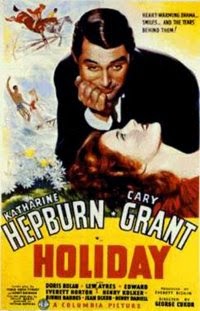
2c3de-holiday_posterJohnny Case (Cary Grant) is a happy go lucky fellow who is crazy in love with the girl of his dreams. He returns to town telling his friends the Potters that he has plans to marry this girl he met 10 days ago at Lake Placid! He is ecstatic and not afraid to show it.

However, he must become acclimated with her family and their lifestyle. Most important is gaining the approval of her sometimes stuffy and always money-minded banking father. Julia Sefton is by all accounts a lovely girl who seems to truly return Johnny’s affection. Honestly, though he is not quite used to her type of society. He makes his entrance by arriving through the servant’s door and wanders around the stately manor marveling at all the trappings. Doing the rounds he runs into her drunken but genuine brother Ned (Lew Ayres). Then, there is sister Linda (Katharine Hepburn), the so-called black sheep of the family, although her only fault is being an energetic free-spirit.

Immediately she and Johnny hit if off, and she soon realizes that her sister has a real catch on her hands. The wedding is finally agreed upon by Mr. Seton, and a big New Year’s Eve Party is thrown much to Linda’s chagrin. The night of the big to do there are two parties that take place. Downstairs all the snobs and high society mingle with Julia parading Johnny around. Upstairs is a different matter where the quarantined Linda is eventually joined by the Potters,  Ned and even Johnny.

The little gathering gets quashed and that is not all. Father and daughter are adamant that Johnny works at the bank and make money because that’s what any respectful husband would do. They take little heed of Johnny’s dream to take a holiday once he has raised enough money to live off of. He just wants to live life free of distractions for awhile, but they just do not understand. Finally, Johnny is feeling too restricted by all the obligations to bear it any longer, because he simply cannot live that way. Again, both father and daughter do not understand. But Julia does, and she finally realizes what she must do. It’s time to take a holiday.

Here is a formidable trio in Cary Grant, Katharine Hepburn, and director George Cukor. It makes me beg the question, how this film has become so overshadowed by Bringing up Baby and The Philadelphia Story? Johnny Case is a wonderfully vibrant role for Grant, and his acrobatics alone are worthwhile viewing. Hepburn on her part plays an equally spirited individual but without the scatter-brained or feisty edge that she often carried. Instead, she is just wonderfully footloose and fancy-free. Edward Everett Horton and Jean Dixon are an absolute riot, and I would love to have friends like them. Lew Ayres role was rather an odd one, but both Doris Nolan and Henry Kolker had an adequate amount of stuffiness to pull off their parts. That juxtaposition was necessary for the film to work and it did.

4/5 Stars

Review: City Lights (1931)

 86b16-charliechaplincitylights2A comedy romance in pantomime. That’s just exactly what City Lights is, because, despite the fact that talkies had been around for approximately 4 years, Chaplin was hesitant to transition his Tramp over to sound. In many ways, I can understand why since the universality of his character would be gone and Chaplin’s own voice would give a very different feel to the little man. With his great popularity and artistic control, Chaplin made this film and Modern Times without dialogue. All he used were synchronized sounds and musical scores. As audiences can attest to, it worked out just fine for him.

This film opens with the Tramp in all his glory sleeping on a statue during its public unveiling. He is rudely awakened and shooed off on his way. He drifts down the boulevards finally meeting a lowly flower girl, showing her kindness before moving on. Although I am partial to Paulette Goddard, Virginia Cherrill plays the blind girl believably and she is a wonderful love interest for Chaplin’s character.

His next acquaintance is a drunken millionaire (Harry Myers) bent on committing suicide. His attempt is unsuccessful partially in thanks to the Tramp. He even gives the man a few positive words as is his custom (Tomorrow the birds will sing, be brave, face life!).

And there you have it. Chaplin introduced his audience to the two people who would be closest to the little man. The two new chums head to a high society hang out where they nearly get in a fight over everything from a bottle of seltzer to a chair, and even the floor show.

The Tramp goes back to the girl, and as another act of kindness he purchases her whole basket of flowers for $10 and continues to masquerade as a high society swinger. As the next title card reads, the sober dawn awakens a different man. Thus, The Tramp is initially rejected by his friend from before, but the drunken millionaire gets reincarnated once again and they begin a wild rager. The next morning the cycle begins again with the Tramp being thrown out.

The Little Man has taken it upon himself to be somewhat of a guardian angel for the blind girl who has become his love. Money is needed if she wants to have a home, and despite getting fired from his job, he resolves to get the funds the next best way. In a boxing match. This is where my favorite sequence, which plays out in the ring, comes to fruition.

The Tramp is seemingly outgunned, but that does not stop him from duking it out. He uses the referee, hugs, and anything else at his disposal to try and not get clobbered. The scene had to be choreographed extensively because at moments it looks just like a dance perfectly synchronized between the three characters. The so-called dance becomes even more uproarious when he begins to tackle his opponent and then unknowingly takes out the ref next. The fight seems even with each man falling down repetitiously as the ref tries to say the count. Unfortunately, the little man cannot hold out and he loses the pot.

One final time he runs into his millionaire friend just back from Europe, and he gets the much-needed money for his girl. Matters are complicated by burglars and a misunderstanding with the police. All works out in the end and the flower girl has her home and enough over to get a surgery to allow her to regain her sight.

Chaplin’s character pays the cost though, winding up in jail because of the “stolen” funds. When he gets on the outside he is more destitute than ever, but the girl’s business is now flourishing.

He runs into her and eyes her happily. Little does she know who this man is. This is not the debonair gentlemen she was expecting. She laughingly proclaims, “I’ve made a conquest.”

Only when she touches his hand by chance, reverting back to her old self, does she comprehend who this really is. This is her savior, the one person who radically changed her entire life. He is dressed in tatters and barely has a penny to his name. But he did have kindness and compassion for her.

A lot has been said about the final moments of the film where she has her “aha” moment, and he responds accordingly. What strikes me is how Chaplin so effectively reveals the nervous charm of his character. His fingers are constantly near his mouth, flower in hand. He states the obvious (You can see now). Then, the film closes with his face lit up with another nervous smile, fingers still in mouth.

It is hard to say where the story goes from this point. That’s not the important part here, though. The important part is that in both of The Tramp’s relationships his two friends cannot see who he truly is. The girl is physically blind and the millionaire is blinded by his stupor. They easily accept him in certain circumstances and yet they truly do not know him.

He, on the other hand, seems to accept them no matter the person they are at that moment. He is faithful and compassionate to them in all circumstances. It seems that perhaps the Tramp truly knows them because he is not blinded like they are. Again, I marvel about how so much can be pondered thanks to the actions of an unassuming vagabond. He is a remarkable little man with a very big heart.

5/5 Stars

Review: Modern Times (1936)

6b168-chaplin_-_modern_timesModern Times: A story of industry, individual enterprise, humanity crusading in the pursuit of happiness

With those words, Charlie Chaplin’s Modern Times opens with the final installment of The Little Tramp. Clocking in at a little under 90 minutes, Chaplin is still able to do so much, because he does not waste a single segment of film. This is one of the most wonderful pieces of social commentary that Chaplin was able to dream up to reflect the life and times of his audience — to reflect these modern times.

As was his style with The Great Dictator as well, he pokes fun and critiques his targets all under the guise of comedy. He sets the stage at the industrial factory that the Tramp works in. In a precursor to the famed I Love Lucy conveyor belt episode, it is the Tramp who must fight against the constant stream of nuts and bolts. Breaks and lunch become a thing of the past, and the little man suffers a nervous breakdown that leads to mayhem involving a wild ride through the cogs of the machinery as well as some oily madness.

Right off the bat, Chaplin poked fun at this mechanized system that is overseen by a Big Brother-type figure who spends his idle moments at his desk working on puzzles and reading Tarzan serials.

After the Tramp is forced to leave his job following the series of mishaps, he is confronted by numerous issues that Chaplin gleefully exploits. These include communism, the police force, prison, and even drugs (smuggled nose-powder).

Through the Tramp character, Chaplin comments that with the state of the nation during the Depression it was better to be in jail than out in the world. At least you got a bed and food. It was better than unemployment or starving to death with the police constantly on your backs ready to quell any riots.

These sorts of issues are explored through the character of the Gamin (Paulette Goddard). She becomes the Tramp’s love interest for the rest of the film, but the circumstances of their meeting are important. She was attempting to steal a loaf a bread from a bakery truck. It was not out of malice but desperation to feed her family.

The antics are often funny throughout these sequences, but the reality is, she and her sisters lose their father, and they are already motherless. The future is bleak and there is no help to be found with the Depression at its peak.

Here is where possibly my favorite part of the film begins. The two vagrants imagine themselves living in a middle-class household with fruit they can pick from outside their window and a cow that comes up to their door to be milked. They have a fully furnished home with furniture, ottomans, drapes and a fully stocked kitchen. This is their American Dream and that is where their hope lies. One could say that this was the consumerism culture of the post-war 1950s in a nutshell.

Next, the Tramp becomes a night watchman in a department store and for the evening he and the Gamin have the place all to themselves: To roller skate, eat, and use the beds and furs as they please. It is a moment of relaxing diversion from their normally grungy, monotonous lives.

Finally, they find a home as well. It is a real fixer-upper, but it’s home and that’s all that matters. They have each other, and they seem happy enough making do. The Tramp goes back to his 9 to 5 at the factory only to get kicked out once more. The pair of them land work at a local restaurant only to have juvenile officers come after the fugitive Gamin after an uproarious floor show from the Tramp.

Thus, they are once more on the road again. But that never stopped them before, and with his inexhaustible spirit the little man cheers on his love, “Buck up, never say die. We’ll get along!”

They walk off down the highway with new resolve but more importantly they have each other. If they ever do find that elusive lifestyle I am not sure it would be all that it is cracked up to be. The life of a Depression Era vagabond was no picnic, but I think the gift of the Tramp is he is able to make the best of all circumstances. He may look to a better lifestyle in the future with hope, but he does not need it to bring him happiness. Because the reality is, it never could completely satiate. I tip my hat to you for once little man, because for someone so humble you teach us a great deal about ourselves.

Chaplin did it again bringing us a near silent picture in the age of talkies. Although I admit it might seem awkward at times, this film uses sound and the score wonderfully to accentuate the images onscreen. Chaplin did not need the needless babble of dialogue unless it was for comic effect. After all, he and Paulette Goddard had enough chemistry beforehand, they didn’t need words.

5/5 Stars

It Happened One Night (1934) – Updated

Hopefully no one holds this against me, but I have never been a big fan of Claudette Colbert. However, I will say that I am a Capra aficionado and Clark Gable is certainly a classic Hollywood star who is dynamic in this film. Thus, despite my hangups with Colbert, I can still thoroughly enjoy this romantic comedy, the so-called original screwball. It helps to have such comedic fellows as Roscoe Karns, Alan Hale Sr. (father of The Skipper) and Walter Connolly.

Peter Warne is the down on his luck newspaper man and Ellen Andrews is a socialite who feels trapped between her suffocating father and an upcoming marriage. Does this formula sound familiar? It undoubtedly is, but this was the original, all those following were impostors.

The unlikely pair begin a cross country trek towards the destination of New York. It includes uncomfortable bus rides, awkward overnight stays, a bit of hitchhiking, and eating carrots to survive.

Only in the movies could such a scenario play out and yet that is the fun because anything can happen one night or another. In this case all the caterwauling and antics lead to a happy ending. To think many people thought this film would not be very good! That was obviously proved wrong by numerous accolades. Just think this film came out 80 years ago and we are still watching it today! That is amazing. That is the power of the movies.

Peter Warne: A normal human being couldn’t live under the same roof with her without going nutty! She’s my idea of nothing!
Alexander Andrews: I asked you a simple question! Do you love her?
Peter Warne: Yes! But don’t hold that against me, I’m a little screwy myself!

5/5 Stars

It Happened One Night (1934)

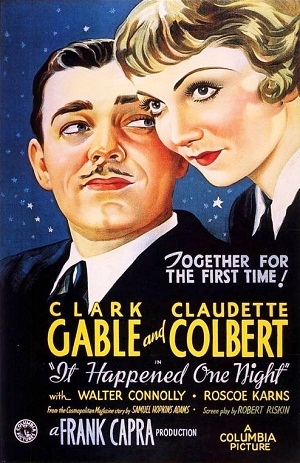
Gable_ithapponepm_posterStarring Clark Gable and Claudette Colbert with director Frank Capra, this light romance pits a sunk newspaper man with a dissatisfied socialite. Colbert feels stuck in her life with a domineering father who does not approve of her marriage, and so she runs off to get away. While on a bus she meets the recently fired Peter (Gable) and there is immediate friction between them. However, realizing she is inexperienced, Peter watches out for her and they travel together. Finding out who she is, he is even more driven to get a story and stay with her. Along the way Colbert begins to fall in love but he does not immediately react. When he finally realizes his true feelings, the situation becomes complicated when Colbert returns to her father and fiancee. In the midst of the wedding she hears of Peter’s true love and runs off to him. By that evening they are married and the “walls of Jericho” come tumbling down. Gable and Colbert both do well in this film and Capra gives us another light classic.

5/5 Stars

Destry Rides Again (1939)

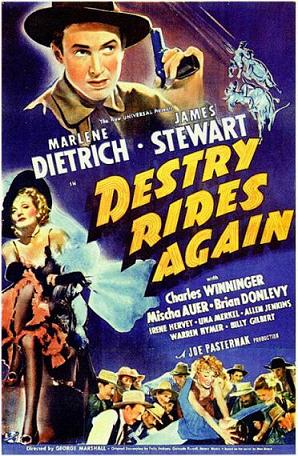
4ff56-destryridesagainposterThis comedy turned dramatic western, starring James Stewart and Marlene Dietrich, begins in a town run by a saloon owner and inhabited by a sleazy song girl. Corruption and cheating reign supreme as the sheriff is killed and the town drunk takes his place. He turns right around and calls the son of an old friend, Tom Destry Jr., to be his deputy. Despite a comical entrance, and an abhorrence for guns this man is very different. Using his smarts and playing dumb, he is able to work for justice even though he seems to be helping the villains. He picks up the trail of the dead sheriff only to have the present sheriff shot as well. In the final unorthodox showdown, good fights bad and the womenfolk join the fray. Destry finally takes up his gun and is nearly killed, but he gets the town boss in the end. It carries another great cost however. Despite this tragic end, the film finishes on a lighter note. You will finish the film understanding that Destry knew a lot of people in his time.

4/5 Stars

You Can’t Take it With You (1938)

Starring a cast boasting Lionel Barrymore, Jean Arthur, James Stewart, and Ed Arnold, this is another comical Capra film. Arnold is a wealthy banker bent on acquiring a block of land for business purposes. Stewart is his son who has fallen over heels for his secretary. Things are complicated by her peculiar family household partly because her grandfather will not give up his land to the banker. Fireworks go off literally and figuratively when the two families meet. It leads to prison, and a chaotic court appearance which causes a further rift. Because his grand daughter is sad, Grandpa decides to sell the family home. Arnold seems to have won, but his son leaves him for his love and so Arnold changes his way. Thanks to a harmonica duet and some dancing a friendship is made and everyone is happy in the end. Every Capra films comes with a message and this one preaches the importance of friends and family compared to money because after all “You Can’t Take it With You.”

4/5 Stars

Gunga Din (1939)

ac5f5-gungadinStarring Cary Grant, Victor MClaglen, and Douglas Fairbanks Jr. with Sam Jaffe in the title role and director George Stevens, the film follows three men in Her Majesties’ Forces. They soon have a run in with a violent cult but they narrowly come out in one piece. However, after that things quiet down and one of the three plans to leave the service so he can get married. Another follows the water boy Din and happens upon a golden temple. Then the cult takes him prisoner while Din flees to get help. His tow buddies come alone only to be captured as well. After putting up a fight they watch in horror as their troops start to fall in the same trap. The wounded Din sounds the alarm just in time, allowing the forces to defend themselves and then lead an offensive attack. Miraculously the three friends come out alive and Din dies a hero. This film is a great combination of action and humor. As Kipling would say, “You’re a better man than I am, Gunga Din.”

4.5/5 Stars

Swing Time (1936)

0c747-394px-swing-time-1935Starring Fred Astaire and Ginger Rogers with director George Stevens, this light film is like a screwball romance with a lot of added dancing. Astaire is a man who has missed his wedding and he agrees to go off to the city with a friend so he can make money to bring back. There he meets a fiery dance teacher accidentally and then they begin to perform together. As “Lucky” (Astaire) and his friend try to survive by gambling with the little money they have, he begins to fall for Penny (Rogers). However, she does not find out until later that he already has a fiancee. When she realizes the situation she goes to marry another. In the end everything is all a big mistake full of laughter and of course everything is made right again. There is no denying that Astaire and Rogers are not only good dancers but good performers. Many of the numbers they dance and sing are memorable like “The Way You Look Tonight,” Pick Yourself Up,” and of course “Waltz in Swing Time.”

4.5/5 Stars