Vincent Sherman Noir: Nora Prentiss, The Unfaithful, Affair in Trinidad, The Garment Jungle

I’m not sure how many people end up watching a list of movies by director Vincent Sherman, but here we are!

I tried to watch a handful of his most noirish films that I had not seen before, including a rewatch of Nora Prentiss with Ann Sheridan. Please let me know what you think!
Nora Prentiss (1947)

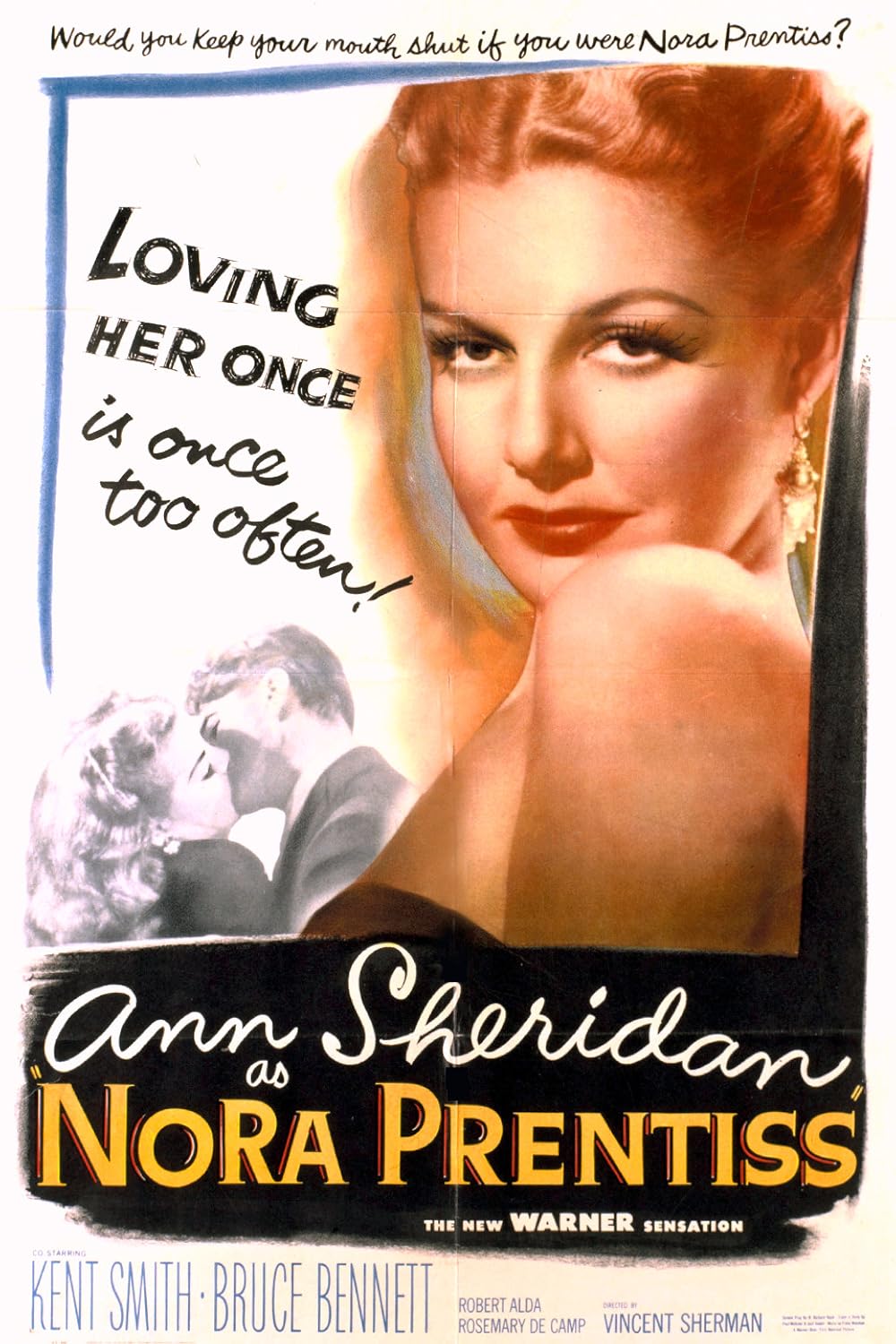
Ann Sheridan proved on more than one occasion she could play a Frisco dame. One of them was Woman on The Run, and her first head-turning go at it was as Nora Prentiss. The movie is directed by Vincent Sherman with cinematography by the revered James Wong Howe.

It is structured around Dr. Richard Talbott (Kent Smith). He is the conventional family man you could set your clock by, only to become the moth enchanted by a flame. The gravitational pull of the entire picture revolves around Sheridan. It occurs to me that the story goes to great lengths to suggest how his ordinary life is oriented around what the Greeks might call chronos time: The daily rhythms making up life.

However, in this world, kairos, or those propitious moments that break into the everyday, do not seem to exist unless it’s to signal impending doom. Because after a few inopportune moments in time, you could end up in the gutter, hit by a taxi cab, or flailing from a pretty lady’s charms. The movie gets into gear when the dutiful doctor attends to the nightclub singer and his prim manner quickly brushes up against the straightforward charm that’s all Sheridan.

Some of the great femme fatales come off that way because they are ruthless. Others feel like they don’t know the sway that they have over a man. It’s unwitting, but either one can be needlessly destructive.

It is a movie that grieves me in the sense that we watch the dissolution of a family. They’re imperfect, but a family nonetheless, as Richard’s life gets turned upside down, spending his waking hours with this tantalizing woman. It gets to the point where the good doctor must make a choice, but he is too cowardly to choose either until fate drops in his lap and he chooses the most desperate option.

The added length of a new life for him and Nora doesn’t do the story any favors, but we are privy to noirish nightmares played out in a courtroom as Talbott allows himself to get caught up in what feels like a cruel joke.

Smith is not well-remembered (He is also in Cat People), but by the end, it’s his pessimistic nobility that has the final say next to Sheridan. Her name is in the title, rightfully so, but as the everyman, the heart and soul of this picture is found in him.

3.5/5 Stars
The Unfaithful (1947)

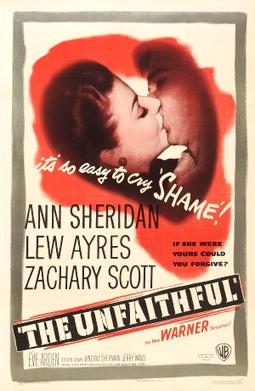
The Unfaithful shares some basic DNA with Mildred Pierce as a Warner Bros. vehicle crafted for much of the same female post-war audience (I had even heard a disgruntled Ann Sheridan turned down the role that ultimately won Joan Crawford her Oscar). This time around, Zachary Scott gets the opportunity to play the faithful, jilted husband opposite Sheridan.

Eve Arden turns up early on as a nosy divorcee in the social circles. She also maintains the trademark wit one comes to expect from such a consummate comedienne. Late-period Lew Ayers takes up the distinguished secondary lead of an attorney and family friend quite well by now.

Strains of noir begin to seep in when Sheridan returns home after a party, only to be attacked by a home invader, and the traumatic incident echoes throughout the entire film as her assailant is left dead in the aftermath…

One of the most delectable aspects is how Sheridan is allowed to shape-shift as her life begins to change overnight. She is the devoted, sensible wife of an architect and a man she married before he shipped off to war. Given how sympathetic she is within the community, she’s an obvious victim until it becomes clear she’s not entirely what she seems…

It’s a genuinely intriguing premise from the outset as the story evolves and we predict what it will become. A smarmy art dealer (Steven Geray) tries his hand at blackmail, and a woman comes out of the woodwork. The narrative grows a bit more stale when we recognize what is afoot. It has a slight sense of contemporary topicality, wrapped up in drama. We are dealing with themes of post-war marriage and grounds for divorce playing out like a nightmare.

One of the major delights of the picture comes with getting some definitive views of mid-century Los Angeles, even as there is a passing reference to Laurel Canyon and other places. Purportedly, the picture was inspired by Somerset Maugham’s The Letter, and though it’s been some time since I’ve seen William Wyler’s adaptation,  I’m predisposed to enjoy the modern aspect of this film. It’s purely because it provides an added layer of authentic character to the story. The ending plays as a hopeful referendum on your typical noir doom.

3.5/5 Stars
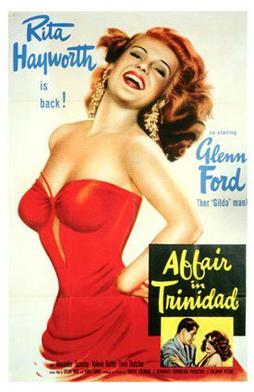
Affair in Trinidad (1952)

It’s difficult not to see the movie in relation to Gilda as a reunion of Rita Hayworth and Glenn Ford in another exotic locale. Although comparison can be the thief of joy and leaves Trinidad seeming unbecoming, once you separate the two, it’s easy enough to enjoy what it has to offer. Namely, the names on the marquee.

Although the parameters of the plot are hardly as interesting, nor are the relations of the characters, in case anyone needed a reminder, Rita Hayworth reminds us why she was a luminous cinema star and a lithe dancer with a killer hair flip.  In these incubated moments of dance, she’s able to bring to mind her work with Fred Astaire as much as Gilda. There’s so much ebullience to be had.

One’s left to wonder how Ford got shoehorned into the picture as a brother-in-law, but if nothing else, it’s an excuse to get the two stars back onscreen together for another round of sizzling antagonism.

It is her husband who is found dead by a local fisherman under dubious circumstances, and he flies in to deal with his brother’s affairs. He’s not looking to make any friends. Steve is accusatory of the vaguely aristocratic Fabian, who has a hand in local business, a sinister edge, and an obvious interest in Chris. She is unattached after all.

We see all throughout the picture how men worship her, and she confesses to her brother-in-law that she can’t help how Fabian looks at her. It feels like it could be a meta-analysis of Hayworth’s relationship with the male audience throughout her entire career.

This is more interesting than anything in the plot, which is layered with more than a few aspects of Notorious. If he is a reliable hand, Vincent Sherman still does not have the same bravura as Hitchcock, and there’s not a lot of elegance to the story.

It’s more about prolonged inscrutability than thrills, though leaning into its pitch-black noir aesthetic certainly does it some favors. At the end of the day, anyone drawn to Rita Hayworth or the reliable mercurial nature of Glenn Ford will find at least some reason to give it a watch. If you come with those expectations and not expectations of Gilda, all the better.

3/5 Stars
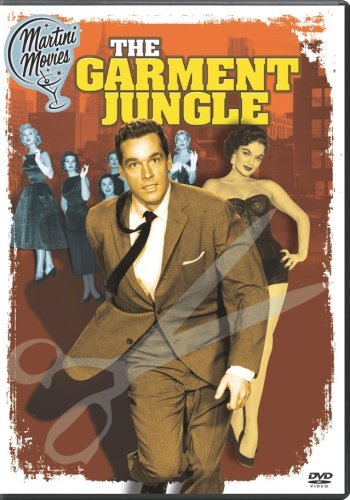
The Garment Jungle (1957)

Here is a picture giving off the aura of all things overblown and exploitative, making it more than worthwhile for viewing, replete with costumes by Jean Louis. Although it doesn’t have quite the same ring as The Asphalt Jungle or The Blackboard Jungle, The Garment Jungle does earn its keep when the co-owner of a garment business is killed in a runaway elevator car during the opening minutes of the picture.

It’s not quite on par with the powerful Richard Attenborough film The Angry Silence, but it is a Hollywood version of a union movie, turning the melodrama up a few notches. The dead man’s anti-unionist partner (Lee J. Cobb) is left to pick up the pieces in the aftermath of the tragedy. He’s innocent, even genuinely grief-stricken, but there’s no love lost between him and the faction led by young Robert Loggia, looking to organize his confederates.

The movie seems to be crammed with a varied assortment of available contract players, including Gia Scala and Valerie French.  Another one, Kerwin Matthews, plays Cobb’s son, who’s looking to get into the family trade while lending his dear old dad a lingering conscience in the cutthroat industry.

It’s easy to rue the fact that Robert Aldrich was not allowed to see the picture to completion. It’s still tough, even brutal around the edges, thanks to the likes of the ever-reliable heavy Richard Boone.

Cobb is actually sympathetic, playing a refraction of On The Waterfront, but it does feel like Sherman’s version of the story, at the behest of Harry Cohn, is a bit more traditional. And that’s saying something in a movie where at least two central characters die. The tumultuous production cannot strip the movie of some of its grittiest inclinations, and that’s worth something.

3/5 Stars

Johnny Belinda (1948) and Evoking Silent Cinema

johnny belinda 1

I must admit to committing an unforgivable fallacy. Maybe I’m the only perpetrator, but there might be others too. In my own mental computations, I often attribute Jane Wyman as the first wife of Ronald Reagan more than I equate her with her acting career. And though Nancy Davis hardly built such a substantial Hollywood career, I am quick to remember her because she was, after all, the First Lady.

However, with viewings of the Yearling and especially Johnny Belinda, I hoped to remedy this by recalibrating my brain’s gut responses. It was a stunning success. I’ve never been more mesmerized with Jane Wyman, and the core of Johnny Belinda’s merit lies in how simple it is. She does so very much with so little and in a medium often hampered by excess, Johnny Belinda is, in its finest moments, a quietly moving examination of a human being.

Cape Breton can be easily placed. There’s a wharf and a cannery. Men work at sea bringing in the days catch, and there’s nothing glamorous about their existence. The work is hard and the people blue collar. It’s the wrong coast, but these are the kindred of Steinbeck and certainly, you cannot help but think of Fritz Lang’s Clash by Night with its seascape and gale of drama.

However, I happen to think Johnny Belinda weathers the drama with a more delicate touch. We must turn to the characters to understand how this really happens. Because the small-town setting is stocked up with all types and shades of people. An amiable doctor named Richardson (Lew Ayres) has recently set up practice on the island making housecalls aided by a pleasant bedside manner. His swooning young housekeeper (an oft-forgotten Jan Sterling) is smitten and wishes above anything to be noticed.

It’s true he’s both a generous and obliging fellow though he doesn’t go to church on Sundays. It’s one reason for the old ladies in town to still somehow doubt his sincerity. He certainly can’t be familiar with “Christian charity” as they are!

Aside from the run-of-the-mill gossips, there’s the slimy reprobate Locky McCormick (Stephen McNally). Presently we might label him rightly as a bastion of toxic masculinity. However, the bottom line is he’s a vain and destructive human being who is able to fly under the radar due to the town’s hypocrisy. In other words, he goes to church on Sundays and manages to be romantically linked to the aforementioned housekeeper Stella.

We must also mention the gruff but not unkind farmer Black MacDonald (Charles Bickford). In fact, over time, he starts looking better and better as his work ethic and old-fashioned decency begin to let slide his affection for his daughter (Wyman). Meanwhile, his sister is played by Agnes Moorehead, a criminally underrated actress, perhaps because people do not superficially tout her looks. And yet she is a remarkable performer bringing strength and an acerbic edge to her part.

Even with these people, the spokes of a story aren’t altogether obvious as the kindly doctor takes the dumb and mute young woman under his tutelage, perceiving her intelligence and the dormant curiosity inside of her.

Wyman models her transformation exquisitely, first, picking up signing, then learning basic gestures of communication. However, in a town like this, there are certain types of ignorant people. People who will only ever see her as a “dummy.” There is no beauty or intelligence to unlocked inside her countenance because they can only comprehend the physical.

One prime example is when some merrymakers have an impromptu shindig at MacDonald’s barn fater picking up their weekly order of flour. The good doctor stands by Belinda beaming, showing her a fiddler plucking away joyously on his strings. The discovery is manifested on her face as she touches the violin with its vibrating strings and her feet begin to patter modestly. Her legs move tentatively but sweetly as if unshackled for the first time.

Others see it too. First, Locky his eyes burning with lust and then his jealous girlfriend trying to win back his affection with a carnal kiss. These are the only things they know about passion and romance. Add alcohol to the mix and it’s a volatile cocktail.

The film’s most helplessly terrifying moment comes when the belligerent thug wanders off from the party and finds a peaceful Belinda. His eyes burn with malicious intent. She has only innocence which quickly turn to fear as he encroaches. The subsequent inference of images and cuts speak for themselves as do ensuing events…

johnny belinda 3

Recently I’ve been pushing back against the era’s tendency toward over-illumination when it comes to spelling information out. However, some of the greats, Hitchcock and Lang among them, were able to imbue sound films with a certain silent sensibility where passages rely on the primacy of image over sound.

I won’t put Jean Negulesco in the same group as these others, but nevertheless, his premise necessitates a certain amount of nuance in order to approach the subject matter. It’s a tact that I very much appreciate because the film ably takes on the restraint and the functionality of a silent film especially when considering the subject of Belinda.

Consider, for example, a near-wordless entrance into the church with the stunned congregation looking on as a lovely Belinda enters in her Sunday best. In the same sequence, Dr. Richardson watches Belinda’s face swell with apprehension upon seeing McCormick for the first time. The power comes in this unspoken revelation.

The story must progress, and it evolves into a modern play on The Scarlet Letter with pernicious scandal digging in. You must remember this is the same small town with ears and eyes on every street corner. News travels fast that Belinda has a child and everyone has their preconceived notions on who the father is. They are intent on taking matters into their own hands. I need not expound upon this anymore.

More useful still are the impressions of the following scenes. In a strikingly poignant interlude, Belinda signs “The Lord’s Prayer” as the solemn bystanders join her in grieving the dead. We are reminded this is a different era imprinted with Christianity and a God who was a present comfort in the face of adversity.

Her moments taking care of her baby are also so tender and one is reminded of the universal experience of parenthood. Belinda might not be able to speak or hear but she feels and becomes both guardian and protectorate of that little bundle of joy no matter the cost.

An ensuing trial has her in the defendant’s seat and these scenes are generally conventional. They crop up in any amount of noir, melodrama, screwball comedy, whatever. It’s the precise circumstances that make it an engaging end. Because court is all about testimony and defense. What if someone is barely able to defend themselves?

They require others to intercede on their behalf. The final safety valve providing the audience a release is overblown and a foregone conclusion, but up to this point, what a joy it is to watch events unfold moment after moment.

This is a fine turn by late-period Lew Ayres although he is nothing without the quiet dignity and sprightly inquisitiveness of Jane Wyman. Johnny Belinda is a stunning reminder truth need not only come in the powerful wind or the quiet whisper. It can come in silence as well.

4/5 Stars

All Quiet on the Western Front (1930)

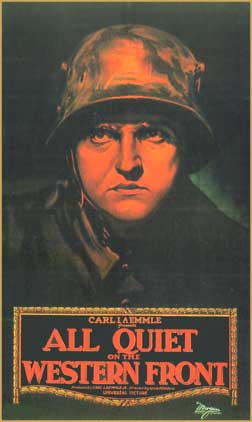
c7ab8-all_quiet_on_the_western_front_1930_film_posterDirected by Lewis Millstone and starring an ensemble cast headed by Lew Ayres, this archetypal anti-war film based on the novel of the same name, begins with a group of school boys during the dawn of WWI. This group of patriotic German youth is hungry for adventure and the glories of war. 

Then they arrive and begin their training which causes them to despise their commanding officer and they also lose some enthusiasm. It gets worse when they head to a combat zone and join a company of veteran soldiers without any food to eat. They finally head to the front and after a day in the trenches their number is fewer. 

Trench warfare proves to be hardly as glamorous as it seems with constant bombardment, rats, lack of food, and most of all the shedding of blood. One of their pals loses his leg and his boots, then slowly more get knocked off or wounded. Now Paul is one of the only ones left but after a bout of hand to hand combat with a French soldier he becomes even more disillusioned. Paul too gets wounded and is sent home on furlough to his family but he finds his friends and family have no concept of the gritty, grimy reality of war. He returns to the lines one more time and a few of his old comrades are still alive. 

However, in a fateful moment Paul reaches out for a butterfly in his trench and just like that he is dead. The last of this school room full of young, naïve boys is now dead or injured. That is the horrible scar left by not only by WWI but any such conflict. 

Despite the fact that all the main German characters are played by Americans, this film has a sharp sense of realism that extends all the way through the film. Even though many of these young actors were unknowns and are not well known today, together they made a powerful ensemble. The themes of this film were so powerful in fact that it was banned in Germany.

5/5 Stars

Holiday (1938)

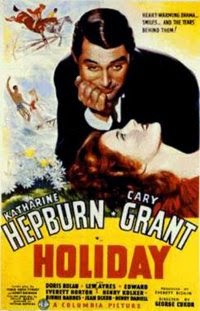
2c3de-holiday_posterJohnny Case (Cary Grant) is a happy go lucky fellow who is crazy in love with the girl of his dreams. He returns to town telling his friends the Potters that he has plans to marry this girl he met 10 days ago at Lake Placid! He is ecstatic and not afraid to show it.

However, he must become acclimated with her family and their lifestyle. Most important is gaining the approval of her sometimes stuffy and always money-minded banking father. Julia Sefton is by all accounts a lovely girl who seems to truly return Johnny’s affection. Honestly, though he is not quite used to her type of society. He makes his entrance by arriving through the servant’s door and wanders around the stately manor marveling at all the trappings. Doing the rounds he runs into her drunken but genuine brother Ned (Lew Ayres). Then, there is sister Linda (Katharine Hepburn), the so-called black sheep of the family, although her only fault is being an energetic free-spirit.

Immediately she and Johnny hit if off, and she soon realizes that her sister has a real catch on her hands. The wedding is finally agreed upon by Mr. Seton, and a big New Year’s Eve Party is thrown much to Linda’s chagrin. The night of the big to do there are two parties that take place. Downstairs all the snobs and high society mingle with Julia parading Johnny around. Upstairs is a different matter where the quarantined Linda is eventually joined by the Potters,  Ned and even Johnny.

The little gathering gets quashed and that is not all. Father and daughter are adamant that Johnny works at the bank and make money because that’s what any respectful husband would do. They take little heed of Johnny’s dream to take a holiday once he has raised enough money to live off of. He just wants to live life free of distractions for awhile, but they just do not understand. Finally, Johnny is feeling too restricted by all the obligations to bear it any longer, because he simply cannot live that way. Again, both father and daughter do not understand. But Julia does, and she finally realizes what she must do. It’s time to take a holiday.

Here is a formidable trio in Cary Grant, Katharine Hepburn, and director George Cukor. It makes me beg the question, how this film has become so overshadowed by Bringing up Baby and The Philadelphia Story? Johnny Case is a wonderfully vibrant role for Grant, and his acrobatics alone are worthwhile viewing. Hepburn on her part plays an equally spirited individual but without the scatter-brained or feisty edge that she often carried. Instead, she is just wonderfully footloose and fancy-free. Edward Everett Horton and Jean Dixon are an absolute riot, and I would love to have friends like them. Lew Ayres role was rather an odd one, but both Doris Nolan and Henry Kolker had an adequate amount of stuffiness to pull off their parts. That juxtaposition was necessary for the film to work and it did.

4/5 Stars