Stagecoach (1939)

Directed by John Ford and starring a young John Wayne, this classic western opens with various people boarding a stagecoach for various reasons. The passengers include a drunken doctor, a prostitute, a soft-spoken whiskey salesman, a gambling southern gentleman, an impatient banker, and the wife of a cavalry officer. Driving up top is Buck and the Marshall rides with his eyes open for the wanted Ringo Kid (Wayne) and the threat of Apaches. Despite their differences and the imminent danger, these people are forced to push on toward their destination together. They face unexpected challenges including hostile Apaches, but they finally do reach the town of Lordsburg. After the arrival, Ringo must figure out his relationship with Dallas while also facing the foes that are waiting for him. He does what he has to and ultimately his friends show their true colors. This film is a great character study with very good scenery, stunts, and action. As Wayne’s first big role, it is easy to see how he became a star after this performance. He was supported nicely by the likes of Claire Trevor, Andy Devine, Thomas Mitchell, and John Carradine. Without them and other like them this classic would lose the character depth that makes it work so well.

5/5 Stars

Only Angels Have Wings (1939)

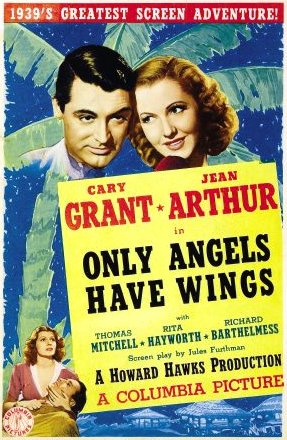
a4eff-only_angels_have_wings_posterStarring Cary Grant and Jean Arthur with a cast including Thomas Mitchell, Rita Hayworth, and Noah Beery Jr., with director Howard Hawks, the film follows pilots who fly mail throughout South America. Grant is the head of the dangerous operation and it becomes apparent to Arthur that he is callous, after a great tragedy strikes. However, she still stays out of interest in him. Things get complicated when the new pilot arrives and he carries a past that puts him at odds with everyone. It doesn’t help that his wife (Hayworth) was the former girl of Grant. In order to keep the operation going, Grant is forced to send out this Macpherson as well as his best friend “The Kid” (Mitchell) into a large storm. Needless to say that are not able to make it. Arthur is about to leave after this second disaster, but beforehand she says goodbye to the saddened Grant. He soon peps up when the weather clears and then prepares to fly again. Arthur at first feels rejected but with a flip of a coin she realizes his love for her. This is certainly a tragic picture, but good nonetheless.

4/5 Stars

Bringing Up Baby (1938)

In this mile-a-minute screwball comedy directed by Howard Hawks, Cary Grant is forced to deal with Katharine Hepburn’s ditsy socialite character. A Paleontologist (Grant) has been trying to assemble a dinosaur but he is missing a bone. On top of that Huxley is about to enter into an unhappy marriage and he also must impress a museum donor. The next day he meets a socialite (Hepburn) by accident and through a mix up he finds himself being taken to her home in order to help take care of a tame leopard named Baby. In the following chaos a dog buries the bone needed for the dinosaur, visitors come, Baby runs away, a wild leopard is on the loose, and the free-spirited girl finds herself falling for “Mr. Bone.” To complicate matters, the pair wind up in jail trying to explain their story to a quirky constable. In the end everything works out and despite the craziness, Huxley realizes he cannot live without this girl. This may not be  my favorite screwball comedy, but I would say it definitely is the zaniest and that stands for something.

4/5 Stars

Topper (1937)

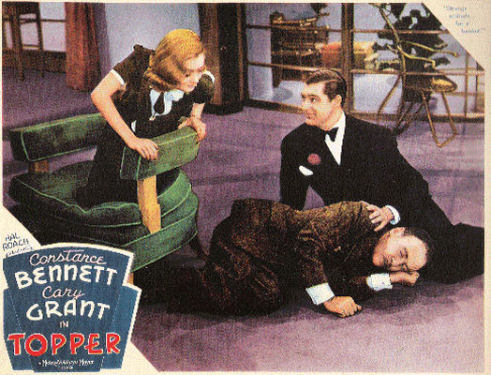
e1812-topper_lobby_cardThis fantasy comedy starring Cary Grant and Constance Bennett opens with a married couple flying down the road in their automobile. The unusual thing is that George Kerby is driving with his feet and that pretty much sums of this pair straight from the beginning. They live a wild, fun-filled life full of wealth and parties. However, all this craziness gets them killed when George takes on a curve in the road too fast. They decide as a good deed they must brighten up someone else’s life. Their subject of choice is Mr. Topper, an older fellow from the bank where George had acquired a great deal of stock. He is rather like a grumpy but lovable old dog who just does not want any excitement. The ghosts’ of the Kerbys change that however causing “Toppie” to get his name in the gossip columns after a stay at a chaotic vacation spot. His stuffy wife is dismayed, and his butler is peeved, but finally Topper is starting to enjoy life thanks to the prodding and trouble making of the Kerbys. This film has some good moments, but I would say that Grant’s comedy roles would just keep getting better after this one. 
 
3.5/5 Stars

The Awful Truth (1937)

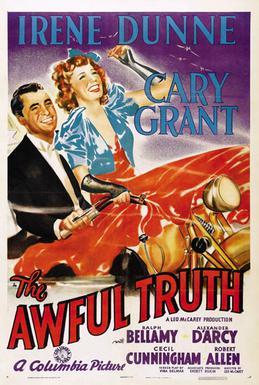
99f81-theawfultruth1937Starring Irene Dunne and Cary Grant, the film revolves around a couple after they split up over unfounded assumptions of unfaithfulness. The divorce is granted and after the wife gains custody of the beloved dog Mr. Smith, the 90 day waiting period begins. First she tries to get over him by spending time with a kind but dimwitted man from Oklahoma. Then Grant gets involved, and at first he gets enjoyment seeing his wife uncomfortable, but he soon becomes a bit jealous and sad. He then takes up his own relationship with an heiress and on the eve of their divorce they seem to be parting ways. However, Dunne’s character will not let it end that easily and she poses as his sister, eventually getting him away from his fiancee. Needless to say that in the end they get back together. This screwball comedy has very funny dialogue and Grand does some wonderful slapstick. It probably is one of my favorites from the genre.

4.5/5 Stars

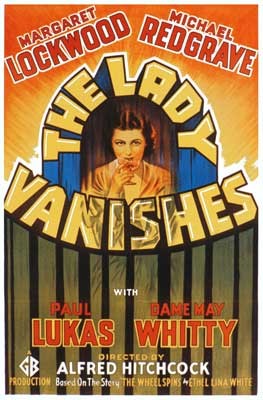
The Lady Vanishes (1938) – Alfred Hitchcock

Margaret Lockwood plays an American socialite in Europe in this Hitchcock mystery-thriller. The night before she is to leave, Lockwood meets a kindly middle-aged lady who is fascinated with European music. The next day the two ladies sit together on the train to talk. Being a bit disoriented, Lockwood takes a short nap however when she wakes up Ms. Froy is mysteriously gone. Seemingly no one remembers seeing the woman and no one will believe Lockwood. Finally, she teams up with a man who she had a run in with the night before (Michael Redgrave). Together they try to figure out what has happened to the lady. Finally discovering the truth, they come under great danger and must fight for their lives and those of the other passengers. Hitchcock does it again, bewildering the mind and making us intrigued at the same time.

4.5/5 Stars

39 Steps (1935) – Alfred Hitchcock

In one of Hitchcock’s great English films, he plays with the idea of a man on the run. Robert Donat is just an ordinary Englishman until a strangle woman tells him a deadly secret. Upon finding her murdered by a dangerous foe he flees. However, that puts him under suspicion and the hunt is on. He makes his way up to Scotland and gets some assistance however soon trouble brews. Somehow he finds himself cuffed to a woman he detests and he drags her away with him in order to escape. Due to their predicament, the unlikely pair soften to each other and try to discover the truth. After running for so long the answer finally comes to Donat  in the theater. He finally discovers what the 39 Steps are.

4.5/5 Stars

The Thin Man (1934)

c6713-poster_-_thin_man_the_02Starring William Powell and Myrna Loy and adapted from a Dashiel Hammet novel, this comedy-mystery follows a former detective and his rich, loving wife. At first Nick Charles is reluctant to go on a case that revolves around a thin man who he knew and who has disappeared. The police believe he is the culprit behind the three subsequent murders. Other mysterious events and the many suspects, leave both the police and audience unsure. After the constant begging of Nora, Nick follows a hunch and joins the case. He seemingly makes a break through and he and Nora hold a dinner with all the suspects. There the truth is discovered and the culprit is found. This is like a screwball comedy that is further complicated by the mystery. Powell and Loy play off each other very well and the supporting cast is good.

4.5/5 Stars

Mr. Smith Goes to Washington (1939)

84a24-mrsmithgoestowashingtonposterAs both a political drama and feel good movie, this film cemented James Stewart as an acting powerhouse. Furthermore, despite its age, it acts as a timeless reminder of the evils of political machines. It makes us root for the underdog, and it is distinctively American. Here is a cast and a story that seemingly could never be equaled, but what this film really had going for it was an idealistic outlook. I can, myself, often be a cynical person, and still Mr. Smith never fails to make me acknowledge the numerous attributes that make our country great, whether it is through montage, monuments, music, and of course Jefferson Smith himself. 

In one of his best performances, Jimmy Stewart is an idealistic, naive boy’s troop leader named Jefferson Smith. The starry-eyed Smith trusts that our nation is founded on some very noble principles that should be fought for tirelessly in government and in society. Above all, he is a likable fellow, who earnestly believes in the merits of this country, and he is beloved by boys all across the state. Now, this all sounds fine and dandy, but it would never have come across on the screen if it had not been for Stewart. He emanates this awkward and innocent energy that puts life into the idealistic creation of Jefferson Smith. 

When the film opens, everything is in turmoil when a senator suddenly dies and a replacement is needed fast. Believing Smith will be a pawn, a powerful man named Taylor (Ed Arnold) gets Smith a seat in the nation’s Senate. There he joins the respected Senator and old family acquaintance, Joe Paine (Claude Rains), who is also a cog in Taylor’s machine. However, although he is out of place in Washington, the patriotic Smith does his best to be worthy of his position. He realizes that the press will not give him a break, and the other Senators do not take him seriously.

So, on the urging of Paine, he decides to come up with a bill for a boys camp back in his home state. He requires the help of the world-weary secretary Saunders (Jean Arthur) to get his bill done. Initially, she is disgusted by his naivete, but as she grows to know him, she realizes he is only going to get himself hurt. His action to propose a bill soon find him face to face with the political machine that elected him. Taylor also has stakes on the piece of land where the boy’s camp would be, and he wants it for a dam. 

Smith finds himself being accused of using his position for his personal gain, and pretty soon he is before a committee with false evidence piling up against him. With all odds and seemingly everyone else against him as well, Smith makes one last monumental effort. Thanks to the help and guidance of Saunders, Smith fights to plead his case through a filibuster.

Fatigued by many hours of giving impassioned speeches and reciting the Constitution, Smith finally collapses, but not before effectively succeeding at his task. I doubt this would ever happen in real life, but in the film, it is fantastic watching the Senate break out into complete and utter mayhem. Ultimately, a young man with “a little bit of plain, ordinary, everyday kindness and a little looking out for the other fella,” was able to win. True, it may be overly sentimental, but it is a wonderful piece of sentiment all the same.

Frank Capra was wonderful at these type of cheering tales and his stars were in top form. There is an absolutely wonderful supporting cast here including Claude Rains, Edward Arnold, Eugene Pallette Thomas Mitchell, Charles Lane, Harry Carey, William Demarest, Beulah Bondi, and numerous other familiar faces I don’t even know the names of. That’s the beauty of the studio system I guess. It may have the same director, same leading man, and some of the same general themes, but Mr. Smith Goes to Washington covers completely different territory from Capra’s later classic It’s a Wonderful Life. Mr. Smith should be seen as a unique, and very much American film.


5/5 Stars

Ninotchka (1939)

e937e-film_ninotchkaStarring a cast including Greta Garbo and Melvyn Douglas with director Ernst Lubitsch, the film opens in Paris with three quirky Soviet Russians. They are sent to sell some jewels and at the same time to marvel at the capitalist society. Their curt, robotic, and serious comrade arrives to help them. She meets a Parisian playboy and seriously hopes to learn about his society.  However, after he finally makes her laugh the two of them become romantically involved. A jealous duchess manipulates the situation and Ninotchka is back in Moscow. She is reunited with her friends there but still is somber because she is no longer with her love. That changes quickly enough though. Lubitsch gives us another witty comedy that plays off the conflict between ideologies and cultures. Garbo, Douglas, and the three Russians are all likable characters that help make this film fairly good.


4/5 Stars