The Adventures of Robin Hood (1938)

Starring Errol Flynn, Olivia de Havilland, Basil Rathbone, and Claude Rains, the film chronicles the legendary exploits of the outlaw Robin Hood. Whether he bolder enters the royal castle, meets Little John, or encounters Friar Tuck, Robin always exhibits bravado and bravery coupled with lightheartedness. Ultimately, he always helps the needy and that makes him the sworn enemy of both Prince John and Guy of Gisbourne. After narrowly escaping death again following an archery match Robin soon returns to the castle to profess his love for Maid Marian. However, after he leaves, Robin learns she has been imprisoned but also King Richard is rumored to have returned. With one final bold and clever move Robin aids Richard and duels Gisbourne to the death. Of course everything ends happily ever after. This film is full of swashbuckling fun, a good score, striking color cinematography, and light moments as well.

5/5 Stars

“Hanging would be a small price to pay in the company of such a charming lady” – Robin Hood

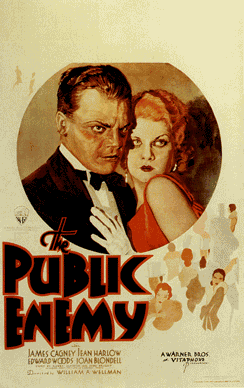
The Public Enemy (1931)

Starring James Cagney, the story follows Tom Powers as he and his friend Matt grow up in Chicago and eventually get involved with the gangsters of the Prohibition era. Tom’s life of crime gives him money and female company. However, it causes a division with his older brother. He sticks with his life and continues acting as  an enforcer for other gangsters. Every barrel of beer he delivers has blood behind it. As always fate catches up with Matt and eventually Tom. His life reveal the problems with Public Enemies. This is Cagney’s breakthrough performance and it makes sense because he literally steals the show. With every slug, slap, grapefruit, and devilish grin he captures the screen.

4.5/5 Stars


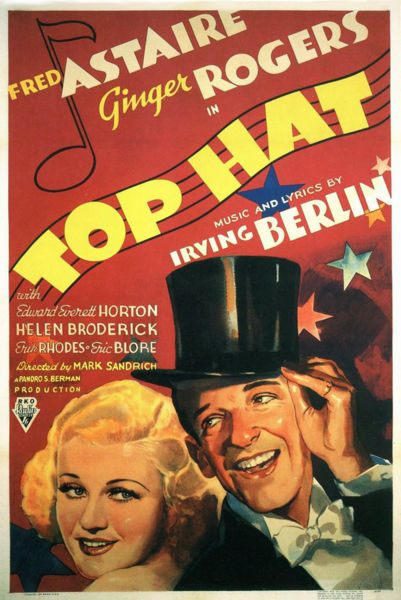
Top Hat (1935)

46fb6-tophatorgiStarring Fred Astaire and Ginger Rogers with Edward Everett Horton, this musical opens with Astaire in London as he gets ready to star in the show of his good friend Horace (Horton). However, after a late night confrontation with an annoyed neighbor Jerry is hopelessly in love. Multiple times he tries to spend time with her while the show is running. Then, he is eager to travel to Italy when he learns that the woman Dale will be there along with Horace and Madge Hardwicke. After a case of mistaken identity, Dale gets the wrong idea and believes that Jerry is married to her good friend Madge. Unaware of the mix up, he continues to pursue her, madly in love. She feels bad and at the same time tries to stave off Jerry’s advances. The whole mess leads her to marry a buffoon of an Italian designer. However, Jerry catches wind of what happened and tries to resolve their relationship. Through a hilarious loophole they get back together and dance off into the sunset. Some memorable routines include “No Strings (I’m Fancy Free),” “Isn’t This a Lovely Day (to be Caught in the Rain),” “Top Hat, White Tie, and Tails,” then “Cheek to Cheek.” I found the supporting cast    to be good and aside from Swing Time this is a good Astarie/Rogers pairing.

4/5 Stars

The Rules of the Game (1939)

bcb9f-la_regle_du_jeuThis French film directed by Jean Renoir is a light comedy that turns into a critique of the Upper classes. The film involves the superficial events and racy love affairs as only the French can have. It opens as a famous aviator lands his plane only to be disappointed that his married lover did not come to see him. Soon we learn that her husband has a mistress of his own. Put these four together,  Renoir in his jolly role of Octave, all the other guests, then the many servants, and soon you have a major spectacle. They dine, hunt, gossip, put on a show, quarrel, and above all fall in love. It is all fun and games however until someone gets hurt. Although this film is not what we may be accustomed to in our present generation, it is easy to appreciate the satire, cinematography, and ensemble cast. Kudos to Renoir for making a very intriguing film.

4.5/5 Stars

Frankenstein (1931)

e7a7f-frankenstein13Starring Colin Clive and Boris Karloff, this archetypal horror film is loosely based on the novel written by Mary Shelley. Frankenstein is a man intent on creating life. However, his creation is made out of corpses and then comes the fateful day that he brings his Creature to life. Once it is alive his own life will never be the same. Soon it begins to cause havoc by killing a little girl and scaring others. It even attacks Frankenstein and his wife on their wedding day. In the end the Creature meets his demise in a burning barn and Frankenstein seemingly escapes utter disaster. This became the perfect set up for the Bride of Frankenstein (1935).
4/5 Stars

City Lights (1931)

In this Charlie Chaplin film we follow the Tramp as he romances a blind flower girl and is befriended by a crazy millionaire. In line with all the great Chaplin silent films, this one has many comedic moments but also sentimentality. In one scene the Tramp might find himself dragged along with the millionaire or fighting in a boxing match. However, the next sequence he might be sharing a very nice moment with the girl who only knows him by his voice and kind deeds. Fittingly, in the final moments of the film, the flower girl who can now see is reunited with the humble tramp who showed her so much kindness. Overall this was a very good film and it seemed to have a wonderful balance of humor and romance. It proves that sound is not always needed if you are a good storyteller.

5/5 Stars

Other Chaplin films I may watch in the future include The Kid (1921), The Circus (1928), and The Great Dictator (1941)

King Kong (1933)

Starring Fay Wray, this Pre-Code film starts with a movie director who wants to travel by ship to a wilderness in order to shoot his next picture. However, he needs a leading lady and that is where Ann Darrow (Wray) comes in. He finds her in New York and brings her along to use in his film. All too soon the filming plans go awry after natives take Ann as an offering for Kong. The filmmaker, first mate, and some crewmen go looking for her only to run into enormous trouble. Kong proves to be deadly but he is brought down and Ann is saved from her giant suitor. The movie man takes Kong to New York as a show attraction. The Beast cannot be contained and escapes going on to terrorize the inhabitants of the city. In the climatic scene atop the Empire State Building the story is finally resolved. The special effects are obviously not great compared to modern standards but that is part of the charm. With its pulse pounding score and many harrowing moments, King Kong certainly has its thrills.

5/5 Stars

The Wizard of Oz (1939)

6bda0-419px-wizard_of_oz_original_poster_1939Coming from the great year in film of 1939 this is one of the quintessential musical, fantasy, and family films. It has some of the most famous songs around, a memorable cast including Judy Garland, and serves as a constant reminder that there’s no place like home. Furthermore whenever we think villain the film’s Wicked Witch is almost always ingrained in our minds. 

*May Contain Spoilers
The story is adapted from the L. Frank Baum novel and it follows a young Kansas girl named Dorothy who lives on a farm with her aunt, uncle, the dog Toto, and three farm hands. When a big tornado hits, Dorothy becomes unconscious and when she wakes up she finds herself in Oz. There she encounters the good witch and the land of the Munchkins. As Dorothy begins her journey to the Great Oz to get home, she meets several unique characters. First there is a scarecrow who wants a brain, then a tin man who desires a heart, and finally a lion who aspires for courage. Together they travel to Oz and the wizard tells them they must kill the Wicked Witch of the West. Dorothy finds herself eventually in captivity but her new found friends rally to save her and inadvertently kill the Witch. When she gets back to Kansas Dorothy realizes that there is truly “no place like home.” With iconic characters, memorable lines, and infectious songs it is easy to understand how this film became a classic. The added color does not hurt and also the special effects are not too shabby for 1939.

4.5/5 Stars

Modern Times (1936)

Arguably the first great superstar of film, Charlie Chaplin was the man known simply as the Tramp in his silent movies. For this reason Modern Times seems like the perfect bridge between the early silent era and the age of talkies starting in the late 1920s. Chaplin had many successes earlier including The Gold Rush (1926) and City Lights (1931). However people wanted to hear talking and soon enough everyone would have to make the transition or else die out. Because of Chaplin’s popularity he was able to make one last great silent picture. From that point on however it got a lot louder in theaters.

In this film the iconic Tramp character finds himself up against modern technology and the Great Depression. The whole movie seems to be critiquing factories, the police, the economy, and even modern film by using little actual dialogue. With that being said, this is a great film which exhibits everything that made Chaplin famous. He still has that walk, that mustache, and new hilarious antics to accompany everything else. Yet again there is a love story, between a tramp and a beautiful homeless girl played by Paulette Goddard (Only in the movies). Despite all the hardships they face this resilient pair amazingly still have hope. Fittingly, in the end the two lovebirds walk off into the background, seeming to bring the end of the Chaplin era, but also leaving us with a feeling of hope for the future.

5/5 Stars