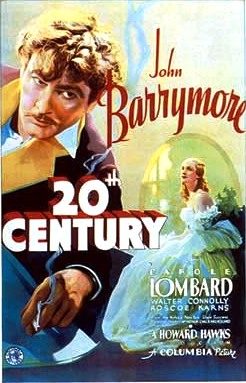
Twentieth Century (1934)

63742-twentieth-century-post1Starring John Barrymore and Carol Lombard with direction by Howard Hawks, this archetypal screwball comedy revolves around a frenetic impresario and the emotional girl he made into a household name on Broadway. 

Oscar Jaffe is the undisputed king of Broadway and after he christens the inexperienced Mildred Plotka, Lily Garland, she becomes his box office Queen. He makes her into a great actress and their numerous collaborations turn out success after success. However, as several years pass Lily is fed up and she ends her connection with Jaffe in a volatile falling out after she finds that he has hired a private investigator to keep tabs on her. Without his starlet Jaffe produces flop after flop and he is endangered of being jailed by his backers. He escapes in disguise and boards the Twentieth Century Limited train. He is accompanied by his two quirky assistants and it just so happens that Lily has boarded that same train. Jaffe sees it as a chance to make amends, but Lily will have nothing of it. They have some more frenzied confrontations on the train as Jaffe tries to convince her to star in his next project. In a last ditch effort he pretends to be deathly ill after a scuffle so that she will sign a contract in her distress. In the end she proves to truly care for him and once again they are back on Broadway, Lily Garland star extraordinaire, and Oscar Jaffe the domineering visionary. 

Along with It Happened One Night, this is one of the early examples of the screwball comedies. This was a perfect practice run at it for Howard Hawks who would direct the more well-known Bringing Up Baby in 1938. The leading performers are absolutely chaotic and over the top in their performances, but it’s the way it should be. Furthermore, like most screwball comedies the odd supporting characters are often a great source of laughs. The extended train sequence here reminded me somewhat of The Palm Beach Story another raucous film.
 
4/5 Stars
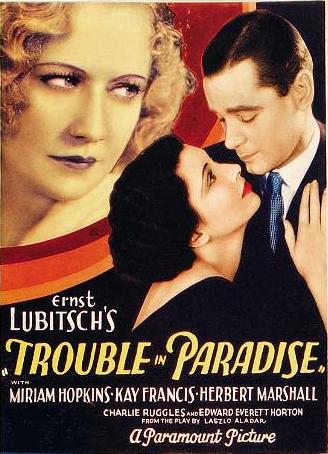
Trouble in Paradise (1932)

73432-troubleinparadise1932Starring Kay Francis, Herbert Marshall, and Miriam Hopkins with director Ernst Lubitsch, this film is a funny pre-code era romantic comedy. A man and a woman crook meet each other in Venice and after wreaking some havoc they fall in love and get married. The two of them move to Paris in order to pull a big heist on the elegant Collete perfume tycoon. Things get complicated when the male crook begins to fall in love with her. Furthermore, her two other suitors get jealous and eventually realize where they have seen him before! Then his wife learns what is going on and she is jealous. He sadly breaks off his relationship with the lady he meant to rob. But once a pick pocket always a pick pocket and he and his wife make up. For being an early 1930s film, I particularly enjoyed this one. Lubitsch did a fine job directing and there is a lot of wit.

4.5/5 Stars

A Day at the Races (1937)

Starring The Marx Brothers, the film begins with a pretty young lady who owns a sanitarium near a racetrack. In danger of closing, she brings in a new doctor named Hackenbush (who specializes in horses) and at the same time her love buys a race horse. A powerful man wants the place closed down so he can build a casino and he is in cahoots with the financial adviser  a wily woman, and the police. However, wanting to help the two lovebirds out, Groucho, Chico, and Harpo lend a wild helping hand. It all culminates with an uproarious Day at the Races. This film is full of funny moments such as the code book sequence, the dinner and wall papering scene, the medical exam, and of course the final race. I felt that a lot of the music was an unnecessary added feature.

4/5 Stars

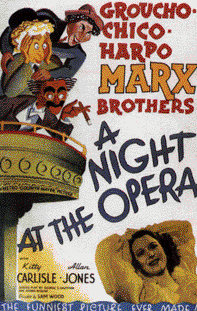
A Night at the Opera (1935)

Starring The Marx Brothers, this vehicle for their comedy has Groucho, Harpo, and Chico trying to help two lovers earn  positions at the opera. Along the way Groucho tries to marry a rich patron and Chico and Harpo run from the law as stowaways. This film which could be seen as having a dramatic story, is constantly interrupted by Marxian gags. Some memorable moments include the insanity clause, two hard-boiled eggs, Groucho’s crowded stateroom, and the final scenes in the opera house. Only with the Marx Brothers would you hear Take Me Out to the Ball Game at the opera. Although Duck Soup has critical acclaim, I find this one more entertaining as comedy with a real story line. The MGM years were ushered in by this film and solidified the Marx Brother’s legacy.

4.5/5 Stars

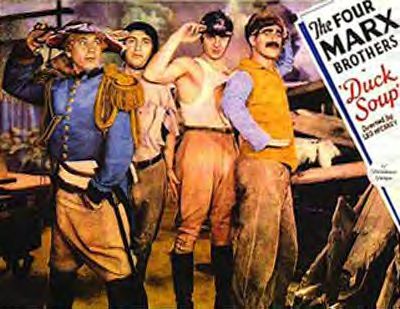
Duck Soup (1933)

47a2d-duck_soupArguably the greatest movie of The Marx Brothers, Duck Soup takes place in the country of Freedonia where Rufus T. Firefly (Groucho) is appointed the new leader. All too soon he proves to be incompetent and the ambassador from the rival country of Sylvania wishes to start a war with Freedonia so he can take over the country. He enlists the help of a wily woman as well Chico and Harpo who are spies. Chico is caught and his trial ultimately leads to war. However, he is also Firefly’s secretary of War and with the Brothers leading things it is sure to be zany and wild. Beside the ever present puns and quips, some memorable moments include the opening serenade, the street vendor scenes, the famous mirror sequence, and of course the war at the end. This would be the last film with Zeppo but the other brothers would move onto MGM and keep their career going. This film is good but upon seeing more of their films I would say I appreciated A Night at the Opera more.

4.5/5 Stars

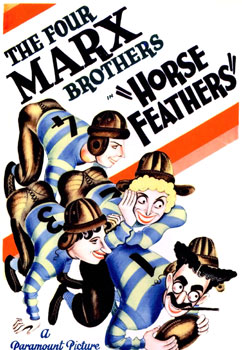
Horse Feathers (1932)

8349f-horsefeaThis comedy starring The Marx Brothers opens with Groucho being made the new president of a college. His son Zeppo implores him to get some players to help them win a big football game. However, after going to the Speakeasy Groucho winds up with Harpo and Chico while the professionals are on the other team. At the same time, first Zeppo and then Groucho fall for a girl with bad intentions. The game day comes and things look bad but the Marx Brothers turn the tide with their shenanigans on the field. Memorable moments include the opening number, the password gag, anatomy class, and of course the crazy football match! There is also a precursor to the stateroom scene from A Night at the Opera. Fewer people but still craziness.

4/5 Stars

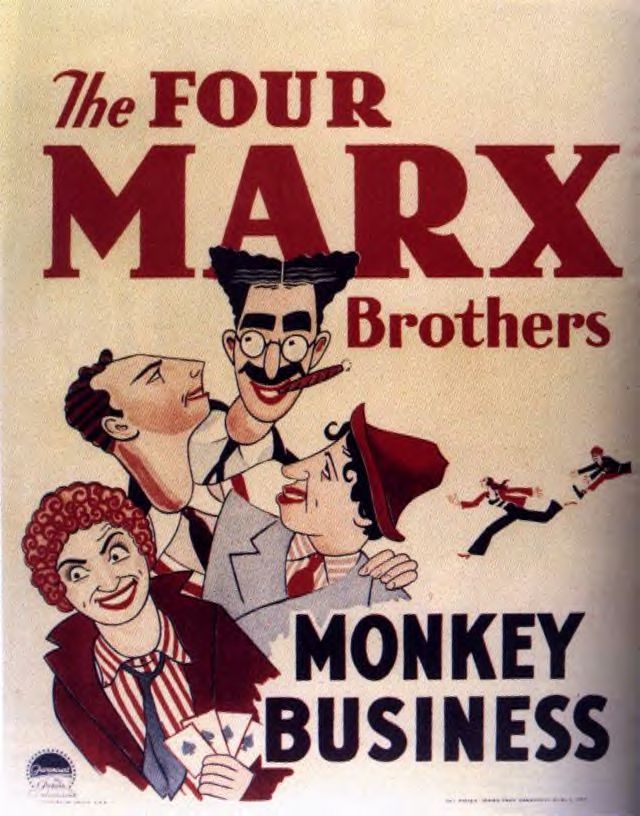
Monkey Business (1931)

53140-monkey_business_1931_film_posterStarring the four Marx Brothers, the film opens with them stowing away aboard an ocean liner. As they try to avoid the crew, they cause trouble as always and then accidentally get involved with rival mobsters. When they finally get off the boat, they attend a party of one of the men.
However, during the festivities mixed with craziness, his beautiful daughter is kidnapped by the other gangsters. In the final showdown, the Brothers lend a hand and save the girl being help captive in a barn. Aside from the usual chaos, some notable scenes include the opening sequence, the Punch and Judy Show, the Maurice Chevalier scene, and of the course the final barn sequence!

4/5 Stars

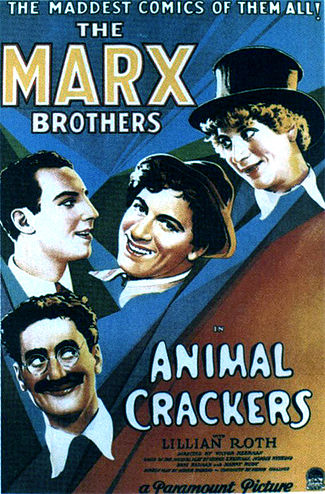
Animal Crackers (1930)

efe9f-the_marx_brothers_animal_crackers_film_posterHeaded by the four Marx Brothers, the film opens with the return of the famous African explorer Captain Jeffrey Spaulding (Groucho), who is being honored at the estate of a Mrs. Rittenhouse (Margaret Dumont). Along with him there are two musicians (Chico and Harpo), and an art lover with an especially extraordinary painting in his possession. The daughter of the hostess is in love with a young, aspiring artist. She enlists the help of the two musicians to replace the painting with a fake done by her beau. However, they are not the only ones with an interest in the masterpiece and mayhem ensues. In the end all is revealed and everything works itself out. Besides some famous Groucho quips about his travels, there is “the flash” sequence, several musical numbers, and the final scene with the insecticide gun. As always the brothers deliver the chaotic and pun laden humor they gained notoriety for.

4/5 Stars

The Adventures of Robin Hood (1938)

Starring Errol Flynn, Olivia de Havilland, Basil Rathbone, and Claude Rains, the film chronicles the legendary exploits of the outlaw Robin Hood. Whether he bolder enters the royal castle, meets Little John, or encounters Friar Tuck, Robin always exhibits bravado and bravery coupled with lightheartedness. Ultimately, he always helps the needy and that makes him the sworn enemy of both Prince John and Guy of Gisbourne. After narrowly escaping death again following an archery match Robin soon returns to the castle to profess his love for Maid Marian. However, after he leaves, Robin learns she has been imprisoned but also King Richard is rumored to have returned. With one final bold and clever move Robin aids Richard and duels Gisbourne to the death. Of course everything ends happily ever after. This film is full of swashbuckling fun, a good score, striking color cinematography, and light moments as well.

5/5 Stars

“Hanging would be a small price to pay in the company of such a charming lady” – Robin Hood

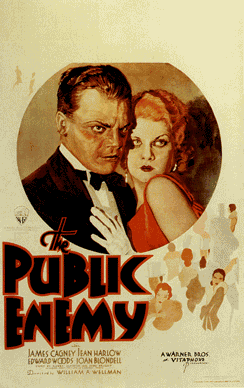
The Public Enemy (1931)

Starring James Cagney, the story follows Tom Powers as he and his friend Matt grow up in Chicago and eventually get involved with the gangsters of the Prohibition era. Tom’s life of crime gives him money and female company. However, it causes a division with his older brother. He sticks with his life and continues acting as  an enforcer for other gangsters. Every barrel of beer he delivers has blood behind it. As always fate catches up with Matt and eventually Tom. His life reveal the problems with Public Enemies. This is Cagney’s breakthrough performance and it makes sense because he literally steals the show. With every slug, slap, grapefruit, and devilish grin he captures the screen.

4.5/5 Stars