
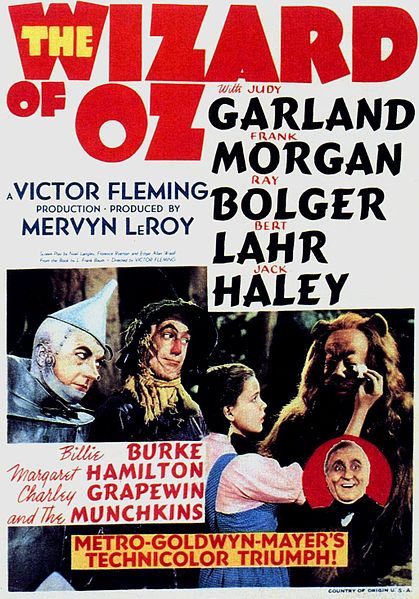
 Coming from the great year in film of 1939 this is one of the quintessential musical, fantasy, and family films. It has some of the most famous songs around, a memorable cast including Judy Garland, and serves as a constant reminder that there’s no place like home. Furthermore whenever we think villain the film’s Wicked Witch is almost always ingrained in our minds.
*May Contain Spoilers
The story is adapted from the L. Frank Baum novel and it follows a young Kansas girl named Dorothy who lives on a farm with her aunt, uncle, the dog Toto, and three farm hands. When a big tornado hits, Dorothy becomes unconscious and when she wakes up she finds herself in Oz. There she encounters the good witch and the land of the Munchkins. As Dorothy begins her journey to the Great Oz to get home, she meets several unique characters. First there is a scarecrow who wants a brain, then a tin man who desires a heart, and finally a lion who aspires for courage. Together they travel to Oz and the wizard tells them they must kill the Wicked Witch of the West. Dorothy finds herself eventually in captivity but her new found friends rally to save her and inadvertently kill the Witch. When she gets back to Kansas Dorothy realizes that there is truly “no place like home.” With iconic characters, memorable lines, and infectious songs it is easy to understand how this film became a classic. The added color does not hurt and also the special effects are not too shabby for 1939.
4.5/5 Stars
4.5/5 Stars

 4 Star Films