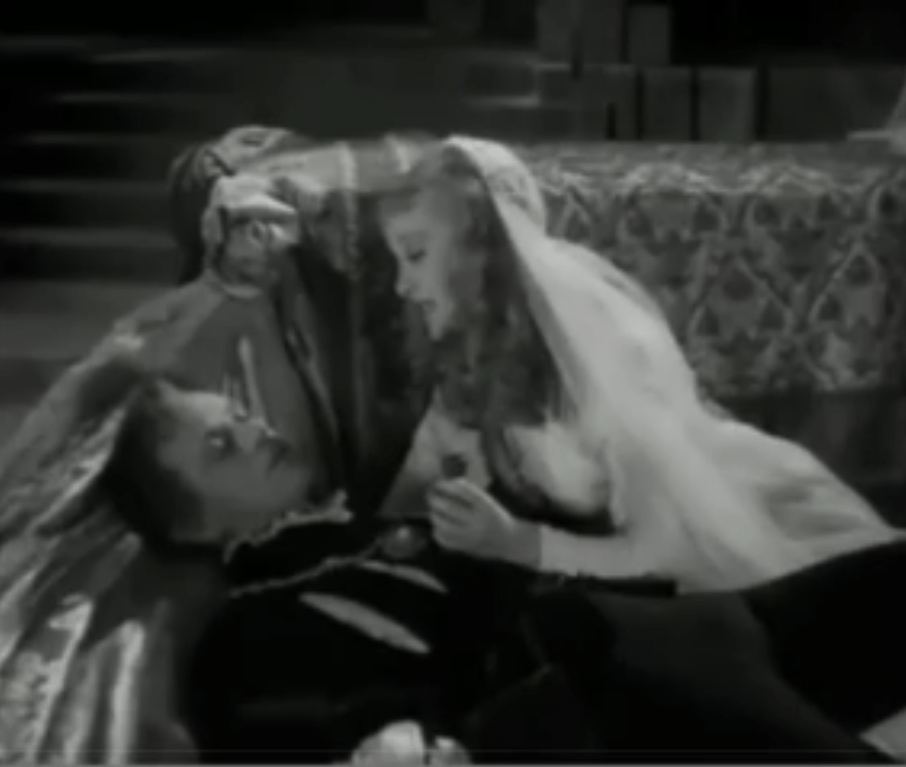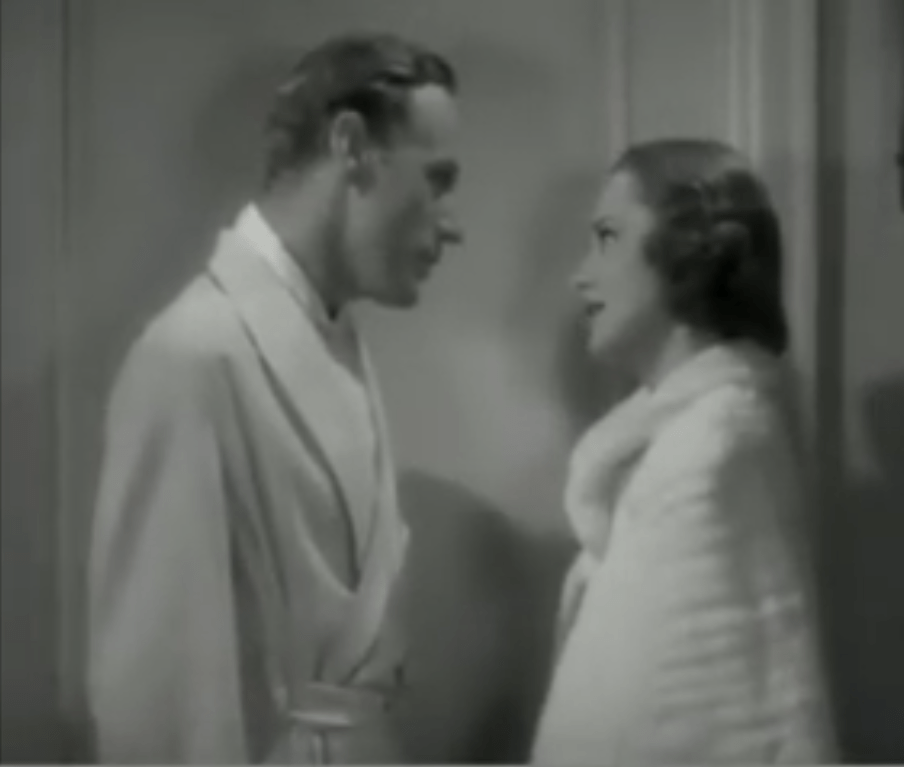
The Hunchback of Notre Dame (1939) and The Rejected Cornerstone

hunchback of notre dame 1.png

Note: This post was originally written a few days after the Notre Dame fire on April 15th, 2019.

“All over France, in every city there stand cathedrals like this one, triumphant monuments of the past. They tower over the homes of our people like mighty guardians keeping alive the invincible faith of the Christian. Every arch, every column, every statue is a carved leaf out of our history.” Harry Davenport as King Louis XI

We often say rather facetiously “if only these walls could talk,” referring to those hallowed grounds imbued with a history of ages gone by, whether they reach near or far into the past. However, it’s necessary to acknowledge, with a place such as Notre Dame de Paris, such an aphorism rings true. It takes on resonant meaning the very week I write this.

Only a few days ago, this landmark of Paris (even preceding the Eiffel Tower) was stricken by a fire that ran rampant, even torching the iconic central spire, so it came crashing down. Given the context and what this structure stands for — even as implied by this film — it’s no small surprise the news grieved, not simply an entire nation, but the world-at-large.

It is part of the reason I desired to watch this adaptation of Victor Hugo’s lauded novel. It is a bit of a memorial, but also an act of solidarity. We need to remember these bastions of history because they carry so much worthwhile beauty within their walls.

As would have it, this version of the famed Parisian tale begins with the two pillars of authority within the film, rather like the towers of Notre Dame themselves, albeit one good and the other bad. The King (Harry Davenport) is an open-minded, bright-eyed, and benevolent ruler, who looks at advancements like the printing press with only mild amusement. He sees no harm in the people being able to spread ideas.

Meanwhile, his counterpart, Frollo (Cedrick Hardwicke), is the local judge and arbiter over the judiciary system. To mollify the production codes, he was changed from a religious hypocrite to a far more secular villain as his behavior is unbecoming a man of the cloth. Disney’s version would rectify this minor faux pas and yet for the longest time, this tweak went all but unnoticed. The sentiments and moral dilemmas work out much the same. Likewise, there’s little doubting the weight of the other performances in this version.

Like A Tale of Two Cities or Les Mis, both adapted throughout 1930s Hollywood, the palpable world being constructed here is one of the most prominent assets of this period piece. I might be biased toward these literary adaptations of old. They certainly are not faithful distillations of their sources; they’re processed through the mechanism of Classic Hollywood, and yet they never cease to amaze me for the sheer amount of atmospheric world they are able to put forth on the screen.

Case and point is the initial street carnival hitting the audience full-on with a flurry of activity, gaiety, and sensory overload in every area. There’s no way to fill in all the background with computerized extras or scenery and so what you see is what you get, from a mass of cackling gypsies to a giant hog on a spit, to all sorts of medieval dunces, stilt walkers, and street performers milling about. It’s true such an arena would be impeccable for a fruit fight and of course, there is one.

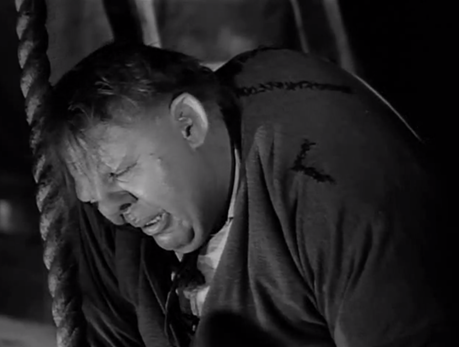
Charles Laughton’s turn as Quasimoto is a highpoint in an illustrious career because he willfully commits to the character in all of his outward ugliness and ostracization, while still endowing him with the tenderness dwelling therein.

At times, it’s a near-silent performance, which makes it potentially more compelling — so much is left to posture and expressions — the nuances of behavior speak volumes on his behalf. Dialogue might turn into a crutch for other characters, but very rarely for him. His words — when used at all — are chosen carefully and, thus, there is a meaning behind them well worth considering.

hunchback of notre dame 2.png

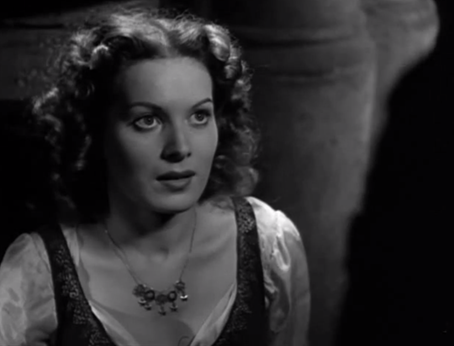
For the day and age, there is arguably no better lass to portray Esmerelda than Maureen O’Hara as youthful, fiery, and supernally beautiful as she is in this very moment. Whether she’s a convincing gypsy or not, it’s easy enough to believe she draws the admiring eye of nearly every mortal man.

So many eligible (and not-so-eligible) men vie for the affections of the striking, thoughtful, free-spirit. She is smitten with the handsome Captain of the Guards: Phoebus (Alan Marshal), who returns her favor. Another is the scorned poet Pierre Gringoire played by an initially unrecognizable Edmond O’Brien, due to the utter youthfulness of his features. Quasimoto harbors his own crush on the pretty maiden, though his is not the only unrequited love.

Frollo, as painted here, is no Disney villain — harsh and corrupt he may be — but there is something buried there to feel sorry for, even as his soul is twisted up inside. Tormented by an infatuation he cannot seem to quell. Ultimately, what remains is his vindictive polemic against gypsies and anyone he deems to be pernicious to his self-prescribed social order.

Here the narratives channels this undercurrent of Aryan prejudice sweeping the European landscape, this heavy strain of anti-Semitism that, ironically, brought a plethora of talent to Hollywood. The parallels are too overt not to comment upon. It goes to show how the social climate of the time cannot be completely stripped away from material which, while timeless, also has striking ties to the contemporary moment.

On a lighter note, what better vagabond to be King of the Hall of Miracles than the one and only Thomas Mitchell. His year would yield performances in a staggering five movies — all of them classics — including Gone with The Wind, Mr. Smith Goes to Washington, Stagecoach, Only Angels Have Wings, and this film. What’s more astounding is the consideration that this might be the weakest of all the pictures he was in! One can never discount the inevitable shadings of color he adds to any ensemble.

The Christ metaphors with Quasimoto are also blatantly clear. He is crowned the King of the people on the first day only to be ridiculed and mocked in the streets the next. He is the scapegoat, taking on all the people’s ills, grievances, and malevolence upon his head. Even the local leaders, as reflected by Frollo, look down on him in disdain and utter malice. So Quasimoto’s station in life is that of a total outcast, despised by everyone.

There is only one person who has pity on him and it is, of course, Esmerelda. She showed it before, marrying the poet to save him from hanging, and this is her second act of goodness. The wheels of justice can be harsh as she is sentenced to death, based on the bleatings of a Goat named Aristotle. The logic used is not unlike Witches sinking during the Salem trials. Her innocence falls on deaf ears, not as a result of clanging bells, but instead, even harder hearts.

There is a certain gravitas with the young vision of beauty bowed on the steps of the cathedral, awaiting her execution. The lingering essence is very much the same to Dreyer’s seminal masterwork Joan of Arc. A figure of such common virtue subjected to such ignominy on such a grand scale.

Again, the Christ-like metaphors cannot be dismissed as yet another martyr is unfairly condemned for practicing witchcraft. It takes one outcast rescuing another and seeking sanctuary in the house of God. While it might seem an antiquated tradition, there is something impactful about the walls of Notre Dame being a haven to all who call upon them.

The final storming of the cathedral feels more like disastrous miscommunication than a fully-fledged battle for the heart and soul of the city. Regardless, the last note is a resounding one. Esmeralda ends up with her man. Quasimoto, in a realistic development, despite being a hero, is forced to carry on his life of solitude.

Though he might not be the most prominent feature of Notre Dame de Paris, it becomes increasingly apparent he is like the cornerstone  — a vital component — mostly rejected and forgotten by the world around him. He did everything out of deep, abiding love, requited or not. Much the same might be said of Laughton’s performance. The whole story falls apart without him, and he handles each scene with his usual aplomb and theatrical bearing.

4/5 Stars

Port of Shadows (1938) and The Face of Jean Gabin

port of shadows 1.png

“Like the movies. I see you. I like you. Love at first sight.” – Jean Gabin

Jean Gabin has one of the great visages of the cinema. But in making such a statement you immediately run the risk of giving the wrong impression. To actually see him on the big screen is to know what I mean. He is not classically handsome in the Hollywood sense, fitting somewhere in between Spencer Tracy, Bogart, and Fonda when Hank had a chip on his shoulder. And yet set off in black and white as Gabin always was during his most prolific periods, there is something unmistakable about his face.

It is worn with the grooves, contours, and the residual sadness that come with life. He gives the impression of seeing the world, having his heart ripped out, being battered and bruised, while still choosing to press on anyway. You could say he has the entire French experience of the early 20th century on his brow. He’s simultaneously a projection of their best self in the face of hardship.

Historically, the cultural mood and the looming world war to come were ill-omens, as far as the release of the film was concerned. It was far too portentous to be met without some amount of resistance

In Port of Shadows, Gabin fittingly plays a jaded soldier who catches a lift to the nearby port town of Le Havre. In an opening act of clemency, he keeps his truck-driving benefactor from quashing a mutt masked by the billows of fog. It’s an instant flag. We know this man. His emotions are not obvious, but they are there; he concerns himself with the well-being of others. There is a heart under there somewhere. Scene after scene his constant companion is the runty little dog, a continual reminder of who he is as a man.

Along with setting up its star, we soon learn director Marcel Carne cares about his characters and takes care of them. Not that the environments are unimportant. Between the pitch darkness of the highway or the smoky and garish interiors of the club, there’s atmosphere aplenty. But Carne is focused on his players; their faces and distinct movements, allowing them to be focal points of scenes in a generally clean, uninterrupted fashion.

Between the instantly palpable world and the menagerie of players cycling in and out, Port of Shadows cannot help but feel like a prototype for everything from Casablanca to the entire film noir movement with its smoky brand of realism.

I don’t know much about the time frame of when the picture takes place. In all honesty, I’m not all that concerned with that so much because instantly you are pulled into a world’s depth of field with its shadow and fascinating figures. There’s a compulsion to fall into the story and be as fully involved as possible.

He’s in town, flat broke, and there’s an unspoken understanding he’s not looking to get noticed by the local gendarmerie — most obviously a deserter. This is one of those picturesque places where you can fall in with drunken vagabonds and find yourself on the receiving end of neighborliness.

As is, everyone who is down-and-out or in trouble seems to go to Panama’s, though it serves as little more than an old shack with a couple of rooms.  A sorry excuse for a hangout and yet it has far more life than the fancy club in town. It’s the people there who truly make it worthwhile.

port of shadows 2.png

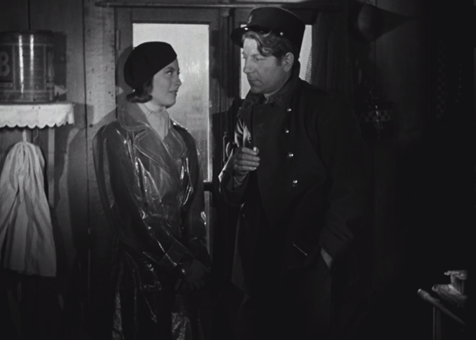
Jean (Gabin) is given a meal by the ragged proprietor, gets some fancy talk from an amiable artist, before meeting the most important person: Nelly (Michele Morgan). She’s young but precocious, mature beyond her years. The same might be said of Morgan who assuredly holds her own against all her male costars. She’s thoroughly outnumbered yet she handles it poise.

It’s a testament to the strength and varied colorfulness of the characters that the illustrious Michel Simon almost becomes of less interest as Nelly’s despicable godfather, especially compared to the peculiar sots he was tasked with portraying in Boudu and L’Atalante. His big scenes come near the end of the picture anyway.

Mostly this is a love story. In a rare moment of self-reflexity, Jean mentions how theirs is a movie romance. It’s this heightened sense of romantic reality. If we put it up against anything we experientially know to be true, it’s poppycock, but between the eyes and embraces of Morgan and Gabin, it just feels right.

We also learn more about Jean. Not only is he capable of deep measures of love, but he has no tolerance for lowlifes and scum — those lacking a sense of honor or principle. You have it out with a man face-to-face with fists, not from behind. One of his main targets is the local gangster Lucien who is nothing more than an arrogant rich kid with too much time on his hands. He wants his hands on Nelly. Jean is having none of it. He cuts directly through the artifice, slapping him around for his impudence.

The story comes to a head on the docks and again, of all places, at the bumper cars in the middle of a carnival. You do not mess around with Jean Gabin when a girl is involved. This could be the movie’s ending; the romance would be the euphoric and the hero would remain triumphant. However, it is a movie and so a greater, darker, more wistful avenue of drama is in order.

Because Jean knows he is not safe, though he has gratefully taken another man’s identity. It is better for him to leave on the latest vessel shipping out to Venezuela the following day. His love for Nelly is great, but there is a need to move on, to let her be while also keeping her away from the trouble that would come from knowing him. He does the selfish or heroic thing (depending on how you look at it), in cinematic terms, and he doesn’t tell her. He holds off as long as possible.

One fine sequence is at the waterfront bar with kegs of alcohol lodged right outside the door. There’s a conversation at the bar between the bartender and an old acquaintance we’ve already met. At a distant table, our protagonist, with his new identity bequeathed him by the philosophizing painter, charts his course for Venezuela aboard the freighter now sitting in the harbor.

These seem like mundane enough scenarios, but instead of a normal cut, Carne rides an extra with his camera, acting like the seamless segue between the two conversations. It’s a classy and efficient way to keep the scenarios fluid even in a seemingly sedentary state.

These lulls lead up to what can only be seen as the film’s inevitable tragedy. Like the most sublime expressions of cinema, Port of Shadows is a visceral, emotive experience capable of so many things. It’s a piece of art: humorous, tragic, brooding, and searingly romantic. In short, a sheer pleasure to take part in.

4.5/5 Stars

It’s Love I’m After (1937): In Honor of Olivia De Havilland

Screenshot 2020-07-01 at 8.42.44 PM

There is a very significant reason to be watching It’s Love I’m After at this time. Her name is Olivia de Havilland, and by some brilliant piece of Providence, she has just recently turned 104 years old! She, of course, was in her early 20s when this movie came out and what a charmer it is.

A few years before To Be or Not To Be, here is another movie hamming up Shakespeare on the stage. This time it’s Leslie Howard and Bette Davis as they act out their version of Romeo and Juliet for a rapt audience. What makes the sequence is the dueling couple whispering snide asides to one another mid-performance. Barbs about garlic breath and upstaging come out because they’re both conceited and jealously in love.

But where is Olivia in all of this? She’s up in the balcony swooning over the sublime eye candy down on the stage. She’s seen all of his performances and is positively devoted to his very essence. Her boyfriend (Patric Knowles) looks on with frustration as he’s having to compete with a rival who has never even met his girl before.

This is soon remedied when she promptly goes backstage to pay her respects. It’s all quite innocent. Basil and Joyce continue their incessant bickering from their adjoining dressing rooms, still at each other’s throats, despite the wall between them.

Then, Marcia West presents herself positively agog by the image of her idol thoroughly in the flesh before her. He’s flattered but he hardly knows what he’s doing when he accepts her compliments. Worse still, Joyce sees the young woman on her way out. Harmless or not, it adds further fuel to their relational fires.

What a delight it is to see such beloved thespians and titans of dramaturgy like Howard and Davis doing comedy, of all things, and doing it quite well in the screwball vein. After all, this would be their third picture together following Of Human Bondage and Petrified Forest. There’s no comparison.

The movie is totally overtaken by bipolar swings in fortune. First lovers’ quarrels — it’s the worst New Year’s Eve ever — then there are marriage proposals, and finally, Basil resolves to help a young fellow out.

They do have some handy support. There were few better in this department than Eric Blore, and he has a readily available supply of birdcalls and advice on his master’s matrimonial habits on the “precipice,” as it were.

Being your typically theatrical, philandering type, Basil resolves to shirk his impulses and pursue his own moral salvation. In this case, his good deed is for a lovesick fellow whose best girl is smitten with the stagebound Romeo. The actor doesn’t know it’s the same girl. How can he? No one in these movies ever stops to compare notes.

Screenshot 2020-07-01 at 8.46.48 PM

Still, he resolves to turn up on her doorstep and rudely ruffle her illusion of him. He and his man Digges (Blore) pay a late-night housecall to the West residence. Their shouts of “ire” soon become “fire” and brief pandemonium sets in as an impromptu round of “We’re here because we’re here” comes out sounding a lot like “Auld Lang Syne.”

He schmoozes his way into the house, making himself at home in the company of the avuncular father, befuddled mother, and a gossiping sister (Bonita Granville) always peeping through keyholes. But in Marcia’s eyes, he can still do no wrong. Now he’s got quite the prompting audience, and he’s all but ready to do his part.

His bit of showmanship has him playing up his image as an egotistical malcontent tearing through the guests and their breakfast table with ferocity (and some help from the Bard). Digges does his best to complain about the lack of kippers and other inadequacies. None of it congeals as they were hoping, in fact, it has an adverse effect. Marcia agrees with his every word.

As someone fed on a steady diet of P.G. Wodehouse and Jeeves and Wooster, there’s something familiar and comforting about the picture’s comic situation. Basil is no Bertie Wooster. Digges is no Jeeves, but they are stuck in the same madcap realm of romantic entanglement mixed with comedic hijinks.

Whatever Basil tries is quite unsuccessful in quelling the ardor or the affection of Ms. West. The best-laid plans all too quickly go awry and poor Digges can do little to stop the inevitable. Joyce makes her reappearance at precisely the most inopportune time. She catches her man in the arm of another. The jealous boyfriend feels affronted as he watches his girl be ripped away from him, albeit unwittingly.

The story couldn’t look bleaker and further from its agreed-upon happy ending and yet, eventually, it comes, like any good rom-com. Don’t ask me how it happens. Maybe it’s the youthful fickleness of De Havilland’s ingenue. Perhaps cinematic serendipity gets in the way. Regardless, the partners shuffle around only to get back together with their ordained.

Leslie Howard and Bette Davis are, again, madly in love, then yelling and screaming and pushing each other across the room. Digges is busy packing the suitcases only for the contents to come tumbling out as future husband and wife make up and share a passionate embrace. What light through yonder window breaks? It is the East and Juliet is the sun! End scene.

3.5/5 Stars


The Love Parade (1929): Ernst Lubitsch’s First Talkie

the love parade 1.png

Looking over it now, The Love Parade just might be one of the finest pre-1930s musicals, capitalizing on the rising trend thanks to the success of The Jazz Singer and Broadway Melody. Whereas many of its contemporaries are mainly interesting as historical relics, this Lubitsch comedy still has some inspiration to offer, riding on its own merits alone.

The acclaimed German director’s first sound project shows no signs of a needed learning curve all but translating his command of the medium into the sound era with ease. Yes, the set-ups appear choppy due to the editing of sequences.  True, the action is often static because the camera was yet to be truly mobile. But this is also part of Lubitsch’s deceptive skill in incisively drawing our eye to whatever will give us the clearest visual cue to the jokes that he’s staging.

It’s rarely a cluttered experience though Chevalier adds to it by breaking the fourth wall, even intermittently speaking in French and English. In fact, a separate cut of the picture was made in the French-language. Also, much of the sound design was synced afterward. Both are realities of the changing times and what talkies meant for the evolution of a global industry.

But what is most striking of all is, again, Lubitsch’s impeccable handle of the visually comic because that’s something that translates from the silent days exquisitely and far from using dialogue as a mere crutch or idle chatter, in its very best applications, it’s used to punctuate the scenes with a gag.

The same goes for noises and sounds. Far from oversaturating our ears, Lubitsch almost uses them strategically giving each more import whether a whistle, a song, or erupting cannon fire. There’s a cadence in the use of noise to underscore scenes, and it feels succinct and genuinely artful.

It’s true that it’s difficult to go backward, but sometimes you wonder if filmmakers should.  Allow me to explain. The likes of Lubitsch and Hitchcock had substantial success in the modern era of filmmaking and yet they never lost their early sensibilities. It goes allow with this innate principle suggesting moviemaking was a visual medium above all else. Of course, for Hitch that meant he was the master of staging thrillers. Lubitsch will always be remembered as the king of sophisticated comedies of manners. The Love Parade is little different.

Sylvania is a country with marriage on the mind. It seems like everyone from subjects to royal courtesans are constantly obsessing over who is to be married and when. Most important of all is their Queen Louise (Jeanette MacDonald) who has yet to tie the knot. It’s very much an unfortunate circumstance for the honor of the kingdom.

However, their savior just might come in the form of Count Alfred Renard who resides as the military attache in the Sylvanian embassy in France. But he also happens to be quite the lady’s man. It is true that the somehow deeply-rooted stereotype of Frenchmen as witty, suave romantics must at least, cinematically, start with Maurice Chevalier, before making its way through Charles Boyer and later generations.

He and the Queen gladly trade repartee in the winking song “Anything to Please the Queen” and the comic conundrum proceeds from there. He is sent before her to be reprimanded for his indiscretions, and she finds she rather likes him.

Their first dinner together carries the rapt attention of many invested onlookers from all walks of life and any number of perches, from ladies in waiting to cabinet members, and then lowly servants played uproariously by Lupino Lane and the ill-fated Lillian Roth.

the love parade 2.png

However, an onslaught of bad luck comes in full force on the wedding day including whistling, mirrors, and the piece de resistance: a cross-eyed man. Chevalier shudders at the thought until his worst nightmares come true in the form of a palace guard (Ben Turpin). The vows are spoken with a twist as the minister confirms, “I pronounce you wife and man.”

It’s summed up succinctly by one of the portly advisers (Eugene Pallette) as such, “Man is man and woman is woman. No man can be a wife.”

Perhaps it seems a silly bit of conflict and yet even now, it feels cutting-edge for the day because men still feel emasculated for such a thing. We are still so used to being the breadwinners and in positions of power almost a century later. Yes, it’s played for a certain comic effect, but the fact is MacDonald has the position of true influence as ruler of the kingdom, while Chevalier is brought up to her station in life by the title bestowed upon him when he becomes her husband.

Jacques and Lulu revel in the fact that they can get married without the complications of class in “Let’s Be Common,” backed by some stellar physical acrobatics verging on vaudeville-style slapstick. And still, marital discord exerts itself behind the palace doors. Renard is unhappy with his pointless life. Meanwhile, downstairs the male and female servants quarrel over whether or not “The Queen is Always Right.”

Is it a spoiler to admit that some concession is arrived at in the end, for the sake of love? I don’t think so, and Chevalier and MacDonald shine in the first of several pairings together. What we are left with is that unprecedented blending of sauciness and sophistication afforded to Lubitsch, particularly at this time in history, without the harsh enforcement of production codes for a few more years. What is more, the films arguably only became richer over time from The Smiling Lieutenant (1931) to Rouben Marmoulian’s Love Me Tonight (1932) and finally The Merry Widow (1934).

3.5/5 Stars

Maytime (1937): Starring Jeanette MacDonald and Nelson Eddy

maytime 1.png

The arrival of a local May Fair celebration brings back a flurry of bittersweet memories for elderly Miss Morrison (a made-up Jeanette MacDonald). She fondly recalls some past romantic dreams that we have yet to discover, which color how she sees the young lovers before her, caught in a quarrel.

There is the young woman who has aspirations for a career in the big city and the faithful boyfriend she looks to leave behind. The spat between them looks to be the end of it, but in her tranquil way, Miss Morrison finally opens up about her earlier years, setting up the flashback composing much of the picture.

Once she was living the dream as a pupil to a well-respected member of the French cultural elite Nicolai Nazaroff (John Barrymore) who was, in one sense, an exacting individual but also a highly knowledgeable mentor for her. His shrewdness quickly trains her up in the ways of the art world and soon enough an opera is being written specifically for her. Marcia is on her way to stirring success.

In truth, she’s heavily indebted to her voice teacher, grateful for everything he has done for her, and so when he proposes marriage, she excepts not out of romantic love but due to a certain amount of gratitude and platonic affection.

In another life, it’s easy to imagine that Maytime might have been a precursor to Gone with The Wind (1939). Actually, the production was meant to be shot in color initially though this was later overhauled in deference to black and white.

Still, the costuming and lavish sets carried over, and we do still have the contemporary star power of Jeanette MacDonald and Nelson Eddy, who did so much for the modern popularity of opera, channeling it through the medium of film. To put it another way,  what Astaire and Rogers did for dance, these two did for operettas.

Previously, I never gave much respect to MacDonald, but somehow the winsomely attractive appeal she exudes is more evident now, even as she wows with her vocal talents. However, part of this newfound geniality is also due to Eddy who makes a stirring impression from the get-go in a rousing role that bowls you over not only in song but with the outright fervor he takes to every moment on screen. It’s infectiously disarming.

I indubitably do our stars a major disservice because I’m no musical protege or deep opera aficionado. Regardless, they certainly have a pair of pipes. My word! Together there is something deeply affecting coursing through them (purportedly both onscreen and off). But now’s the time to mention Paul Allison (Eddy) who doesn’t show up until well into the picture.

The first time she sets eyes on him, following a restless jaunt to clear her mind, his passionate charisma sweeps her up along with everyone else in the local tavern she finds herself frequenting. Of course, she has her career ahead of her with rehearsals and the like, and he’s only a lowly singer, but he also happens to be a very persistent gentleman.

He inquires about her coming to lunch with him — a connection made between two Americans in a foreign land — and she reluctantly agrees, partially to assuage him. But that’s not the end of it. He finagles any way he can to possibly be close to her, and it earns him another outing.

Together they share in a May Day carnival conjuring up images of not only the Naughty Nineties but the Rococo confections of Fragonard. There’s certainly something lovely in the air, full of gaiety and amusement, underscoring the time spent between the two singers. They top off a glorious day with a lovely rendition of that beloved standard “Santa Lucia.”

It becomes increasingly obvious that Barrymore has a bit of a thankless part. He’s part tyrant, part taskmaster, and yet strangely affectionate and thoughtful at times. It’s at the crossroads of such a life as his where you find such individuals who prove complex characters indeed.

He is the lover scorned by the most benevolent woman who ever lived so it seems and still somehow, we cannot bring it within ourselves to hate him. Because he hardly did anything wrong and yet he is getting the short end of the stick. His reactions are understandable if not completely prudent.

It’s a heartbreaking albeit touching sentiment that the film obliges with as we return back to the present. It almost makes you forget the somehow implicit moral of the story: It seems to be saying that, for a woman, the love of a man surpasses any aspirations of career advancement. There’s a dichotomy.

One is good and the other inevitably leads to tragedy. But why get caught up in that? Maytime has some lovely moments of genuine repute. MacDonald and Eddy were a big deal during the 1930s for reasons made obvious herein. Song and romance were rarely this passionately elegant, and they make it continually rapturous, even as it ultimately turns tragic. One could wager that it, in some ways, mirrored life.

3.5/5 Stars

Shall We Dance (1937): Fred, Ginger, and The Gershwins

shall we dance 1937.png

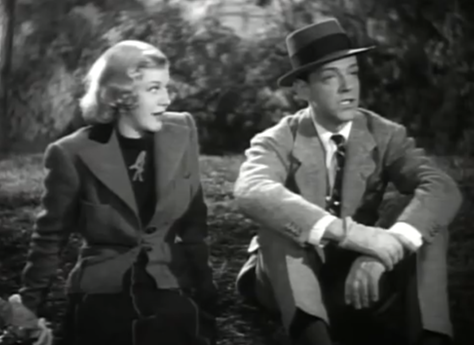
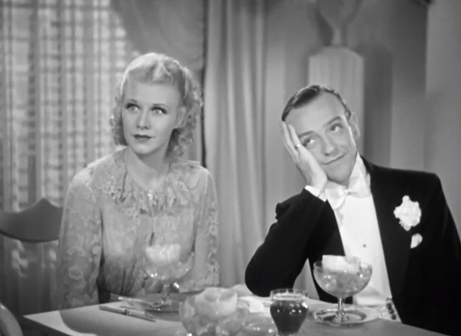
The name Gershwin is synonymous with “The American Songbook” and part of the draw of Shall We Dance is how it included two of them: both the brothers, George and Ira Gershwin. Ira would tragically pass away that same year. However, together they provided the compositions and lyrics for the film which, in some sense, feels like an atypical Astaire and Rogers vehicle.

While Mark Sandrich is in the director’s chair once more following The Gay Divorcee (1934), Top Hat (1935), and Follow The Fleet (1936), there are some unprecedented deviations from the normal foolproof formula. Namely, Astaire plays Peter P. Peters, an American who trades in his taps for a Russian ballet company. He’s certainly will always be a hoofer in most people’s eyes, and it does feel oddly out of character.

What hasn’t changed is his instant infatuation with Rogers, a famous tap dancer in her own right, named Linda Keane. But he must contrive some sort of gimmick and thusly takes up the persona of the touchy Russian dancer “Petrov” to antagonize her on the road toward love. Meanwhile, he tries his very best to evade the flirtations of his former dance partner Denise (Ketti Gallian) who looks to snatch him up.

Of the earliest offerings, Astaire gives us the treat of his cane dancing like he did in Top Hat and then there’s a fine boiler room number, “Slap that Bass” supported by a host of African-American performers thrumming with a healthy dose of character.

The film’s most catastrophic mix-up comes when the newspapers begin promoting a secret marriage between our two stars, thanks to a cockamamie story Peters cooked up on the spot to keep his former suitor at bay as he leaves on an ocean liner.

Petrov and Keane develop some chemistry dog walking together on the deck of the ship only for the gossip swirling about to reach a fever pitch. Astaire’s bumbling boss, Mr. Beard (Edward Everett Horton) uses it as the perfect chance to get rid of her for good. Meanwhile, Eric Blore as his ever-huffy hotel clerk tries his best to figure out the marital status of Petrov and Ms. Keane when preparing their rooms. They leave him ceaselessly befuddled.

Then, a second nefarious scandal is cooked up by Keane’s road manager (Jerome Cowan feeling out of place with the screwball elements), who does his best to kill the upcoming marriage his star has embarked on.  Thanks to some late-night photography and a mannequin bearing a striking resemblance to Linda, the news spreads like wildfire. What are his motives, you ask? He’s got his own reasons.

shall we dance 2

Not surprisingly, the closest thing we get to the Astaire and Rogers numbers of old are also the film’s finest entries, including the comic tune “They Laughed at Me” sung by Rogers before being joined in a routine by Astaire. After they sneak out to get away from the publicity hounds, “Let’s Call The Whole Thing Off” proves a handy follow-up number.

The extended sequence purportedly took a plethora of takes, upwards of 100, while the final fall into the grass left Fred and Ginger with black and blue backsides. They suffered and yet as the audience, we no doubt reap the benefits, especially because Shall We Dance hardly has their traditional big numbers like a Top Hat (1935) or Swing Time (1936) so seeing them on skates together is nearly consolation enough.

They show everyone by getting married, making it easy enough to get divorced so Linda can marry the man she’s meant to. Since their movies always took a page out of screwball comedies anyway, it makes sense this picture is another riff on the comedy of remarriage, which could be a sub-genre all its own.

Ultimately, two shows are merged in an instance of inspiration and yet that doesn’t mean that Petrov’s got the girl. An oddly disconcerting final number follows as Astaire dances with a host of gals all donning Ginger Roger’s face, disrupted by a shushing war instigated by our favorite misfits Blore and Horton. Though the picture could have used a feisty female like a Helen Broderick or Alice Brady, there’s also never enough of Blore and Horton to suit their faithful fans. They make every film a little more colorful, and it would hardly be an Astaire-Rogers picture without a stellar supporting cast of veteran jokesmiths.

Surveying Shall We Dance, it’s certainly not at the top of the pantheon of the movie musicals that these two icons made together, but it’s ripe with some of the usual delights in spite of a laborious plot and a different brand of dancing than we’re used to. It’s hard to complain too much about the results. There’s no doubt the entertainment value for true aficionados still remains.

3.5/5 Stars

The Gay Divorcee (1934): The Astaire & Rogers Foolproof Formula

the gay divorcee.png

The plots to the Astaire and Rogers musicals are usually deceptively simple. Thus, thanks be to their dancing transcending it all. The affair opens in some posh corner of Europe where the always dithering Edward Everett Horton is sitting with Fred Astaire who has to prove his identity to get out of paying a check. They’ve both conveniently misplaced their wallets. After a routine complete with pretty girls and dancing fingers, he gives an impromptu performance of his own bringing down the house and proving he really is world-renowned performer Guy Holden.

Later on, at the docks, a fellow American, arriving in England (Ginger Rogers), is meeting her lovably fatuous aunt (Alice Brady) only to have her dress accidentally caught in a travel trunk. The man who comes to her aid and subsequently rips her garment is, of course, Astaire. Being a gentleman and genuinely taken with her, he gives her his coat to cover up, but the damage has already been done. She finds him a bit bothersome. You can tell it instantly by every look of disdain she throws him. Meanwhile, he eats up any pretense to talk with her, though she dismisses his advances. It’s how the story always goes.

He turns his resolve to find the girl, matched with the everyday occurrence of getting dressed to go out on the town, into the number “Needle in a Haystack,” which has Astaire exuding his typical elan on taps. Of the millions of women around, he’s looking for one very particular needle, and he’s not above canvassing the streets, even if it’s an insurmountable task, made increasingly apparent through montage. It goes to all this trouble only to very coincidentally rear-end her as he’s rubbernecking (adding yet another reason for her not to like him much).

Meanwhile, Egbert (Horton) is looking to make his father proud of him in the family law firm, though he’s never seemed to have much gumption or stomach for the trade. His worst nightmare, Hortense (the same Alice Brady) comes back into his life also bringing with her the proposition of a case that just might be his opportunity to assert himself. Mimi, the same woman constantly harried by Holden, is looking to get out of a loveless marriage and so the inept lawyer suggests setting up a rendezvous with a professional gigolo to end the union for good.

He invites Guy along for the ride knowing the sunshine, gaiety, and girls might do him good as a distraction for his lovesickness. He needs to forget this girl he’s so taken with. However, they’ve failed to compare notes. It doesn’t take extra-sensory perception to read where the picture will go from here, in fact, there’s hardly a need to continue. The human mind might do a finer job in its vivid imagination to derive what complications will arise from such a premise.

It’s a pleasant surprise to see Edward Horton doing a little saucy jig, “K-nock K-nees,” which also proves an early showcase for 40s wartime superstar Betty Grable if you’re able to recognize her. Likewise, in the subsequent scenes, Eric Blore is delightful as ever, this time as a waiter with his typical crisp & snooty delivery, ably sparring with the comic foibles of Horton.

Fortuitously, he turns up in several more instances to serve up the tea things along with idle chatter to anyone who will lend an ear. Astaire and Rogers’s first number together is the Cole Porter standard “Night and Day,” only to birth further misunderstands thanks to one ironic code phrase, “Chance is the fool’s name for fate.” Don’t ask for an explanation.

“The Continental” is an impressively glossy number that until Gene Kelly conjured up his American in Paris (1951) dream sequence, clocked in as the industry’s longest continuous dance number. Some of it involves our leads, but not the whole thing. It feels much more like a Busby Berkeley extravaganza.

And yet right there you understand the exquisite nature of Astaire and Rogers because they made dancing into something intimate and personal. It was between two people as much as it was a lavish production number, and that’s what resonates with us even after the curtain falls and we’ve been wowed by the expansive nature of the staging.

Yes, the geologist husband finally makes his token appearance as expected and the hired romancer Tonetti (Erik Rhodes) continues to bumble along in an effort to play his raffish role. Of course, Astaire proves far more convincing in the part of the lover finally getting the girl as expected.

Does any of this matter? Hardly. But it’s one final opportunity to get Astaire, Rogers, Blore, Horton, and everyone else in a room together. That’s surely enough to recommend this frolicking trifle of gaiety starring everyone’s favorite couple on taps. There’s nothing better to lift your spirits than Astaire and Rogers.

4/5 Stars

A Christmas Carol (1938) and The Meaning of Humbug

achristmascarol1938In viewing the 1951 version of the Christmas classic, I took particular interest in the name of our protagonist Ebenezer Scrooge, attempting to redeem it for the masses. For this picture, I was curious in considering another integral term in our lexicon: Humbug.

The term is so ubiquitous and elicits such an explicit connotation, one surmises it loses much of its inherent meaning. What is humbug exactly? To put it simply: hypocrisy. And it’s telling coming from the lips of Scrooge.

It suggests, in his contorted world, he believes himself to be the only honest soul in Britain because he is not taken in by this pipe dream of Christmas. Of celebrating when you have nothing and giving when it probably won’t do any good anyway. He cannot understand how joyous his nephew manages to be, despite being no better than a pauper. In fact, Scrooge holds scorn for just about everyone.

There are actually some prominent revisions to the traditional story that generally succeed in adhering to the tone this picture is searching out. An opening connection is made between Scrooge’s merry nephew Fred and the Cratchit boys. They have quite a time of it sliding across the ice together — even crippled Tiny Tim — riding on the young man’s back.

Fred finally makes it to the offices of Scrooge and Marley paying his yuletide greetings to the jovial yet flighty Bob Cratchit (Gene Lockhart). Years in the service of Mr. Scrooge have taught him to always keep on his toes and never push the envelope. Because Scrooge is the sort of man who invests his money in such eminent institutions as the local prisons.

For him, charity is, again, humbug. Altruism is all a put-on to make people feel good and make the world out to be a nicer play than it is. Of course, he would never tell you that. The only way to get at this conclusion is by the most roundabout manner.

It’s true this version of A Christmas Carol works in swift, impressionistic strokes of the past. Before we know it, Scrooge has awoken at night and begins his fateful journey. The narrative zips along telling his story through the visitations of Jacob Marley (Leo G. Carol) and the three Christmas spirits. First, he’s being fetched from school by his ebullient little sister for Christmas away from his boarding school.

Then, he’s back at the old warehouse where he worked for the generous soul Fezziwig and first met his curmudgeonly partner Marley. The church chapel is full of the merry intonations of “O Come All Ye Faithful,” not to mention a few furtive slides on the ice by Fred and his lovely fiancee. Of course, there is the final vision as well featuring a world with Tiny Tim (the marker of wide-eyed innocence) dead and gone.

Because it never attempts to go into the gothic depths of despair (nor does it have ample time), there is not the same rapturous payoff, but then again it manages to be quite cheery from beginning to end. Cratchit loses his job only to go home to his family, arms stacked high with food and happy as ever. Why he even levels a snowball at his good master on accident, resulting in his dismissal.

Promoted from his minor spot, Scrooge’s nephew adds dollops of his own charm to the mix supplying a few good slides across the icy streets. All parties involved contribute to the holiday cheerfulness such that even Scrooge seems unable to douse the gaiety, although there is hardly enough screentime for him to manage the task.

When I was in middle school, I once saw the eminent Hal Landon Jr. in his own stage interpretation of Scrooge, his most famous feat being his somersault on the bed to put on his hat. Meanwhile, Alistair Sim manages to be giddy with delirious delight as the utter despair of Christmas Yet to Come is stripped away from him fortuitously. Upon hearing Lionel Barrymore was meant to star and performed the role countless times on the radio, I am even more curious to hear him. Thanks be we have Mr. Potter.

Reginald Owen is a sterling Scrooge in his own right, even a yuletide archetype of the old crusty miser. Though a respectable performance, it’s no doubt overshadowed by Sim’s, among others, for the simple fact it feels conventional. There’s little wrong with this and the 1938 version of A Christmas Carol is nothing if not sentimental and streamlined for annual holiday viewing with the whole family. There’s time yet for other entries to sink into the depths of woe in order to reach the zenith of Christmas cheer. The final word is to not live a humbug life. Christmas is meant for so much more. Where jaded cynicism is replaced with radical generosity and even child-like faith.

3.5/5 Stars

Beau Geste (1939): Brotherly Love in The French Legion

beau geste 1.png

“The love of a man for a woman waxes and wanes like the moon…but the love of brother for brother is steadfast as the stars, and endures like the word of the prophet.” ~ Arabian Proverb

No matter what Joseph Von Sternberg thought of such a proclamation, we can concede his Morrocco was a film concerned with the former. Von Sternberg’s dalliances with Marlene Dietrich behind the scenes and then Dietrich and Cooper in front of the camera are a living testament.

Beau Geste stakes its claim early to being a film of undying brotherly love. It brings to mind the words of scholar and author C.S. Lewis when talking about philia as a “side by side, shoulder to shoulder” appreciative love. It comes not by looking at each other but having a vision of something in front of us.

“Every step of the common journey tests his metal; and the tests are tests we fully understand because we are undergoing them ourselves. Hence, as rings true time after time, our reliance, our respect and our admiration blossom into an Appreciative love of a singularly robust and well-informed kind.”

I think this is a perfect illustration to begin to understand why Beau Geste is an initially compelling hero’s journey because it relies on a joint adventure to bring out expressions of deep-rooted love.

Admittedly, William A Wellman’s film is a close remake of the 1926 silent Ronald Colman vehicle. One element this film borrows from its predecessor are intertitles, and they’re too many of them for a talking picture.

But soon enough a cold open places us within the ranks of some French Legionnaires who come upon a fortress only to find the stronghold littered with the bodies of their comrades propped up against the walls. Something dreadful must have happened to them. For now, we get no more explanation as the story quickly fades back into the past, 15 years prior.

There we meet five children, three of them named Geste, one of them named Isobel, and the fifth a bespectacled killjoy named Augustus. You see, the others are still enraptured with adolescent imaginations that find them gallivanting around on the most glorious adventures as soldiers or possibly members of King Arthur’s court.

Their exploits are to be remembered with a Viking’s funeral with a dog lying at their feet. The beauty of their temperaments is the fact they hold on to a bit of their youthful exuberance when they grow into young men.

It always is a bit of a start when you jump from child actors to their corresponding adult selves. In the picture, I couldn’t quite make the jump seamlessly but no matter. All I know is I do have an appreciation for our leads — that is the three Geste brothers. They really are rather like the three Musketeers with Gary Cooper, Ray Milland, and Robert Preston making a jocund company.

Also, on a side note, this is too perturbing for me not to mention. I double-checked records multiple times and our three stars were born in 1901, 1907, and 1918 respectively. I’m still trying to figure out why Robert Preston hardly looks any younger than his costars or at least Milland. Maybe it’s his mustache. At any rate, age differences aside, the chemistry is present.

What is not present is the priceless jewel “The Blue Water” that was stolen one evening from the home of their adopted aunt Lady Patricia. The same evening Beau runs off to the Foreign Legion followed soon thereafter by Digby (Preston) and finally John (Milland) who gives one parting embrace to Isobel (Susan Hayward) before leaving on the grand adventure. Hayward is exquisitely beautiful and though her ingenue role is in no way groundbreaking, we have the solace of many meaty performances to come.

The film’s true standout is Brian Donlevy as an unscrupulous tyrant in charge of new recruits. He eventually finds himself commanding the entire outpost with the whole outfit threatening insubordination. His hunger for power verges on the deranged.

My expectations were more of the rip-roaring adventure variety but as the previous commander’s remarks on his deathbed, “Soldiers die as much from fevers as they do battles.” Meanwhile, Digby is unceremoniously pulled away from his brothers on a work detail and subsequently, misses out on most of the final act.

beau geste 2.png

I would say wholeheartedly the film is salvaged in its last push as we are granted the spectacle we have been waiting for as the remaining men hold down the fort against incoming marauders. It makes one nearly cry out “Remember The Alamo!” The sentiment is there anyway.

It seems a horrible thing to say, but Cooper affected me more when he was on the verge of death than when he was alive. The all but wordless finale plays particularly cryptically as Digby sneaks around the compound to carry out his oldest brother’s wishes.

I must admit to dismissing Beau Geste‘s storytelling prematurely as it evoked greater complexities than I would have expected. The mechanisms of the opening and overlapping moments are more intricate than I might have given them credit for. The mysterious words spoken once upon a time, while Beau was hiding in the suit of armor, come to fruition as do the opening moments, neatly folding back into the tale.

The reunion of John with Isobel and his Aunt arrives in the nick of time to satiate audience wish-fulfillment. It almost elevates the film wholeheartedly, but the pacing and where the story chooses to focus its efforts feel scattered. Had they come together more succinctly we might be hailing Beau Geste one of the great actioners.

While Gary Cooper in a foreign legion kepi is nonetheless iconic, I am apt to remember him more so for Morocco (even if that picture belonged to Dietrich). Although if one is sentimental enough to forgive the faults, it’s painless enough to say Beau Geste belongs to three devoted brothers. Coop, Milland, and Preston maintain a spirited solidarity throughout.

3.5/5 Stars

The Lives of Bengal Lancers (1935): Colonial Camaraderie Sullied by Hitler

the lives of a bengal lancer 1.png

In the imperialist traditions of the likes of Tarzan The Ape Man (1932), Gunga Din (1939) and even Lawrence of Arabia (1962) comes The Lives of Bengal Lancers. We cannot take the era or the colonial sentiments for granted like the contemporary viewer did since we must reconcile with the complicated filter hindsight lends.

It’s a bit like an old Cowboy and Indians picture except instead we have lancers and Indians. In theory, our allegiances lie solely with the dominant sides, and the rebels have our ire because revisionist filmmaking had yet to be created. This is the victor’s myth.

Director Henry Hathaway in later years would be remembered as a veteran of both crime pictures and classic John Wayne westerns including True Grit. The Lives of Bengal Lancers was his first formidable success, and the action and adventure itself are frankly quite thrilling.

Gary Cooper, as one of American’s dashing action heroes of the day, plays our protagonist MacGregor, a rough-edged soldier who nevertheless conceals the age-old heart of gold. A prime example comes when he makes up some excuse to send a new recruit to call on his father so they can talk in confidence. The boy has yet to see his flesh and blood face-to-face without constant rules and regulations getting between them.

Actually, we have two new recruits who come aboard: Forsythe (Franchot Tone) a glib sportsman who finds great relish in crossing wills with MacGregor and then dashing Lieutenant Stone (Richard Cromwell) still wet behind the ears. His father is the commander of the entire outpost. A journeyman soldier, “Old Ramrod” Stone (Guy Stander) is an incorrigible stickler for duty and discipline.

the lives of a bengal lancer 2

But the task at hand is the apprehending of a charismatic gunrunner and local outlaw Ahmad Khan (Douglass Dumbrille), who subsequently holds great power over the territory. The favored sport of “Pig Sticking” provides a handy cover for snooping around.

Most delightful of all is the one-upmanship fostered between our two manly specimens played by Cooper and Tone. The constant friendly competition between the blunt Canadian straight-arrow and the more polished and tempered “Blues Man” brought up in Britain is one of the film’s finer assets.

But of course, the inevitable happens and our heroes get captured by Khan. The famed line misstated on numerous occasions is actually, “We have ways to make men talk.” However, it feels anticlimactic considering.

It’s also difficult to decide if it’s to the film’s credit or not, but the villain, played by the white actor Douglas Dumbrille, is not trying to hide it. He is educated and resists playing up some savage image. He leaves that to all his underlings who do his every bidding.

While imprisoned, our heroes spend their idle time, outside of being tortured, playing at cockroach races and letting their stubble grow out. Once again, it represents the very best of the film instilled by the performances of Cooper and Tone opposite one other. Because everyone else we can easily see in any of these old adventure epics. It feels like standard stuff. They are not.

Certainly, the story teases out this issue between the duties of a soldier and the scruples of a man with inbred common decency. Should the family be sacrificed for the sake of the outfit? Is a man who has poured everything into his military career because he believes in regulation fit to be praised and venerated? The commander’s appreciative colleague (C. Aubrey Smith) lauds his actions acknowledging, “Love or death won’t get in the way of his duty.” Whether that is an entirely good thing remains to be seen.

Of course, we see analogous themes in even some of John Ford’s pictures like Fort Apache and specifically Rio Grande. The latter film has the same father-son dynamic playing out, except inside of conveniently killing off the spouse to streamline the conflict, that film actually digs into the themes more definitively. Anyone who has seen the film will agree Wayne and Maureen O’Hara’s relationship is the most interesting dynamic. A close second is the camaraderie of the soldiers.

In The Lives of Bengal Lancers, again, we have no such relationship, so the film is at its best with the soldiers sharing their lives together. One must note while the western might be dead, these old adventure yarns feel even more archaic. This brings up a host of other issues to parse through.

Watching the film unfold we cannot know for sure if we are on the right side of a righteous or unjust war; the underlying problem is the film does not leave it open. It’s already accepted who the conquers and heroes will be. I have nothing against the likes of Gary Cooper and Franchot Tone. I rather like them. But I can’t help but feel their team is playing a bit unfairly. The deck is stacked in their favor.

This ties into another notable caveat to make the viewer wary because Lives of a Bengal Lancer was purportedly a favorite of Hitler. In its digressions, he saw agreeable conclusions to inspire his own empire — the Third Reich — namely an unswerving duty to country along with elements of racial superiority.

Because it is these Brits with their bravery and know-how who are able to hold off the hordes of enemies. Their valor in itself is not an issue but placed up against their enemy, it is slightly troubling. The fact Hitler made it compulsory viewing to members of the SS is another level of bone-chilling. It’s hard to look at the picture in the same light after such a revelation.

3.5/5 Stars