The Accused (1949)

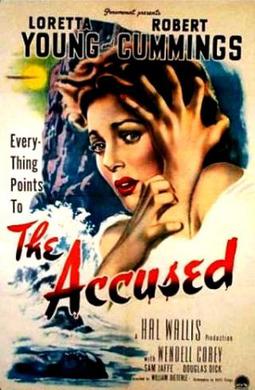
Loretta Young must own a pair of the most luminous eyes in the history of Hollywood, and in black and white, she’s incandescent. More important than that, she’s one of the great sympathetic heroines of Classic Hollywood. In The Accused, she plays both a woman in danger and a working professional. They don’t have to be mutually exclusive, and it makes for a far more nuanced character, especially for the post-war 40s.

Like poor Ida Lupino in Woman in Hiding, we meet her in the dead of night on the road. It’s evident she’s frantic and on the run from something. She gets picked up by a truck driver, though she’s not much for conversation, and he lets her off without much consequence.

A flashback introduces her pre-existing life as Dr. Wilma Tuttle, a professor of psychology at an unnamed university in L.A. It’s finals week as students take their exams and classes wind down.

We get an inkling of drama as we watch the wordless interaction between the fidgety teacher with a leering male student, mirroring her every move and, no doubt, turning in a Bluebook analyzing her own personal psychoses from biting on pencils to tugging on her hair. It’s a queasy relationship because, although she’s in a position of authority, she also seems helpless to do anything.

Douglas Dick does well as the slimy, if charismatic, co-ed who looks ready to entrap his teacher; he’s a kind of skeevy-eyed homme fatale playing teacher’s pet and coaxing his favorite instructor along — first offering her a ride home and then stopping by the seaside in Malibu.

Without using too much equivocation, it becomes a movie about assault and trauma, with the feminine victim becoming the accused, much like Anne Baxter in Blue Gardenia. There needn’t be a movie, but in the 1940s, she operates out of a position of fear in a predominantly male world.

Wilma’s internal monologue gets a bit oppressive, becoming a monotonous crutch, but the cavalcade of performers who come alongside Young are a worthwhile reason to stay the course. Robert Cummings and Wendell Corey aren’t showstoppers necessarily, and still, they have the prerequisite appeal to see them through the career of a reliable actor in Hollywood.

We meet lawyer Warren Ford (Cummings) and Lt. Ted Dorgan (Corey) together at Malibu police headquarters. The former was the boy’s guardian, and the policeman is investigating the case. After the boy’s body washed up on the beach, it was deemed an accident and no foul play.

No fingerprints were found in the car. Immediately, as an audience, we’re doing our mental calculations. Could this be, or is it merely a glaring plot hole? I’ll save you the trouble. Young was wearing gloves as a true lady does in the 1940s. Or else she wiped them…

The film’s asset comes with how it ties all of its primary relationships into twisted knots, all in the name of interpersonal tension. Warren has some personal connection with the deceased, but he quickly becomes enamored with the lady professor, and why wouldn’t he be? They effectively mix work and play, with Cummings being the smooth silk to Corey’s abrasive sandpaper approach.

In its latter half, The Accused becomes a Columbo episode from the inside out. We have our Hollywood star. There’s an opening prologue before the police get involved, and she falls in love. She also begins to feel trapped by what otherwise would be everyday occurrences as she tries to protect herself and cover her tracks.

One of her pupils is a primary suspect. She’s also requested to drop off the dead boy’s Bluebook, which might incriminate her. The truck driver who picked her up in the dead of night is called in as an eyewitness. Then, there’s the business of a missing note that she left for the dead boy and then misplaced. She must find and incinerate it.

Corey’s character is difficult to read. There’s something horrid about him, far worse than his incarnation in Rear Window, and yet he tries to play it off as an act or all part of the game he’s embroiled in on the daily as he does his job. It’s a bit of a curious surprise to see both Henry Travers and Sam Jaffe taking up positions in the police lab. There’s a rational inevitability about the work they do.

Wilma feels the heat, and a date at a boxing match brings out all her latent traumas to the surface again as she transposes the boxer in the ring with the boy she killed. In one sense, there needn’t be a movie because she is a victim, though she digs a bigger hole for herself.

Ultimately, the movie’s denouement is open-ended. The courtroom proceedings are just beginning, and her fate is far from settled, but as we stare into the dazzling eyes of Loretta Young, it’s easy enough to know she will beat the rap with a hedge of innocence around her.

If you dwell a little too much on the implications, the optics that Dorgan also observes might be a flaw in the justice system — if sympathetic appearances are taken as everything. However, in a movie about a woman who is assaulted and then plays the culprit out of fear, it’s at least par for the course.

There’s also a couple of oddities: Corey flirts with her in the courtroom, and Cummings is effectively defending her for killing his “nephew,” though they weren’t close. And still, Corey’s impish sense of humor and Cummings’s passionate orations for his beloved don’t change the bottom line.

This is Loretta Young’s movie, and even as she plays an intelligent woman often hassled and infantilized by the world around her, there’s something so winsome and generous about her performance. The noir elements burn off to make it a story of reclamation and vindication of a life. If you go digging, it does feel like a movie moderately ahead of its time, courtesy of screenwriter Ketti Fring and Young, respectively.

3.5/5 Stars

The Unsuspected (1947)

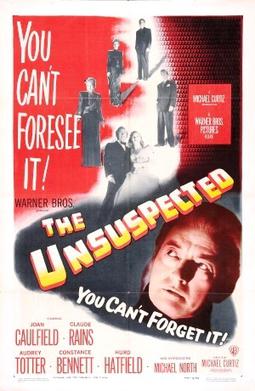
The Unsuspected has a delicious opening dripping with a foreboding chiaroscuro atmosphere. It’s the dead of night. There’s a woman on the telephone tucked away in a back room. The familiar face of Audrey Totter picks up on the other end of the line. She’s out enjoying herself at a club with some male company.

Someone emerges and descends on the flustered secretary. Moments later, she winds up hung from the ceiling — a grisly murder framed as suicide. For ’40s Hollywood, it doesn’t pull punches.

Since Totter is a consummate femme fatale, it’s easy to question what angle she could possibly have in this whole affair. We don’t have the answers, and so we must follow the rest of the film to find out; it’s a genuine pleasure to be afforded the opportunity.

If it’s not apparent already, we are in the hands of professionals with Warner Bros. stalwart Michael Curtiz directing a screenplay by Ranald MacDougall and the director’s wife, Bess Meredyth.

The film is dressed up nicely for a bit of noirish drama with the added benefit of the shadowy, gothic interiors when the story moves to the abode of one Victor Grandison (Claude Rain), a revered radio mystery performer who is reeling after the death of his secretary and the loss of his beloved niece who perished recently at sea.

Rains is an actor with such poise and regality, but building off his turn in Notorious, he plays another complicated figure. It’s a role worthy of his talents, and he anchors a packed menagerie of the usual suspects.

Totter as the sultry Althea always seems to take vindictive pleasure in playing the venomous harlot, and she’s just about one of the best from the era. With her arched eyebrows and intense eyes, she reflects the perfect epitome of an opportunistic, venomous vamp. Though it’s possible she only looks the part. Other people are willing to stoop to murder.

Her inebriated wet noodle of a husband (Hurd Hatfield) feels like a non-entity in comparison, and that’s precisely the point. Fred Clark always has a shifty authority about him, and he’s a close associate of Grandison. Over time, we realize he’s actually the local police detective, a handy man to have as a friend…

The ubiquitous Classic Hollywood heavy Jack Lambert is introduced in one lingering shot, looking out the window of some dive hotel window. What could he have to do with all of this? It’s difficult to implicate him immediately, but we know he’s waiting there for something.

Constance Bennett might just be the finest addition to the cast. She was the wit and experience like Eve Arden a la Mildred Pierce, both beautiful and able to trade banter and wisecracks with just about anyone. She lends a sense of levity to a movie that might otherwise feel oppressively dour. In some ways, she lives above the fray of everyone else, providing a kind of narrative escape valve for the audience.

If you think you already have a line on The Unsuspected, it’s a joy to mention it’s a movie full of perplexing wrinkles. A mysterious stranger (Michael North) shows up on their doorstep unannounced like a specter, and he asks to see Grandison. His next claim is even more outlandish: This young man, Steven Howard, was secretly married to Grandison’s niece Matilda.

Then, a dead person is resurrected like an apparition. Joan Caulfield’s character suffers from a cruel lapse in memory. What happened to her? I should have noted it sooner, but she has the aura like Gene Tierney in Laura, down to the portrait.

Like that picture, it’s a movie spent deciphering people’s motives; it feels like everyone is keeping secrets and no one wants to tell. Is it a case of elaborate gaslighting? It’s not unthinkable in the noir worlds of the 1940s, and Caufield is a ready victim, so sweet and innocent.

What are we to think? Who can we trust? In taxicabs, we find conspirators of a different kind — those trying to ascertain the truth behind a suicide. Because they know there is more than meets the eye.

Matilda returns to her home, lighting it up with the glow of her virginal white countenance in the dark recesses of the family mansion. It feels like oil and water. She does not belong there, but the story is still unresolved. There are several skin-crawling moments as Matilda is subjected to danger with a touch of Hitchcock’s Suspicion (1941). Something’s not quite right, but perhaps her mind is playing tricks…We know she’s not crazy.

It might be low-hanging fruit, but the crucial nature of the antagonist makes the film feel like an early precursor to the Columbo series. Although we don’t know everything right away, eventually the audience is given the keys to the murder, and we must sit back in earnest to watch how they play out, from botched murders to car chases with the police toward the city dump.

I’m also intrigued by the trappings offered by murder mystery radio programs, and though they are used in other films like Abbott and Costello’s Who Done It?, to my knowledge, they aren’t as prevalent in Classical Hollywood as one might imagine.

There’s a delightful meta-quality with Grandison narrating plotlines that played out in the story around him, adding another perturbing layer for the filmmakers to play with. It feels especially fitting here, thanks to Rains’s mellifluous voice and the continued prevalence of mystery and true crime stories to this day. It seems like we still can’t get enough of them over 75 years later. The Unsuspected represents the best of Warner Bros. and the mystery genre, wrapped up in a movie that rarely gets talked about.

4/5 Stars

The Chase (1946)

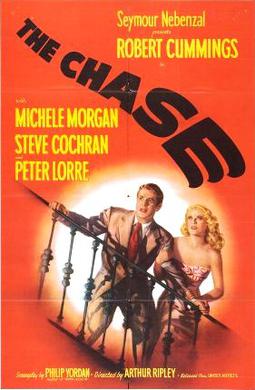
The Chase opens as a wonderful contrivance of noir done up in a couple of successive visuals. A bedraggled man (Robert Cummings) stares through a shop window at a griddle laden with fresh bacon and hot cakes. He leans in so his hat brim mashes up against the glass, and proceeds to cinch up his belt. He doesn’t have any dough.

Then, he looks down right at that precise moment and notices a wallet at his feet stacked with cash. Any person in the real world would have seen it immediately, but it’s set up perfectly for the camera. He proceeds to treat himself to breakfast and a cigar, and after he has a full belly, he decides to pay a visit to the address inside the wallet.

You get a sense of the milieu with a mention of a standoffish Peter Lorre staring through a peephole and questioning what the stranger wants. Our hero is unwittingly cryptic, saying he wants to see one Eddie Roman — he has something to give him…

It could be a belly full of lead or something more innocuous, and, of course, it’s the latter. They give him the once over and reluctantly let him in. The room’s stacked high with statues and ornate antiquities; somehow, they make the interiors feel not just capacious but hollow.

Who lies down the corridors is anyone’s guess because this isn’t where ordinary folks dwell, only cinematic creations. Sure enough, the ex-Navy man Chuck Scott has just happened to fall in with a psychotic lunatic (Steve Cochran). We’re introduced to his temperament when he gives his manicurist a slap for screwing up and sends her simpering out the front door.

Still, he’s impressed by Chuck: An honest guy shows up on his doorstep, and he even tells him he treated himself to breakfast for a dollar and a half (those were the days!). For being such a standout guy, he repays him with a gig as his chauffeur. When you’re destitute, you don’t bite the hand that feeds you.

There’s an uneasy tension in everything Cochran and Lorre, his right-hand man, have their hands in. The controlling Eddie is married to a young lady (Michèle Morgan) named Lorna; he’s hardly allowed her out of the house in 3 years. It says so much about their relationship.

The sadistic slant of the movie becomes increasingly apparent as they stick a different dinner guest in the wine seller to be ripped apart by Eddie’s prized pooch. He has something they want for their business dealings, and any semblance of hospitality burns off as his bubbly conversationalism quickly turns into despair.

For a time, The Chase becomes a kind of contained chamber piece drama. It’s not obvious if it will break out and be something more as Chuck forms an uneasy existence between the backseat driving of his new boss and the despondency of Lorna, who stares out at the crashing waves of the ocean, all but bent on presaging Kim Novak in Vertigo by jumping in and ending it all.

Lorna and her newfound advocate book two tickets to Havana and are prepared to skip out together. Even these scenes evoke a foreboding mood more than anything more concrete because there’s only a vague sense of plot or purpose. From here, it builds into this debilitating sense of obscured conspiracy in the bowels of Havana.

There are obdurate carriage drivers, slinking foreigners, and cloak-and-dagger antics that find his woman harmed and Chuck fleeing from the authorities. The surreal tones of the story just continue to proliferate with novel characters and new environs materializing rather than moving systematically from one scene to the next.

This inherent sense of surreal atmosphere might place the picture ahead of its time, with a select few films of the era. However, it comes off as rather stultifying after auspicious beginnings because it doesn’t accomplish what many of the great Classical Hollywood films managed by telling compelling three-act stories with a sense of economy.

The underlying perplexing tension set against a dreamscape, siphoned from Cornell Woolrich’s source material, is not enough for The Chase to fully pay off on the goods. It feels more like an intriguing experiment than a successful crime drama.

3/5 Stars

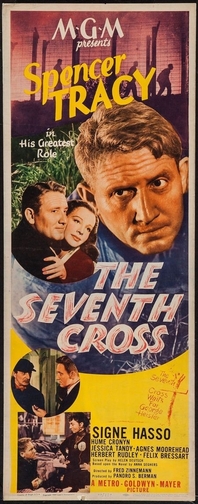
The Seventh Cross (1944)

Fred Zinnemann had one of his first Hollywood successes with the daring Seventh Cross. Since he was Austrian and lost family to the concentration camps, the personal nature of the material is unquestionable. He takes the novel by fellow Austrian emigre Anna Seghers and packs the story full with a wealth of European emigre actors and a few choice Americans as well. What it delivers is a stirring testament to humanity and the joining together of grit and determination in the face of oppressive evil.

I actually don’t mind Spencer Tracy playing the lead in the picture because it has the Hollywood bent of the studio system. Like casting James Stewart as a Hungarian in The Shop Around The Corner, there’s a collective understanding that Tracy’s attributes, as a kind of grounded everyman, are what matter most. It helps make this very specific and personal story a universal story for all men to see themselves in.

He is one of seven prisoners who make a nighttime escape from a Nazi concentration camp. As they all break off from one another and go their separate ways, we know the goal is the active pursuit of survival in a malevolent world. There’s nothing more fundamental, and we walk alongside George Heisler as he searches out any old friends and his former flame, who might be able to help him in his dire need.

Meanwhile, all the other prisoners are mercilessly rounded up and hung up on the crosses erected by the camp commandant; they are meant to be a warning sign to anyone else, but everyone knows the inherent metaphor. They are martyrs to the cause like the thief hung next to Christ. There is hope that they will one day see paradise.

The story utilizes a dead man’s voiceover before Billy Wilder took the device for Sunset Blvd. Here it feels a bit more like a crutch to distill Anna Seghers novel down; he lives as a ghostly subconscious entreating Heisler to remember the address 46 Morganstrasse…

At its best, the movie becomes a lyrical pilgrimage for this character as he’s privy to the kindness, passivity, and utter heartlessness of common people, each in turn. Because at your lowest, when you have nowhere to go and you rely solely on the good graces of others, this is where their true nature becomes evident.

I can see Classic Hollywood films, taking on Nazism, being derided in a modern context for going too soft, especially if you have a preconceived notion of what they might be. Certainly, these artists didn’t know every atrocity that had been perpetrated, but they were not stuck with their heads in the ground. In many cases, they knew far better than the general American public.

There’s immense consequence to everything within the frame, and Zinnemmann brings many searing evils to the screen, both seen and unseen. The aforementioned cross imagery is bleak iconography borrowed from Seghers. There are little boys with Nazi armbands rumbling around town to try and tattle and find fugitives.

One of the runaways, a formerly famed trapeze artist, must flee across the rooftops as locals gawk at the show and the Nazis hunt him down like cornered game. He takes one final curtain call after being mortally wounded and leaps forward in total serenity. It’s his final performance with his last breath. Heisler watches the scene, and before catching the ending, he disappears around the corner grimly.

His former flame Leni (Kaaren Verne) vowed to wait for him, but now she’s married and terrified to see him. The fear in her eyes manifests itself in brusque accusations. He has nothing but fondness for her; he’s requesting food and accommodation, and she will give him nothing. He stuffs a few crusts of bread in his pocket and disappears, feeling totally betrayed.

There’s another particularly unnerving scene. As the dragnet closes around George, he gets a tip about a doctor who might be sympathetic and can bandage him up for a wound. He pays a call on the man. Dr. Lowenstein (Steven Geray) states in accordance with the law that he must tell his patients before working on them that he is Jewish.

There might be other contemporary cinematic depictions of the Nuremberg laws or other anti-Jewish legislation like this, but the mundanity of this institutionalized prejudice is like ice in the veins. It’s right there in the open and in the face of this, the doctor still chooses to do an act of good.

Our hero is graced by another generous soul when he’s put up in a Hofbrau on his perilous road to freedom. By now, his name and likeness are all over the papers; Toni (Signe Hasso) the barmaid, could turn him, and yet she doesn’t. They share the kind of solitary love story that exists suspended in movies or those real-life moments where there is no time to stop and think before two ships pass on in the night.

George Macready even gets one of his first opportunities to play a conflicted, if ultimately sympathetic man caught in the crosshairs of the war and his own personal comforts. It takes all kinds for the sake of the cause.

Hume Cronyn shows up over halfway into the movie, and he is our respite. Paul Roeder might have the first genuine smile in the entire film with his domestic life alongside his wife, Liesel (Jessica Tandy), being a refuge from the hopeless world at large. He treats George well, symbolizing the growing tide toward human decency.

What he also represents is another viewpoint. The movie has the right to paint the Nazis as villains, and yet it does present a German character like Paul, who has been mostly shielded from the horrors.

What he sees is the economic prosperity and the help he’s received as he goes about providing for his wife and caring for his kids. The government has done good by him, and this is what he holds onto. George must help him see the other side and bet on the human proclivity toward good, even if we must forgive how easily Paul gets away from SS interrogation.

For being a film with so much grief and oppression — even if it’s fashioned on a Hollywood backlot — the movie does ring even more resolutely with this affirmation of human dignity. Instead of labeling it mere naivety, I prefer to see the optimism as represented by Paul and the little people.

Felix Bressart has the briefest cameo as the local delicatessen owner who brings George sustenance for the long journey ahead. Like his Shylock speech in To Be or Not To Be, he comes to signify the entire picture with his resolute encouragement. He doesn’t know the man, and yet he extends this generous hand; he’s just one of the faithful worker ants who will not let goodness die. Together, they can overcome.

What the film does well is distill these sentiments into individual human interactions we get to observe and imbibe as an audience. So although we are not completely inured to the state of the world, we are not blinded to it either, like Paul.

In 1944, there was still much of the war to be fought and won. Thus, The Seventh Cross does feel like a daring picture and one with immeasurable worth. I’m not sure if it was appreciated in its day, but looking back on it, there is much to admire in its incisive self-awareness.

3.5/5 Stars

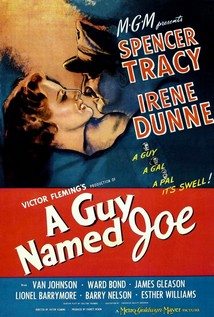
A Guy Named Joe (1943)

Although I would probably choose 30 Seconds Over Tokyo, a movie also penned by Dalton Trumbo and featuring Spencer Tracy and Van Johnson, there are numerous reasons to search out A Guy Named Joe.

This was Van Johnson’s first starring role, allowing him to craft a stage presence that would only become more self-assured with time. It nearly got derailed by a gruesome car accident that purportedly left him with a plate in his forehead. And yet out of this came one of the most popular young stars of his day.

Also, Irene Dunne, one of the often unsung comediennes and finest dramatic actresses of the 30s and 40s, gets the opportunity to show her stuff opposite Tracy. I will never miss an opportunity to see her because she’s easy to rate next to other luminaries like Katharine Hepburn and Barbara Stanwyck.

Some well-informed viewers might also be aware that Steven Spielberg transposed the action to the 1980s with his light remake, Always, starring Richard Dreyfuss, Holly Hunter, and a cameo by Audrey Hepburn. It’s easy to surmise the later film misses out on the historical context, making A Guy Named Joe about something immediate.

Pete Sandidge (Tracy) is your stereotypical loose cannon, hotshot who’s always receiving the ire of his superior (James Gleason). Nevertheless, the two of them maintain a playful game of cat and mouse because deep down, they both know they’re invested in the same cause.

Pete’s also reunited with his effervescent girlfriend, the alliterative Dorinda Durston (Dunne). She also flies planes, albeit not in combat. All the lovey-dovey grousing and such isn’t new, but between Tracy and Dunne with Ward Bond as the third wheel, it’s inherently watchable. They channel a love-hate relationship: getting sore at each other and making up in a passionate reverie.

Tracy and Dunne aren’t normally associated, and yet watching them together is an immeasurable pleasure because they have a grand capacity for bits of sly humor and shared humanity, elevating the material above mediocre fare.

The movie also boasts some impressive and truly immersive aerial sequences as Pete leads his men on one of their perilous bombing raids against the enemy. This latest mission also signals a shift in the story; a fatal crash occurs, and Pete’s last gasp of heroism means he’s good and dead.

He’ll spend the rest of the movie as a guardian angel, though he’s more like a ghost. So A Guy Named Joe quickly shifts from a purely WWII picture to another film in the cinematic angel canon (It should come as no surprise that producer Everett Riskin also worked on Here Comes Mr. Jordan).

Pete walks through the clouds of the afterlife not with a harp but a decidedly more militaristic objective. There’s a pointed weightiness in casting by making Lionel Barrymore the CO of the heavenly realms. He passes down to the newly deceased his marching orders: He will be serving as an unseen co-pilot to some new recruits.

Again, the movie shifts to focus on Don DeFore and Van Johnson as two problem flyers still wet behind the ears. Johnson plays a wealthy, if diffident, young man named Ted Randall who can barely keep his plane airborne. Tracy shudders at the future of the war in the hands of such callow talent, but he tries to get them up to speed anyway, albeit subconsciously.

These sequences are rather mundane because, unlike other stories in the angel canon, Tracy’s connection to the real world is very thin compared to Claude Rains, Cary Grant, or even Henry Travers in It’s a Wonderful Life.

The movie picks up again when Van Johnson is on the ground and progressing in confidence. We see an early pairing of Johnson and a nearly unrecognizable Esther Williams, perhaps because she’s not robed in Technicolor and a swimsuit. They share a dance, and he extends an act of kindness to a homesick soldier.

Tracy is forced into being an observer in the physical sense, and somehow, the passivity doesn’t suit him. It’s good for a few gags and dress downs of former friends and colleagues who can’t hear him, but it becomes a bit of a gimmick.

And after waving a movie about Tracy and Dunne in front of us, it tries its best to stitch together something between Dunne and Johnson that just feels a bit disjointed and forced.

Still, A Guy Named Joe has these compartmentalized moments of human connection, laughter, and tears, making it more than worthwhile. You get the sense of the war years, the transience that these young men and women felt on so many accounts. Be it the death of friends and comrades, or even the distance of loved ones so far away. Everything spells heightened emotions.

To its credit, I never thought I would see a movie with Irene Dunne breaking ranks to fly a bombing raid solo and drop a payload on a Japanese target. There’s something both ludicrous and oddly progressive about it, never mind how it seems to muddle the collectivist themes the movie seems to be aiming for.

However, the fact that there can be no catharsis for Tracy and his lost love might be a final lesson about the war years. It is a dream and a desire that cannot be fulfilled. In its wake, Johnson and Dunne must chase after each other instead in a swelling romantic ending without any earthly consequences as Spence disappears into the distance. It’s a pale imitation, but it will have to do.

3/5 Stars

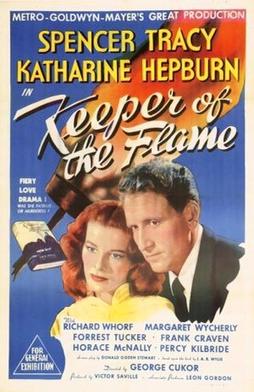
Keeper of The Flame (1942)

Keeper of The Flame strikes me as good ol’ fashioned Hollywood storytelling. It’s conveyed through a fatal opening car crash and a flashing montage of newspapers spelling the death of that great American institution, Robert Forrest. We’re hooked immediately as the story keeps on rolling.

The world itself in the formerly sleepy town has the definitive consciousness of Home Front America, full of interiors and then exterior-looking interiors, all on the studio lot. Moreover, there’s a frantic industry and a general chaos in the face of shortages, bringing out American know-how and good humor in the face of everyday adversity.

Namely, a bevy of journalists and well-wishers descending on the place not fit to handle such an overflow, especially during wartime. A harried Donald Meek monitors the telephone line and does his best to get the flood of people in front of him booked in any vacant rooms still available.

Steven O’Malley (Spencer Tracy) wanders in unannounced and mostly unseen. He pays respects to an old friend who barely recognizes him. It’s the eyes. He gives Janey (Audrey Christie) that quiet congenial Spencer Tracy look, and she asks quizzically if it hurt much when Hitler gave him the boot.

We glean he must have been a war correspondent, either based in a concentration camp or the Berlin press bureau. Their jokes are casual. You know they must do this in their line of work and in 1942, we can hazard a guess they don’t know the full extent of what they’re saying.

Christie has the whip smart repartee of a journalistic working woman a la Rosalind Russell. Since the house is packed, she coyly registers him as her “husband,” though there’s another colleague up for her affections (a young Stephen McNally).

O’Malley has an aspiration to get into the grieving Mrs. Forrest so he might share her husband’s story with the people. Riffing off of It Happened One Night, his pals quip that she’s the Queen of Jericho and he’s no Joshua. The walls of her castle won’t come down for just anybody. Though Tracy always had a certain dogged tenacity about him, and that’s what makes him a compelling, active hero.

Algonquin Round Table alum Donald Ogden Stewart builds out his screenplay in the opening act with all these intriguing nooks and crannies and characters who seem capable of existing of their own accord with intricate backstories.

Howard Da Silva is a guarded vet of the Argonne and de facto groundskeeper of the Forrest estate. A little boy (Darryl Hickman) grieving the wake of this great man from a lamppost; we learn he too has an intimate connection to the deceased.

There’s another relation to Mrs. Forrest who’s equally distrustful of the press and drinks his sorrows away with ginger ale. The dead man’s bespectacled press secretary (Richard Whorf) chooses a different approach: He’s highly elegiac and accommodating because his job requires levels of PR, though there’s plenty he’s not letting on about.

Beyond Christie, a personal favorite is the peculiar old cabbie (Percy Kilbride), laconic and chewing his cud while offering up homespun wisdom. He provides O’Malley transportation to and fro as the journalist pokes around for his story.

We know from a fair distance Keeper of The Flame is a kind of grade-A American propaganda piece, and it finally becomes most explicit when Tracy gives a little soft-spoken speech to Daryll Hickman about not letting the unseen enemy make them slaves and kick them around by putting chains on their minds and tongues.

In its defense, it’s mostly soft-pedaled moralizing because Tracy’s soapbox is small and he has a way of making the serum of slightly hokey words tolerable thanks to his usual candor.

However, the local doctor (Frank Craven) provides one of the most telling remarks after paying a house call to the imposing estate: “Ever since we’ve been falling out of touch with God, we’ve become pushovers for hero fever.” When he speaks of a young woman who was sent away, he surmises,  “You don’t fall in love with a god, you just worship him.” He’s a sympathetic fellow and in making his opinion of Forrest quite clear, it’s one of the first dubious signs we have to go on.

These ideas are thematically rich with potential, not to mention controversy. The movie becomes less so with the tinges of forested and thunderous gothic melodrama. Coincidentally, it’s not material I would immediately attribute to George Cukor although the 1940s were replete with such fare.

And it’s true there is a vague Citizen Kane-like bend to the story of a prominent man now dead. Although I also think of Welles’s other great figurehead Harry Lime for casting a shadow over the film, which is not too dissimilar to Hitchcock’s Rebecca, albeit gender swapped. These are mostly uncharitable comparisons and few can argue the point.

Katharine Hepburn might seem uncharacteristic in something so grim and restrained, but she proves her capacity for it. While I always am skeptical of her as a shy wallflower in a picture like Undercurrent, she handles this tormented role with a certain inscrutability. Although I don’t know if even she can manage keeping the story from getting out of hand.

There’s something in it on the tip of my tongue tying into almost John Fordesque mythmaking, whether it be Fort Apache or The Man Who Shot Liberty Valance. Sometimes you print the legend to protect people because the truth is too destructive to reveal. Except Tracy isn’t squeamish about giving the electorate a sober reality check.

In this regard, it feels like a daring sort of picture and you wonder if this was the saving grace, making it a draw for audiences beyond the conspicuous nature of the romance and brooding genre elements.

Still, the initial propaganda moments burn off only to come back like a raging conflagration. Hepburn brings them back again and she drops them right in our laps when she mentions fascism as embodied by her late husband. In one sense, it’s an impressive rallying cry and also an utter disappointment given the film’s best parts.

The finale of literal fire and water is all things histrionic and ham-fisted. Hardly the film’s finest achievement. All of this comes with a convenient ending, but I suppose in wartime you give the people what they want — assuming this was it.

Even with the underlying sentiment, Keeper of The Flame still has its moments that feel downright groundbreaking, and better yet, the wit of the supporting characters lives on in the mind’s eye. Alas, this was not meant to be.

Most of all, I regretted characters like Audrey Christie and Percy Kilbride fading away without consideration; I suppose they were sacrificed on the altar of a greater cause. I understand the sentiment and still, it feels like a waste of a stellar set-up for such conventional ends — even if it was for the sake of galvanizing wartime propaganda.

Perhaps this is all the more reason to want more out of the film. This is a good impulse because it means there are more than a few things worthy of praise.

I’ve only one final thought. In many ways the movie presages what Jacqueline Kennedy chose to do in the wake of her husband’s tragic death. More than once in the movie, an allusion is made to Abraham Lincoln, and Jackie made sure her husband had a funeral evoking that of the nation’s first slain president.

Then, at his final resting place in Arlington Cemetery, there burns an eternal flame. She was the keeper of that flame — solidifying his stature for generations of Americans. I won’t get into conjecture about her husband’s legacy, but it does play as an intriguing counterpoint to this film’s central figure.

3.5/5 Stars

Berlin Express (1948)

Added to the landscape of The Third Man, Germany Year Zero, and A Foreign Affair, Berlin Express is a fascinating portrait in the rubble-film genre. These are the pictures on the cutting edge of filmic history, shooting on-location in the post-war world that was still licking its wounds and putting the pieces back together across France, Germany, and really any other place that was directly affected.

Although we see the IG Farben Building — famously Eisenhower’s command post after the end of the war — it’s the bombed-out world surrounding it that proves the most telling. Even as the newsreel narration feels overbearing after a certain point (it doesn’t have the wry verve of Carol Reed), we’re getting to see elements of the world as it was at that precise moment. Jacques Tourneur is at his best with evocative canvasses to work against, and the post-war landscape certainly fits the bill.

It is a different take on The Third Man milieu. You get the seedy, grungy impoverished nature of the world, tramping around the train station where men fall to the ground for a dropped cigarette while peddling any miserable trinket they possibly can.

But the drama also considers the zones of the newly divided Germany by calling up characters of each rank and nationality. They are all very overtly represented and implicated in this story.

It commences with a train loaded with passengers of all different nationalities who make for a convenient focal point for our story because they come to represent the Allies looking to consolidate power and pave the way for the Cold War in a decaying imperialistic society.

One can’t help but think of archetypal train tales like Christie’s Murder on The Orient Express or Hitchcock’s The Lady Vanishes. However, the movie shares more in common with The Narrow Margin than some may realize. Even Charles McGraw, who would play the protagonist in the later Richard Fleischer B picture fills a part in this one.

Here he’s helping to smuggle a very crucial German leader (Paul Lukas) across the country to help the reunification efforts. The remnants of the Nazis would love to get their hands on him or do away with him for good. They are the film’s primary evil — lurking in the negative space — until they are finally forced to show their hand.

Merle Oberon calls on the sense of camaraderie from each Allied faction to help her find the missing doctor because it’s true that despite the best-laid plans, betrayal is imminent. He is far from safe. They group off to search in all the local back alleys and hellholes.

At this point, Robert Ryan seizes his chance because he’s taken an immediate shining to the French girl Lucienne (not to be confused with the film’s cinematographer Lucien Ballard). It’s amazing to acknowledge approximately 49 minutes into the picture Oberon and Ryan finally get together in what feels like a more traditional Hollywood dynamic with the headliner stars linked romantically. Until this point, however, it’s very much (and very purposefully) a picture by committee.

Ryan for his part is fairly straight-laced and likable, Oberon is principled, and the other blokes add their own touches of good humor or contrarian perspectives. It never feels like a consistent drama and there are whole patches of dialogue broadcasting its intentions too readily. Of course, this has been the cardinal sin of screenwriting since the dawn of time. Closely connected to the storytelling commandment passed down from Billy Wilder: Thou shalt not bore.

But when Tourneur is able to take moments and work them out through dynamic visual means, we get something wholly worthwhile. Even as it’s not always superb storytelling, watching Robert Ryan punch it out in a vat of beer in an abandoned brewery, cloaked in the shadows of noir, is the movie at its very best.

Close behind is when a wounded clown incognito totters onto the stage to uproarious laughter only to topple right on top of the camera as the investigating military police are left to pick up the pieces.

In such moments, it doesn’t matter where it happens or what it means so much as how it is executed for our benefit. We feel the impact. Or later on the train, with a traitor in their ranks, a violent act is perpetrated and implausibly reflected out a train window. Whether it makes total sense, the core of the action is relayed to the audience in such an ingenious fashion.

Then, the movie wraps up with more wry, slightly disdainful commentary about the bombed-out ruins of Berlin as if it’s a sightseeing tour. It runs in tandem with many of the more staged moments promoting a lasting message of goodwill. Alas, it was not to be.

So while the film can never get out of the shadow of propaganda or cast off its noble intentions, for viewers interested in something more timeless, Berlin Express has a handful of genuinely gripping moments belying any bouts of heavy-handedness. It’s relatively easy to latch onto the good and tolerate the rest.

3.5/5 Stars

George Sanders: The Picture of Dorian Gray, The Ghost and Mrs. Muir, Ivanhoe

We’ve been doing a rather casual retrospective on the films of George Sanders and as part of the series, we thought it would be fitting to highlight three more of his performances. They run the gamut of literary adaptations, fantasy romances, and medieval yarns. Sanders remains his incorrigible self through them all, and we wouldn’t have him any other way.

Picture of Dorian Gray (1945)

“Lead us not into temptation, forgive us our sins, wash away our iniquities”

Whether you say he cornered the market or simply got pigeonholed, George Sanders could always be called upon to play snooty Brits bubbling with wry wit and aristocracy. His Lord Henry Wotton is certainly wanton — an incorrigible influence on many a man — and his latest acquaintance becomes Dorian Gray.

Hurd Hatfield is the picture of handsome youthfulness, dark and aloof, though his piano playing leaves much to be desired.  His reputation must precede him and perhaps an actor with greater gravitas could have done more with the part. Hatfield feels generally inert and uninteresting. Over time, it’s hard to confuse his distance with inscrutable mystery.

The primary object of his desire begins with Angela Lansbury, an entrancing tavern singer with an equally gorgeous voice to go with it. Lansbury and then Donna Reed (his second flame) both deserved better, at least in their romantic lead if not the roles they were given.

It’s a quite loquacious film thanks in part to Sanders, who always has a cynical word for every situation and thus lays the groundwork for Dorian’s total immersion into hedonism.

The movie must work in mood and tone because there isn’t much in the realm of intemperate drama, and for some reason I found myself crying out for something more substantive than elliptical filmmaking. Whether it was merely to assuage the production codes or not, so much takes place outside the frame, which can be done artfully, and yet the distance doesn’t always help here.

The impartial narrator discloses Gray’s internal psychology to the audience as he’s perplexed by his evolving portrait — the lips now more prominently cruel than before. The ideas are intriguing in novel form in the hands of Oscar Wilde. Here it’s all rather tepid and not overtly cinematic watching a man traipse around his home tormented by his own inner demons.

It’s easy to contrast them, for their exploration of warring psyches and the duality of man’s morality, but this is not Jekyll and Hyde. However, on a fundamental level, I must consider my own criticisms because this is a story about pride, narcissism, and the selfish roots of evil in the human heart. They can be unnerving as we consider the portrait that might be staring back at us.

I find it a drolling, monotone movie other than the inserted shots of color that shock us into some knee-jerk reaction. It’s made obvious there’s a moral leprosy eating away at Dorian and the ending showcases much the same, doing just enough to hammer home the core themes of the story in a rousing fashion. Though your sins be as scarlet, I will wash them white as snow. It’s possible for the portrait to be remedied, though not without consequence.

3.5/5 Stars

The Ghost and Mrs. Muir (1947)

“Haunted. How perfectly fascinating!”

If you don’t love Gene Tierney before The Ghost and Mrs. Muir, surely you must adore her afterward. She’s totally her own person; strong but not unpleasant thanks to her ever-congenial manner. She has immaculate poise and knows precisely what she wants.

Even in her mourner’s outfit in honor of her late husband, she has a regality drawn about her, vowing to leave his family and take her daughter (Natalie Wood) and their housekeeper Martha (Edna Best) to carve out a life of their own.

The film has a score from Bernard Herrmann post-Citizen Kane and pre-Vertigo that’s warm, majestic, jaunty, and frantic all at the precise moment to counterpoint Joseph L. Mankiewicz’s rather peculiar take on a romance film.

I realized an appeal for the picture I had never considered before. I find old haunted house movies, aside from those played for comedic effect, mostly overwrought and uninteresting. And yet even this early on in the lineage, The Ghost and Mrs. Muir effectively subverts the expected conventions.

Instead of merely being frightened off by the specters in an old seaside haunt of a deceased sea captain (Rex Harrison), it becomes her pet project. She’s intent on making it her home because she’s an obstinate woman — a descriptor she takes as the highest of compliments.

It’s pleasant how their immediate distaste and ill-will soften into something vaguely like friendship (and affection). They take on a literary voyage of their own as she helps transcribe his memoirs and vows to get them published for him.

George Sanders — always the opportunistic ladies’ man — shows up with his brand of leering, if generally good-natured impudence. In this case, he’s living a double life under the beloved pen name of Children’s book author Uncle Neddy. If his introduction seems sudden, its purposes quickly become evident. He is a real man of flesh and blood. It only seems right that Mrs. Muir makes a life for herself with him…

It’s curious how both men evaporate around the same time: one out of sacrifice, seeing her happy in reality, and not wanting to complicate her life more. The other’s gone because, well, he’s a cad. For those fond of Rex Harrison, it’s rather a shame he is absent from much of the picture, but this is by design because it is his very absence — this perceptible passage of time developed within the movie — that allows for such a meaningful conclusion.

It’s what the entire film builds to and between the rapturous scoring of Hermann and the simple but efficient special effects, it allows them to walk out together arm in arm as they were always meant to be. If they are apparitions, then at the very least they are together again no longer separated by chemistry, mortality, or anything else. These themes have been melded together innumerable times before but rarely have they coalesced so agreeably.

4/5 Stars

Ivanhoe (1952)

As a child, Sir Walter Scott’s Ivanhoe always lived in the shadow of Robin Hood. The same might be said of this movie and The Merry Adventures of Robin Hood from years prior. By now Ivanhoe is both a feared and beloved mountebank and although late-period Robert Taylor is a bit old for the part and removed from his matinee idol days, it’s easy enough to dismiss.

Taylor and Errol Flynn were both heartthrobs around the same time. Now a generation later he looks a little weathered and threadbare for his tunic though he proves stout-hearted enough. Joan Fontaine also effectively replaces her own sister as the guiltless romantic interest.

However, there are some other intriguing elements I would have not expected of the film. It becomes a fairly robust dialogue on anti-Semitism and the relationship between the Jews and the Gentiles. We always think of British history or this particular period as a war merely between the Saxons and the Normans. Here we are met with a bit more complication.

Ivanhoe must play the rebel in the absence of his beloved King Richard, but he is also called upon to be a friend to the downtrodden even those of a different religious faith. In the moments where he’s called upon, he’s an unadulterated hero, and it’s all good fun watching him bowl over his rival knights like a row of five bowling pins. However, this is pretty much expected. It gets far better when he’s faced with mortal wounds in the wake of a duel (with George Sanders of all people).

Both Elizabeth Taylor and Joan Fontaine stand by ready to dote over him. The ambush by the Normans sets up a rousing finale every lad dreams about. Because my old friend Robin of Locksley comes to their aid prepared to lay siege to the enemy’s castle. Meanwhile, Ivanhoe leads a rebellion on the inside, freeing his friends and stoking a fire to smoke them out into the open.

Watching the choreographed craziness full of arrows and swords, shields, and utter chaos, I couldn’t help relishing the moment because we feel the magnitude of it all being done up for our own amusement. And it is a blast. Regardless, of the romantic outcomes, it’s a fairly satiating treat; I do miss the age of Medieval potboilers.

3.5/5 Stars

This Land is Mine (1943): Renoir, Laughton, and O’Hara Take on The Nazis

This Land in Mine initiates itself as a memorial to WWI. We see a statue with a crouching soldier. It’s inscribed with the following message: “In memory of those who died to bring peace to the world.” In the foreground, the Nazi juggernaut rolls into town. Peace did not last thanks to Hitler’s voracious appetite for “Lebensraum.”

The juxtaposition is key, and it says everything Renoir wants us to know without putting words to it. A newspaper is strewn on the ground with a very prominent headline featuring Hitler’s latest invasion. We’re seeing it firsthand.

There is only the very beginning, and it suggests something elegant about Renoir’s critique of the Nazis. In his case, it doesn’t come in the guise of a thriller like we might see with Fritz Lang or Hitchcock — this fit their own proclivities and doubled as pulse-pounding entertainment.

For Renoir, the story is a drama of a different sort. The local school is run by only a handful of teachers who must do their best to keep the school of rowdy adolescents afloat even with so many outside distractions. Suddenly Plato’s Republic and Voltaire’s writings are deemed dangerous by the new administration.

The school’s beloved Professor Sorrel (Philip Merivale) muses what the Nazis have before them is a delicate operation — cutting out the heart without killing the patient. Put in such terms, it sounds tenuous at best if not doomed to fail. Something must give way and perish.

The movie’s not about force or sheer strength, but the resoluteness and free reign of ideas. Because this is what brings people together and allows them to think for themselves about the true tenants of good and evil.

The two primary teachers are the middle-aged, ever-reticent Albert Lorry (Charles Laughton), who still lives with his mother, and the fiery soon-to-be-engaged Louise Martin (Maureen O’Hara). They are tasked with “correcting” their textbooks, though Ms. Martin’s act of passive rebellion is to hold on to the miscreant pages for the day they can be pasted back in. If all this sounds harrowing and positively medieval, stinking of Fahrenheit 451, that’s because it does.

Still, we live in a modern society of self-censoring. Not of ourselves mind you, but we like to cut out all the pages of the culture and the world with ideas we don’t find palatable or don’t summarily agree with. It’s so much easier to insulate ourselves with things that are innocuous and inoffensive from our own tribe. Then, as a result, we’re left with an ill-fated and potentially disastrous conception of the world.

This is partially what allows tyrants to take over and also what allows bipartisanism to poison people, since they never see the human being sitting across from them. Does it say something that I often feel less proud of my country than ever before? It’s not so much for the historical sins, because I’ve always known them to be there, but it’s for what feels like our current failures. And not just our failures but the persistent callousness and cynicism pervading our world.

Walter Slezak was always a fine performer in a bevy of roles as diverse as they come. Here his Nazi is in the mold of military efficiency; he’s totally pragmatic — just trying to do his duty and get by. He knows from experience he wants no sabotage and no martyrs. Because this churns up emotions and will blow up like a powder keg.

Later, he preaches how the children of today are the soldiers of tomorrow. No one knows that better than the Nazis with their Hitler youth regimen and indoctrination. But with that, you have the muddied center that a man like George Sanders train station manager must contend with. He lacks the idealism of the academics, namely, his fiancee O’Hara, the principled young woman who gathers the children together to sing rousing songs in the air raid shelter while the Allied bombs fall overhead.

You have this rowdy boy’s hall out of Mr. Chips set against the backdrop of an occupied city during wartime. It makes for a strange marriage but not an inauthentic one. Because, as we’ve already suggested, it’s another crucial battleground for the hearts and minds of the next generation. These are life-altering battles to be fought on their behalf, and it’s not solely with guns and bombs.

Since it has not been mentioned already, This Land is Mine is an unofficial reunion of The Hunchback of Notre Dame and not just the same players. It’s an extension of this same sweet but painful romance as reflected by the bashful Laughton. He has feelings for his young colleague — they care for one another — but she is with another.

Mrs. Lory (Una O’Connor) is a demonstrative lady, with deep-seated opinions, but her maternal love knows no bounds, and it’s phenomenal to watch in action. Her son is imprisoned, no fault of his own. In a world of daily paranoia, he’s one of 10 innocents imprisoned in recompense for two German soldiers murdered in the streets by a saboteur. It’s a debilitating moral dilemma for those who know the perpetrator intimately. After all, it is one life weighed against ten others.

It occurs to me that the man who made Le Grande Illusion could not sell his characters short in time of war. The generation changed and brought with it a new enemy — and we’ve toiled with history to make Hitler and his ilk a different kind of evil — but that almost makes it too easy. We can keep them at arm’s length with a clear conscience.

George Sanders says something telling as he commiserates with the town’s mayor. They are both in undesirable positions of power where they either compromise with the powers that be or fall under fiercer tyranny. Their acquiescing is deemed to be spineless. Sanders retorts:

“It’s easy for people in free countries to call us names, but you wait to see how they behave when the Germans march in. They’ll shake hands. Make the best of it.” A lesser film would have made them mere stooges and collaborators. I made the mistake of believing this was all they were. However, although the moral gradient is quite nuanced, it doesn’t mean Renoir doesn’t have a clear preference.

It comes in the form of Albert, a seemingly diffident man who nevertheless evolves when challenges are thrust upon him. Laughton has every opportunity to save himself quite easily, and yet he resolves to stand for an idea with his fallen friends.

When Laughton gets on the stand and talks about the Nazis’ assault on working-class people, making them into slaves pitted against a middle-class afraid of chaos and disorder, it’s very plainly Renoir’s point of view aided by scribe Dudley Nichols. Truth under any form cannot be allowed to live under the occupation. This is what Laughton stands up for because it is far too precious to go down without a fight.

There’s a lot of rousing defiance in the final act, good for stirring up the patriots, but what did it for me was Laughton’s exit. He gets his kiss and is unceremoniously shoved out of his classroom. But he’s a new man pushing the guards away, hands in pockets, perfectly at peace with the moment. His newfound courage is evident to all.

After watching the film, I had to ask myself the question: If this land is mine — the land I call home — why don’t I start acting like it? It’s so easy to cast aspersions on others and quite another thing to take personal responsibility.

4/5 Stars

Swamp Water (1941): Jean Renoir in Okefenokee

A place with a name like Okefenokee feels immanently American and this is an inherently American story though expatriate Jean Renoir feels sympathetic to these types of folks. He wasn’t a working-class filmmaker but in movies from his home country like Toni or La Bete Humaine, you see his concern for people in this station of life. They work in the fields, on the trains, making a good honest living, and sometimes their existence gets disrupted.

Granted, it’s early in his career trajectory, but it flabbergasted me that Dana Andrews is billed fourth. His Ben Ragan is our most obvious protagonist as an obdurate young man aiming to get his lost bloodhound back from the nearby quagmire of Okefenokee swamp, a cesspool of gators and crosses mounted with skulls. Worse still, it’s said to be the hiding place of wanted mankiller: Tom Keefer (Walter Brennan).

Ben’s father is an ornery old cuss named Thursday (Walter Huston), who remarried a younger woman. She’s a sign that he can be an affectionate man; he just has a difficult time showing it to his son.

Given these origins in a real place, I’m thoroughly intrigued by the world especially because it wasn’t completely fabricated on a studio backlot but was shot on location. This level of mimesis blends actors we know from all the Classic Hollywood projects with something that lends itself to greater authenticity. It’s not stark realism, but it adds a layer of tangible reality to the picture aside from some unfortunate back projections.

When Ben goes in search of “Old Trouble,” he sounds his horn like the Israelites marching around Jericho. Instead, he finds Walter Brennan who comes off like a fugitive mountain man with almost shamanistic qualities. Nothing can bring him down; not even a cottonmouth. But he also carries the film’s core dilemma with his fate. The town wants to string him up for killing a man; he pleads his own innocence, and Ben must for the time being keep his secret.

Swamp Water doesn’t get much press and The Southerner is usually touted as Renoir’s best American offering, but the link between the two pictures seems increasingly evident. The film has some of the same pleasant surprises. Some people are a whole lot better than you think they are and some are a whole lot worse.

The mercantile where Ben sells his furs is full of a gang of actors you relish seeing in these old Hollywood productions. Their prevalence is only surpassed by their instant recognizable character types. I’m talking about the Ward Bonds, Eugene Palletes, and Guinn ‘Big Boy’ Williams.

Whether John Ford got it from Renoir or Renoir got it from Ford, they both seem to have this enchanting preoccupation with dance even if it’s merely on a subconscious level. With The Grapes of Wrath and Swamp Water or The Southerner and Wagon Master we see firsthand how these communal events engender personal connections between the masses.

Except in a small outpost like this, they also bring all the local feuds and all sources of gossip to the surface. Ben’s flirtatious beau (Virginia Gilmore), comes off a bit like a blonde Jane Greer, albeit with a lightweight spitefulness. In contrast, Anne Baxter owns a curious role as a near-mute social pariah thanks to the notoriety of her fugitive father.

Rebuffed by his own girl, Ben vows to bring the ostracized (Baxter), now gussied up and quite presentable, to the gathering. It’s a bustling dance floor of dosey-does which is just as easily replaced by fisticuffs. It doesn’t help that Mr. Ragan is intent on searching out the man who accosted his wife, and he’s not squeamish about making a scene.

But beyond this, the Ford and Renoir connection can be seen in the stable of actors shared between Ford’s usual company and this 20th Century Production. It’s easy to say most of this falls to coincidence. This might be true, but in men like Walter Brennan, Ward Bond, and John Carradine, there’s something intangible we might attribute to the characters at the forefront of both these directors’ works.

When I look at these faces, they do not look the part of movie stars, but they are iconic faces like Jean Gabin or even John Wayne. They can carry the weight of drama, and yet when you look at them, it seems like they’ve already been through drama enough in life. And so when we watch them, we appreciate their struggles and every wrinkle and whisker on their face. Because it’s these things that put them on our level as an audience. They are our fellow human beings.

If the legend holds, I can’t understand how Daryl Zanuck wouldn’t let John Ford remake Le Grand Illusion for fear he would ruin it, and then Zanuck turned right around and meddled in Renoir’s picture. It’s something I would like to learn more about, although it’s possible only the unspoken annals of history can tell us now.

What we have as a mud-caked monument is Swamp Water: A vastly interesting curio imbued with the fractured imprint of Jean Renoir. It proves you don’t have to be born in America to tell a profoundly American story. I’m not surprised Renoir was a naturalized citizen by 1946. If his cinema is any indication, we would gladly consider him one of our brethren because movies know no bounds.

4/5 Stars