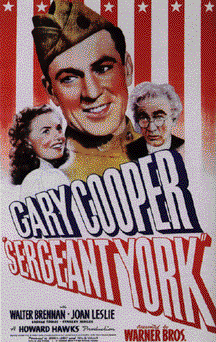
Sergeant York (1941)

Starring a wonderful cast including Gary Cooper, Walter Brennan, and Joan Leslie with director Howard Hawks, this is a feel-good film. Alvin C. York (Cooper) lives in a small town in Tennessee where he works hard but also drinks a lot. Over time however he becomes a devout Christian and falls for a girl named Gracie (Leslie). He is hoping to get married and own a piece of bottom farm land. World War I begins and after a great conflict inside of himself, Alvin decides to go fight. While there he proves his valor, helping to capture 132 German soldiers almost single-handed.  He returns home a great hero and is reunited with his family and Gracie. Despite being a great war picture, this is also a very nice biography of a simple yet religious man who tried to live his life to the best of his abilities.

4/5 Stars

The Philadelphia Story (1940)

Headlined by Katharine Hepburn, Cary Grant, and Jimmy Stewart, The Philadelphia Story  tells a comical tale of a divorced socialite who is about to be remarried. Tracy Lord is an arrogant socialite who divorced her equally fiery husband C.K. Dexter Haven. Now it is the day before her wedding to another man. However, Haven returns and brings a long two magazine reporters to get a scoop they were forced into. After a lavish party and many drinks the reporter (Stewart) and Tracy Lord find themselves spending an inebriated night talking and swimming. Haven manipulates the situation and the future husband Kittridge, who catches the tail end, believes something bad is happening. The next morning the wedding is in jeopardy and Hepburn and Stewart are oblivious. Although nothing happened, Lord agrees to terminate the wedding and Mike (Stewart) tries to save her embarrassment by proposing marriage. However, she realizes it is not meant to be and goes to Haven while Mike returns to the camera woman who loves him. It all ends well but the joke is still on them in the end. This romantic comedy has a lot of star power and it is actually pretty good.

4.5/5 Stars

His Girl Friday (1940)

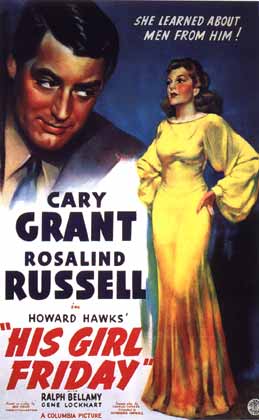
30c9f-his_girl_friday_posterStarring Cary Grant and Rosalind Russell with direction by Howard Hawks, this film’s rapid and overlapping dialogue helps make it a witty comedy romance. Walter Burns (Grant) is a newspaper editor who was formally married to Hildy Johnson (Russell). However, now they are no longer together and she is on the verge of marrying another man (Ralph Bellamy). Grant still loves her and tries all the tricks he knows in order to get her back. Soon the two of them are deeply involved in a story having to do with a man who is soon to be hung. As they work to get the scoop, the two of them slowly begin to realize they still love each other despite their differences. Finally, Russell rejects a normal life with her new fiancee and she and Grant unite once again. A directing legend, Hawks has another success with the screwball comedy. Grant and Russell play well off each other and they have a good supporting cast behind them.

This film is a sensory overload with words whizzing by so fast that you hardly have time to catch them. But what you do pick up is great and the overlapping, rapid fire dialogue is delivered so effectively by the entire cast, including Grant and Russell. Russell takes on the persona of the independent career woman prevalent in the late 30s and early 40s. As such she knows how to trade blows with the boys in the newsroom and she delivers a spirited performance to counter Grant’s constant conniving and tricks in his sly attempt to win her back. Aside from the main stars, the film has a brilliant set of stock characters and the dialogue is such that it seems like it would be a joy to read the script. There is the self-referential humor to Ralph Bellamy, then to a Mock Turtle as well as Archie Leach. The first is Grant’s role in Alice in Wonderland and the second is his real name. The film even has time to deal a few jabs to Hitler, Communists, and most especially the newspaper industry. All in all His Girl Friday is a comedic whirlwind but it is a pretty good piece of mayhem.

4.5/5 Stars

The Ghost and Mrs. Muir (1947)

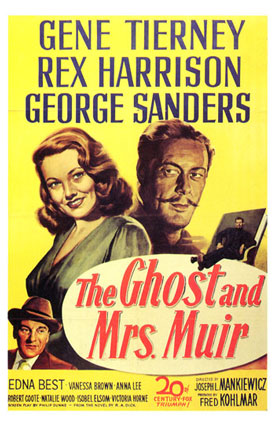
f5ab0-the-ghost-and-mrs-muir-postersStarring Gene Tierney, Rex Harrison, and George Sanders, the film is about a widowed mother who moves with her daughter to a supposedly haunted house. She and the ghost have some altercations but she will not be intimidated and she has fallen in love with the unique home. Soon Mrs. Muir and the Ghost bond as he dictates his life story for her book. However, once it is done, they realize the problems with their relationship. Mrs. Muir falls for a human man and when it gets serious Michael decides to leave her life, causing her not to remember him. Soon the years pass and the unmarried Mrs. Muir is getting older with her daughter growing up. Finally Mrs. Muir passes away peacefully and now she is reunited with the one she forgot and they can be happy for eternity. This is a very nice film and Tierney and Harrison are both wonderful in their roles. Although the plot is simple it is unique and enjoyable all the same.

4/5 Stars

The Razor’s Edge (1946)

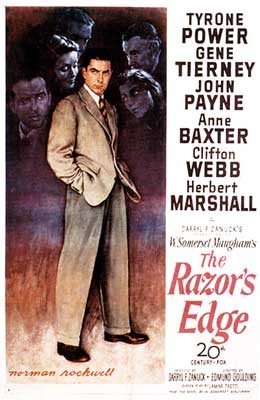
06cc8-razors_edgeAdapted from the novel by Somerset Maugham, this drama films stars Tyrone Power, Gene Tierney, John Payne, Anne Baxter, Clifton Webb, and Herbert Marshall. The film opens after WW I with an air force vet who is engaged to a young socialite. They are in love and yet he wants to discover the meaning of life before he settles down. She reluctantly lets him go to Paris while she remains in the states. While Larry lives in Paris and travels to the Himalayas their childhood friend Sophie gets in a car accident which kills her husband and baby. Isabel had tried one last time to win Larry back but with that not working she decides to marry the affluent Grey instead. Soon we learn that Grey lost everything in the Crash and he had a nervous breakdown. In Paris Maugham meets his old acquaintances and Larry helps Grey with his problem. They then encounter a drunken Sophie in a Parisian night club. Larry also helps her and decides to marry her. Isabel will have none of it and she leads Sophie back into alcoholism only for us to find out later that she was murdered later on. With Elliot on his deathbed Larry also does him a favor and afterward he correctly ascertains that Isabel led Sophie to drink. He moves on content and she can only be consoled by Maugham. Some interesting questions were brought up but it doesn’t seem that Larry figured everything out completely.

4/5 Stars

Laura (1944) – Film-Noir

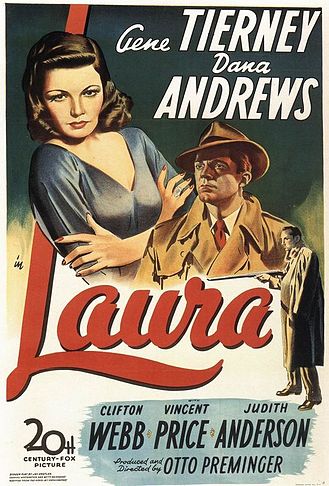
fb137-laura23234If you have never seen Laura, I would first advise you to watch it and then look at my review afterwards. I do not usually do this but with Laura I think you should watch it beforehand. Enjoy!

*Contains Spoilers

Directed by Otto Preminger and starring Dana Andrews, Gene Tierney, Clifton Webb, Vincent Price, along with Judith Anderson, this is a great film-noir. With its voiceover narration, flashback, close-ups, shadowy atmosphere, plot twists, and hard-boiled detective, Laura is intriguing. From the beginning, this recently murdered woman who has a portrait on the wall, fascinates us. We follow the detective (Andrews) as he questions the columnist who helped make Laura succesful (Clift), and the playboy she was going to marry (Price). Soon Andrews finds himself also falling for this woman. However, everything changes when Laura reappears with seemingly no knowledge of any murder. After this development Andrews tries even harder to get at the truth with much difficulty. On a hunch he seems to crack the case however Laura is still in danger. In the final climax all is right again with the conflict over Laura.

5/5 Stars

Review: Casablanca (1942)

It was over 70 years ago that Casablanca hit the silver screen for the first time. All the main players are dead and gone now. The Golden Age of Hollywood, where pictures were being churned out with factory-like efficiency, has given way to a modern era of blockbusters. To borrow a quote from the movie, it doesn’t seem that one little film would “amount to a hill of beans” in our present world. Still, somehow Casablanca is beloved to this day, despite the numerous other films that have undoubtedly entered the black hole of film oblivion. It seemingly will not die and for good reason.

Considered one of the greatest films of all time, this well-loved classic deserves to be here. It is the hallmark of Humphrey Bogart and Ingrid Bergman’s careers. It also has one of the greatest scripts of all time, and it has achieved legendary status over the years. Many consider it purely the best film ever made and in all honesty, I would never try to refute that.

The film opens quickly and we are immersed in a world that is at the height of the Nazi terror, and many people are fleeing Europe by way of Casablanca. It is a treacherous place full of pickpockets, corrupt authorities, refugees, and naive tourists as well. Two German couriers have been murdered and some invaluable letters of transit have been stolen. That’s when we are first introduced to Rick’s Café Americain and its cynical proprietor Rick Blaine (Bogart).

A shady fellow named Ugarte (Peter Lorre) comes to Rick with the letters and asks Blaine to keep them for him. However, later that night Ugarte is taken into custody, and things begin to get even more complicated. Wanted resistance leader Victor Laszlo (Paul Henreid) is now in Casablanca, however, a Major Strasser has arrived from Germany to take him in. To top it off, Laszlo’s wife Ilsa (Bergman) was Blaine’s old flame in Paris and, needless to say, it didn’t end well.

Laszlo desperately needs the letters of transit to escape, and he inquires about them. Soon he is led to Blaine, but as Rick often admits he sticks his neck out for nobody. Knowing all too well that he is in danger, Laszlo still shows his defiance against his enemies by leading the people in a round of “La Marseillaise” and as a result, Rick’s is shut down.

All the memories of Paris begin flooding back, and then Ilsa confronts Rick in order to get the letters. This is possibly the most critical point in the film because this tense altercation ultimately renews the relationship between Rick and Ilsa. Rick asks her to trust him, and he begins to take things into his own hands. The results of his actions created one of the great romantic and cinematic moments in the history of film. The whole film leading up to this point hints at it, but Rick truly is a sentimentalist at heart. He can live with the notion that they will always have Paris and that leads him to commit a selfless act of love.

This film holds such a tremendous presence in movie history, and upon seeing the movie it makes complete sense what all the hype is about. What more could you want than Bogey, Bergman, Casablanca, and some of the greatest quotes ever uttered? Do not forget the corrupt, but nevertheless lovable French Captain Louis (Claude Rains), who delivers some terribly witty lines. Honestly, he may be my favorite character in the whole film, and that’s saying a lot!  Then, of course, there is the immortal tune of “As Time Goes By,” sung by Dooley Wilson which will forever be ingrained in film lore.

However, you also gain an appreciation for the other interesting characters of Casablanca, some comical, some sympathetic, and others despicable. We have a rogue gallery of everybody under the sun from Peter Lorre, Sidney Greenstreet, German soldiers, various guests, and all the staff at Rick’s Place. This movie has conflict and the uncertainty of war in practically every scene because at the time World War II was in full force. There are a broken romance and a forlorn hero who shows his courage in the end. As an audience, we come to realize the transformation of Rick into a truly great man. Ilsa on her part has the most radiant face I have ever seen.

It is wonderful that Casablanca succeeds as entertainment despite the fact that it is not modern. In fact, part of its charm is the black-and-white cinematography that helps make Rick’s Café so atmospheric. It effectively makes each interior shot moodi34 and every romantic scene even more striking. I am very doubtful that they would ever be able to pull this film off in color. It just wouldn’t work.

You do not need explosions and violence either, only great characters and a story with both drama and humor to reel the audience in. Up until the final moments of the movie you are captivated the entire time. Then, fittingly, you are left with the two men walking off into the night with the words, “Louis, I think this is the beginning of a beautiful friendship.”

In fact, with this film, my thoughts always go back to the script. Lines like “Here’s looking at you kid,” “We’ll always have Paris,” and “Round up the usual suspects” are so rampant that you cannot possibly remember them all, and I doubt there will ever be another film that is so immersed in American cultural lexicon. Still, many of my favorite lines in the film are those that get overshadowed by the more famous ones. That is the sign of an amazing film that never grows old. Even those who have not seen this classic film like to think they have, because the influence of Casablanca reaches everywhere. I guess I’m rather an idealist myself, so I would like to think that even if 70 more years pass, we’ll always have Casablanca.

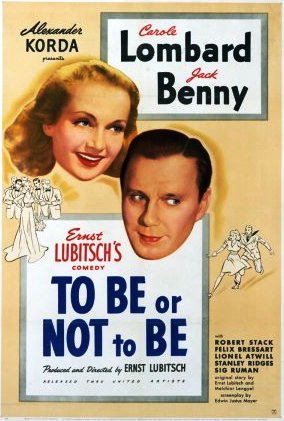
To Be or Not to Be (1942)

Starring Jack Benny and Carole Lombard with director Ernst Lubitsch, the film follows a group of actors in Poland during the outbreak of World War II. All too soon their act seems to be in jeopardy and they must put on the most important performance of their lives. Benny and Lombard are a husband and wife acting duo, who with the help of their troupe must stop a spy from giving damaging information to the Nazis. With the help of their acting and disguises, they are able to pull off the monumental task. This satire is so extraordinary because it made fun of the Nazis and found humor in that subject at the same time their villainy was occurring. Benny certainly seems out of place in Poland and he is not much when it comes to performing Hamlet, but I suppose that’s part of his charm. He is so vain and suspicious of his wife and yet he ends up a hero.

When I first saw this film I expected major laughs and it really does not have that, at least not in the way that Chaplin lampooned Hitler in the Great Dictator. Here Lubitsch weaves a somewhat darker story and yet it causes us to smile because of this Polish acting troupe that embodies the words of Shakespeare that “All the world’s a stage.” He meant it to be metaphorical but they take it to heart and their acting turns into reality. The bit player Greenberg goes as far as reciting the Jewish part of Shylock from the Merchant of Venice and it ultimately saves their lives. As such the film often switches back in forth from stage to actuality and pretty soon it is hard to separate them. The the plight of these people was close to Lubitsch, but he also was adept at the romantic comedy. Thus, despite the constant bickering and the trials faced by Joseph and Maria Tura, we cannot help but laugh at their love story. To Be or Not to Be is not your everyday comedy, but instead it occupies its own unique niche. Hopefully no one walks out on it!

4/5 Stars

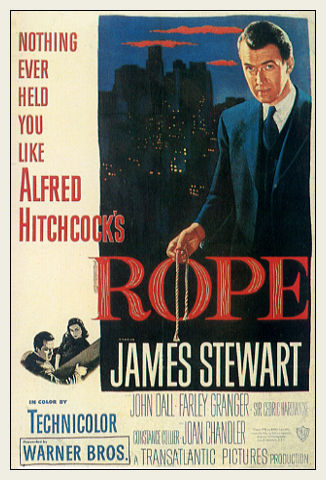
Rope (1948) – Alfred Hitchcock

eeca4-rope2What is the perfect murder? Hitchcock seemingly toys with this question in Rope . Starring Jimmy Stewart, Farley Granger, and John Dall, the latter two are students who murder their peer from university. Their only reason for doing it however is to see if they can get away with the crime. To complete their little experiment, they invite the boy’s family, his girlfriend, and other guests over to dinner, right in the room where they committed the murder. As an after though they invite their former professor (Stewart) who is the only one who would be able to catch them. At first Stewart does not suspect anything but eventually he becomes suspicious without letting on. Finally, the students lose their cool and Stewart catches them red-handed. This quickly puts an end to the perfect crime. This film is interesting because it was made to look like it was shot on one reel. Hitchcock’s movies are often known for the editing and yet this film was shot almost like a play in very long takes.

4/5 Stars

Spellbound (1945) – Alfred Hitchcock

Directed by Alfred Hitchcock and starring Gregory Peck and Ingrid Bergman, the film follows the complicated story of an intelligent lady doctor skilled in psychoanalysis. Bergman’s character is very focused on her work and often withdrawn. That soon changes when she meets the new doctor (Peck) whom she falls for. However, soon Bergman realizes he is not the real doctor and further uncovers his state of amnesia used to forget his past. Trying to keep him out of the hands of the police, she takes Peck to her former colleague and they try to delve into his dreams. When Bergman finally seems to have all the answers unexpected complications arise. Now she must save her patient and lover before it is too late. Hitchcock’s directing, a great score, collaboration with Salvidor Dali, and good acting make this film worth seeing. Michael Chekhov is certainly good for a laugh or two as well.

4/5 Stars