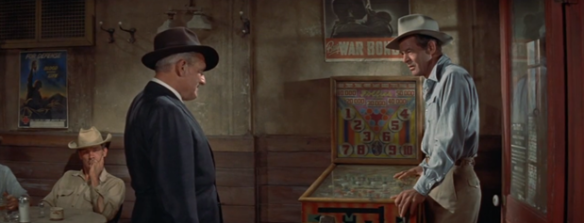
Human Desire (1954): Fritz Lang vs. Jean Renoir

human desire 3.png

Edgar Buchanan always annoyed me endlessly on Green Acres reruns, and it’s affected me for a long time. Because only recently have I begun to realize just how broad and robust his body of film work is. He can be categorized with a breed of movie actor that is generally lost in today’s industry.

These were studio workhorses with filmographies so abundant it almost becomes second nature for them to don certain roles. It happens so easily and with such regularity, there’s rarely a need for explanation. It’s all right there in the character and the countless other pictures he’s popped up in before. His part is small but it doesn’t matter.

Because he is the kind of actor only Hollywood of a certain era would have utilized to his full potential. Why does any of this relate to the discussion of this film? My best explanation is the fact Human Desire is not a standalone entry. It comes from a lineage boasting Emile Zola and Jean Renoir’s Le Bete Humaine. And yet Human Desire can be viewed as nothing less than noir cranked out of the salt mines of Hollywood.

The traditions of Michel Carne and Jean Renoir, themselves in the late 30s, coalesced with the early works of Fritz Lang, like M (1931), to form a sturdy foundation to this American iteration of crime cinema. There’s no doubt Lang and Renoir were aware of each other. An obvious point of reference is the fact Lang would adapt La Chienne into a film of his own — Scarlet Street.

Human Desire is his second go at the eminent Frenchman’s filmography, albeit less to his liking. Lang’s railroad imagery isn’t quite on par with the evocative ever smoky grittiness of Renoir’s earlier effort and part of it must be chalked up to interiors which strip away much of the rail tie reality.

In even brief interludes there could be overlap with the work of the Frenchman’s father or other famed realist artists of generations before and there are quite a few lighter, brighter tones, although Le Bete Humaine is still a notable precursor to noir cinematography.

But then it gets dicey because Lang himself came out of the other tradition which all but berthed the dark genre, German Expression, with films like M or American pictures like Fury and You Only Live Once, unmistakable for their equally brooding imagery.

Renoir has an appreciation for the everyman’s daily life as it pertains to this world of grunge and brutality. There manages to be something real, this animal magnetism — a literal madness that somehow feels more authentic.

Lang picks up solely on the total bleakness of a canvas bathed in black. It’s suffocating in that sense. He also functions better within the facades and inherent artificiality of the Hollywood system. Renoir tried it too, and it proved more stifling than productive. Lang, perhaps out of necessity, used the resources more to his advantage.

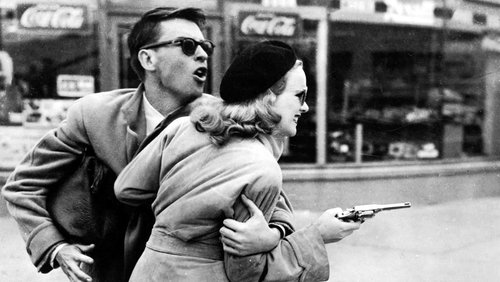
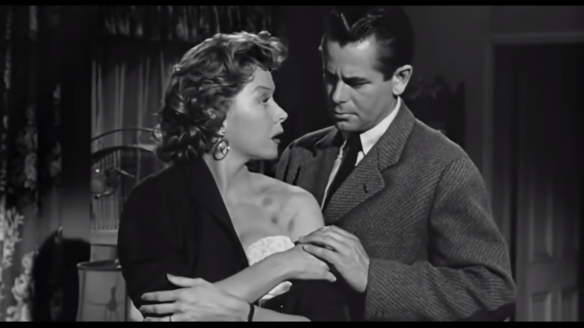
After the stirring success of The Big Heat, he comes back with his two stars in Glenn Ford and Gloria Grahame to do it again. It’s unfairly overshadowed even as Grahame turns in a blistering, merciless performance as a conniving wife. But as with all black widows, the exterior begins demure and innocent enough. It only evolves and becomes more malevolently deadly as time marches on.

human desire 1

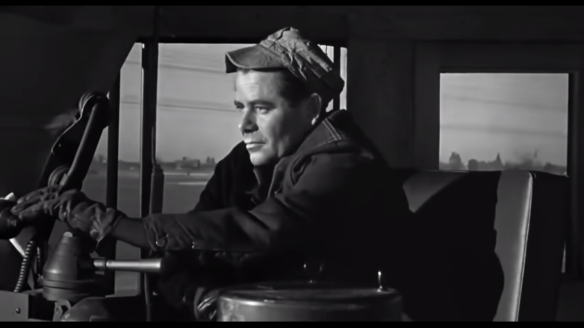
The newfound lens of a returning soldier fits into the context of the era. Because Human Desire is a story revamped for 1950s America, and it translates itself easily enough. Jeff Warren (Ford) is coming home from the army with ideals of a steady job, fishing on weekends, and nights at the movies with a pretty girl. It presents this fresh exterior just waiting to be dragged through the mire.

Because the conventions of American-grade noir, in particular, make for a compelling tale of lust and sleaze. Not that they were entirely absent in Renoir’s picture but they have a different effect.

Human Desire throws together a femme fatale and a formerly clean-cut veteran whose eyes bulge out of his sockets the first time he snatches a glance at the girl. They are not perpetrators of murder by they are implicated in the following courtroom proceedings with Warren complicit in a cover-up. There is a streamlined love triangle between Ford, Grahame, and Broderick Crawford that rarely feels interesting on its own merits.

At its best, it lives out its existence on the screen as a low-grade railway riff on Double Indemnity or The Postman Always Rings Twice. There are obvious antecedents in its French predecessor but somehow in this context, it seems applicable to canonize it as noir. Emile Zola never felt closer to James M. Cain.

I could only consider the very concrete plot points, not the literary styles themselves. Because Human Desire, of course, is not literary at all — or if it, it is only in the pulpy seediness such entertainment engendered.

Renoir could actually claim some basis in Zola’s literature, not simply by his pedigree but also by evoking the words themselves. Regardless, the two creatures have their distinct appeals for two diverse camps. There’s no question the two helmsmen were a pair of phenomenal craftsman deserving individual repute. The differences in them are as beguiling as the similarities. The same might be said of Human Desire and its forefather. Choose your poison and my guess is you won’t be disappointed either way.

3.5/5 Stars

The Blue Gardenia (1953): Anne Baxter a Victim of Noir

blue gardenia 1.png

The Blue Gardenia chooses to establish its characters and allow ample time for the audience to get acquainted with all the players. It’s genuinely a pleasure as we have a number of affable people to grow accustomed to over the course of the story.

There’s local journalist Casey Mayo (Richard Conte) and then pin-up artist Harry Prebble (Raymond Burr), giving a momentary glimpse of a Burr character who is not looking to murder someone or force himself on a woman. The fact that he’s a mere womanizer feels almost tame, showing the desensitization he is capable of instilling.

He, as well as Mayo, can be found wandering around the Los Angeles’ switchboard ward, constantly bustling with activity, call transfers and busy signals galore. The real reason for them to be hanging around are all the pretty working girls. I’m not sure it’s a great reason, but they hang around nonetheless.  The male cast is also rounded out by one of my genre favorites — Richard Erdman, as the ubiquitous cameraman, always lounging on the couch.

It’s with the female talent where Blue Gardenia samples the close-knit camaraderie of such movies as Gold Diggers of 1933 where you have a gaggle of girls living together balancing a career, a love life, and a few laughs. Crystal Carpenter (Ann Sothern) is the wise one who has lived life, maintained her looks, and currently spends evenings with her former husband the homely Homer. Sally (Ms. Jeff Donnell) is her exact antithesis as the young and unattached gal whose idea of a quality evening are dime-store crime romances.

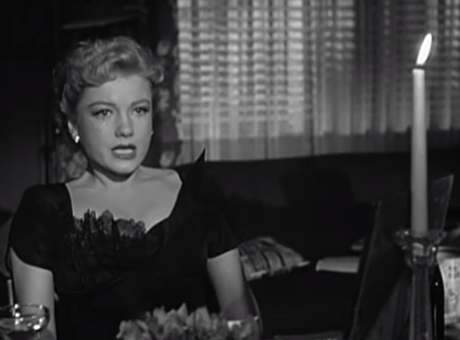
Somewhere in the middle falls Norah (Anne Baxter), the amiable, even-tempered lady who is waiting devotedly for her man to come back from Korea (the war that is). By all accounts, they are madly in love, she has remained eternally faithful to him, and waits upon his return with exuberant expectations. Instead of spending her time out on the town, she imagines romantic meals together by candlelight with roast and champagne.

The Blue Gardenia punches up the melodrama with the disclosure of a fateful letter. It turns out her man has found true love in Tokyo, and Norah has been left adrift with her whole romantic outlook compromised. What is she to do now?

On a whim, she takes up an invitation from Mr. Prebble that was meant to be extended to one of her other roommates. She gets to the Blue Gardenia on Vine, right off of Hollywood, and soaks in the laid-back Polynesian vibe. She’s a bit unsteady, unsure of how to proceed, but she’s there. The main attraction on the floor is none other than the velvety vocals of Nat “King” Cole. His song subsequently haunts the rest of the picture as the story begins to unravel.

Because as hinted at before, Raymond Burr had a certain pedigree, before his days as whip-smart attorney Perry Mason. For lack of a better term, he was always a lascivious cad. We know what his mind is thinking because it’s always blatantly obvious from the expression on his face. Sure enough, a trip to his apartment follows, Norah gets herself more and more intoxicated — a confused and helpless victim in his lair.

He forces himself on her, and she fights him off with a fire poker. Like Philip Marlowe, she enters into a swirling pool of disorientation. It’s this bit of ambiguity laced with terror that the whole plot relies on. Equally crucial is how a victim turns herself into a culprit.

It becomes an uneasy metaphor for the way society is built around men and women are the ones blamed and villainized in certain contexts. This goes back deep into human tradition to the days when a woman’s testimony was not even considered valid in court. Implicitly, it’s as if the burden of proof is on them to prove they are innocent from the very beginning. Norah has every reason to be frightened.

blue gardenia 2.png

Because news of Prebble’s death comes out and the paper and the police are looking for the lady who left her shoes behind — this murderess who fled the scene of the crime. Here Mayo comes back into view as he promises to tell the woman’s story if only she would come forward to his paper. However, his intentions seem more driven by circulation goals than an actual charitable heart. Everyone is a wolf out for himself.

This makes it even more tragic that this woman feels so isolated and debilitated she is incapable of going to her best friends and the women around her, as they would be the ones most ready to help her. The other wrinkle is how the newshound unwittingly starts to fall for the girl he’s been looking for. It’s the height of irony even as Norah finally gets implicated in the murder.

Throughout Fritz Lang suffuses the drama with style captured not only in the most traumatic moments but also in the extensive use of tracking shots within the narrative. Still, the dramatic situation is lacking because it is hard to share the same convictions as our lead. It’s not that we don’t sympathize with her.

It’s the fact she should have nothing to be ashamed of or to be fearful about. If there was more time to isolate its themes and hone in, Blue Gardenia would be very much about the recovery process of an individual going through so much trauma. The heart and soul of the picture could be found there, but as is, there simply is not enough time to tease out these ideas.

The penultimate twist is a fine addition although it’s not as if the story can really be salvaged in one instant — happy ending notwithstanding. Despite the talent all around, the mechanisms of the storytelling alone make it apparent this was a genre quickie made with only mild regard for the material. Lang and Nicholas Musuraca are still integral to what we know as film noir — and this film is no exception — but it certainly is a less engaging effort. Probably because we know the illustrious heights they are both capable of.

3/5 Stars

Bad Day at Black Rock (1955): Spencer Tracy and Small-Town Bigotry

Review: Bad Day at Black Rock: Japanese-Americans and Small-Town Bigotry

In its theatrical cut, Bad Day at Black Rock opens furiously, charging forward with the momentum of a freight train as the credits roll and Andre Previn’s score thrashes in the film’s most manic moment.

From thenceforward, its greatest strength is restraint. The whole town cowers around watching the train arrive with a mysterious one-arm man named Macreedy aboard. If the mysterious out-of-towner isn’t enough, it might also be the fact they haven’t had a visitor for well-nigh four years. This is big news but they aren’t looking to be neighborly. The local observation from the train conductor is telling:

“Man, they look woebegone and far away.”

“I’ll only be here 24 hours.”

“In a place like this, that can be a lifetime.”

The opening minutes not only set up our character but this impeccable environment for accentuating the underlying unfriendliness. The wide-open spaces of Lone Pine, CA are as much about the vast planes created between people as it merely breathtaking landscape. Because it’s gloriously austere, and it’s completely evident we really are off the beaten track.

Spencer Tracy might seem an odd choice, given the traits of his character; he seems too old and overweight to be a recently discharged veteran of WWII, especially since the year is 1945. And he’s hardly a western hero or an action star in the commonly accepted sense. A film like this would normally call for a hybrid between Joel McCrea, Gary Cooper, or Clint Eastwood.

It borrows from westerns and noir, but I hesitate to label it as either. Because it has near revisionist outcomes and a palette more akin to large-scale epics than B-level entertainment. There’s really nothing else I can think of with such a fascinating and simultaneously confounding pedigree.

Macreedy is intent on visiting Adobe Flat, but he seems like a genial fellow. It’s everyone else who loiter around menacingly. They’re either outright brusque like, the local hotel clerk, or pushy folks who ask him straightforward-like what he wants around their town.

bad day at black rock 2.png

In certain terms, Black Rock is the epitome of rural America — with a sinister twist. It’s smaller than small. Everyone knows the business of everyone else. But these folks are about as tight-lipped and inhospitable as anyone ever in the history of humanity when it comes to outsiders. What’s more, they have little reason to be unless they have something to hide. Of course, they must be covering some secret, but we don’t know quite what it is. There we have our movie.

The beauty of the story is how it plays close to the vest on both accounts. Because Macreedy seems to be in no hurry to broadcast his news all around. Simply the fact he has come to town at all seems like enough. He finally does let his business come out talking to the local sheriff (Dean Jagger), another very gracious fellow in line with all the others. Macreedy is there to see a man named Komoko. The name is a tip-off for some. He is Japanese and we are sitting on the tail-end of WWII.

It recalls the quote always attributed to Hitchcock: “The thrill is not in the bang but the anticipation of it.” John Sturges, while known for action films, does such a measured job of stretching out of the tension of this picture. It gets to this unbearable high deserving some sort of release.
bad day at black rock 5

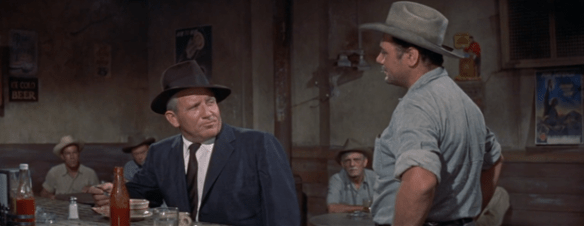
One could say it happens in the diner. Spencer Tracy is working on a bowl of chili, only to get needled by Ernest Borgnine. First it’s a squabble over a chair, then it’s a bottle of ketchup being poured into a bowl of chili. It’s a maddening scene of belittling, but Spencer Tracy takes everything in stride with the finest brand of mild amusement. Everything slides off his back. The following interchange is representative:

“You’re a yellow-belly Jap lover, am I right or wrong?” – Coley Tremble
“You’re not only wrong, you’re wrong at the top of your voice.” – Macreedy

Robert Ryan and Lee Marvin are lounging around to watch the show. Up until this point Macreedy has kept his cool and one might say he walks out as calmly as he came in, but he also exerts himself like he has yet to do. It’s a cathartic moment and as an audience, it gives us an unalienable belief in our hero. We wanted to believe he could hold his own implacably and he can. But the forces against him are nevertheless stifling.

We get the final piece of vital information. Macreedy came to town because of Joe Komoko, who died in Italy saving the life of his brother-in-arms. Forever in his debt, he thought the least he could do was pass on a medal and his condolences. It’s gratifying to have it spelled out, but the bottom line is still the same. Tracy is all but trapped without any outside assistance.

His only chance is some inside help — someone who is willing to do something right for a change, instead of turning a blind eye. The closest he finds is in the local doctor/undertaker (Walter Brennan) who gives his best half-hearted attempt to help the stranger.

Meanwhile, the town’s poor excuse for a sheriff (Dean Jagger), who spends his days nursing the bottle and his nights sleeping in his own jail cell, finally feels compelled to take a stand. His behavior strips him of his badge. The final reluctant players are the tight-lipped hotel clerk and his young sister (Anne Francis), who both aid Macreedy begrudgingly. In a town like this, each action seems nearly monumental. One questions if it is enough.

I challenge anyone to stack the movie up against most any cast of the 1950s, especially because this is not some grandiose epic. This film clocks in at a mere 81 minutes of film, but it has more than enough to go around. Robert Ryan, in particular, is a crucial piece. He always gets these roles as militant bigots and in one sense you feel bad for him and in the other, he’s so convincing at it you can understand why.

His blatant malevolence briefly hidden under a thin exterior is the perfect foil for Tracy to bounce off of. Because they share conversation civilly enough, but it all draws out how diametrically opposed they are. Macreedy got it in Italy. Smith tried enlisting straight after Pearl Harbor but wasn’t accepted.

We come to understand his view of humanity is cut-and-dry. Komoko was a lousy Jap farmer. Pearl Harbor and Corregidor. They’re all the same. There’s no such thing as a loyal Japanese-American. Its this type of rhetoric we must immediately be wary of. For it is pernicious.

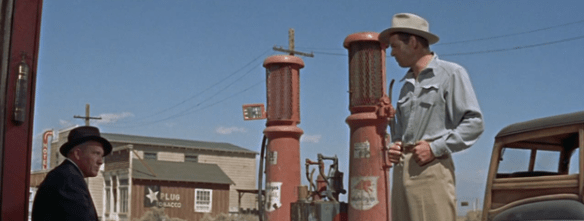
At his first chance, Macreedy decides he should get out of town since he’s hit a dead-en, attempting to notify the state police on his way out. He bumps into another bystander, the squeamish telegraph officer Hastings, who excuses himself by saying, “I’m just a good neighbor.”

Of course, as Macreedy suspects, his definition only stretches to those who share his skin tone. He is yet another problem character. Because he has no guts and if I indict him then I am indicting myself as well. There is no place for wishy-washiness with such issues.
bad day at black rock 4

Bad Day at Black Rock, personally, is an important film for me because, like Daisy Kenyon or The Steel Helmet, it stands as a record of Japanese-Americans place in a polarized society. There was injustice done, and it’s not something we should try and forget. The acknowledgment alone is a victory and yet another important record in the annals of visual history.

However, getting beyond, this thriller is ultimately about a hero who is doing his best to honor another man — of course, he happens to be Japanese-American — but most importantly he is given the dignity and the respect of a human being. Because there is no greater love than a man laying down his life for his friends. Even if we never see Motoko, or his deceased son in person, their presence over the film is still felt, and it’s meaningful for me. The implications are that he matters as not merely an innocent citizen but a sacrificial hero for the sake of our country.

It manages to be universal. Because Black Rock could be the stand-in for any such towns. In this particular instance, it’s about a Japanese man. But in other stories, he could be any marginalized individual. The hateful frenzy of The Red Scare is too fresh to disregard any type of allegory in that context.

This type of bigotry and incensed racial (or political) hatred is not a thing of the past. It disadvantages many types of people by conveniently terming them “other” from the accepted subset of society.

What always fascinates me in history and in the stories we excavate is finding the people who faced this abhorrent reality and willingly pushed against it. Still, others initially accept it with apathy. It’s the path of least resistance. However, even they are forced to make a stand, lest they continually bury their conscience and grow miserable.

Bad Day at Bad Rock is about precisely these types of people, and it takes all sorts. So the beauty of it is that we can enjoy its utter intensity and the mystery at its core. It keeps its secrets close and only divulges them at opportune moments. The dialogue too is sparse and measured.

But seething under the surface is a commentary framed by a none too flattering portrait of America. It stands as a testament to fear leading to hate and hate leading to violence. There’s this sense of full-blown conspiracy and holding onto each other’s secrets because we’re all implicated.

If we are to break the chain, it’s imperative to band together in opposition and bring all those dirty secrets into the light. The greatest gift Spencer Tracy gives to this picture is not brawn but the unwavering sense of integrity — in his acting and in that iconic face of his. In a world of shady two-timers, his candor is something we can trust.

4/5 Stars

Riot in Cell Block 11 (1954): Social Commentary in The Guise of Exploitation

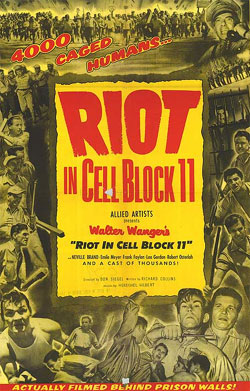
Riotcellblockpost.jpgIf you’re like me you met Don Siegel because of Dirty Harry (1971) or maybe The Invasion of the Body Snatchers (1956). But it was only after discovering the rest of his work — the likes of The Big Steal (1949), The Lineup (1958), or even this film, where you began to appreciate the consummate craftsman that he was.
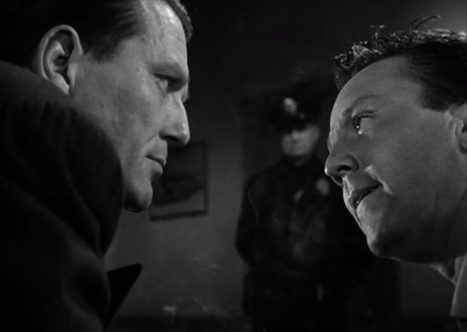
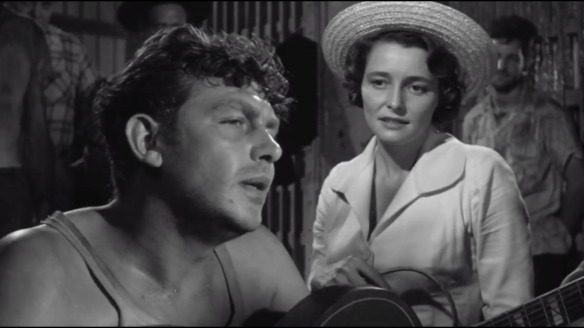
The film makes a creative choice to set up its narrative with real-life newsreel footage of prison riots across America and this is no facsimile; it feels like the real deal. This decision begins with the initial impetus of producer Walter Wang to make a picture authentic to the plight of prisoners. Showing the inside and the inherent issues with such mass incarceration. Why would he have such a stake in telling these stories in a picture like Riot in Cell Block 11 or I Want to Live (1958)?

It’s because he actually spent a spell in prison himself after shooting his wife’s lover. That is a whole different story, but it gives us some context for the aims of this project.

Compared to Brute Force (1947) or Caged (1950), for instance, this is not simply a story of brutality at the hands of some maniacal prison guard like Hume Cronyn or Hope Emerson. Those narratives are assuredly entertaining. But for something that looks similarly exploitative, this picture decides on a more nuanced approach in a generally successful attempt at open-ended social commentary.

The warden (Emile Meyer), for instance, is a no-nonsense man but far from a tyrannical monster; he has a grim view of the prison system, knowing they are not always able to offer the best rehabilitation. He constantly strives for discipline while also harboring a certain level of sympathy for those deserving of it. He is a first-hand witness to the short-sighted effects of negligence in our justice system.

It turns out that before the days of Johnny Cash, Folsom State Prison was used as the shooting location for this film. Siegel even had the ingenuity to cast real-life prisoners as extras. I’m not sure how the logistics worked out, but the film undoubtedly benefits surrounding the already believable tough guys like Neville Brand and hulking Leo Gordon with a host of others.

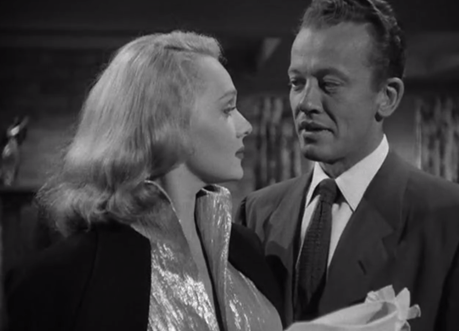
The usual suspects include a skulking Alvy Moore (pre-Green Acres) and “The Colonel” who is the most learned of the inmates and helps to give them some credibility. The lives of prison guards, including Whit Bissell and Paul Frees, reflect how close the jailers get to their charges. That’s a dangerous arena and especially with the guy’s in solitary.

Without this overcrowded, undermanned system, there would be no Riot in Cell Block 11. As it is, four guards are easily overpowered and held hostage to be used as leverage against the authorities.  There’s a giddy jubilance to their trashing of the cell block that’s nearly comical, even as the stakes are far more harrowing. It proves far more than a game, with lives on either side of the wire at stake.

James V. Dunn (Brand) takes the lead, daring all others to join him and his band of cronies. Crazy Mike Carnie (Gordon) is the one who frightens everyone into line. But it is The Colonel (Robert Osterloh) who is called upon to organize their grievances to be presented. He provides a voice of reason and rationality we would be lacking otherwise.

The warden is put in an agonizing position, walking the tightrope between the prisoner demands and the outsiders coming in, including the pitiless commissioner Haskell (Frank Faylen), going all the way up to the governor. Likewise, worried spouses call his office about their husbands’ well-being as journalists (including William Schallert) look to stir up the story around the riot.

At its cores is this ideological war of treating prisoners firmly but with inherent dignity and then caging them up with the most merciless of standards to keep them in line. To show clemenscy is seen as a sign of weakness.

Inside and outside the bars, you see people with grievances and problems like any person. It humanizes everyone, in a sense, going beyond mere exploitative drama. It somehow wears a fairly convincing cloak of authenticity while still remaining pulse-pounding stuff. Because I’ve seen prison riots captured on film before but to my knowledge, there’s never been anything so enveloping and tumultuous on all fronts.

Keeping with Wang’s agenda, the film does not pull any punches as it slinks back into the status quo. There is tragedy, there is victory, and finally, there is a feeling of powerlessness in the face of bureaucracy. It’s as if a man’s word stands for nothing. It’s as if this whole ordeal was entirely pointless.  The finale is as eye-opening as it is pessimistic. But movies have a license to do that. It makes them a lot more lifelike.

4/5 Stars

Armored Car Robbery (1950): Wrigley Field L.A. Noir

armored car robbery 1

Armored Car Robbery instantly had my rapt attention in part because of its location shooting and due to one place in particular. We start out at L.A. City Hall and soon a shooting and a robbery are being called in from nearby Wrigley Field, which sends Lt. Cordell (Charles McGraw) and his partner out to respond.

It proves to be a false alarm but the setting alone might throw some contemporary audiences for a loop. After all, Wrigley Field is synonymous with the ivy-laden bricks of Chicago, not Los Angeles.

Except L.A. enthusiasts might know that the area once held a Wrigley Field of its own, formerly the home of the original Los Angeles Angels expansion team in 1961. It also served as the backdrop in many classics including Meet John Doe and Pride of the Yankees. Added to that list is Armored Car Robbery, although it only uses a facade of the stadium, which could just have easily been a studio set.

Aside from always being fascinated by time capsule moments — Wrigley Field was all but demolished in 1963 — I had always heard talk of my Grandma growing up down the street in Los Angeles. She was born in L.A. County and her family ran a grocery store in the area. I don’t have much of a picture of that world and so even a brief image like the one provided here gives me a glimpse into yesteryear. But I digress.

Richard Fleischer’s heist noir is an obvious precursor to The Killing for its stadium locale and the ever necessary complications that begin to present themselves in due time. What good is a heist if it doesn’t go completely haywire?

Because of its limited time, Armored Car Robbery spends minutes on the preparations and the actual execution of the job. But the trick is, it’s all so efficient, we are never allowed time to get bored by the usual rhythms. Still, all the information is there for us to be brought into the crime.

Generally known as defense attorney Hamilton Burger on Perry Mason,  William Talman gives a far more insidious turn as a meticulous criminal obsessive about keeping a low profile and tying up every loose end so he can pull off the perfect crime. What’s more, he’s secretly got a bite on his accomplice’s girl, a heartlessly opportunistic blonde bombshell (Adele Jergens).

By night she’s got the entire male populous ogling. By day, she’s looking pretty, hanging around the bar, and getting miffed with her husband (Douglas Fowley), who can’t seem to make any dough. Hence her convenient extramarital operations. Dave Purvis is the man for her, taking charge of two other thugs as they set their sights on $200,000 of cold hard cash.

armored car robbery 2.png

But there’s always a slip-up. There can hardly be a heist genre without the wrench that causes everything to hurtle out of control. As it turns out, Lt. Cordell (Charles McGraw) and his partner are on the beat, responding to the subsequent distress call at Wrigley immediately. The culprits aren’t expecting it, and the ensuing shootout leaves one of the officer’s dead in the line of duty and one of the gangsters badly injured. Soon the alarm has been raised with roadblocks set out everywhere and the police force on high alert for the four fugitives.

For the rest of the film, Cordell must live with this galling injustice, stewing day and night in his own distraughtness and copious amounts of lukewarm coffee. First, jaded by the untimely murder of his partner and then saddled with a wet-behind-the-ears replacement (Don McGuire). Although the new recruit nevertheless proves to have a certain amount of gumption when it counts.

The film employs a low-budget airport terminal ending — one of the few times it lets slip its meager means — but the film goes for the narrative jugular. We see precursors to the likes of The Big Combo, The Killing, and even Bullitt. On multiple occasions, it’s not at all squeamish about letting the bullets fly and the death toll rises as a result. And it’s this disregard for the sanctity of life that gives the narrative real heft. No one is protected and there we have grounds for a thrilling drama.

These kinds of stories are awesome pulp classics with a stripped-down punchiness that’s instantly gratifying. RKO was such a wonderful studio in this regard for giving us such raw delights. They don’t make them like this anymore.  We waste too much time.

While not completely related, one should note RKO is the only of the major classic studios that completely folded. Those were the good old days. But all good things must come to an end. Wrigley got demolished. Actors die. Studios close down. That’s why cinematic memorials are often so important. They allow us to journey back into the past.

4/5 Stars

A Face in the Crowd (1957): Lonesome Rhodes is No Andy Taylor

a face in the crowd 1.png

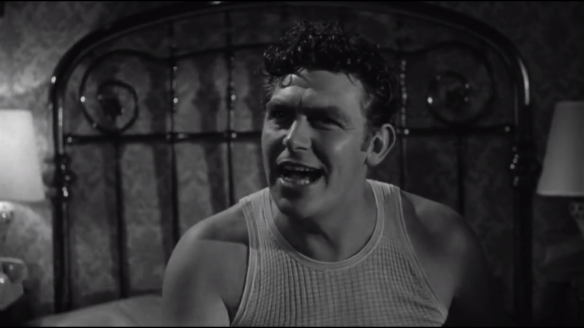
It begins unobtrusively enough. In a backwater Arkansas jail, a drunkard plays his guitar on a radio segment of “A Face in the Crowd” being broadcast from his cell. They don’t know it quite yet but soon the host who found him, Marcia Jeffries (Patricia Neal), and Larry “Lonesome” Rhodes (Andy Griffith) capture the public’s imagination. Far from just plucking Rhodes out of obscurity, Jefferies also rebrands him with an off the cuff remark and uses her daddy’s radio reach to broadcast him all around.

With such a platform, Rhodes does the rest with his wild whoops of down-home charm and strangely beguiling magnetism. He’s a natural performer and showman who knows how to form a connection with the folks at home. Soon they have created a following or as is popular in the lexicon these days a “tribe” giving him real media presence in the cultural conversation.

Someone asks him the question, “How does it feel to be able to say anything that comes into your head and be able to sway people?” But it’s true. He’s at the forefront of a grassroots democracy turning into a television phenomenon.

Meanwhile, Jefferies watches it all unfolding with bright-eyed awe and deep enthusiasm. It’s absolutely rich seeing it sweep over the country. One of the cogs in the machine is a jaded writer named Mel (an early Walter Matthau) who watches the unfoldings with grim amusement. Meanwhile, Lonesome’s ever-ambitious and cutthroat promoter (an even younger Anthony Franciosa) positions his man to continue broadening his success. Everyone’s trying to get a piece of this new pie. Because what’s more American than pie?

Rhodes keeps up his side of the bargain by purveying his own brand of “authenticity.” On one show he brings on a destitute African-American woman and gives a call-to-action and the money comes pouring in, in response. Another week he crosses a mattress sponsor and subsequently raises the man’s sales all across the country simply by belittling his product.

Soon he’s brought on to promote the product of the stuffy Vitajex company and he takes their pride and joy, disregarding their focus groups and tradition, selling the pill straight to the public. By the time he’s done with them, the public’s buying them up by the barrelful.

He also captures the imaginations and the fancy of all the young girls all across the nation — soon has them all swooning over him — but one lucky girl wins out (Lee Remick) with her baton twirling during the Ms. Arkansas Majorrette competition of 1957. Of course, Lonesome Rhodes is made the judge and after getting mobbed by the girls, he takes a shine to Betty Lou.

Marcia gets pushed further and further into the periphery of his life as Rhodes weds the frisky twirler and sets his sights on the next domain to be conquered. Politics have entered a new stage — the television age — and no man is more beloved than Lonesome Rhodes. “You gotta be a saint for the power the box can give you,” as Mel notes, and in the wrong hands, this immense power is dangerous.

a face in the crowd 2.png

Rhodes throws his support behind a stodgy old lawmaker giving him advice in the process. The film was already predicting the famed televised debate between Nixon and Kennedy. Where campaigning is about punchlines and glamor; it becomes a popularity contest and an advertising endeavor as much as a smear campaign. He uses his Cracker Barrel Show to promote the senator in a more relaxed atmosphere and has the position of Secretary of National Morale waved in front of him.

He even notes his candidate should get a dog, observing that it didn’t do Roosevelt any harm or Dick Nixon neither (referring to the well-received “Checkers” speech in 1952). Because these events begin to hint out how corruption, even double talk, begin to make the general public question “authenticity.”

In one off-handed remark, Lonesome crows, “This whole country is just like my flock of sheep.” However, like Arthur Godfrey, his downfall (though more rapid) occurs after an onscreen incident that removes his mask and undermines his image before the people. They can never see him the same way. The saboteur, as it were, is Marcia for she cannot bear to see the people taken in.

So the final trajectory is obvious — the ascension and the dethronement — but that can hardly neutralize what we have already witnessed. A Face in the Crowd lingers with fair warning, relevant to any analogous situation in the modern landscape, only magnified to the nth degree.

Earl Hagen’s down-home waterhole tunes fit The Andy Griffith Show just as this arrangement from Tom Glazer gels with A Face in the Crowd. Speaking of, I must insert a thought on what I know more about, as I grew up watching countless hours of The Andy Griffith Show.

The character of Andy Taylor obscures the fact of what a fine actor Andy Griffith was. To some extent, the same can be said of No Time for Sergeants because like the early seasons of his show, he’s just playing a bubble-headed hick. Later on, he became more of a straight man and after Barney Fife left, he settled into a more irascible role so there was an evolution.

Regardless, Lonesome Rhodes turns the overarching stereotypes of the man on their head. You can still see him as the benevolent Sheriff of Mayberry but this certainly lingers in the back of your mind. Take away the moral integrity and others-centric mentality of Andy and you wind up with Lonesome.

Given its themes about media and television, which seem like a cutting-edge indictment in their contemporary age, it seems logical to lump A Face in The Crowd with Network. Similarly, though technology and advertising continue to become more advanced and invasive, the themes explored feel, not less relevant, but more so.

We simply have to magnify them. Instead of television, we have Twitter and smartphones. Instead of people who willfully hide their intent, we have people in power who seem to blatantly disregard moral uprightness.

I want Lonesome Rhodes to be outdated and immaterial but to make such a claim would be an immense act of folly. It would cater to the same sense of ignorance and sway in all sectors of society, which led to the rise of such a person in the first place. Then and now…

4.5/5 Stars

Note: An earlier version of this review erroneously said Rip Torn instead of Anthony Franciosa (He was featured in an uncredited role).

Baby Doll (1956): Elia Kazan Does Southern Comedy

baby doll 1.png

Elia Kazan had a fairly lucrative partnership with Tennessee Williams and the same could be said of his ongoing working relationship with Karl Malden. It’s fitting that all three are back for Baby Doll and yet it still manages to feel like a bit of an outlier in Kazan’s oeuvre thus far.

As per usual, Kazan invests great commitment in his actors and the emotional richness of their performances, which enter near hyper-realized heights. Because there would be no Baby Doll without Malden, Eli Wallach and of course, Carroll Baker. They must carry its weight and for what it’s worth, they manage the task quite well.

Malden is the bug-eyed hick, Archie Lee, who made a pact with the dying pappy of his virginal bride that he would take care of her. Whether he’s held sway on his side of the bargain is up for debate, as Baby Doll and he live in a home literally crumbling around them by the hour

He’s a narrow-minded cotton gin operator who has recently been hitting the skids due to competition. If you are looking for the bare minimums of the story, there you have them. The situations themselves venture on the absurd in this hardly fully-realized plot.

With their house a decrepit eyesore, the furniture soon gets taken away. Archie Lee’s just about at the end of his tether and so he sneaks out one night and commits an act of arson on a whole silo full of cotton. It’s a desperate attempt to give himself an advantage and direct some business his way.

It’s true many might be unaccustomed to comedy in a Kazan film because though it’s masked by typical antics, melodrama, and the risque veneer that precedes it, the humor is unquestionable. If it sounds like melodrama you only have to look at the performances to crack a grin because they do feel like over-the-top exaggerations.

The galvanizing moment, of course, is our first view of Baby Doll lounging in a crib-like bed, sucking on her thumb. Her husband peeps on her through a hole in the plaster giggling like a lecherous schoolboy when she wakes up. We have a Lolita archetype and no doubt the source of its censorship woes, which elicited a “Condemned” rating from the Catholic League of Decency.

What always stings more is hearing the N-word bandied around so inconsequentially as the African-American characters play an unheralded supporting role in the far-off periphery. There you see the hypocrisy. No one in the Catholic or Southern Christian communities probably saw it fit to condemn this element, no doubt considering it acceptable, even commonplace. It’s at least something worth acknowledging soberly.

baby doll 2.png

If Archie Lee is our entry point into this asinine world, then Baby Doll and Vacarro (Wallach) have the presence to keep us watching. In a momentary lapse in judgment watching Long Hot Summer, I mistook Lee Remick for Carrol Baker because they look vaguely similar at first glance. However, Baker does more than a southern belle here full of sing-song dialogue. There’s a tremor, an impediment to her speech which, comes off as strangely childlike. She boasts a cutesy name and enticing sensuality akin to Darling Jill from God’s Little Acre and really there’s the film we can draw the most parallels between.

Because Eli Wallach plays the other man who pays Archie Lee a visit the following day after the conflagration at his place. He’s derisively referred to as a “Whop” and so it’s easy for him to become the outsider with a chip on his shoulder. He’s willing to do what he needs to do in order to get back on top of the heap. Ironically, he lets Archie Lee in on his philosophy.  He’s a proponent of “biblical justice,” an eye for an eye and a tooth for a tooth, though he obviously didn’t read the scriptures too closely.

Instead, he implements their “Good Neighbor Policy” and while the other man is out fixing his machines to take on a new cotton crop, Silva starts playing with his wife even sneaking into the house to toy with Baby Doll. But remember this is not A Streetcar Named Desire. Wallach has his own inner demons but he’s no Stanley Kowalski and Baby Doll’s no Blanche.

Their trajectories take them into different places as a drunken Archie Lee gets jealous of his wife’s suitor, going after his adversary with his shotgun. However, in the end, the stakes are slighter than its predecessors and yet there’s something novel and slightly refreshing in this. While Baby Doll is nowhere near the best of Kazan’s work its “otherness” makes it a risible endeavor out of left field.

3.5/5 Stars

The Naked Dawn (1955): An Edgar G. Ulmer Western

220px-The_Naked_Dawn_film_poster.jpgThe western is founded on certain unifying archetypes, from drifters to revenge stories, showdowns and the westward progress of civilization butting up against the lawless wilderness. It always proved a fitting genre for morality plays and deeply thematic ideas. The tradition of the bank robbery goes back to Edwin S. Porter and The Great Train Robbery, and it plays an important role in The Naked Dawn.

The action opens with Mexican banditos robbing a train and looking to flee the scene. Though they manage to get away, it’s not without consequences. One hombre named Santiago watches as his campanero Vincente dies in his arms. He comforts him with visions of heavenly cattle grounds even though the man’s life was full of indiscretions, to put it nicely.

The story does occupy itself with religious rhetoric, which feels very much a part of the cultural landscape, as do the Spanish language and such ubiquitous elements as taco stands, cantinas, and a mariachi soundtrack. The film rightly steeps itself in this perceived world below the border. Whether it is authentic or not feels slightly immaterial, because something fairly immersive is erected. In one sense, this is the most impressive success of The Naked Dawn.

There is “brownface” needing acknowledgment and a certain stereotypical gaze, but director Edgar G. Ulmer develops a surprising amount of atmosphere for such a meager western. Secondly, Arthur Kennedy somehow manages to give a thoroughly flamboyant performance showing his competency in anchoring a leading role — even in an admittedly small scale oater like this.

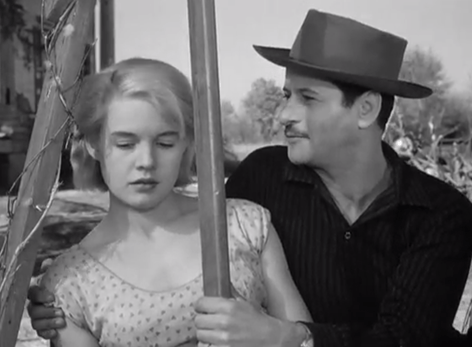
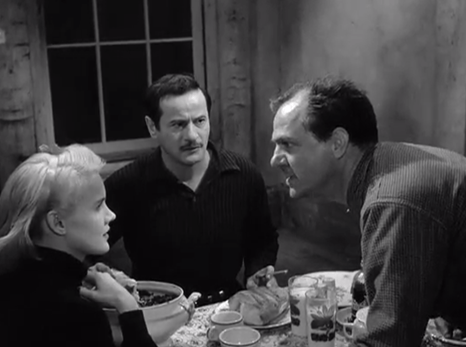
Because in typical drifter fashion, he goes from leaving his dead buddy behind to finding a day’s shelter at a farmhouse along the trail. There he is met by an energetic young farmer and his dutiful wife. The presence of such a figure as Santiago unearths all their flaws even as he overwhelms them with his vagabond existence, full of a certain high-living and nostalgia for the old days.

Although initially hesitant to get involved, the husband finds himself brought along for a raid on a crooked shipment manager who they overpower and string up while raiding the contents of his safe. In the midst of all the money, Manuel (Eugene Iglesias) suddenly becomes brave and also greed springs to life in his heart.

For thence onward, Manuel holds this stranger in high regard, in awe of this man who has seen so much and takes him for the time of his life in the local watering hole, partaking of all the worldly pleasures afforded from strong drink, saucy women, lively music, and a bar brawl to wind out the entertainment.

But if this is the grand exciting world away from the ranch, then back with his doting wife (Betta St. John), we find a certain amount of unrest. She does not love her husband but his prospects were so much better than what she had before. Still, this new man makes her heart glad; she is ready to elope with him without fear of consequences.

The utter irony is the very fact that while Santiago is the outlaw, at least he is obvious and upfront about his waywardness. In his new company, Manuel fancies himself an honest man and his wife comes across as an angel. However, whether it’s unwitting or not, they both have more conflicted characters than they let on. Santiago is the one who allows them to salvage their lives.

It should be noted Francois Truffaut purportedly gleaned inspiration from this film’s love triangle for Jules et Jim. At first, any sort of comparison seems superficial at best. However, I finally settled on the fact both films contrive this three-way relationship that plays peculiarly for the very fact it lacks a great deal of interpersonal drama.

There is a passivity to how it unwinds and this feels counterintuitive to how these stories are supposed to function. Although we have tragedy on both accounts, the fact it is so detached leaves a different taste, rather than a blistering, jealousy-fueled gunshot finale. For that, we have to look at alternatives like Laura (1944) or Truffaut’s own Soft Skin (1964).

There is not a lot of time and space but the resources are used in all number of facets to at least touch on issues of religion, law and order, romance, greed, and unquestionably, so much more. Fittingly, as the picture zips to its rapid conclusion, we have come full circle with our larger-than-life Bandido dreaming of the pearly gates much like his campanero before him.

Ulmer blesses the audience with another extraordinarily lucid 10-day effort. Let that sink in for a second. The Naked Dawn is yet another marvel in economic ingenuity. Better yet, any drop off in quality or production values only seems to add to the film’s inherent flavor.

3.5/5 Stars

The Desperate Hours (1955) Bogart Vs. March

desperate hours 1.png

As the credits roll, the camera zooms its way down a residential street but doesn’t feel natural. It’s like a peering gaze casing the scene as music hammers away in the background. What makes the imagery more disconcerting is that this tranquil picture-perfect suburbia could be plucked right out of Leave it to Beaver. In fact, coincidentally, the house is the very same!

In this film, it belongs to your typical everyday family circa 1955. The man of the house, Fredric March, sits around the breakfast table, preparing for his job at local bank, bemoaning the fact his kids are growing up.

Little Junior is already showing signs. Not wanting to kiss his pops goodbye. His daughter is lovestruck and intent on marrying her beau, which he can’t stand to think about. His wife is perfect. Pretty, maternal, and a fabulous homemaker. Its all a bit insipid on the whole but that’s very purposeful. Currently, we might call his daily struggles “first world problems.”

It is a bit of the lifestyle that can be easily plucked out of any of the old family sitcoms from Fathers Knows Best to The Donna Reed Show. And yet what those portraits of the nuclear family never did have was the threat of three convicts at-large…

Their hardened leader is Glenn Griffin (Humphrey Bogart) joined by the boisterous slob Kobish (Robert Middleton), and Griffin’s kid brother Hal (Dewey Martin).  Come to think of it, there was an episode of The Andy Griffith Show with striking parallels, albeit with more comical resolutions. As is, William Wyler’s piece falls more in line with The Detective Story (1951) from a few years prior pushing the stage elements out a bit but still centering its action on the family domicile.

Arthur Kennedy at the Police Precinct is brought on the case but he really feels like a wasted opportunity and a dead-end at best. The real meat of the story is within that house between the two men vying for control.

Bogart, who got his break in Petrified Forest (1936) as a crazed heavy, is essentially book-ending his career with tough guy roles. Even if he’s over the hill for such roles, he still makes a good snarling approximation of his former self. One could argue that time has only made him more disgruntled and worn. His convict is a much more sorry figure with 20 years sagging under his dour eyes.

He plans to lay low in the residential neighborhood until the money they’re expecting gets sent their way. So we expect the plot to be a waiting game. Except the subsequent tension comes with criminals existing in such close proximity to this family, a theme running through other contemporary dramas like He Ran All The Way (1951) and Suddenly (1954).

To be ousted by the authorities means that everyone gets it. And yet the Hilliards are commanded to stick to their daily rhythms as closely as possible, even as the fugitives take over the home and turn it into a shambles. The conflict that goes through Mr. Hilliard’s head is between doing as the convicts say to protect his family and trying to get in contact with the police. He’s faced with the most nervewracking proposition of his life as the hours tick excruciatingly by.

desperate hours 2.png

When March finally gets to his office, frazzled by the turn of events, it feels like a Wyler touch of perfectionism to have three portraits prominently sitting in his office. The way they’re arranged perfectly toward the camera feels blatantly artificial. No one would have them set up that way and yet they’re implicitly reminding him (and us) that the lives of the people he holds most dear are still in constant jeopardy. The worst part: he’s all but powerless to do anything about it.

Meanwhile, the police are shacked up in Al’s Dining Room kitchen as their command center itches for a decent lead. Cindy tries to head off her beau (a far too old Gig Young) so he doesn’t find out about the fugitives and get the family in more trouble. A garbage man gets it for seeing too much. Mr. Hilliard sweats it out waiting for a letter loaded with cash destined for his office.

One can easily surmise Wyler had great relish filming along the staircase because it all but visually summarizes the tension of the film. Stairs are all about space and the relationship of people to one another. It’s shorthand to explain an unbalance or shift in power. For Mr. Hilliard, this is about his family. That’s all that matters. For the policeman who’s just thinking about his reelection, it’s an entirely different scenario.

And what the picture does tease out is the idea that extreme duress often causes people to show their true colors, whether empowered by integrity or saddled by cowardice. In the end, a businessman living a so-called cushy life shows a fiercely defiant fortitude that ultimately holds his family together. It has less to do with the police or even the criminals that stakeout in his home.

In the end, it’s his own grit, determination, and will to protect his family that wins out. If the film is an exercise in suburban melodrama, it’s also a resounding testament to the human spirit as well. The scary part is that like The Hitchhiker before it, the story was partially based on real-life events. Why is that frightening, you ask? It means real people were faced with these dire consequences. We saw what they did? Implicitly we must also beg the question, what would we do when the desperate hours hit us?

3.5/5 Stars

Rancho Notorious (1952): Chug-a-Lug

Rancho-Notorious-poster.jpgThe legend goes that the ever-meddling megalomaniac of RKO Pictures, Howard Hughes, insisted the film’s title be changed to Rancho Notorious because European audiences wouldn’t know what a “Chug-a-Lug” was. Director Fritz Lang, who was himself a European emigre, snidely replied they definitely knew what a “Rancho Notorious” was.

Regardless, Rancho Notorious doesn’t miss a beat with an opening close-up of a couple’s tender embrace. The lovers are pried apart reluctantly as Vern Haskell (Arthur Kennedy) goes back to work as a ranch hand, leaving his best girl, Beth (Gloria Henry), to mind her mercantile store.

As he leaves, two strangers ride into town scowling around and leering at the pretty gal waving her love off on his way. One of the two thugs enters the shop to inquire about the contents of the safe, glowering over her lecherously as she reveals its contents. It doesn’t take much to extrapolate what’s next. You can fill in the blanks.

This sequence alone is a testament to the fact that the menace of Fritz Lang can even encroach on the colored palette of the western through music and foreboding shadow. With a woman now ruthlessly ravaged and murdered, it sets her man off on the trail seeking vengeance. But being the snake in the grass that he is, one of the marauders shoots his accomplice in the back before absconding with their cache.

Haskell makes it to their encampment just soon enough to induce the dying man to let out his final breath. The only tidbit he has to go on is the phrase, “Chug-a-Lug” so he goes on the trail again sticking his nose anywhere and everywhere people might have a lead.

More often than not it leads to a near-mythical lady named Alter Kean (Marlene Dietrich), tall tales of her exploits being spread all across the territory. Everyone from neighborly townfolk to old acquaintances gladly spin myths and regale the interested passerby with their recollections. Because while he’s interested, so is the moviegoing audience.

There were her days as a saloon floozie, racing with all the other gals on the backs of eligible young men and she had the pick of them all. In those days she worked for Baldy Gunner (William Frawley) though her employment was terminated prematurely. She was too rough on the customers and they were too fresh so she got the boot.

But not before running off with most of Baldy’s money thanks to the even-keeled strong-armed tactics of Frenchy Fairmont (Mel Ferrer) who holds that often touted distinction of being “The Fastest Gun in the West.” He, like Alter, could easily be cast as a mythical figure. Everyone wants to see him and take him down. He just wants to be left alone instead of having to shoot his way out of every town he wanders into. Their reputations precede both of them and in that regard, they are kindred spirits. They seemingly understand each other. Romance might be in the air as well.

Why does this matter in Vern’s quest? For that, we must look to the Election Day taking place in a wild and wooly western town where Frenchy is currently being held along with a trio of crooked politicians. The three men are all set to be hung the very same day if their political party gets overturned. The trills of democracy haven’t really reached this far west yet. Anyway, Vern gets brought in on some minor charge to get close to this outlaw and gain his confidence.

Finally, his assiduousness pays off, and he follows Frenchy to an oasis for wanted thieves, lascivious vagabonds, and societal outcasts. He makes it to Chug-a-Lug, an isolated horse ranch now run by none other than Alter Kean, in all her glory.

He now has a group of men to begin whittling down because, if his suspicions are correct, then his culprit is undoubtedly among them. For now, it’s just Marlene and the boys of the range and she whips them pretty darn good, around the card table and otherwise.

Theatrically, Rancho Notorious has the relatively unique distinction of being an interior western. Certainly, there are exterior shots but due to budgeting at RKO and what he was given to work with, Lang is forced to go the cheaper route. However, he leverages that handicap which does often give way to a fake and garish looking mise en scène to nevertheless create an unnerving world of tension and claustrophobia.

The space is crowded with thugs just ready to go off like sticks of dynamite. They just need a match to light them off and Arthur Kennedy is precisely that. Of course, Dietrich is quite the firecracker in her own right and always the focal point.

The main themes highlighted in the title song of “Hate, Murder, and Revenge” would be returned to time and time again throughout the western canon but they also tie nicely into Lang’s own filmography.

One moment that Lang’s camera brings these themes to light most blatantly occurs when Kennedy spies the broach he gave his dead girlfriend on another woman. His gaze jumps down the gallery of leering thugs (maybe they’re only grinning) all around him with each successive cut. It’s jarring and also makes it supremely evident what Vern thinks of each and every one of them. The rage burns red hot. But he keeps it under wraps for now.

For now, the only progression that seems evident is Vern slowly moving in on Frenchy’s turf. Relations all down the line get continually testy. What follows is a contentious bank job that suggests there is no honor among thieves. Meanwhile, Alter is selling her ranch and ready to pick up and leave the territory. The end is nigh. We must have the Gunfight at Rancho Notorious or better yet The Gunfight at Chug-a-Lug to wrap up all the loose ends.

While not quite on par with Johnny Guitar, Dietrich, like Joan Crawford, more than holds her own, still strikingly alluring and fiercely independent. She also earns herself an ending that evokes and, in some ways, surpasses Destry Rides Again (1939).

In full disclosure, I rather like the title Rancho Notorious because not only is it slightly provocative but it gives some indication of the people who reside right at its heart. People driven by vice, rage, greed, jealousy, and passion. Because regardless of the location or the genre or the characters, Lang’s pictures were always about these intense emotions and innate urges at the core of human beings.

One of them is a purportedly good man who turns callous. Thus, we must question if the very same proclivities don’t rise up within ourselves. Could it be we’re all capable of a little notoriety? We all require a place to hide out one time or another and we all desire a second shot at redemption. Of course, the Chug-a-Lug wheel of fate is not always so forgiving.

4/5 Stars