Night of the Demon (1957) Starring Dana Andrews and Peggy Cummins

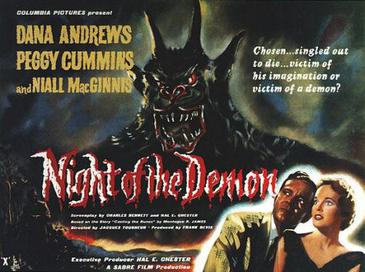
Nightofthedemonposter.jpg

There’s not a more fitting place to start a horror film set in England than with Stonehenge, those relics of old that we can easily imagine being hexed with pagan cults and rituals summoning some unknown evil into the world.

Jacques Tourneur is no stranger to horror films and Night of the Demon (or Curse of the Demon in the U.S.) has its most obvious roots in his work at RKO with Val Lewton and the traditions hearkening back to the days of Cat People and I Walked with a Zombie. It’s stellar company to keep indeed. What hasn’t changed is filmmaking that surpasses its budget to create something genuinely unsettling through the generation of eerie atmospherics.

Except, one could contend that this production was much more tumultuous thanks to the ongoing struggles between producer Hal E. Chester on one side and Tourneur and screenwriter Charles Bennett on the other. In their estimation, the man supplying them with funds, was compromising the integrity of their vision and what they saw in the script.

One particular point of disagreement was in the actual incarnation of the devilish spirits, which take on an actual form rather than simply being implied or left fully to the imagination. The creation of a windstorm conjured up on the spot was another instigator as Tourneur demanded the use of airplane engines instead of electric fans. It got so bad lead actor Dana Andrews even threatened to quit if there was further interference with his director’s work.

Even in spite of these forms of strife going on behind the scenes, the picture genuinely comes off as a harrowing tale imbued with the ongoing terrors of witch cults and devil worship.

The beauty is when these seemingly supernatural, spiritual, or otherwise questioned forces impart themselves on the real world. The real world is grounded by a skeptical psychologist named Dr. John Holden (Dana Andrews) who is not about to believe in any of that kind of rubbish until he has no choice but to.

You couldn’t have a better and plainly a more blatantly obvious form of opening exposition. A man sleeps on a plane. It’s Dana Andrews and the paper propped over his eyes conveniently shows his picture and bears the headline that a prominent psychologist is about to arrive in England. Behind him, keeping him up needlessly, is Joanna Harrington (Peggy Cummins), a kindergarten teacher. They don’t know it yet but they will be seeing a great deal of each other in the near future.

Certainly people note that Andrew’s career took a tailspin in the 50s due in part to bouts of alcoholism and a changing milieu but if The City Never Sleeps and Night and The Devil are representative of his low budget efforts, then I can’t say I’m too heartbroken. At least his later career gave us a few quality films to relish. At any rate, it still looks like much the same man from Laura (1944) and The Best Years of Our Lives (1946). He’s simply seen more of the world.

Likewise, Peggy Cummins is a winsome heroine and a terribly underrated actress who proves a fine companion for the good doctor. They realize they have both arrived in England much for the same reason, to pay their respects to the late Professor Harrington, who died under mysterious circumstances.

Joanna (Cummins) was his niece and intuition tells her something is gravely wrong with her uncle’s untimely death. Though John is forever the skeptic, he’s nevertheless interested in investigating the research his late mentor was doing, which involved runic symbolism as well as the deceased man’s main rival Dr. Julian Karswell (Nial MacGinnis).

Taken at face value, Karswell seems a deceptively bubbly chap who fancies being a magician for the local kiddies. There’s an eccentric and ultimately ominous charisma about him, first claiming he conjured up a wind storm and then when he feels slighted, proclaiming John will be dead in three days’ time.

At first, John takes it lightly but strange occurrences that follow involving a parchment paper seem to suggest he is indeed a marked man with an impending threat on his life. If he’s not totally afraid yet then Joanne is certainly worried for him. She talks him into attending a seance with the medium of Karswell’s peculiar mother, bringing even more strange revelations to the table.

The doctor and his colleagues look to use hypnosis on a local named Hobart, caught in a catatonic state of immobility, to try and pry out answers about this foreboding ordeal right in their midst. The doctor even rushes to an outgoing train because he knows who he will find aboard; his last chance to make it out alive.

Ultimately over strong objections, Hal E. Chester won out and got images of the demon inserted into the film. I would wager it compromises the picture but it cannot completely detract from its unnerving nature, weaving together reality and mysticism into a compelling tale of irrefutable doom. There’s a shroud of powerlessness and dread overtaking the frames even as there’s a general sense our heroes are facing something they cannot quite comprehend. That works very much to its favor.

You do get the sense that Chester only saw this project as a fledgling picture to slide easily on a double horror bill. Tourneur, being the genre wizard that he was, knew he could do far more. Night of the Demon, like the finest horror films in the tradition, remains with us, lingering even after the credits have rolled.

4/5 Stars

Nightfall (1957): Jacques Tourneur’s 50s Noir

nightfall 1.png

To begin to compare Nightfall with Jacques Tourneur’s Out of The Past (1947), his film noir masterpiece from a decade earlier is a deeply unfair proposition from the outset. One could argue the films feel nothing alike — like apples and oranges — and they came into being in two very different environments. The former is in the world of gumshoes and femme fatales, what we consider now the archetype of noir and it’s true the picture, known as Hang My Gallows High, is a landmark with its photography from Nicholas Murucacas, iconic even on its own merit.

Nightfall is certainly a B-picture but that in itself is a delight. Put it together with a fledgling group of underrated classics like The Burglar (1951), Crime Wave (1954), Kiss Me Deadly (1955), The Lineup (1958), and Murder by Contract (1958) as showcases of how exquisite this genre can be in its very gritty economy. Because we have moved on from the expressionistic facades of the ’40s into a period of more authentically hewn pictures, which were ultimately blessed not simply by the low lighting of studio sets but on-location exteriors.

The script itself by Stirling Silliphant, who consequently would also pen The Lineup, is not altogether extraordinary but it hones in on one man who was caught up in a very unfortunate moment of fate and now has it following him wherever he goes. So we can concede that it shares that same cloud of darkness following Jeff Bailey in Out of the Past.

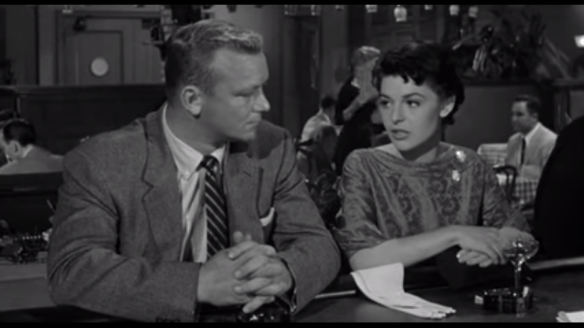
But for Jim Vanning (Aldo Ray), from when we first meet him on an L.A. street corner, it becomes apparent that other stories are being grafted in with his and it starts long before we meet him. He steps into a bar and on pretense is introduced to the working model Marie (Anne Bancroft) sitting next to him.

We wonder where their conversation will end. A good bet is some sort of romantic tryst or at least a future date, except, instead it’s into the grasp of two thugs who seem like they’ve been waiting for him. Eventually, we learn through a flashback what happened.

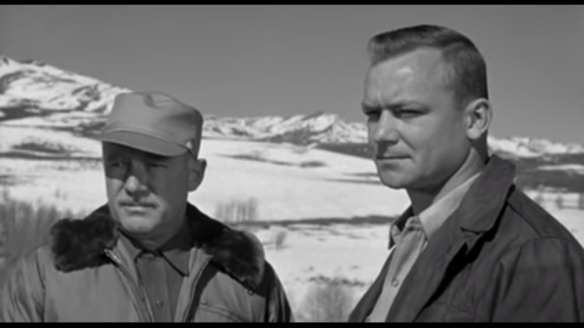
He was having a quiet weekend away with his good friend, a doctor (Frank Albertson). The scenery around them is gorgeous, the snow peaks of Teton country poking up behind them in their white-capped winter majesty extending as far as the eye can see. But against that, a truly harrowing development arises.

They see a passing car careen off the road and they go over like any decent citizen to provide aid only they are met by a pair of bank robbers who have a cutthroat mentality seeing as they ran off with $350,000  worth of cash. Almost instantaneously Jim’s reverie is shattered by the worst reality check he’s ever been stabbed with.

nightfall 3.png

By some miracle, a fortuitous piece of counter fate, he escaped with his life. However, despite a change of location, name, and even occupation — he’s an advertising artist now — like clockwork John (Brian Keith) and Red (Rudy Bond) caught up with him.

He thought Marie was in on it as well and confronts her about it but the romance blooming between them and the fact she’s an oblivious bystander throws them back together. Jim’s resolved to take a bus ride back out to Wyoming to recover the money because his hand is forced. He knows the two robbers will be after it. He doesn’t realize at first they’re not the only ones. A personable insurance investigator (James Gregory) has some vested interests of his own.

Nightfall is generally more fascinating for its locations and elements of style and atmosphere than its actual plotline but sometimes with B noir that’s admissible. The stark contrast is stunning taking us through ’50s era Los Angeles and providing an excellent time capsule juxtaposed intermittently with the snowy scapes of Wyoming.

In a particularly terrific moment, we watch as the noir world seeps into the refined elegance of a ladies’ fashion show where Marion is working the runway. It’s this lovely collision of peoples and settings we are not used to seeing together in the same frame. Meanwhile, the continually dueling voices of Aldo Ray and Anne Bancroft prove a simple pleasure in their own right with such rich tonalities of character that distinguish them fully. Perhaps it’s a mere consequence of cigarette smoke.

Not terribly unlike Nicholas Ray’s On Dangerous Ground (1951), the picture goes back to the powder of the Wyoming winter and climaxes in a snow plow finale, which is invigorating as much for its backdrop as it is for the action. Some will note the character arcs have been much revised from Out of the Past and we get our hero’s happy ending. Nevertheless, it traverses a brutal road in its own right.

3.5/5 Stars

Great Day in The Morning (1956) and Owen Pentecost

great day in the monring.png

The backdrop is important to understand where we’re at in America’s history. It’s the 1860s. We’re in the Colorado Territory but it’s the eve of the most egregious war that ever was fought on American soil. Already blood is boiling between diehard Northerners and the Secessionists who want nothing better than to bury each other under a foot of dirt.

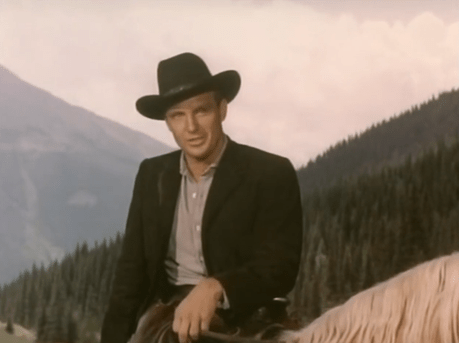
We get a taste of it in a man name Zeb who helps save another man’s life from marauding Indians only to turn right around and wish he’d left him for dead upon hearing he’s from North Carolina. However, he’s not the one giving orders. He and a more reserved companion, with a covert mission of his own, are working under hardy Virginia Mayo who is intent on setting up a dress shop out west. She obliges the stranger, the wonderfully named Owen Pentecost (Robert Stack) and he gladly joins their peculiar company.

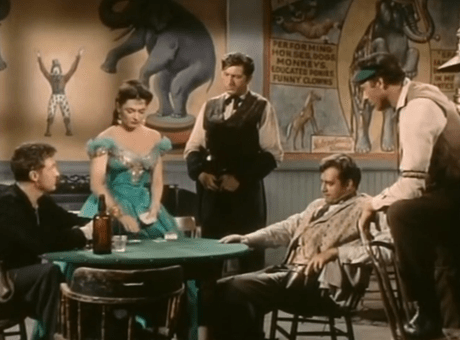
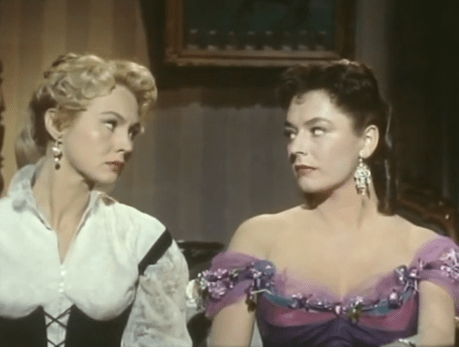
When they get to town, Pentecost challenges a local saloonkeeper (Raymond Burr) in a high stakes poker game and in the last hand winds up owning the place. As a result, he’s made few friends on either side of the brooding town except for the flirtatious chorus girl Boston (Ruth Roman) who frequents the joint and stacks the deck in his favor.

great day in the morning 2.png

He takes up with his brethren below the Mason-Dixon line because he’s heard rumblings that they have a payload of gold and no way to get it back home. Their goal is to use it to bankroll the early stages of the inevitable war. Pentecost is no rebel and no patriot. He’s purely in business for himself and that makes for a thoroughly enjoyable character given the present climate. Because he ends up being an outsider to both contingents.

Instead, he looks to start a revival, preaching a gospel of gold as he’s got a lot of stakes in his ownership, which have yet to be excavated. Though most people around hate his guts, some are in desperate need of money. He lets everyone know he won’t tolerate any double crossing and yet it ends in the inevitable. One man is left for dead and it means very little to Pentecost until the orphaned son comes west, oblivious of the fate of his father or by whose hand. Pentecost takes him under his wing, foregoing to tell the boy about the precise events behind his father’s untimely demise.

He has no sentimental lumps in his throat about going off to war. His only goal is staying alive and he has quite the test ahead with Fort Sumter surrendering and the territory overrun with bloodthirsty Union men as it is. The northern loyalists come to his saloon with one thing on their minds. Making “The Rebels” pay by filling them full of lead. Hanging is too good for them.

But violence only sows more violence and hate still more hate. The collateral damage is far-reaching. The minister (Regis Toomey) watches the world continually shot to hell around him and he puts his hands up and runs into the fray to be some voice of peace even as he too is affected.

A daring escape is finally undertaken with the Union soldiers camped out nearby looking to gun them down decisively if they won’t surrender their goods. It ends up not mattering. The wagons loaded with gold take off in the cover of the night as the loyal Northerners look to chase them down led by the Union officers who have been tasked with the assignment.

It’s at this point that Pentecost finally seems to get a noble streak. In one sense, we see a certain amount of gallantry even on the verge of such a traumatic war but there are also tones that are unquestionably, even morbidly dark. It’s as if to suggest that war might bring out heroism in people but it can also bring out our very worst tendencies too. It’s just our innate nature as human beings.

It seems such a long distance that we have traversed since those opening shots on the brightly lit plains, one newcomer, a lady giving the orders, and two men who will turn out to be deeply invested in this newly forged war. The Civil War changes the entire complexion of the film by its end, even the mores of our main character.

great day in the morning 3.png

Cinematographer William E. Snyder boasts chiaroscuro color photography that’s so easy to take for granted because it bathes most of the picture, particularly the later scenes where it seems like more and more drama unfolds during the evening hours.

Part of the reason there’s little to no fanfare around a picture such as this is it’s wholly counterintuitive for B-grade entertainment to be formalistically stylish but that’s what Tourneur always seemed capable of since the days of Cat People (1942). It’s little different here and in one of his final westerns, he continues shooting beautiful sequences with storylines that don’t have any right to be.

There are interludes where Great Day in The Morning has rather peculiar beats and one could say the ending comes early or it’s anticlimactic or it didn’t matter, to begin with. Any one of those conclusions could, in fact, be correct but regardless, some might be taken just as I was with this unassuming oater.

It’s buried movies like this keeping hungry cinephiles always searching for a new delight. It doesn’t have to be a glowing success but if it even momentarily sparkles with shards of inspiration while bringing together a fine cast, we have a winner. Maybe I’m just an ardent Tourneur fan or have a soft spot for Ruth Roman and Virginia Mayo, not to mention the western genre as a whole. Either way, I have few qualms in liking this outing for precisely these isolated reasons.

3.5/5 Stars

Stranger on Horseback (1955) with Judge Joel McCrea

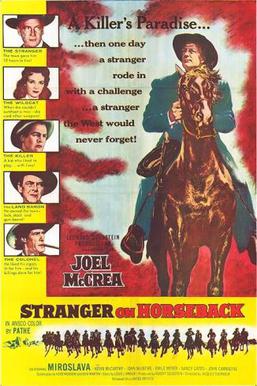
Stranger_on_Horseback_film_poster.jpgI didn’t know my Grandpa too well because he passed away when I was fairly young but I always remembered hearing that he really enjoyed reading Louis L’Amour. It’s not much but a telling statement nonetheless. I’ve read and seen Hondo (1953), which stars John Wayne and Geraldine Fitzgerald, and yet I’d readily proclaim Stranger on Horseback the finest movie adaptation of an L’Amour novel.
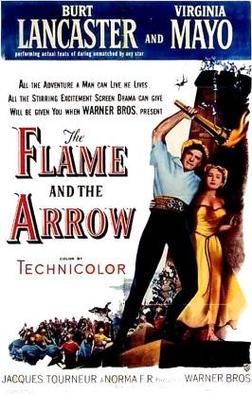
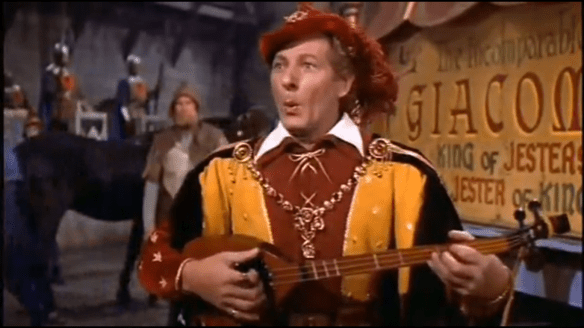
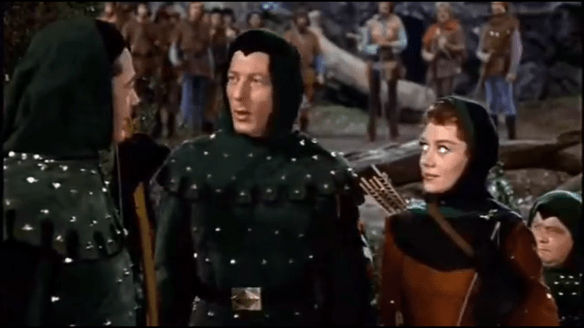
Exhibit A is Joel McCrea as a circuit judge, highly principled but firm in his dealings. He’s not simply an idealist either also having the guts to back up his philosophy, packing a gun and walloping thugs when it’s called for. He comes off as an irreproachable, unstoppable enactor of justice — a truly fascinating hero to stand front and center in a western.

Exhibit B has to be one of the most underrated directors of this period in Jacques Tourneur who not only showed an early penchant for low budget black and white horror but in a handful of color westerns, he showcased an equal affinity for visual filmmaking. Shot in Anscolor, Stranger on Horseback is quite the looker, encapsulating the 1950s western landscapes of old. No budget is too minuscule and no runtime too short for Tourneur to make an interesting picture.

The man rides past the unmistakable images of a pine box and a makeshift funeral. The dead man and the reasons for his death are still to be told. However, it becomes apparent very quickly that he was gunned down.

John Carradine leads the welcoming committee as the local attorney and stooge who is very conveniently on the Bannerman payroll and therefore in the family’s pocket. Because in a small place like this hidden away from the long arm of the national government, the Bannerman family and their associates remain king and they have their hand in everything.

The crotchety Josiah Bannerman (John McIntire) is looking to buy out the judge and invite him over to dinner to straighten him out about the killing that took place. He actually meets Judge Thorne and realizes full-well that’s not going to happen with such a principled man. For once there’s someone who isn’t afraid of him, even if he should be.

There’s his niece Amy Lee (Miroslava) who’s handy with a pistol and though she’s on the verge of marrying a feckless local boy, there’s a sense that he cannot give her anything. She is too strong like Bannerman. She needs a man who can match her self-assured toughness.

But it is Tom (Kevin McCarthy) the cocky, smart-aleck son who the judge forcibly takes to the local jailhouse to hold him for the murder of another man. Thorn’s put a target on his back and he knows that the retribution of Bannerman will come swiftly if he cannot be bought out.

He gets the support of the local sheriff (Emile Meyer) who’s eager to shed the apathy that the town breeds and back a man with real guts who will stand by his gun. That’s attractive to him and so if no one else stands up, the Judge has one friend. Meanwhile, he rustles up a few clandestine witnesses to testify against the Bannerman boy because they saw what happened and though initially reluctant they agree to testify since it is the right thing.

With the nearest speck of civilization and with it the nearest courtroom being in the town of Cottonwood 47 miles away, it’s inevitable that Bannerman will send his cronies after the small caravan to stop them in their tracks. It looks to be a daunting proposition at best but again, the Judge never balks.

The finale is all but cut short on an abrupt even awkward note much as we suspected. Our hero has been met and his bluff has been called. But we soon realize since he has been a brazen and thoroughly scrupulous man thus far, he’s not about to change anytime soon. So the final outcomes might surprise just as much as they captivate in a mere matter of minutes.

The question remains, why does the judge go through all this trouble? Is it some vendetta that has him out for vengeance? Is he doing it to prove his stature or receive the admiration of a woman? Is he simply a fellow who’s a stickler for rules and regulations? We never know for sure. Of course, there are obvious markers.

Our best hint comes out of another man’s mouth as he reminds his daughter, “There’s right and there’s wrong and when you see the difference you’ve just got to speak up.” In Judge Thorn, McCrea has brought to life a man who holds to precisely those moral tenets.

He puts his safety in jeopardy, he makes himself unpopular and foregoes major payoffs that could help him live comfortably. All because his view of justice and of right and wrong are so lucid he sees no other way of going about his duties. Let there be more men in our world like the Judge. Not sticklers but men of immense integrity.

Stranger on Horseback is a testament to small-scale westerns that have the guts and the certain level of ingenuity to stand out and weather the ultimate test of time.  Dig it out of obscurity, dust off the mothballs, and you might just find yourself in for a pleasant outing.

3.5/5 Stars

The Flame and The Arrow (1950): Italy’s Acrobatic Robin Hood

Flame_and_the_arrowposter.jpg

In the region of Italy called Lombardy, Dardo Bartoli (Burt Lancaster) is a bit of an Italian Robin Hood. However, his acclaim as an outlaw is brought on by personal conviction and a blatant disregard for authority. Others are captivated by his lionhearted bravado and fearlessness that, even as a peasant, leads him to brazenly defy the local despot Count Ulrich (Frank Allenby), known as “The Hawk.”

The two rivals have a muddy history embroiled in wonderfully complicated family dynamics as we soon come to understand. No, they are not related, as Dardo has no noble blood, but his former wife (Lynn Baggett) has willfully taken up as one of “The Hawk’s” courtiers. For that, the proud man has never forgiven her and entreats his young son to remember his mother so he can know the truth about what she did. The boy is played by the terribly precocious Gordon Gebert who many might remember from his memorable turn opposite Janet Leigh in Holiday Affair (1949). He’s much more astute than his age might lead us to believe.

In an act of skill and overt cheekiness, Dardo shoots down one of the king’s prized hunting birds and must flee across the rooftops, scaling walls and scrambling away to live another day. But his son is not so lucky and he gives himself up to the guards so his wounded father can get away. He will be taken to be with his mother and trained up in the way of a nobleman. Learning how to carry himself and dance like a little gentleman. But that doesn’t mean he has to like it. He is the heart and soul over which the entire film will be fought over.

Though he received a great deal of help from quality stunt performers like industry veteran Don Turner, there’s no doubt Lancaster’s own training as an acrobat was put to good use in this swashbuckler, which even saw him partnered with one of his old company Nick Cravat.

There’s an instant camaraderie between Dardo and the mute Piccolo. It’s palpable because the two performers have, in fact, spent many years together on the road doing acrobatic feats together so the trust is by no means a fabrication. They put the real-world rapport to good use through every trial they must face together. They know amid all the treachery on hand, their friendship will hold fast.

Among other bits of mischief, they create a man-made avalanche to come raining down on “The Hawk’s” guards in a mountain pass to frighten them away. Then, the merry brigands are joined by Allesandro (Robert Douglas) who was recently scorned by the Count. He is accompanied by his bard, a very well-versed fellow with a wry wit (Norman Lloyd).

Soon Dardo is on his way to disrupting the king’s courts to collect his son and comes swinging down right into their dinner, fending off the soldier’s lances with a flaming torch. Whether or not it would be practically effective is up for debate but it sure looks cool.

Although they are thwarted in their initial objective, in the hubbub, they manage to steal the princess, the Count’s glamorous niece (Virginia Mayo), away from the castle as leverage. She’s taken back to their lair, situated on some ruins in the wilderness, far from the prying eyes of the Count, to wait it out in captivity. The next move is to bait an irresistible trap for the outlaws by taking Dardo’s feeble uncle to be hung on the gallows within the city gates. The showdown is set. And yet when that is handily dealt with a whole row of new hangings come in its place.

The Count is beyond playing nice. He wants to see Dardo squirm and he’s going to do everything in his power to end him once and for all. In fact, it looks like he’s outmatched his pesky arch-rival. Yet with the help of the townsfolk, the outlaw pulls off one of the great death-defying stunts of all time.

At its best, The Flame and The Arrow really becomes a game — a medieval fencing match with deliberate lunges to go on the offensive then feints and parries, ripostes and other countermeasures all culminating in one final victor. But it comes down to the wire.

The king’s guardsmen prove no match for hordes of villagers and carnival showman led by Dardo, in one last daring siege, rescuing prisoners and overrunning the premises in a most uproarious fashion. But the beauty of how the allegiances have been set up means in order to get to the king, who is looking to run off with Dardo’s boy to live another day, he must go through Allesandro who is compelled to hold him off.

All in all, The Flame and The Arrow lives up to its name with lively acrobatic combat sequences and an impressively agile Burt Lancaster. I must admit I had never seen him in this light as a kind of cavalier action hero cast out in the mold of Douglas Fairbanks or Errol Flynn. I know now he was more than capable of the rigorous challenges.

Virginia Mayo is as feisty as she is radiant, caught between her royal blood and a man who excites her more than anyone she has ever met. Meanwhile, Jacques Tourneur demonstrates once again that he is one of the finest directors of genre pictures Classic Hollywood ever had moving so freely between horror, westerns, adventure, etc. He can do it all.

4/5 Stars

The Court Jester (1955): The Brew That Is True

the court jester 3.png

Maybe I’m simply partial to Medieval forms of entertainment but it’s hard to imagine a finer vehicle for Danny Kaye than The Court Jester. It needs to be lithe enough to accommodate his goofy even acrobatic brand of song-and-dance buffoonery. What better arena for Kaye than the king’s courts, that laughable domain of a man in a dunce cap and tights?

However, equally important is some form of plot for the actor to hang his routine on. The production is complemented exquisitely by a lavish setting replete with fine costuming, bejeweled individuals, and everything from knights and sword fights to magic incantations, backroom treachery, and romantic entanglements.

The humorous tongue-in-cheek opening diddy “Life Could Not Better Be” sets the tone nicely. We are inserted into a storyline that is a decidedly genial Robin Hood knockoff. In his place is our righteous outlaw The Black Fox who is looking to install the rightful king to the throne, the infant with the royal birthmark — the purple pimpernel.

The malevolent, power-hungry King Roderick has usurped the domain and set himself up as the supreme leader of the land, surrounding himself with an array of equally loutish characters, namely Lord Ravenhurst (Basil Rathbone). The King is hopeful an alliance with a knight named Griswold will help him to vanquish his mortal foe, the Fox, promising to betroth his reluctant daughter (Angela Lansbury) as a sign of goodwill.

Ravenhurst, fearful that his place of prominence might be undercut, calls on the services of a Court Jester named Giacomo (John Carradine) to do away with the king’s other consorts. However, on the surface, it seems the perfect disguise for the minstrel Hubert Hawkins (Kaye) to aid the Black Fox in his raid on the castle.

the court jester 1.png

If Kaye is for all intent in purposes our Allan a Dale thrust into our Robin Hoodish role, then Glynnis John is his fair companion Maid Jean (aka Maid Marian) who also happens to be a trusted captain of the Foxes men (aka his capable Little John).

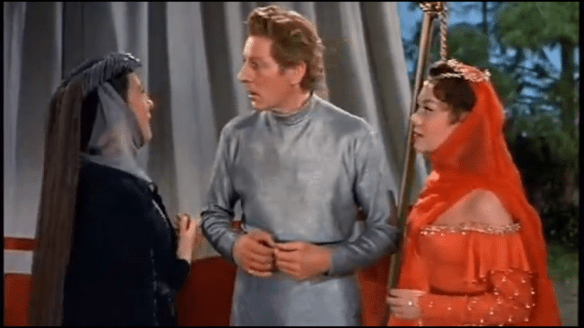
After they overtake the real Giacomo, the carnival showman dons the robes of a jester for the masquerade. He thinks there is only one agenda. To meet a contact within the castle on behalf of The Black Fox. Little does he know, he’s also got to look after the well-being of a precious baby in a basket while unwittingly making a connection with Ravenhurst who assumes him to be an assassin (“Get it?” “Got it.” “Good!”).

Meanwhile, the princess receives an oracle from her personal maid — a witch named Griselda (Mildred Natwick) — that a gallant man will soon arrive at the castle to have her hand. Little does the new Giacomo know he’s now caught up in a third complication as Griselda casts a spell on him turning him into a strapping and virtuous lover with the snap of her fingers — another one of the film’s recurring gags.

After his new entertainment arrives from Italy, the king also sends out an edict that all the fair wenches of the land be brought into his courts and, of course, the lovely countenance of Maid Jean gains the favor of the king, earning her a prestigious place in his company.

As he does his best not to bungle (by purposefully bungling) his floor show to earn the approbation of his master, Kaye must try and resolve the three plans of action put forward, though he’s conveniently forgotten them all.

the court jester 5.png

Soon our hero is ousted as an imposter and a cunning plan is enacted to red light him for knighthood so he will be eligible to face off against Griswold at the following day’s tournament for the hand of the princess. It’s all but inevitable. He’s a dead man without a chance at survival unless the Black Fox can come in time to take his place! Alas, it is not to be.

Their last-ditch effort is to try and poison Kaye’s formidable foe before they enter into combat. What it sets up is the film’s most beloved gag and one of the most heavily quoted routines there ever was: The Vessel with the Pestle and The Chalice from the Palace. In typical Kaye fashion, he struggles to remember which one holds the brew that is true or as he says it “the true that is brew.” Add the Flagon with the Dragon to the verbal shell game and he’s done for.

The extended hijinks is pure tongue-twisting, mind-boggling perfection, given an added exclamation point by his suit of armor becoming conveniently magnetized. This causes him to continually clunk into his adversary as they present themselves before the king. It couldn’t be funnier. And as a good belly laugh is often hard to come by these days, I was greatly delighted. The scene plays just as well as the first time I’d seen it.

But the antics in part give way to some genuine thrills as the jester leads a daring uprising against their would-be captors capped off by a counter-offensive by their friends. A merry band of little people sneaks in only to terrorize the courts and form a conveyor belt to fling their adversary away from the castle premises with a catapult. What follows is a storming of the castle by the rest of the rebels and a finale of the best comical homage to Technicolor Robin Hood there ever was.

A final duel with Ravenhurst showcases Kaye’s bipolar “dual” personalities. First, the frantic slap fighting of a craven coward, then the cocksure swordsmanship of a man with endless confidence, though it takes some support from his true love to send Ravehurst to his fitting demise.

There, in a nutshell, you have the impeccable concoction of the film reflected in Kaye. He’s a buffoon as much as he is a hero who nevertheless comes out on top thanks to another’s love. With a fairy tale ending such as this, life could not better be. Of course, The Court Jester is spruced up by the very fact it supplies a wagon-load of laughs to supplement a thoroughly agreeable adventure.

4.5/5 Stars

He Ran All The Way (1951): John Garfield’s Final Film

he ran all the way 1.png

We meet the belligerent two-bit criminal named Nick Robey (John Garfield) sleeping one off in the grungy apartment he shares with his acerbic mother (Gladys George). It’s not exactly the lap of luxury but it gives us some immediate insight into who he is. He’s an oafish, pitiful excuse for a human being and he’ll never amount to anything. One very visible reason comes from his open disdain for other people; he and his mother share no amount of affection whatsoever. It’s not a very promising portent.

Norman Lloyd, once again, plays some sidewalk sleaze, like he did in Scene of The Crime (1949), this time coaxing his pal Nick into helping him pull a job. It looks as easy as pie. And it is. The man parks, starts walking away with his briefcase full of dough, and they overtake him easily — without a hitch of any kind. But it’s inevitable; in order for there to be any movie at all, something must go wrong. A nosy policeman starts poking around and they scramble to get away before he nabs them.

The cop fatally wounds Lloyd but Garfield gets away, not before gunning down his pursuer. Just like that he winds up a cop killer. Except no one knows his identity definitively. So he’s got to go on the lamb keeping himself masked with the weekend crowds.

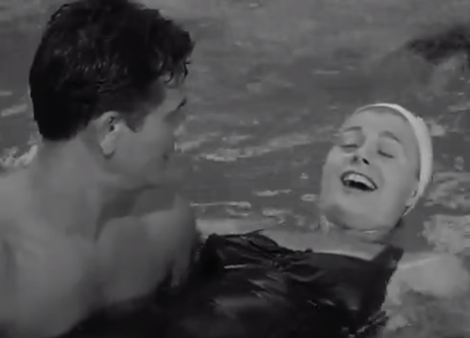
It’s a fascinating documentation of weekend diversions, in particular, community swimming pools. With his payload of money in toe, Nick nervously tiptoes around the pool eyeing the oblivious policemen milling about. There he also meets a girl. She’s not only a cover but a bit of a welcomed distraction from his continual paranoia.

he ran all the way 2.png

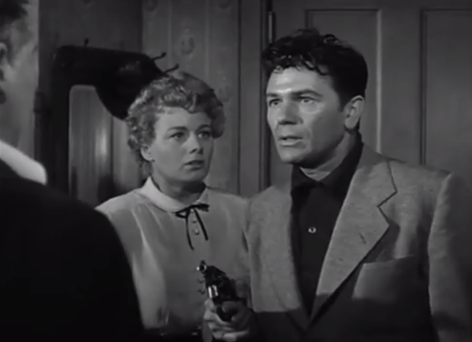
He Ran All The Way takes on a motif reused in Suddenly (1954) and other such pictures as Nick essentially becomes a live-in guest to Peg Dobbs (Shelley Winters), her parents (Wallace Ford and Selena Royle), and her kid brother (Bobby Hyatt). He lets them go about life partially unimpeded, keeping one of the family at home at all times as constant leverage. That way there’s no funny business.

While the picture is hardly Garfield’s best, it is imbued with tightly coiled tension that’s instigated in the opening minutes. The ticking clocks never end aided by confined spaces, oddly intimate relationships between captors and hostages, as well as a volatile showing by Garfield. He’s all turned upside down trying to deliberate on his future plans.

Then they have a clash of principles over the dining room table. The family with their stew and him with the turkey and the lavish meal he’s gotten together. They want no part of it but he’s going to get them to eat even if he has to provoke them at gunpoint. In another scene, he inquires gruffly, “What does that church stuff do for you?” Without skipping a beat, still working away on his model vessel, Mr. Dobbs succinctly replies, “it makes you understand the virtue of love.”

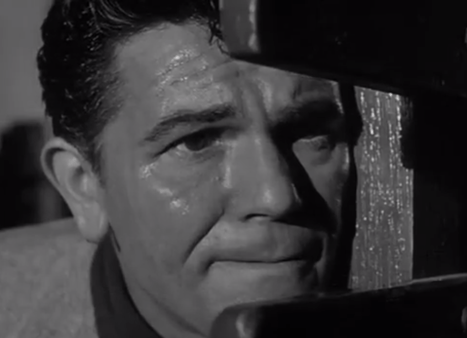
Thus, this dialogue aptly frames the story as a tale pitting family versus romance in such a way that only one can come out intact. Peg is the one forced to make a choice. James Wong Howe’s camera works in numerous close-ups and that continues even until the end of the film to underscore moments of isolated impact. Garfield’s face, in particular, is singled out. We see the fear, the anger, and the confusion breaking out across his features time and time again.

A stairwell finale perfectly epitomizes the dynamic between the two leads, see-sawing back and forth perilously. Until they make it to the ground level and things must come to their harrowing conclusion once and for all.

he ran all the way 3.png

For all the hell Garfield put his captors through, the look on his face is striking, when it all comes to an end. It’s betrayal and fright and forlornness all rolled into one. Even as he’s a hard-bitten, tormented man, there’s still a sliver of something inside of him that we cannot help feeling sorry for. That’s a testament to the earnestness of his talent.

The context of the picture becomes arguably just as important as the film’s condensed narrative. Like any movie, it was hardly conceived in a vacuum and the early 1950s were, of course, characterized by the paranoid finger-pointing culture of McCarthyism.

The emblematic figurehead that always gets brought up is The Hollywood Ten — who subsequently were some of John Garfield’s closest collaborators. Dalton Trumbo even worked under a pseudonym on this script while director John Berry, for all intent and purposes, might have been christened the 11th member of this targeted group. Following the production, he would enter a self-exile in Europe.

But this would also be John Garfield’s last film and it would primarily be his last film — most people agree — because his heart attack, brought on at the age of 39, was caused by undue stress from the allegations he was embroiled in.

Even though he went before the House Committee on UnAmerican Activities, his appearance did not completely absolve him and on top of that, a separation with his wife looked to be ending in divorce. He would die on May 21st, 1952, his funeral attended by masses of mourning friends and fans.

He was the apparent forerunner to such other tragic figures like James Dean and Montgomery Clift and the not-so-tragic decline of Marlon Brando. Without Garfield, those fellows would have come out of nowhere but from him, you trace the line of progression from hardboiled stars like Cagney and Bogart. Watch these films and you recognize that same pent-up alienation and angst. Most importantly there’s a newfound sense of vulnerability being awakened.

3.5/5 Stars

Executive Suite (1954)

executive suite 1.png

Executive Suite is a story of the high rise corporate jungle where on a daily basis it’s a Darwinian experiment not only pitting company against company but, on a microscale, man against man. After all, in the most cynical sense, that’s what free market capitalism is.

Top to bottom, the film boasts rich reservoirs of talent from sure-handed director Robert Wise and screenwriting newcomer Ernest Lehman who would soon be a hot commodity in the industry thanks to the likes of The Sweet Smell of Success (1957) and North by Northwest (1959).

It also proves to be an All-Star cast if there ever was one,  stacked with at least 10 easily recognizable names rounding out a lineup which could go toe-to-toe with any other drama of the decade on talent alone. Such a bevy of stars hearkens back to the golden years of MGM in the 1930s before television was ever a thing and they had as many stars as there were stars in the sky.

Today Executive Suite admittedly doesn’t get much coverage as a drama because, in spite of its vast ensemble, it’s not necessarily grandiose or vibrant, even compared to later Wise successes like West Side Story (1961) and The Sound of Music (1965). However, this in no way should downplay its striking qualities and there are some compelling ones.

Out of all the stylistic choices, one of the most noticeable ones and, subsequently, unusual decisions for the era is the absence of any form of traditional musical scoring. In this regard, we could say the scenes are not manipulated by any amount of sonorousness. What we see is making some claim at authenticity with street noise in lieu of diegetic sound and Chet Huntley introducing our narrative set in the upper echelons of a skyscraper.

Though a bit gimmicky by today’s standards, Wise does immediately catch our eyes with an extended POV shot taking on the perspective of an unseen big wig name Bulliard, the formidable head of Tredway Furniture Co. He’s coming back to town and has slated a meeting for that same evening, upon his return. Except something highly unsuspected happens. One might blame the taxing strain of his work but he winds up dropping dead in the street. Some scrounger conveniently picks up his discarded wallet, making any form of identification more difficult for the police.

The company is thrown into an uproar following his sudden and untimely death, especially because there is no true contingency plan as the deceased had no single, hand-picked second-in-command.

Nina Foch is the secretary managing a vast network of information, funneling down to all the executive suite. She is the runner between offices and boardrooms, relaying the information to all the necessary contacts as Bulliard’s right-hand assistant.

executive suite 2.png

They gather for their impromptu meeting. There’s Frederick Y. Alderson (Walter Pidgeon), a career man who has been by the side of his friend Mr. Bulliard for many, many years now. Loren Shaw (Frederic March) is a relatively new addition to the company but as chief controller and a shrewd numbers man; he’s been able to up the annual earnings at Tredway as of late.

J. Walter Dudley (Paul Douglas) is the charismatic head of sales who could talk anyone into buying just about anything. He’s that good. Of course, his dirty little secret is he’s been embroiled in an affair with his secretary (Shelley Winters).

The ambitious young family man Don Walling (William Holden) holds a more hands-on position in the factory, overseeing design and development while the old warhorse, Mr. Grimm (Dean Jagger), is in charge of manufacturing. However, with their product going down in quality to cut expenses, he’s got an idea to retire. He holds no pride in his work anymore.

Between all these men and the opportunistic snake-in-the-grass, George Caswell (Louis Calhern), we have the gathering of the top brass and quality acting talent. It’s a bountiful proposition getting all these people in a room together. And when the news breaks it’s essentially an exhibition of “who died and made you king” as the factions scramble into action, assembling to vie for some form of supremacy.

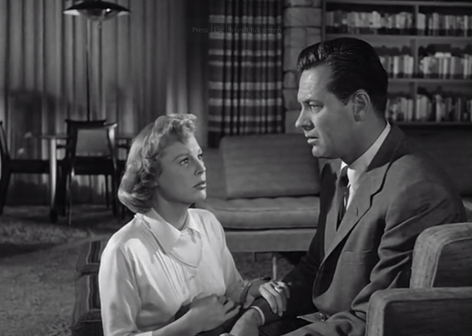
Shaw is the first man spurred into action in the wake of Bulliard’s death because though Alderson holds private aspirations, he resigns himself to acquiescence. But that doesn’t mean they’re going down without a fight. Walling plays the number games late at night trying to figure where everyone stands. He confides in his wife (June Allyson) and plays catch with his son but his work-life balance is suffering. His wife worries the instability will bury him professionally.

It’s true the names are continually interchanging thanks to dirty politics and a plethora of finagling, leveraging, and leaning to line everything up for the impending nominations session to be undertaken on a closed ballot.

executive suite 4.png

In a man’s world, it’s fitting that Barbara Stanwyck would be the only woman with any sway on the meeting of the mind’s thanks to her stock holdings in her father’s company, which Bulliard helped appreciate. She doesn’t have much screentime but her very financial capital makes her crucial to the picture as an unpredictable swing vote. Her wild card and some late arrivals obscure the resolution to the last possible instant in thrilling fashion.

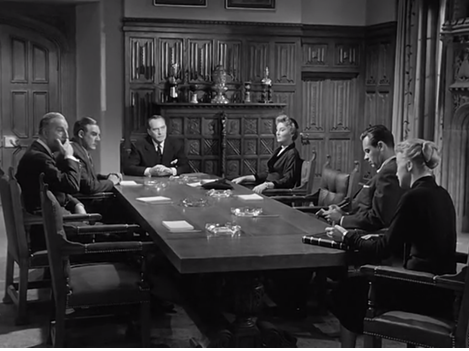
It’s true Henry Fonda was up for a part in the movie and that inkling gives me a rather obvious realization. Executive Suite does play like a bigger, loftier version of 12 Angry Men (1957). Especially in its most crucial minutes. Far be it from me to say people sitting around a boardroom table cannot be interesting because once more I was invested in what decision was arrived upon and I knew it took every one of those actors around that table to make it stick.

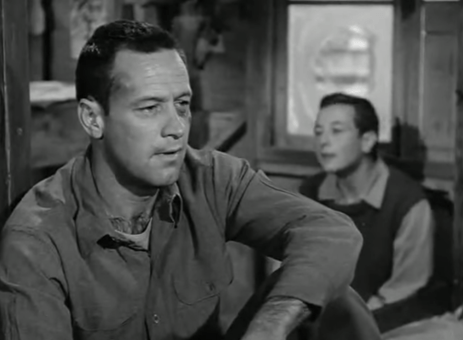
Someone has to rise to the occasion and that person is William Holden, positioned as the initially hesitant one, dismissed as still inexperienced, and yet he has a vision the others lack. He’s not a tired old man. He’s not driven solely by profits or bitter over past affronts.

He’s looking beyond to new territory and a future where the company can prosper not simply because of penny-pinching but an actual pride in the quality of the product they can offer their customers. If you wanted to make a sweeping statement, you could say he, even momentarily, redeems the American Dream, a symbol of the American everyman with his white picket fence, beautiful wife, and high ideals. That is until the next board meeting happens. But I would like to think he is capable as a leader for change. It’s true we need people like him in this world of ours.

4/5 Stars

Review: Stalag 17 (1953)

stalag 17.png

I grew up with Hogan’s Heroes reruns on our Magnavox analog television. In fact, at one point it was my favorite show because it had such a colorful cast, it was perennially entertaining and utterly goofy to the extreme. But others have understandably decried the show because they see it finding humor in something that is not very funny. They contend it was making light of the Holocaust and WWII on the whole. Although I do believe this is an oversimplification and I don’t have time to tackle it right now, it’s still an important dialogue to have. I will defer to others for the time being.

The point of discourse I want to take up is Billy Wilder’s Stalag 17 because it’s obvious there would be no Hogan’s Heroes without this P.O.W. comedy-drama. The plots, even the characterizations, are eerily similar, close enough to prompt plagiarism lawsuits. But the difference is Hogan functions as pure zaniness carried by the strength of its ensemble where the Germans are utter buffoons. That’s the hallmark of characters like Sergeant Schultz (John Banner) and Kommandant Klink (Werner Klemperer) who are both lovable imbeciles. They will never be allowed victory over Hogan and his allies.

In Wilder’s hands, a P.O.W. camp is silly and light-hearted at times, yes, but it’s also equally dark and cynical. Because what would a Wilder picture be without some pointed comic venom? Two obvious points of reference would have to be the wartime comedy directed by his idol Ernst Lubitsch, To Be or Not to Be (1942), which some would argue employs morbid humor. Then there’s Grande Illusion (1937) starring Erich von Stroheim (featured in Sunset Boulevard) as a prison camp commander who can easily be contrasted with Otto Preminger’s Colonel von Scherberg. In both, you have those evident counterpoints of humor and tragedy exquisitely executed.

Stalag 17′s opening escape attempt of two men is snuffed out by machine gun fire just waiting to mow them down. It’s the definition of unsentimental and it is the first of numerous breakdowns in communication. There is a rat somewhere. There has to be.

stalag 17 2.png

Then, the picture is back to its belly laughs supplied most obviously by Harry Shapiro (Harvey Lembeck) and his tubby, scruffy buddy Animal (Robert Strauss). They spearhead all of the shenanigans, including a daring attempt to break into the prison camp of Russian women to sneak a peek. You see, Animal’s deeply broken up by his unrequited love for Betty Grable. They bicker with the resident Sergeant Schultz (Sig Ruman), another Hogan’s Heroes precursor, who good-naturedly chortles at all their ribbing. Surely this isn’t anything like how Stalags actually operated?

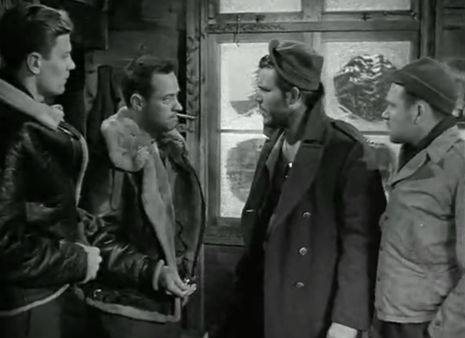
Wilder’s trademark biting wit is most fully realized in Sefton. For the part he was initially reluctant to take, William Holden donned a crew cut and scruff generally masking his normally dashing features. But this was hardly the aspect making him uneasy about the role.

Sefton is a textbook undesirable. He openly trades with the enemy in an effort to make himself as comfortable as possible. He bets a boatload of cigarettes the two fugitives won’t make it out of the camp and when it proves morbidly correct, he makes a killing.

Likewise, he’s the local wheeler-dealer, maintaining the Stalag 17 rat race turf complete with betting for all the servicemen. His other enterprises include a distillery — a flamethrower of sumptuous potato peel schnapps — and “The Observatory” where all the boys eagerly line up for a tantalizing look at the Russian delousing shack. Conveniently, he’s also the obvious culprit when a stoolie is suspected within their ranks.

It takes all kinds to liven up the joint and make it into a space with real drama to go along with so many lighter notes. We already mentioned Harry and Animal but the Barracks chief is the always reliable Hoffy (Richard Erdman), head of security is Peter Graves, Duke (Neville Brand) is the rough and tumble one who’s not squeamish about having a fist fight. There’s a blond brainiac, the catatonic one, the amputee who uses his spare space to sneak materials in and out of the barracks, and the nasally mailman with a voice to top all voices.

stalag 17 3.png

When a new prisoner named Dunbar (Don Taylor) gets brought in with his copilot (Jay Lawrence), who has a penchant for spot-on impersonations, they receive a hero’s welcome. After all, they helped to sabotage enemy armaments on their way to being captured. But the information leaks continue with their radio being confiscated and Dunbar being called in for questioning, due to his treacherous activities. The SS is coming to take him to Berlin for questioning. If he’s ever going to come out alive the P.O.W.s must make a last ditch effort to try and get him to safety.

Meanwhile, Sefton gets a going over by the whole barracks, which is quickly overshadowed by Christmas in the camp complete with carols, dancing, and parading full of gaiety. It’s meant to lull us into a false sense of security as Sefton is put in his place and things are good again. It all conveniently diverts from something else. Sefton’s not the culprit. Someone else has been communicating with the Germans and tipping them off.

The final confrontation is when the film really puts it all on the line. We find out who the perpetrator is and Sefton’s vindicated in everything, even going out as a kind of hero. Except to the bitter end, he’s never redeemed as a human being. He’s as hard-edged and acerbic as ever and yet to the folks at homes, he’s who will be cast a hero because he did something brave. Holden was uncomfortable with this as much as we are as an audience but Billy Wilder was unflinching and ultimately right in creating this dissonance.

If anything, Stalag 17 as realized by Billy Wilder and his team is a reminder of the harshness and utter absurdity of war. This is how he conceives it — a man who lost his parents to concentration camps and was sent over to his former land to help rebuild it. He probably knew as much as anyone how horrible the Nazi atrocities were but to memorialize every attribute of the Allies as noble would not document the whole truth.

If Sefton’s the poster boy of the war, then we have to take a deep hard look out our ideals and what we stand for. Because, of course, he was the only one not taken in. Everyone else was so quick to accuse him and to see what they wanted to. It’s almost as if a film documenting an aspect of WWII was in the same breathe suggesting what was afoot with the red scare in the rising fury of the Cold War. Heaven forbid a person we don’t like or don’t agree with is not so easy to demonize as “other.”

It’s far too scary to concede they’re probably just like us. They just didn’t have the decency to hide it. Perhaps they’re better because they were not swayed by the clouded judgment of others.

So if I watch Stalag 17 and become turned off by this incongruity between the historical setting, the lightness in tone, and the shock of a generally unsympathetic lead, maybe it says more about my conception of the world than anything wrong with Billy Wilder’s admittedly incisive picture. It’s a scary admission to make but it just might be true.

4.5/5 Stars

The File on Thelma Jordon (1950)

the file on thelma jordon

There is arguably no director who is, in retrospect, more important to the film movement that became classified as film noir than German emigre Robert Siodmak. His name isn’t quite as well known as the Billy Wilders or Fritz Langs necessarily but one can contend his influence on this style is without equal.

While not his greatest achievement, The File on Thelma Jordon is yet another example of the man’s proclivities for deliciously shadowy melodrama which, while not always plausible, is more often than not incessantly intriguing.

In this particular case, we are involved with a local district attorney (Wendell Corey). He is a man who loves his wife while not being too fond of her overbearing father. In fact, Cleve conveniently stays away from home whenever the in-laws are around. It’s certainly complicated his marital relationship as of late.

One such night he stays at the office to knock a few back only to cross paths with a Ms. Thelma Jordon (Barbara Stanwyck) who mistakes him for someone else as she recently inquired about protection for her paranoid aunt — a woman fearful of burglars. On the verge of a real bender, he invites her for a drink and they spend some time together. She’s just what he’s been looking for to fill the void in his life.

Meanwhile, his wife is going away with the kids for a summer at the beach house and he hates to see them leave; he really does. Maybe he knows deep down they are slowly drifting apart and his urges to see the other woman are all but insurmountable. He can’t fight it much longer. There used to be someone — an estranged one-time husband named Tony — but he’s purportedly no longer around. Cleve brushes him off and they keep seeing each other whenever possible.

But their relationship hits a dramatic turn one evening. She calls him up in the thick of night and he comes at her beck and call. They slink in the shadows as she breaks the news to him. Her aunt has been killed by an intruder; the old woman’s worst fears coming to fruition with priceless jewels being stolen from the safe.

The situation is complicated by a frantic Thelma who panicked by altering the crime scene and failing to call the police. Now the man across the road has his interest piqued and comes over to investigate. In the heat of the moment, they must hastily cover everything up as Cleve rushes out of the window and Thelma feigns sleep. It’s all part of an intense interlude coursing through the middle of the picture making the collective heart of the audience pulse with anxiety.

What follows is a murder inquest and then a trial with Ms. Jordon standing as the defendant. She’s got herself a stone-cold and exacting lawyer who could care less about her guilt or innocence. In his mind’s eye, she is innocent and that’s how he plans to win her case regardless.

Meanwhile, Cleve gets put in a very sticky and uncomfortable situation as he finds himself made the prosecuting attorney on the case. As the two sides try to legally sway the jury, the identity of a mysterious Mr. X still swirls around the case, and Cleve tries everything to throw the case in the most indirect ways possible. It’s a perilous balancing act where he will lose something regardless. Siodmak milks it for all its tension as the frenzied proceedings press on with the media jumping on it like ravenous wolves. Someone’s got to be a fall guy. Stay the course and you might be surprised in how the case resolves itself.

Wendell Corey could always be called on for steady and at times wry support but that being so, it’s refreshing to see him in a substantial leading role playing opposite a true professional. They work capably together as the story relies mostly on their two performances.

Barbara Stanwyck is great when she’s bad. Phyllis Dietrichson is the epitome of this fact, remaining one of the crowning achievements of her career. Though a lesser-known incarnation, Thelma Jordon is worthy of some notoriety in her own right.

However, the sublimeness of Stanwyck here is how she never really feels slimy or full of guile, even in the stages when the books are all but closed on her case and we get a fuller picture of who she is. The whole time we are kept constantly guessing and fluttering this way and that in indecision. More than once she surprises us.

The trick to a femme fatale like herself is never consciously deciding to be destructive. She’s doing what she personally believes to be right even if it’s due to a lapse in judgment or an impending sense of fear. I’m sure there was some greed in there too but we all harbor a little bit deep in our hearts somewhere.

So though it ends with a malaise that can only be film noir, there is some sense of rightness in the way everything goes down. It’s not to say there’s not a bite to the picture. When the file closes on Thelma Jordon two lives have been deeply affected forever with far-reaching repercussions. There’s no changing that.

3.5/5 Stars