Lavender Hill Mob (1951) – Updated

33bec-lavenderhill1Here is a madcap comedy heist film that differs from the usual stories we are used to. First of all it stars Alec Guinness as an English foundry worker and the mastermind behind a gold heist. Except he is far from the criminal type (more of an English gentlemen actually) and so his attempt to snag the gold although clever has many problems. Rather than being tragic this tale is far more humorous and light with crazy chase scenes and humorous characters. If you want dark moody drama I would recommend The Asphalt Jungle or The Killing instead. You will find none of that type of violence here.

I hope to watch more from the Ealing Studios soon because like The Archers, these films seem quintessentially English which I am a fan of.  Aside from Guinness, Stanley Holloway gives a delightful performance as a partner in crime and there is also a very early appearance by Audrey Hepburn.

4.5/5 Star

Auntie Mame (1958)

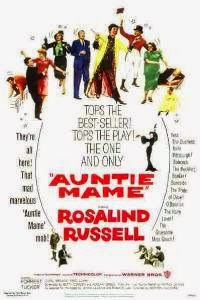
32347-auntie_mameWith Rosalind Russell reprising her role from the stage, this film is made by her scene stealing portrayal. The film opens when a rich man dies suddenly and his young son is sent to live with his Auntie Mame. She is a social, energetic and free-spirited woman. Despite the fact that Patrick was raised proper, Auntie Mame soon teaches him how to enjoy life and they grow close to each other.

However, Patrick is taken to a boarding school against the wishes of his aunt. They still remain close as Mame tries to get work and then she meets a southern gentleman. Patrick is growing up as Mame travels the world with Beau. He is killed in an accident so Mame returns home to work on a memoir. She soon realizes how grown up her little Patrick is because there is a girl he is intent on marrying.

Mame does not voice her displeasure with this upper class girl and her superficial parents. Instead she invites them all to dinner and by sabotaging everything Mame makes Patrick realize he is not like these people. He once again embraces her idea that life is a banquet and most poor suckers are starving to death. You have to get out and live a little.

This film was shot almost like a stage play and I found it rather long but Russell is superb and she holds the film together nicely.

4/5 Stars

Hondo (1953)

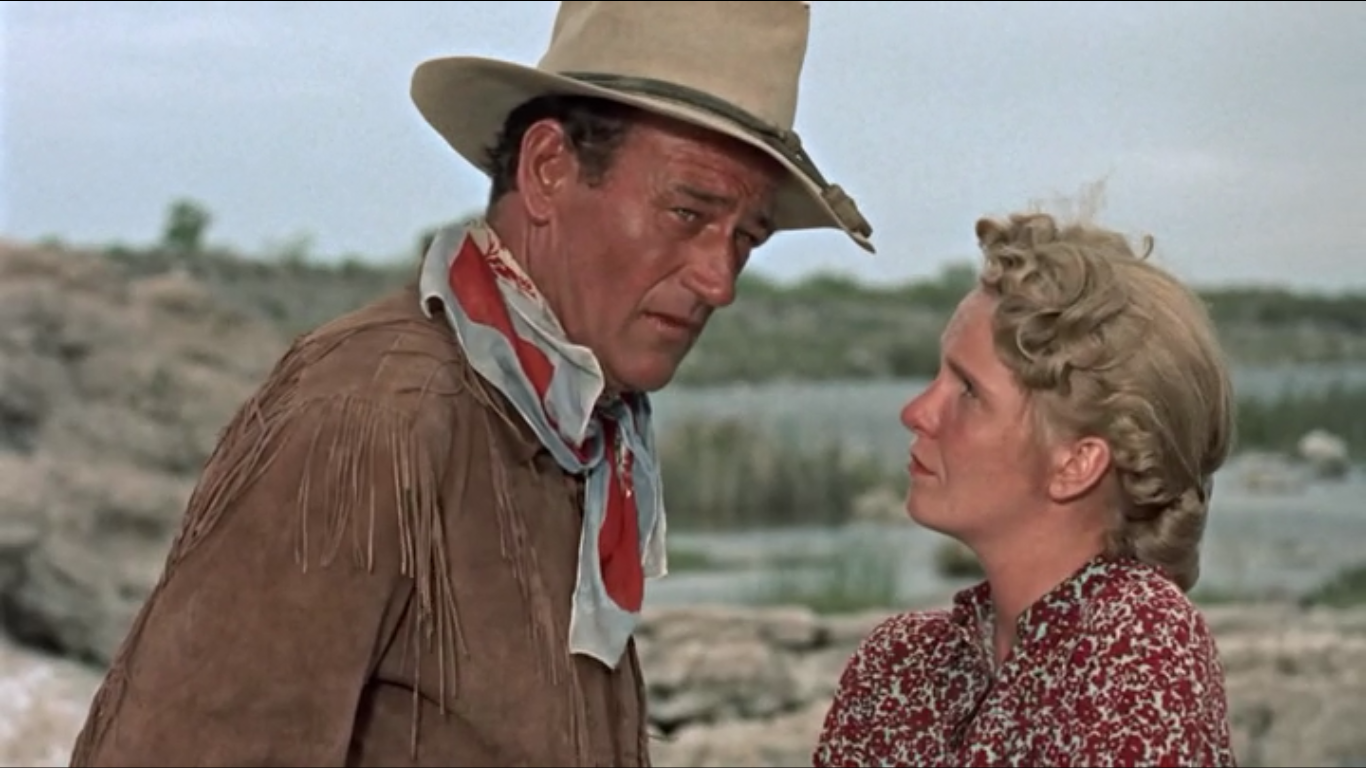
0a5df-hondo3In many ways Hondo feels a lot like Shane since it came out the same year and follows a wandering gunslinger who comes in contact with a frontier family. The story based off the novel by famed western writer Louis L’Amour is a lesser addition to the Western canon, but its hard to complain about a film with John Wayne. I was not a big fan of Geraldine Page (she seemed too needy) but I was happy to see some western mainstays in Ward Bond and a young James Arness.

The film opens with homesteader Angela Lowe and her 6 year old son Johnny spotting a man off in the distance. At first they are tense but as he gets closer and they interact with Hondo, it is clear he only has the best intentions and needs assistance since he lost his horse.

A great deal of the film revolves around the conflict between the native Apache and the U.S. Cavalry with Lowe and her son stuck in the middle of it all. Both sides seem to be at fault at times and in the right in others. Hondo used to be a scout for the Cavalry and he killed three men in the past year which raises the lady’s suspicions but she does not know the circumstances.
When Hondo’s not having run-ins with the Apache or on the brink of being killed, he gets in hot water with Lowe’s vagrant husband. Through it all he returns to the ranch and watches over Johnny who has been made a blood brother to the Apache.
His relationship with Angie deepens and when all seems to be lost during an Apache ambush, he breaks up their wagon circle and kills the enemies leader allowing them to flee. Hondo has a happy family life ahead of him, but it is pretty evident that the Apache existence will die out soon with the arrival of still more Cavalry forces.
3.5/5 Stars

White Christmas (1954)

58e88-white_chrismas_filmMany times I feel like a broken record (this time playing a Christmas tune), but White Christmas is one of those classics that I never get tired of. It is so ingrained, so integral to my childhood memories, that I have difficulty analyzing it or finding fault.

Wonderful, visceral films stop being something that must be thought about and simply become an all out experience. That’s what White Christmas is for me. A full blown Christmas experience courtesy of Bing Crosby, Danny Kaye, Rosemary Clooney Vera-Ellen, Dean Jagger, director Michael Curtiz and of course Irving Berlin.

I mean this as a compliment, but at a basic level, I always thought of White Christmas as a Christmas-like version of Singin’ in the Rain. We have a talented and dashing leading man in Crosby (Bing Crosby) and his mischievous and hilarious partner in crime (Danny Kaye). They are never better than during their parody of the sister’s act (It’s a priceless gem of a moment). Although, there is constant chemistry throughout the film thanks to the bickering and back and forth between two buddies.  Similarly to Singin’ in the Rain, you also have big spectacles, lavish sets, great songs, dancing, and constant quotability. It brings out the most reluctant of crooners and even the guys with two left feet. But what about the story?

White Christmas follows those two war buddies as they make it big as a boffo double act. Along the way, they help out a pair of sisters as well as their washed-up former commander General Waverly (Dean Jagger), who owns an inn in snow-less Vermont. Although, it’s lacking in business,  it’s the perfect locale for matchmaking, acts of kindness, and misunderstandings courtesy of local innkeeper and resident eavesdropper Emma (Mary Wickes). But what we end up receiving is a joyous romance with plenty of Christmas cheer and sentiment to go around.


Bing Crosby’s pipes are as good as ever (“Count Your Blessings”) and Danny Kaye can make his voice crack like no other. Vera-Ella has a talented pair of legs and Rosemary Clooney can carry a tune in her own right opposite Crosby. Whether it’s “Snow,” “Sisters,” or the eponymous track, there’s so much to offer. Weather any slow sections and you will be rewarded thanks to the even-handed direction of Michael Curtiz (Casablanca), paired with the ever memorable compositions of Irving Berlin. Now go spend the holidays with your kith and kin. Vermont must be nice this time of year, all that snow.

4/5 Stars

Pickup on South Street (1953)

bf34b-pickuponsouthstreetFrom American cult film director Samuel Fuller comes a brief, yet potent film-noir laced with communism, pickpocketing, and a lot of shady business on the streets of New York.
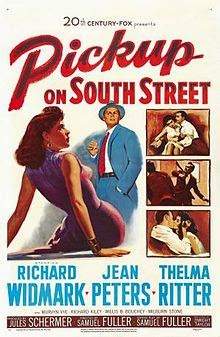
Grifter Skip McCoy (Richard Widmark) is just recently out of the can, and he is back on the streets up to his old tricks again swiping wallets. His victim this time around is a pretty young dame named Candy (Jean Peters) who has a mission of her own to drop off a package. Neither of them knows quite what they have gotten into and to start off with, nothing happens. What exactly has Skip stumbled upon? The answer includes microfilm, spies, and the Commies. All of a sudden things are hot, as McCoy tries to cut a deal with the Reds, and Candy tries to recover the film she unknowingly lost. Candy gets caught in the middle of her boyfriend who is sided with Communists and Skip who wants to cash in on his good fortune. Between Skip and Candy begins a wild and passionate love affair that seems destined for disaster. Both have their own agendas, but it is ultimately Candy who drops hers because of her new found affection. McCoy is callous at first but he comes around, in the end, leaving this noir on a surprisingly positive note.
Thelma Ritter was usually colorful in her many screen appearances and she has another memorable turn as the wheeler-dealer Moe Williams in this film. However, Moe does not just deal ties and secrets; she is a woman with a conscience and a touch of good old-fashioned patriotism. In her own simple way, she is a hero whether people know it or not.
Widmark played a similar conman in Night and the City (1950), but this time around things worked out a little differently for his character. The pickpocket sequences were perhaps less elaborate but still similarly intricate to Robert Bresson’s Pickpocket (1959). It is possible that he got some of his inspiration from Fuller’s work here.
This is a real communist era thriller that Fuller injects with passion, grit, and some unadulterated violence. It is not a pretty film necessarily, but that is not what Fuller is going for, and he never does. Instead, as a former journalist, he reveals to his audience the nitty-gritty of South Street up close and personal. He succeeds with flying colors in delivering a first rate scoop of uncompromising pulp.
4/5 Stars

The Big Combo (1955)

b456e-bigcombo1There is so much to the plot of The Big Combo, but the irony is that the story is not altogether extraordinary. Instead, highlights include David Raksin’s (Laura) jazzy score infused with brass which is somewhat unusual for the genre. Cinematographer John Alton also helped in making this film visually and stylistically engaging. There are some crazy, overstated shadows making this undeniably film-noir. There are very few better examples of so-called “dark” cinema with prototypical chiaroscuro and low key lighting.

Honestly, I have never been a huge fan of Cornel Wilde, and I can understand why he is not that popular or well known. He’s relatively beady-eyed, not particularly good looking, and his voice is not altogether memorable. Like Mr. Brown said in the film, “It’s personality. You haven’t got it. You’re a cop.” Even Dick Powell has some wit but Wilde’s character is straitlaced and steady. There’s nothing of much repute about him. But enough about Wilde.

The story is your somewhat typical procedural with a righteous cop facing off against a big time mobster. Mr. Brown is practically untouchable with a large pool of money at his disposal and a group of faithful thugs ready to do his bidding. He has a girl, Susan Lowell, who is about fed up with him, but she sticks around.

Lt. Diamond (Wilde) is totally fed up with the corruption but himself is also infatuated with Lowell. His only lead is the name “Alicia” which leads to trouble with Brown and his thugs who rough him up and leave him drunk. However, he learns from a man named Betini that “Alicia” was Brown’s wife who was supposedly murdered and thrown overboard with an anchor.

Next on the beat is a tight-lipped Swedish antique dealer, and ultimately, Diamond comes up with proof that Brown’s wife is still alive. He’s getting too close so Mr. Brown sends out his thugs Fante and Mingo to shut him up for good. They get the wrong person.

Alicia finally turns up, a few more figures get mowed down in Mr. Brown’s wake including Diamond’s trusty colleague Sam (Jay Adler). All that’s left is a showdown at the airport that is like Casablanca‘s atmosphere on steroids. It truly is a stunning achievement in visual storytelling for Alton and director Joseph H. Lewis.

There is not a great deal of sympathy to be had for a lot of the characters who got it, and though she seemed to have little bearing on the plot, Rita’s demise was surprisingly difficult to take. She was the girl with the heart of gold. Brown’s heartlessness finally came back to bite him but honestly, I could have cared less if Diamond was the one to catch him or not. He couldn’t have done it without Susan anyways.

3.5/5 Stars

The Defiant Ones (1958)

2672e-defiant_ones_posterStarring Tony Curtis and Sidney Poitier with director Stanley Kramer, the film opens in the pouring rain with a truck full of convicts. It goes off road and no one is hurt except two men escape.  A Sheriff an state policemen begin tracking them on foot. However, this pair is unique since one is the white “Joker” Jackson and the other is a black man named Noah Cullen. Their racial prejudice and conflict of interests causes sparks to fly. Through it all they are forced to work together just to survive, whether it be wading through rapids, climbing out of a ditch, or trying to break their chains.  Along the way they narrowly escape a hanging and they meet a lonely white woman. Jackson is forced to make a decision about his newfound comrade and Cullen in turn also makes a sacrifice of his own. This is such an extraordinary story about racial conflict. Ultimately, they are no longer so much black or white as much as they are fellow men. In an era full of racial tensions, this film was extremely relevant and it is still powerful to this day.

 
4/5 Stars

Paths of Glory (1957)

87e30-pathsofgloryposterStarring Kirk Douglas and directed by Stanley Kubrick, this war film with a twist follows a French Colonel Dax (Kirk Douglas) and his men during World War I. He is ordered to take part in a suicide mission by a general and everything soon goes awry. After they unsuccessfully go through with the mission , three of Dax’s men find themselves being court martialed as examples for supposed cowardliness. Despite a defense by Dax in court, the three men are found guilty and later executed by firing squad. This and other events cause Dax to openly question the decisions of his superiors. In a very touching final scene there seems to be a questioning of the inhumanity of war. In one of his earlier films Kubrick delivers a poignant piece.
 
4/5 Stars

Wages of Fear (1953)

2c3da-salairedelapeurr350Directed by Henri-Georges Clouzot, this international thriller stars a cast headed by Yves Montand. The film opens in a hell-hole of a town in South America where many jobless drifters spend their days. The joke is that it is really easy to get there, you just can never get out again. 

A Frenchman named Mario (Montand) is one of these vagabonds who has little to do except make eyes at a pretty girl (Vera Clouzot), and sit around the local hangout. Then a massive fire breaks out at a nearby oil field of the corrupt, American Southern Oil Company (SOC). In order to stop the devastation, the solution is to use explosions triggered by nitroglycerin. But the journey to the fields is extremely dangerous so there is the brilliant idea of finding four eager vagrants to transport two trucks of nitro on this 300-mile suicide mission. In need of a break, most of the town jumps at the opportunity. However, only four men actually get this “privilege.” 
One is Mario, another his jovial roommate Luigi, and then the closed off and menacing Bimba. The fourth man who eventually joins this trio is Jo who is an older French fellow who befriended Mario. Then, Mario and Jo leave in one vehicle followed by Bimba and Luigi with the fun just beginning. They must navigate the treacherous roads full of not only bumps but barricades and giant boulders. All the while they are worn thin physically and psychologically. 

Soon the confident Jo turns into a sickly coward, but the other three must keep on going if they want their payoff. In the end, this mission turns out to be too much for some. Eventually, Mario gets ready to return to his girl with $4,000 in toe, a deliriously happy man.
First off, when it is said that this film is a “thriller,” we are not talking about a Hollywood thriller here, with overwhelming action followed by twist after turn. What makes the Wages of Fear so powerful is the sustained intensity because every moment that the nitroglycerin is in the picture you half expect something to go wrong. As such a thriller, I almost came to expect the ending because I really do not think it could have ended any other way. In many ways, it is not simply a critique of the American oil industry, but also the American film industry, and it confidently defies both.

4.5/5 Stars

The Day the Earth Stood Still (1951)

911a0-day_the_earth_stood_still_1951Starring Patricia Neal and Michael Rennie with direction by Robert Wise, this sci-fi film begins with the landing of a mysterious alien space craft in Washington D. C. At first nothing seems to happen and the whole country is tense. Then an extra-terrestrial named Klaatu gets off followed by his giant cohort Gort. He comes in peace but he is wounded by a frightened gun. From that point he is taken to a hospital but his only mission is to warn the world that they must change their ways. 

Klaatu gets away from the hospital and he takes up the identity of one Carpenter in order to integrate himself so he can give the people his message. He ends up befriending a widowed lady and her small boy with his quiet kindness.  

His goal is still to deliver a message to the leaders of the world and the man he wants to speak to is Professor Jacob Barnhardt (Sam Jaffe). When he finally is able to talk, he warns against the use of atomic power, because other planets have become apprehensive and will surely neutralize the earth if they do not stop.

He is followed by Bobby and Klaatu finally reveals his true identity to Helen. Soon he shuts down all the non-essential power across the country, and when the chaos dies down, the manhunt for the culprit intensifies.

In his final entreaty before leaving earth Klaatu pleads with the people:

“It is no concern of ours how you run your own planet, but if you threaten to extend your violence, this Earth of yours will be reduced to a burned-out cinder. Your choice is simple: join us and live in peace, or pursue your present course and face obliteration. We shall be waiting for your answer. The decision rest on you.”

So ends a film that was not just another sci-fi flying saucer movie of the 1950s. It was a representation of the atomic age and an indictment of the Cold War sentiment at the time. Klaatu in many ways becomes a Christ-like figure who calls for peace, takes the name “Carpenter,” and even rises from the dead. In many ways he saved humanity too, on the day the earth stood still.

4/5 Stars