Shane (1953)

10788-shaneposterThere is often something special about westerns, and Shane is no different. Directed by George Stevens and starring Alan Ladd, Van Heflin, Jean Arthur, and other great character actors, Shane is simple yet charming. It has many of the qualities of a great movie, because of what it shows of mankind. Furthermore, it simply makes you feel good.

In the film Shane (Ladd) is a wandering ex-gunslinger, who decides to live with a frontier family as a hired hand. His presence makes everyone happy because he is quiet, humble, and fundamentally so good. However, there is trouble from a man named Riker and his gang. Heflin’s character is adamant he must face the foe and defend his home. Shane will not allow it knowing this is a job for him. The two friends fight it out with Shane winning and riding into town. In the end, he wins the shootout but more importantly he is reconciled with the family’s boy Joey. The time has come for him to move on and Shane rides off into the distance, a humble hero.

The first thing that always strikes me about this film is the brilliant scenery around Jackson Hole, Wyoming with the Tetons looming majestically behind a solitary cabin. In some sense, this is not just a western, but the archetypal story of a family taming the land.

The very next thing of importance is the eponymous and unassuming drifter Shane. He always seems so kind and good, but early on there are glimpses of another, perhaps darker past. And yet from the point of view of Joey, he is an idolized, almost mythological figure. What is so striking about Shane is that he is obviously handy with a gun and an excellent fighter, but he never flaunts it. Perhaps it is because he wishes to rely on it as his last possible resort, or maybe it is because he is just a humble man.

As an audience, much like Joey, we want him to fight back, and we are happy when he finally does. During the course of the film, Grafton’s mercantile and saloon is often the place of conflict, and here multiple times Shane ultimately uses violence. It is his fallback, but he uses it effectively even against his own friends if he sees fit. Then Shane drifts on and the cycle undoubtedly continues again.

Yes, he certainly could be called a hero, with no last name to speak of, but he is a man, who will always be on the move. This may not be because he wants to, but because he really has no other option. Shane foresaw what we did not want to see, and now he cannot come back even if he wants to, so he rides on. This is the middle of George Steven’s so-called “American Trilogy” and probably the hallmark of his illustrious career.

5/5 Stars

A Place in the Sun (1951)

In this film starring Montgomery Clift, Elizabeth Taylor, and Shelley Winters, with George Stevens directing, a young man (Clift) tries to rise up in his uncle’s company. He is poorly-educated yet ambitious and he slowly moves up in the Eastman business. While he works George begins to fall for a modest girl (Winters) who also works in the assembly. They slowly begin to show romantic feelings for each other because they face the same hardships. With a new found postition George begins to interact with people of higher social status. Although he feels out of place there, he meets the beautiful and rich Angela (Taylor) who he begins to fall in love with. As he begins to get more involved with Angela, he learns that his former love interest is pregnant and therefore wishes to marry him. Faced with a dilemma, George makes a decision that will ruin him forever, whether he goes through with it or not. A hard-hitting drama, and an adaptation of “An American Tragedy” by Theodore Dreiser, the latter half is the best part, including the chilling finale.

4/5 Stars

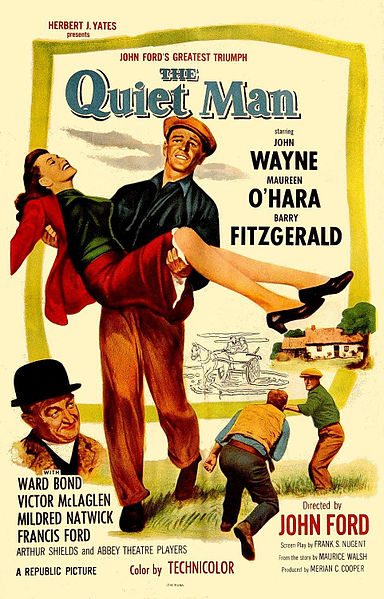
The Quiet Man (1952)

Starring John Wayne and Maureen O’Hara with director John Ford, the film follows an ex-American boxer as he returns to his roots in Ireland. Soon he is befriended by the proper yet kindly folk in the quaint town. Also, a beautiful red-haired girl catches his eye one day. Fireworks start between the American and the proud brother, so he will not condone the courtship or marriage of his sister. Finally, Wayne does gain his wife but she is unhappy without her dowry and she believes her husband is a coward since he will not fight for it. Little does she know the past he tried to escape, but once he gets it off his chest, he does fight. Through the exciting event both men grow fond of each other and the town gets a kick out of the entertainment. O’Hara and the rest of the cast including Barry Fitzgerlad are wonderful as the Irish folk, all playing off the Quiet Man.

5/5 Stars

The Searchers (1956)

d4eb3-the_searchersOne of John Wayne and John Ford’s best westerns respectively, The Searchers follows an ex-Confederate soldier (Wayne) as he looks for his niece Debbie, who was taken by Indians when they killed her parents. Now Wayne and a young man played by Jefferey Hunter must look for her and bring Debbie home. With an almost obsessive desire, Wayne’s character Ethan Edwards vows to find her. Along the way, the old vet and young man have conflicting personalities that get in the way. Even when they finally find her, she has become more Indian than white, and Edwards seems bent on killing her much to Hunter’s horror. In the end, the gruff but courageous searcher shows his true colors.

A great western, and simply a wonderful film, The Searchers has a lot to offer with great action, Monument Valley scenery, and of course John Wayne. The supporting cast is good as well, including Vera Miles, Natalie Wood, Ward Bond, John Qualen, Hank Worden, and Ken Curtis.

There are some pivotal scenes in this film that I think really get to the core of what it is about, and Ford constructs a multitude of scenes which are simply a joy to observe as they unfold. One turning point has to be when the two Searchers look over a few white girls that the cavalry recovered from the Comanche. One of the girls gives off a childish screech, which causes Ethan to turn around, and Ford’s camera closes in on his scowling face half covered by shadow. Here is a proud man who would not surrender during the end of the Civil War. Here is a man full of prejudice and vengeance. Here is a man who shows glimpses of kindness, and here is a man who knows pain. It is complicated because he heads out after Debbie seemingly in an act of love. But soon it seems that it has become his vendetta, and Ethan has simply become bent on revenge. It takes his final confrontation with Debbie to reveal the true depth of his character.

Undoubtedly this is one of the preeminent American westerns, but I think you could also call it a social commentary on racial prejudice. Furthermore, The Searchers influence ranges from the plight of Luke Skywalker in Star Wars to the music of Buddy Holly (“That’ll be the Day”). I think fittingly enough the film ends with Wayne framed in the doorway, walking off into the distance. After all, he is a searcher, and you cannot expect a man like that to stay put.

5/5 Stars

Hiroshima Mon Amour (1959)

72bd9-hiroshima_mon_amour_1959This film is not only a seemingly early form of the French New Wave, it also has many qualities of a documentary, and it is certainly an international film. The film opens with a one night stand between a French actress and a Japanese architect who rendezvous one night in Hiroshima. In the short time they spend together, she reflects on her memories of the city that was not too long ago devastated by the atomic bomb. He often rejects her recollections but nevertheless, he cannot bear for her to leave and he continues to pursue her. Eventually in the course of their time together she relates her days back in the town of Nevers in France. During the occupation, she had a beau who was German and was eventually killed. The events and aftermath haunted her even many years later. They spend some of their time together walking the streets of Hiroshima and with their time running out they vow to remember each other by Hiroshima and Nevers respectively because their real names are never mentioned. This film begins very much like a documentary on Hiroshima but very quickly it turns into a character study focusing on ideas of love, memory, and personal identity. This film is more about art and expression and it uses quick flashbacks to replicate the past with voice-overs bringing the audience back to the present. That being said it should be treated as such because it truly is a masterpiece from Alain Resnais.

4.5/5 Stars

Go for Broke (1951)

Starring Van Johnson along with a handful of WW II vets, this film looks like your average war film. It follows this group of soldiers from their initial training all the way to deployment. Then, we follow their exploits in Italy and France that coincide with their everyday interactions. However, this film is very significant because it actually tells the story of Japanese Americans in the 442nd infantry unit. They not only faced the enemy on the battlefield, they also had to deal with a great deal of prejudice within the armed forces. However, as with the example of Van Johnson, the Budha-Heads were able to win respect because of their courageous fighting. In the climatic moments of the film these men save a lost division and then return home as heroes. Since I am half-Japanese it was exciting for me to come across this film because this kind of topic has not been covered often. The fact that it actually had Nisei actors and was  made quite soon after the war is also amazing.

3.5/5 Stars

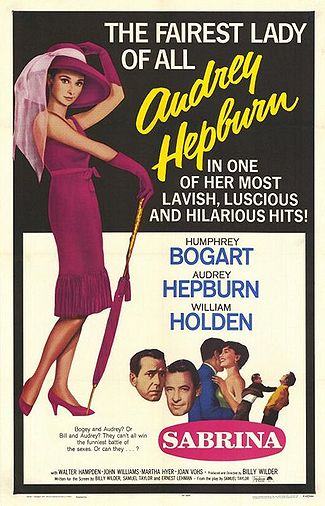
Sabrina (1954)

Starring Audrey Hepburn, Humphrey Bogart, and William Holden, with director Billy Wilder, the film begins with Sabrina (Hepburn) as a young girl. She lives with her father who is a chauffeur for a rich family. Sabrina loves the younger playboy son (Holden) however he gives her no serious attention. Depressed, Sabrina wants to kill herself and her father decides to send her off to culinary school in France. Some time passes and the grown up Sabrina is a perfect lady. Soon she catches the eye of Holden back home and all her dreams come true when they spend time together at a party. However, his older practical brother (Bogart) does not like it one bit since Holden has a fiancee. Wanting to get Sabrina away from his brother, Linus wines and dines her so the strategic wedding will stay on schedule. He then gives her a one way ticket and sends her off. Only afterward does he realize his own feelings for Sabrina and thus he decides to follow her. This film overall is a charming romance that is worth seeing.

4/5 Stars

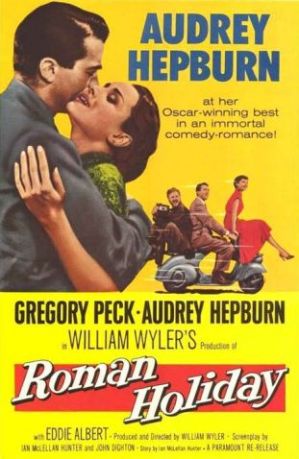
Roman Holiday (1953)

3fd3e-roman_holidayStarring Gregory Peck and Audrey Hepburn with direction by William Wyler, this movie has one of the greatest romances ever depicted on screen. Hepburn is a young princess named Ann on a trip to a foreign country. However, she is constantly bored from the rigidness of her life. On a whim she escapes in the night and finds herself sleepily wandering the streets of Rome. An American journalist (Peck) happens upon the disorientated princess and eventually decides to take her in since she seems lost. Soon enough he figures out just who she is and decides to take her through Rome with a friend (Eddie Albert) so they can get a scoop. Together they take her through the city to explore and secretly take candid photos.

However, Peck soon finds himself falling in love and he cannot bring himself to submit the article. With the thanks of the princess, they are left with the simple satisfaction that they were able to spend the day together. Peck and Hepburn are both wonderful in this one and the story is heartwarming and funny.

I tried to figure out why it is always so enjoyable coming back to this film. Was it the romantic chemistry of Peck and Hepburn, the timeless setting of Rome? Or perhaps is it the direction by William Wyler, the screenplay by blacklisted Dalton Trumbo, or the support work of Eddie Albert as Irving? Undoubtedly all of these wonderful occurrences play some part in making this film a classic.

Most of all it struck me that much like Jacques Tati’s Mr. Hulot’s Holiday, this is not just a film. It is quite like a vacation for the audience and we get to enjoy it along with all the main players. We get the privilege of taking part in all the adventure and the laughs. By the end we don’t want it to end but like any holiday we must say goodbye and wait until our next vacation comes around. Thus, it seems that Roman Holiday never gets old because the audience is constantly looking forward to the time away in 1950s Rome with our romantic stars.

5/5 Stars

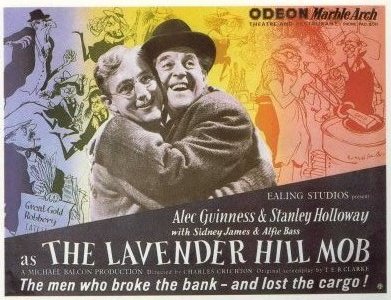
The Lavender Hill Mob (1951)

1dadb-the_lavender_hill_mobStarring Alec Guinness and David Holloway this Ealing Studios comedy-heist film begins with an older man recounting how he got away with a large amount of gold bullion. His job had been to ride with gold shipments while they were transported. However, soon he met a quirky fellow partial to art and together they devised a plan to get the gold. They enlisted the help of two small-time criminals. The day of the caper was far from smooth and they must improvise. With luck they get away and the two instigators take their prize to Paris. There they have disastrous results and arrive back in England eventually to even more craziness. This film had endearing characters and its share of comical moments. If you pay attention you can see a young Audrey Hepburn for a blink of an eye near the beginning too!

4.5/5 Stars

The Caine Mutiny (1954)

With a stellar cast starring Humphrey Bogart, Van Johnson, Fred MacMurray, and Jose Ferrer among others, the film begins with a young ensign assigned to the mine sweeper named the Caine. After the first lax captain is reassigned, their new commander Queeg (Bogart) is a stickler for detail and order. After a series of incidents the crew becomes increasingly annoyed with him. The situation worsesn when Queeg begins to obsess about a few missing servings of strawberries. All these events boil over during a typhoon when the second-in-command (Johnson) prodded on, feels Queeg is unfit for command and he takes over control of the Caine. In the ensuing court martial, he is put on trial for mutiny and his attorney (Ferrer) must try to show Queeg to be truly unstable. Although he wins the case, everyone soon comes to realize Queeg was just a war-wearied man who gave a lot of himself. Despite some stark revelations the young ensign finally marries his girl and gets a pleasant surprise when he is reassigned to another boat.

4/5 Stars