Late Autumn: A Close Reading of a Japanese Auteur (2015)

lateautumn_1_originalYasujiro Ozu has the esteem of being christened “The Most Japanese Filmmaker.” It’s certainly a high honor, but at first it can feel rather counter-intuitive, because after all such a great master of cinema cannot be considered a composite or even representative of Japanese film history. And it doesn’t seem like that is what this name is trying to get at. In reality Ozu experimented with the conventions written by classical western filmmakers over time and out of those frameworks he built his own unique aesthetic. It’s quite evident especially in his later films. That being said, his films are very Japanese in the way they interact with and dissect the culture that he comes out of, and that is paramount to understanding and appreciating his work.

A prime example is Late Autumn, Ozu’s penultimate film, a social-familial drama that shares a great deal of similarity to some of his earlier storylines. The fact is he’s constantly returning to these ideas of marriage, family, generational differences, and the underlying etiquette that is so prevalent to Japan and Asian cultures in general. Yes, he takes on the everyday as his subject matter, but far from being mundane, it suggests that Ozu gets at the very fabric of Japanese society like few directors were ever able to. But of course, much of what he examines is universal and that’s part of what allows his films to remain timeless.

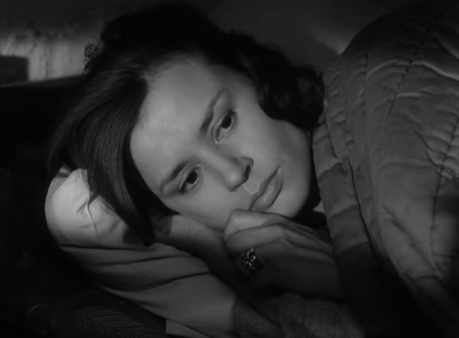
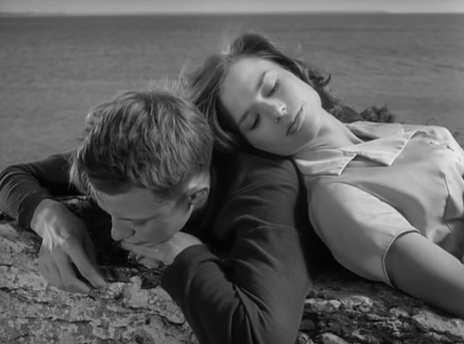
One scene that proves crucial in Late Autumn occurs when the radiant young beauty Ayako (Yoko Tsukasa) returns home to her mother in a huff. This scene is integral because she believes her mother is keeping secrets from her about getting remarried, and it threatens to drive a spike through their relationship.

As he often does, Ozu will use an extended establishing shot, in this case, the outside of the apartment, and he lingers on it for a time, as if to convey the space that his characters occupy. In fact, these type of sequence became so synonymous with the director they received the moniker “pillow shots.” Historians Bordwell and Thompson contend that we can “hardly consider these mere ‘establishing shots’ in the classical Hollywood usage, since many of them are more confusing than orientating” (6).

The following long shot is of young Ayako (Yoko Tsukasa) walking solemnly down a hallway, and it conveys her dismay even from a distance. Her downward gaze tells the full story as much as the muted colors on the walls around her. Next we are situated inside her home watching Ayako come into the space that she shares with her mother. However, the normally peaceful sanctuary is certain to be a place of conflict, at least this evening. What follows is a long shot peering in from the next room, once again suggesting the distance that has already been created between these characters. Akiko (Setsuko Hara) comes into the frame for the first time. What it does is create a space for the audience to observe this intimate scene while still maintaining a certain amount of space to analyze what is in front of us.

There is a medium shot of the mother sitting down and she begins to talk about something routine like the groceries she was buying at the local market. What follows is one of Ozu’s variations on the classic Hollywood shot-reverse shot formula, as mother and daughter trade comments. Ayako is facing away from the camera, sitting by the window sill. Understandably Akiko is oblivious about what happened earlier. How could she know what her daughter heard from Mr. Mamiya? We end up going back and forth between mother and daughter with Akiko facing the camera head on as if she’s talking directly to the audience. Her daughter is completely turned although she does finally turn around and accuse her mother of lying. There’s still a noticeable distance between them.

But the camera does another interesting thing during this climactic moment. It makes a move, ending up behind the daughter, looking over her shoulder. It’s still stationary, but Ozu has circulated through this world made of 360 degrees of movement. Thus, “Once this pattern of circular space is established, Ozu’s films use the same devices Hollywood does, but without the axis of action” (29). Essentially, he is not constrained by the 180 degrees of Hollywood filmmaking. Such a tactic allows him to elicit a different response and capture a different view in such an integral sequence. Because Ayako has just accused her mother of hiding her plans of marriage, and we know what she’s talking about, but if we look at Ayikko’s face we can tell she’s confused; certainly befuddled by it all.

Then, just like that Ayako gets up to leave and once more the camera shows a medium shot of the doorway. This time the mother gets up and questions her daughter, but really it’s directly to the audience once more. She doesn’t get an answer as her daughter leaves without a word, the door closing behind her. It’s seemingly such an everyday look at human interaction, but it’s full of so much meaning, so much emotion. A great deal of that is thanks to Ozu and how he situated his camera in reference to his two actors. Each works off the other in perfect unity to make this sequence simple but at the same time dynamic in its effectiveness. We care about these people and truly feel their hurt, because we are experiencing it alongside of them.

This scene really resonates because it feels like one of the first times we actually get to know these characters. Oftentimes we cannot judge people by how they interact when times are good. That especially rings true in a Japanese culture that often appears to hide behind manicured etiquette and demure smiles. True, all cultures do this in a sense, but it feels especially prevalent in Japan. It’s a nation where the whole is more important than the individual. You’re not to show how feeling out of respect for those around. However, it’s when there’s actually a source of conflict or pain that a person’s true character breaks through the guarded exterior. In this instance, Akiko no longer carries her ever-present grin, but instead it’s given way to a look of deep concern. Her daughter was equally bright-eyed most of the film, and now her brow is furrowed with frustration. These are not the character we first met, or perhaps this is the first time we have seen them for who they really are. They have shed the holistic mentality, and finally given way to their true self.

To Ozu’s credit, he sets up his scenes beautifully, optimizing the space in front of him and situating his camera in a way that is unobtrusive yet unique. It provides the perfect environment for examining his human subjects in their natural rhythms of life. It’s simple, it’s beautiful, and it’s ultimately very telling of the human condition.

R.I.P. Setsuko Hara

Au Hasard Balthazar (1966)

auhasard1Robert Bresson’s Balthazar is the best piece of art I have viewed in some time and it is art in the sense that it may have various interpretations, it causes us to think, and it elicits an emotional response. In truth, it is a story that I do not fully understand and I can never hope to know, but there is nevertheless an austere beauty to this parable. Furthermore, there is a kind of magic in this air of ambiguity. I want to watch it, again and again, to see if I can understand, to see what revelations come my way. It was one of those experiences that left me wondering what I had just watched, however, I know enough by now not to fight it, but enjoy that feeling of not comprehending in full.

Essentially this is a tale about a donkey cherished by a young girl and over the years they lose contact, reunite, and go away again, as is the rhythm of life day to day. The plot points started becoming less important in comparison to the images and emotions that begin to well up inside of us. At the same time that the donkey is often being mistreated or carrying the burdens of his various masters, his girl Marie (Anne Wiazemsky) is growing up trying to figure out what love is. She is close to a boy named Jacques only to have him drift in and out of her life several times. She cannot decide how she feels exactly about him. There’s the boy Gerard who is good at raising hell and Marie spends some time with him. But it remains to be seen what the real agenda of her parents or Gerard and his friends are. What of these matters of honor and murder? Do all the particulars even matter that much?

Balthazar’s own path includes whippings, long hard toil as a beast of burden, a stint in the circus with all the other captive animals, and happy times driving Marie’s cart. But is that wrong to personify him? Is he even capable of emotion? I’m not sure if he is, but the audience certainly is. We can be joyful when we see that cute young donkey being enveloped in hay with young children playing. We can become somber as Balthazar is slowly being worked to death as the years drag ever onward and his master considers putting him down in lieu of getting a new harness. Somehow a donkey can be a victim of his circumstances, bravely taking the abuse of others, and living without a shred of retaliation. In some strangely entrancing way, it works.

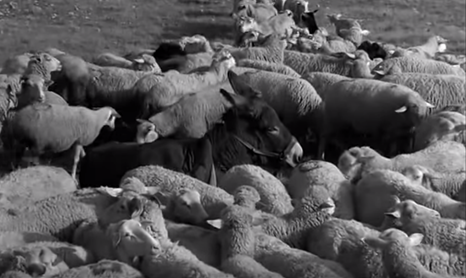
auhasard2Then, Balthazar takes a stray bullet and weakened he comes upon a green pasture where he kneels down peacefully to die. Around him comes a flock of sheep led by a shepherd. It’s a deeply heart-wrenching and visually arresting moment evoking Biblical imagery from Psalm 23. The full life having been lived and now it’s over in tranquility. It’s really a summation of the spiritual journey that each one of us traverses in our lifetime and yet Bresson brings us this allegory through simple, clean strokes. Images and sounds balanced exquisitely together in a completely naturalistic mode of expression.  Wiazemsky on her part is a natural beauty who positively captivates with every move she makes (reminding me of Anna Karina) Furthermore, Bresson somehow causes us to build a deep connection with a donkey which is hard to believe.

It’s the trademark of Bresson to have a stripped-down, straightforward approach to film-making, so much so that his style almost feels like no style at all. It’s so clean and unobtrusive. He shows us the world simply, succinctly, and without pomp. Even with the casting of non-actors, and in this case a donkey, as his main players. But he’s undoubtedly the master of inducing a response based on even the most basic of subjects. There are times it’s almost easy to forget you’re watching a film entirely because you get so wrapped up in what he is showing us.

4.5/5 Stars

The Young Girls of Rochefort (1967)

rochefort1If the Umbrellas of Cherbourg is a piercing operatic drama, The Young Girls of Rochefort is pure, unadulterated escapism at its finest. 

Directed by Jacques Demy and starring an ensemble cast including Catherine Deneuve, Francois Dorleac, Gene Kelly, Michel Piccoli, George Chakiris, Grover Paul, and Danielle Darrieux, this is a whimsical French musical that has no equal. 

rochefort9

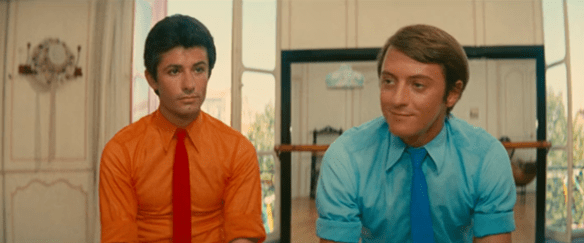
The film opens with a group of performers coming into the town of Rochefort to get ready for a big outdoor show. They become acquainted with the local hangout that includes a kindly matron (Darrieux) and many locals including an idealistic artist and sailor who is searching for his ideal lover. Nearby her two adult twin daughters hold piano and ballet lessons as they too get their little prodigies ready for the big show. Delphine (Deneuve) is fed up with her suitor and desires a new love, while Solange (Dorleac) on her part hopes to advance her career as a pianist. She goes to the proprietor of a local music store to see if he can introduce her to a prestigious American Friend.

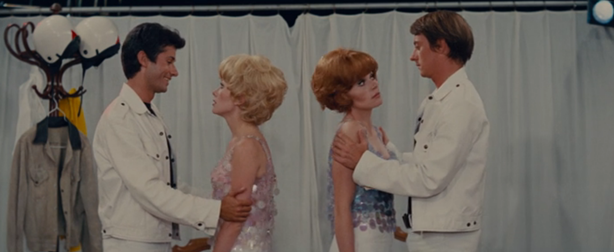
A great deal of dramatic irony sets in and the plot is constantly moved forward through song. Yvonne at the café is still depressed over a split with a lover 10 years prior, because he had an unfortunate name. Solange has a chance encounter while stopping to pick up her kid brother Booboo, and Delphine becomes curious about an artist who painted a portrait that looks strikingly like her. All of these events reach their apex on the Sunday of the big performance, and in need of some performer, the carnies enlist the help of the twins. They are a huge success and things wind down.

rochefort4

The next morning the performers get ready to leave for Paris and the girls decide to follow suit. However, Solange has another encounter that changes her plans and then Yvonne is united with her love. That leaves only Delphine to go with the boys to Paris, but not to worry, she would be united with her painter soon enough.

The light and very French-sounding tunes are hard not to like, but that is only the very beginning. Demy pays homage to Hollywood musicals of old going so far as casting Gene Kelly (Singin’ in the Rain) and George Chakiris (West Side Story) in his film. He undoubtedly owes a debt to Vincente Minnelli and Stanley Donen with some striking moments reminiscent of An American in Paris (1951). It makes sense. Demy uses the pastels and costumes of a Hollywood musical extravaganza while also including dashes of French style.

rochefort2

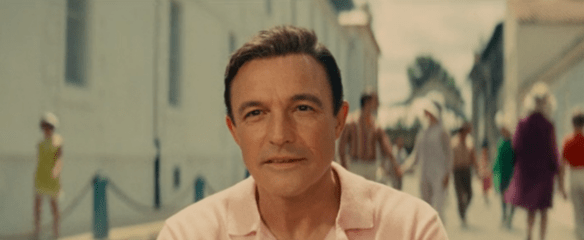
Rochefort takes place in a real location, but it truly is a fantasy world that the characters inhabit, full of perpetual dancing and dialogue that is delivered through song. The real-life sisters do a wonderful job in this film and there is something reassuring about seeing Gene Kelly. Rather like an old friend who gives comfort in a whimsical, but altogether new experience. The story arc of dashed, renewed, and ultimately newfound love allows Demy to once more explore the issues of fate and chance that always seem to enchant him.  His partnership with Michel Legrand is once again bountiful including the enduringly memorable “Chanson Des Jumelles,” an infectiously bouncy, trumpet-laden number performed by the sisters.

There’s nothing much else for me to say except The Young Girls of Rochefort is one of those underappreciated gems that is thoroughly enjoyable and chock full of all sorts of fun. It delivers a serving of something with a familiar flavor while giving it a little extra panache. It’s about as playful and fluffy as you can get which in this case is not a bad thing at all. 

4.5/5 Stars

Review: Dr. Strangelove or: How I Learned to Stop Worrying and Love the Bomb (1964)

Dr._StrangeloveHow to speak of Dr. Strangelove? To clarify I mean the film and not the character. First and foremost, it’s one of those films that has so much significance, because of the era it came out of and for the way it represents that time and space. It’s the defining film about the Cold War, much in the same way All the President’s Men is identified with Watergate and the sentiments at the time.

This film is wickedly funny, and yet I never found myself laughing out loud. There was more often a smirk slowly forming on my face. This film is a landmark and an important piece of cinema and yet I could never say I have a passionate love for it. What sets it apart is the way that Kubrick is able to tackle the paranoia at the time.

His plot is utterly ridiculous and absurd and yet in anything, there is always a sliver of truth that seems all too real. A film throwing around talk of nuclear war and doomsday devices is rather bleak and so I suppose Dr. Strangelove is a type of morbid humor. Certainly a black, satirical comedy.

Kubrick’s story is split into three sections: There the B-52 bomber where the crew including Slim Pickens and a young James Earl Jones patrol the skies until they get the unmistakable order to proceed with “Plan R” which begins an attack on Russia. Slim Pickens is an inspired piece of casting with his iconic southern drawl because he plays everything straight, but you cannot help find it funny. He sticks out like a sore thumb in the cockpit and then there’s, of course, his mounting the bucking bomb, but that comes later…

The order was given on the command of a General Jack D. Ripper (Sterling Hayden) after he ordered his aide British officer Lionel Mandrake (Peter Sellers) to put their base on high alert. All this came about because of Ripper’s fears about fluoridation and bodily fluids. He’s sure the Commies have infiltrated and so he prepares to decimate them. He bypasses the president, all communication is cut off, and he locks himself and Mandrake up in his office. As far as he’s concerned the deed is done. He can just go on chomping on his cigar while comforting Mandrake. Because there’s no way that he would ever disclose the three-letter code so his aide can warn the Pentagon.

The final setting of the film takes place in the legendary war room which feels rather like a velodrome with a table in the center. There the highest officials of the nation gather round to try and figure out what to do about this national crisis. General Buck Turgidson (George C. Scott) advises the president on what to do about the situation while chewing away at a wad of gum. President Merkin Muffley (Sellers once more), is far from pleased and he even sends a call over “the hotline,” to the Russian Premier. He shares his deep regrets about the situation with Dimitri and it gives Sellers a stage on which to work his deadpan humor. Muffley also tries to maintain order after Turgidson and the Russian Ambassador get in a scuffle (Gentlemen, you can’t fight in here! This is the War Room!).

Meanwhile, a battle ensues at Ripper’s base as the apt billboard inscribed “Peace is our Program” sits in the background. This is an utterly ludicrous firefight and it ends with an appearance by Keenan Wynn ready to take Mandrake and Ripper captive. However, the general has already kicked the bucket and Mandrake attempts to use a payphone to reach the Pentagon.

But the best advice the president gets comes from Nazi defector Dr. Strangelove (Sellers number three), who is restricted to a wheelchair and still has trouble stifling his “Heil Hitler” and “Mein Fuhrer.” His final solution is to gather a few hundred people in mine shafts underground, away from the radiation, where they can procreate. The female to male ratio optimally would be 10:1 and that starts Turgidson salivating. We don’t quite know how it ends, but Kubrick ends with the iconic juxtaposition of nuclear bombs exploding as “We’ll Meet Again” wafts through the air. It’s the last brilliant piece of humor.

Dr. Strangelove is a great film in part because of its performances beginning with Sellers. We’re used to his lovable buffoon Inspector Clouseau and yet he’s quite different here. Each character is starkly different in fact, but each one is played straight with their assorted quirks laid out for us.  Slim Pickens, a man also known for his comedic sidekick roles is playing it straight, which is also funny in itself.

Finally, George C. Scott is one of the stars that we would label a dramatic actor, and yet this is probably the most over the top and odd performance of his career. It’s wonderfully vibrant in all respects from the gesticulation of his body to his facial expressions.

Everything’s an odd mix where hysteria with global consequence is matter-of-fact. There’s no fighting in war rooms. There are Cold Wars and Hotlines. Nazi Doctors advise the president and Russian ambassadors are tackled to the ground. It’s pointing to the inconsistencies in this world that we live in. It’s a satire about the absurdity of nuclear deterrence in an age where that was en vogue.

4.5/5 Stars

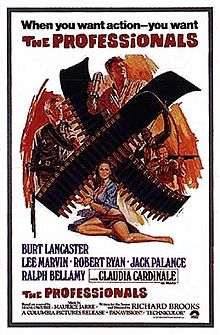
The Professionals (1966)

220px-Movie_poster_for_-The_Professionals-Who wouldn’t be enticed by a film entitled The Professionals? It feels a little like an amalgamation of The Magnificent Seven, The Dirty Dozen, with a  little sprinkling of Mission Impossible, and dare I say The Wild Bunch? We have a band of four big-time pros who are brought together to rescue the wife of a man named Grant (Ralph Bellamy). She is being held at ransom in the heart of Mexico. That’s no small task in the wake of Pancho Villa and the Mexican-American conflict, but these men are the best of the best.

The leader is none other than Lee Marvin (of The Dirty Dozen) with his prematurely white hair, leading the band as Rico Fardan, a skilled tactician, and former U.S. Army Officer. He is joined by Jake Sharp (Woody Strode), who is the best tracker around and also a crack shot with a bow and arrow. Next, comes skilled horseman and pack master Hans Ehrengard (Robert Ryan), who keeps mainly to himself. The most dynamic part is that of Bill Dolworth (Burt Lancaster), an unscrupulous scrounger who nevertheless is a good shot and an artist when it comes to using explosives. He’s not what you call a trustworthy type, but Rico would trust this man with his life and that says a lot.

Richard Brooks story is straightforward enough. This dream team goes in with their mission clear: The man who stands in there way is revolutionary turned outlaw Jesus Raza (Jack Palance), who is the one keeping Maria (Claudia Cardinale) captive.

As they push forward, they witness the brutality of Raza and his men as they raid a passing train and execute many of the occupants. Soon Fardan and his crew move in on Raza’s compound and wreak havoc one night so they can pull Maria out and take her to safety. But she seems like a very reluctant damsel in distress. She also seems very intimate with Raza. That’s the first sign that something’s up, but still, they follow the parameters of the assignment and pull her out.

Retribution follows and after a gunfight The Professionals flee through the mountains with Raza in hot pursuit. They use explosives to try and impede the progress of the rebels, and then Dolworth resolves to stay back to bide his partners time so they can get across the border. It’s at this point that he fights like one of the magnificent seven, in an impressive rearguard action that has his foes befuddled.

It’s when he actually comes face to face with his enemy that things become interesting. They know him and he knows them. Once upon a time, he fought with Raza and he was also acquainted with the lively female marksman Chiquita. When they finally get back to good ol’ Mr. Grant they find he’s not as straight-laced as they once thought, so they make a costly decision. They lose out on their big payoff but do the honorable thing by setting Maria free.

The Professionals gives us want we want. Honestly, we want cool characters and fun action sequences and that’s essentially what we get. There’s quite a bit of fairly graphic violence too for a ’60s western signaling a slow change in the genre. Lee Marvin is impeccable as the self-assured, tough as nails commanding type. Lancaster is, of course, the most interesting, and I can only imagine he had the most fun because playing a scoundrel would undoubtedly be a treat. Strode, Palance, and Cardinale were enjoyable to watch in their own rights as well since we did not necessarily need a whole lot of depth from them. It was only Robert Ryan’s role that felt rather like a throwaway part that did not have much to it. No matter, the Professionals was still an enjoyable all-star western.

J.W. Grant: You bastard.

Rico: Yes, sir. In my case an accident of birth. But you, sir, you’re a self-made man.

4/5 Stars

Review: The Apartment (1960)

The_apartment_trailer_1What has always stood out to me about Billy Wilder’s films and the writing behind them is that you can almost always observe cynicism paired with wit. They are continually sharp, often funny, but they also are underlined by more serious topics altogether. This quality is what allowed him to make films as diverse as Double Indemnity and Some Like it Hot. There’s a subversion of the norm that sometimes is dark, sometimes is funny. His second pairing with Jack Lemmon in The Apartment seems to fall somewhere in between.

The legend is that this story formed in Wilder’s mind after watching a Brief Encounter, about a tryst between an English man and woman. What interested him was a very small detail indeed. What type of person would allow his place to be the location of such a rendezvous? And in such a question came the inception of C.C. Baxter a man who was unwittingly funny, but also pitiful as played by Lemmon.

He’s a man trapped in the bureaucracy, attempting to climb the corporate ladder of a  company. He’s fighting in this game of survival of the fittest and trying to get ahead the only way he knows how. Lending his flat out to higher-ranking executives who are looking for a place to take their dates and have a good time. Baxter is somewhat of a hapless stooge though. He’s far from shrewd and his high ranking pals like him for it. He follows their requests. Does what they want. He’s a perfect cog in their plan. He’s one of them. Even Baxter’s neighbor Dr. Dreyfuss and his landlady get the impression that he’s a real high flyer since there’s always music emanating from his suite and bottles piling up outside his door. But he lives the charade and spends many a frosty evening waiting for his customers to clear out. It’s certainly a sorry existence, but he doesn’t mind at first since it pays off handsomely as he moves up the ranks.

One of the more personable employees in this mass of humanity is elevator gal Fran Kubelik (Shirley MacClaine), who is always friendly with Mr. Baxter since he is a true gentleman. However, she is also caught in an affair with top exec Mr. Sheldrake (Fred MacMurray) and she is actually in love. It’s a messy situation made even more complicated when Sheldrake asks Baxter for the use of his flat. He enthusiastically agrees, but he has no idea who else will be there. That’s one of those painful moments of dramatic irony where our opportunistic nonetheless lovable protagonist gets hurt. Lemmon is good at playing the drama movingly and filling his scenes with organic humor (much like the late Robin Williams).

At this point, C.C. Baxter becomes the general scapegoat for his colleagues and even his neighbors. Everyone gives him a hard time for things he has not done or does not really deserve. Sheldrake leaves his wife and looks to solidify things with Fran, and this moment is paramount because Baxter finally mans up. He may have lost his job, but he got to finish the best game of gin rummy of his life.

I must admit the themes of The Apartment are not always my favorite. I am much more partial to Some Like it Hot or even The Odd Couple, but Lemmon makes the film for me. Whether he’s straining spaghetti through a tennis racket or trying on his new suave business bowler for size, it’s hard not to like him. Ray Walston, Fred MacMurray, and about every other character is a cad. Shirley Maclaine is pretty good, but then again she’s never been the most captivating for me actress-wise.

When it’s all said in done, this is not Wilder at his absolute best, but teaming up with IAL Diamond elicited another classic vehicle with Jack Lemmon. Now shut up and deal!

4/5 Stars

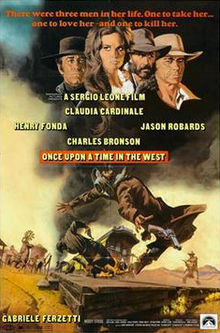
Review: Once Upon a Time in the West (1968)

Once_upon_a_Time_in_the_West 2I’m not well versed in Spaghetti Westerns, but I certainly do not need someone to tell me that Sergio Leone’s film is a sprawling epic. That’s an understatement if there ever was one. The cast, the score, the visuals. Everything about it fits together so marvelously. All the moving parts succeed in developing a majestic piece of cinema that really is awesome. I try not to use that word lightly.

Recently I saw Tarantino’s Django Unchained which of course pays homage to the Spaghetti Western, and it undoubtedly exhibits the Tarantino style. However, Leone’s film lingers as well, but with Once Upon a Time in the West, I didn’t mind. The film, after all, has a cold open that lasts 13 minutes and most of it is spent staring at Jack Elam and Woody Strode. Except the way Leone captures it all, I don’t really mind. In fact, I thoroughly enjoy it. Whereas Tarantino’s film felt like it was dawdling, Leone’s film didn’t seem to dawdle. It was just stylish in its makeup.  The pacing at times feels like a lazy Sunday afternoon underlined by dread for something to come. Then for a brief blip, the trouble comes violently and then just like that it’s gone. Everything’s back to the status quo except this structure makes every killing and gunfight seem all the more dynamic.

The main players are Claudia Cardinale, James Bronson, Jason Robards, and Henry Fonda. Cardinale, of course, is one of the icons of cinema, and here she feels like a wonderful embodiment of this woman who helps bring civility to this land. Whether it’s simply her immense beauty or some emotion behind her eyes, it’s hard not to watch her every movement. First, as she learns she is a widow, next when she is introduced to the other main players, and finally when she sees her dead’s husband’s dreams forming all around her.

James Bronson as the aloof, but deadly “Harmonica” has to be at his coolest. He hardly has to say anything because that ominous harmonica music is his calling card. Every time we hear it we know he’s around and also his eyes are so expressive. Sergio Leone is never squeamish about lingering on his star’s faces. In fact, that paired with landscapes is one of his signatures that helps define his iconic style. The contrasts stand out and the interludes often lacking dialogue somehow help make his characters even cooler. They take on an air of mystery and in the case of “Harmonica”, we only understand his vendetta near the very end. It all starts to make sense.

Robards is the outlaw Cheyenne, who is pinned with the murder of McBain’s wife and children. A posse is after him and his gang, but he was actually pinned for the rap. He is cast in the light of a scruffy anti-hero and Robards plays him rough around the edges, but most importantly with a heart. He’s one of the few characters who seems to get Jill. He knows enough that none of the men around her are worthy of her, because she is a special class of woman, in spite of what her past may say.

Perhaps the most striking of casting choices was Henry Fonda because by now he was well along in his career and most certainly best known for his plain-speaking heroes. That’s what makes Frank such a great character because dressed in all black and armed with a revolver, he guns someone down the first moment we see him. It’s a shock and it sets the tone for the rest of the film. He goes on to backstab his sickly employer and continues to put pressure on Mrs. McBain to give up her land. It goes so far as taking advantage of her at her home. He’s a monster, but the part is such the antithesis of the Henry Fonda we know, making it a pure stroke of genius.

At least for me, you soon forget about the dubbing of certain characters and just allow yourself to become fully engaged in the dynamic West as envisioned by Leone. After all, since there isn’t a whole lot a dialogue, in some scenes it loses its importance. It’s often about the desolately depicted visuals. The wry smile on a face. The buzz of a pestering fly or the squeaking of a windmill. That’s another thing. This film puts sound to use so wonderfully. Whether it’s the harmonica, Morricone’s engaging score, or diegetic sounds. In fact, the score evolves and reprises in concordance with the pacing of the film. It can be ominous. It can be playful. And sometimes it’s nonexistent.

When it all comes down to it, we get the final showdown between “Harmonica” and Frank, but the film is a lot larger than that. After all, we have been following multiple characters. Jill finally sees the world around here coming to life, and she has weathered the Wild West as an independent woman. As for Cheyenne, he ends as a tragic hero of sorts. There’s no question, Leone’s film, arguably his greatest alongside The Good, The Bad, and The Ugly, helps define a version of the West, with iconic characterizations placed up against striking pictorials. It’s one of those film’s that despite the length, never feels like a labor. A smile is constantly forming on my face, to mirror the visage of James Bronson. I really wish I could play the harmonica now. It’s so ridiculously cool! That’s what I really took away from this film.

5/5 Stars

Review: To Kill a Mockingbird (1962)

Atticus_and_Tom_Robinson_in_courtHere is one of the rare occasions when novel and film are so closely connected in my mind that I cannot help love Harper Lee’s initial work and its adaptation to the screen. They’re both so timeless in their own ways. Don’t get me wrong. They are very firmly entrenched in a bygone era, but this story exudes certain themes that are universal.

It’s rather like visiting an old friend. It seemed like so long. I can hardly remember the last time I sat down with To Kill a Mockingbird the book, or the movie for that matter. And yet it rushes back so easily. The characters, the settings, the story. I can almost visualize the words on the page as the scenes take place on screen. It’s a wonderful experience and I wish I could connect with something like this more often. But To Kill a Mockingbird is special to me because I read it at a young age and really ate it up. Thanks to Peck’s performance the story was just moving the second time around. It never ceases to be.

It struck me that I thoroughly enjoy Gregory Peck’s iconic performance as Atticus Finch, because of Mary Badham. Finch is a stalwart father figure and that comes out in the ways he guides and leads his young daughter Scout through life. She has a very cut and dry view of the world, not getting down the nuances or complexities around her. What Atticus does is model what it is to live life with other people, pure and simple. He takes the complexities of life and simplifies them in terms his daughter can try to make sense of.

To a lesser extent, that means telling his kids to leave the Radleys be and complementing the always ornery Mrs. Dubose. He is not prone to bravado by acting his age instead of playing football and not gloating about his skill with a gun. He’s too humble a man for that. He also does not fight back. He has more self-respect for himself and other people.

He attempts to instill this and other skills like tact in his kids, especially naive Scout. He gives her the eponymous metaphor that it is a sin to kill a mockingbird because they are a bird (supposedly) that brings only beauty and goodness into the world. And as he says, and I’m paraphrasing, you never understand someone else until you climb into their skin and walk around a bit. He delves into what empathy is and it’s what allows him to feel sorry for the Ewells, instead of desiring vengeance.

Atticus Finch is one of the special characters that I would actually use as a model. He makes me question my own actions as I take on a role much like Scout. He’s constantly reminding, constantly being patient, and modeling what it means to do what is right. All this is done without condescension, without lecturing. It’s done out of love.

His greatest act is, of course, defending accused African-American man Tom Robinson (Brock Peters), because after all, without this central point there is no film or book before it. But rather than focus on the depiction of these African-American characters and whether they are objectionable or not, I would rather acknowledge that this was a simpler time with a lot of evil still left in the world (as there is now), so this film speaks to me, because on a basic level, it is a story of good in the midst of all this blind discrimination and hatred.

That simple truth still speaks to me even with a story that is over 50 years old. The only adult cast member who is still with us now is Robert Duvall, and he is well into his 80s. Gregory Peck with his bespectacled visage and his soothing yet commanding voice is gone. Brock Peters is no longer with us, nor are the many other lesser known figures. But their story and these characters they embodied remain as a testament to Harper Lee’s original work.

It seems important to ask ourselves why would a man like Atticus do what he did? Why would he take that risk when no one else would? He answers Scout in this straightforward manner, “If I didn’t I couldn’t hold up my head in town, I couldn’t represent this county in the legislature, I couldn’t even tell you or Jem not to do something again.” He’s a man who holds himself to a different set of standards.

5/5 Stars

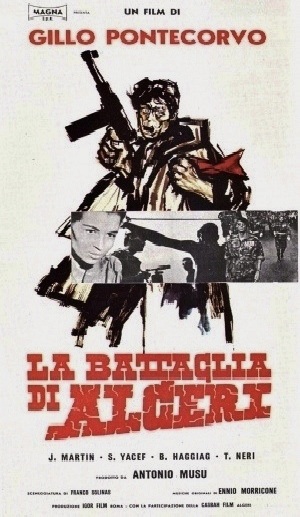
The Battle of Algiers (1966)

The_Battle_of_Algiers_posterBeing rather oblivious to the relations between France and Algeria as well as the battle of Algiers, this documentary-style film proved to be an enlightening and thoroughly engaging historical exercise. I certainly cannot corroborate all the facts, but the reality is, The Battle of Algiers is one of the most well-paced films that I have ever seen coming out of Europe. There is a great deal of drama, harrowing intensity, and it all brings up numerous political questions that parallel the world we live in even to this day.

It’s the story of 1950s Algeria and specifically the Casbah Muslim district of the city. It is there between 1954 to 1957 that the National Liberation Front waged war against their perceived oppressors from France. And they certainly had a point that imperialism has left an indelible mark on them. However, their own strategies include bombings and assassination that utilize civilians and people loyal to the front. You don’t know when the next attack will come, and they sweep across the land like wildfire. The leaders of the FLN include the fiery Ali la Pointe and El-hadi Jafar, who recruited la Pointe early on. A Lieutenant Colonel named Mathieu is brought in to bring down the enemy, but it proves to be a difficult task since the FLN, much like a tapeworm, will never die until the head is destroyed. Otherwise, it’s extremities will keep rebuilding in the form of loyal underlings.

The film is rather shocking in its straightforward depiction of violence, whether it be bombed buildings, gunfights in the streets, or French authorities being gunned down by insurgents. Somehow these images feel still very relevant to the contemporary age. You have the imperialists clashing horns with the locals. There’s racial profiling. Women and children are involved in the violence just as much as anyone else, and destruction pervades the public squares. There is no refuge from bomb or evil. Anyone coming around a corner could be carrying a bomb or looking to shoot you when you least expect it. Really it is amazing that a film like this was even made, and it was undoubtedly a lightning rod for controversy.

In the film’s epilogue, the unrest continues and it is finally noted that Algeria did eventually receive their independence. The French may have won the battle, but they ultimately lost the war. The audience is left to develop their own opinions about this conclusion. As for me, I find Gillo Pontecorvo’s film fascinating, because he takes a point of view that does not seem especially biased. This is not noticeably propaganda in its depiction, but instead, it is a thought-provoking document of civil unrest developing questions on war and race relations. Maybe we can even learn something from it as well in this modern age that still includes so much human conflict.

5/5 Stars

Through a Glass Darkly (1961)

througha2There is so much that could be talked about with Through a Glass Darkly, but I feel the need to point out the more obvious, to begin with. Ingmar Bergman, in retrospect, envisioned this film as the first installment in his 1960s trilogy. As such, the film is a chamber piece that takes place entirely on a single island with only four main players. It lets go of some of the symbolism of many of Bergman’s films, but it still surges with religious content that reflects Bergman’s own background and spiritual conflict.

Through a Glass Darkly is one translation of 1 Corinthians 13, essentially suggesting that at the present time we only get a poor reflection of what is to come. In other words, we cannot fully understand the ways of the world and the ways of God. But how does this theme relate to the film you ask? That’s what I wanted to know as well.

At a basic level, this is yet another story about family and interpersonal relationships. Karin is staying on an island with her husband Martin (Max von Sydow), her father David (Gunnar Bjornstad) who is an author, and her baby brother Minus. She recently was released from a hospital for schizophrenic-like symptoms while her father has recently returned from Switzerland trying to combat a fierce case of writer’s block.

In a day’s time, these four individuals try to parse through all that is going on. Though they initially attempt to shroud it with morning swims and silly stage productions, they cannot completely disregard their reality.

througha3Minus feels he is lacking love and affection. He feels like his sister makes fun of him while his father is aloof and withdrawn from his life. Meanwhile, David is grief-stricken in private, realizing that his daughter’s condition is incurable and yet he also regrets his morbid fascination with it. David tries to cope with his wife’s condition, but although she seemed jovial and fine at first, Karin’s situation begins to decline.
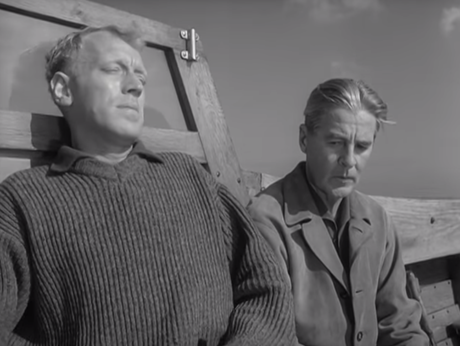
She hallucinates, speaks of going through the walls, and faints. Matters are made worse when the voices in her head tell her to go through her father’s diary. There she reads about his thoughts on her and her “incurable” state. When they take a boating outing Martin asks his father-in-law about what he wrote on the request of Karin, and they get into a discussion. As Martin surmises he seems to be a man with all the right words, but no clue about life itself, and David does not try and object.

Back on the island Minus is with his sister, who confides in him about the voices, and when a storm hits she hides dejectedly in the hull of a boat. Minus follows soon after along with his father. They send for an ambulance to fetch Karin and in a penultimate moment, she speaks candidly with her father one last time before she is to be taken to the hospital. In these final moments she goes up to the attic and while being observed by her husband and father, Karin, breaks into hysterical fits. The visions she has seen are obviously too horrible to bear

througha5This is a film about brothers, sisters, husbands, wives, fathers, and daughters. All revolving around four characters wrapped up and intertwined in this complex spider web of relationships. The spiritual content is great and there is also a lot of minutiae in Through a Glass Darkly. It shares some of the same mind-bending moments as Persona (1966) and yet this film felt even more personal if that is possible. As the title suggests and David even tells his son, we cannot fully understand what is happening, but we can be certain that someday we will know if only we grasp hold of love and the love that God has for his people.

Ingmar Bergman’s type of film-making seems foreign to us now and I don’t mean simply since it’s Swedish, but due to the fact that it is so connected to issues of spirituality and deep questions of faith and love. He cannot and will not allow his work to be cut and dry, because he cares about delving into the human condition. And that condition by default is chock full of ambiguity and complexity. Through a Glass Darkly. The title fits aptly indeed.

4.5/5 Stars