Judgment at Nuremberg (1961)

This epic court drama relates the true story of the War Crime Trials after World War II. With Stanley Kramer directing, this cast is amazing. Spencer Tracy, Burt Lancaster, Richard Widmark, Marlene Dietrich, Montgomery Clift, Judy Garland, Werner Klemperer, and even William Shatner all play a part. However, Maximillian Schell is by far the standout because he is such an amazing defender of his country’s honor throughout the entire film. He wants the Holocaust to be known and yet all the while he goes through the case with dignity even though the pressures are so great. For every intense moment the viewer is stuck in their seat and when the verdict comes it is hard to contain the emotion. This movie should be seen by all not only because it is great but it also chronicles an important event in history. Whatever happens we should never forget the events surrounding the Judgment at Nuremberg.

4.5/5 Stars
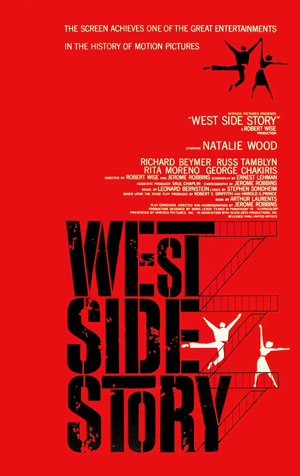
West Side Story (1961)

354d1-west_side_story_posterIn this 1960s, musical adaption of Romeo and Juliet, two lovers become infatuated with each other but the problem is that none of their friends would ever approve. They come from two different classes and backgrounds which are constantly at odds. The two sides frequently clash as represented by the Shark and Jet gangs. Naively, the lovers believe they can get away and be happy forever. However, the situation escalates when the gangs take part in a rumble. Pretty soon the situation is out of control and it has become something nobody wanted. Hope for the future finally seems possible for the pair but it is brutally crushed in an instant. The viewer is left with a feeling of tragedy. This is a very good film for the most part and many of the songs are great, sticking with you afterwards. I suppose it is quite difficult to go wrong with a story from Shakespeare .

4.5/5 Stars

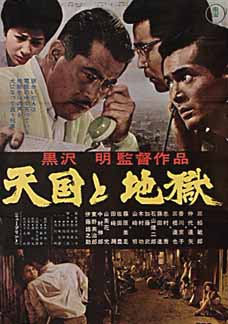
High and Low (1963)

Directed by Akira Kurosawa and starring Toshiro Mifune, the film opens with a wealthy shoe company executive as he tries to struggle for control of the company. He makes a big gamble, waging everything he has to try and succeed. However, things take a bad turn when he believes his son has been kidnapped and the culprit wants an enormous payoff. It turns out that the son of Mr. Gondo’s chauffeur was taken but that makes no difference to the kidnapper. Mr. Gondo finally resolves to make the payoff and then the police who have been advising him take it from there. They work diligently to gather all the evidence they can and the net slowly begins to close  The police finally find the culprit, catch him in the act, and recover most of the money. However, in a meeting with Mr. Gondo the man who is about to die wants no pity at all. Despite the relatively long length of this film, it held my interest. All I had seen of Kurosawa before this were samurai films and so this gave me a different look at his work.

4.5/5 Stars

What Ever Happened to Baby Jane? (1962)

This psychological thriller starring Bette Davis and Joan Crawford with Victor Buono, opens with the bratty vaudeville star Baby Jane Hudson. Her sister Blanche lives in her shadow but begrudgingly agrees to watch out for her sister. Now in the 1930s Blanche is the movie star and Jane is all but forgotten. After a mysterious accident, the film moves to the present where Blanche is confined to a wheelchair and Jane vengefully takes care of her. Because of Jane’s psychotic and often cruel behavior, Blanche tries getting help several times but to no avail. She is at the mercy of her sister, when Jane is not trying to renew her career with the help of a young accompanist. Ultimately  the truth is revealed and the film ends on a pitiful note. This film is full of suspense and Davis is absolutely creepy; never was one staircase so integral to a story either.

4.5/5 Stars

Inherit the Wind (1960)

Starring two battling greats in Spencer Tracy and Frederic March, with Gene Kelly as well, the film chronicles a fictitious version of the controversial Scopes Monkey Trial which acted as an allegory for the McCarthy era. March is the prestigious prosecutor on the side of Creationism and Tracy is the famed defense attorney fighting for a young schoolteacher (Dick York). The two spar back and forth on the touchy subject while staying friends outside the courtroom. The whole town backs Brady, condemning Cates and Drummond as evil. However, despite all that is against them, Drumond saves the case by bringing Brady to the stand. The two stars have commendable performances if not their best. Gene Kelly proves he can be a serious actor, playing the cynical newspaper man. The cast is rounded out nicely by Harry Morgan and Claude Akins. Here Stanley Kramer puts together a respectable movie version of the stage play.

4/5 Stars

The Good, The Bad, and The Ugly (1966)

Starring Clint Eastwood, Lee Van Cleef, and Eli Wallach as the title characters, this is a memorable Spaghetti western. Angel Eyes (Cleef) is on the prowl for a man who stole some gold. Meanwhile Tuco (Wallach) is on the run until three bounty hunters confront him. However, Blondie (Eastwood) is the one who turns him in and then helps Tuco escape after he picks up the reward. Finally, the two accomplices split up on bad terms. The next time Tuco turns the tables capturing Blondie and marching him through the desert. While on their journey they learn where the gold is hidden. First they have run ins with Angel Eyes an the Union army and then they got caught up in a Civil War skirmish. The two of them endure it all and go to the cemetery where the gold is. There they have the final showdown with Angel Eyes in epic fashion. This film is great because it is exciting, it features an iconic Ennio Morricone score, and it has great cinematography which is a trademark of Sergio Leone. An Italian western may seem strange but Leone somehow makes it work.

5/5 Stars

For A Few Dollars More (1965)

7c912-forafewdollarsmoreStarring Clint Eastwood and Lee Van Cleef with director Sergio Leone, this Spaghetti western is the second film in the “Dollar Trilogy.” The film opens with two bounty hunters, and in two separate instances we quickly realize their skill in bagging their man. However, when a notorious outlaw, “El Indio,” and his gang begin to cause trouble, both men are intent on getting the reward. Reluctantly they agree to join forces and Manco (Eastwood) joins Indio in his robbing of a bank so the two mercenaries can bring him down. The bandits get away with the money and then later they overhear the intentions of Manco and the Colonel, and so they rough them up. In secret Indio has them released, then sends his gang after them so he can get away with the money.

However, the colonel took the loot and so the next morning he and Manco systematically mow down the bandits. Indo comes for the money and shares a tense moment with the colonel only to have Manco appear too. Using the chime of a pocket watch, they face off. In the end one man leaves, his revenge complete and the other takes the reward. Although this is not the best Eastwood western, it certainly had some action-packed moments that were very entertaining.

4/5 Stars

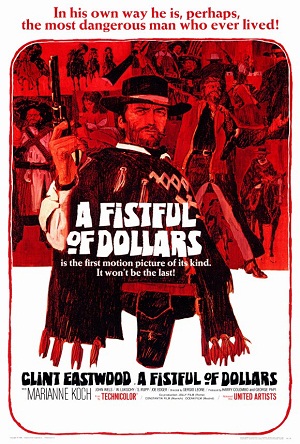
A Fistful of Dollars (1964)

c0810-a_fistful_of_dollars_posterStarring Clint Eastwood with director Sergio Leone, this western adaption of Yojimbo has a poncho-wearing gunslinger (Eastwood) playing two rival gangs off of each other. Upon entering the town, the man with no name is soon disturbed by the Baxters and he makes light work of four men.

Then, he decides to join the rival Rojos gang while spending the rest of his time at the local saloon. After a massacre takes place over some gold, the man uses two of the bodies to lure both sides out to a cemetery  In the ensuing chaos, the Rojos capture one man and then the man with no name sends a hostage over the the Baxters. He was able to get money from both sides before the exchange took place. That night the Rojos celebrate and the gunslinger sneaks off to rescue a woman who is captive. He does a virtuous deed but is found out and the Rojos beat him to a pulp. Using his ingenuity yet again, the man escapes to fight another day. Thinking he received help from the Baxters, the Rojos brutally wipe them out.

With his friend the innkeeper in trouble, the man returns for the final showdown. He outwits his foe and beats the sharpshooter, Ramon, at his own game. As would become the norm  the man would ride off as the victor in one of Leone’s famous panoramic shots.

4.5/5 Stars

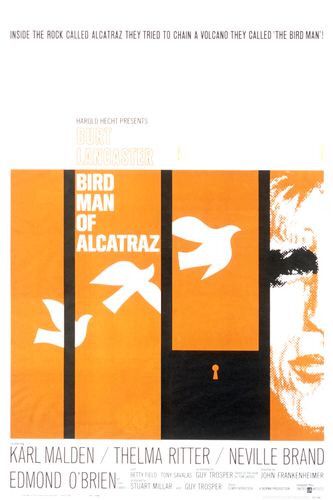
The Birdman of Alcatraz (1962)

Telling the semi-biographical story of Robert Stroud, Birdman relates his life from violent beginnings until his later years. Burt Lancaster superbly characterizes Stroud as a tragic hero. Despite a relatively simple plot following the progression in a man’s life, Birdman is worth seeing. Ultimately, it is the charcters played by Lancaster, Karl Malden, and Thelma Ritter respectively, that make this movie. Ironically, by the end of the film after all he has accomplished the Birdman is still not a free man. Even if it is not completely historically accurate, this movie tells a great story. Having actually toured Alcatraz after viewing this film, I have to say it resonated with me even more.

3.5/5 Stars

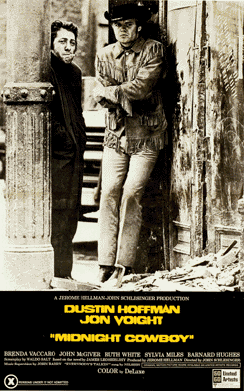
Midnight Cowboy (1969)

The film stars Jon Voight as a naive Texan and Dustin Hoffman as Ratso Rizzo, the bum who initially cons him and eventually befriends him. Voight comes to New York expecting to make money off of rich city women as a male hustler. However, his callowness leaves him broke. That’s when the crippled, coughing, stealing, and nasally-voiced Ratso invites him to stay in Rizzo’s home on a condemned lot. Because they are both just trying to survive on the streets of New York, they befriend each other. When they are not walking the streets, stealing, or trying to bring in money, they talk and we slowly see into the pitiful lives of Joe and Ratso. Since winter has hit, Ratso gets ill so they decide to head out to Florida. On the way Rico (as he wanted to be called) spent his last breath. Both actors have powerful performances and Nillson’s Everybodys Talking is a nice added touch to the soundtrack.

4/5 Stars