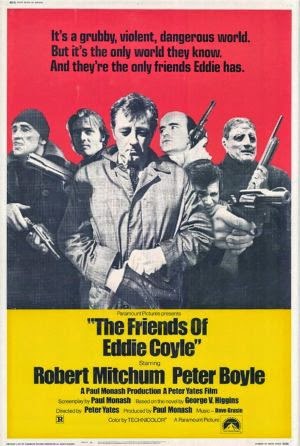
The Friends of Eddie Coyle (1973)

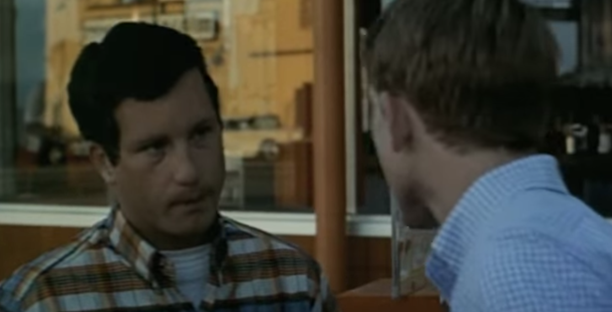
76af9-the_friends_of_eddie_coyleIn this precursor to other gritty Boston crime films like The Departed, Eddie “Fingers” Royle (Robert Mitchum) is a middle-aged truck driver who does some gun running on the side for the mob. On one occasion he got caught with his hand in the cookie jar, and it meant two more years of jail time. He’s seen the clink before.

Three men have been pulling off bank jobs in clear daylight using hostages and new guns each time. Eddie is the guy who has been delivering the guns, and he deals with a young thug (Steven Keats) who acquires the stolen merchandise.

Eddie also gets acquainted with F.B.I. agent Dave Folley (Richard Jordan) who tells Eddie his only way to dodge prison is to become an informer. Unbeknownst to Eddie, Folley has another informant working for him, in fact, it’s the man who set Eddie up. Now Eddie is thinking of himself and so he sets up the gunrunner Jackie because he has everything he needs. Folley closes in and nabs the guy. Eddie wants to be done with it, but Folley wants more. Eddie’s buddies who have been pulling the heists are his next victims, but Folley’s other man gives him the information faster and Royle is left with nothing to bargain with. To top it off, he is suspected to be the stool pigeon, and a hit is secretly planned on him. The middle-aged, hopeless, beat down, world-weary, nobody is knocked off and no one loses any sleep over it.  The manipulative stooge reaps the benefit and agent Folley has what he wants. Royle was the one who got the short end of the stick. Some friends he had.

Peter Yates proves again after Bullitt that he can deliver on gritty crime films. He left San Francisco and car chases behind for Boston, Mass. and bank jobs. Murder seems prevalent everywhere and with the killing comes a wide array of tough guy types. The violence is not over the top and neither is the drama, but it is cool, collected and unsentimental.

I cannot help but compare Mitchum’s performance to earlier crime films of his like Out of the Past. He has some of the same grittiness and toughness, but he is decidedly wearier in this film. He has similar moral ambiguity, but his death is far more pitiful. There is no redemption here, and he is a lowlife loser to the end. Despite his rough edges and shady activity, it is difficult not to feel just a little sorry for the man. The film’s title only helps to point out the irony of his situation. We thought he was the rat, but it turned out it was someone else. He needed to find new friends, but then again it takes one to know one. They were a product of their environment and that environment was not the friendliest place to be.

4/5 Stars

“Look, I’m getin’ old, you hear? I spent most of my life hanging around crummy joints with a buncha punks drinkin’ the beer, eatin’ the hash and the hot dogs and watchin’ the other people go off to Florida while I’m sweatin’ out how I’m gonna pay the plumber. I done time and I stood up but I can’t take no more chances. Next time, it’s gonna be me goin’ to Florida.” ~ Eddie Coyle
Review: Star Wars (1977)

ccbff-starwars1Star Wars has such a giant mythology and full-blown culture surrounding it that it becomes nearly impossible to separate the entire galaxy from the film franchise. It is so much more than just a movie with a plot and some characters going on an adventure. Sure, George Lucas let his boyhood imagination run wild taking pages out of numerous playbooks from John Ford’s westerns, Kurosawa’s samurai, and the serialized sci-fi adventures of Buck Rogers.

However, when I look at this classic that I grew up with for so many years now, it is nearly impossible to shed the role of a pure fan and take on the role of a film critic. One prime example would be Sir Alec Guinness. All my knowledge of film history tells me he is one of the greatest English actors of all time and for good reason. However, there is also this innate conflict that says he’s Obi Wan Kenobi since that’s what I knew him for originally. That’s what I identify him with, and I probably always will. Because, as I said before, Star Wars: A New Hope (As it was later titled) means so much to so many people like me on a personal level.

But let me hold off on that for a moment and focus on Star Wars the film. First and foremost, you would be hard-pressed to find a more colorful array of characters. C3PO and R2D2 are the films jesters and the story is told from point of view, to begin with. You have the hapless farmboy, the wise old man, a spunky princess, a dashing tough guy, and his ever faithful fuzzy sidekick. Not to mention the greatest, most imposing villain every developed for the silver screen. It took some developing with three different actors, a mask, a cape, and SCUBA sounds all joined to create his persona.

That aside, the world Lucas created is so astounding and inventive that it has become second nature to true Star War fans. Jawas on Tatooine, the Cantina in Mos Eisley, and Storm Troopers on the Death Star are simply a no brainer. They are part of our lexicon just as many of these quotes easily roll off our tongue. “May the force be with you,” “I’ve got a bad feeling about this,” “Help me Obi Wan Kenobi, you’re my only hope.” You get the idea.

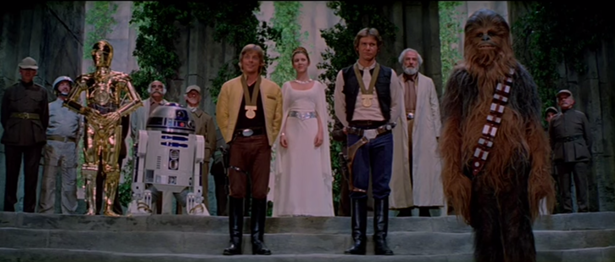
Then, it goes without saying that John Williams propelled this film from being good to great. Because without his iconic scoring, Star Wars is just not the same. It lacks the same energy and epic vibrancy that pulses through every scene. One prime example is the final scene in the Throne Room on Yavin IV. That could have been the longest most awkward award ceremony in history.  When you think about it, no one is talking, they just stare at each other as the medals get bestowed. But with Williams score, it develops a grand crescendo that caps the film on the highest notes as the credits role.

I am also convinced that Ben Burtt is a genius because he breathed still more life into the Star Wars world through his sound design. He gave us blaster noises, RD-D2’s “voice,” Chewie’s distinctive growls, and of course the hum of lightsabers and Darth Vader’s iconic breathing. A personal favorite of mine is the ever present Wilhelm Scream, but I digress.

Thus, what we witnessed the first time we saw Star Wars (followed by countless more times) was not just a film, but a revolution, and I’m not just talking about the rebel alliance blowing up the Death Star.

As I suggested before, Star Wars is so affecting because it is not simply a movie we watch. In many respects, it brings up flashbulb memories in our lives. I remember birthday parties, childhood afternoons playing Legos, or being a Jedi with my very own lightsaber. Star Wars infected my entire adolescence and so when I watch this film it causes all the many great memories to flood back.

It is a joy to watch it again because I almost feel like a kid once more, experiencing the same excitement all over again as if it’s the first time around. My taste in films may continue to mature and evolve, but I dearly hope I never lose my affinity for Star Wars. In many, it would be like losing some of my memories and even a little bit of my humanity.

Not to worry, though, because based on this most recent viewing I will not be dismissing Star Wars any time soon. As some wise man once  said, “absence makes the heart grow fonder.” I forgot how much I missed “a long time ago in a galaxy far far away.” It was great seeing an old friend.

5/5 Stars

The Conversation (1974)

6d644-theconversationDirected by Francis Ford Coppola and starring Gene Hackman, this film begins with a commonplace conversation between a young man and woman in the relatively busy Union Square in San Francisco. As they make their way around their words seem of little importance and yet unbeknownst to them they are being followed and recorded. 

The mastermind behind it all is the surveillance expert Harry Caul who uses his know-how and a small team to track their words from a van.  As a professional and a highly respected member of his field, Caul is guarded and he tries not to concern himself with the reasons behind his surveillance. However, as he works his magic in his private lab space, Caul finally does become affected when he picks up on bits and pieces of the conversation. It deeply troubles him and he continually plays the tapes back. 

Because of his concern, Caul holds out on giving the tapes to the assistant of the Director, the man who commissioned the job. The aide pressures him more and more and then finally Caul finds the tapes are stolen. Fearing that the couple is in grave danger, Caul takes the room right next to theirs, but unfortunately despite his best efforts, his fears seem to be confirmed. After searching the empty room Caul goes to confront the Director only to find that things are not as they seem and Caul is the only one who realizes it. The disillusioned man is then threatened over the phone and informed that now the shoe is on the other foot and he is under constant surveillance. Little did he know the implications of the conversation… 

Gene Hackman may have played more memorable characters like Popeye Doyle, Lex Luthor, or even Norman Dale in the Hoosiers, however, I am not sure if he played a more complex character than Harry Caul. He is a detached man who has no telephone, tells white lies about his birthday, has multiple locks on his door, keeps his equipment caged and he has no significant relationships. The other side of him loves the saxophone and is a devout Catholic. He is no hero and not what we would normally call a villain. He is Harry Caul a lonely, confused human who has tendencies for good but still constantly struggles to reconcile that with his career. Above all, The Conversation is a thought-provoking psychological thriller which gives the audience lots to mull over.
 
4.5/5 Stars

Review: American Graffiti (1973)

e38f5-americang3 The year was 1962. Cars were cool, the music was hopping, and teens were young and in love. It’s a simpler world, but it is not a world without your typical worries, especially since high school is over and college is just around the corner for some.

Curt (Richard Dreyfuss) is destined for college with a big scholarship under his belt, but he is still not convinced it’s the right fit for him.

Steve (Ron Howard) is also college bound, but he finds himself spending his last night patching things up with his girlfriend, Curt’s sister Laurie (Cindy Williams).

Their friend Toad (Charles Martin Smith) has the night of his life with Debbie (Candy Clark), leaving his puny Vespa behind after Steve’s loans his ride to the lovable geek.

Cool king of the strip John Milner (Paul Le Mat) gains an annoying co-passenger and winds up having an unorthodox but memorable night all the same.

It would be a pleasure to dive further and further into each arc, but it seems wholly unnecessary. The joy of American Graffiti is the ride it takes you on. The differing perspectives, varying experiences, and ultimately, a full realization of a certain time and place. True, I was never around in 1962, but it feels like I was. Some of Buddy Holly’s thunder has been stolen by the Beach Boys. JD (James Dean) is boss and Ozzie and Harriet can be seen on the picture tube. It goes without saying that the hottest pastimes are cruising and necking.

Understandably, George Lucas pulled from his own past love of cars and music to transport us back in time. That would have been impossible without the music that acts as the ultimate jukebox and it is pervasive wherever the night takes us. With that nostalgia comes Wolfman Jack who highlights the lightness of the age while also making a more somber cameo which contrasts with the image that he created on the radio waves.

This is a story about young adolescents, and it certainly is a comedy as life is often a comedy. There are memorable moments, fights, and times where we just need to puke. Through it all we learn a little about ourselves and those around us. Dreams can be made and re-imagined as they were for Steve and Curt. However, when it all comes down to it, each one of us has our own path we must carve an existence out of. For each individual it looked a little different. However, one of the reasons I always come back to American Graffiti is the timelessness or rather the way it so wonderfully freezes time. I feel like I’m there in the moment with these characters. I laugh, cheer, and empathize with them. Perhaps the time and place of their world differs from mine, but their worries and aspirations are universal.

No one wants to fade into the past and we all are looking for our girl in the white T-Bird. Only time will tell what actually happens. We just have to live life and see what kind of ride we get taken for.

5/5 Stars

Serpico (1973)

acd89-serp2“Come on Frank. Let’s face it. Who can trust a cop who don’t take money?”

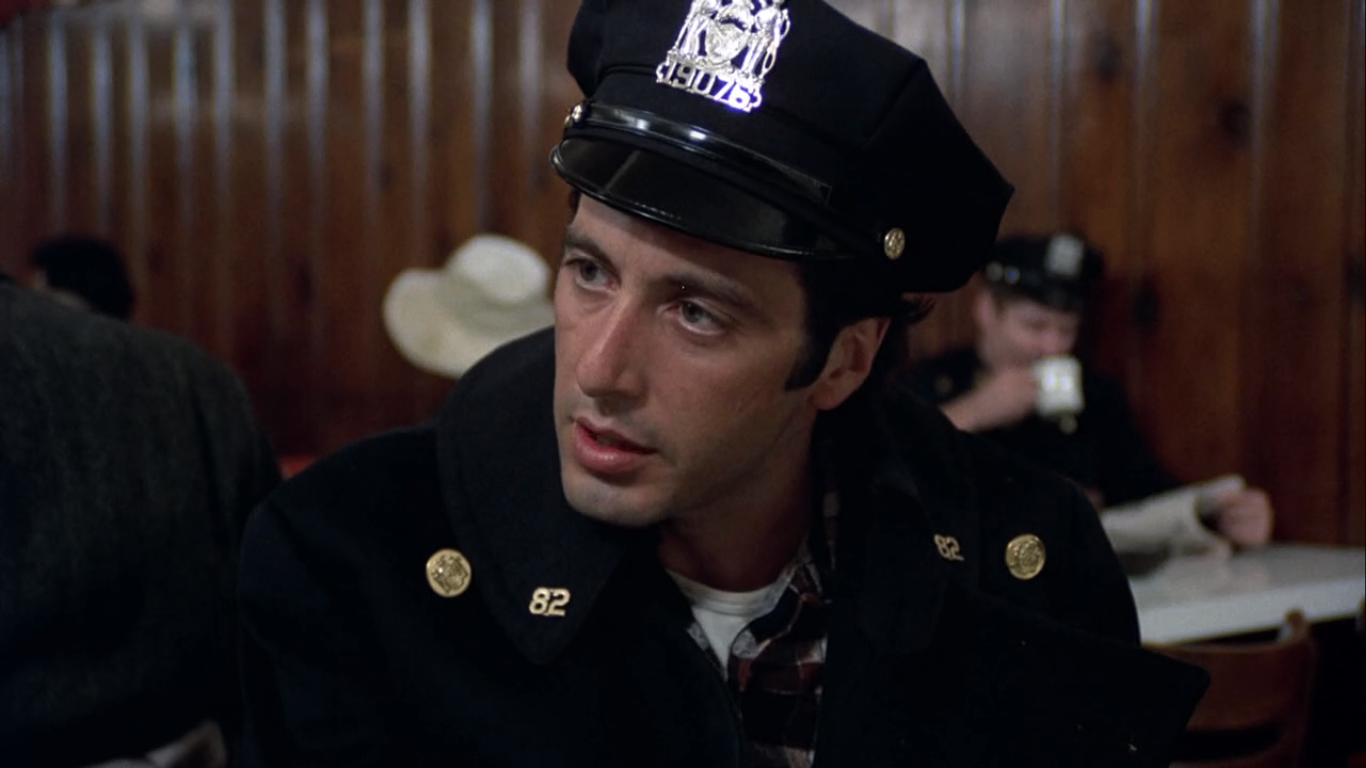
This is the state of affairs in the police department that green police academy grad Frank Serpico (Al Pacino) finds himself thrown into. At first, he is unaware of it all as he moves up the ranks as a young uniformed cop. In fact, he looks exactly like a post-war Michael Corleone at this point. His new role seems like an honorable life of camaraderie, duty, and public service. The corrupt is obvious and distinct from the good. Soon his brash, forthright style creates waves, but it soon becomes apparent that he is not one to care about hurting egos.

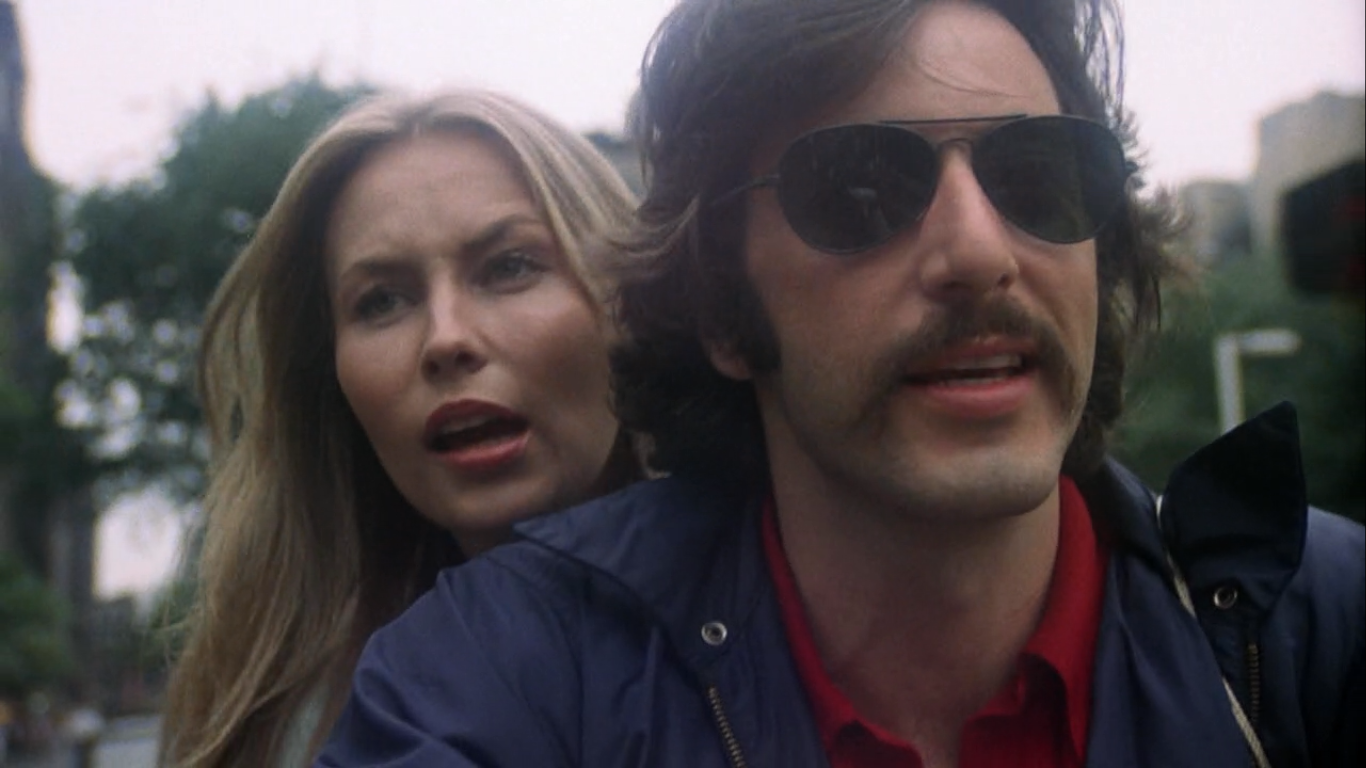
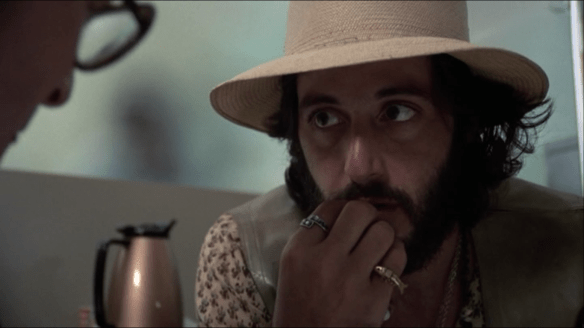
39dd2-serp2b3He moves on with his career working in plainclothes and getting a new apartment followed by a new dog. His appearance begins to change as well as he starts wearing a thick bushy beard and wearing hippy garb. It suits him fine in his work and outside he meets a pretty girl named Leslie Lane, but it’s not meant to be.

Serpico corroborates with colleague Bob Blair (Tony Roberts) trying to figure out how to bring attention to the bribes he has 60789-serp2b4been offered. But honest help is hard to find especially from someone who makes it stick. The higher ups care more about the reputation of the department over corruption, making progress difficult to come by. He continually bounces around from division to division and nobody seems to want him, or trust him for that matter. There are only a few honest Joes around and they are few and far between. Serpico gets transferred this time to the “upright” 7th division and begins seeing his next door neighbor named Laurie. Too soon he learns that one of his acquaintances is instrumental in the extortion that takes place department-wide. By now Frank is feared, hated, and despised because he will not take money under any circumstances. It takes its toll to be all alone in the force, and he lashes out at Laurie who leaves him for good. Now he truly is alone.
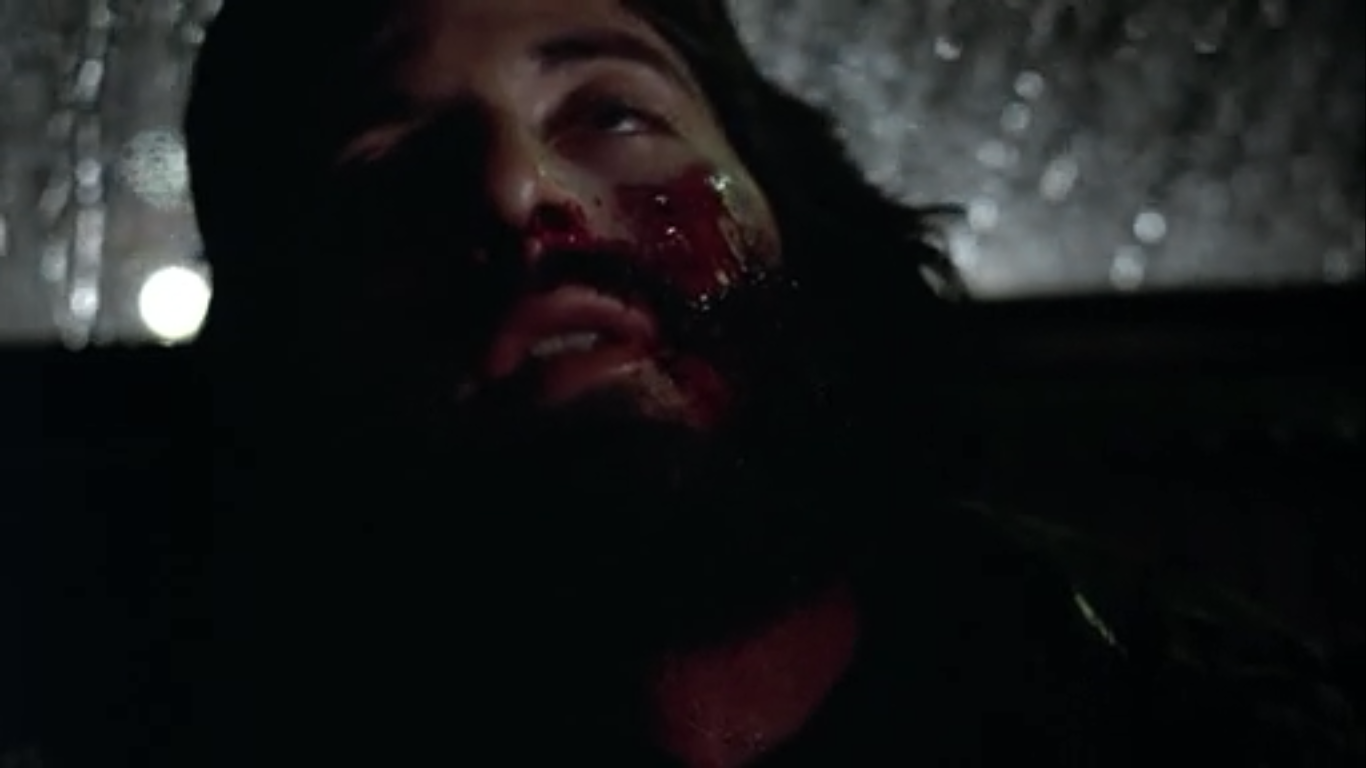
He becomes increasingly combative and paranoid as he gets ready to testify before the grand jury. Another case of bribes comes out and when Serpico and his upright partner try and report it nothing is done. As a last resort, Frank goes to The New York Times and they blow the cover right off. He soon receives an ominous death threat and gets shot when trying to bust someone.

He lays in the hospital recuperating asking for his guards to be relieved and watching the hate mail pile up. His badge is returned to him, but he rejects it in disgust, soon resigning from the police and waiting for a slow boat to Switzerland. That’s as far from New York as he could get.

It seems like there are so very many close-ups of Frank Serpico, and thus, over the course of the film we get the opportunity to truly study his face, or rather the face of Pacino as he embodies this character. His cold, aloof eyes, his facial hair that goes under several transformations, but that is only the outward appearance. It is his inner transformation that is most important because that is where his conscience lies, to guide him each and everyday on the beat.

My New York geography leaves something to be desired but that’s not the problem of native New Yorker Sidney Lumet. This is a story that takes place in New York, made for New York, and fit perfectly with its director. It seems like he knew the streets of the New York like the back of his hand, really creating an authentic atmosphere for this police biopic. It has a touch of The French Connection and yet it is a far more personal look at the life of Serpico himself.


This is also extraordinary because the story of Serpico was so fresh, still only a year or two old at most. Furthermore, the film has the same disillusioning and depressing tone of other dramas that came out of the 1970s. Back in the 1950s films like 12 Angry Men (Lumet’s debut) still had an air of idealism. That had mostly dissipated in the New Hollywood period, because the good guys aren’t black and white. Serpico is not the greatest guy around, but the one thing he has going for him is that he is not crooked and that’s saying a lot in the corrupt world he exists in. This is his story told with all the blemishes, personal troubles, and drama that went with it. The greatest service to him is that his story got told and hopefully truthfully enough.

4.5/5 Stars

The Parallax View (1974)

1c362-parallax_view_“Fella you don’t know what this story means”

The first shot and we know where we are. We’ve been here before. It’s Seattle. The occasion is a Fourth of July parade honoring Senator Charles Carol. Any viewer paying attention knows something fishy is afoot and in perhaps the most intense moment of the whole film the man is violently assassinated. A committee deliberates and comes to the conclusion that the perpetrator was acting alone. And so begins The Parallax View.

Second rate journalist Joseph Frady is known for getting into trouble or causing it most of the time. So when he is interested in rehashing the old story his long-suffering supervisor is skeptical (Hume Cronyn). It all starts because news reporter Lee Carter comes to Frady fearful for her life. It turns out that 6 of the people who were there during the assassination have all died one by one. It’s all very circumstantial and seemingly harmless enough. Soon Carter herself is dead due to barbiturates and alcohol. Frady heads first to the town of Salmon Tale (in search of the elusive Austin Tucker), where he runs into trouble with the local authorities and stumbles upon the Parallax Corporation. He gets his rendezvous with Tucker who is also fearful for his life. Minutes later Kabooom.

He continues winding up with more questions than answers as new bits and pieces crop up. It turns out Parallax is in the very lucrative business of recruiting assassins, so he goes off the grid to join them. His training includes a montage of images to condition him, and the audience is submitted to the process as well. Frady diverts a bomb threat thanks to a stack of napkins, but still another one bites the dust. He finally finds his way to a convention hall where a big to do is in the works for a senator. In a perfect bookend, another man is shot and after deliberating the committee concludes Joseph Frady acted alone. The biggest conspiracy in the country gets away with murder again and slinks back in the shadows.

Gordon Willis’s cinematography exhibits beautiful wide and long shots framing his subjects in their environments. Beatty is fit to play the somewhat rogue reporter but very few of the other characters are memorable. Perhaps that’s precisely the point. The film has extremely deliberate pacing (ie. Two men ride up an elevator one after another in no immediate hurry). However, the paranoia elevates as the film progresses, because we have little idea what is going on, we just know that something is going on. I am partial to The Manchurian Candidate, but here is a film that represents the 1970s, a decade still fraught with political unrest and a myriad of recent assassination attempts.

3.5/5 Stars

Annie Hall (1977)

annie hall 4 alvy“I would never want to belong to any club that would have someone like me for a member. That’s the key joke of my adult life, in terms of my relationships with women.”

So begins Annie Hall a film that Woody Allen, also known as Alvy Singer, begins with an opening monologue borrowing a quip from Groucho Marx. It acts as a lead into his life story, romantic and otherwise.

He had a childhood characterized as being morose, depressed, and so on, because as he noted early on “the universe is expanding.” He grew up living under a roller coaster and having fun with the local bumper cars. He grew up to be a comic with the same despondent outlook on life. In one memorable long shot of a sidewalk, we listen to Alvy talking to his friend about people making jokes about him being a Jew and his assertions seem uncalled for.

Alvy Singer and Marshall McLuhan

When Alvy was dating Annie, they went to Ingmar Bergman films and The Sorrow and the Pity was a personal favorite of Alvy. A favorite film with a perfect title and subject for the pessimistic fellow. However, what really vexes him are puffed up know-it-alls who pontificate on and on like they are God’s gift to the universe. It seems necessary at this point to break the fourth wall.

As Alvy recalls his early childhood and first relationship which began at an Adlai Stevenson rally, it is rather funny that he remains unchanged the whole time. Physically Woody Allen is playing Alvy as a young man and an old man without any change.

Then there is the fiasco with the lobsters and the memories of his first meeting with Annie over tennis. That was when he met the girl who came out of the Norman Rockwell painting. Seemingly the antithesis of Alvy himself.

Their relationship is examined with all its quirks from a trivial conversation about art, with underlying subtitles that reflect their real thoughts, to Annie’s stint as a nightclub singer. They have a comical time people watching, and Alvy recalls his second wife and the one who was a Rolling Stone reporter. His relationship with Annie also has its share of arguments, over spiders at 3 in the morning and adult education. Through it all Alvy still views Annie as a cartoon version of the Wicked Queen from “Snow White,” who he secretly loves.

It is during a famous split screen sequence (actually a split room) where the stark differences, not only between the pair, but the genders are pointed out. Things are changing. They take a trip out to sunny California and Alvy cannot help but hate it compared to pleasantly gray New York. They have laugh tracks, wheat germ killers, and trash which is subsequently made into T.V. shows. Annie loves it all.

The inevitable comes and Annie breaks up only to have Alvy soon revisit California to propose marriage. Needless to say, it does not happen. He returns to New York and makes his first play about their last conversation verbatim, with one small revision. Alvy sees Annie one last time when she returns to New York, and they share some laughs while highlights role across the screen.

Allen’s stand-in Alvy sums it all up with one final joke about a guy who has a brother who thinks he a chicken, but he fails to do anything about it because he needs the eggs. That’s how he feels about relationships. “They’re totally irrational, and crazy, and absurd,” but you keep on because you need the eggs. Another philosophical gem from Alvy Singer.

The irony of Annie Hall is that many a person has gone on to pontificate on and on about it, but if we actually pulled an Alvy Singer and dragged Woody Allen from out behind a movie poster, I’m sure he could set us straight. Annie Hall is chock full of humor, a far from typical type of romance, and people trying to find their way in life. Take away discussion about psychoanalysis, modernism, antisemitism, and what you are left with are people just talking. Some of what they say is about such philosophical topics, but sometimes it’s not. It’s about memories, simple observations of life, and the little things that happen along the way.

There are clashing worldviews that come up against each other like New York and California (brought to us by the cinematography of Gordon Willis). There are different sorts of people like Alvy Singer and Annie Hall. Yet we still go through relationships “because we need the eggs” so to speak. We are searching for that type of intimacy and closeness, and very often we keep looking and looking. It is painful, seemingly necessary, and all the same, it can feel pointless. It’s part of being human I suppose.

Annie Hall works for me because of the quirks that give a fresh face to the typical romantic comedy and it will be the measuring stick for other such films that are being released for years to come. I am not usually a major fan of Woody Allen films, but this one is his undisputed masterpiece. It exemplifies his general philosophy and approach to comedy. Not to mention his typical players in Diane Keaton and Tony Roberts.

4.5/5 Stars

The Bad News Bears (1976)

c75ba-bad_news_bears_1976The Bad News Bears is the quintessential sports movies about a ragtag group of misfits and losers. If there was ever a worthy heir to Charlie Brown’s club it was these fellows, but that’s not the end of it. Rome wasn’t built in a day, and the Bears pick up the slack after numerous drubbings. They somehow acquire Morris Buttermaker’s reluctant pitching prodigy Amanda (Tatum O’Neal), and their new star is town delinquent Kelly Leak (a boy who smokes cigarettes and rides a Harley). They begin to climb the ranks, and Buttermaker realizes his squad has a fighting chance to make it to the championship game.

Things become more and more competitive culminating in the final showdown against the hated Yankees, coached by Roy Turner (Vic Morrow). Buttermaker has recently become a hard-nosed jerk solely focused on winning, but he has a mid-game change of heart. He lets his boys play, clears his bench, and the results are good if not great. However, The Bad News Bears can be proud that they left their heart out on the field, and the Yankees will be going down the next year for sure. The most important thing is that they played together as a team with a lot to be proud of.

Walter Matthau has enough of the lovable grouch in him to make it work, although he does have the foul mouth to go with it. Amanda is the perfect counter for Buttermaker because they both have spirit and fiery impudence. O’Neal perfected the pout after Paper Moon (1973) and it’s still going strong here. However, she is not the only one. On a team that is populated by a few nerds and weaklings, there also are a share of sharp tongues and real potty mouths.

Carmen is a nice touch during the rout scenes,  and it makes me think they never heard of the mercy rule, but I guess it is the 1970s and we have to have drama after all. This is far from a kids movie, but it probably resonates with the many adults who played organized baseball as kids.

The film is a satire of American’s Pastime for this audience because even on the smaller stage of Little League the game often gets blown way out of proportion. It becomes a question of are we playing it for the love of the game or to win at all costs (even if it means family turmoil). Morrow’s character epitomizes just how far parents will go because they become so involved in the lives of their kids. Wanting to live vicariously through them, they push their children until they can no longer be kids, but must be perfect instead. The Bad News Bears choose to play the game for fun as it was meant to be played, and that is partly thanks to Buttermaker. They are not done yet though because there are still many more life lessons to be learned. I’m not sure if I said this yet, but this film actually made me laugh a lot since it began as a comedy of errors and only then did it turn into a satire. The comedy was certainly present, but not the most important.

4/5 Stars

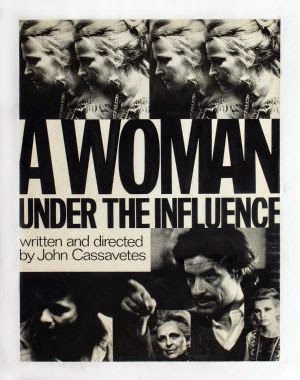
A Woman Under the Influence (1974)

a6338-awomanunderinfluenceWow, this film from John Cassavetes was truly gut-wrenching and powerful. Gena Rowlands and Peter Falk are wonderful as Mabel and Nick. At their core they both seem like essentially good people. They love their kids, their family, and friends. Except Mabel’s problems tear them apart and in turn hurt the ones they love. The drama is not created my major plot twists, but the mundane and the typical. Dinner conversations, picking the kids up from school, gatherings with friends. This is when the film takes place and this is where we see their family unwinding at the seams. It is a personal story and the cinematography and the script for that matter are not polished. They are allowing us to see into this situation and thus the heartache and the pain washes over us and we become engaged with it.

Supposedly Richard Dreyfuss threw up after watching this film. Some may not be able to claim that same reaction, but there is no doubt that your heart goes out to not only Mabel but her children who are caught in the middle of it all. Even Nick, who can be a callous and even violent person is given a heart because he was portrayed by the great Peter Falk. This is definitely powerful stuff that is worth seeing.

This film may actually be more difficult to watch than some gorier films for the simple fact that it will hit the audience close to home. Literally. This is my first film from the director John Cassavetes and hopefully there will be more in my near future. Take a chance with this one because there is a chance that it is different than many of the polished Hollywood films you have seen in the past.

4.5/5 Stars

The Shootist (1976)

24767-shootist_movie_posterIn his last film performance, John Wayne stars alongside Lauren Bacall, Ron Howard, and James Stewart in this tale about a notorious old gunfighter, who comes to stay in a small western town. J.B. Books gets a medical diagnosis from an old friend, and the doctor confirms that he is slowly dying from cancer.

 Books pays for a room in the home of a local widow (Bacall) where his reputation and actions one night scare off tenants. He receives a visit from the uneasy local sheriff (Harry Morgan), gets an offer for a book to glorify his life, has an old flame drop in on him, and old rivals and young guns are bent on killing him.

His lifestyle impresses the young man Gillom (Howard), but his mother openly disapproves of Books. Amidst all this, Books desires to live his last days in peace and he is waited on by Bond, and the two of them become to respect each other as her boy also comes to idolize Books more. The shootist sets everything up to die on his 58th birthday, going so far as ordering a special tombstone and sending three separate notes to different gunmen in town. He leaves his horse to Gillom and bids farewell to Bond before heading off for one last showdown. 

In the saloon, he is met by three men bent on killing him. Books is wounded but proves his skill one last time. In a cruel moment, however, Books is gunned down right in front of the horrified Gillom, who in a single instant ceases to be an innocent boy and becomes a man. 

This film was the perfect swan song for Duke because in many ways the character he plays mirrors his real-life western persona. Gone were the days when he was a kid in Stagecoach, a courageous sheriff in Rio Bravo, or even the gritty old codger in True Grit. He was truly reaching the twilight of his career.

Even it was one of the most storied of acting careers it was finally coming to an end. In just three years he would die of stomach cancer, and there was no gunshot to go with it this time around. During this movie, he still has life in him though, and even when he shares scenes with the whitening and tired-looking icon James Stewart, Wayne seems as resilient as ever. The Shootist is certainly not his greatest film or best performance, but I think it can be said John Wayne went out on his own terms just like Books.

4/5 Stars