Claire’s Knee (1970)

claireskneeClaire’s Knee is a film made for color. Eric Rohmer’s other films up to this point had almost exclusively been black and white, but it’s as if he knew that his newest oeuvre deserved different treatment. It’s vast countrysides and glistening lakes abundant with flowers and fruits fill up our senses. We get to watch and see and experience the beauties of this oasis. And there is no music because the songs of the birds suffice.

Jerome (Jean-Claude Brialy) is a reserved but genial diplomat, who also pulls off his beard quite well. He’s taking a peaceful holiday at Lake Annecy as he prepares himself for marriage with his longtime sweetheart. Quite by chance, he bumps into an old friend named Aurora during a jaunt in his speedboat. Through her, he meets her landlady Madame Walter, the lady’s daughter Laura, and finally Claire, Laura’s older half-sister. It’s an increasingly interesting chain of acquaintances.

The course of the film follows the progression of the summer days signified by white inter-titles expressing the date and time. During these days Jerome, in a sense, willingly becomes Aurora’s “Guinea pig” for her next novel as they discuss love, life, relationships, desire, and the like. Early on, Aurora notices that young Laura has taken some liking in Jerome, and he good-naturedly pursues the relationship, to see what happens.

clairesknee2She’s a young girl who has some big ideas. Laura admits feelings for Jerome, but it’s seemingly only fleeting young love. She still has many years ahead of her, and yet her opinions on love and friendship are already forged. She’s willing to discuss them in depth with her much older counterpart. They take a hike through the mountains together, dance together on Bastille Day, but it’s not a romance. She moves on to a younger boy more fitting for her.

But that’s enough skirting around the uncomfortable. It’s the entrance of Claire that feels integral to the film, if not simply for the fact that the film’s title revolves around her. The fact is Claire is a beautiful girl, who intrigues and disturbs Jerome for the simple fact that her physical appearance is all he knows about her.

The moment he witnesses her picking fruit off a tree up above him, he cannot stop looking. He’s absolute powerless around her. She intimidates and casts a spell that mystifies him. The fact he wishes to touch her knee is hardly a thing to be taken all that seriously. By this point, we know that Jerome and Aurora are not all that serious. It’s almost as if they’re playing a game. And yet Jerome still earnestly wishes to touch Claire’s Knee.

In a moment of sincerity he even acknowledges he is drawn to thin delicate girls, but having a girl made to order would hardly be a recipe for true love. Because the fantasy could never equate to actual compatibility and joy for two individuals. The perfect moment does finally arrive, and it seems like Jerome can finally act out on his desire. He is caught in the rain with Claire and they must wait, taking refuge from the rain. He has news about her boyfriend that brings her to tears. In an instant, he caresses her knee, but soon enough all the desire is gone and it gives way to a good deed.

clairesknee3Thus, somehow Jerome maintains his good-natured personality despite his potentially disastrous relationships with the two girls. It’s as if he knows that inconsequential flings and fantasies can never measure up to true love. He heads off ready to marry his bride to be. We never get a feeling that this is some odd ploy to get a dramatic rise out of its audience. Rohmer’s moral tale is genuinely curious about love. In truth, it’s packed full of musings and revelations on the issue. It draws the conclusion that love means nothing without action.

To his credit, Brialy pulls off the role nearly flawlessly, because he could have so easily seemed like a perverted jerk, but somehow he still comes out of this film with his reputation intact. Perhaps it’s because Laura and Claire are such striking characters. Jerome somehow pales in comparison, despite his age. Although young, Laura seems beyond her years and then there’s Claire. A young woman so exquisitely beautiful in a natural, carefree sort of way. She is perfect to be the subject of this film.

4/5 Stars
3 Women (1977)

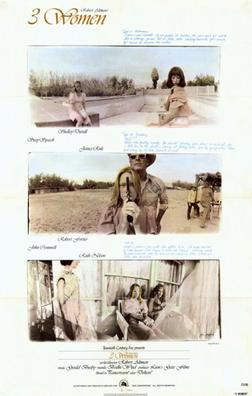
3womenposterSupposedly Robert Altman’s inspiration for 3 Women came from a dream he had, as with many of the most original ideas out there. Admittedly, in some ways, the resulting project feels like his rendition of a European art-film. It has some roots in Bergman and Polanski while transposing the action to his usual locales that are inbred into the fabric of America — places like the California deserts and Texas.
The film revolves around two rather pathetic individuals who meet while working at a facility for the elderly.

One is passive and dependent, the newbie trying to learn the ropes as she becomes acclimated to her new position. The other believes she is independent and exists self-assured, but really she is an oblivious outcast in her own right. Millie Lammoreaux (Shelley Duvall) becomes the teacher, in a sense, and savior of timid young Pinkie (Sissy Spacek). She offers her a home and makes countless recipes that are meant to be enlightened, but were probably even antiquated in their day.

Furthermore, Millie drinks, smokes, shoots guns, and likes to have a good time, because that’s what you’re supposed to do. Except, the only problem is, no one seems to want to interact with her. All those in the apartment complex avoid her like the plague, talking about her quietly in their little enclave. Meanwhile, she likes to tell herself that all the boys are fawning over her. She’s one of those people.

Pinkie makes her seem important, but Millie also grows tired of the other girl’s constant presence. She’s so needy, so withdrawn and homey. That is until the film reaches its main turning point…

Pinkie ends up in the hospital and Millie stands by her faithfully, even going so far as getting in contact with her roommate’s parents. They come and they go. Eventually, Pinkie returns home a different person.

It is around this point where the film’s constant foreboding finally reaches its apex. Pinkie has nightmares following her disconcerting transformation. In this stretch, it’s akin to Persona and Repulsion as she simultaneously becomes a version of Millie and begins to enter psychological distress.

The film at times feels like an expansive lucid dream constantly steeped in symbolism and uneasy anxiety for no apparent reason. The narrative is constantly intercut with enigmatic underwater images of the human form lurking under the surface of the pool. It becomes a film swimming with psychological anxiety, estrangement, and identity disorder. However, it, unfortunately, deteriorates into an incoherent jumble at times. Although, if it is based on Altman’s subconscious, then perhaps he hit the nail on the head.

Its score also becomes overly theatrical, bringing to mind NBC movie mysteries like Columbo, but otherwise, 3 Women is a perplexing piece from one of the cinematic masters of subversion. We exit the film with the eponymous three women and no idea of how we quite got there.

4/5 Stars

Day for Night (1973)

dayfornightposter10 years prior Jean-Luc Godard made his own film about movie-making entitled Contempt (1963). It too delved into what it looked like to make films, as well as the individuals behind the camera because their relationships undoubtedly affect what is revealed in front of it. His colleague Francois Truffaut came out with his own meta-film about film, but Godard was open with his criticism. In fact, their long friendship suffered because Godard accused his longtime collaborator of selling out and telling a lie.

However, if we look at Day for Night today, that feels a little harsh, because while Truffaut’s film is engrossing and different than his earlier New Wave work, he is, in general, a more accessible director on the whole than Godard. That should certainly not take away from what he gifted to his audience. What he does is color the lines between film and real life. Because, while one mirrors reality, it can never quite replicate it and things get messy when the two begin to get in the way of each other.

Immediately we are thrown into a street scene only to learn minutes later that it’s only a set; these commonplace people only extras filling up a cinematic space. It’s the perfect entry point into the meta nature of the film. Ferrand (Truffaut himself) is the director flooded with all your typical problems, setbacks, and deadlines. He must work around his stars, navigating the drama that comes about with so many personalities all gathered together. Severine is a has-been starlet with troubles remembering her lines. Alexandre is her love interest, a fading star in his own right who is aging gracefully. Alphonse (Jean-Pierre Leaud) is the young heartthrob, who secured a script girl position for his girlfriend, but their playful romance is not without bumps. All the while everyone waits with baited breath for the arrival of transcontinental star Julie Baker (Jacqueline Bisset), who has recently recovered from a nervous breakdown followed by a marriage to a distinguished doctor.

We are privy to series of takes, rushes, and all the decisions that are going on behind the scenes. It is in many ways far fuller and more in-depth than the picture Godard gives, but Truffaut maintains the same respect for his heroes. He goes so far as name dropping: Hitchcock, Hawks, Bresson, Godard himself, Bergman, Rossellini, Lubitsch, Bunuel, Jean Vigo, Jean Cocteau, not to mention an initial dedication to the Gish sisters. Even Citizen Kane and The Godfather, two of cinema’s landmark achievements, are both alluded to in passing.

But adding an exclamation point to everything is the drama of death, romantic affairs, and even a pregnancy, suggesting that life is a lot messier than a moving picture. All the strips of celluloid get tied together in a nice bow. They can be explained away by a plot point. They can be completely discarded on the cutting room floor. Or a double can be hired as an easy fix for any discrepancy. In this, there is a falseness that fails to perfectly align with reality. There is no perfect way to convey the truth, because everything, even a documentary, can never be complete subjective reality. A mirror image is only a reflection of what is real. That is part of what Truffaut is getting at and that is part of the irony of his row with Godard.

You only have to look at its title, because Day for Night points to the inherent artificiality of cinema, but Hollywood films especially.  So, far from telling a lie, Truffaut seems to riddle the film industry with all sort of holes, pointing out the difficulties that come with such a business. Life and film may meet and overlap, but they can never truly reconcile their differences because there is bound to be contention along the way that cannot be perfectly remedied by even the greatest director.

But far from condemning the art form, it’s important to realize Truffaut is pronouncing his undying affection for the medium. He was the one who famously asserted, “I have always preferred the reflection of life to life itself.” This man unquestionably loved movies and it shows.

4.5/5 Stars

Carnal Knowledge (1971)

carnalknow1“If you had a choice would you either love a girl or have her love you?”
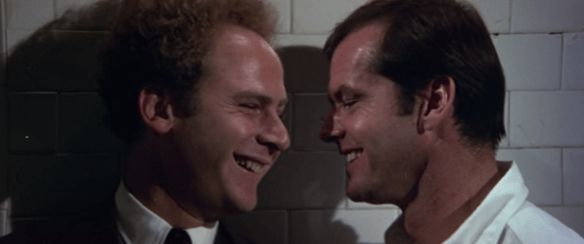
That is the question posited to commence the daydreamy dialogue rolling over the credits of Mike Nichol’s Carnal Knowledge. The nostalgic refrains of Glenn Miller’s “Moonlight Serenade” bring us in as we begin to listen to the cadence of two voices. We’ve heard those voices before probably numerous times. One has a sneering quality, and it belongs to none other than Jack Nicholson, coming off a few early classics like Easy Rider and Five Easy Pieces. He’s got the trademark snideness in his delivery. It’s all there. The other voice is more soft-spoken and calming. It can be heard on numerous folk records of the ’60s and ’70s — the voice of Art Garfunkel.

These two men play Jonathan and Sandy, two college roommates who spend their entire lives confiding in each other as they try their hands, usually unsuccessfully, with relationships. The age-old debate between looks and brains is only one major point of contention.

There are the awkward opening moments at a college mixer. The college dorm room talks cluttered with girls, girls, and more girls. In fact, they both get tangled up mentally, emotionally, and physically with a girl named Susan (Candice Bergen).

Both leave college going off in two different directions in the realm of romantic relationships. Nicholson’s character is more about the open-minded approach keeping his options open and he thumbs his nose at any ultimatums a woman gives him. He’s his own man and he’s not going to be held down — even going berserk with his longest partner Bobbie (Ann Margret), because of her insistence on wanting more. He’s not about that but ends up cycling through the women. The irony, of course, is that although he seems like a more stable, contented than his best friend, Sandy still winds up in several different marriages just the same.

Really, the film fits somewhere in there with Who’s Afraid of Virginia Woolf and The Graduate if only for the fact that Carnal Knowledge engages with broken human relationships once more. In one sense, there can be a great deal of hurt, pain, and even abuse that come out of them. But also they can be wellsprings of depth and even humor at times. What makes this film, based off of a Jules Feiffer script, is the buddy perspective. It’s the buddy perspective that you could argue that was given a facelift and re-popularized by When Harry Met Sally. And yet you can see it here as well.

There’s candid, frank, sometimes even overtly crass dialogue. And it continues through their entire lives no matter who they are with, what jobs they are in, or how their looks have changed. The conversations continue. The sobering fact is that both haven’t been able to figure things out. It doesn’t seem like they’ve come all that far from their naive college days. Jonathan now seems like a lonely dirty older man compared to a dirty young man. Sandy is enraptured by a young woman who can mystify him with her thoughts. They haven’t really changed a whole lot.

The closing moments of Carnal Knowledge are perturbing not necessarily because of what happens, but because of the realization of what these men have become (or haven’t). We see first-hand that Jonathan has fully succumbed to his own self-narcissism while Sandy tries to convince himself that he’s happy. It’s sad really.

3.5/5 Stars

Mad Max (1979)

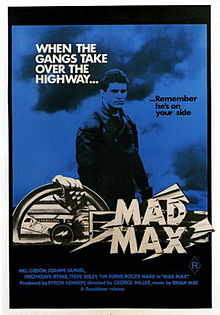
MadMazAusThis is where it all began and honestly, I knew so little about it. You have Mel Gibson and about everyone else is unknown to me. But that’s fun because they are a population that’s made up of clean slates. I have no expectations for them so they’re constantly engaging me and altering my expectations. Australia’s Outback is not quite apocalyptic yet, but we’re on the road there soon enough, with bleak roads and gasoline shortages. Likewise, Max Rackatansky has not quite taken his name to heart. He needs to go through hell first, and that’s where this film leads.

Max and his best bud Goose are Main Force Patrol officers who work for the highway patrol. They soon are chasing after the crazed gang member “Nightrider,” who is looking to outrun his pursuers in a stolen vehicle. But Max waits patiently for his prey and then strikes after his colleagues are knocked out. But despite the demise of “Nightrider,” his motorcycle gang lead by Toecutter continue to ravage the roads. They commit rape, partake in all kinds of destruction, and raise fear in anyone who gets in their way, because of their sheer unpredictability.

The fiery Goose becomes an easy target for their mayhem, and he’s left a sitting duck. Not even his good friend Max can save him and with his friend gone our hero seems content to get away with his family. He doesn’t want to deal with the madness so he picks up and leaves on a vacation. Max takes his beautiful wife Jesse and their little baby, but of course, the gang crosses path with him once more, and yet again there’s nothing he can do. He’s too late. Max has a choice now: either do nothing or go on a mad rampage of vengeance. He chooses the latter.

George Miller shows his audience these events without holding our hands, simply placing them in front of us and allowing us to observe as if this is in fact cold hard reality. Despite what we might think, there is nothing strange or out of the ordinary about it. This is the way society works and once you buy into the adventure, it’s easy to get enraptured in the action. Although there are jumps in narrative most definitely, it is made engaging by a dystopian world and characters who have so many odd ticks and mannerisms. Perhaps more importantly, stunts, car chases, and crashes never feel like pointless eye candy, but they are executed with precision and impact that is impressive. There’s nothing cheesy about it. This is all grit and a lot of road rage.

3.5/5 Stars

Ali: Fear Eats the Soul (1974)

alifear4Werner Rainer Fassbinder is one of those artists known for his tumultuous personal and political life, and yet with all the dialogue swirling around his backstory and untimely death, there is no doubt that he sent a charge through the film community that is still being acknowledged today. The New German Cinema of the 1970s breathed new life into an industry and created a massive impact. Part of the fact is that Fassbinder’s work hearkens back to his forefathers while constructing a space within the medium that was all his own. That’s what the great filmmakers do. They take what has already been done, grab hold of some inspiration, and run with it into some new uncharted territory.

In the case of Ali: Fear Eats the Soul, he takes the work of 1950s melodrama master Douglas Sirk and transposes it to his contemporary Germany. His particular inspiration is All That Heaven Allows, which revolves around the shocking romance between a respectable woman and her younger suitor. That in itself makes for a juicy piece of drama, but Fassbinder expands on that by adding a racial component. Always fascinated by topics of race, Fassbinder looks at an elderly German lady (Brigitte Mire), who begins to form a bond with a much younger Moroccan laborer named Ali (El Hedi ben Salem).

alifear3What begins as a small gesture, soon enough actually develops into something more, because once they sit down to coffee, they realize they actually appreciate each other’s company. Although I don’t understand German, the subtitles make it clear that Ali’s German is rather rudimentary, and yet that matters little to Emmi. She just enjoys having someone to talk to.

Emmi works as a maid and her husband is deceased and her children are grown up. She’s lonely. Ali has a group of friends from his homeland, but he feels like he’s treated less than human in Germany. Emmi’s different than your average German, but then again, her first husband was a Pole during the Nazi regime, so she’s no stranger to going against the grain. To her, it’s not a big deal. It’s just gets blown up by family and the tenants around her. Her nosy neighbors are quick to gossip and they all have a heavy case of discrimination. In fact, the unlikely couple is surrounded by narrow-minds sitting atop old bodies. A prime example is the local grocer, who ignores Ali, before changing his tune since he wants Emmi’s business.  But even Emmi’s children are not pleased. You can understand being surprised and a bit dismayed, but once a television set is kicked in, there’s automatically more to it. It’s not simply anger in it being such a rash decision, but the fact that Ali is a foreigner (and much younger). And yet all these separate issues are so closely intertwined it becomes an interesting situation. More often than not it’s the pervading bigotry that is the most noticeable.

alifear5Although the issue of age plays a role too, because at times Emmi looks out of place with Ali’s friends, and the same goes for Ali among her friends. It even leads him to a one night stand with the sultry bar owner (Barbara Valentin).  But Emmi is a very forgiving soul and in her, Ali finds grace. I’m not sure if I concur with all the conclusions that Fassbinder draws, but I can respect his stands on race. In fact, when Ali alludes to the catastrophe in Munich during the Olympics in ’72, such a current events make this prejudice toward Arabs all too real. It was a real pertinent issue and it still is to this day.

As for Fassbinder, he certainly knows how to work around his sets. The composition of his scenes is simple, but vibrant in mise-en-scene. He certainly has a touch of Sirk, being a little less luxurious, but still as bright. The closest modern example I think of is Wes Anderson as far as utilizing interesting color schemes and symmetry to frame shots. Also, there are quite a few times where Fassbinder maintains a shot for seconds on end. In such moments, it feels like we’re looking at a painting in a Fassbinder gallery. And it is exactly that. Art with an emotional depth from one of the foremost German masters.

4.5/5 Stars

The Conformist (1970)

conformist3 I had never seen anything from Bernardo Bertolucci, but a few of his other films that came to mind were Last Tango in Paris and 1900. I was expecting some mix of The Godfather and Le Samourai set in Italy during the 1930s. In all honesty, those were the meager reference point I was going into this film with. In some respects, it felt like my first time with The Leopard or The Battle of Algiers, because I thoroughly enjoyed the films, but the history and backstory really eluded me. Not knowing the ins and outs, what was fictitious or what was reality, I was forced to strip it down. So even if I could not track with everything, I could appreciate it as a piece of cinema trying to paint a picture of a certain time and place.

That’s what Bernardo Bertolucci and his cinematographer Vittorio Storaro do so well, and it turns The Conformist into a visual delight. It can stand on that merit alone, depicting gray facades that are only an outer shell for beautifully stylish interiors, flooded with light and infused with colors and textures. The drawing rooms are luxurious and Paris and Rome become the perfect backdrop for a world that vacillates between the bleak and the decadent. It’s the clean modernization of this fascist society intermingled with the ways of old. Storaro on his part, even makes leaves compelling and a man walking down the street becomes fascinating with dutch angles and contorted perspectives. That’s just the visual side of this film.

conformist1The Conformist, at its core, is a character study of one man, Marcello Clerici (Jean-Louis Trintignant), who is trying to find normalcy in a 1930s Italian world that is dictated by fascism. He’s a member of the secret police, who is assigned to knock off a political dissident seeking asylum in France. The target turns out to be one of his former professors so that in itself begins a personal conflict. There is a constant clashing of the state and duty with family and kinship. But within this main objective which drives the entire story and eventually takes Marcello from Rome to Paris, there is also a lot of personal baggage to be parsed through.

Although Marcello is pursuing the professor with his comrade Manganiello, a barrage of flashbacks cast some light on the rest of his life. It develops the framework for this man, what he does, and why he does it. His mother lives in their crumbling family mansion contenting herself with the companionship of her Japanese chauffeur “Tree.” Marcello’s father is locked away in an asylum. That is his family of origin and even going back to his childhood, he was traumatized and sexually abused. Now, in the present, he tries to conduct a normal lifestyle with his fiancee Giulia (Stefania Sandrelli), but when he goes to confession on her prompting, we realize how hardened he has become. His family does not seem all that important to him and religion is little more than a social structure.

conformist5And when he finally travels to Paris with Giulia, to meet with his old professor and complete his objective, that task gets complicated when he sees Anna (Dominique Sanda). Whether they know each other from before or not is ambiguous, but what’s not ambiguous are his advances towards her. It’s another weird, twisted dynamic because she knows that he is a fascist, and Marcello knows he will soon enough have to kill her husband. His wife and Quadri’s wife get along quite well. There is no animosity there, just like there seems to be no visible animosity between Marcello and his former teacher.

Murder should not enter this equation just as adultery doesn’t seem logical. Marcello even has his doubts, but again relationships, love, and family all take a back seat to the cause, just as he takes a back seat and lets everything run their course. But he cannot maintain his perfect veneer forever. There has to be a breaking point somewhere and so there is. With the fall of Mussolini, no one wants a conformist and Marcello is stuck in this gray area.

In The Godfather, since they are in America, at least they have some corrupted notion of family and religious faith. They accept capitalism although they work outside of it at times. But in The Conformist, although Marcello likes the idea of family, he really does not desire it. He falls for another woman in lieu of his wife, and yet that woman is of little concern to him when it comes to the agenda of the state. He looks for normalcy and maybe he gets it in a sense, but underneath it lies so much pain, dirt, and corruption. Just look at Marcello. He’s a repressed, misogynistic, faithless, fascist conformist. We expect him to be like Le Samourai, and he can’t even pull a trigger with confidence. He’s a pitiful, messed-up man who has been riddled with fascism. It didn’t kill him, but it might as well have.

4.5/5 Stars

Sunflower (1970)


sunflower

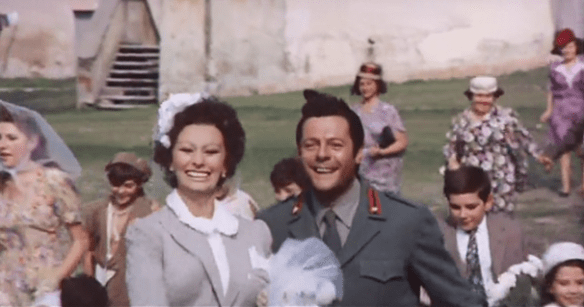
Vittorio De Sica is at the forefront of Europe’s most accessible filmmakers of the 20th century and that’s because the stories he crafts are heartfelt, moving, and also enter comical territory with ease. Sunflower pairs him once again with two of Italy’s Titans Sophia Loren and Marcello Mastroianni, and as you would expect the film starts off full of passion, playfulness, and a little pasta. It’s the dawn of WWII and the frisky pair is in love, deciding to get a quick marriage so they might get a 12 day leave before Antonio has to ship out.

In a sense, this is a kind of war film, because Anto gets sent off to the Russian Front and we get a glimpse of the harsh realities there. We are treated to some newsreel style war footage all the while veiled with a billowing red flag. Sunflower is not a film about the politics of the war per se, but rather the effect that war has on people and their relationships.  It can heighten passion, tear people apart, and change lives for good.

When the news comes home that the war is over, there is a flood of relief and then everyone including Giovanna (Sophia Loren) frantically begins the search for their kith and kin. Worried mothers and wives bring their long-cherished photos into train stations clinging to the hope that just one person passing by will be able to give them some fragment of hope. That’s what Giovanni gets and it’s not much, but a jaded soldier who suffered alongside Anto tells her the last time they were together, he was freezing to death in the snow. Her first reaction is to berate him, but he’s too tired to care by now. So she prepares for the journey to Russia to find the whereabouts of her long-lost love. She will not take no for an answer, but what she finds is more painful than even she could expect. It’s a different type of scar, a different type of hurt that no one could foresee.

sunflower1In some respects, Sunflower feels like a precursor to Life is Beautiful (1997), because both films are full of hopefulness, but they both exist as heart-wrenching stories. They deliver the same moving swells of emotion, but for different reasons. Sunflower ends up feeling a little like Umbrellas of Cherbourg in its tragedy. But the title seems to suggest, maybe, just maybe, like the old adage says, out of the ashes beauty can still rise. All the pain and suffering are only the fertilizer for flowers to spring up from the desolated earth. A memorial of what has happened, but also a harbinger for the future.

This is truly an international film because although it’s in Italian, it was partially shot in Russia (a first for the USSR) and features Russian performer Lyudmila Savelyeva in a prominent role. But the lovely score comes courtesy of America’s own Henry Mancini, rounding out this film perfectly. It’s another pleasant surprise from Vittorio De Sica.

4/5 Stars

Review: Nashville (1975)

nashville3What to say about Robert Altman’s Nashville? It has a lot of songs and music so it’s technically a musical. It has its smattering politics and Altman is typically one for subverting the norm so you could call it a satire. There’s romance, drama, in-fighting, and star power certainly, but that hardly gets to the heart of the film.

In fact, Nashville has an ensemble bulging at the seams with 24 individuals billed in alphabetical order and their names called out at the beginning of the film as if someone is trying to sell us an album. It’s a little over the top, feels superficial, and it’s a little pretentious. Maybe the director’s trying to tell us something. Over the course of the following minutes, Altman gives us a picture of a few days in the life of the country music capital of the world, and he shows us all sorts of people.

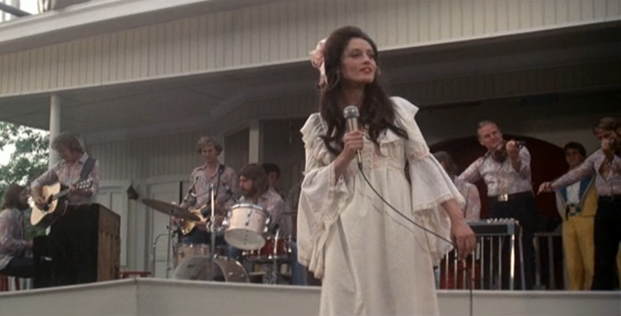
nashville1To name all of them would be tedious and would not give a whole lot of illumination as far as the plotting, but a few of the more prominent names are as follows: Barbara Jean, the sweetheart of Nashville, who opens the film receiving a warm welcome at the airport from her adoring public. But she is physically and emotionally fragile after recovering from a traumatic injury. Then there’s Haven Hamilton, who is an established country star, who still enjoys large popularity and political ambitions are on his radar. Jeff Goldblum, Lily Tomlin, Karen Black, Ned Beatty, and even Keenan Wynn all make appearances. So as you can see the cast is oozing through the cracks.

Their stories are constantly colliding, intertwining, and weaving in and out of each other. Making for a type of narrative that feels organic despite having a script. It feels like a realistic and truthful immersion into Tennessee reality. We even get appearances from a couple Altman regulars Elliot Gould and Julie Christie. Furthermore, it wasn’t much of a secret that the industry in Nashville did not take a liking to the film, but really is that any surprise?

Going into the film we already expect to get a look at the industry’s underbelly and we do, but it’s hardly seems sensationalized; it almost feels commonplace until the final moments. Singers griping, sleeping around, reporters ingratiating themselves to whoever they can find, and the general public coming from far and wide to be a part of the spectacle. It’s about what you expect from an industry that can be ruthless, superficial, and very rewarding to some. To those on the outside, it’s something to be fawned over.

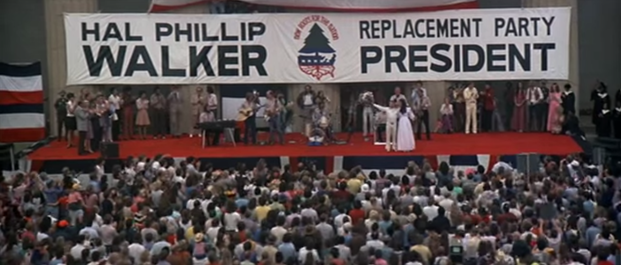
nashville2The story is framed with the political campaign of the unconventional Hal Philip Walker of the Replacement Party. You can see his van going all across town proclaiming his wisdom to the honest citizens of Nashville. Most of them could care less about politics. Even in the closing moments at a concert in the park with a big flag patriotically displayed on stage with a giant campaign banner underneath, you get the sense that no one has gone there for political reasons. They want to hear Barbara Jean, Haven Hamilton, and maybe tolerate anyone else who comes up on stage. In a sense, that’s the American way wrapped up in a nutshell.  Taken in that light, the way that Altman ends his film is not all that surprising. There has to be something to break up the normalcy. Subvert all that is good and patriotic. Throw a wrench in the every day, because after all his whole film has revealed everything that besmirches the industry. It’s just that it usually stays under the surface or is thrown away to be trampled on or forgotten. Take the no-talent Sueleen Gay, who stubbornly tries to make it in an industry that doesn’t want her.

I’m the first to acknowledge that I’m not much of a fan of country, except if it’s someone like Johnny Cash. So overall I find the tunes of Nashville to be homely and often tiresome, although I do appreciate the fact the actors wrote most of their own songs supposedly. The one exception I cite is Keith Carradine’s memorable tune “I’m Easy” which works as a simple ballad reminiscent of a Jim Croce-type singer-songwriter.

However, I don’t get hung up on Nashville‘s music too much, because this film represents so much more to me. It’s about the intermingling of people and the analysis and dissection of the relationships that are so closely entwined with the country music industry. Whether it’s the insiders or the fans who make them big, Nashville is a thoroughly interesting view of America circa 1975. Some things have certainly changed, fashion-related and otherwise, but I think we can all agree that a lot of things certainly have not. Politics, music, and most certainly people essentially exist as they always have.

4.5/5 Stars

Review: The Godfather (1972)

godfather1That moment when the undertaker is first seen pleading for justice and the camera slowly pulls closer, it’s so slight we hardly even notice it, but we hear his bitter monologue about America and his disfigured daughter. A head appears in the frame and we get our first vision of the now iconic Don Vito Corleone (Marlon Brando as masterful as ever). It’s a brilliant little scene that introduces us to the character this whole narrative revolves around, and it really is an important point to enter his story, on the wedding day of his daughter.

But it’s not just this opening scene that’s of note. In the sprawling expanse of this film that goes from New York, to Hollywood, to Las Vegas, and even back to the old country in Sicily, there is so much to be taken in. A gruff studio head faces the wrath of Corleone when he gets a present in bed, and he learns never to cross the Godfather again. There’s the moment where Vito first utters the words, “Make him an offer he can’t refuse” and then it is mirrored by his son Michael later on.

godfather2You have the quip from the tubby Clemenza after they pull one of the many hits and then very business-like they leave the gun, but take the ever-important cannoli. There’s the turning point where Michael the war hero faces off against crooked cop McCluskey  (Sterling Hayden) and the opportunistic heroin dealer Solozzo because he wants revenge for the shot they took at his father. There’s the striking juxtaposition when Michael takes part in the dedication of his god-child knowing full well what is happening to the bosses all across town. Finally, we once more peer into the inner office now with Michael at the helm, and the door closes as a concerned Kay looks on at what her husband has become.

But not many people need to be told what their favorite scenes from The Godfather are, and they could probably rattle them off while giving color commentary. Aside from just being great scenes, however, these moments tie together a major theme that pervades this entire epic narrative. Because really, when you break it all down, with all the bloodshed, all the business, and everything else this film encompasses, it’s really about family. It becomes such an interesting paradigm, how Family can be sacred, held in such high regard, and yet violence is at times necessary and it’s also seen as a part of life. The two things are so interconnected and yet somehow they still can occupy two different spheres. Wives, children, etc. are left out of the fray. But when it comes down to business, men like Don Corleone will do what they have to do. After all, they are the men of the family and with that comes responsibility and a need to be stoic and strong. Never lose your temper, never show weakness, never say what you’re thinking, and always make them an offer they can’t refuse.

Vito Corleone played so famously by Marlon Brando is the epitome of The Godfather. A 40-year-old man was made to look decades older, he was given a distinctive mouth guard, and the rest is a giant simply delivering his lines with the nuanced — almost gasping delivery — that he was so well known for. He is in many ways the center point as the patriarch of this great family and the head of their business. Although his role does change as the circumstances change, he is a man of incredible influence with a great many friends, allies, as well as a few enemies. In other words, he’s the man with judges and politicians in his pocket, but it doesn’t come without a cost.

Sonny (James Caan) is the eldest son who is first in line to take over the role as head of the family. But although Sonny is a tough guy, his fiery temper is his downfall. He doesn’t know when to keep his mouth shut, and he lets his anger get the best of him. It doesn’t bode well in a business like his.

Tom Hagen (Robert Duvall) is another interesting addition to the family, because he’s not really one of them at all, but Vito took him off the street and he’s rather like a son, becoming a trusted member of Corleone’s inner circle. He helps carry out business and represents the Don when it comes to legal issues. He’s a good man to have around, but it also makes for an interesting dynamic with Sonny and even Michael.

Fredo (John Cazale) is the one brother who is lost in the shuffle, and he’s most certainly the weakest. All he’s good for is living it up and getting drunk so the family sends him to Las Vegas to stay out of trouble. He is unfit to be head of the family, because he simply has no guts and although his father cares about him, he would never trust him with the business.

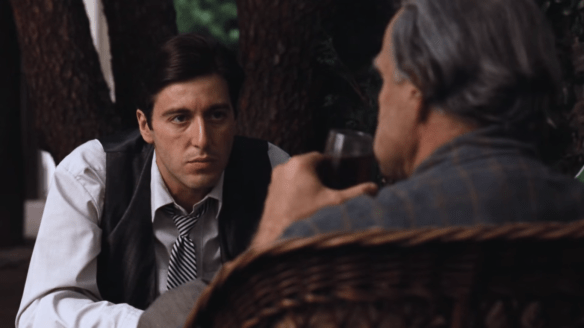
godfather3

Michael (Al Pacino) comes back a war-hero and with a girlfriend in Kay (Dianne Keaton) who has no understanding of his culture or his people. In fact, the family wants to keep Michael as far from the fray of the family business as possible to protect him. The only possible role he might play is something unimportant so there’s no chance of him getting hurt. But while Don Vito is the focal point at first, The Godfather really evolves into the evolution of Michael from beginning to end. He starts out as an idealistic veteran so far removed from corruption. But the turn of events that deeply affect his family cause him to step into a different role, and he changes as a result. He is a far cry from the man we met during the wedding because now his almost subservient nature has been replaced by a cold-blooded dominance that is personified through his eyes. They’re like to icy black holes that can stare right through you, and they do.


The cinematography of Gordon Willis is obviously superb and generally popularized the golden tinge of The Godfather that gives it a classy and generally nostalgic touch of the 1940s. It makes locales like the open air wedding, Don Vito’s inner office, or even a cathedral all that more atmospheric. On his part, the score of Nino Rota manages to be hauntingly beautiful at one moment and even upbeat when necessary.

What more is there to say but that The Godfather is cinema at its purest and transcendent in its scope. There are few films that carry such magnitude in the vast annals of film history.

5/5 Stars