Star Trek IV: The Voyage Home (1986)

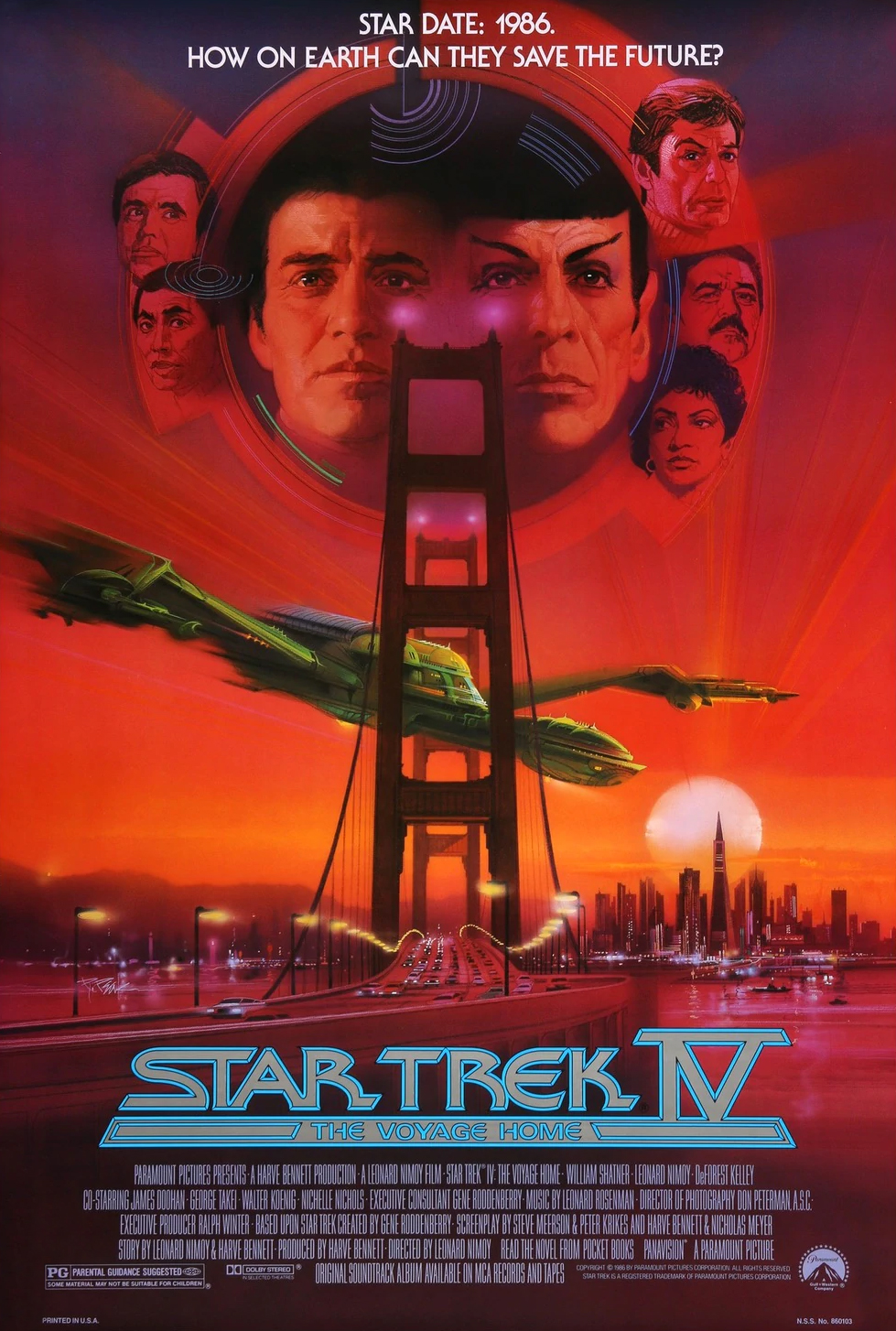
“The Cast and Crew of Star Trek wish to dedicate this film to the men and women of the spaceship Challenger whose courageous spirit shall live to the 23rd century and beyond…”

The opening remarks of The Voyage Home honoring the “courageous spirit” of those lost on The Challenger is a perfect encapsulation of the ethos of Star Trek.

Because it was always very much a franchise that was a social allegory for our world and by taking place in a sci-fi future, it was able to champion all that was good and valorous of people living through a space age even as they tried to reconcile with living with one another on earth with fraternity.

As a kid, Voyage Home was always my favorite Star Trek movie, and probably still remains so now. I’m not quite sure what it was exactly, though I do have some ideas. It’s important to acknowledge it right out front. Voyage Home has a wild and wonky premise full of a certain incredulity, but it’s also a good deal of fun.

Spock is back after Star Trek III, but now there is a new problem: Not only is Kirk a wanted man, but a frequency of humpback whale calls is causing chaos to reverberate all throughout the galaxy. Yes, you heard that right.

Kirk leads his fugitive compatriots on a Klingon ship with cloaking capabilities to time travel to the past — that is, the contemporary moment the film came out — 1986. The wheels start turning.

I’m no Star Trek savant, but it didn’t evade me that this is a subtle twist on the notable “City On The Edge of Forever” episode that sent Kirk and Spock (with his ear-concealing bandana) back in time to the soup lines of the Great Depression.

Voyage Home mines most of its comedy from your typical fish out of water premise, in this case pitting the Enterprise Crew of highly intelligent and advanced space cadets against a world that feels so analog and decidedly archaic to their sensibilities. Meanwhile, to the average guy on the street they look like helpless weirdoes.

A particularly memorable vignette involves a spiky-haired punk rocker on the bus with his blaring boombox. He does look rather like an alien to anyone left unawares from a different century. A little Vulcan nerve pinch gets the whole bus clapping with appreciation for curbing the noise.

Pairing Bones and McCoy off together is a pleasure in its own right, though it need not be expounded upon in depth here. The rest of the crew is entrusted to build a tank to carry the whales across the galaxy and also locate a nuclear reactor to help power their ship home.

Spock’s coming up to speed with the modern vernacular offers its own hilarity as does his commune with the whales in their enclosure at a Sausalito aquarium. It’s in plain view of everyone and another breach of societal norms. This just isn’t done in the 20th century. Spock has greater concerns as Kirk tries to guide him through this strange world like a blind man leading a blind Vulcan.

The resident biologist Dr. Gillian Taylor (Catherine Hicks) is incensed. She cares about these animals’ well-being deeply. Later, she offers a ride our two lovable nut jobs up in her pickup because she has a penchant for hard-luck cases.

The addition of Hicks in a fairly substantial role begins as a screwball comedy with her skeptical incredulousness around Kirk and Spock. It then builds into a kind of swelling romantic comedy served with a side of pizza pie. Somehow it plays as the less tragic inverse to Joan Collins turn in “City on The Edge of Forever.”

Because they push the boundaries of her belief and still, if she doesn’t quite have faith in their clear-eyed tall tales, she recognizes their shared mission to protect the whales. If it’s not quite faith, then her trust in them is rewarded in an extraordinary way as an unimaginable world of the 23rd century opens up before her eyes.

She always feels a bit out of step with the world around her, and then she finds these like-minded people, a little eccentric, and yet they suggest to her that she was made for so much more. It’s an extraordinary development.

Chekhov gets captured in a restricted area and is shipped off to a hospital in the city after he suffers an injury. Kirk and Bones lead a search and rescue mission masquerading in scrubs, then Gillian finds out the whales were shipped off early. They have to intercept them en route if they ever hope to save the whales and thereby the galaxy. No big deal.

Hanging out with the crew of the Enterprise in San Francisco sounds like a good time, and it’s a pleasure to assure everyone that it is. For such gargantuan stakes, Voyage Home feels surprisingly lightweight, lithe, and generally fun because we rarely feel burdened by them. It’s not bogged down by a lot of self-importance and this is to its credit. So it worked then, in my childhood, and it still holds up now eliciting the same kind of stirring reactions.

3.5/5 Stars

Star Trek II: The Wrath of Khan (1982)

If I had to take a stab at the age-old distinction, I would differentiate Star Trek and Star Wars like so.  Star Wars was a sci-fi Fairy tale and became something more. Star Trek began as a sci-fi allegory on TV and became something more. In a word: beloved.

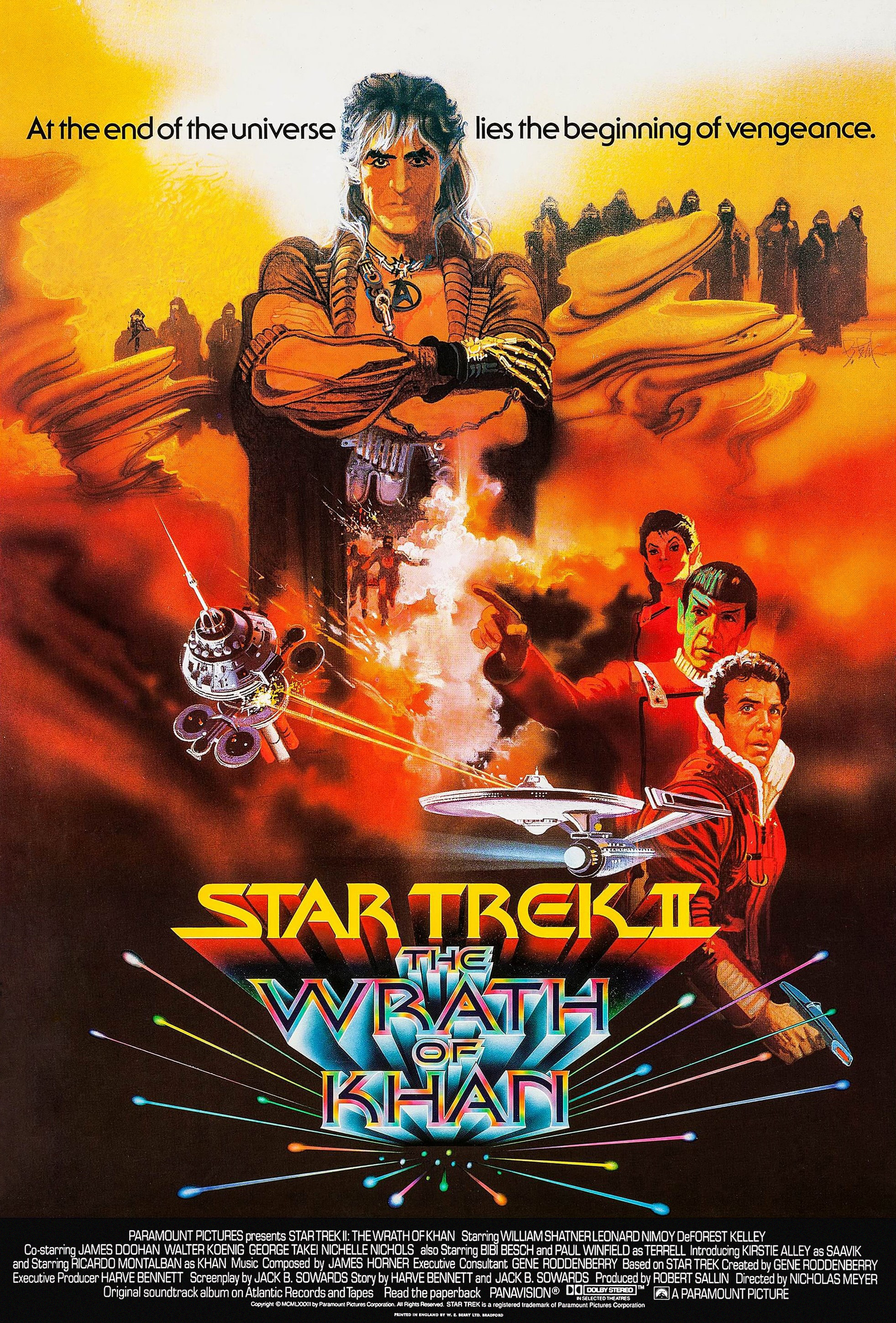
The Wrath of Khan opens with a scenario involving the usual suspects on the USS Enterprise, except standing in for Kirk is a  Vulcan named Saavik; they must rescue the crew of the Kobayashi Maru, and it all goes terribly wrong.

Moments later we learn that the entire escapade was a simulation.  Kirk (William Shatner), now an admiral, was watching from the wings. It turns out the Kobayashi Maru is a “No-win scenario” elucidating the character of the ship’s commander. You can probably imagine how Kirk handled it in his day, very unconventionally.

Bones (DeForest Kelley) chides his friend to get back out there. He’s not made for a desk job; he’s meant out there on the edges of the galaxy with his crew and wits about him tackling the universe’s most pressing problems. The pull of the movie means he has no choice in the matter.

Captain Clark Terrell (Paul Winfield) and Chekhov (Walter Koenig) lead the crew of the USS Reliant to an uninhabited world; it’s part of an interdisciplinary project to use the newly devised Genesis technology’s immense power to revitalize desolate planets.

There’s something ominous about it after they beam down, and it’s true they are not alone getting ambushed by the vengeful Khan (Ricardo Montalban) who still holds a vendetta for Captain Kirk leaving him to die (see “Space Seed”).

Among his entourage of scavengers he keeps some burrowing creatures as pets and they make his two hostages highly compliant. Khan’s quick to commandeer the ship, and we know what his aims are before he’s put them into action.

A trap gets set to lure Kirk. The USS Enterprise is alerted and comes face to face with The USS Reliant. Their purported friends have treacherous intentions looking to blow them out of space from close range.

There’s a robust theatricality to Montalban’s villain that feels large and provocatively cunning as he holds onto a grudge going back to Star Trek‘s TV days. It’s an inspired piece of work not only in building out the story, but in having the actor back for another installment because he already has a built-in history.

It turns it in a fine chess match and a space opera with Kirk and Khan crossing wits and playing out their old grievances in outer space. It takes this scope and the unfamiliar if appreciated world of space ships, phasers, and light speed, distilling them down into something so intimate and human.

If you’re a cynic, you could say the action mostly involves the two foes talking to each other over video screens. If memory holds, they never actually share the same frame. Still, regardless of what you think of the special effects or the sheer eightiesness of the film’s sets and wardrobe, the story is grounded in a conflict that feels so primal and compelling.

And if that is what gives us a movie, then we must also consider the other relationships. Kirk once had a romantic relationship with one of the head technicians of the Genesis project Carol Marcus (Bibi Besch); her grown son has followed in her footsteps and has a major chip on his shoulder when it comes to Kirk. His notoriety certainly precedes him.

The film is at its best when its heroes are put under duress. Echoing the film’s opening, Kirk and Spock look to rescue them from an untenable situation as they fight back against Khan’s unreasonable demands and Scottie tries to salvage what’s left of the Enterprise in the obliterated engine room. Radioactivity is contained, but with a busted engine, prospects are grim.

Like the second installment in the Star Wars franchise, Empire Strikes Back, Khan is a film about the ultimate sacrifice for the ones you love. If Han Solo did just that in the prior film, Spock does it here. It’s hard to think of two more beloved characters to watch suffer and giving them up hurts.

It’s fitting that the movie references A Tale of Two Cities with Kirk quoting Sidney Carton in the closing moments, “It is a far, far better thing that I do, than I have ever done; it is a far, far better rest that I go to than I have ever known.” This injection of classic Dickens reinforces how Star Trek is always grounded in traditional human history even if it’s pushed onward into future centuries.

Our hero is laid to rest with Scottie’s bagpipes. It always feels a bit anachronistic and then we hear the refrains of “Amazing Grace” in deep space suggesting it can touch even the far reaches of the galaxy.

Kirk eulogizes his buddy saying, “Of my friend, I can only say this: of all the souls I have encountered in my travels, his was the most… human.” That is the profound paradox of this friendship.

Spock’s a fundamentally rational character, and yet all these human impulses are pleased to dwell inside of him. It’s part of what makes him compelling because if we required a manual to read and comprehend him, it would be seem straightforward.

Kirk is the live wire, the unconventional one, who hates to lose — most of all he hates to lose his crew and the people he cares about. Yet in their camaraderie, we see something so formative, and Spock to the end is a noble, loyal friend.

It’s true he does bear the most human of traits and that’s why we hold him so dear because he knows what it is to love and care about other people. He has a heart to go along with his head, continually surprising us with the depth of his humanity despite his stoic countenance.

Like all the great adventure films, Khan has drama grounded in deep relationships, including the primary villain. In such a pressure cooker, every minute of action feels pregnant with real meaning and consequence. It also helps when characters we love and respect are at stake caught up in the middle of it all.

4/5 Stars


Tokyo Pop (1988)

Since my time living in Tokyo, I’ve continued to be fascinated with how Japanese culture will create these hyper-specific niches of popular fandom. Japanese people take their hobbies very seriously and they go all in. You often meet teenagers or straight-laced salarymen who can barely string together sentences in English, only to discover they have some unique knowledge about American culture, especially in the realm of music.

There was a businessman who loved Olivia Newton-John; his go-to English-language Karaoke song was “Physical.” There was a student who jammed out to Korn, or one of my fellow teachers who shared a love of Sam Cooke and taught me about jazz musicians like John Coltrane and Charlie Parker.

Japanese popular culture was arguably at its height during the 1980s. You had the economic miracle or the “bubble,” which led to unprecedented prosperity in the country and with it greater disposable income and thriving youth subcultures.

Tokyo Pop feels like a perfect time capsule for this precise moment. There are evocations of pop culture that blend Japanese tradition with Western influence. Front and center are a Mickey Mouse ryokan in Iidabashi, then iconic brands like KFC, McDonalds, and Dunkin Donuts.

There were even a couple of times I sat up in my seat because I felt like I knew where a storefront or restaurant might be below the neon lights of the city. However, some of the most famous landmarks are unmistakable. We get views of Shibuya near the Hachiko statue or greasers and punks hanging out in Harajuku near Yoyogi Park.

I don’t need much plot to enjoy the movie, but here it is. Wendy Reed (Carrie Hamilton) isn’t having much luck on the music circuit in America. When she receives a postcard from a friend, plastered with Mount Fuji on the front, she makes the impetuous decision to make the trip. However, she arrives only to realize her girlfriend has already moved on.

So she’s left high and dry bumming around Tokyo like a helpless baby who doesn’t know the culture, can’t speak the language, and is quickly running out of money. Hiro Yamaguchi (Diamond Yukai) spies her at a street vendor where he’s eating late at night with his buddies, and they bet him that he can’t get lucky with her. He takes them on. It’s a trifle, a cliché-filled scenario, but it’s easy to excuse the film based on what it excels at.

Carrie Hamilton and Yutaka “Diamond” Yukai try and go through the paces of antagonism, however, it’s their genuine camaraderie and shared appreciation of music that really shines through. In one sequence he serenades his American flame with an acoustic rendition of “You Make Me Feel Like a Natural Woman.”

Meanwhile, his band spends their time trying to get to a prominent Tokyo tastemaker named Doda who can make or break their careers. When all their ploys fail, Wendy finally takes the very direct approach waltzing into his office and commanding the room.

Eventually they make it big playing poppy covers of “Blue Suede Shoes” and “Do You Believe in Magic.” We see their rapid ascension as media personalities and global sensations, but at what cost? The couple’s able to get their own apartment and they should be happy, but their art suffers. They’ve pigeonholed themselves doing something that isn’t life-giving. They want to rock out.

Tokyo Pop‘s alive with so much youthful energy and, I would argue it has an even more perceptive viewpoint than later works like Lost in Translation. Although it has an entry point for American audiences, so much of it feels attuned to aspects of Japanese culture; they’re the type of moments I see and totally recognize, not as foreign and other, but authentic.

Japanese lavishing effusive praise on their fellow countrymen for any nominal use of English. Shoes taken off at the entryway. Every taxi driver’s fear of foreigners. Karaoke and alcohol as one of the most beloved forms of socialization, and the kindness of elderly men and women who will walk you where you need to go in spite of any language barrier.

In its day, Fran Rubel Kuzui’s movie was quite a success at Cannes only to fall away thanks to a distributor that went defunct. For a film that’s so perfectly in my wheelhouse, it’s a joy to see it resurrected from obscurity in a fancy new print that does wonders in making the images of the 1980s explode off the screen. There’s a tactile sense that we are there in the moment.

During an interview, the director acknowledged, only years later when friends told her, that she and her Japanese husband Kaz Kuzui were basically Wendy and Hiro. If not in actuality, then certainly it mirrors how their relationship crossed cultural bounds.

It’s also easy to draw parallels between Tokyo Pop and Lost in Translation for how they capture a moment in time (and coincidentally they both feature Diamond Yukai). Although the former film is more upbeat, and lacks much of the alienation of Coppola’s work, you do still see the darker, lonelier edges of Tokyo on the fringes.

From passionless love hotels to getting lost in the masses of humanity, and the crippling societal expectations of Japan, it’s still present. Because while Lost in Translation is always about the western perspective incubated in Tokyo’s fast-paced modernity, it seems like Kuzui’s international marriage gives her a more perceptive and localized understanding of Japan.

I’ve long been a fan of John Carney and there’s some of that energy here where music is so integral in constructing the story. No matter how humble the means, the production of the music functions as a platform and a showcase for the performers in such an authentic way. By the end, we appreciate the music and by extension the characters as well. But they both work in tandem to supersede the plot.

Some of the songs feel like absolute knockouts like “Hiro’s Song,” which can stand on its own two feet. They leave the film on a feel-good high that extends beyond the credits. With the latest reissue of the film for its 25th anniversary in 2023, it seems ripe for rediscovery by a new audience.

3.5/5 Stars

His Motorbike, Her Island (1986) and The Rocking Horsemen (1992)

His Motorbike, Her Island (1986)

There’s an immediate aesthetic artifice to His Motorbike, Her Island. Our hero is cool and simultaneously cruel representing a husky-voiced, brusque masculinity that feels no doubt appealing and equally toxic. He recounts his life’s observations through voiceover — the monochrome dreams making up his memories — and as such the movie slaloms easily between black & white and color.

It feels perfectly at home in its moment as part ’80s biker movie full of style. Some of this no doubt comes from director Nobuhiko Obayashi who always seems to have a propensity for commercial pop culture imagery. I would hesitate to call him a technician, and yet since he both edited and directed many of his films, maybe I don’t want to use the label because it sounds too austere.

His films are suffused with a vibrant energy and although the comparison misses the mark, the only reference I could think of was Richard Lester. I’d be interested in hearing who others bring up.

The movie’s premise is quite simple. Koh Hashimoto (Riki Takeuchi) runs errands on his motorcycle part time. His idle hours are taken up with a docile beauty name Fuyumi. He even gets in a duel with the girl’s older brother, who’s worried for her honor. Whether the outcome impacts his view of her or not, Koh, breaks it off. By his estimation, she’s boring (all she knows is crying and cooking).

Koh is looking for the Japanese version of the aloof dream girl, and he finds it in Miiyo. She captivates him with her confident vivacity, taking pictures of him, chatting in the onsen, and ultimately taking up his first love of motorcycles.

Their relationship blossoms when he visits her hometown out in the country during Obon, and we witness how the summer holiday is rooted in both a veneration and a celebration of dead loved ones. Koh’s captivated watching Miiyo dance during the festival proceedings. It’s something about her spirit he finds so attractive.

It also signals the film’s dangerous edges. Because if I wanted to distill His Motorbike, Her Island, down to its essence, we would need to talk about the intoxicating and reckless abandon of youth. It’s mesmerizing when it’s projected up on the screen in all its glory existing without worldly consequence of any kind.

Miiyo follows Koh and becomes infatuated by his singular passion: a 750cc Kawasaki. But it’s not just a supercharged motorcycle, and it’s not so much about an object made of chrome and an engine. It’s the adrenaline hit and emotional high of riding a motorcycle and riding it fast. It’s almost a dare for life to come at you head-on. For them, living life on on the edge like this is an obvious antidote to the malaise.

It’s both what attracts them to one another and threatens their ultimate undoing. Live fast, die young, has a poetic inevitably to it. I feel like I will need to watch the movie again down the road sometime, but there’s a pervasive sense that this motorbike, this island, this young man and this young woman take on a kind of mythic proportion.

Just like I never caught onto a perceptible rhythm of the monochrome and color, what we witness is not always an objective, tangible world. It exists in the hinterlands of memory, love, passion, and emotions just out of reach. The irony is obvious.

Sometimes, to feel alive, people need to get as close to death as possible. I’m not sure if this star-crossed, high-octane hedonism is still en vogue, but it’s easy to understand how it could seem attractive albeit misguided. There’s a hubris to it.

3.5/5 Stars

The Rocking Horseman (1992)

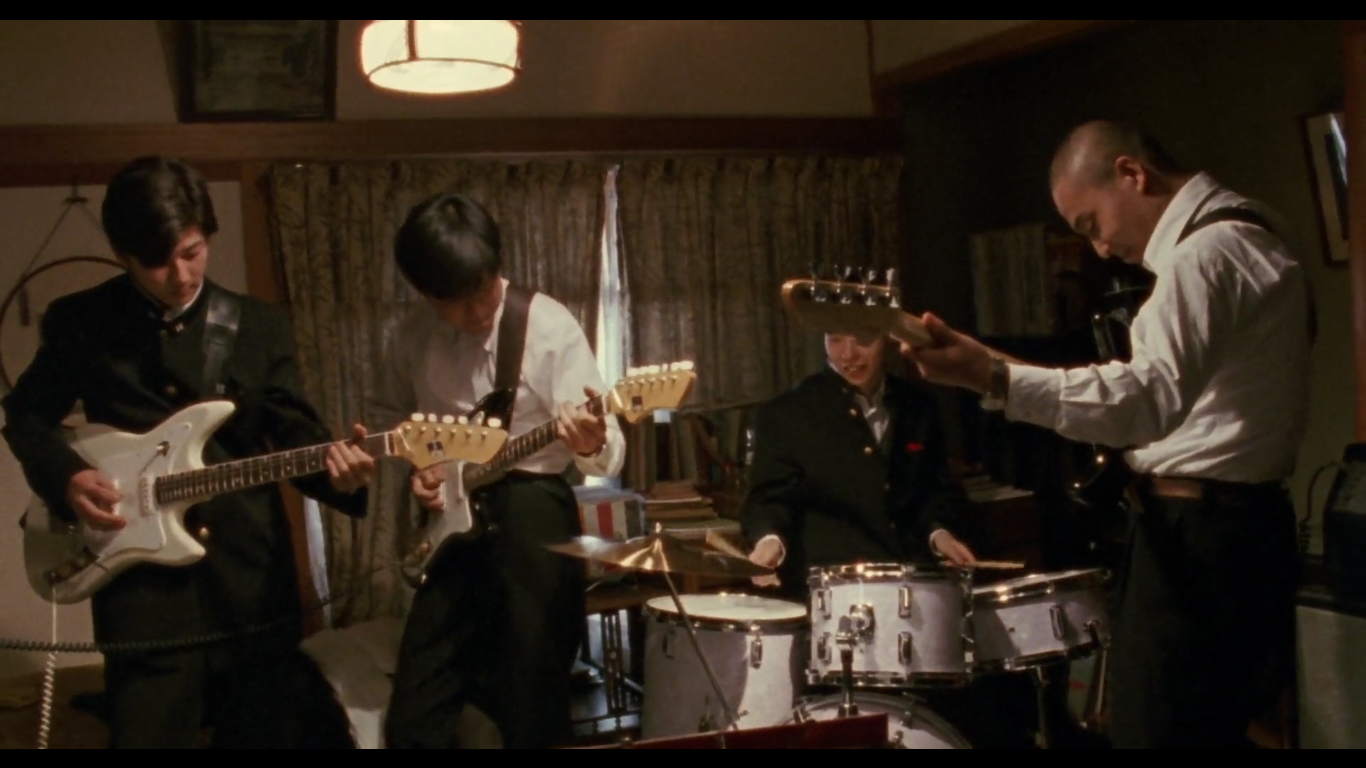
When I lived in Japan, I was flabbergasted to learn that there was a group that was bigger in Japan during the ’60s than the Beatles. It was The Ventures! This instrumental act kicked off the “Eleki Boom” as their iconic onomatopoeic glissandos (deke-deke-deke) captivated a generation of youth. These teenagers subsequently rushed out to buy their electric guitars and start their own bands during the “Group Sounds” explosion.

Although I didn’t think about it at the time, I’m a sucker for a good musical coming-of-age movie, and this landscape was ripe for such a story. Recently, when I came upon The Rocking Horsemen, I realized a void in the cinematic landscape had been filled thanks to Nobuhiko Obayashi

Fujiwara (Yasufumi Hayashi) feels like the most innocent and congenial of Obayashi’s boy heroes, a Ferris Bueller-type who instantly takes us into his confidence by not only providing voiceover but speaking directly to us.

OB’s films are easily placed in this provincial milieu outside the hustle and bustle of the big city. This gives them a kind of comfortable intimacy, and it’s only a small jump to place them in the past. In this case, Japan during the 1960s. I already mentioned that the movie covers a subgenre I have a private preoccupation with: form-a-band origin stories. That includes That Thing You Do! and Sing Street to The Commitments, Nowhere Boy, and School of Rock. What sets this one apart is the unique context and cultural moment.

Now I’ve been inculcated from an early age that the Beatles had the greatest music, but Fujiwara is coming of age with an ear raised to the admonitions of his elders. Pop music is puerile entertainment, cultural dregs compared to the sophistication of classical music. The Beatles included.

Then, his radio played “Pipeline” and he is changed forever. Any kind of snobbery quickly dissipates. The new sound assaults him as he reclines in his bedroom. There’s no escaping its force, and he converted for good, caught up in the same boom I read about. It was electric liberation.

Since a rock musician can’t look like a Buddhist acolyte, the first course of action was to grow out his hair. It occurs to me that one of the reasons I find these movies compelling is it involves some kind of youthful industry. When you’re young you don’t need to be told the odds. If you want to start a band, and that’s you’re impetus, you can go ahead and do it. No permission is necessary (parents notwithstanding).

In this way, Fujiwara meets his future bandmates. The first shares his interest in rock and turns his back on the more traditional setlist the school club follows. The rest of the members include a priest’s son, who’s the band’s source of worldly wisdom, and then a gawky dork who gets coerced into playing the drums for them.

If initially they fall together organically enough, they also premeditate how to best go about their business. In the end, they resolve to get summer jobs at a local manufacturing plant to save up to buy their instruments. These scenes are mostly transitory — only an end to the means — but as “Woolly Bully” plays over their assembly line, there’s a sense of optimism. They’re getting closer to their goal.

Ittoku Kishibe shows up again after Lonely Heart as a good-natured teacher who supplies American lyrics and ultimately offers to become their club advisor. It’s a small addition, but his tacit affirmation of their endeavors speaks volumes.

I’m fascinated by how pop culture can infiltrate and suffuse through the cracks of a society, especially in an international context. I met Japanese folks with very specified knowledge about Korn or Olivia Newton-John, Sam Cooke, Jazz or Punk music. Or think of the two teens in Mystery Train who go on a pilgrimage to Memphis in search of The King. Where does this come from?

While I wouldn’t call the general Japanese populous particularly aware of world culture, you do find these hyperspecialized niches of expertise. These boys glean their inspirations thanks to radio and import records, even older siblings who pass down a love of Nat King Cole.

A perfect example is Jan and Dean’s “Little Old Lady from Pasadena” played as our hero rides his bike through his neighborhood. It’s a totally different context from the California surf culture I was born and bred in. But it still reaches them on the other side of the world. The same might be said of The Animals, “Don’t Let Me Be Misunderstood.”

It doesn’t feel like a mistake that the first time the new band convenes and brandishes their new name — The Rocking Horsemen — they start playing, and it’s a flawless rendition of “Pipeline” (exactly like the Ventures recording). They make their debut at a show during Christmas with mixed results, but they disregard the critics and play their hearts out. What’s more, they gel and become galvanized as a group. How can you not under the circumstances?

But as school comes to a close, their journey together winds down too. Their first and last big show comes at the annual school cultural festival and with a set list including “I Feel Fine” and “Johnny B. Goode,” they can’t miss. We’ve seen this moment before in many a movie so it’s a kind of expected wish-fulfillment watching them go out.

When you’re an adolescent these are the kind of memories that stay with you. And in a final act of solidarity, Fujiwara now listless and despondent over the future, has his newfound brotherhood to come around him. They christen him their “Bandleader for Life.” So even as their journey as a band might have met its logical conclusion more than an impasse (not many make it like The Beatles), The Rocking Horsemen do have some amount of closure. The music and those relationships will never leave them.

4/5 Stars

Lonely Heart (1985)

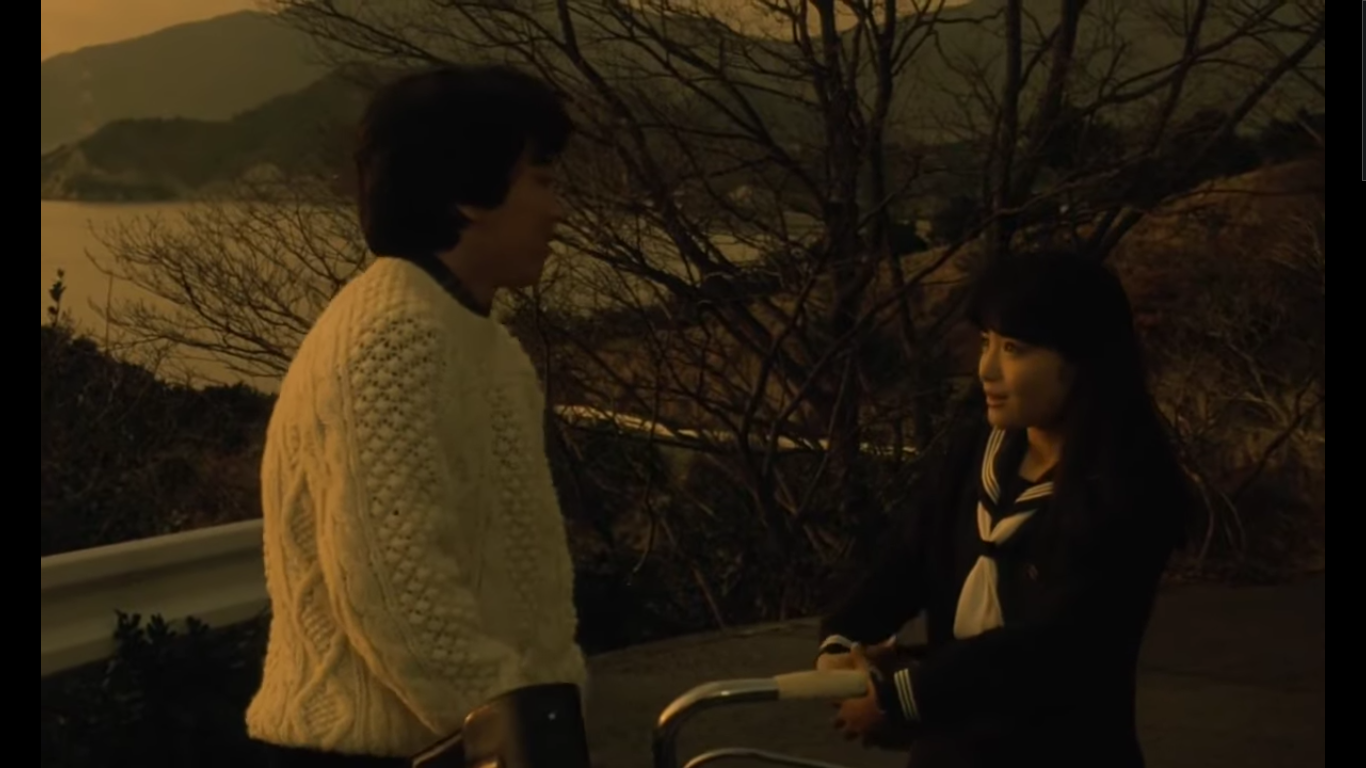
Lonely Heart is a film bathed in the golden hues of nostalgia (“natsukashii” in Japanese). It also boasts a rural landscape with a topography that’s the utter antithesis of Tokyo’s urban skyline. This in itself already evokes a certain quaintness, regardless of the story being told almost 40 years ago.

Hiroki (Toshinori Omi) envisions his world through the shutter of his camera — though he rarely has actual film to use — and so he imagines what he might capture. After school, he can be found scampering through the village streets in his school uniform with his two best friends doing backflips and cracking all manner of jokes. They have a youthful ingenuity that’s clever when it’s not getting them in trouble.

For instance, their use of Bunsen burners, forceps, and various pieces of lab equipment to cook up a delectable meal is inspired. Then, Hiroki’s friends razz him about following his father’s footsteps to be a Buddhist monk — he must give up meat lest he goes to hell for cutting corners on the road to enlightenment — and they’ll gladly eat his portion.

The next moment, they’re ushered off to the principal’s office to clean as a minor punishment. Instead, they teach vulgarities to the principal’s prized parrot and their mothers have the ignominy of coming into school to atone for their indiscretions. Hiroki’s mother is your typical portrait of a Japanese parent, at the very least because she’s always on her son to study more and pick up his grades. Their underlining failure to communicate is a universal adolescent struggle.

But his life stage is also about love, something that still feels naïve and untarnished by regrets and ample experience. He often looks through his camera viewfinder at the mystery girl, “Lonely Heart,” as she plays the piano, rides her bike, and takes the ferry home. If this was all it was, Lonely Heart might be a fairly rudimentary exploration of youth — another boyish awakening where the girl is cast as an object rather than a human being with a unique inner life.

Some of this happens in the movie with the ethereal Yasuko Tomita, but there’s also a parallel tale leaning into these themes in a more profound way. In fact, it takes them a step further. Hiroki receives a visitation from an impish ghost of a girl who materializes on numerous occasions even going so far as berating his mother and toying with her.

This seems like a curious development, but then Japanese culture has a greater tolerance for ghosts. If you’ve seen some of Miyazaki’s movies (arguably Japan’s most beloved cinematic export), you already know there’s a kind of acceptance of these things. They aren’t so much supernatural and if she’s labeled as “weird,” she’s also more or less accepted as fact.  Just as magical realism and surrealism can often permeate Japanese cinema.

This is easier to accept as I often have trouble with Japanese humor because it feels broad (whatever that means). The film is full of juvenile shenanigans and adult caricatures who overwhelm the screen from time to time blindsiding us with absurdity.

However, in juxtaposition, there are these instances of sensitivity playing out in Lonely Heart’s more pensive parts, personifying what Hiroki grapples with all throughout the film. It’s this long-lost love — the deep longing within all of us — resigning us to be these lonely creatures.

In Japanese culture, there’s also something innately beautiful about this sacrificial melancholy for the sake of some greater good or greater call. If I didn’t get my cultural signals crossed, it ties into the essence of “mono no aware” — an impermanence or transience of things. I’m not sure if Japanese culture would speak about love with these same terms, but please allow me to, even if only momentarily.

I’ve gotten to a juncture in my film-viewing life where, if I haven’t quite matured, I’m willing to take things on their own terms. Lonely Heart does not function within our western logic. If you asked me to explain everything away I’d be hard-pressed to say all the whys and wherefores. And yet something about this movie, mixed in with all its various forms and flights of fancies, left me with an indelible sense or feeling that will remain with me.

Somehow it reminded me of the more recent gem Petite Mamman. It has to do with honing in on a magical and poignant connection between parents and children. It developed differently than what I was expecting — the fantasy has a unique kind of functionality — and so by the time the movie’s over it has done work on us.

It’s offered up a quiet epiphany that we might tuck away for later enjoyment. Hopefully, if you get the chance to watch the film you’ll understand exactly what I mean. However, I wouldn’t dream of divulging that here.

3.5/5 Stars

Three O’Clock High (1987)

The introduction of the main character Jerry Mitchell (Casey Siemaszko ) feels fairly standard and in line with Ferris Bueller, Say Anything, or any of its brethren from the ’80s. Late for school. Dirty shirts strewn about. Simultaneously zapping pop tarts and wet clothes in the microwave. Flat tires and your kid sister hands you a diet Coke to gargle the toothpaste you just finished brushing with. It’s quirky enough to give us some sense of who we’ll be following for the next hour and a half without straying too far from genre convention.

Still, all of this handy exposition feels a bit like a misdirect or at least suggests up-and-coming director Phil Joanou started out with one movie in mind and came up with something else along the way. More on that momentarily.

Jerry is a likable, if innocuous, dweeb we can probably imprint ourselves on and his high school, located in Odgen, Utah definitely doesn’t have the Hollywood glam. It lends itself to a different kind of visual milieu we can appreciate. All the adults in the movie for the most part are only totems to hang necessary impressions and sentiments on.

Jefferey Tambor is the closest to an actual character as a teacher who entrusts Jerry to run the student store and marvels at what a profitable business he’s managed. Otherwise, most of the authority figures and even government agents (how they always have time for teenagers is beyond me) feel like caricatures without too much premeditation.

Despite some promising introductions, most of the friends and female characters feel fairly empty no fault of their own. Jerry’s sister Brei has a chatty wit about her but essentially disappears from the movie popping up only when required.

There’s his thoughtful if slightly ethereal girlfriend (Annie Ryan) whose eyes grow luminous as she speaks candidly about spirit animals and her spirit “guide” Ethan. Don’t ask me to explain. And because Franny’s the brunette (yes, her name’s Franny), there’s also the untouchable blonde goddess Karen (Liza Morrow) who exists as a figment rather than a full-bodied character. She’s always ready to induce traffic accidents and seismic heart palpitations in our fearless hero.

Although it is Jerry’s story, it almost feels like it’s too much about Jerry and his inner psychology. He’s not the most intriguing part of the picture though we do need him as a conduit. Perhaps more could have been built out of his relationship and even his alienation from others. But it’s also necessary to take a moment to consider the movie’s tone and inspiration.

I’m not sure how to parse the fact from the fiction (this oral history is the best resource available) but supposedly this is one of the films Steven Spielberg requested to have his name taken off as an executive producer. It probably comes down to how dark it becomes though even this might lack the ring of truth.

Although it’s easy to label Three O’Clock High as a high school rendition of High Noon, it actually stands more in line with Martin Scorsese’s After Hours from a couple years prior. Given this comparison, Spielberg’s purported surprise would make more sense because this premise has all the potential hallmarks of a traditional ’80s teen movie.

Like its predecessor, I find it drags in the middle using time a bit like After Hours to give in to its most absurd and surrealist tendencies as Jerry’s world dissolves and slowly closes in around him.

One could easily say Soho in the prior film has been distilled down to the school corridors and classrooms Jerry is tied to as he sweats the hours ’til his inevitable annihilation. It does make it feel like Gary Cooper’s Will Kane when evoking the limiting factor of ticking clocks.

However, a venture to the principal’s office features the décor and camera angles fit for The Bates Motel. Later Jerry’s chased down by a security guard in the parking lot. Wasn’t the man in After Hours pursued by an angry ice cream truck? Otherwise, there’s a ghoulish school assembly accentuated by Tangerine Dream’s quintessential ’80s synths and any number of preliminary bouts laying the groundwork for his dreaded showdown.

We have yet to mention the movie’s primary villain whose psychotic reputation more than proceeds him, whispered throughout the halls and steps of the school as it is. The only reason there’s even a movie stems from Jerry’s position at the school newspaper. He’s given the unenviable assignment to profile Buddy Reveill (Richard Tyson) and one urinal encounter makes them mortal enemies for life. Nothing he can do can put off the unavoidable.

The ending does deliver on some of its payoffs by casting off any sense of moralism for a good old-fashioned bloody smackdown between good and evil without a ton of didactic consequences. Law and order are thrust aside as the adolescent masses cheer and rage sensing the brass-knuckled fury in the air. I did begin to wonder if in 80s-era America this hulking villain was a stand-in for fascist or authoritarian regimes. It’s of little importance.

Because this is only an afterthought as Jerry faces Goliath and is subsequently saved by the student body in a deus ex machina a la It’s a Wonderful Life. The lesson: It pays to stand up against tyranny and oppression in the school parking lot. More important still, boyish fantasy is kindled and nothing else exists beyond this singular moment in time. It is a kind of wish fulfillment for young males of a certain age.

Whether it was Joanou’s inspiration, screenwriters Richard Christian Matheson & Thomas Szollosi, or more likely a confluence of everything, Three O’Clock High feels more like a cult curio than an unadulterated classic. That’s not meant to be a slight, nor a total dismissal. It’s not Scorsese (it’s not even Speilberg). But it shouldn’t have to be. It deserves to be taken or left on its own terms as another addendum to the ’80s teen movie canon.

3/5 Stars

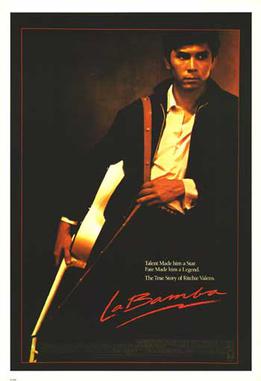
La Bamba (1987)

I must have learned about Ritchie Valens through Don McLean’s “American Pie.” Because there was a time when I was fascinated by all the musical references that seemed so oblique to my young mind. Eventually, the songwriter’s ode leads you to “The Day The Music Died” and if you know about Buddy Holly, you soon learn about The Big Bopper and Ritchie Valens.

The song “La Bamba” feels like a definitive track of a certain rock n roll era, and only now does it become easier to realize what an important cultural milestone it represents. The Mexican language went mainstream blending the rock craze with folk traditions of a people who felt well nigh invisible if no less important in the ’50s.

I do not know much about Luis Valdez, but as an emblematic figure in the Chicano movement of the ’60s and ’70s, he also gave us two of the most noteworthy Chicano movies of the 1980s. He turned his own play into Zoot Suit with Edward James Olmos, a film I was never able to fully connect with, but La Bamba feels like a more straight down-the-line biopic. He effectively brings to life one of the great Chicano heroes of the second half of the 20th century.

Lou Diamond Phillip’s vibrant performance glows with undeniable warmth and vitality. There’s not a disingenuous bone in his body, and he’s able to evoke the joy behind the microphone and the quiet fortitude that comes with his humble migrant background.

This is one of the most moving things about Valdez’s film because even almost 40 years on, these slices of life are still not always prevalent on the big screen. To see them in a period piece seems even more fitting because it’s a way of capturing the cultural moment for us lest we forget.

We see the plight and humble living conditions of migrant workers, there’s instability and broken families, but also the unbreakable bonds of extended families and communities looking out for one another.

La Bamba also has many of the beats of the biopic and since I don’t know the life of Valens intimately, I can only give conjecture on what’s fact and fiction. Part of the story involves his older half-brother (Esai Morales), who exists as the black sheep of the family opposite Ritchie. There’s the blooming of young love with the new girl in class, Donna (Danielle von Zerneck). His family and high school lives run in tandem with his meteoric rise after a record producer, Bob Keane (Joe Pantoliano), agrees to record some of his tracks.

Valens fear of flying, after a midair collision over his school, which killed his childhood friend and left him with recurring nightmares, has the ring of truth stranger than fiction. In keeping with this, the opening interlude of Santo and Johnny’s “Sleepwalk” feels apropos to represent the general mood of the era. What follows is a bit of a dream even as other moments sting with harsh realism.

There are so many narratives that could happen. There’s a bit of a Romeo and Juliet romance as Donna’s father tries to rebuff Ritchie’s sincere advances. Still, Donna remains devoted throughout the picture, and what a lovely thing is to see their euphoric joy together. The images suggest you don’t have to look like one another to fall in love. The fact the movie draws up this star-crossed romance between a 17-year-old and his 15-year-old beau feels of small consideration. It is a movie.

His brother knows how to make an entrance rolling up on his motorcycle, sunglasses on, cigarette between his lips. Or maybe this is only how we imagine him. Still, Bob’s demons could have been their own movie making him into a perturbing, abusive, drunken figure at the movie’s volatile center.

He’s effectively cast as Cain, never good enough or able to find favor in comparison to his thriving little brother. He spends the whole movie self-destructing and coming to terms with his brother’s burgeoning success. Later in life, it seems his real counterpart was able to resurrect his life and became a beloved member of his community.

Likewise, Bob Keane shows up in Ritchie’s life. We don’t really know how he got there or what all his motives are; still, there’s nothing too sinister in it. He helps Ritchie get big by recording and promoting him, and Valens is on top of the world.

It’s easy to see how all of these dynamics might have been either simplified or drawn up in such a way as to streamline the story or punctuate the dramatics. And yet I never begrudge the movie its choices, because it does feel like such a bountiful cultural artifact. The fact Los Lobos provided much of the soundtrack and even show up in a musical cameo is another notable distinction.

And the gutting, sinking feeling in the pit of our stomachs signals the dream cannot last. This talent taking the world by storm and rocking out with Eddie Cochran and Jackie Wilson will be snuffed out far too soon. So if everything else gets resolved in a Hollywood manner, our star is still going to be taken from us in the final reel. There’s no way to get around it.

McLean’s song mourned over it as “The Day The Music Died.” Thankfully, he was wrong. Yes, we no doubt lost out on years of musical output from Holly and Valens. Their young talents were undeniable, and yet their contributions to rock ‘n roll are far from dead. For their relatively short time in the public eye, they’ve cast very large shadows indeed. “La Bamba,” “Come on, Let’s Go,” and “Donna” feel like genre standards by now.

In his own way Valdez has guaranteed Valens won’t be totally disregarded (it was added to the National Film Registry in 2017), and Lou Diamond Phillips, bless his heart, made Valens far more than a hagiography of a deceased icon. He’s a young man with a warm, beating heart, a love for his family’s culture, and a love for rock ‘n roll. I can’t think of a better testament to Ritchie Valens than that.

4/5 Stars

Mystery Train (1989)

I hold an immediate affinity for the images at the core of Mystery Train: A Japanese couple (Youki Kudo and Masatoshi Nagase) riding a train. This is the ’80s so they’ve got a walkman with an audiocassette tape, and it’s blaring Elvis! It becomes apparent they are making a pilgrimage to Graceland so famously immortalized by Paul Simon. The song “Mystery Train” becomes an apropos and uncanny way to enter the story while paying homage to the King.

Jim Jarmusch always strikes me as such an open-minded and curious filmmaker. Modern society speaks in terms of diversity and inclusion, but the beauty of watching a Jarmusch picture, it’s the fact he’s not looking for these things in order to meet some quota. He seems generally interested by the stories and perspectives a whole host of characters can provide him, and his films benefit greatly from this enduring proclivity.

Regardless of where the funding came from, who else would consider making a film about two Japanese youth in search of Elvis Presley in the 1980s? They spend the first several minutes speaking a language that the primary audience probably does not understand. They likewise are bewildered by a upbeat yet motormouthed docent at Sun Records. Still, somehow shared passions for Carl Perkins, Jerry Lee Lewis, Roy Orbison et al., draw them together in inextricable ways.

There’s something perfectly fated about the whole thing with Screaming Jay Hawkins as a rather flamboyant hotel clerk aided by a youthful bellhop (Cinque Lee). I don’t know how to describe it but Hawkins has a command or a sway over the picture rather like Wolfman Jack in American Graffiti. His presence is felt and becomes so indelible in accentuating an aura. He comes to represent a certain era and a place in human form.

Jarmusch’s characters of choice often feel like sojourners, strangers in a strange land and Memphis is such a place. It is a film that features degradation — cracked pavements, garish neon lights, and portions of the world that are not perfectly manicured. What a concept. It’s almost like Jarmusch is giving us the real world albeit composed through his own cinematic lens. It’s no coincidence it has this kind of baked-in glow of Paris, Texas another film of geographical Americana captured so exquisitely by Robby Muller

It’s only a personal observation but my level enjoyment slightly decreased with each descending story. As someone who journeyed in Japan and went to one of the greatest concerts of my life in Yokohama, I feel this kind of kinship with these Japanese youths in their pilgrimage to Elvis and Carl Perkins. Also, on another level, this is a point of view we just don’t often see in movies of the 1980s or even today. Jarmusch is not using them as some kind of stereotypical punchline. He’s genuinely interested in their story and allowing it to play out in front of us.

Then, there’s Nicoletta Braschi in part two. She’s told a ghost story by a dubious stranger and gives him a tip to be left alone. She too seeks asylum for the night at the same hotel and gains a chatty roommate (Elizabeth Bracco) who is linked to our final vignette.

This last interlude with Steve Buscemi feels like it exists in the time capsule moment of a certain era where Tarrantino, the Coens, and others were making these stylized, often grotesque comedies. Elvis (Joe Strummer) gained his nickname inexplicably, but he’s also started to become unhinged because his girlfriend went up and left him. The cocktail of booze and firearms make his buddies Charlie (Buscemi) and Will Robinson (Rick Aviles) uneasy. Although it feels more like an absurd episode of The Twilight Zone than Lost in Space.

Regardless of my own preferences, Jarmusch still gives his world a sense of purposefulness. Again, it’s this serendipitous quality reminiscent of Jacques Demy’s fated films where lives cross paths and intersect in deeply poignant ways.

There’s something somehow elegant about the structure. It’s certainly premeditated and Jarmusch purportedly was inspired by classical literary styles in constructing his triptych, but it’s also a genuine pleasure to watch it unfurl.

The movie revolves on the axis of a few shared moments and places: A hotel, a radio DJ (Tom Waits) playing “Blue Moon,” and a gunshot. But it’s not like they’re all building to some kind of collective crescendo; it’s more so just a passing indication of how lives, whether they mean to be or not, are often interrelated.

Characters orbit each other and interact in these preordained ways that reflect the mind of the maker, in this case, Jarmusch. There’s something oddly compelling and comic about it, but there’s simultaneously a sense of comfort. We have order and a kind of narrative symmetry leading back out from whence we came.

Jarmusch is calling on the poetry of the ages and so in a movie that seems to have a free and laissez-faire attitude, there’s still a very clear order behind it, three distinct threads end-to-end and yet still interwoven into a tapestry that we can appreciate. Mystery Train represents the best in cinematic storytelling — with purposeful composition and aesthetics — but also a sense of aura and inscrutability.

It’s funny and yet when it’s over there’s also satisfaction and a hint of wistfulness. I wish there were more of its ilk today. The movie that’s come the closest is Paterson — another modern jewel from Jim Jarmusch. I see that film in a new light as a much older, wiser, and more forthcoming Masatoshi Nagase sits down on a bench with Adam Driver.

Again, it is a story about the human journey, how we are all travelers in some sense, and what a beautiful thing it is to relish the road because it can lead us to so many beguiling places if we take the time.

4/5 Stars

Beijing Watermelon (1989)

Nobuhiko Obayashi is known to a pocket of western moviegoers for his crazy, unhinged haunted house flick Hausu (1977), but as I’ve gotten more familiar with at least some of his filmography, I’ve come to appreciate his more grounded works.

Using this phrase has the danger of giving the wrong impression about him. This doesn’t imply boring or anything of the sort. Still, some of his later works are told with such humanity through relationships, humor, and often a wistful nostalgia that comes on the tails of youthful optimism.

Beijing Watermelon hardly makes a blip on the radar. I consider myself fairly well-versed in film (albeit with many noticeable blind spots), but I had never heard of it.

Still, this film spoke to me through its simple rhythms. It’s easy enough to introduce the premise and still fail to totally articulate what makes this movie such a meaningful experience for the right person. Because it a mundane slice of life tale following a grocery store owner who comes to form a bond with a contingent of Chinese students studying and living in Japan.

It begins inauspiciously enough when a poor Chinese student tries to barter with him. He’s a bit offended by it — his prices are already reasonable — but events cause him to take an interest in the young man’s life and his well-being. He meets Li and a host of local students who are many miles away from home. It feels inexplicable at first, but as time progresses, they form an unalienable connection. I’m not sure if other’s find this cross-cultural relationship to be unbelievable or at the very least somewhat whimsical.

As someone who has lived abroad in Japan of all places and relied on other people’s good graces, there was something so resonant about this scenario. It spoke to me on a profound level, and it was not in spite of the mundane nature but rather because of it.

The comedian “Bengal” who stars as the greengrocer Haruzo Horikoshi, somehow reminds me of the Tora-san character. It’s almost like he’s an extension of the Japanese comic prototype. He’s at times a buffoon and outlandish, and yet he’s imbued with so much heart and by extension pathos. If we stretch the Tora-San metaphor, he feels a bit like the Japanese everyman who brings back nostalgic reminisces of a different era. There’s something hilarious and tragic and warm about him all at the same time.

I must admit that there’s a point where it feels like the Chinese students are taking advantage of Mr. Haruzo. Perhaps it’s just a cultural difference and a way of showing good-humor and affection, but as an outside observer and someone who has a modest appreciation for Japanese courtesy I felt bad for the man.

At the same time, he continues to grow more and more accustomed to providing them discount goods, maintaining letter correspondence with Li when he returns home, and then picking up a new arrival at the airport named Zhang.

As a side note, there are two airport sequences that feel so authentic. The callow student looks downs and realizes his bags are missing! Of course, they are nearby where a thoughtful lady has set them aside out of the way. Also, a local Japanese man brags about his English prowess. Except the moment an English-speaking tourist asks for directions, he has no help to offer and sheepishly walks away.

By this point, we must ask the question: why does Mr. Haruzo feel compelled to do all this? There’s something in his constitution that makes him different, causing him to go against the tide of Japanese convention. Because what he does transcends polite niceties and keeping up appearances. Dare I say, it’s true sacrifice.

Could it be he’s slowly falling in love with the earnest Pingping? A lesser film would have played this up for the sake of drama. But while the affection is evident, it never goes further than that.

Meanwhile, his local neighbors joke that he’s caught the “Chinese disease.” If that’s so I’d probably wish I had it too. Of course, eventually it seems to derail his life. His business isn’t profitable anymore, he’s less present with his family. His long-suffering wife (Masako Motai) is trying to pick up the slack because he feels mostly absent. His kids feel ashamed by how he’s acting. Even his shaggy-haired employee vows to go to a rival supermarket where he won’t be a laughingstock.

It feels like Mr. Haruzo’s ruined — entirely thrown away his life — and soon the tax board comes to impound his belongings while he’s also detained for a hilarious public disturbance while requesting a loan. The heightened blood pressure leads to an extended stay at the hospital. Surely this cannot be the fruit of his troubles? He’s in such a dejected space with his family unsure what to make of him.

It’s a bit on the nose, but I think of that immortal line that “no man is a failure who has friends” and of course, the friends Mr. Haruzo has in his life come to his aid when he needs it most. It’s a beautiful sentiment and something I’m sure many of us recognize if we’ve ever been enmeshed in a close-knit community.

The watermelon becomes one of the substantive cultural metaphors of the film, and as someone who lived in Japan as a westerner and has spent many years working in international spaces, this film speaks to me on a deep level.

Surely you don’t need this in order to appreciate the film, but as I watch this Japanese man build cultural bridges and become a kind of local institution with a spread in the paper and then getting treated like a king by all his grateful beneficiaries, I was fundamentally moved.

I think of the people in my life overseas who watched over me at my most vulnerable or lifelong friends my parents and siblings have made when they were abroad. If we let it, film can be one of the great universal unifiers, a language unto itself that connects us and transcends cultural origins or international borders. That’s what it’s often been for me and Beijing Watermelon is such a winsome portrait of what I aspire to in my life.

I’m not sure if anyone else has made this comparison, but Haruzo Horiko feels a bit like a Japanese Mr. Chips because with his name comes a lasting legacy and impact. It turns out to be an extraordinary life.

There is one last aspect of Beijing Watermelon that deserves some comment. I acknowledged already that this is one of Obayashi’s more formally traditional films, and yet he still breaks out of narrative convention — not for want of ostentatious showmanship — but because it serves the story he wishes to tell.

I could not track down any definitive details, but Beijing Watermelon is supposed to be based off real events that happened. However, Obayashi takes this biography and gives it a Brechtian ending, somehow working with the negative space of the film and what it does not show.

Bengal speaks to us and tells us we are back on a Japanese set in a studio. He and his movie wife journey to China and yet it’s made explicit that they are in the cabin of a plane set and not an actual plane for a reunion with all their Chinese friends.

If you’re like me, you question why have this break with the cinematic reality? The movie was humming along beautifully without the distraction. But then it slowly becomes more apparent the longer you sit with it, especially considering the cultural moment and what was happening in China — the Tiananmen Square massacre of June 4, 1989 being a particular inflection point…

Because even if you are not aware of any of this, there’s something imperceptible and still intuitive about the melancholy that comes over the viewer. It’s all there in the movie both the warm feelings welling up inside of us, but also this inherent sense of sadness carried with those Chinese students as they play and sing their bittersweet song on the beach with the credits rolling against them. The postscript of the movie is what does it for me as a final rallying cry and call for greater cultural understanding:

“We dedicate this film to all our young Chinese friends.”

What an extraordinary film. I hope more people can search it out and enjoy it as much as I did.

4.5/5 Stars

Mask (1985): Eric Stoltz and Cher

Peter Bogdanovich lost his girlfriend Dorothy Stratten to tragedy in 1981 and after the release of their picture together, They All Laughed, it was anyone’s guess if he’d ever be able to return to directing.

I’ve heard an often-repeated anecdote that he ultimately decided to take Mask as his next project as a way to honor Dorothy. The reason isn’t immediately obvious. However, he explains that Dorothy was fascinated by the Elephant Man, who shared the same condition as Rocky in Mask. But she was a highly sought after beautiful woman. How could she relate?

It seems that extreme ugliness and extreme beauty by the world’s standards puts you outside of the normal purview of society. It’s not something individuals asked for. They are born with it or given it by circumstance, and as a result you have the world’s prying eyes looking at you. So both of these films are about this kind of social “others,” who must make an existence for themselves in a world where they’ll never quite fit in.

The greatest epiphany of Mask is how Rocky (Eric Stoltz) does exactly that. We’ve seen movies about people lashing out because of the hand they’ve been dealt. This is a reasonable reaction, but this movie is never about that.

It’s my own human inadequacies making it so I look at him and feel discomfort. But it’s a classic example of not judging a book by its cover. Outward appearance doesn’t define the mark of an individual.

The brilliance of this teenager is how he rewrites the script and subverts the expectations around him. He’s the personification of all our outcast inclinations when we’re in middle school and high school. None of us would have envied him during those formative years. And yet he rarely gets rattled by any of it, even when he might have the most excuse to do so.

Rocky has a level of supreme confidence so in a manner of weeks teachers know he can succeed and look after himself and his fellow students come to appreciate his wit and his near-Encyclopedic knowledge. He has a high view of himself and this allows him to be self-deprecating. I like the idea that we don’t think less of ourselves, but we think of ourselves less often. It makes our lives centered around others.

Part of this is the family unity around him. They support him and love him for who he is even as he does yeoman’s work to look after his mother. It’s almost as if he’s her guardian sometimes with the lifestyle she leads, a holdover from the ’60s with drugs and a conveyor belt of male suitors.

Cher is a powerful force and she always has a natural charisma in front of the camera that suggests so much about her. Although their relationship is the backbone of the whole movie, they have an entire motorcycle gang to watch out for them including the old family friend and Cher’s past lover Sam Elliot.

He’s a quiet enigma of cool, but with his laidback demeanor and a “Moustache Rides” tee, a character who could easily be a vehicle for outside conflict becomes more of a stabilizing force.

Rocky is even granted one of the loveliest adolescent romances of the 80s as he begrudgingly decides to spend his summer volunteering at a camp for the blind meeting Diana Adams (Laura Dern).

It’s reminiscent of City Lights with a love story based on personality and kindness as opposed to superficial appearance. In other words, it is a deeper bond and even as she’s an equestrian girl with an affluent background and he’s been raised on the road with a motorcycle gang, they relate on what’s most important.

I couldn’t help myself and seek out the writing on the wall. Rocky can’t last forever. In real life Roy L. “Rocky” Dennis passed away at 16 years old. If you didn’t know him you might think this was merciful and yet having watched his life play out on screen, we see the tragedy of it. He was such a loving, vibrant, jovial force to behold. He could have accomplished so much. And one can only imagine his mother was devastated. Because her boy was special and the bond they held was incomparable.

Bogdanovich augments the story with his trademark use of dietetic sound to fill out the world on top of some of Bruce Springsteen’s finest tracks. I watched the director’s cut which included a few extra scenes and all I can say is that I’m thankful to Bogdanovich’s conviction to get his version out there without compromise. This included working with Springsteen himself to get the original recordings licensed for the rerelease. It pays heavy dividends.

Regardless of the director’s shortcomings, I will dearly miss his classical sensibilities as a filmmaker. He made films imbued with joy and melancholy. Both speak to me and surely I’m not the only one because life becomes a subtle dance between a panoply of emotions.

Like the masters of old, he was able to take a story and personalize it so the core themes are somehow made manifest and evident in his own life. It’s a lovely brand of storytelling, and it allows Mask to constantly ambush us with some winsome surprises. This is how movies should be.

4/5 Stars