

A version of this review was published over at Film Inquiry.
I recently watched an interview between Peter Bogdanovich and Wes Anderson reminiscing about the film. One of the most striking suggestions is the inferred sadness in “They All Laughed.” It takes its title from a song but while we think of laughing as an action full of joy, the past tense of the word sets it off. It is something transient — bound to change at any time. Unwittingly it becomes the perfect encapsulation of this most intimate project.
To describe it as a private investigator infused screwball romance is merely confining it to typical genre fare. Realistically, it is none of the above. At least not in the sense we might expect.
We have to play catch up with most of the story although we do settle in eventually. What helps are not only the characters but the actors themselves who are of a generally affable breed. We like getting to know them even when we don’t quite grasp their circumstances.
Also lets clear this up. This is not What’s Up, Doc? (1972). It’s lacking all the goofy witticisms of screenwriter Buck Henry or the wonderfully epic set pieces. Many have probably written it off because of this; furthermore, it was not very commercially successful upon its initial release (this must come with an asterisk).
However, They All Laughed is a surprisingly good-natured effort and some of the same cadence can be found, especially in Charles (John Ritter) and Christy’s (Coleen Camp) conversations, mirroring Howard and Eunice from the earlier picture. Names are swapped with every other sentence while their patter is frantic and harried in a similar manner.

Is it wrong to see a bit of Robert Altman’s Nashville (1975) in between the lines as well? Perhaps it’s the obvious strain of country music that cuts through the New York scene, of all places. If anything, it is a condensed version of the former film shot on the streets of New York with a skeleton crew and fewer actors. The same fresh near-improvisational feel is present with interweaving narratives.
Camp probably gets her best scenes not with dialogue but when she’s singing and simultaneously giving people wandering by an evil eye or a wink of acknowledgment. Like The Last Picture Show, we have another musical collage of classics composed of Jazz tunes of Benny Goodman, Louis Armstrong, and Sinatra with the more earthy diction of Johnny Cash and Waylon Jennings. It just works.
It’s not executed in the same fashion as Nashville, with fewer moving parts and lacking the same brand of weighty commentary underneath the humor but nevertheless, there’s something here. It’s memorable just for the characters and moments and themes of love Bogdanovich seems to be having a grand old time playing around with.
The relatively plotless meanderings might test the patience of some viewers, but if your itching for authentic views of New York and a handful of hi-jinks and neurotic characterizations, you will get some.
Ben Gazzara is the quintessential dashing philanderer who holds something quietly mischievous in his eyes while still providing a sense of regret. He has two young girls from his first marriage and rarely sees them. We understand the scenario.
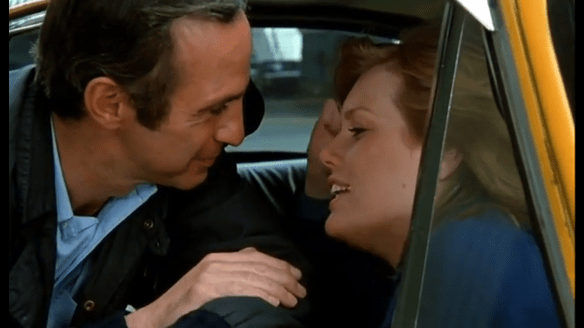
John Ritter exerts his comedic chops as a gutless private eye on a tail. From a purely visual likeness, he can easily be seen as a stand-in for our director who was himself in love with Dorothy Stratten. Like Antoine Doinel’s attempts at private-eyeing, he seems like a hopeless case, but once again, the film is hardly about his day job. Nor is it about Gazzara, another P.I., or their partner in crime, the frizzy-haired, roller skating, joint -smoking pick-up artist Arthur (Blaine Novak).
It’s all merely a pitch-perfect excuse to further complicate the scenario by throwing all sorts of situations together. And if there are glimpses of Doinel in Ritter, by transitive property there must be Tati-like scenarios as well, not least among them positioning the viewers on the outside looking in at apartment buildings seemingly made entirely of glass.
Like the worlds of these French filmmakers (Jacques Demy included), the version of New York depicted here verges on the most agreeable of romantic fantasies where relationships are forged in meaningful even momentary encounters. There is a sense of preordained fate wafting through the air even as a wistful malaise lingers too.
Dorothy Stratten manages to be an ethereal beauty of simultaneous youth and maturity. Bogdanovich’s obvious affection for her is on display in every scene she is in front of the camera. Meanwhile, Patti Hansen — Mrs. Keith Richards — has a part to play as “Sam” the cabbie, which is no less charming. It does appear as the world is made up of attractive women although she is someone with a different type of experience. She’s been around and you cannot phase her. There’s something simultaneously charming and disarming about her self-assured confidence.

But, of course, I must save the best (subjectively speaking) for last — it’s time to talk about Audrey — who gets top billing, understandably so. Though I barely recognized her at first behind her shades, she still maintains the same congenial elegance, even in eighties attire. If anything she’s more grounded. Somehow she almost doesn’t belong but she didn’t belong in Breakfast at Tiffany’s (1961) either and yet her warmth made the movie special.
In fact, it struck me momentarily, this picture is a full 20 years after Tiffany’s and New York, while it has evolved, still holds a nostalgia about it. Because looking back in time with rose-colored glasses, we cannot help seeing it in such a light — not like the grungy, noisy dump of the here and now.
With every one of these characters, there manages to be utterly transparent shades of reality. The details are there if you’re willing to look at them in the most personal light possible. It’s a prime case of when real life seeps into fiction and they feed into each other in a continuous loop. Where one ends the other seems to begin and vice versa.
Take each character and examine their reality and see what sings with the sound of truth. I think Bogdanovich would heartily acknowledge the best films and the best actors are in some way, shape, and form audaciously personal — in this way, they bear something and offer it to the audience.
But even in its themes of infidelity, heartache, and loneliness, They All Laughed somehow manages to cling to the humor found in its title. There is a pervasive conviviality that might feel counter-intuitive to both our plot and the location our story takes place. But it’s indisputably light.
Due to a lack of commercial success — Bogdanovich tried his luck distributing the film himself unsuccessfully — They All Laughed is considered to be one of the ending markers of The New Hollywood Era instigated by a generation of dynamic, young American directors. No one can completely blame him for his decision as he was stricken with immense grief at the time. Because of course, the aftermath of such a warm picture was marred with a tragedy of the worst kind — the murder of rising talent Dorothy Stratten. It proved to be the darkest possible closing note on this story.
Then, for New York a full 20 years after this film came out, The Twin Towers (visible in the opening credits) would be gone. There is so much suffering visible and yet invisible at the same time. Because They All Laughed is a film managing to capture a happy time even if a sobering road was waiting up ahead. Sometimes we need light, frothy movies to remind us of such things.
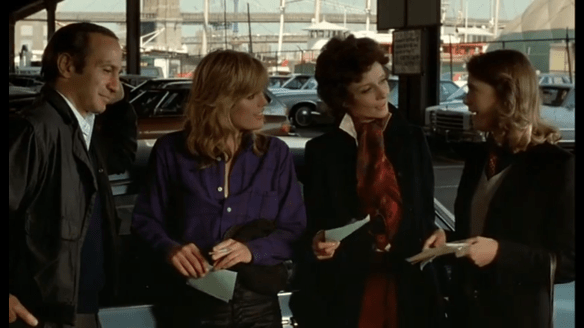
When Peter Bogdanovich revisited the film at a public screening, he was openly emotional to the point tearing up. One can gather it was not simply because of the pain at the loss of someone dear to him, but also because those were happier, dare we say more innocent years. We can never have them back as they were before. Still, no one can take away the memories.
For others on the outside looking in, The Last Picture Show, Paper Moon, or even What’s Up, Doc? might ring of superior film stock but it’s not too difficult to understand Bogdanovich’s own sentiments. This is about as personal as a movie can come even as its weaved into a hybrid private eye screwball tale. It’s not the content speaking, but the moments and happy accidents with friends and people he deeply cherished.
This palpable exuberance exuded by the director and his cast is infectious if also a bit doleful. Bittersweetness has to be one of the most maddening of human emotions. It points to something not yet satiated within us. We are always waiting for the next time we will laugh again or better yet when we never stop laughing. The tears won’t hurt as much then.
4/5 Stars

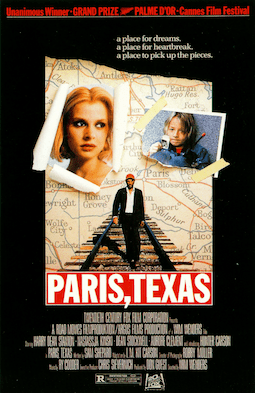 It occurs to me only someone with an outsider’s perspective would choose to make this movie, which is void of any typical Hollywood flair. No American would have thought in a million years to cast Harry Dean Stanton (a lifelong character actor) and Dean Stockwell (an all but forgotten child star) while capturing such a cross-section of America. Therein lies a moderate amount of the allure in Paris, Texas.
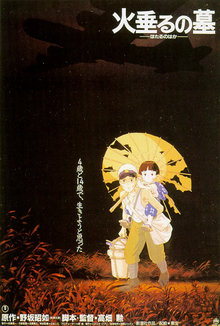 Anime is very much a Japanese art form denoted by its style, the visuals, and even the depiction of its characters with wide eyes all the better to convey emotions. Oftentimes the images onscreen are a great deal more stagnant than the real-time action that American animators try and replicate with a greater frame rate.
 Juzo Itami’s so-called ramen western Tampopo is unequivocably original in its hilarity, opening with what could best be called a public service announcement. A suave gangster is getting ready for the movie screening only to be disrupted by a noisy bag of curry potato chips. He threatens the foodie and sits back down to enjoy the entertainment, concluding the film within a film.
 In the 1970s political paranoia involved issues in the realm of Watergate. Government conspiracy and that type of thing perfectly embodied by some of Alan Pakula’s best films. But it’s important to realize in order to better understand this particular thriller, the 1980s were a decade fraught with fears of Soviet infiltration compromising our national security. The Cold War was still a part of the public consciousness even after being a part of life for such a long time already. So No Way Out has a bit of Pakula’s apprehension in government and maybe even a bit of the showmanship of Psycho with some truly jarring twists.
 4 Star Films