Chariots of Fire (1981)

Chariots_of_Fire_beach“Now there are just two of us – young Aubrey Montague and myself – who can close our eyes and remember those few young men with hope in our hearts and wings on our heels.” ~ Lord Lindsay

I am hardly a world traveler but one of the places I fell in love with early on was the British Isles. London is a wonderful city with so many memorable landmarks from Big Ben to Buckingham Palace. Harry Potter to Sherlock Holmes. There are the Salisbury plains hosting the monolithic Stonehenge, and the Lake District which is undoubtedly some of the most beautiful country I have ever seen. No wonder Wordsworth and Blake were so enamored by it. However, St. Andrews Scotland has to be one of the most starkly beautiful places I have ever had the pleasure of visiting. It’s steeped in golf history due to the Old Course and despite being the home of a university, it is surrounded by a charmingly quaint town.

And of course, most pertinent to this discussion, its beaches became the perfect setting for the opening moments of the now iconic Chariots of Fire. Really it is so much more than its stellar theme by Vangelis because these sequences bookend a truly remarkable story. We enter the narrative in 1978 where two old men eulogize about the old days and their good friend Harold Abrahams who has recently passed.

Cross_and_HaversBack in the 1920s, a brash young Abrahams (Ben Cross) is about to enter university at Cambridge intent on becoming the greatest runner in the world, and taking on all the naysayers and discrimination head-on. He’s a Jew and faces the antisemitism thrown his way with defiance and a bit of arrogance. He’s a proud young man who loves to run, but more than that he loves to win. His best friend becomes Aubrey, a good-natured chap, who willingly lends a listening ear to all of Harold’s discontent. Soon enough Abraham’s makes a name for himself by breaking a longstanding record of 700 years, at the same time gaining a friend in the sprightly Lord Lindsay. Together the trio hopes to realize their dreams of running for their country in the Paris games of 1924. They are the generation after the Great War and with them rise the hopes and dreams of all those who came before them.

Charleson_as_LiddellSimultaneously we are introduced to Eric Liddell (Ian Charleston) a man from a very different walk of life. He’s a Scot through and through, although he grew up in China, the son of devout Christian missionaries. Everything in his life is for the glory of God, and he is a gifted runner, but in his eyes, it’s simply a gift from God (I believe God made me for a purpose, but he also made me fast. And when I run I feel His pleasure). His sister is worried about his preoccupation with this seemingly frivolous pastime, but Eric sees a chance at the Olympics as a bigger platform – a platform to use his God-given talent to glorify his maker while living out his faith. Abrahams is a disciplined competitor and he goes so far as to bring on respected coach Sam Mussabini (Ian Holm) to help his chances. Liddell is a pure thoroughbred with life pulsing through his veins, and of course, they must face off. It’s inevitable.

But this is only the beginning as all these men we have built a connection with travel across the sea for the Olympic Games grappling with their own anxieties and consciences. For Abrahams, it’s the prospect of failure and success. Failure will burn because his whole existence has always been about running — about winning. He has only a few seconds to justify his very existence. However, the fear of winning is almost greater, because at 24 years of age, where else is he supposed to go after winning a gold medal? It scares the life out of him. Liddell’s tribulation is of a different nature as he must stand true to his beliefs even if it seems to be sabotaging his own success. And of course, Aubrey and Lord Lindsay have their own successes and failures that run the spectrum. Perhaps most importantly these men prove their worth not only to their American opponents but the entire world. They can return home with their heads held high — champions of a feel-good tale to be sure.

Yes, this is a story about two strikingly different individuals, but Chariots of Fire becomes so engrossing due to all its characters. Aubrey resonates with me due to his general contentedness. Lindsay has an air of playful charm that is refreshing. Harold embodies my own hopes, fears, and anxieties. Eric reflects every person’s struggles with spirituality and personal conviction. In essence, the narrative goes back to the glory days to bring light to the universal and continual rise and fall of man. We’re far from perfect, but in spite of all our failures, there is still space for redemption.

The refrains of the theme music paired with William Blake’s majestic “Jerusalem” get me every time. I love being steeped in this atmospheric periodness and my heart yearns to be back in England so I can run on those very same beaches with wreckless abandon. But even if I don’t get there soon, I will be content in running life’s race to the best of my abilities wherever I am. That’s all that any of us can do.

“I have no formula for winning the race. Everyone runs in her own way, or his own way. And where does the power come from, to see the race to its end? From within. Jesus said, “Behold, the Kingdom of God is within you. If with all your hearts, you truly seek me, you shall ever surely find me.” If you commit yourself to the love of Christ, then that is how you run a straight race.” – Eric Liddell

4.5/5 Stars

The Empire Strikes Back (1980)

SW_-_Empire_Strikes_BackGrowing up, Star Wars was my life. I lived, ate, slept, and dreamt Star Wars. But notably, Empire Strikes Back was always my least favorite film in the original trilogy. In truth, it scared me because it showed a different side to this galaxy. It seemed to be ignoring the unwritten rule that good should and will always prevail over evil.

Now I know better than that. Every great film trilogy needs that moment where it delves into the darkness and scours the depths of despair. it’s in these moments that characters become solidified, pun intended, and we truly begin to care for them on a deeper level.

Because Empire Strikes Back is certainly a film about darkness; that’s part of the reason why I shied away from it growing up. But such evil always seems to reveal the polarities of nature.  To balance out the dark side there must be light. Heroics, sacrifice, and friendship come to the forefront because baseness calls for such a response from our protagonists.

Another reason I was not always a fan of Episode IV was rather shallow, I admit. Planets like Hoth, Dagobah, and even Bespin were just not as thrilling as Tatooine and Endor for some reason. That still holds true to some extent, but now the first issue I touched on takes greater precedent.

It’s in this story where the Rebels are struggling to survive, fleeing Hoth desperately from an Imperial garrison that seems largely regrouped and unfettered by the destruction of the Death Star. All seems bleak and hopeless once more. Things begin with Luke being kidnapped and dragged off to a Wampa lair. He almost gets crushed by an incoming AT-AT as his buddies get fried, and finally, he crashes his X-Wing into a swamp searching for a Jedi Master who is little more than a green muppet. It’s not much of a hero’s journey, or more precisely it’s a journey full of pitfalls and failures.

Meanwhile, sparks are flying between Han and Leia, not because of their chemistry, but their complete lack of any chemistry. He’s a scoundrel and she’s an aloof princess hardly enamored with his show of bravado. After all, he pilots a heap of junk and walks around with a furry walking carpet prone to fits of rage. C3P0 is at best comical every now and again when he’s not overly annoying. R2D2 is a spunky dynamo like always.  These hardly seem like complimentary words, and it’s hardly thoughtful commentary, but it sets the stage for brilliance.

The plot is contrived just as Vader contrives to lead Luke right into his trap. On both accounts, it works to perfection. Bespin becomes the perfect place for some major truth-bombs. The most obvious one pertaining to a certain person’s father. But we also see the evolution of Han and Leia’s relationship. We see the true camaraderie between Han and Chewie, and the real nature of Lando, another scoundrel with a heart of gold, much like his buddy Han. Finally, we find out that Leia has extraordinary powers of her own.

On a purely cinematic level, The Empire Strikes Back introduces us to our first real lightsaber battle we ever got and it never disappoints. True, Vader and Obi-Wan faced off, but that was more symbolic in nature. The bout between Luke and Vader was the next step, necessary for this story to progress. Luke has fallen and failed this time as the power of the dark side is too strong for him, but this is only the beginning. Any great trilogy must enter into the darkness certainly, but there’s also an ending to the story. Completely different than what came before. In this case, the Jedi will return prepared to bring order to the galaxy as it is meant to be.

Thus, I wasn’t completely against The Empire Strikes Back as a kid, because I knew it wasn’t the end of the story. We leave our characters on a hopeful note as they survey the vast galaxy in front of them. It’s far from being redeemed, but it’s also not too far gone. This is a space western for the ages with dramatic storytelling, twists, and turns worthy of one of the great series of our generation. Let’s just take another moment to salute John Williams too. Without him, Star Wars is far less. He makes this world of George Lucas come alive.

5/5 Stars

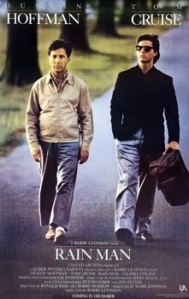
Rain Man (1988)

Barry LevRain_Man_posterinson doesn’t have a masterpiece per se, but he has some thoroughly enjoyable films in his filmography including Diner and Good Morning Vietnam as two prime examples. Rain Man is similar in that it is an interesting film and a heartfelt film, but not, dare I say, a great film.
Tom Cruise plays his typical stuck-up jerk named Charlie Babbit who learns what really matters in life, over time. He starts off as hotshot car dealer in Los Angeles who is trying to swing a big deal while balancing a vacay in Palm Desert with his girlfriend. However, when he gets news that his estranged father has passed away, he must change course for Ohio.

It’s there that he rehashes his old bitterness towards his father, and it is there that he learns something life-changing. He has a brother. An older brother to be exact, named Raymond. Except he never heard about him, since Ray is living in Wallbrook, a mental institution for individuals with autism.

He lives on a regimented schedule that he adheres to without fail. He loves books, baseball, and Jeopardy! among other hobbies. Whenever he gets nervous he starts into a monotone monologue of “Who’s on First.” He seems completely at odds with the world of his younger brother, but the catch is that all their father’s wealth is essentially given over to Raymond.

So in the name of equality, Charlie takes his brother away and holds him at a kind of ransom so Ray’s doctor will hand over half of the family fortune. The doctor doesn’t budge, however, so Charlie is left to travel with his brother to California. Matters are complicated because Ray will not fly on planes, citing the many fatalities in the past. Thus, this story of two brothers turns into a road film where Charlie begins to learn how special Ray really is.

True, he constantly sticks to his regiment (ie. Lights out at 11 and such), but he also has amazing abilities including doing extraordinary calculations and having tremendous recall ability. At first Charlie’s girlfriend, Sussana is upset with how he treats Raymond and she leaves. That was unfortunate because she for a time was my favorite character. However, it does allow for Cruise and Hoffman to share more scenes together. They take Vegas by storm and Raymond is a success while Susanna finally rejoins them. Most importantly Charlie has a newfound respect for his brother and what he is able to do. Dr. Bruner wants to take Ray back to the institution, and despite his objections, Charlie can do little about it. He will have to find solace in the fact that he will be visiting his brother next Wednesday.

In Rain Man I found Tom Cruise to generally be a jerk because that was the part he was playing and he was made for that type of role. Dustin Hoffman, on his part, gave an extraordinary performance which managed to be emotionless and robotic at times. However, he seemed to capture the humanity and reality of an individual with autism so well. Just because they act differently than what we are used to does not mean they are not just as human and relatable. They have feelings and emotions too that matter. That being said, it is understandable why he would be hard to deal with sometimes. Valeria Golino was a fairly good addition because she brought some more energy and seemed to generally care about Raymond. Although Charlie did eventually come around, thanks to a few revelations about his “Rain Man.”

3.5/5 Stars

Witness (1985)

Witness_movieI think of Harrison Ford much in the same way that I think of Paul Newman. They both play the brash, bold, smart alec characters that we adore as audiences. They make the perfect action adventure heroes but are not always respected as actors which is a shame. For Ford, his reputation hinges on a number of great characters from Han Solo, to Indiana Jones, to Rick Deckard. They all are magnificently memorable action heroes. Ironically it is the plain, seemingly everyday cop, John Book that allows Ford to truly show off his acting chops like I have never seen him do before.

The film begins when a young Amish boy named Samuel gets to take his first adventure into the big city with his mother, as they head to see some relatives in Philadelphia. Little Samuel has a pair of dark brown, wonderfully inquisitive eyes in which to take in this world that is so foreign to him. That is, in fact, one of the major themes of Witness, the colliding of two worlds that are at odds.

But anyhow, when he ventures into the restroom to use the toilet, he unwittingly sees a violent murder committed and he is able to hide in the stalls, but he also gets a look at one of the perpetrators. And so, just like that, this little boy who never spent a day in the real world is a key witness to a murder investigation.

That’s when steady, straight-arrow cop John Book comes into the picture. He’s not a bad man by any means, and he wants to wrap up the case quickly so he can let Samuel and his mother go as soon as possible. You can see he finds their customs strange, and Book feels a trifle awkward being around them, but he does his job the best way he knows how, by confiding in his superiors and having his partner watch his back.

Everything blows up in his face. He gets shot and he must make a mad dash with Samuel and his mother to their quaint Amish home. Now the roles are shifted as he must wait it out building up his strength as his pursuers try and locate him. His world of cops and guns seems to have no place in this farm community of peaceful people. But as a former carpenter and a decent individual, Book is able to adapt rather well. Rachael Lapp soon finds herself enjoying his presence around their home since she is a widower and her father-in-law Eli reluctantly allows him to stay.

Book learns how to milk a cow and helps in a barn raising, all the while building a rapport with Rachael, but others seem to be wary of the presence of such a man.

As would be expected, we have our final showdown between Book and his pursuers who are a lot closer to home than he would ever expect. When it’s all resolved he leaves the country peaceful once more, but not without some intense memories.

Peter Weir’s film has a rather interesting pacing for a thriller, starting out slowly, but we know it must be building up to some impending doom so I would reserve from calling it boring. When that moment comes, it becomes a breakneck thriller before quieting down once more in the Amish town. Then the last 20 minutes are that of a dynamic action film. However, it is in these more tranquil moments that Harrison Ford gets to show off his humanity, whether it is talking about guns with young Samuel or dancing to a car radio with Rachael. There’s no doubt that you have not seen Ford like this before, and it’s definitely worth seeing him in this gripping ’80s thriller.

4/5 Stars

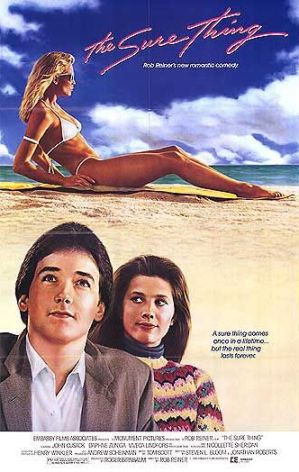
The Sure Thing (1985)

Sure_thingposterThe Sure Thing is one of the early works of both director Rob Reiner and young teen star John Cusack, and it proved to be a success for both parties. In the film, Walter Gibson and his friend Lance are heading off to college. Gib is heading to a stuffy school on the East Coast, while Lance is venturing off to the sun-soaked southern California shores with the female prospects at an all-time high. It doesn’t help Gib who has recently been striking out with the opposite sex, because, to put it bluntly, they don’t buy his astronomy inspired pick-up lines. He’s just too much of a jerk.

And so the two friends go off to their separate spheres and for Gib things do not end up too bad. His school’s not a bore, but he’s not getting the kind of action Lance has, not yet. That is until his friend tells him about a “sure thing.” The girl who is one out of a million and who is available, just waiting for Gib in California. So as any red-blooded American college student would do, Gib begins the cross-country trek over his Christmas Break.

The catch is this. He’s forced to travel with an overly enthusiastic couple obsessed with singing show tunes and that’s not the worst of it. His backseat companion is fellow classmate Alison Bradbury (Daphne Zuniga) who happens to be very attractive, but she also hates his guts.

She and Gib happen to be polar opposites, and they did not get off to a good start at school. She already has a boyfriend. She is always on top of her academics, and she never does anything outrageous. Gib is a showboat, prone to wildness that includes shotgunning beers and trying to pick up girls.

Their constant bickering and nagging find them sitting on the roadside in the middle of nowhere trying to thumb their way to California. And so it looks like they will go their separate ways, but they end up traveling together, broke, wet, and starving. Somehow they get there and along the way they begin to genuinely appreciate each other. There does not have to be anything between them. Of course, right before they get to their final destination a disagreement leaves them at odds. However, after spending so much time with someone like Alison, a sure thing just does not have the appeal it once did for Gib. He proves to himself that’s he’s not quite as shallow as he thought he was. If only Alison could know that.

The enjoyment of this film is not so much in discovering the result because any Joe Schmoe who has seen at least a handful of romantic comedies knows how the story is supposed to end. The true joy of the experience is how we arrive there with these two characters. In the back of our minds, there is a kind of peace of mind, because although they seem so far apart and at odds, we know where they will end up. We can take a little bit of enjoyment out of every single moment they spend together mundane or not. In many ways, the road movie feel of The Sure Thing brought to mind other similar storylines like Train, Plains, and Automobiles as well as It Happened One Night. I have to say I was pleasantly surprised by this film. Cusack pulls off the lovable jerk well and despite her initial stuffiness Daphne Zuniga is a lot of fun too.

4/5 Stars

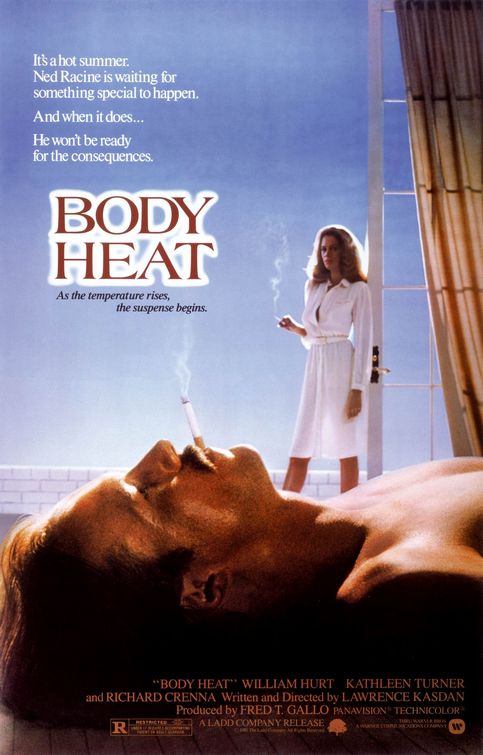
Body Heat (1981)

Body_heat_ver1In his directorial debut, Lawrence Kasdan (screenwriter for Empire Strikes Back and Raiders) brought us a neo-noir burning with passion and positively dripping in sweat. Quite the combination indeed.

It opens with the seductively jazzy score, courtesy of John Barry, dancing over the credits. It brings to mind cool afternoons with cool drink in hand. The first shot we are met with is a man driving in his convertible, top down and shades up. He’s a cool and collected looking young man, but we know that there must be something lurking underneath all of this. This exterior is soon dropped and we are met with a reality that is heavy with humidity and sticky days.

Our protagonist is Ned Racine (William Hurt) who is a struggling lawyer working in Florida during an especially sweltering Florida heat wave. One indelible evening he has his first encounter with a beautiful, cool blonde named Matty (Kathleen Turner) whose temperature runs a little hotter than most. He makes a pass or two even after finding she is married, and she rejects his attempts at first. However, during a point of no return, the two give into their cravings and spiral into a passionate tryst. Their affair is fairly easy to keep hidden from Mr. Walker (Richard Crenna), but an old high school friend of Matty’s and Matty’s niece unwittingly find them out one way or another.

They’ve had enough of secrecy and Racine resolves they must kill Walker so that Matty might be freed and so she might also get money due to his impending death. Not satisfied with that, Matty wants to alter the will so she gets more. Racine is completely against that idea.

The night of the murder comes and they act it out with precision and Racine gets rid of the body.  He finds out only afterward that Matty had a new will drawn up and he doesn’t like it one bit, but he is forced to play along. The prosecutor and police detective involved in the case (Ted Danson and J.A. Preston) happen to be friends with Ned through work. They spend many a sweaty afternoon chatting it up at the local diner. That’s what makes it hard when all the facts begin to pile up and slowly but surely Ned’s involvement becomes more suspect. His alibi and the degree of his relationship with Ms. Walker is being questioned.

Meanwhile, he and Matty must find a pair of glasses that might incriminate them. It becomes clear all too soon that things are not as they seem. Matty ultimately abandons Ned, and he winds up behind bars, happier without her. In one final revelation, he starts to put some of the pieces to together in prison. He’s a hot mess.

It’s difficult not to make comparisons between a film like this and classic noir such as Double Indemnity. In both films, there is a man who seems fully committed to going through with a crime, but it is really the woman who has the most to gain from the situation. Furthermore, Ned as the Walter Neff character has his Barton Keyes in the form of Lowenstein and Oscar, who are friends but also the ones who must bring him to justice. However, Body Heat can get away with more, such as sexuality and allowing certain crimes to go unpunished. It’s a rather surprising ending that is nonetheless very interesting.

Body Heat also has the cigarette prevalence of a film-noir (which Ted Danson comically will not take part in). It’s as if Lowenstein is the only character who realizes this habit is out of place in a world of 1980s sensibilities, not to mention crimes of passion.  It was odd seeing Ted Danson in a pre-Cheers role gulping down ice tea after ice tea. Kathleen Turner and William Hurt were a good fit as the gorgeous siren and her partner in crime. They are two attractive people and yet that did not put them outside of the law as they would find out. Body Heat certainly wrenched up the heat a couple of notches and never let off. It positively burns with frenetic energy and unbridled passion.

4/5 Stars

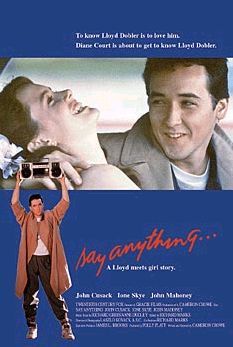
Say Anything… (1989)

Say_Anything“How’d you get Diane Court to go out with you?”
“I called her up.”
“But how come it worked? I mean, like, what are you?”
“I’m Lloyd Dobler.”

She’s a brain, he’s not, sounds simple right? For such a basic premise Say Anything… has surprising depth. A lot of this is a credit to the performances of John Cusack and Ione Skye, along with the script by Cameron Crowe. The story is this: high school is over and the unknown future is what looms ahead. For Diane Court that means college, a fellowship in England, and the like. For Lloyd Dobler, we do not know what that means and he doesn’t either. For the moment he still has time, and he wants to use that moment to pursue Diane, the seemingly unreachable girl.

First of all, you have to understand how insane that goal is for a guy like Lloyd. He is a lover of kickboxing, The Clash, and he is an average student who lives with his sister and little nephew. Diane is the class valedictorian, doted over by her loving father, and she is a surprisingly sweet girl who dresses well and is a cut above. Not in a million years is he supposed to get her, but I said that already.

Anyways, Lloyd is a straightforward and to the point kind of guy, so he simply calls her house to ask her out. She finally gives into to his requests, and they go to a party to celebrate the end of their high school career. For him, it’s their first date, and she sees it just as a very nice evening. Diane leaves with a new found appreciation for Lloyd because he’s not like other guys. He periodically checks on her during the party to make sure she is alright and points out broken glass on the pavement for her to avoid. He is a gentleman in a trench coat, a strangely vulnerable figure.

Lloyd’s only future plans are to hang out with Diane as much as possible and as far as career plans he is not really sure. When everyone else, even his high school counselor, worry about the future, he always seems strangely, even naively, content.

Diane and Lloyd are slowly growing more and more connected and intimate. However, when Mr. Court goes under criminal investigation things begin to change. At first, everything is the same, with Lloyd teaching Diane how to drive stick shift and Diane growing more and more comfortable with him. And yet, with the familial situation at hand, she feels it necessary to break it off with him, leaving him a pen to write her with. Lloyd is especially wounded, confessing to his sister over the phone, “I gave her my heart and she gave me a pen.”

Soon enough Mr. Court’s account is cut off and in some ways, I felt strangely sorry for the man, but more so for Diane. One day Lloyd comes by with his boombox in tow, standing outside her window in one last monumental act of devotion. Nothing happens right then. Diane is still struggling with her father who it turns out has been swindling his elderly clients, but all for her future. She feels lied to and the only person she could run to is Lloyd, so she does and he takes her back.

Later on, he sees her father in prison and shares that his plan is to go to England with her, despite all the objections that come with it. The two jet-setters are together again proving all the doubters wrong. They wait for the ding of the smoking sign signaling the beginning of the rest of their lives.

This is perhaps one of the greatest high school romances ever, because it is far from the typical superficiality. Lloyd Dobler is played so wonderfully by John Cusack. You cannot help love this lanky guy who is fearlessly straightforward and willing to take a chance. Ione Skye is a bit overshadowed, but she is still convincingly sweet as the victim who finds the perfect guy. John Mahoney’s character is a despicable man and yet it is a credit to him that he actually makes us feel a bit of pity, for an instant. Obviously, the boombox scene is iconic, but I think it is the little things about Lloyd that make this film great. Every person could probably take a page out of his playbook by being honest, vulnerable, and most definitely loyal.

4.5/5 Stars

Indiana Jones and The Temple of Doom (1984)

Indiana_Jones_and_the_Temple_of_Doom_Directed by Steven Spielberg and starring Harrison Ford, this is the second installment in the popular series. The film opens in China where Indy is trying to acquire a rare jewel but he runs into problems and must struggle for his life. He escapes with the help of his little friend Short Round and an annoyed night club singer tags along for the ride.

They finally find their way to a remote village which is fearful of a great evil. The trio is then welcomed at a grand palace. After an initial attempt on Indy’s life, they find a secret passage that leads to a temple where the Thuggee cult survives. They witness horrible tings and Indy attempts to recover the stone from the village. However, they are captured and Indy is turned into a mindless worshiper, while Short Round is forced to work and Willie is prepared for sacrifice.
Thanks to Short Round’s escape he is able to recover Indy as they fight to save Willie and get out alive. A harrowing mine car chase ends in another perilous situation for Indiana and his friends. In the final showdown he is able to prevail and as always there is a happy ending.
This is certainly the weakest of the original trilogy in my mind and coincidentally also the darkest. This film did however help bring to pass the PG-13 rating. I am partial to Short Round and Indiana Jones is all we have come to expect.
3.5/5 Stars

Amadeus (1984)

bcd5e-amadeus1

A common film would content itself with developing a biopic on one of the greatest composers of all time reaching the heights of the musical field in the musical capital of the world in Vienna. A typical film might paint on a canvas paying homage to a legend who revolutionized music with his genius.

This story opens as the long-forgotten composer Antonio Salieri (F. Murray Abraham) attempts to kill himself. He gets laid up in a Psych ward where a man of the cloth visits him wishing to hear his story and so the old man obliges. It’s a story that makes light and lacks reverence thanks to its title character.

Salieri was a court composer of prestige and great admiration, but even he knew Mozart was the true master and the first day they met was forever ingrained in his mind. For being such a genius Wolfgang Amadeus Mozart (Tom Hulce) is a jerk, to put it bluntly. Spoiled, conceited, dirty-minded and armed with a cackling laugh, he is hardly the image of a musical mastermind. How could God bless this man with such talent? How could God taunt Salieri using such a man? He makes a mockery of art and yet he is the best there ever was. Salieri must have some kind of justice.

But all that lies under the surface. Mozart is brought on by his Majesty to develop a German libretto. Salieri’s tolerance for God is lost and he turns his back, beginning his passive attack. He shames Mozart’s wife (Elizabeth Beridge) and sends her off as he is looking to undermine his rival as discreetly as possible.

Mozart himself has little desire to take on pupils he deems a waste of time and instead busies himself with his most ambitious piece yet. His father comes to town and is not amused with his son’s conduct or his antics at a masquerade ball. He has none of the sensibilities of a man like Salieri, but what he does have are the talent and brilliance.

Always one to push the boundaries, Mozart’s latest piece is based on the Marriage of Figaro which was expressly forbidden by His Majesty. But due to his skill, Mozart is able to get by with bending the rules. Salieri acknowledges his genius. He knows brilliance when he sees it, but he becomes even more resolved to bring about the death of his nemesis.

After the death of his father, Mozart slowly spirals down into drunkenness and poverty. Salieri manipulates the situation even further to play on the man’s emotions and the desperate Mozart becomes mad composing a funeral requiem requested by a specter of a man. The mysterious figure is, of course, a moonlighting Salieri who no longer sees his actions as justice against Mozart but against God himself and he wants to win.

In a horrible condition, the bedridden Mozart constructs his last great piece with the help of an incredulous Salieri. But Constanze will have none of it and the manuscript remains unfinished because she distrusts Salieri. Just like that Wolfgang Amadeus Mozart suddenly passes away. He’s dead and Salieri can have no satisfaction, no piece of Mozart’s brilliance. God would not give him the satisfaction, resigning him to be the so-called patron saint of mediocrity. God supposedly got the last laugh.

This is a film that makes me want to revise the noted statement to “only the great die young” as the mediocre slowly fade into oblivion. Salieri faced a cruel demise of his own as Mozart instantly became solidified as a legend. That is the irony of life that is made clear no matter how accurate the facts are. Because in Amadeus, the facts are not the most important. Milos Forman gives us a spectacle that is as grand as Mozart’s greatest masterpieces. But this is perhaps, more importantly, a film about human nature. Salieri is a man so ingrained with internal desires.

He wants to play God. He wants all things to play out as he sees fit. His malevolence is focused on others. It is even focused on God. But, in reality, it reflects the pain of his own heart. Humanity has a desire for excellence to be fully actualized. That is a lofty goal and an impossible target. Because ultimately there will always be a hole left within us. It was so with Salieri

Mozart was one of the greatest and most well-known composers of a generation if not ever. He was not a good man (few are), and he met with death early. Salieri seemed moral and yet he himself was undermined by deep-seated avarice and covetousness. Despite still having life, the world was essentially dead to him. He thought God was laughing at him. Neither man won.

4.5/5 Stars

The Breakfast Club (1985)

54f1c-the_breakfast_clubHere is a seminal high school coming of age film that has its moments although it is not altogether brilliant. The story takes place on a Saturday when the local school is empty and five very different characters are all thrown together. For an entire afternoon, apart from your typical adventures through the halls of the high school campus, they sit in a room.

The players are as follows: A brain, an athlete, a social queen, a basket case, and a criminal. Initially they all are annoyed that they have Saturday school and there is tension between them. Over the course of the afternoon they soon open up and realize they all have similarities and despite their differences they can be friends.

There are other coming of age films that are probably better but it is certainly an interesting social commentary and a cult classic thanks in part to the song “Don’t You (Forget About Me).” Lets just face it, the 1980s just would not be the same without John Hughes (Ferris Bueller, 16 Candles, Trains, Plains & Automobiles). He certainly is not the foremost of directors, but he will not be forgotten any time soon.

3.5/5 Stars