Avengers: Infinity War (2018)

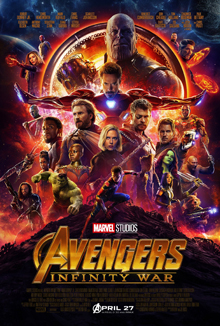
Avengers_Infinity_War_poster.jpgEntering into the latest Avengers blockbuster I felt like I was missing something thanks to a cold open that places us in an unfamiliar environment. It’s a feeling that has come upon me on multiple occasions previously.

Not only because as a mild enthusiast I’ve missed a stray entry here and there but I also easily forget interconnected events and after a certain point, why bother? We have come to accept there will always be another Marvel movie.

Yes, this is the culmination of 10 years that began inauspiciously with Iron Man in 2008 only to balloon into a skyrocketing phenomenon that will not disappear any time in the near future. Superheroes like Iron Man, Captain America, Thor, Hulk, and so many others have reemerged as integral parts of the public consciousness. And many fans have been waiting with bated breath for this day and they will wait again and again for future movies like it. That’s an established fact. Regardless, they can breathe a sigh of relief and thoroughly enjoy themselves with this realization of all their dreams up on the big screen. It will hardly disappoint.

To describe the plot of Infinity War is almost arbitrary as SPOILERS in this day and age are guarded against like the plague but here is a nibble anyway. Thanos (Josh Brolin), a being who has long been alluded to, is finally on the scene. The opening sequence is a microcosm of what he hopes to do on a cosmic scale, leveling half of the remnant left over from Asgard.

As a supervillain, he has a vision for the world that’s not too unbelievable. He seems to have been acquainted with Thomas Malthus’ work (even unwittingly so) while holding a contorted view of what empathy is. What others term mass genocide he deems an indiscriminate mission of mercy — killing half the universe’s population will mean resources are more widely available for everyone else left alive. He proves to be one of the most interesting characters within the narrative for the very fact we have barely met him before.

Infinity Stones also become of utmost importance again as Thanos must add them to his collection so he can rise to the stature of a demigod and dictate the outcome of all life with the snap of his finger. That’s some kind of power! The stones themselves are exquisitely color coordinated. One is safeguarded by Dr. Steven Strange (Benedict Cumbertach), another is implanted in Vision (Paul Bettany) and fiercely protected by his girlfriend the Scarlet Witch (Elizabeth Olsen). The Soul Gem brings Thanos back in contact with his two stepdaughters Gamora (Zoe Saldana) and Nebula (Karen Gillan) with grave consequences.

Everyone else who makes an appearance (and at times a lightning-quick cameo) relies on a viewer’s running tabulation of everything up until this point in the MCU. And though you’ll probably enjoy seeing these characters that you have some familiarity with — and you even laugh throughout — there is a sense they are only vague contours. There are too many of them for the resonance to run deep and personal. It really only works if audiences have bought into the machine and already have some background with these heroes in place. The scarier thought is if viewers do not. Infinity War would be void of any meaning. All flashes of imagery, destruction, and hyper-frenetic editing. Any other actual amount of personality would be absent.

Some people live and others die but to confess I didn’t much care whether any of these characters perished is one of the most unfortunate realities of the movie. It’s not that I know they are coming back necessarily or anything of the sort. I admit to being fickle. I can’t remember why I should care about these characters. Because for some so much time has passed since I had any connection with them. To watch them become collateral damage has little resonance with me. I’m numb to it.

I won’t make allusion to archetypal literature like Hamlet or film references like Star Wars or Harry Potter because in some ways that would denigrate that material. Am I being a bit harsh? Perhaps I am. In fact, it was Hary Potter and The Deathly Hallows (2010) we have to thank for this current reality followed close behind by The Hunger Games and The Hobbit. Stories like these coincidentally begun the practice now popular in the industry.

It was no longer about simply having sequels but milking a movie for all it was worth — breaking them up into pieces — making films that were meant to be a part of a greater whole.  It’s not a film so much as a commodity. Differing from the earlier examples like The Godfather movies or even The original Star Wars trilogy — those were pictures that very much could stand on their own merit. Not that they were not enriched and more fully realized with their later installments but we could consider them alone.

Infinity War comes out of this philosophy where a film was never meant to be taken by itself. Everyone knows it. The producers, the directors, the actors, and the audience.  By now as a collective assemblage of viewers, it seems like we’ve been cowed into submission.

I for one watched the movie and never quite relished it — there was nothing all that new or novel — and yet I was never bored per se. However, even my newest favorite superhero Black Panther felt like he was now fit into the Marvel mold. Nothing surprised. Nothing ignited a deep-seated exhilaration inside me. A Stan Lee cameo comes and goes.

Though the picture does promise action and verbal sparring which it delivers handily. In fact, if you consider the screenplay by writing duo Christopher Markus and Stephen McFeely, they do an admirable job with both the monumental juggling act and crosscutting of multiple storylines. The same can be said for the other dynamic duo directing, brothers Joe and Anthony Russo who must perform the same type of orchestration that would have buried a single director in his grave.

Still, there is an uncanny feeling the picture is made up of two kinds of scenes. You have action sequences packaged nicely with all the trimmings and CGI to your heart’s content. Then you have in contrast many stagnant sequences with all these big names standing around in a single location talking it out usually over some point of conflict, sprinkled with a few jokes or exposition that feels all too familiar. The well-timed comic relief disguises how run-of-the-mill everything is.

That’s what’s Marvel has in many ways perfected. In this regard, there’s nothing lacking and if it’s what you signed on for now 10 years ago (without even realizing it) it takes little hesitation to say you will be satiated at least until the next Marel movie and the next installment of Infinity War in a year’s time.

However, I couldn’t help but leave the experience feeling slightly lackluster about the affair. Because in many ways Infinity War is the culmination of a generation of films and really the emblem of where Hollywood continues to head. Sure, we have yet to get the second half of our story but if this is any indication of what we have to look forward to in the future, it does look like a fairly blasé fate at that. Though the jokes and the pyrotechnics are present in full force, there is little magic — that certain amount of intangibility lifting entertainment above the mediocre and allowing it to capture our imaginations. My only question is — as someone unread in Marvel comic literature — what could the Deus ex Machina possibly be?

3.5/5 Stars


Star Wars: The Last Jedi (2017)

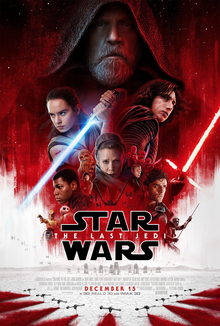
Star_Wars_The_Last_Jedi.jpg“Let the past die.”  – Adam Driver as Kylo Ren
I left the theater feeling completely taciturn. It’s an onerous task to begin articulating all the jumbled fragments circulating through my mind but I will try my very best.  Certainly, there is a great deal to be enjoyed and to be relished about Episode VIII and you would be served well to go into The Last Jedi not searching out its faults but reveling in the successes that are there. Let it be known that there are many and Rian Johnson is a fine maker of movies as he guides us through the Resistance’s latest evasion of The First Order still up to their old business of quashing anyone who dares defy them.

True, I did not necessarily find it a narrative of revelatory reveals or epic showdowns in the vein of what I initially envisioned. However, I can see the picture separating itself from all of its predecessors — subverting the norm and drawing away from all that we knew before. That gels with much of what was said in the wake of The Force Awakens. It could not simply be another Empire Strikes Back if the new franchise was to flourish. In that regard, there’s no doubt Johnson’s film is an undisputed success building on the character arcs instigated in J.J. Abrams’ effort.

Yet my feelings are somehow conflicted.  Kylo Ren’s (Adam Driver) call to action to Rey (Daisy Ridley) midway through was never more pointed. “Let the past die. Kill it if you have to.” And that’s much of what has been done here. Not simply in a single film or to the Jedi order or the legacy of a character but in some respects to an entire franchise.

I am realizing that though I cherish Star Wars as my own, the many aspirations and fantasies of my childhood, it is a communal narrative. It might seem odd to get so thoroughly introspective but I can’t help it. Star Wars is almost inbred into my DNA.

Watching this film might topple the white knights. For one, the Jedi order as we know it. They lose much of their mythical stature that they always evoked. We already lost Han Solo and it’s little surprise that Luke and Leia (with Carrie Fisher’s passing) will most likely not be returning either. The old guard has been all but removed from their posts (with the exception of R2, C3PO, and Chewbacca though Anthony Daniels is the only other returning core cast member).

But it’s no surprise that I often savor the past — the way things used to be. That’s part of what made The Force Awakens such an enjoyable ride. There was an innate sense that this was something new, yes, but it was also squarely centered on the glories of the original trilogy. If I said it once I said it a thousand times, it was like returning to the company of old friends.

Now the old is gone and don’t get me wrong the new additions were greatly appreciated. Once more Rey (Ridley), Fin (John Boyega), and Poe (Oscar Issac) are indubitably winning personalities and fine action heroes. It’s easy to become immersed in their individual journeys along with the newcomers such as Rose (Kelly Marie Tran). However, that doesn’t take away my wistfulness at the conclusion of The Last Jedi.

It wasn’t even the kind of bittersweet conclusion we saw in earlier installments either but a plaintive ending without a giant climax. Harrison Ford received a venerable though tragic send off. His contemporaries not so much. There is still hope and events have been prolonged for Episode IX but not in some monumental cliffhanger fashion.

Whenever I take in a new film I am also constantly filtering it through the reference points that I already know. Obviously, Star Wars has such a vast lineage that must be sorted through but this latest film also can be read through various other archetypes. It strikes me that Luke Skywalker, the Star Wars hero I always aspired to emulate, was like Welles’ Harry Lime in The Third Man — waiting in the wings until he finally stepped out of the shadows.

Though I enjoyed that moment and the pure rush of adrenaline when he came back to the fore, expectations do not always correlate with reality.  Although we get to see Luke Skywalker and there are some enjoyable moments, the best of them come as all too brief reunions with his faithful astromech pal and his sister followed by a showdown with his main adversary — The nephew who turned to the Dark Side — again it was this wistful sense of an anticlimax.

We see in Luke what Obi-Wan (Alec Guinness) once was at least in a visual sense. A hermit who has removed himself from society. Cloaked, bearded, and detached. But whereas Old Ben was a wise, eccentric, and even a fatherly wizard, Luke has become a world-wearied, surly misanthrope. A far cry from the man we dreamed about.

The reverberations of the past echo down in other ways too from the inciting distress signal from his sister that started him off on this cinematic adventure all those many years before and then a visitation from a furry friend.

Likewise, the final showdown is somehow more reminiscent to the archetypal lightsaber battle of A New Hope than all the fanciful epic showdowns we imagined of Jedi Master Luke Skywalker tackling every conceivable villain with his green lightsaber. The old man’s words even mirror the final lines of his late mentor (Strike me down in anger and I’ll always be with you. Just like your father).

Even briefly with lightsaber in hand facing down the greatest forces in the universe as we always thought possible in our mind’s eye, there’s a momentary catharsis. Though the full satisfaction of the moment is stripped from us. Luke is not quite how we remembered him, nay, maybe not even the same man Mark Hamill embodied all those years ago.

It does bring to mind the mythological line out of John Ford’s The Man Who Shot Liberty Valance. “When the legend becomes fact, print the legend.” And it’s still true of Luke Skywalker for those in the galaxy far, far away and right there he can remain a hero.

The film’s most intriguing dynamic reveals itself in the perceived connection between arguably our two most crucial characters in Rey and Kylo Ren also known as Ben Solo. But that core struggle between the two of them — literally the dissonance between the Light and Dark sides of the Force — is rudely disrupted. It’s such an ambiguous dividing line between good and evil and though it still remains, the character of Supreme Leader Snoke, equally implicated in this web comes off as little more than a ploy. All the potential grand conspiracies around it are gone in a puff of improbable smoke.

Intertwined with this is Rey’s familial identity which has been of paramount importance to everyone ever since these new pictures were conceived. It’s not so much that I minded what the revelation was (minor as it was) but it was more the fact that this bit of seemingly crucial exposition was so quickly cast aside as well. It felt once more a bit like a bait and switch — as if the Star Wars saga was somehow rewriting its own mythos in counterintuitive ways.

Maybe for once, Star Wars has become a bit more pragmatic; it has sought out realism and the things of this world more than a galaxy far, far away. Here I will admittedly contradict myself but I am not sure how to deal with this development because Star Wars was always a fantasy, always a science fiction fairy tale built out of imagination and dreams. Now it seems to be inching more and more toward the real world. Not because there are any fewer lightsaber battles or blaster fights or fewer alien species and star systems to explore, but the makeup of the new generation of characters is somehow different.

It is a pipe dream to believe that Star Wars could always be the same because it was not created in a vacuum, it is no longer George Lucas’s, and it has so many other parties invested in it. I for one must come to accept that. The film ends on a rather odd beat with young children getting rapt up in tales of the Last Jedi and looking off into space empowered by the hope brought by the Resistance before the credits roll. Though it felt very un-Star Wars it’s somewhat fitting given this new direction.

Hopefully, younger fans eat up this latest installment and conceive adventures and worlds of their own like I once did, feeding on the visions of the screen as fuel for countless Lego lightsaber battles and made up assaults on the enemy forces with their ragtag band of Rebel Scum. These new films don’t mean so much to me but maybe they can mean something to the current generation. Maybe that’s what they’re meant to do.

Will I see The Last Jedi again? I wouldn’t be at all surprised but unlike The Force Awakens, this isn’t so much an extension of the original trilogy. This is a breaking of the chain. This is something starkly different and it’s taken the galaxy into uncharacteristic territory.

I resolutely admire Rian Johnson for his choices because it seems like he’s made a Star Wars film that is hardly cookie cutter in nature and the fact that it will not please everyone is a marvel (no pun intended) given the usual reality that blockbusters are supposed to be easy on the eyes while hardly divisive. Though flawed, it’s a relatively bold movie in running time, in how it utilizes its characters, and ultimately how it chooses to depart from its longheld traditions. But the boy inside of me still yearns for the Luke Skywalker of my youth as naive as that might sound. I suppose I’ve never been much of a realist.

4/5 Stars

The African Queen (1951)

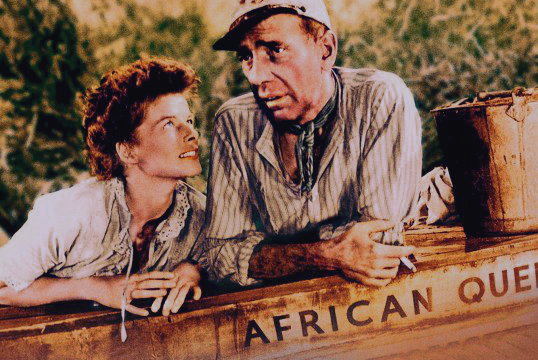
Hepburn_bogart_african_queen.png

And you call yourself a Christian! Do you hear me? Don’t ya? Don’t ya? Huh? What ya being so mean for, Miss? A man takes a drop too much once and a while, it’s only human nature. ~ Charlie
Nature, Mr. Allnut, is what we are put in this world to rise above. ~ Rose

Sometimes when great talent comes together we see the result and question where it all went wrong.  Sometimes it just works pure and simple. The African Queen is such a picture and it’s true that the greatest films function on multiple levels finding ways to exceed our expectations, enrapturing us with storylines and developments that are a far cry from what we first considered. Far from not disappointing, they join the pantheon of classics we would gladly watch over and over again. That is probably the highest praise you can give a picture and The African Queen is such a film.

It’s christened The African Queen because she is the vessel that Charlie Allnut calls his own and she is the very vehicle for this entire adventure. Emblematic of their own grit, ingenuity, and indestructibility. Because the narrative begins with missionaries and the hint of colonialism as Rosie (Katharine Hepburn) and her Reverend brother look to bring the Gospel to the peoples of the Congo.

But due to the outbreak of World War I, Africa too is thrown into the fray as the Germans look to overrun the countryside and sweep it into their clutches. Rosie’s whole peaceful existence of Sunday services and afternoon tea are brutally disrupted. The village is burned, her brother’s physical and mental well-being suffers, and in the end, she has no recourse but to leave her little slice of home behind.

Ironically, her savior is the uncouth, uneducated Mr. Allnut (Humphrey Bogart), a jack of all trades who formerly worked at a mine before it was commandeered by the Germans. He too is an inbetweener in this war, caught on the fringes and simply trying to survive. It’s in these very circumstances that these two diverging personalities are thrown together. And in an act of defiance and pure survival tactics, they do rise above their present circumstances.

Aside from mere plot points, the very fact that the film was shot prominently on location like John Huston’s previous classic Treasure of Siera Madre benefits the film greatly because there’s an authenticity to the entire undertaking that could never be fabricated. You see the waters and the jungles. You’re almost suffocated by the sheer humidity and apprehensiveness of every successive rapid they must ford because this feels like more than a movie. The dividing line between fact and fiction in many ways feels paper thin.

Huston had some wonderful black and white films including The Maltese Falcon, Key Largo, and Sierra Madre but it seems rather fortuitous that The African Queen was made in color given the pedigree of cinematographer Jack Cardiff on such earlier vibrant classics as Black Narcissus and The Red Shoes. He brings a certain colorful exoticism to the frames that feels foreign to the eyes and yet still strangely beautiful. It all works so exquisitely.

Likewise, this is not simply a script penned by film critic, author extraordinaire James Agee with direction by Huston and the talents of legendary screen icons like Humphrey Bogart and Katharine Hepburn. Yes, those are the separate entities that are joined together in this endeavor but they become far more than the sum of their parts.

Agee’s script which Huston also got partial credit for sings with life because of the two individuals it draws up and the world it dares to place them in. Rosie Sayer is a prim and proper missionary in Africa who nevertheless has a fearless streak brought to life so spiritedly by Hepburn as only she could play it. There’s a wonderful stubbornness that’s undeniable but remove the layers and you have the same giddy passion that crept into some of her earlier screwball performances. Mr. Charlie Allnut, as such, is perhaps the most lovable Humphrey Bogart has ever been. Allnut is content just getting by and surviving and he’s good at it — trying to find little bits of comfort in this world medicating himself when gin and a nice cigar every now and again.

But while he pushes Ms. Sayer’s to be practical and lose some of her stuffier tendencies, she, in turn, prods him to step out and do something worthwhile with his life. And it’s not simply about their romance which begins as a small feud, becomes a friendship, and evolves into a frenzied relationship full of affection. Their romance is being forged as they hang onto the faint objective of driving The African Queen into the ominous German gunboat the Louisa. It feels like a small battleground amidst the chaos of World War I but it all depends on your perspective because for Rosie and Charlie this is really is the very pinnacle of their existence. It involves their very will to survive.

They cling to this purpose and the joy of their adventure is the very fact that they are able to see it to the end, in the name of their country but also for their own vindication. And the telling aspect is that they both have been transformed by their experience. They are not so much forged by fire as the jungles that engulf them and the wildlife, foes, and raging falls that all look to be their undoing. And yet this unlikely pair, these polar opposites, prove to be the most formidable allies you could draw together.

The African Queen also has its own forays into spirituality and although they do not remain front and center for the entire film, there is a certain import to them. In a particularly formative scene, Mr. Allnut calls into question the other’s Christian faith which seems at the very least unfeeling if not hypocritical. But you could say the main conflict of this film is voiced by Charlie. It’s human nature.

Charlie has grown passive towards it while Ms. Sayers affirms that humanity is meant to “rise above” and this statement can be taken spiritually or maybe even with a tinge of imperialism (as man must tame the vast wastelands of his environment and such).

But there could also be a more universal ring in her words, suggesting that humanity must rise above every trial and tribulation whether personal, environmental, or social. Any number of these interpretations have stock. The question to ask is where does that will come from? It seems ludicrous to say it comes from within, closer still to say it comes from others, and maybe there’s still something broader going on in the background. No matter your opinion on such matters, The African Queen is still without question, one of the grandest, most rewarding romantic adventures hewn out of 1950s Hollywood.

5/5 Stars

The Princess Bride (1987)

the princess bride 1.png

Few films can please the restless masses that inevitably gather at some unfortunate souls home for a movie night. Because as varied and diverse individuals of a myriad of backgrounds we very rarely agree on anything especially given the proliferation of content that is available to us at any given time. But most can agree on one thing. The Princess Bride is one of the great crowd pleasers of its generation and for good reason.

If quotability was the sole parameter for a great movie then The Princess Bride has few equals and it also happens to be the most fun you’ll have in a single sitting because all that it does, it does with an unquenchable zeal. There’s a spirit to the film full of romance and humor and adventure, even playing to those who will forever be skeptical.

Adapted from his own novel, the venerable William Goldman carries over his framing device of a grandfather reading to his sick grandson and it works marvels to bring us into this tale. Especially when the two actors in question are a precocious Fred Savage (Pre-Wonder Years) and the inimitable Peter Falk (Post-Columbo) slipping seamlessly into the role of a grandpa with a twinkle in his eye.

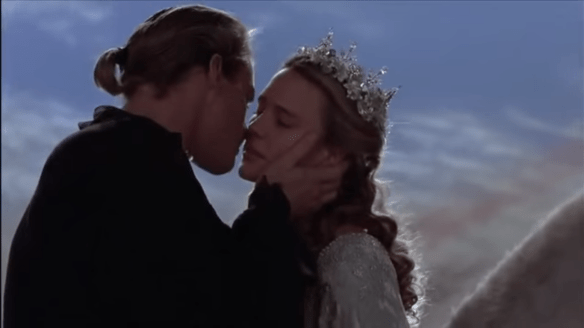
The story unravels like many great fables with a love story torn asunder by circumstance. A young man who goes off to seek his fortune only to die (or more likely take on the identity of the Dread Pirate Roberts) and a young maiden who is made a princess and remains unhappy all the same without her true love. Of course, she does not understand the nefarious intentions of her soon to be husband Humperdinck nor that her love is going to great lengths to find her. And amidst the fantasy, swordplay, trickery, and rampant humor, love conquers all as it has a habit of doing in fairy tales with everyone of note living happily ever after.

This unabashed tale also boasts near pitch-perfect casting. Cary Elwes as Westley does embody a certain quietly confident charm that while not quite Flynn or Fairbanks still manages to guide the film with similar charisma. He can be the hero, handsome and witty, made to play perfectly off all the intriguing figures who inhabit this fairy tale.

In her debut, Robin Wright glows with a radiant beauty and stubborn defiance that’ s enduring and which in many ways has remained a defining moment in her career and it’s certainly not a bad film to be forever remembered for. Meanwhile, Mandy Patinkin plays the vengeful Spaniard Inigo Montoya with the perfect amount of bravado, honor, and charm in his lifelong search for the six-fingered man who killed his beloved father. He’s the perfect accompaniment for Andre the Giant’s lovable brand of brawn and Wallace Shawn’s hilariously irritating turn as their cackling leader.

But what makes the film even better or the odd sorts who pop up here and there including Miracle Max (Billy Crystal) a curmudgeon wisecracker like no other and The Impressive Clergyman (played by the oft-underrated Peter Cook) who single-handedly ruined the solemnity of wedding vows for all eternity.

Rob Reiner is rarely considered a masterful director but if anything it’s easy to make the case that The Princess Bride remains years later his greatest achievement because it has so much life provided indubitably by Goldman’s superlative script and the very figures who dare to fill his world. And Reiner captures it all with a clarity that comprehends the humor but very rarely goes for that at the expense of characters or story (unless they are villains or Billy Crystal). After all, this isn’t a Mel Brooks film.

By this point, it’s a disservice to call The Princess Bride a parody or mere homage– simply a cult classic that’s garnered widespread affection. The reason people love this film is connected to those aspects but also the very fact it stands on its own.

As Falk sings the praises of the story early on, so we can affirm, it has “Fencing, fighting, torture, revenge, giants, monsters, chases, escapes, true love, miracles…” If that’s not exciting nothing is and it’s quite easy to forget that the film is continuously hilarious but there’s something remarkably moving about its story.  It plays the comedy well but simultaneously builds its own road through the mythology and fantasy of fairy tales that have captivated all people for eons.

In The Princess Bride, there’s not simply roots in comedies like The Court Jester but swashbucklers like The Adventures of Robin Hood or the magical journeying of the Wizard of Oz. It covers the spectrum of entertainment which is part of the reason it’s so satisfying.

It has scenes, moments, lines, those little idiosyncrasies and quirks that have left an indelible mark on viewers and as a result our culture as a whole. Lines like “As you wish,” “INCONCEIVABLE,” or best yet, “My Name is Inigo Montoya, you killed my father. Prepare to die.” Each has its special place within the context of the film and is still imbued with that same meaning hours after.

If I write about this film more from my heart than my head you’ll have to forgive but it truly is a weakness. I can envision being little Fred Savage enchanted by the sheer magic of fairy tales. I wouldn’t begin to care about romance until years later but swashbuckling and humor always had me enthralled and they continue to capture my imagination to this day–no more powerfully than in The Princess Bride.  It’s sheer magic in all the best ways.

5/5 Stars

Wonder Woman (2017)

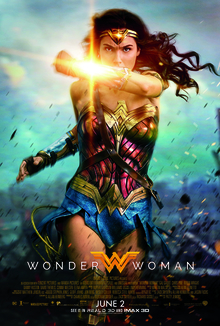
Wonder_Woman_(2017_film)It might sound like meager praise but Wonder Woman is the most engrossing DC offering thus far. It also seems almost unfair to compare across the aisle against main rival Marvel with its terribly lucrative cottage industry or for the very fact that any comparison might suggest how derivative this feature must be.
Yes, Man of Steel and Batman V. Superman cannot hold a candle to most of their competition and Suicide Squad was an atrocious misfire. But this is a film that stands on its own two feet — on the feet of its director Patty Jenkins (Monster) and its heroine Gal Gadot.

Jenkins’ Wonder Woman is ripe for praise and adulation on multiple fronts.  Its closest equivalent would be Captain America: The First Avenger (2011) with its period setting as a stunning backdrop for a superhero narrative. In this one, Diana Prince (Gadot in her first true starring role) is joined by a ragtag band of renegades including Steve Trevor (Chris Pine) and his eclectic compatriots including a drunken sharpshooter, a failed actor with a penchant for linguistics, and a resourceful Native American of formidable stock. They look to sneak into the heart of enemy territory to bring a decisive end to the war (in this case WWI).

But the film also plays a bit like a fish out of water comedy. Diana is the girl born of the Amazons in antiquity and isolation living out the legacy of Greek mythology  — which consequently also seems fused with the Judeo-Christian God and the Fall depicted in Genesis.

Like Thor, she too is god-like, a being outside the realm of humans, trained by her aunt Antiope (Robin Wright) and shielded from the outside world by her mother (Connie Nielsen). Thus, when she actually enters into their world it’s ripe with humorous cultural incongruities. Casual conversation about ancient treatises on sex, sporting the latest fashions which are a bit more modest than her typical attire, learning how to dance, and getting her first taste of an ice cream cone. Each brings a smile to our faces as an audience.

Still, despite her immense skills and innumerable abilities, Diana like Agent Peggy Carter from Marvel is faced with a culture that is not ready for someone who is simultaneously beautiful, strong, independent and wholly unencumbered by normal male patriarchy.  Someone who will not be repressed, blasting through the glass ceilings and cathedral steeples for that matter.

Diana can hardly comprehend how these discrepancies exist. In her eyes secretaries are only glorified slaves and powerful men who sit together in rooms making decisions have no honor whatsoever as their men are brutally slaughtered. It’s ludicrous and it many ways she’s not wrong. We begin to empathize with her character and the problems she sees in the world — the innate desire she holds to make everything right.

Because that gets to what is really truly phenomenal about Wonder Woman. For even the mild superhero enthusiasts she is emblematic of the entire genre with everyone from Batman to Superman, Captain America, Spiderman, Hulk, and all the others. But the one thing that puts her in a class entirely her own is that she is a woman. And this is not meant to single her out but to suggest how important this film is. Lynda Carter gave a landmark performance on the television airwaves in the 1970s but this is the first time this monumental icon has made it to the big stage and it is long overdue.

As such this film becomes a fitting parable reflecting the struggles of women in a callous industry and an oft callous world. Diana becomes a champion of all those women thoroughly capable of living life with individuality, confidence, and above all love for their fellow human beings. Diana comes at life from what some narrow-minded folks might call a woman’s perspective caring deeply about the helpless and their suffering but for the rest of us, it’s a very human point of view.

However, it’s equally important to note that in an attempt to make Diana of great import does in no way relegate the other characters and Steve (Chris Pine) becomes one of the most enjoyable supporting blokes in recent memory.

Gadot and Pine play complementary roles that perfectly mesh together. They’re both brave, they’re both extraordinary, they both care deeply but it can be in different ways. Steve finds himself rescued by Diana and protected by her immense powers as he continues his espionage activities behind German lines. Still, he’s able to explain the intricacies of the world to her and lead her to realize that humanity is not as black and white as she assumed it to be. That is big. In Diana’s eyes, the whole arc of the film is like so. If she can kill Ares, war will be over and mankind will fall back into unity as Zeus had originally ascribed.

Wonder Woman supplies a final twist that while somewhat understandable from a cinematic point of view still manages to take a little of the meaning out of Diana’s realization. Since this is also a love story, that in some ways slightly salvages an ending that succumbs to the usual superhero tropes and pyrotechnics. It’s this further discovery that while Diana may not be to blame for all this chaos, humanity despite their faults is still worth fighting for. What Steve calls “truth” I would probably call “grace” and it’s semantics really but it simply suggests this idea that we do for others what they do not deserve, out of love, the highest noblest form of sacrificial love — always seeing others before yourself even those you disagree with — even when it comes at great cost. For Steve and Diana, those mean two entirely different things again as he tries to thwart the Germans nefarious intentions and she battles it out with someone with powers, not unlike her own.

Despite an admittedly clunky framing device to set up its narrative, the film does learn something from the Suicide Squad as well by focusing on origin story over a mere objective or mindless action. Wonder Woman begins to falter when it simply gets caught up in the normal rhythms of superhero films with villains, explosions, and the like.

What’s interesting are these characters, the wounds that they carry with them, their environments and how that shapes the world that they find themselves in. In this case, Gal Gadot proves to be a winsome heroine with an impeccable blend of innocent beauty, boldness, and heart that’s completely disarming. Meanwhile, Pine’s as charming as ever but let’s not forget whose film this is because we’ve waited long enough. Wonder Woman has made a triumphal return and not a moment too soon for DC.

4/5 Stars

Happy Independence Day!

Tarzan The Ape Man (1932)

tarzan the ape man 1Despite being dated and marred by the imprint of imperialism, this initial entry of the well-remembered Tarzan serial of the 1930s and 4os, based on the works of Edgar Rice Boroughs, is a surprisingly gripping pre-code tale of perilous adventure.

It feels a bit like a jungle cruise, a big game hunting African safari and a bit of Gunga Din all rolled into one. And it has many of those exotic adventure elements, set in the Jungles of Africa (though filmed in Florida, near Toluca Lake in Los Angeles, and on the MGM backlot). Perhaps it’s not Heart of Darkness, but buried in there somewhere is a great deal of commentary about that time and place. In fact, it doesn’t just bring to mind the work of Conrad but other Anglos like Rudyard Kipling, a staunch proponent of the prevailing philosophy of the White Man’s Burden. However, at least this film’s adventure makes no pretense as a mission of mercy. The expedition led by one James Parker (C. Aubrey Smith) is interested in the procurement of ivory pure and simple.

Political undertones aside, Tarzan The Ape Man is stirring good fun in the same vein as King Kong and other thrilling adventure dramas of the 1930s. It boasts treacherous mountain cliffs, murky depths full of hippopotamus and crocodiles and numerous tribes of natives residing in the dark recesses of the countryside.

But if those were the only draw of Tarzan, it seems that this film too would have faded into oblivion for its rather antiquated portrayal of a bygone era. But then we hear the first notes of the unmistakable, piercing cry of the ape-man.  That iconic sound that introduces us to the famed jungle hero is the stuff of legend and rather like the famed Wilhelm Scream years later, it’s taken on a life of its own.

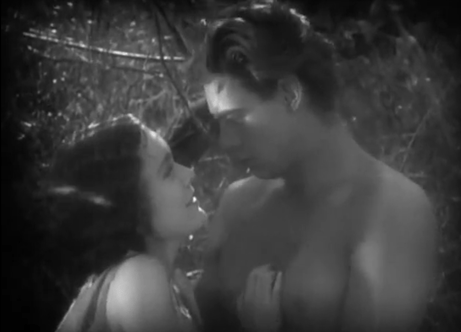
tarzan the ape man 2Furthermore, Johnny Weissmuller is not even the first Tarzan (purportedly the sixth incarnation) but he outshines all his predecessors who have been lost to history. It helped that he remains one of the most iconic Olympians and American swimmers of the 20th century, winning 5 Gold Medals. And he shows his prowess not only swinging from the treetops but in his true element,  gliding through the water.
Maureen O’Sullivan displays a certain amount of pluckiness while at the same time being feminine and fearful. Tarzan at first is a creature to be feared but she soon learns to trust him as he fights jaguars, lions,  and even apes to keep her safe. There’s the question of whether or not Jane Parker suffers from Stockholm Syndrome after spending so much time with this savage jungle man. But over time it does become apparent that she truly does love this chiseled man who is still much more naive and innocent than anyone she has ever known.

Back projections always make me cringe, still, the complete lack of CGI always brings a smile to my face. The elephants, lions, and tigers more often than not are the real thing and the scenes benefit from that, despite other instances that do look decidedly fake. More often than not those small details become overshadowed by the more impressive ones, namely the scenes of the elephants rampaging through the village or Tarzan duking it out with a few lions, despite his injuries. There’s something almost unsettling yet thrilling about it all for the simple assurance we have that it is essentially “real.”

But the final question remains, What’s worse, the black face and portrayal of the colonist tendencies (which were still a present reality) in this film or the modern Disney adaptation’s complete removal of any African characters. Either way, both are important talking points and, in both cases, Tarzan remains a perennially enjoyable hero, no matter the problems that still swirl around him.

3.5/5 Stars


Lethal Weapon (1987)

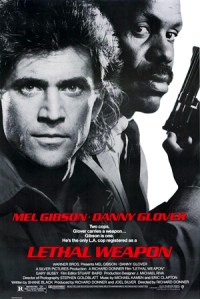
Lethal_weapon1Richard Donner (Superman) has an understanding of the balance of grand spectacle and more subtle moments. The opening aerial shot and the tenuous desert rendezvous with a helicopter churning up sand capture our attention. But it’s the little bits of humor and vulnerability that make the showmanship of Lethal Weapon ultimately worth it. There’s a vibrancy that runs through Shane Black’s script in both the action sequences and character-driven moments.

It’s the quintessential buddy cop action film that in many ways defines the ’80s and that’s because it has a different slant. That’s part of the secret to its success. The main man (Danny Glover) is different and it’s not simply because he’s African-American. His family holds an important place in his life and he’s a genuine person — not an action hero. His partner in crime (Mel Gibson) also has his own deal. We meet Riggs in an abandoned trailer with bedhead, smoking and drinking a beer before he’s even awake. The loss of his wife causes him to contemplate suicide and everyone on the force questions his sanity. But when duty calls these two men are thrown together and out of their initial incompatibility comes mutual respect and genuine fun. As an audience, we enjoy watching them together.

What sets Lethal Weapon apart is how the violence is almost a side thought because what really matters are the characters and their relationships. Friends and family are important. Certainly, there are profane moments but they come in moments of extreme provocation. There’s even gratuitous violence at times but there’s consequence to it, more often than not.

Those in trouble are not simply damsels in distress because most everyone is in the same boat. Martin and Roger both are put in danger, captured and tortured. They don’t just dispense retribution. Their lives and families are put on the line too. However, it’s easy to point out the fact that some characters are killed, most notably in the opening moments, and they feel like mere plot points. For such reasons, the film’s certainly not perfect.

Also, its final moments are admittedly out there. It could be a scene out of Mad Max as Mel Gibson battles in the deluge of a spewing fire hydrant nearly to the death. The question is why, can’t they just arrest the culprit? It’s this scene that allows the character of Riggs to get his desired resolution. In fact, both he and Roger Murtaugh earn a bit of satisfaction as they rise up above the tumult. They are a pair of lethal weapons. But what matters most is that after a hard days work they can get together for a mediocre Christmas dinner. That’s true friendship.

3.5/5 Stars

Review: The Adventures of Robin Hood (1938)

the adventures of robin hood 1As a young boy, no hero was greater in my mind’s eye than Robin Hood and only Star Wars held a more honored spot in my childhood imagination. Because, to this day, Robin of Locksley remains the quintessential hero of mythical lore. Part historical truth mostly canonized myth and that’s the beauty of him. We can believe in him — see how he was in so many ways real but in the same instance larger than life.

To his credit, Erroll Flynn does a surprisingly phenomenal job in portraying the legendary outlaw in Lincoln green with a bit of British (Australian…) cheekiness, as well as bravado and charm. In fact, the film is full of so many wonderful elements from its engaging action sequences full of timeless spectacle and a plethora of characters who come right off the pages of the greatest Robin Hood narratives. Will Scarlett, Much the Miller, Friar Tuck and of course Little John still hold a great deal of esteem in my heart. While there are no men more villainous and corrupted than the likes of Prince John (Claude Rains), The Sheriff of Nottingham (Melville Cooper) and Guy of Gisbourne (Basil Rathbone).

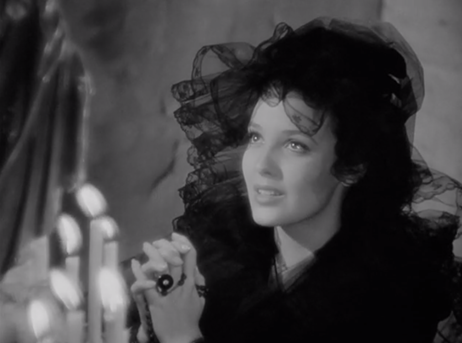
Meanwhile, Michael Curtiz took the reigns of the film and makes it a lively swashbuckler that revels in a sense of good fun and that starts with Flynn’s performance radiating out from there. While this early use of three-strip Technicolor only serves to add yet another layer of elegance and vibrancy to the film’s look. It truly was made for color and every shade of Lincoln green and every bit of medieval opulence proves to be a feather in the film’s cap. It looks absolutely stunning and the same goes for young Olivia De Havilland as Maid Marian.

Olivia_de_Havilland_and_Errol_Flynn_in_The_Adventures_of_Robin_Hood_trailerFrom what I know from Robin Hood folklore, specifically Howard Pyle’s seminal edition, the film is surprisingly true to many of the origin stories and tales that have long since proliferated. As an audience, we become privy to the first meetings of Robin and the formidable Little John (Alan Hale) who lays him out in the local stream after a bout with quarterstaffs. Then, in another instance, Robin provokes the portly Friar Tuck (Eugene Palette) who happens to be a master swordsman and a lover of good food and drink. Still, other vignettes include Robin’s successful masquerade as a lowly archer who wins the grand prize at the Sheriff of Nottingham’s Archery Tournament.
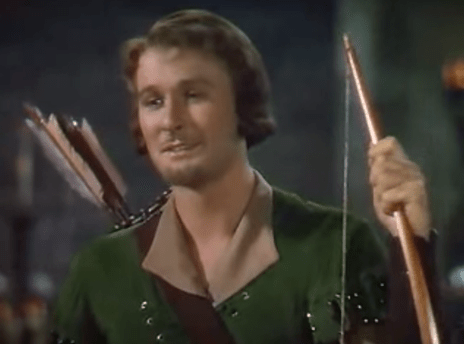
Of course, the most thrilling set pieces occur in Nottingham Castle, initially when Robin brazenly drops in on Prince John and his cronies bearing a deer over his shoulders. Admittedly I have Star Wars on the mind, but this sequence is rather reminiscent of Luke wandering into Jabba’s Palace.

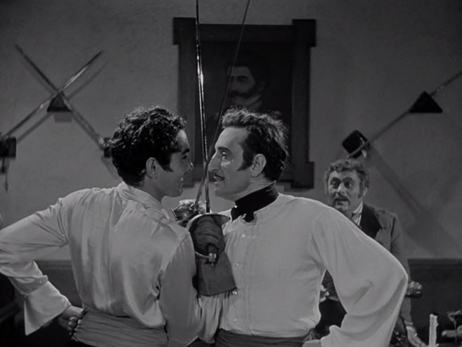
Then, the climax comes later with the return of King Richard and Robin’s assault on the castle full of stellar swordplay and general chaos. The duel between Flynn and Basil Rathbone is especially thrilling and it holds up well even today because there is something so satisfying in watching them thrust and feint back and forth.

the adventures of robin hood 2For me, the reason very few heroes surpass Robin Hood is based on his innumerable qualities. He’s a superior fighter with bow, sword or staff. He’s blessed with a wonderful wit and impressive leadership capabilities. He wins over the girl with his charm. He gets to live out in the forest with his best friends, eating great food. But most of all, he’s a rebel with a heart of gold, robbing the rich to feed the poor.
He’s an embodiment of all things that a little boy dreams of as a kid and in many ways, he’s a fairy tale, but the kind of fairy tale that a boy readily conjures up in his own imagination. The villains are formidable and the action is unmistakable, but it’s all in good fun. That’s why the Adventures of Robin Hood remains an enduring folk tale of the cinema. Its hero transcends a single medium. Because he lives in the heart of many a young lad long after the title credits have rolled.

5/5 Stars

The Mark of Zorro (1940)

markofzorro1Madrid–when the Spanish Empire encompassed the globe and young blades were taught the fine and fashionable art of killing…

The mythology of Zorro most certainly starts with the swashbuckling silents of Douglas Fairbanks, but the character’s legacy would be carried forward into the 1940s. So much so that it even gave some inspiration to a young Bruce Wayne, along with numerous boys picking up comic books in his generation.

In all fairness, I don’t know a whole lot about director Rouben Mamoulian. I assumed his forte was costume dramas and stage production as he did do a lot on Broadway. And if that is true, The Mark of Zorro, while not seemingly the work of some creative mastermind, is invariably enjoyable. That is also to the credit of 1940s matinee idol and dashing leading man Tyrone Power. Although over his career and even in this film, he proves to be more than a handsome face. He seemed to hold his own up against Basil Rathbone when it came to swordplay and he danced between the superficial and heroic personas with relative ease. It brings to mind other such roles as Christopher Reeves in Superman (1978) for instance. That of course, brings up the need for an origin story.

markofzorro2In many ways, it feels anachronistic that Don Diego Vega makes the long voyage from Spain to Los Angeles California, but then in the 1800s Spain still had some presence on the West Coast. It’s there were Vega gives up his sword, rendezvous with his father and mother, while slowly taking on a second life. Zorro certainly has a wonderful double life going. By day a stuffy, foppish playboy fascinated with magic tricks and given to fatigue. Then, by night he dons the black mask and saber as “the fox” wholly prepared to rob from the oppressors and bring hope to the common man. He’s the Robin Hood of the Spanish settlements marking his territory with his iconic “Z” and simultaneously getting a bounty stuck on his head.

markofzorro3The corrupt tub of lard Luis Quintero pushed Vega’s father out of office with the help of his menacing right-hand man Captain Pasquale (Basil Rathbone). On the surface, Don Diego plays into the older man’s hand, while at night he fools everyone including the local priest (Eugene Palette) with his masquerade.

Perhaps most importantly of all Zorro is able to romance the young ingenue Lolita Quintero by eventually letting her in on his little secret and taking down her nefarious uncle. But of course, everything must come down to some epic swordplay and heroics. Zorro and Pasquale eventually face on in an office sword fight that made me absolutely giddy with excitement. As he leads the revolt against the powers that be there is an obvious energy pulsing through the storyline. This is a pure cinematic action-adventure that glories in the age of swashbucklers.

True, we have a pair of tragic stars in Tyrone Power and Linda Darnell. He died of a heart attack at the age of 44 and she died only a few years later at 41 years of age after a house fire. But, for the time being, they are young, vibrant, and full of life. Perfect protagonists in a film where love and justice reign supreme and heroes always conquer evil.

4/5 Stars

The Three Musketeers (1973)

threemusk6In the beginning, this Dumas adaptation was to be the next zany live-action vehicle for the Beatles following the success of A Hard Day’s Night and Help. In fact, they even were ready to work with the same director. Well, Richard Lester stayed and the Beatles were disbanded for several years before this film even got going. In this incarnation, it was set to be a three-hour star-studded epic. Instead, it was thought better of, and this became the first installment with a second film coming out a year later.

Thus, The Three Musketeers has impressive star power, but the direction of Lester also supplies action with a constant barrage of gags for good measure. To top it off the film actually does follow the general story arc of the novel, but invigorates it was bits and pieces of humor that lighten up the tone. So perhaps it’s a light and fluffy piece of entertainment, but it’s still easy to enjoy what Lester’s been able to do here. It’s a great deal of fun.

threemusk4Our audacious d’Artagnon is a strapping Michael York, who has picked up plenty of swashbuckling skills from his father. So he heads out on his own to seek out adventure and uphold his family honor. In a matter of minutes he already a succession of duels lined up, and of course who are they with? The Three Musketeers: Athos (Oliver Reed), Porthos (Frank Finlay), and Aramis (Richard Chamberlain). He sides with his new comrades against the corrupt Cardinal Richelieu (Charlton Heston), and attempt to help the Queen (Geraldine Chaplin) get out of a tight jam.

What follows is a rambunctious array of treachery, romance, and royalty that involves Anne’s lover the Duke of Buckingham, a sly chambermaid (Faye Dunaway), the King, and of course the Cardinal. Peace stands in the balance not to mention the Queen’s self-respect, and so d’Artagnon and the boys do the honorable thing and bail her out. I said before that this film has it’s fair share of sword fights which are fun in themselves, but the laughs really accent the story nicely.

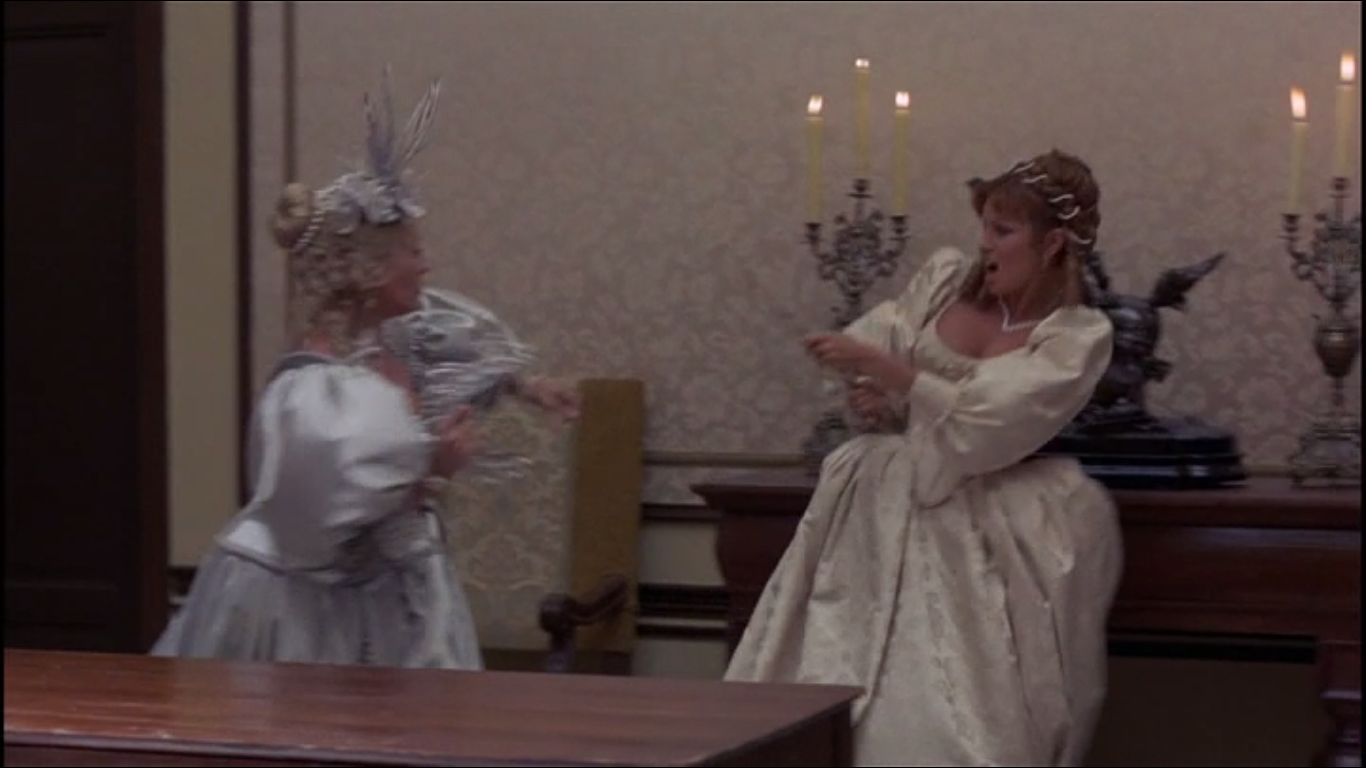
threemusk5The plot is there and we can appreciate the work of Alexandre Dumas, but it is not necessarily the focal point. Charlton Heston gives a seemingly uncharacteristic turn as Cardinal Richelieu, the corrupted man of the cloth, who cares more about politics and social unrest than he does about his faith. He’s no Moses or Ben-Hur for that matter. Furthermore, we are treated to a little tooth and nail type action courtesy of Raquel Welch and Faye Dunaway. It turns out to be yet another rewarding scene because these two ladies were two of the defining icons of the 1970s, and here we get to see them face off.

I’m already revving up for part two because I wouldn’t mind returning to these characters. There’s a lot of good old-fashioned fun to be had here.

3.5/5 Stars